Box Turtle Bulletin
 News and commentary about the anti-gay lobby
“Now you must raise your children up in a world where that union of man and box turtle is on the same legal footing as man and wife…”
News and commentary about the anti-gay lobbyOctober 21st, 2012
TODAY’S AGENDA:
Pride Celebrations This Weekend: Jacksonville, FL; Nashville, TX (Black Pride).
AIDS Walks This Weekend: Atlanta, GA; Austin, TX; Philadelphia, PA; Phoenix, AZ.
Other Events This Weekend: MIX Copenhagen Film Festival, Copenhagen, Denmark; World Gay Rodeo Finals, Ft. Worth, TX; Seattle Lesbian and Gay Film Festival, Seattle, WA.

TODAY IN HISTORY:
The Bishop of Clogher Defrocked for “Sodomitical Practices”: 1822. On July 19, 1822, Bishop Percy Jocelyn, the Anglican Bishop of Clogher in the Church of Ireland was caught in, shall we say, a most compromising position with a Grenadier Guardsman, John Moverly, at the White House Pub’s back room (apparently, they had ’em even then) in Westminster. They were caught by the pub’s proprietor, and dragged through the streets by a mob, mostly naked as they were found, to a nearby jail. Bishop Clogher was granted bail a few days later, but the soldier remained in jail:
Lord Sefton when to see the soldier in prison. He says he is a fine soldierlike man and has no the air which these wretches usually have. The Bishop took no precautions, and it was next to impossible he should not have been caught. He made a desperate resistance when taken away, and if his breeches had not been down they think he would have got away. It seems that the soldier will be proceeded against with the greatest vigour, and the Magistrate is much blamed for having taken such small bail as that which he required. The Duke will not spare the Soldier. Lord Lauderdale said the other day that the greatest dissatisfaction would pervade the public mind at the escape of the Bishop and the punishment of the Soldier, and the people, who cannot discriminate, or enter into nice points of the law, will only see in such apparent injustice a disposition to shield the offender in the higher classes of society from the consequences of his crime, while the law is allowed to take its course with the more humble culprit.
Eventually, the soldier was released on bail as well. Both fled the city and were never seen again (although the Bishop was reportedly later seen in Paris as though nothing had happened). The Bishop’s ecclesiastical trial was set for October 21, and it went on despite his absence. According to the court record:
…It [the evidence] also proved the fatal and depraved purposes for which he associated himself with a private soldier, wholly beneath him in rank and station, as the unworthy and vicious partner of his depravity and guilt. The place chosen by him for that base purpose was also unfitted to him as a prelate of the church, the man of high rank and station; it was a common alehouse, situate in St. Alban’s-place in the city of Westminster. In his career of vice, he was very fortunately stopped, before he had perpetrated the last foul act, or crime, which he himself designed; and by which, if committed, his life would have been forfeited to the offended law of the country. Being found by the watchman and others, in a situation disgraceful and degrading to him, he was made a prisoner, in order to be removed to the watch-house of the district.
The bishop wasn’t actually convicted of the capital offense of sodomy itself because English law required that the act be, err, fully consummated, a standard of proof that was difficult to reach. Hence the observation that he was caught before perpetrating “the last foul act, or crime” of the, um, emission of seed. But the evidence was strong enough to strip the bishop of his office for “the crimes of immorality, incontinence, Sodomitical practices, habits, and propensities, and neglect of his spiritual, judicial, and ministerial duties.”
It’s almost impossible for a scandal to unravel worse than this one. First, the fact that a Bishop was caught in flagrante delicto was itself quite shocking. That was compounded by the perception that he had been given preferential treatment with his early release with very low bail. And if all that wasn’t enough, the Bishop was a well-known member of the Society for the Suppression of Vice. All of this hypocrisy was too much for Londoners to bear, and for many weeks afterward it was unsafe for members of the clergy to be seen on the streets. But it all made great material for satirists:
The Devil to prove the Church was a farce
Went out to fish for a Bugger.
He baited his hook with a Frenchman’s arse,*
And pulled up the Bishop of Clogher.
*Moverly was from a French family.

TODAY’S BIRTHDAY:
Dale Jennings: 1917. If anyone knows anything about Jennings, it’s probably limited to just one thing: his false arrest in February of 1952, from within his own home, on charges of soliciting a police officer for immoral acts. It wasn’t the fact that he was arrested which was so notable, but that he chose to fight the charges while also refusing to deny that he was gay. A gay man arguing before a jury that he was innocent was so unusual it made headlines across the country. Those headlines only got bigger when the jury deadlocked 11-1 for acquittal and the charges were dismissed (see Jun 23).
If he was known for anything else, then perhaps it was because two years earlier, Jennings helped to found the Mattachine Society with Harry Hay, Chuck Rowland, Rudi Gernreich, and Hay’s student at the California Labor School, Bob Hull, who happened to be Jenning’s boyfriend at the time. Jennings had met Hay and Gernreich while involved with the Communist Party in Los Angeles. When Jennings was arrested in 1952, it was the Mattachines who came to his rescue by raising money, hiring a lawyer, and generating enough publicity about the case that it would come to the attention of those newspapers which wrote about it. The case also had the effect of raising the Mattachine Society’s profile among gay people who previously hadn’t known about the secretive group, and its membership skyrocketed.
That it was Jennings who galvanized the Mattachines and gave it a sense of purpose is, perhaps, the greatest irony. Jennings, despite his flirtations with Communism, had little patience for the political theorizing and navel-gazing that took place in the early Mattachine meetings. One early Mattachine member recalled that as the group droned on about “the pain and sorrow, the desperate loneliness of being homosexual and afraid, always having to lie and hide,” Jennings “struggled not to laugh out loud.” He also had little patience for Hays’s insistence that homosexuals made up a distinct minority who were inherently and qualitatively different from heterosexuals. Jennings maintained that there were no differences whatsoever between men who preferred sex with women and men who preferred sex with men. “How could you construct a cultural minority out of a group of people with little in common except what they did in bed?”, he asked. Where Hays wanted the right to be publicly gay, Jennings wanted nothing more than the right to be left alone.
Jennings may expressed a desire to be left alone, but his combative nature ran counter to any desire he might have had to leave things well enough alone. As a budding novelist and playwright, he felt like he had a lot to say and wanted to say it. And so during another one of the interminable Mattachine meetings, he found himself drifting into the kitchen where a smaller group of people were discussing the need for a nationally-distributed magazine (see Oct 15) — a real magazine, professionally typset and graphically designed rather than the typewritten and mimeographed newsletters that had tried to pose as pale imitations. Jennings’s contributions would prove to be crucial: he was the only one of that small group who knew the first thing about the mechanics of publishing: editing, layout, typesetting, artwork, advertising, and so forth. He also provided access to the magazine’s first printing press: the first issue was printed by Jennings’s sister and brother-in-law in their basement.
Jennings wound up serving on the editorial board of ONE Magazine when it made its debut in 1953. As was common practice with ONE in its early days, Jennings not only wrote under his own byline, but under other pseudonyms as well to provide the illusion that ONE’s staff was larger than it really was. That first issue included his first-person account of his arrest and acquittal under his own name, along with two other articles as “Heironymus K.” and “Elizabeth Lalo.” In ONE’s third issue, as “Jeff Winters,” Jennings wrote “Homosexuals Are Not a People,” which, as the title suggested, reiterated his contention that homosexuals did not make up a distinct minority (“Homosexuality is today’s great irrelevancy.”). As “R. Noone,” he lambasted President Eisenhower’s executive order barring the employment of gay people in the federal government (see Apr 27), and in 1954, again as “Jeff Winters,” he wrote “Can Homosexuals Organize?”, a very critical history of the Mattachine Society which had just kicked out its founders and reorganized itself as a much more conservative organization (“The present Society however invites certain destruction by denial of all those things for which the Mattachine was founded. …From the trembling president on down to the least officer, they are terrified.”).
Jennings tenure as ONE’s first editor-in-chief was short-lived. He was headstrong and opinionated, which led to constant fights with business manager Dorr Legg (a.k.a. Bill Lambert), Don Slater (see Aug 21), and others. That divisiveness — and Legg’s unease over Jennings’s Communist ties — led to Jennings’s departure in March of 1954. (He was replaced as Editor in Chief by Irma “Corky” Wolf, who went by the pseudonym Ann Carll Reid.) As Jennings acknowledged nearly three decades later to Slater:
Bill Lambert got rid of me at almost the precise time that the local red cell took my membership card away from me for being a carnivore (gay) and hence a security risk. Naturally both organizations were quite correct and should have been more circumspect about letting me come near them in the very beginning.
After leaving the Mattachines and ONE, Jennings more or less dropped out. In 1968, he published his first novel, The Ronin


Jennings bought a ranch outside of Los Angeles, but then lost it in a lawsuit to a former lover. He then moved to northern California, but decided in the 1980s to move back to southern California and reconnect with the gay community. But by then, the gay community had long since moved on and had forgotten him. Not only that, but the gay community had moved left politically while Jennings moved hard to the right. He did manage to reestablish contact with Don Slater in the 1980s, and they maintained a correspondence that lasted until Slater died in 1997. In 1984, Jennings sent one Christmas card to Slater lamenting, “When I was a loud-mouthed commie, people fled the Mattachine in the thousands; now that the prevailing shade this season is red, my conservatism is worse than damned: it’s ignored.”
Through the 1990s, Jennings became reclusive, surly, and a heavy drinker. He spent every day working on his memoirs on a word processer, but he often lost an entire day’s work by shutting the machine off without remembering to hit save. He began losing his memory, but was cognizant enough to ensure that his papers would go to Slater’s Homosexual Information Center Archives, which are currently housed at California State University at Northridge. He died on May 11, 2000 at the age of 82.
[Source: C. Todd White. “Dale Jennings (1917-2000): ONE’s Outspoken Advocate.” In Vern L. Bullough (ed.) Before Stonewall: Activists for Gay and Lesbian Rights in Historical Context
If you know of something that belongs on the agenda, please send it here. Don’t forget to include the basics: who, what, when, where, and URL (if available).
And feel free to consider this your open thread for the day. What’s happening in your world?
October 20th, 2012
A couple of months ago, the Springfield, MO, City Council was considering adding “sexual orientation” to the ordinance banning discrimination. So Rev. Dr. Phil Snider of the Brentwood Christian Church (Disciples of Christ) trotted down to the City Council meeting to inform them about what the Bible says. His little mini-sermon caught someone’s attention yesterday and has gotten him a bit of attention since then.
http://www.youtube.com/watch?feature=player_embedded&v=iohQID8SY2M
The ordinance change has been tabled.
October 20th, 2012

AP Photo/Dennis M. Rivera Pichardo
If you had told me a month ago that a Puerto Rican Olypian boxer was going to come out, that his community and the boxing world would cheer him on, and that rather than taunt him his next opponent would praise his abilities, I would have suggested that perhaps you ought not operate heavy machinery. But that is what happened.
On October 4th, Orlando Cruz announced that he is a proud gay man. He immediately got tons of media attention and a pile of tweets and emails, which he said was 90% positive. That seems to have been reflected by the audience last night: (FoxLatino)
The minute Orlando Cruz stepped into the boxing ring, all talk of his sexuality disappeared.
With these last two weeks weighing heavily on him, Cruz was finally able to breathe a sigh of relief when he walked out to a cheering crowd displaying flags of his native Puerto Rico.
And Cruz was successful, winning the bout by unanimous decision over Mexican Jorge Pazos. And what did Pazos have to say after losing to a ‘maricon’?
“He’s a boxer who moves too much, he knows how to box and he has good legs,” Pazos said. “I couldn’t get him.”
Here is his post-fight interview with ESPN’s LZ Granderson:
Somehow while I wasn’t paying attention, it seems that the boxing world suddenly became very classy and tolerant.
October 20th, 2012
TODAY’S AGENDA:
Pride Celebrations This Weekend: Columbia, SC; Jacksonville, FL; Nashville, TX (Black Pride).
AIDS Walks This Weekend: Atlanta, GA; Austin, TX; Philadelphia, PA; Phoenix, AZ.
Other Events This Weekend: MIX Copenhagen Film Festival, Copenhagen, Denmark; World Gay Rodeo Finals, Ft. Worth, TX; Seattle Lesbian and Gay Film Festival, Seattle, WA.
TODAY IN HISTORY:
“Homosexual Ring” of Service Women Broken Up: 1953. According to a newspaper report, “army investigators have ‘broken up a ring’ of approximately 25 women members of the armed forces who, the investigators charged, engaged in abnormal sex practices. It said the crackdown stemmed from charges made last month by a 19-year-old WAC private who is currently under treatment at a local (Washington, D.C.) army hospital. Half a dozen of the group were said to have confirmed the WAC’s disclosures. Most of the 25 were said to be WACS, but ‘three our four’ were reported as navy WAVES. All were described as enlisted personnel.”
None of the women were identified in the article, but the article went on to say that the women were “rounded up and questioned. Disciplinary action is pending. The group under investigation was said to have used two taverns located in the Georgetown area (of Washington) as ‘hangouts’ where meetings and ‘dates’ were arranged during off-duty hours.” An Army spokesman said that cases like these “are a continuing problem in the army,” and that military regulations required that persons found guilty of homosexuality were to be discharged as undesirables, except in some cases “where psychiatric examinations show that medical treatment or disciplinary action is warranted.”
Miami Formally Outlaws Gay Bars: 1954. Miami’s ongoing hysteria over the shocking discovery that there were gay people in the city (see Aug 3, Aug 11, Aug 12, Aug 13 (twice that day), Aug 14, Aug 26, Aug 31, Sep 1, Sep 2, Sep 7, Sep 15, Sep 19, and Oct 6) reached an important legal milestone when the Miami City Commission passed new ordinance which prohibited liquor establishments from employing gay people or allowing “homosexuals or perverts” to congregate. The ordinance provided up to 60 days in jail, a fine of $500 (that’s about $4,000 in today’s money) and the loss of their liquor licenses. This latest ordinance came about after a previous proposal by Mayor Abe Aronovitz (see Oct 6) was rejected for being “too broad.” The vote on the revised ordinance was unanimous, and because it was adopted as an emergency ordinance it went into effect immediately.
And in another move to protect the morals of Miami’s children, the City Commission also made it illegal to sell horror comic books to children under the age of seventeen.

TODAY’S BIRTHDAYS:
Edward John Barrington Douglas-Scott-Montagu, 3rd Baron Montagu of Beaulieu: 1926. Okay, first of all: how can you not love a name like that? Lord Montagu has been a Conservative member of Britain’s House of Lords since 1947. He knew from a very early age that he was bisexual, but he always tried to keep his affairs with men quiet. That proved impossible when in 1954 he and two others were convicted and imprisoned for twelve months for “conspiracy to incite certain male persons to commit serious offenses with male persons.” Britain, like America, was then in the midst of a massive anti-gay witch hunt. The Sunday Times had editorialized that “its eruption… is today a serious and growing criminal problem,” while a Daily Mail headline read, “Homosexuality spreading like a foul growth in our midst.” As many as 1,000 men were arrested every year for violating the country’s anti-gay laws, and Home Secretary Sir David Fyfe urged magistrates to inflict maximum penalties on those who were found guilty.
But with Montagu protesting his innocence even after his conviction, the trial ended up provoking a sharp debate in British popular opinion. Kinglsy Martin exemplified a growing discomfort over Britain’s gross indecency laws when he wrote in New Statesman & Nation, “It is a social evil but its bad effects are greatly aggravated by our savage criminal law … There should be no penalties attached to adult males consorting together who, in private, decide to live a homosexual life… I believe there are Members of Parliament who’d be willing to make this change in the law.”
Parliament instead decided to study the issue by establishing a special commission to look into Britain’s laws against homosexuality and prostitution. Chaired by Lord John Wolfenden, the commission met over the next three years, and in 1957 issued its report recommending that “homosexual behaviour between consenting adults in private should no longer be a criminal offence.” The report also found that “homosexuality cannot legitimately be regarded as a disease, because in many cases it is the only symptom and is compatible with full mental health in other respects.” It would take another ten years before Parliament would act on the report’s recommendations and decriminalize homosexuality.
As for Lord Montagu, the distress over having been arrested and imprisoned never faded. He never talked about it, saying that he abhors the idea of becoming “a professional convict.” He married his first wife in 1958, and the couple had one son and one daughter before divorcing in 1974, when he turned around and married wife number two, who bore him another son in 1975.
But when Britain’s Channel Four was preparing to air a documentary about the trial in 2007, Lord Montagu felt that it was time to speak up. “I am slightly proud that the law has been changed to the benefit of so many people. I would like to think that I would get some credit for that. Maybe I’m being very boastful about it but I think because of the way we behaved and conducted our lives afterwards, because we didn’t sell our stories, we just returned quietly to our lives, I think that had a big effect on public opinion.”

Allan Horsfall: 1927. He was born in the tiny mining village of Laneshaw Bridge in Lancashire where he was raised by his grandparents, whom he described has “God-fearing Conservatives and fervent upholders of law and order.” Like most gay men who grew up in small towns, it was during his time in military service — the RAF, in particular, where Horsfall discovered other gay men. One man, in particular, he met in an ex-Servicemen’s Club in 1947: Harold Pollard, a primary school teacher, would remain his life partner until Harold’s death in 1996. But unlike a lot of gay men who grew up in small towns, Horsefall didn’t flee to the big city. He decided instead to return back to his small town, take up residence in a simple miner’s cottage and become a clerk for the National Coal Board.
Horsfall settled in to a rather non-descript life until 1956. when the Suez Crisis inspired him to enter politics. He joined the Labour Party and won an election as a councillor in Nelson. After the Wolfenden Report was released in 1957 with its recommendation that homosexuality be decriminalized, Horsfall immediately became involved with the London-based Homosexual Law Reform Society. When he decided that the HLRS was too hidebound, closeted and aloof to be effective, Horsfall helped to found the North West Committee for Homosexual Law Reform in 1964. In doing so, he made it clear that he believed gay people shouldn’t remain closeted in order to support law reform. His North West Committee also rejected the national campaign’s opinion that gays were “unfortunates” who deserved pity. Again, against the advice of friends, he used his home address and phone number as the public point of contact. But he found that there was actually very little hostile reaction. If anything, his experience harkened back to the days of Edward Carpenter from the turn of the century (see Aug 29), who lived openly and undisturbed in the mining vilage of Milthorpe while Oscar Wilde was being prosecuted for “gross indecency” in London.
 After Britain finally decriminalized homosexuality in 1967 (see July 28), the London-based HLRS, believing that its work was done, floundered for a few years before folding. But Horsfall’s North West Committee kept going and evolved into the Campaign for Homosexual Equality which, in 1971, took part in the first major gay rights demonstration in London. Horsfall’s main focus, by then, was on increasing the social support for gay people by establishing membership clubs in the north of England. Modelled after Working Men’s Clubs, his proposed Esquire Clubs were intended to function as a combination community center and pub for rural and small-town gays and lesbians. The clubs themselves were unsuccessful, but his fight to establish them paid a very different kind of dividend. In Burnley, Horsfall’s CHE organized a public meeting to confront the local Christian Alliance, which had formed to prevent the opening of an Esquire club there. During the packed meeting, Horsfall asked all of the homosexuals to stand up. Over one hundred did so, making it one of the first mass coming-out demonstrations in the U.K. It also marked a coming-of-age for the gay rights movement in Britain. CHE went on to become the UK’s largest LGBT-rights organization, with over 5,000 members in more than 100 local groups across England and Wales.
Horsfall suffered a heart attack in 1970, and by 1974 he began withdrawing from the front lines of the gay-rights movement. As a sign of the respect he commanded, he was named President for Life of CHE. In 1998, he became involved in the case of the Bolton Seven, a group of gay men who were prosecuted because, while homosexuality was legal, group sex between men was not. He also campaigned for an end the ban on gays serviing openly in the military, the equalization of the age of consent, and allowing gays to adopt children. He also became involved with the Campaign for Nuclear Disarmament during the 1980s.
Horsfall died on August 27, 2012 of heart failure at the age of 84. His web site, Gay Monitor, has been selected for preservation by the British Library’s UK Web Archive.
If you know of something that belongs on the agenda, please send it here. Don’t forget to include the basics: who, what, when, where, and URL (if available).
And feel free to consider this your open thread for the day. What’s happening in your world?
October 19th, 2012
In 2010, David Blankenhorn was the chief (virtually only) witness for Proposition 8. This proved to be an unwise choice for two reasons: Blankenhorn was not qualified to testify on much of the matter to which he was the assigned witness, and Blankenhorn is a decent man who isn’t anti-gay and thus was susceptible to reasoned and well-articulated argument in favor of equality. So much so, in fact, that he now supports including gay and lesbian couples fully into the fabric of society.
Here he is on Minnesota’s proposed constitutional ban on equality:
http://www.youtube.com/watch?feature=player_embedded&v=ZExF-jMIKQw
October 19th, 2012
One of the things one regularly hears during election season are “Don’t vote for that Democrat, he’ll appoint pro-homosexual judges” and “Don’t vote for that Republican, she’ll appoint anti-gay judges.” But such simplistic assumptions are seldom accurate.
And in the fight for marriage rights in the courts, more often than not the judges finding that gay people are entitled to equal treatment under the law have been appointed by a Republican president or are themselves Republicans, sometimes quite conservative ones. And in this latest ruling – one that goes further than any to date – this pattern holds (LATimes)
“Homosexuals have suffered a history of discrimination,” Chief Judge Dennis Jacobs said for a 2-1 majority. And while gays have been winning political victories, he said, they are still subject to many discriminatory laws. Jacobs said courts should view all laws that discriminate based on sexual orientation with the same skepticism accorded to laws that discriminate based on gender.
Jacobs, who has a generally conservative reputation, was appointed to the court by former President George H.W. Bush. He was joined by Judge Christopher Droney, an appointee of President Clinton. In dissent, Judge Chester Straub, another Clinton appointee, said judges should not change the traditional definition of marriage. If it is to be changed, he wrote, “I believe it is for the American people to do so.”
It isn’t just disabusing us of silly memes that makes me appreciate this trend; I also think that it provides us with both a stronger position and greater hope. For one thing, it silences the screams about “liberal activist judges” and gives our neighbors assurance that our victories aren’t being awarded because of partisan legislation from the bench. Bipartisanship goes a long way towards cultural acceptance of judicial decisions.
But an even more important reason is the message it send to the Supreme Court. As Republican judges address this issue, they do so from a particular perspective with particular viewpoints on what the Constitution means. And when they write opinions, they do so utilizing language that reflects these perspectives and viewpoints. And as it is believed that the Supreme Court justices which will need to be swayed in our favor are all Republicans, these opinions can speak to them in the terms which best plead our case.
October 19th, 2012
TODAY’S AGENDA:
Go Purple for Spirit Day: Everywhere. In 2010, Canadian teenager Brittany McMillan came up with the idea of having everyone wear the color purple to show their support for LGBT young people who are victims of bullying. From that first Spirit Day observance — named for the purple stripe of the Rainbow Flag which represents “spirit” — the observance has spread to include a number of entertainers and celebrities, including late-night talk show hose Craig Ferguson, the casts of Days of Our Lives and Degrassi, Margaret Cho, Kathy Grifffen, LaToya Jackson, Mario Lopez, Reba McEntire, dog-whisperer Cesar Milan, Shaquille O’Neil, — and Snooki. Even the Las Vegas Strip will go purple. What about you?
 Affirmation LGBT Mormon Conference: Seattle, WA. Affirmation, the LGBT-affirming group for members and former members of the Mormon faith, will begins its its annual conference in Seattle beginning today with a welcoming receptions featuring opening remarks by Emmy-wining filmmaker Kendall Wilcox. He helped to produce last spring’s the “It Gets Better” video for Brigham Young University’s unofficial LGBT affinity group. The conference will include a variety of workshops dealing on topics of particular importance for LGBT Mormons and ex-Mormons, particularly in areas surrounding spirituality, bridge building, and relationships. The conference takes place at the Renaissance Sattle Hotel and continues through Sunday with a morning Devotional and a closing luncheon.
Pride Celebrations This Weekend: Columbia, SC; Jacksonville, FL; Nashville, TX (Black Pride).
AIDS Walks This Weekend: Atlanta, GA; Austin, TX; Philadelphia, PA; Phoenix, AZ.
Other Events This Weekend: MIX Copenhagen Film Festival, Copenhagen, Denmark; World Gay Rodeo Finals, Ft. Worth, TX; Seattle Lesbian and Gay Film Festival, Seattle, WA..

A Daughters of Bilitis breakfast, 1959. L-R: Del Martin, Josie, Jan, Marge, Bev Hickok, Phyllis Lyon.
TODAY IN HISTORY:
Daughters of Bilitis Founded: 1955. Phyllis Lyon remembered the phone call in September. Rose Bamberger was on the other end, asking, “would yo like to be a part of the group of six of us that are putting together a secret society for Lesbians?” Lyon recalled later, “We said ‘Yes!!’ Because we would immediately know five more lesbians and we did, which was…. AMAZING.” The “we” were Lyon and her partner, Del Martin. They had known each other since meeting in Seattle in 1950, and lived together in San Francisco since 1953. But since then, Lyon and Martin felt isolated because they hadn’t made any other friends who were lesbians. So when Rose, whom they met earlier that summer through a gay male couple they knew, suggested they start a secret club, Lyon and Martin jumped at the chance. “She wanted it to be in people’s homes and she wanted it to be so we’d be able to dance … so that we wouldn’t get caught up in police raids and we wouldn’t be stared at by tourists and so on. You couldn’t dance in the bars in those days. And she loved to dance. That was the whole idea behind it.”
Over the month of September, four couples, including Martin and Lyon, met to make plans for forming the club. Their first decision was its name. Several names were suggested: Que Vive, Habeas Corpus, Plus Two, Amazon — but all of them were rejected. Then someone suggested Daughters of Bilitis, named for the work of nineteenth century poet Pierre Louys, whose Songs of Bilitis spoke of lesbian love. Lyon had never heard of him. “Del and I went to the library to look up Bilitis, and of course found nothing. They had said it would be a great name because no one would know what it meant. The second decision was how to pronounce it. They rejected Bill-EYE-tis because they thought it sounded too much like a disease. So Bill-EE-tis it was.
The small group met several more times to begin putting some organization behind the idea: bylaws, membership rules (no one under 21, males welcome only as guests on specific occasions), and a tentative schedule. Business meetings would be held on the first Wednesdays of each month at 8:00 p.m. “Qui vive” became the club’s motto, sapphire blue and gold the colors, and an triangular insignia was chosen — that was serendipitous; they didn’t know that the pink triangle marked homosexuals in Nazi concentration camps. And then they named interim officer: Del Martin was president, Noni Frey was vice president, Phyllis Lyon was secretary, Rosemary Sliepen was treasurer, and Marcia Foster was trustee.
The first official meeting took place on October 19, 1955. It was awkward. The women quickly realized that they would be welcoming other women into their homes with whom they had very little in common except their sexuality. But the meeting was also a success, and more followed. As the members became more comfortable with each other, they also became more confident, and within a year began reaching out to the local Mattachine Society and the staff of ONE magazine in Los Angeles. When they joined the Mattachine Society to lobby for a change in California’s sex laws, they began to get involved in local advocacy and cooperation with other homophile groups.
Meanwhile, they remained focused for providing a social and intellectual outlet for women within the larger gay movement. In 1956, DoB began publishing The Ladder, first as a typewritten and mimeographed newsletter, then as a nationally distributed magazine which became a lifeline to lesbians across the country and around the world. Soon, there were DoB chapters in dozens of other cities, including one in Melbourne, Australia, which was the first “openly homosexual political organization” in that country. Beginning in 1960, the Daughters held the first of their biennial conventions in San Francisco.
DoB remained active as a national organization until 1970, when the national organization disbanded but allowed the remaining local chapters to continue under the name. The Ladder survived the national organization by two years, until it went under due to a lack of financial support in 1972. But as many as twenty local DoB chapters continued in several American cities, with New York, Boston and the original San Francisco chapters remaining particularly active. The original San Francisco chapter folded in 1978, and its files, which included both the local and national archives, were turned over to the GLBT Historical Society in Los Angeles San Francisco. At last report, the Boston Chapter, since moved to Cambridge, was still in existence as of 2004, but it appears to have gone dormant sometime since then.
[Source: Marcia M. Gallo. Different Daughters: A History of the Daughters of Bilitis and the Rise of the Lesbian Rights Movement

“Downtown” Markleeville, Alpine County’s unincorporated county seat.
Gay Group Plans Takover of Alpine County: 1970. The Gay Liberation Front in Los Angeles hit on a novel idea: What if enough gay people gathered in one location in numbers sufficiently large enough that they could then take over the area through free elections? On October 19, the group issued a two-page statement announcing their dream of encouraging gay people to move to sparsely-populated Alpine County, California. Located high up in the Sierra Nevadas just south of Reno and Carson City, Alpine County only had a little over 400 residents and 384 eligible voters.
The way GLF member Don Jackson figured it, if they could get a similar number of gay people to move, they could have the county all sewn up with little difficulty. And with homosexuality still a criminal act in California (it would remain so until 1975: see May 12), having power over law enforcement would be an important advantage. “A gay Superior Court Judge would have great discretionary powers. A gay district attornehy could choose which laws and which criminals he wished to prosecute. … It would mean a … gay civil service and a county welfare department which made public assistance payments to refugees from prejudice,” he told reporters. The numbers were in Jackson’s favor; he already had 479 gay people sign up to move into the county by January 1.
As you can imagine, not everyone was thrilled with the idea, especially the people who already called Alpine County their home. Hubert Bruns, chairman of the county’s Board of Supervisors, joined four other officials in a closed-door meeting Gov. Ronald Reagan’s assistant legal affairs secretary to try to figure out what options were available to them. When a reporter asked if they were encouraged by what they learned, Bruns simply replied “No,” then added, “If these people come up here and abide by the laws, there’s nothing in the world we can do to prevent them from coming and registering. Today, to the best of our knowledge, we don’t have gay people here. We do not need that kind of business.”
 Bruns predicted a chilly reception. “We thought it was a joke,” Bruns said. “Today we don’t think it is a joke. They will receive a hostile reception when they come.” When asked how he would know which of the new residents were gay, Bruns replied, “We’re going to make every attempt to find out. I’m sure we’ll know some of them.” Other observers noticed that the cool reception wouldn’t just be from county residents. The planned January 1 start date would have coincided with the dead of winter when it’s not uncommon to have twenty-five feet of snow on the ground.
Not everyone in the gay community was on board either. The Gay Liberation Front of Berkeley voted against the proposal. They gavethe same reason they gave whenever they opposed anything else: it was “sexist” and “racist”. And”impractical,” something that they had not been known to be worried about before. Berkeley’s vote didn’t bother L.A.’s Don Kilhefmer though. “All the Berkeley vote means is that they don’t dig the idea, while San Francisco and Los Angeles is going ahead.” But as the deadline approached, the plan fizzled. Good thing, too, because that January the worst snowstorm in nineteen years blanketed Alpine County with more than eight feet of snow.
Postscript: In 2008, Alpine County was one of just three interior counties in California to vote against Prop 8. County residents disapproved of the ban on same-sex marriage by 379 to 293.
TODAY’S BIRTHDAYS:
 Robert Reed: 1932. Poor Carol Brady. How could she know that her husband was gay? Actually, Florence Henderson, who played “the lovely lady” in The Brady Bunch, figured it out the first time they shared a screen kiss in the first episode. Reed was already a well-established character actor, appearing in episodes of more television series than anyone can count. He also worked on Broadway, in Neil Simon’s Barefoot In the Park. Reed never liked his role on The Brady Bunch, thinking that the schmaltzy show was beneath him. He often sparred with the show’s producer, Sherwood Schwartz over the silly scripts and nonsensical story lines. But Reed liked his co-stars and filled the role of father figure to the six younger cast members whenever he could. After the third season wrapped, he even brought the entire cast on vacation to New York and a cruise on the Queen Elizabeth II to London. Most of the cast members knew he was gay, but they were very protective of the fact. After all, in the 1970s it would have been a career-killer. When he died in 1992 of colon cancer and lymphoma, the media reported that he had died of AIDS (he had tested positive for HIV the year before but it had not progressed to AIDS). His Brady family was taken aback by the sensational reporting surrounding his death. As he was a father figure to the Brady cast in life, they returned the favor by being something of a family-figure to him. The cast attended his memorial, while many of his actual relatives stayed away.
 Divine: 1945. He was born as Harris Glenn Milstead, but everyone knew him as Divine, the Drag Queen of the Century who practically defined what a John Waters movie was all about. Divine described his character as “just good, dirty fun, and if you find it offensive, honey, don’t join in.” But he drew a clear distinction between his private life and his performance. “My favorite part of drag is getting out of it,” he said. “Drag is my work clothes. I only put it on when someone pays me to.” And yet whether he was in or out of drag, he was always Divine: he even had it put on his passport. His most famous character, that of Edna Turnbald in the film Hairspray, was so popular that the character has been played by a male in drag in every adaptation since then, whether on the stage or the 2007 film remake. But not all of his characters were in drag; he also appeared as the racist TV station manager Arvin Hodgepile in Hairspray and as Earl Peterson, the fat man driving an Edsel station wagon who picks up Divine while hitchhiking. Divine was nominated for a Razzie Award for playing Rosie Velez in Lust In the Dust, which Tab Hunter both produced and starred in. I think he should have won an Oscar, with Lainie Kazan receiving special kudos for playing Divine’s step sister. He died, much too soon, of heart failure in 1988 at the age of 42.
If you know of something that belongs on the agenda, please send it here. Don’t forget to include the basics: who, what, when, where, and URL (if available).
And feel free to consider this your open thread for the day. What’s happening in your world?
October 18th, 2012
In April 2011, Gary Gates, a demographer at UCLA’s Williams Institute who specializes in the gay community, announced:
An estimated 3.5% of adults in the United States identify as lesbian, gay, or bisexual and an estimated 0.3% of adults are transgender.
While I thought his number was in the ballpark, I was decidedly unimpressed with his methods (averaging averages, adopting the lowest possible estimates, and not separating mens’ and womens’ sexuality). And I placed little reliance on his report.
However, over the summer, Gates worked with Gallup Polls to have the following question asked to over 120,000 people:
Do you, personally, identify as lesbian, gay, bisexual or transgender.
With a sample size so huge, they can assign 95% confidence that they have less than 1% error margin. In other words, this is really rather accurate.
The result?
Yes…………………………………. 3.4%
No…………………………………. 92.2%
don’t know/refused …….. 4.4%
There is some very interesting data that can be mined from the detail. For example, though no one has ever illustrated that there is any racial differentiation in orientation, those identifying as gay differ by race: Black 4.6%, Asian 4.3%, Hispanic 4.0%, White 3.2%. The error of margin overall is less than 1%, but the subpopulations have less statistical confidence and this difference may well be within margin. However, as ‘common wisdom’ (which is often neither) assumes that blacks are less likely than whites to identify as gay, this is a statistic worth noting.
And, of course, there’s age:

As is pretty consistent with such polls, LGBT identity drops with age. This is generally understood to reflect a greater willingness in younger respondents to so identify. And that does likely play a role.
But over time one would expect some creep in the numbers over time such that in newer polls the 30- 49 demographic was no longer a decrease from 18 – 29. Instead, I think we are seeing the same pattern now that we have seen for decades. So I’m not certain that ‘today’s new attitude of youthful acceptance’ fully explains that phenomenon, unless we assume that some go back into the closet in their 30’s.
Personally, I am beginning to suspect other factors that may play some part. Here are but a few possible other things to consider.
The most drastic shift is from the first to second demographic. This time also reflects a very common shift in relationship status from single and dating in your 20’s to married in your 30’s. It is possible that this reflects an internal perception of free and available to someone who is committed to a specific person of a specific sex (most often the opposite sex).
After 30, the demographic LGBT identification gradually decreases, but there really isn’t a comparable increase to “not-LGBT” identification. Rather, “don’t know / other” seems to take up the slack.
This could be entirely due to “the closet”, but I don’t think the closet lends itself to any identity other than “no! LGBT? no, no, I’m not that, no-sirreee, not me!” So I wonder whether this reflects something else.
It could contain elements of older same-sex attracted persons who see “lesbian, gay, bisexual or transgender” to be an identity that reflects a way of life, a community, a worldview. Perhaps this is a person who thinks, “Joe and I? No, we don’t go out to bars and all our friends are straight and we just aren’t part of all that. So I’m just not sure how to answer that question.”
Another option is that as age increase, there may be a willingness to let go of some presumptions and limitations. Perhaps unexpectedly you found yourself attracted to some random stranger of the opposite sex and it threw your self-perception on its ear.
I don’t have data to support any of that speculation – and I doubt there is ready data to address it either way – but I introduce it as a few alternate possibilities to help explain the curve. I don’t know that these explanations have much validity, but I’d like us to think outside of the box a bit.
And the poll seems also to have presented some data that challenges another assumption that we have held to:

There are two dialogs that I’ve heard about the financial condition of gay individuals and families: either gays are flush with cash (when we call for more gay specific advertising) or living in poverty (when we call for increased services). I don’t think this supports either assertion, though it could serve either.
It seems that a larger percent of the less affluent identify as gay and the wealthier are less likely to do so. But this follows more or less the age breakout. Which one would expect. Generally those who are in their 20’s are likely to be making less than those in their 50’s. So I’m not sure there is much there.
However, that being said, it is true that a larger percent of the poor identify as gay than do the rich. On the other hand, 2.8% of those making over $90,000 identify as LGBT, a percentage higher than any of those who are over the age of 50.
So while that is interesting, it does not clearly support (or refute) either assertion. And all of the variables are probably within the margin of error of the subpopulations anyway.
Because we are such a small percentage of the population, and because questions about sexuality and sexual orientation can seem to either be intrusive or a threat, surveys simply cannot answer definitively the question as to our size and we are limited in the amount of trust we should place on any of this.
However, that being said, I think that we can say with confidence that at least 3.2 percent of the US population identifies as LGBT.
October 18th, 2012
The Seattle Times has decided to prove the effectiveness of newspaper advertising by running ads themselves and documenting their impact. They will be spending about $75,000 each on two political campaigns: GOP gubernatorial candidate Rob McKenna and Referendum 74 in support of marriage equality.
The decision to run the ads was made by the corporate side of The Times, and was “completely separate from the journalism functions of the newspaper,” Alan Fisco, Seattle Times executive vice president, revenue and new products, said in a news release.
Fisco described the effort as a pilot project to show the power of newspaper political advertising and to attract new revenue. He said the company will analyze the effectiveness of the ad campaigns and present the results to political consultants and campaigns to try to persuade them to advertise more in the newspaper.
October 18th, 2012
From the Baltimore Sun:
Gallaudet University is asking the group opposing Maryland’s same-sex marriage law to take down a new commercial that features a university staff member who was suspended for signing a referendum petition.
…
“The video they are using, the ad, is actually copyrighted by us,” said Katherine Murphy, executive director of communications and public relations at Gallaudet in Washington. “We’re in touch with our attorneys to have them follow up with the group to ask them to take down the ad.”Deana Bass, a spokeswoman for the Maryland Marriage Alliance, said the group has not heard any formal complaints about the spot, and it has no intention of removing it.
“It is a fair use of the footage,” said Bass. “At this point, [the incident] is in the public space. We want people to understand what is at stake with Question 6.”
On Tuesday, J. Wyndal Gordon, a lawyer for McCaskill, told The Baltimore Sun that his client had not agreed to be featured in any advertising about the same-sex marriage referendum. He said McCaskill’s decision to sign the petition to allow voters to decide the issue was not an indication of her position on same-sex marriage.
Gordon later told a Washington television station that if McCaskill “had her druthers,” the commercial would be pulled. He did not return calls Wednesday evening.
It’s fair to note that she absolutely does have her “druthers” about her response to the ad. She could publicly denounce those who seek to use her story to their advantage. She has not done so. She has accused Gallaudet of a host of things, but she has not had one single public word of criticism for the anti-gay campaign. One must assume that is because she doesn’t want to.
October 18th, 2012
The Second Court of Appeals in Manhattan has affirmed a lower court’s decision (PDF: 199KB/83 pages) which held that Section 3 of the Defense of Marriage Act is unconstitutional. The case, Windsor v. US. was brought by Edie Windsor, who is being forced to pay an inheritance tax of $363,053 after her legally married wife passed away, a tax that she would not have to pay if she had been married to a man. Last June, Federal District Judge Barbara S. Jones ruled that the tax was unconstitutional when she granted a motion for summary judgment last June.
The Second Court of Appeals’ ruling today is important for two reasons: First, the court find that heightened scrutiny is justified in evaluating DOMA:
Instead, we conclude that review of Section 3 of DOMA requires heightened scrutiny. The Supreme Court uses certain factors to decide whether a new classification qualifies as a quasi-suspect class. They include: A) whether the class has been historically “subjected to discrimination,”; B) whether the class has a defining characteristic that “frequently bears [a] relation to ability to perform or contribute to society,” C) whether the class exhibits “obvious, immutable, or distinguishing characteristics that define them as a discrete group;” and D) whether the class is “a minority or politically powerless.” Immutability and lack of political power are not strictly necessary factors to identify a suspect class. Nevertheless, immutability and political power are indicative, and we consider them here. In this case, all four factors justify heightened scrutiny: A) homosexuals as a group have historically endured persecution and discrimination; B) homosexuality has no relation to aptitude or ability to contribute to society; C) homosexuals are a discernible group with non-obvious distinguishing characteristics, especially in the subset of those who enter same-sex marriages; and D) the class remains a politically weakened minority.
According to the ACLU which brought the case on behalf of Edie Windsor, this is the first federal appeals court ruling to hold that government discrimination against gay people deserves heightened scrutiny. This means that the government must demonstrate that the law serves an important governmental interest in order to justify such discrimination. The bottom line for the court is this:
DOMA’s classification of same-sex spouses was not substantially related to an important government interest. Accordingly, we hold that Section 3 of DOMA violates equal protection and is therefore unconstitutional.
Our straightforward legal analysis sidesteps the fair point that same-sex marriage is unknown to history and tradition. But law (federal or state) is not concerned with holy matrimony. Government deals with marriage as a civil status–however fundamental–and New York has elected to extend that status to same-sex couples. A state may enforce and dissolve a couple’s marriage, but it cannot sanctify or bless it. For that, the pair must go next door.
The court’s ruling was 2-1 (the dissenter was Clinton-appointee Judge Chester Straub), and the second reason this ruling is so important is that Chief Judge Dennis Jacobs wrote the majority opinion. Judge Jacobs is a very conservative judge and a favorite of the Federalist Society. As ThinkProgress notes:
He joined a court decision effectively declaring corporations immune to international human rights law — even when they “trade in or exploit slaves, employ mercenary armies to do dirty work for despots, perform genocides or operate torture prisons for a despot’s political opponents, or engage in piracy.” And he once gave a speech to the conservative Federalist Society decrying the “anti-social effects” of attorneys providing free legal services to the less fortunate.
This is the second Appeals court ruling striking down Section 3 of DOMA. The First Court of Appeals in Boston also “ruled last May against DOMA in two cases involving same-sex couples in Massachusetts. The U.S. Supreme Court may elect to consider all three of these cases sometime after the November election.
October 18th, 2012
Simultaneous to Equally Blessed’s report on the Knights of Columbus’ extensive donations against marriage equality since 2005, the Human Rights Campaign released its tabulations of contributions to the four 2012 battleground states in which marriage proposals are on the ballot. According to the HRC’s calculations, the Catholic Church and its affiliate organizations are providing more than half of the funds that have been raised so far against marriage equality in each of the four battleground states.
The major sources of funding include various dioceses and parishes of the Catholic Church itself, the Catholic charitable organization the Knights of Columbus, and the National Organization for Marriage, which has extensive ties to the Catholic hierarchy. The breakdown of Catholic spending against marriage equality in 2012 goes like this:
Minnesota: Of the nearly $1.2 million raised so far, $600,000 has come from the Minnesota Catholic Conference Marriage Defense fund, $135,000 from the Knights of Columbus and its local chapters, $188,200 from Catholic dioceses and parishes across the nation, and $23,000 from NOM. Nearly 78% of Minnesota’s anti-marriage funding has come from Catholic sources.
Maryland: Of the $855,00 raised so far, $250,000 has come from the Knights of Columbus, $400,000 from NOM, and $12,000 from the Maryland Catholic Conference. About 77% of Maryland’s anti-marriage funding has come from Catholic sources.
Washington: Of the 1.6 million raised so far, $675,939 has come from NOM, $250,000 from the Knights of Columbus, another $4,000 from a local Knights chapter, $5,000 from St. Monica Parish. About 58% of Washington’s anti-marriage funding has come from Catholic sources.
Maine: Of the $446,317 raised so far, $263,324 has come from NOM, and $1,135 from the Knights of Columbus. About 59% of Maine’s anti-marriage funding has come from those two sources.
These activities contrast sharply to public opinion polls which show that Roman Catholics increasingly support marriage quality for gays and lesbians. A Public Religion Research Poll in 2011 showed that nearly three quarters of self-identified Roman Catholics support civil recognition of marriage or civil unions, with 64% of weekly churchgoing Catholics holding that same opinion. In 2012, Catholic support for marriage equality has risen noticeably, particularly when the question is framed in terms of civil marriage. When same-sex marriage is defined as a civil marriage “like you get at city hall,” Catholic support for allowing gay couples to marry increases by 28 points, from 43% to 71%. (This large jump is undoubtedly due to the fact that Catholics — divorced Catholics in particular — are very attuned to the distinction between a civil marriage and a church marriage.) This latest data demonstrates a growing divide between lay Catholics and the actions of the Catholic Church and its affiliated institutions.
October 18th, 2012
Moments ago, the Equally Blessed coalition of four Catholic organizations who support full equality for LGBT people issued a new report (PDF:1.3MB/38 pages) detailing heavy financial involvement of the Knights of Columbus in various anti-marriage initiatives across the U.S. The Knights of Columbus, a Catholic fraternal organization similar to the Masons which defines itself as a charitable organizations, has developed a solid reputation for funding a large number of social support and genuinely charitable works.
But since 2003, the Knights has become an increasingly political organization, pouring almost $6.3 million directly to anti-marriage efforts since 2005. In addition, the Knights spent more than $9.6 million in what the report classifies as indirect support for fighting same-sex marriage, including such areas as educational, theological and spiritual programs to support the position of marriage as one-man/one-woman. For example, the Knights has contributed $1.5 million to the Becket Fund for Religious Liberty, which has mounted legal challenges to marriage equality on the grounds that it infringes upon the religious liberties of those who oppose it. Other recipients of what the report calls indirect support for anti-marriage efforts include the Pontifical John Paul II Institute for Marriage and Family ($6.3 million), the Federalist Society ($130,000), Morality in Media ($150,000), and the Howard Center for Family, Religion and Society ($75,000) which sponsors the World Congress of Families.
As for the direct contributions to anti-marriage fights, the Equally Blessed report indicates that the Knights was a major contributor to ballot measures in California, Kansas, Florida, Arizona, Washington, Maryland and Maine. The Knights became involved in anti-marriage fights in 2005 when they donated $100,000 to DOMA, Inc, which was fighting for a constitutional amendment banning same-sex marriage to the Kansas Constitution. The Knights was not just the largest single donor to DOMA, Inc., their donation made up 80% of the total $126,000 raised by DOMA. That proposed amendment passed in April 2005 by 70% to 30%.
In 2008, with marriage amendments on the ballot in four states, the Knights stepped up its game considerably. In 2008, the Knights contributed $1,150,000 to ProtectMarriage.com out of a total of $39 million raised to strip California’s gays and lesbians of their rights to marry. The Knights also contributed $200,000 to support Florida’s successful fight in Amendment 2, and $100,000 to pass Arizona’s Prop 102. The Knights also contributed $250,000 in a failed effort to promote a constitutional convention to impose a marriage equality ban.
The Knights has also given significant resources to state Catholic Conferences and other organizations to run public relations campaigns against marriage equality. In 2008, at the same time that the Knights contributed $1.7 million directly to state battles to ban same-sex marriage, they contributed an additional $500,000 to the National Organization for Marriage. With those expensive state-level campaigns over in 2009, NOM became the recipient of $1,430,000, the single largest grant that the Knights have made to date for anti-marriage efforts. NOM, in turn, donated almost $2 million to the effort to turn back marriage equality in Maine. That same year, the Knights contributed $169,000 to Family Institute of Connecticut Action to air “religious freedom” ads on local media in their fight against same-sex marriage. (That year, the state legislature modified their marriage laws to conform with a 2008 state Supreme Court mandate requiring Connecticut to provide same-sex marriage.)
The United States Catholic Conference of Bishops naturally have also been the beneficiaries of the Knights’ largess. Beginning with a $50,000 grant to the USCCB in 2007, the Knights have poured almost $1.2 million to the USCCB’s coffers through 2010. That is in addition to some $300 to state level Catholic organizations.
The report from Equally Blessed was based on the Knights’ IRS-990 tax filings through 2010. Because the Knights have exercised their rights to delay filing their 2011 tax returns until November 15, 2012, the report does not include Knights expenditures for that year. But by examining the campaign filings of marriage opponents Maine, Maryland, Minnesota and Washington campaigns, Equally Blessed was able to tabulate that the Knights have contributed over $635,000so far, with allocations ranging from $250,000 in Washington and Maryland to just $1,135 for Maine.
The report only covers donations made by the national Knights of Columbus. It does not include donations made by individual Knights chapters across the U.S. The full list of donations for direct fights against marriage equality shown below are taken from Table 1 of the report. The report also includes a separate table showing donations for indirect support for marriage quality fights.
| Amount | Purpose | |
|---|---|---|
| 2005 | 100,000 | DOMA Inc. for constitutional amendment to ban marriage equality in Kansas |
| 2006 | 25,000 | Various state-level marriage protection initiatives |
| 2007 | 150,000 | PA Catholic Conference for marriage protection initiative |
| 50,000 | MA State Council for marriage protection initiative | |
| 50,000 | Family Institute of Connecticut for marriage protection initiative | |
| 50,000 | US Catholic Conference of Bishops for National Pastoral Initiative for Marriage | |
| 2008 | 1,150,000 | ProtectMarriage.com to support Proposition 8 in California |
| 500,000 | NOM to support the mission to be a national resource for marriage-related initiatives | |
| 275,000 | Connecticut Catholic Conference to promote a constitutional convention for a marriage equality ban | |
| 200,000 | Florida Family Action to pass Marriage Protection Amendment | |
| 100,000 | YesForMarriage.com to pass Proposition 102 in Arizona | |
| 50,000 | Catholic Conference for the “Future Depends on Marriage” campaign | |
| 35,000 | NJ Catholic Conference to produce DVD for nationwide use to oppose marriage equality | |
| 2009 | 1,430,000 | NOM to support the mission to be a national resource for marriage-related initiatives |
| 418,000 | US Conference of Catholic Bishops Ad Hoc Committee for Defense of Marriage | |
| 169,000 | Family Institute of Connecticut Action for “religious freedom” ads | |
| 50,000 | Stand for Marriage Maine to ballot initiative to overturn legalization of marriage equality | |
| 25,500 | Family Institute of Connecticut for administrative costs | |
| 25,000 | NJ Catholic Conference to produce DVD for nationwide use to oppose marriage equality | |
| 15,000 | NJ Council to support pro-marriage rally | |
| 2010 | 722,150 | USCCB Ad Hoc Committee for Defense of Marriage |
| 26,000 | Family Institute of Connecticut for administrative costs | |
| 2012 | 250,000 | Preserve Marriage Washington |
| 250,000 | Maryland Marriage Alliance | |
| 134,000 | Minnesota for Marriage | |
| 1,135 | Protect Marriage Maine | |
| TOTAL | $6,250,785 |
October 18th, 2012
TODAY’S AGENDA:
Pride Celebrations This Weekend: Columbia, SC; Jacksonville, FL; Nashville, TX (Black Pride).
AIDS Walks This Weekend: Atlanta, GA; Austin, TX; Philadelphia, PA; Phoenix, AZ.
Other Events This Weekend: MIX Copenhagen Film Festival, Copenhagen, Denmark; World Gay Rodeo Finals, Ft. Worth, TX; Seattle Lesbian and Gay Film Festival, Seattle, WA.
TODAY IN HISTORY:
Two Suggestions for Curing and Preventing Homosexuality: 1947. Dr. F.H. Taylor had published a paper in the October 4, 1947 edition of the British Medical Journal in which he described the outcomes of treatment for 96 people who had been sent to His Majesty’s Prison in Brixton. Of those committed, 66 were identified as “pseudo-homosexual,” with 34 showing some signs of mental illness (although his definitions were someone surprising, as he included three “epileptics,” twelve with “personality defects”, and five as “dull and backward.” The “pseudo-homosexuals” were those which Taylor described as “hav(ing) heterosexual tendencies and in whom the homosexual offence was in the nature of a substitution for the normal heterosexual act.” Twelve more were classified as bisexuals (“not so much by way of a perversion in the psychiatrical sense,but rather an indication of sheer depravity”), five as prostitutes (which he, again, considered to be rather situational like the “pseudo-homosexuals”) and thirteen cases of “the true inverts.”
It was that last group which was the focus of his paper. Of those thirteen, seven showed no improvement in treatment, three refused treatment. Of the remaining three, one was “too dull to be able to co-operate in any form,” and another ” had already been considered by a clinic and a consultant psychiatrist and turned away as unsuitable.” Only that last man, whose ” offence was directly attributable to heavy consumption of alcohol,” was considered a good prospect for treatment. “Thus out of 13 cases, in only one was there any indication that psychotherapy would be of any value whatsoever-and then only as a palliative, not as a cure.”
Two weeks later, a couple of letters to the editor appeared in response to Taylor’s article. One letter, by Dr. Clifford Allen of London, said, essentially, that it was no wonder that Taylor’s views on treating gay people were so pessimistic “since in prison psychiatry the hopeless cases and failures are most likely to be met, while the successfully treated ones live normal lives.” Allen then offered his solution: “My own solution to this problem is that there should be a definite clinic for psychosexual conditions to which the courts send these cases for psychotherapy. The psychiatrists working on this one type of case would be certain to become more skilled than otherwise, and the patients more likely to be cured.” How Allen believes that his solution would be any difference from Taylor’s, he doesn’t explain. The second letter, from L.M.M. Beadnell was equally non-sensical:
SIR,–Dr. F. H. Taylor’s article (Oct. 4, p. 525) on homosexual offences makes me wonder once again why one never sees any mention of gonadal treatment in these cases; surely it must have some effect on at least a proportion.
A few years ago on transferring to a new area I came across a health visitor, aged about 35, who had a very deep voice and a distinct moustache. She had had a major operation, presumably a hysterectomy, about a year previously for dysmenorrhoea. About a year after I met her she was forced to leave the district as there had been several complaints from the mothers of girl guides in a company which she ran. I do not know exactly what these complaints were, but it was common local gossip that the girl was a homosexual. I feel sure that if this girl; had been given appropriate hormone treatment at the time of and subsequently to her operation she would not have become a Lesbian.
I should be interested to know if others have any experience of these cases being prevented or alleviated by hormone therapy.–I am, etc.
L.M.M. Beadnell
Rushden, near Buntingford, Herts.
White Supremacists Found Guilty In Gay Nightclub Bombing Plot: 1990. Robert John Winslow, a twenty-nine year old former infantryman from Laclede, Idaho had it all figured out. He used a towel spread out on a table top to represent the area around Seattle’s Neighbours Disco, a popular nightclub in the Capital Hill gayborhood as he explained to Rico Valentino how it would all go down. They’d plant four bombs in the alley adjacent to Neighbours’ rear entrance. They’d paint them black and hide them in the shadows, on opposite sides of the alley. They could even use propane to create a “fireball effect.” Then someone would phone the bar with a bomb threat and everyone would evacuate out into the alley. “Fag burgers!” Winslow laughed. Why? Winslow said that homosexuals in America were threatening “white Christianity.” They also talked about bombing the Anti-Defamation League, cars owned by Jews, and businesses owned by blacks and Chinese.
They began planning the operation on April 20, 1990, during an Aryan Nation’s celebration of Hitler’s birthday, and now they were ready to do it. Winslow, Stephen Nelson, 35, and Procter Baker, 58, who had served as master of ceremonies for the birthday observance, were members of the Church of Jesus Christ Christian (Aryan Nations) at Hayden Lake, Idaho. But Valentino, a former professional wrestler, was a paid informant who had been working undercover for three years for the FBI. He wore a wire as Winslow laid out the plans. He also collected evidence at the Aryan Nations compound in Idaho. On May 12, 1990, Winslow and Nelson were arrested after driving with Valentino to Seattle. FBI agents trailed the van and arrested them in a motel parking lot near Seattle-Tacoma International Airport. Agents found pipe-bomb components, a .38-caliber pistol, a 12-gage shotgun and white-supremacist literature. Baker was arrested at his home in Coeur d’Alene. A search of his cabin in Kendrick turned up a partially assembled pipe bomb.
On October 18, 1990, Nelson, Winslow, and Baker were convicted of conspiracy and manufacturing and possessing pipe bombs. Nelson and Winslow were also found guilty of using interstate commerce in a conspiracy and possessing firearms during a violent crime. Winslow was sentenced to nine years, Nelson eight, and Baker to two years. The sentence was considered light: they had faced 20 to 25 years. But U.S. District Judge Harold Ryan rejected prosecutors contention that their actions amounted to “domestic terrorism,” and he also declined the government’s request to add time to the sentenced based on the intended victims.
 Navy Apologizes for USS Iowa Blast Accusation: 1991.The U.S. Navy apologized for suggesting that Gunner’s Mate Clayton Hartwig had intentionally set off a blast on April 19, 1989 in the Number Two 16-inch gun turret, killing 47 crewmen who were inside the turret. Investigators immediately set out the theory that Hartwig had detonated the explosion in a suicide attempt after the end of an affair with another male soldier. As far as the Navy was concerned, the case was closed. But Congress and the general public weren’t satisfied. After mounting criticism, Navy Secretary J. Lawrence Garett III ordered the service to reopen the investigation and hand it over to independent investigators. During that investigation, a sample of gunpowder drawn from the same lit that killed the sailors spontaneously ignited.
With that, the original investigation, which was based on circumstantial evidence, also went up in smoke. The Navy was left with nothing to do but apologize. “For this, on behalf of the U.S. Navy, I extend my sincere regrets to the family,” said a statement from Adm. Frank Kekso, chief of naval operations. “The Navy will not imply that a deceased individual is to blame for his own death, or the death of others.” He also apologized to the other families of those who died because “such a long period has passed, and despite all efforts, no certain answers regarding the cause of this terrible tragedy can be found.”
TODAY’S BIRTHDAY:
 Martina Navratilova: 1956. Billie Jean King called her “the greatest singles, doubles and mixed doubles player who’s ever lived.” During her career, she became the all-time record-holder of 31 Grand Slam women’s doubles titles, in addition to 18 Grand Slam singles titles and 10 Grand Slam mixed doubles titles. She reached the Wimbledon singles final twelve time, including nine consecutive years from 1982 through 1990. She also won the women’s singles title at Wimbledon a record 9 times, and with Kink won 20 Wimbledon titles, another all-time record.
In 1975, the Czechoslovakia native sought political asylum in the United States after Czech sports authorities decided that she had become “too Americanized.” She was stripped of her Czech citizenship when she defected. Naveratilova became a U.S. citizen in 1981. That same year, she came out publicly as a Lesbian, In 2008, her Czech citizenship was restored, although she has not renounced her American citizenship, nor does she plan to.
If you know of something that belongs on the agenda, please send it here. Don’t forget to include the basics: who, what, when, where, and URL (if available).
And feel free to consider this your open thread for the day. What’s happening in your world?
October 17th, 2012
I think I may have underestimated the boxing world.
Two weeks ago I told you about Cuban boxer Orlando Cruz coming out. Now we hear the response of his opponent in Friday’s bout: (BoxingScene.com)
Jorge Pazos
I have to win whether he is gay or not. But I don’t think about that. He made a decision and I respect him for it. That is outside the ring. It is different inside the ring.
Are you worried about losing to a gay man and going home to hecklers in Mexico?
I don’t think about that. I can’t think about that. He is a good boxer, an Olympian.
And that is a classy response. (but I still hope Cruz wins)
Featured Reports
 In this original BTB Investigation, we unveil the tragic story of Kirk Murphy, a four-year-old boy who was treated for “cross-gender disturbance” in 1970 by a young grad student by the name of George Rekers. This story is a stark reminder that there are severe and damaging consequences when therapists try to ensure that boys will be boys.
When we first reported on three American anti-gay activists traveling to Kampala for a three-day conference, we had no idea that it would be the first report of a long string of events leading to a proposal to institute the death penalty for LGBT people. But that is exactly what happened. In this report, we review our collection of more than 500 posts to tell the story of one nation’s embrace of hatred toward gay people. This report will be updated continuously as events continue to unfold. Check here for the latest updates.
In 2005, the Southern Poverty Law Center wrote that “[Paul] Cameron’s ‘science’ echoes Nazi Germany.” What the SPLC didn”t know was Cameron doesn’t just “echo” Nazi Germany. He quoted extensively from one of the Final Solution’s architects. This puts his fascination with quarantines, mandatory tattoos, and extermination being a “plausible idea” in a whole new and deeply disturbing light.
On February 10, I attended an all-day “Love Won Out” ex-gay conference in Phoenix, put on by Focus on the Family and Exodus International. In this series of reports, I talk about what I learned there: the people who go to these conferences, the things that they hear, and what this all means for them, their families and for the rest of us.
Prologue: Why I Went To “Love Won Out”
Part 1: What’s Love Got To Do With It?
Part 2: Parents Struggle With “No Exceptions”
Part 3: A Whole New Dialect
Part 4: It Depends On How The Meaning of the Word "Change" Changes
Part 5: A Candid Explanation For "Change"
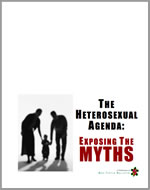 At last, the truth can now be told.
Using the same research methods employed by most anti-gay political pressure groups, we examine the statistics and the case studies that dispel many of the myths about heterosexuality. Download your copy today!
And don‘t miss our companion report, How To Write An Anti-Gay Tract In Fifteen Easy Steps.
 Anti-gay activists often charge that gay men and women pose a threat to children. In this report, we explore the supposed connection between homosexuality and child sexual abuse, the conclusions reached by the most knowledgeable professionals in the field, and how anti-gay activists continue to ignore their findings. This has tremendous consequences, not just for gay men and women, but more importantly for the safety of all our children.
Anti-gay activists often cite the “Dutch Study” to claim that gay unions last only about 1½ years and that the these men have an average of eight additional partners per year outside of their steady relationship. In this report, we will take you step by step into the study to see whether the claims are true.
Tony Perkins’ Family Research Council submitted an Amicus Brief to the Maryland Court of Appeals as that court prepared to consider the issue of gay marriage. We examine just one small section of that brief to reveal the junk science and fraudulent claims of the Family “Research” Council.
 The FBI’s annual Hate Crime Statistics aren’t as complete as they ought to be, and their report for 2004 was no exception. In fact, their most recent report has quite a few glaring holes. Holes big enough for Daniel Fetty to fall through.
“Google” is a trademark of Google Inc.
© Box Turtle Bulletin. All Rights Reserved.
 Posts
Posts  Posts via daily email: