Box Turtle Bulletin
 News and commentary about the anti-gay lobby
“Now you must raise your children up in a world where that union of man and box turtle is on the same legal footing as man and wife…”
News and commentary about the anti-gay lobbyJanuary 30th, 2012
TODAY’S AGENDA:
HUD Bans LGBT Discrimination in Housing: Washington, D.C. The Department of Housing and Urban Development today will finalize non-discrimination rules for LGBT people in federally funded housing programs. The rules, which were first proposed by HUD in January 2011, will cover low-income subsidized housing and FHA mortgage insurance program. As the Washington Blade reports, the new rules will do three things:
- It prohibits lenders from using LGBT status as a basis to determine a borrower’s eligibility for FHA-insured mortgage financing.
- It clarifies that “families” otherwise eligible for HUD programs can’t be excluded because one or more members of the family is LGBT, in a same-sex relationship, or is perceived to be such an individual or in such a relationship.
- It prohibits owners and operators of HUD-assisted housing or housing whose financing is insured by HUD from inquiring about the sexual orientation or gender identity of an applicant or occupant of a dwelling, whether renter or owner-occupied.
The new rules were announced by HUD Secretary Shaun Donovan during a speech at the NGLTF’s Creating Change conference in Baltimore over the weekend.
TODAY IN HISTORY:
NY Times Report AIDS Breakthrough: 1996. The AIDS epidemic had raged unchecked for at least fifteen years with very little hope in sight. For countless numbers of people around the world, an AIDS diagnosis was a death sentence. It wasn’t a matter of if, but when. When the drug azidothymidine (AZT, marketed as Retrovir), first approved in 1987, was a nucleoside analog reverse transcriptase inhibitor (or “nuke”), which blocked a particular enzyme associated with HIV. It was virtually the only means for fighting the disease for almost a decade, but it’s effectiveness was sorely limited. In 1995, another “nuke”, Lamivudine (3TC, or Epivir) became available, giving doctors a second option for when patients became unresponsive to AZT. But when taken together, AZT and 3TC seemed to offer an additional “punch” for many people than they did when taken separately.
Then in 1996, an entirely new type of drug, Indinavir (marketed as Crixivan) entered the market. Known as a protease inhibitor, it inhibits another HIV enzyme known as the protease enzyme from functioning. The New York Times wrote a very cautious report on the breakthrough. At a meeting of the Infectious Diseases Society of America, a study was presented which found that when combined with AZT and 3TC, Indinavir reduced the amount of HIV swimming around in patients’ blood by about 99 percent, to levels which were undetectable by standard laboratory tests in 92% of patients. Many among the more than 2,100 scientists at the meeting expressed optimism about the findings, in part because it was one of the few bits of good news about AIDS in a long time,” The Times reported. “But, recalling how they had been wrong about several other initially favorable AIDS findings, leading scientists urged caution.”

As tentative as the initial reports were, the results soon proved unmistakeable. When 3TC joined AZT in 1995 as a viable treatment, there was a noticeable plateau in the number of deaths due to AIDS. But in 1996 when the three-drug cocktail became available, the number of deaths due to AIDS would see its first drop since the epidemic began. And it wasn’t a slight drop either — it was a 20% improvement from the year before. People at death’s door began coming back from the abyss. For some who had prepared to die, finding that they were living again presented an entirely new set of challenges. The emotional whipsaw, dubbed “the Lazerus Syndrome” made restarting a life (including an education, careers, or simply a place to live) that had been systematically dismantled through disease, disability and stigma just one more challenge to surmount while still dealing with the anxiety of wondering if the other shoe was yet to drop.
The three-drug cocktail, which became known as Highly Active Antiretroviral Therapy (HAART), wasn’t a cure, but the breakthrough was undeniable. Further improvements in HAART resulted in more effective combinations and dosages which made adherence much simpler. HAART would eventually transform AIDS from a terminal disease to a chronic disease, albeit still a very serious one. More recent research shows that, thanks to HAART, people with AIDS can now expect a near–normal lifespan. And yet, HAART’s side effects can take a brutal toll on the body, and its cost — ranging from $10,000 to $15,00 a year for a single patient — makes life-prolonging medications a severe financial strain for anyone without insurance or governmental assistance. All of which makes finding a cure still as important as ever.
If you know of something that belongs on the agenda, please send it here. Don’t forget to include the basics: who, what, when, where, and URL (if available).
And feel free to consider this your open thread for the day. What’s happening in your world?
January 29th, 2012
TODAY’S BIRTHDAYS:
 Greg Louganis: 1960. During the 1976 Montreal Olympics, he came in second for the tower diving behind Italy’s Klaus Dibiasi. When Dibiasi retired two years later, Louganis won his first world title and was a favorite for the 1980 Olympics. Unfortunately, that was the Moscow Olympics, which the U.S. boycotted overt the Soviet Union’s invasion of Afghanistan. But in the 1984 Olympics in Los Angeles (which the Soviets boycotted in retaliation), Louganis won his gold metals in springboard and tower diving. During the 1988 Seoul Olympics, he hit his head on the springboard during preliminaries, resulting in a concussion. But he went on to earn a gold during the finals. That same year, he tested positive for HIV. He came out as gay in 1995 — where else? — on The Oprah Winfrey Show, and his 1996 memoir, Breaking the Surface

 Sara Gilbert: 1975. Kid sister of Melissa Gilbert, Sara is perhaps best known for her role as the sardonic Darlene Conner on the ABC sitcom Roseanne. While still on the show, Sara also attended Yale where she majored in art photography, with producers accommodating her academic schedule by shooting remote segments on a New York soundstage. She has had a recurring role on The Big Bang Theory, and in 2010 she became the co-host and executive producer of The Talk. That same year, she came out as a lesbian. She and her former partner, TV producer Allison Adler, separated in 2011 after a ten year relationship and two children.
 Adam Lambert: 1982. Critics agreed: he had the talent and the chops to win the eighth season of American Idol, but Christian conservatives, appalled by his open sexuality, thought otherwise and mounted a phone campaign to make sure the ‘mo didn’t win. He wound up coming in second place, but his career was set. (Trivia question: does anyone remember who came in first? No fair Googling.) His first studio album, For Your Entertainment, debuted at number three on the Billboard 200. Subsequent releases cemented his reputation an in 2010 he became the only American Idol contestant so far to headline a worldwide concert tour in the year after appearing on Idol. He’s theatrical, androgynous, and unabashedly flamboyant — in the best, gayest sense of the word. His controversial American Music Awards performance — risqué in ways that was old hat for Madonna and Britney Spears — nearly got him banned from television. ABC relented, but would only allow him to appear on The View in a pre-recorded appearance.
If you know of something that belongs on the agenda, please send it here. Don’t forget to include the basics: who, what, when, where, and URL (if available).
And feel free to consider this your open thread for the day. What’s happening in your world?
January 28th, 2012
On Facebook I saw a Photoshopped pic of Maggie Gallagher, a mock-up of Maggie surrounded by boxes of junk food, a cheap shot at the fact that she’s no size 2.
I hate that stuff.
I’ve thrown lots of mockery and ridicule at Maggie Gallagher, but only in ways relevant to our battle. When she lies about us, it matters. When she attacks us with bad logic, it matters. When she’s a hypocrite or a bigot, it matters. But her looks? Not so much. It only hurts us to attack her on that basis. I’ll explain, but first I have to admit I’ve got a dog in this fight. I have a personal, purely emotional reaction against bullying tactics, and I know exactly why.
I was Neville Longbottom. And, really, I still am.
 Neville Longbottom |
 Me, circa 1974 |
My details weren’t exactly the same (no parents killed by an evil wizard), but like Neville, I was an easy target for abuse:
I was a shambling, stumbling, stuttering, metal-mouthed oddball with a facial tick around my eyes who dressed like an old man, wrecked the curve for everyone else on every test, and constantly carried a paperback with garish aliens on the cover under my arm. I had two friends, much the same. We spent our lunches pretending people weren’t throwing food at us.
I can’t stand bullying.
I have an immediate, visceral reaction when I see it, and I struggle not to feel like a 12-year-old misfit on the alert for sudden, inexplicable assaults. But that’s my story, right? Not yours. So why should everyone else quit the bullying too (besides the fact that it’s just wrong)? One simple reason:
It hurts us and helps them.
No one likes a bully. NOM — and Maggie in particular — have cultivated the notion that they’re just kind and gentle people trying to protect families against the onslaught of hateful, intolerant, bigoted gays. Mocking Maggie Gallagher for her weight is like handing her a stick to beat us with. I bet she loves this sort of thing, from a professional perspective at least. I bet she wishes we’d take this low road in a televised confrontation. It’s an automatic win for her side.
It also kills our credibility. Right now we’re trying to reach that undecided 20% of America who just don’t think that much about marriage equality. If I were part of that group and I saw gays insulting Maggie for her weight, I’d figure they had nothing else to offer, nothing of substance anyway. That’s why this is different from mocking our opponents for factual errors, mistakes in logic, and hateful homophobia. That kind of mockery, at least, stays on relevant ground.
So please stop ridiculing Maggie’s appearance. Don’t expect me to join in or laugh along. Be the change you want to see in the world. Remember that your means will shape your end. We’ve got too much going for us to resort to petty, schoolyard bullying.
January 28th, 2012
On Thursday, I thought there might be a split of sorts emerging between Exodus and NARTH when Exodus removed their books on Reparative Therapy from the Exodus bookstore as it seeks to change its focus towards the more religious, ministerial aspects of the ex-gay movement. Recently, Exodus president Alan Chambers said that “99.9%” of people he has known in the ex-gay movement did not experience a change in their sexual orientation, but rather changed their identity and behavior. Now NARTH, which sees itself as a “scientific” organization, has continued to cling to the promise of change in sexual orientation itself. Perhaps in response to the statements coming Chambers, NARTH’s board of directors yesterday issued a statement from their board of directors on “sexual orientation change,” which includes this shot at their erstwhile religious allies:
Finally, it also needs to be observed that reports on the potential for sexual orientation change may be unduly pessimistic based on the confounding factor of type of intervention. Most of the recent research on homosexual sexual orientation change has focused on religiously mediated outcomes which may differ significantly from outcomes derived through professional psychological care. It is not unreasonable to anticipate that the probability of change would be greater with informed psychotherapeutic care, although definitive answers to this question await further research. NARTH remains highly interested in conducting such research, pursuant only to the acquisition of sufficient funding.
January 28th, 2012
As we have said many times before, it is inconceivable that Texas Rep. Ron Paul, who is waging a libertarian campaign for the GOP presidential nomination, could not have known about the many scores of newsletters that went out under his name for the better part of the decade containing virulently homophobic, racist, anti-Semitic, rants embedded with some of the most incredibly imaginative conspiracy theories which would gave Art Bell a run for his secretly-stashed bullion. Paul has tried to distance himself from those newsletters, claiming that only “eight or ten sentences” were offensive (I’m still waiting to see how he narrows the tranche down to “eight to ten sentences”) and besides, he didn’t pay any attention to what he sold — and sold at a very handsome profit — under his own name.
But squaring the incredibly neanderthalic views expressed in the newsletters with his votes in Congress (he voted to repeal DADT, for example) and his positions in the GOP debates has represented one of the greater mysteries in politics. Today, the Washington Post reveals that there’s no mystery to it whatsoever. In fact, the explanation couldn’t be simpler: it all comes down to the root of all evils, the love of money. According to the Post, Paul was a “sharp-eyed businessman” whose company, Ron Paul & Associates, published the newsletters, with Paul himself signing off on articles and speaking to his staff on a daily basis:
It was his newsletter, and it was under his name, so he always got to see the final product… He would proof it,” said Renae Hathway, a former secretary in Paul’s company and a supporter of the Texas congressman…
A person involved in Paul’s businesses, who spoke on condition of anonymity to avoid criticizing a former employer, said Paul and his associates decided in the late 1980s to try to increase sales by making the newsletters more provocative. They discussed adding controversial material, including racial statements, to help the business, the person said.
“It was playing on a growing racial tension, economic tension, fear of government,” said the person, who supports Paul’s economic policies but is not backing him for president. “I’m not saying Ron believed this stuff. It was good copy. Ron Paul is a shrewd businessman.”
Ed Crane, longtime president of the Cato Institute, met with Paul during this time and they both concurred that “people with extreme views” were more likely to respond to sales pitches. Paul told Crane that he got his best response from ads taken out in the anti-Semitic and racist newspaper Spotlight. That led to a calculated strategy that proved to be a gold mine for Paul. In 1984, Paul was in debt to the tune of $765,000. By 1995 toward the end of his run of newsletters, his net worth was $3.3 million. It’s the oldest trick in the book: incitement for influence, demagoguery for dinero, provocation for power. It’s worked for everyone from Coughlin to Goebbels to McCarthy to the Family “Research” Council. How’s that for integrity?
January 28th, 2012

TODAY’S BIRTHDAYS:
Richmond Barthé: 1901. Mississippi-born Richmond Barthé spent his formative years in New Orleans, where his parish priest, Father Harry Kane, encouraged his aesthetic development as a painter. But since he couldn’t enroll in art school during his teenage years because of segregation, he remained self-taught until Kane was able to get him enrolled in the Art Institute of Chicago. During his senior year, Barthé discovered sculpting and never looked back. He moved to New York, won a Guggenheim fellowship (twice), and became a celebrated figure of the Harlem Renaissance. His work explored both race and eroticism. When crime in New York began rising after the war, Barthé moved to Jamaica. Which crime began to rise there in the 1960s, he moved to Switzerland for five years, then to Pasadena. When he moved to an apartment above a garage, the city decided to name the street after him. There, he worked on his memoirs and editioned many of his most important works, with actor James Garner being among his most important patrons. He died in 1989.

Bobbi Campbell: 1952. An early AIDS activist, Campbell was the 16th person in San Francisco to be diagnosed with Kaposi’s sarcoma, one of the more common opportunistic infections associated with AIDS. He came by activism rather simply but boldly: by simply refused to hide his face, he became known as the “KS poster boy” in late 1981 when he began writing a column for the San Francisco Sentinel. He gained nationwide attention on August 8, 1983 when he appeared with his partner on the cover of Newsweek. That same year, he co-founded the People with AIDS Self-Empowerment Movement, which established the Denver Principles which rejected the notion that people with AIDS (PWA) were “victims” and demanded the inclusion of PWAs in all aspects of organized responses to the epidemic, including the right to make informed decisions with regard to their own care.
If you know of something that belongs on the agenda, please send it here. Don’t forget to include the basics: who, what, when, where, and URL (if available).
And feel free to consider this your open thread for the day. What’s happening in your world?
January 27th, 2012
I got a fundraising email from Maggie Gallagher the other day. It’s unbelievably long (as in, I can’t believe she expects people to read this whole thing). One sentence jumped out at me before I gave up on the piece.
Are two men pledged in a sexual union really a marriage?
Personally I’d answer, No.
Actually, I’d blink twice, tilt my head, squint quizzically, and then answer, No. Mostly because I don’t know many men who have pledged to each other in a merely sexual relationship.
On the other hand, suppose Maggie had asked:
Are two men in romantic relationship — who have pledged to have and to hold from this day forward, for better or for worse, for richer, for poorer, in sickness and in health, to love and to cherish, from this day forward until death does them part — in a marriage?
I’d answer, Of course.
But of course, Maggie didn’t write that. She knows it would devastate her argument. She knows the only way she can win is to deny that such a commitment is even possible between two men. That’s why NOM’s website contains this false and dehumanizing assertion:
Love is a great thing. But marriage isn’t just any kind of love; it’s the special love of husband and wife for each other and their children.
‘Cause you see, two men can’t feel that kind of love. Not for each other. Not for their kids.
Maggie’s key strategy here is denial of reality. We see the same thing in different words from NOM’s resident intellectual (God help them) Jennifer Roback Morse, who claims marriage equality will reduce the institution to nothing more than a “registry of friendships.”
Again: denial of reality. And it truly is offensive. Compare it to statements like these:
Well, perhaps that last item doesn’t belong. But those first two statements are no less offensive than what NOM wrote about gay and lesbian relationships.
Okay, that last bit was kind of a tangent. My real point here is that our opponents resort to this rhetorical strategy all the time. We need to point out that it’s not just false, but self-defeating. Not just wrong, but devastating to their own argument. We need to Gingrich ourselves up (rhetorically, not maritally), stop playing defense, and turn their words against them. We need to say:
No. It’s not just a sexual union. It’s not just a friendship. And if you can’t make your case by calling things what they are, then you don’t have a case at all.
January 27th, 2012
LGBT rights advocate Val Kalende sees developments in Uganda that she says the foreign press has been reluctant to notice because it doesn’t fit the popular narrative. Despite the headlines, she says an important story isn’t getting told: it’s getting better for the LGBT movement in Uganda:
The death of David Kato has galvanized a breed of new activism and synergies in the Ugandan LGBT community. On my recent visit to Uganda, I met and interacted with a number of young activists and organizations whose joining the movement was a response to the death of this great activist. The movement has certainly grown bigger and stronger thanks to ongoing organizing by the Uganda Civil Society Coalition on Human Rights and Constitutional Law. It is encouraging to know that what began as a make-shift entity to respond to the Anti-Homosexuality bill has not only become proactive in action but more grounded in a multi-dimensional sexual rights advocacy. Members of the coalition feel that it is time to move Beyond the Anti-Homosexuality bill and build a movement of sexual rights activists who will influence policy and change repressive laws that hinder the freedom of sexual minorities.
…The general situation of LGBT persons in terms of security and awareness of rights has improved. What is often read and heard in international media is not what is on the ground. It is not what I saw on my recent visit. LGBT persons in Uganda are not in hiding. When people like Secretary Hilary Clinton speak out against human rights violations in Africa, they send a strong message to our governments that persecution of LGBT persons is a human rights violation. This comes with some degree of protection from the state because our governments know that the world is watching. I spoke with some activists who feel protected by the state (the Police) than ever before. Even if there’s still a lot of work to be done by government, it is important to acknowledge that today, LGBT activists can engage the police. According to a report from the Hate No More campaign launched in 2o11 by Freedom and Roam Uganda, activists have held meetings with the police and some police official have shown interest in being educated and engaged on LGBT issues.
The situation of LGBT persons in Uganda is getting better. Not worse. It is important that international allies, donors, and partners know that their support and resources are making a difference.
Kalende writes that it’s hard to get that message across; foreign journalists don’t want to hear it. They’re more interested in creating pieces like the BBC’s Scott Mills, whose documentary “The World’s Worst Place to be Gay?” she found to have “prey(ed) on the plight of Ugandan LGBT persons and do nothing to give back to their communities.” Instead, she points to a group of LGBT community activists living in a Kampala ghetto who embarked on community development projects that earned the respect of otherwise “would-have-been homophobic heterosexuals.” She adds:
I was speaking at a conference at Union Theological Seminary in NYC when an American journalist walked up to me and said her editor doesn’t want to publish stories that portray the “getting better” situation for LGBT persons in Uganda. For the past three years since the introduction of the Bahati bill we have talked about how bad things are. Can we now begin to celebrate the progress we are making?
She notes that the international attention has been helpful in shining a spotlight on the Anti-Homosexuality Bill and related problems, but:
In self-criticism, I know that most African LGBTs are not bold enough to condemn the kind of “Mill’s nonsense” that my colleague echoed. We have allowed the West to dictate our politics and write our narratives that we are losing our identity. I know that the arguments I make here are not popular; they don’t attract sympathy because they portray African LGBT persons as competent and independent when people expect them to be stupid.
Afrogay nods in agreement. Val’s essay is required reading, a heart-felt piece with much to chew on. I don’t think it’s to say things in Uganda are even close to perfect. They aren’t. But balance and perspective is always a must, and wherever improvements occur they should be noted.
January 27th, 2012

TODAY IN HISTORY:
Rep. Dick Armey Calls Barney Frank “Barney Fag”: 1995. It’s not easy being the biggest ‘mo in the House. In an interview with a group of radio broadcasters, House majority leader Rep. Dick Armey (R-TX), he discussed the acrimonious atmosphere in the House of Representatives, which was then under the leadership of Newt Gingrich. “Newt’s a very patient fellow and able to handle a harangue going on around him better than I,” Armey said. “I like peace and quiet, and I don’t have to listen to Barney Fag — Barney Frank — haranguing in my ear because I made a few bucks off a book I worked on.”
Armey apologized to Frank when word of his remarks got out, first in person and then again on the House floor, but not without a harangue of his own: “I take this exception especially in light of the fact that I went to the press that had the tape and explained to them in the best humor I could that I had simply mispronounced a name and did not need any psychoanalysis about my subliminal or about my Freudian predilections.” He also castigated House Democrats for focusing on what he called a “mispronunciation.” Frank wasn’t inclined to accept the apology. “I don’t think it was on the tip of his tongue, but I do believe it was in the back of his mind,” said Frank. “There are a lot of ways to mispronounce my name. That is the least common.”

TODAY’S BIRTHDAY:
Alan Cumming: 1965. Well let’s see. He was the M.C. in the 1993 London staging of Cabaret, the evil Boris Grishenko in GoldenEye, and he had roles in Eyes Wide Shut, the Spy Kids franchise, X2, and Gray Matters, among others. He earned two Emmy nominations for his guest role as Eli Gold in The Good Wife, and he won produced the Independent Spirit Award-winning Sweet Land. Where the Scottish actor once described himself as a “frolicky pansexual sex symbol for the new millennium,” he now simply says he’s bisexual. On January 7, 2012, he married his husband Grant Shaffer in New York, on the fifth anniversary of their 2007 civil partnership in London.
If you know of something that belongs on the agenda, please send it here. Don’t forget to include the basics: who, what, when, where, and URL (if available).
And feel free to consider this your open thread for the day. What’s happening in your world?
January 26th, 2012
It was one year ago today when Ugandan LGBT advocate David Kato was brutally murdered in his home. Today, NTV Uganda has posted this news report on a memorial service which was held on the grounds of the Emerald Hotel in Kampala.
There has been a great deal of discussion over the past several years about the influence American pastors have had in stoking the flames of homophobia in Uganda. Against that backdrop, it was very refreshing to see an American pastor, Rev. Joseph Tolton of Rehoboth Temple Christ Conscious Church in New York City, speaking at the memorial. Also speaking at the memorial was Kato’s mother and retired Anglican bishop Christopher Senyonjo.
January 26th, 2012
As further evidence of a possible shift of Exodus International’s focus, Warren Throckmorton pointed the removal of books on reparative therapy from Exodus’s bookstore. When Throckmorton asked Exodus International president Alan Chambers for comment, he responded:
The reason I removed RT books from Exodus Books is because I don’t agree with using this research as a means to say that “this” is how homosexuality always develops, “this” is the primary means in which to deal with it and this is “the” outcome you can expect. Too, Exodus, as a whole, is not a scientific or psychological organization…we are a discipleship ministry and that is where I think our strength is and energy should be focused.
This comes two weeks after Chambers told an audience of gay Christians that “the majority of people that I have met, and I would say the majority meaning 99.9% of them, have not experienced a change in their orientation or have gotten to a place where they could say that they could never be tempted or are not tempted in some way or experience some level of same-sex attraction.”
Before we jump to conclusions here, it is important to step back and unpack this a bit to understand what is happening. When most people think of the phrase “reparative therapy,” it is generally assumed that what is being “repaired” is a person’s sexual orientation. But clinically, that’s not what is meant by “reparative therapy”. Reparative Therapy is a very specific term which describes just one particular type of therapy out of a large array of therapies aimed at changing sexual orientation. Reparative Therapy in particular derives its name from the theoretical underpinnings of this particular form of therapy, which is based on the assumption that gay men become gay because they suffered a “masculine deficit” due to the failure to form a healthy bond with their fathers. That “masculine deficit” sets up a “reparative drive” in the son. That “reparative drive” is defined as the son’s impulse to “repair” that masculine deficit by his seeking out relationships with other men. As Joseph Nicolosi suscinctly sums it up: “We advise fathers, if you don’t hug your sons, some other man will.” Reparative Therapy, therefore, is aimed at addressing that “reparative drive” by ostensibly increasing the client’s self-perception as a male and reframing the boundaries of his relationships with other men.
Reparative Therapy, strictly speaking depends on one single theory of male homosexuality, and it is quite rigid on that point. This is why we here at BTB do not use the phrase “reparative therapy” as a generic term for sexual orientation change therapies. We use the term only when we are talking about this particular form of therapy intended to address the theorized “reparative drive.”
While Reparative Therapy does not describe just any form of sexual orientation change therapy, it is a central focus, almost to the point of being the exclusive focus, of the National Association for Research and Therapy of Homosexuality (NARTH), an organization which was co-founded by Nicolosi. He is not only known as “the father of Reparative Therapy,” but he literally wrote the book on it (see Reparative Therapy of Male Homosexuality: A New Clinical Approach
In contrast, Exodus’s official statement regarding Reparative Therapy reads:
Reparative Therapy is a specialized counseling approach that focuses on resolving relational deficits and/or trauma believed to be a contributing factor in the development of same-sex attraction. Exodus International believes that Reparative Therapy can be a beneficial tool. Exodus International is not a clinical facility but does affiliate, within the Exodus Professional Counselor Network, with licensed therapists. A minority of these professionals may ascribe to some aspects of Reparative Therapy.
Reparative Therapy has been beneficial to some within our network therefore Exodus does provide limited referrals to a select and small group of independent and licensed Christian professionals who offer this resource.
By removing Reparative Therapy books from Exodus’s bookstore, Chambers has now signaled something of a dissatisfaction with RT’s underlying assumption that the reparative drive is the only explanation for sexual orientation development. This is not a new position for Chambers. In fact, it’s not even new for him to consider the possibility that biology can play a part. When I attended the annual Exodus conference in Irvine in June 2007, I heard him challenge his audience to consider the possibility that there may be a biological basis for homosexuality. I don’t have the exact quote with me, but I do recall that he then went on to challenge his audience to remain committed to living according to what he considered to be “God’s best” for them (i.e. a life of celibacy or sexual monogamy with another person of the opposite sex in marriage) regardless of whatever sort of biological errors (my words, not his) may have occurred.
This, of course, is anathema at NARTH. But seen in the overall context of the past half-decade at least, Chambers’s recent moves do not represent a dramatic departure for Exodus. Exodus was always more ministry than psychology, and it appears that Chambers is moving to sharpen the organization’s focus toward the former and away from the latter. But those moves may signal a growing split between Exodus and NARTH (which bills itself as a “scientific” organization), both in approach and tone. That change hasn’t gone unnoticed at NARTH. As evidence, Throckmorton points to an article by David Pickup, who frequently presents at NARTH’s convention and who runs NARTH’s private Facebook page. Pickup blasts Exodus for deemphasizing Reparative Therapy:
In my experience, Exodus has, quite unintentionally for the last 20 years, failed to understand and effectively deal with the actual root causes of homosexuality and what leads to authentic change. I laud their willingness to admit their naiveté’, but I do not see anything so far that indicates they now truly understand the psychological, developmentally-based causes of homosexuality or what produces real change.
…If Chambers and Exodus do want to truly understand the nature of homosexuality, then they should be open to understanding the psychological underpinnings of these issues and start to recommending qualified therapists who are experts at facilitating significant change. If not, then Exodus will fall into deeper controversy than they are in already. They will be reduced to the myopic ministry of simply helping people to deal with their homosexuality through behavioral changes, which, by the way, reflects the American Psychological Association’s belief about Reparative Therapy: that real change is not possible and people may be helped only in the sense of conforming their behavior to reflect their religious beliefs. In short, Exodus will eventually lose even more effectiveness and begin to flounder.
For an idea of how Pickup addressed his reparative drive, check out this video.
So what does all of this mean? It’s hard to tell at this point. Exodus may not sell books on Reparative Therapy, yet a number of reparative therapists are a part of the Exodus referral network. Chambers may acknowledged that “99.9%” of people don’t change their sexual orientation, but the Exodus website says otherwise, and even dangles out there the carrot of marriage:
Exodus affirms reorientation of same sex attraction is possible. This is a process, which begins with motivation to, and self-determination to change based upon a personal relationship with Jesus Christ. We facilitate resources for this process through our member ministries, other established networks and the Church. The key outcome of this is measured by a growing capacity to turn away from temptations, a reconciling of ones identity with Jesus Christ, being transformed into His image. This enables growth towards Godly heterosexuality. Exodus recognizes that a lifelong and healthy marriage as well as a Godly single life are good indicators of this transformation. [Emphasis mine]
But it does look like there have been some nips and tucks in other areas which may reflect Exodus’s increasing autonomy from Focus and NARTH. For example, in 2007 I attended Love Won Out, Exodus’s traveling infomercial for ex-gay ministries, which featured a detailed exposition of Reparative Theory as the only significant explanation for male homosexuality. The lecture was delivered by Nicolosi, who spent about an hour making the case first thing in the morning. When Nicolosi left LWO a year later, his place on the schedule was taken by former Exodus president Joe Dallas, who delivered Nicolosi’s talk on Reparative Therapy with only a few minor changes here and there. That was when LWO was a joint venture between Exodus and Focus On the Family. Beginning in 2010, Focus bowed out and LWO became an exclusively Exodus project. Since then, the published agenda for LWO has changed drastically. I can only assume that the changes reflect a change in Exodus’s emphasis, but I can’t be certain from this vantage point. I guess this means I’ll have to book a flight and attend another conference to get caught up to date.
January 26th, 2012
 …to his longtime partner Jim Ready. A spokesman confirmed it today, although no date has been set.
January 26th, 2012
 In response to the outcry to New Jersey Gov. Chris Christie’s call for a statewide referendum putting the marriage rights of same-sex couples up for a vote, Gov. Christie has doubled down against criticisms against putting the rights of minorities at the mercy of the majority:
“The fact of the matter is, I think people would have been happy to have a referendum on civil rights rather than fighting and dying in the streets in the South.”
This is the rest of the quote: “It was our political institutions that were holding things back. I don’t think there’s anything necessarily so special about this particular issue that it must be handled by a Legislature. Why would that be?…I don’t understand how anybody could argue with letting the people decide this issue.”
Seriously? Seriously?
Does he really think that holding a referendum on civil rights in 1964 in Arkansas, Alabama, Mississippi, Louisiana, Georgia, Florida, the Carolinas — or in Massachusetts or Michigan — would have put an end to official desegregation? Does he even think that Southern African-Americans themselves would have even been allowed to vote on this referendum? Does he honestly believe that the white citizens of Selma, Greensboro, Atlanta, Birmingham, Little Rock and Mobile would have voted to allow African-Americans to sit at their lunch counters or next to them in theaters, let alone work in their front offices and department stores? Is Christie completely unaware of the racial segregation that was legally enforced in his own state of New Jersey?
Actually, I’m beginning to think that he is fully aware of what such a referendum would have produced. He’s right in one sense: I’m sure there were a lot of people who would have been perfectly happy to hold a referendum on Black civil rights in 1964. And there would be many more people today who would be ashamed of how their parents and grandparents voted in Christie’s referendum.
Update: I love BTB readers. A commenter points out that Christie’s suggestion was already tried in California in 1964:
We did have a vote on civil rights, in California, in 1964. Prop. 14 would have put in the state constitution a provision that would void all local and state ordinances on racial discrimination in housing, and replace it with a property owner’s right to refuse to lease, sell or rent property on any basis.
The initiative passed by a 2-1 majority in Nov. 1964, even with a liberal Democratic ticket sweeping the state. It took the U.S. Supreme Court to void it.
QED.
So yeah, you don’t even have to guess at how Christie’s suggestion would work out.
January 26th, 2012
 The Jewish Press, a conservative newspaper which has published advertisements for the Jewish ex-gay group JONAH, this morning published an op-ed by Chaim Levin detailing the abuses he experienced while participating in ex-gay therapy. Levin wrote in response to another op-ed by Elliot Resnick published six months ago in The Jewish Press, “Orthodox Homosexuals and the Pursuit of Self Indulgence,” in which, without mentioning Levin’s name, Resnick responded to Levin’s “It Gets Better” video by saying that he should learn to suffer in silence. In this responding op-ed, Levin describes what Resnick believes he should remain silent over:
The worst part of my experience in reparative therapy came at the end. In a locked office, alone with my unlicensed “life coach,” I was told to undress, stand in front of the counselor and do things too graphic to describe in this article. I was extremely uncomfortable, but he said that I must do this for the sake of changing and that if I didn’t remove my clothing I wouldn’t be doing the work it takes to achieve change. I would do anything to change, and so I did what he asked me to do. It was probably the most traumatizing experience of my life.
I tried to tell people what happened, but the organization said it wasn’t true and refused to fire the life coach. But I have spoken to other men whom underwent the same experience. And I can only imagine how many other young men who this has happened to who have not yet come forward. One of the most frustrating aspects was that because this coach is not licensed by any professional board, he is unaccountable to any licensing committee. Since I was over eighteen and agreed to this kind of therapy, I am told that I have no legal recourse. But I do have my voice! Yet, even after coming forward with what happened, nothing has changed. I often hear that this therapy has helped people, that it is wonderful, but I wonder, how helpful can an organization be when it causes great suffering and pain to many who come to them for hope.
Two weeks ago, JONAH founder Arthur Goldberg admitted and defended the practice of asking clients to undress, but denied that anyone was asked to touch their genitals.
Levin lays out the evidence for homophobia in the Orthodox community, citing the recent Torah Declaration case for “perpetuat(ing) the notion that all homosexuals in the Orthodox community must change in reparative therapy. …Unlike these other statements, it does not allow those for whom this kind of therapy is harmful or not working to seek other options. It kills me that this Torah Declaration will be used by parents to force their children into therapies that may be harmful to them.” He also mentions a grass roots Orthodox support community, JQYouth, who he says “saved my life.”
January 26th, 2012

TODAY IN HISTORY:
Government Payments to Maggie Gallagher, Other Columnists Revealed: 2005. Howard Kurtz revealed in a Washington Post story that the Bush Administration had paid hundreds of thousands of dollars to two columnists in a “pay-to-sway” scandal to promote the administration’s policies. In one case, it was revealed that the U.S. Department of Education paid columnist Armstrong Williams $241,000 to promote and talk up the No Child Left Behind Initiative and to encourage other journalists and columnists to write favorable articles on the law. It was also revealed that Maggie Gallagher had accepted $41,500 to promote the Bush Administration’s marriage initiative, which called for abstinence education and premarital counseling. Gallagher responded in a rather creative way: first by defending her role in the contract (“I’m a marriage expert. I get paid to write, edit, research and educate on marriage. If a scholar or expert gets paid to do some work for the government, should he or she disclose that if he writes a paper, essay or op-ed on the same or similar subject? If this is the ethical standard, it is an entirely new standard.”), then by acknowledging that she should have disclosed the contract when she later wrote about the Bush marriage initiative. “But the real truth is that it never occurred to me. … I would have, if I had remembered it. My apologies to my readers.” Nice work if you can get it.
Armstrong was dropped by from syndication by the Tribune Company. Gallagher continued writing for Town Hall as though nothing had happened.

David Kato Murdered: 2011. It seems like yesterday; it seems like a lifetime ago. But it was one year ago today when Ugandan LGBT advocate David Kato was brutally murdered in his home. The murder took place almost four months after his photo appeared on the front page of a local tabloid as one of Uganda’s “top homos” with the tag, “Hang Them!” And the murder took place less than a month after a Ugandan Court issued a permanent ruling baring that tabloid from outing gay people on its pages. The police, before they even had a suspect, were quick to deny that homophobia had anything to do with his murder, and they maintained that position after they settled on a suspect and obtained a “confession.” To seal the deal, the alleged murderer was quickly found guilty and sentenced — in proceedings so rushed that his own lawyer didn’t know he was appearing in court. But LGBT advocates in Uganda know the real score and aren’t buying the government line. On this anniversary, it’s important to pause and remember that there are martyrs for gay rights: Harvey Milk, David Kato, and many others, known and unknown.
In honor of Kato’s memory, the David Kato Vision and Voice Award has been established to recognize those who demonstrate “courage and outstanding leadership in advocating for the sexual rights of lesbian, gay, bisexual, transgender and intersex (LGBTI) people, particularly in environments where these individuals face continued rejection, marginalization, isolation and persecution.” It is awarded annually on December 10, Human Rights Day. The first recipient of the award was Jamaican gay rights activist Maurice Tomlinson

TODAY’S BIRTHDAY:
Ellen DeGeneris: 1958. She made her own bit of history in 1997 during the fourth season of her sitcom, Ellen, when she came out publicly as a lesbian on the Oprah Winfrey Show. Her character soon came out on her sitcom, and that coming out episode was one of the highest rated episodes of her series. That episode won her her first Emmy, but the show’s popularity dropped soon afterward and was cancelled. Ellen withdrew form television and returned to her roots in stand-up comedy (and taking on a voice-acting stint for the 2003 film Finding Nemo) before re-establishing herself as a popular talk show host on Emmy-winning The Ellen DeGeneris Show, where she often talks about Portia de Rossi, her wife of three years. Her show is very popular with housewives and not a few gay men, with her popularity undoubtedly helped along with segments like this:
In November 2011, Secretary of State Hillary Clinton named her a Special Envoy for Global AIDS Awareness.
If you know of something that belongs on the agenda, please send it here. Don’t forget to include the basics: who, what, when, where, and URL (if available).
And feel free to consider this your open thread for the day. What’s happening in your world?
Featured Reports
 In this original BTB Investigation, we unveil the tragic story of Kirk Murphy, a four-year-old boy who was treated for “cross-gender disturbance” in 1970 by a young grad student by the name of George Rekers. This story is a stark reminder that there are severe and damaging consequences when therapists try to ensure that boys will be boys.
When we first reported on three American anti-gay activists traveling to Kampala for a three-day conference, we had no idea that it would be the first report of a long string of events leading to a proposal to institute the death penalty for LGBT people. But that is exactly what happened. In this report, we review our collection of more than 500 posts to tell the story of one nation’s embrace of hatred toward gay people. This report will be updated continuously as events continue to unfold. Check here for the latest updates.
In 2005, the Southern Poverty Law Center wrote that “[Paul] Cameron’s ‘science’ echoes Nazi Germany.” What the SPLC didn”t know was Cameron doesn’t just “echo” Nazi Germany. He quoted extensively from one of the Final Solution’s architects. This puts his fascination with quarantines, mandatory tattoos, and extermination being a “plausible idea” in a whole new and deeply disturbing light.
On February 10, I attended an all-day “Love Won Out” ex-gay conference in Phoenix, put on by Focus on the Family and Exodus International. In this series of reports, I talk about what I learned there: the people who go to these conferences, the things that they hear, and what this all means for them, their families and for the rest of us.
Prologue: Why I Went To “Love Won Out”
Part 1: What’s Love Got To Do With It?
Part 2: Parents Struggle With “No Exceptions”
Part 3: A Whole New Dialect
Part 4: It Depends On How The Meaning of the Word "Change" Changes
Part 5: A Candid Explanation For "Change"
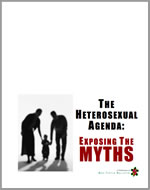 At last, the truth can now be told.
Using the same research methods employed by most anti-gay political pressure groups, we examine the statistics and the case studies that dispel many of the myths about heterosexuality. Download your copy today!
And don‘t miss our companion report, How To Write An Anti-Gay Tract In Fifteen Easy Steps.
 Anti-gay activists often charge that gay men and women pose a threat to children. In this report, we explore the supposed connection between homosexuality and child sexual abuse, the conclusions reached by the most knowledgeable professionals in the field, and how anti-gay activists continue to ignore their findings. This has tremendous consequences, not just for gay men and women, but more importantly for the safety of all our children.
Anti-gay activists often cite the “Dutch Study” to claim that gay unions last only about 1½ years and that the these men have an average of eight additional partners per year outside of their steady relationship. In this report, we will take you step by step into the study to see whether the claims are true.
Tony Perkins’ Family Research Council submitted an Amicus Brief to the Maryland Court of Appeals as that court prepared to consider the issue of gay marriage. We examine just one small section of that brief to reveal the junk science and fraudulent claims of the Family “Research” Council.
 The FBI’s annual Hate Crime Statistics aren’t as complete as they ought to be, and their report for 2004 was no exception. In fact, their most recent report has quite a few glaring holes. Holes big enough for Daniel Fetty to fall through.
“Google” is a trademark of Google Inc.
© Box Turtle Bulletin. All Rights Reserved.
 Posts
Posts  Posts via daily email: