Box Turtle Bulletin
 News and commentary about the anti-gay lobby
“Now you must raise your children up in a world where that union of man and box turtle is on the same legal footing as man and wife…”
News and commentary about the anti-gay lobbyJanuary 7th, 2011
A Catholic school district in Canada has banned gay-straight alliance clubs. Says school board chair Alice Anne LeMay:
Gay-straight alliances are banned because they are not within the teachings of the Catholic Church.
Okay. I mean, it’s a Catholic school, after all. I’ll have second thoughts if they’re receiving taxpayer funds, but so far it’s a pretty straightforward explanation of the ban, one that many (most?) straight North Americans would find quite reasonable. This sort of opposition is the hardest for us to fight.
But there’s more.
Here’s the full quote:
We don’t have Nazi groups either. Gay-straight alliances are banned because they are not within the teachings of the Catholic Church.
YES!! Way to equate gay 14-year-olds with the most brutal mass murderers the planet has ever seen!

Alice Anne Lemay
Unintentional hero in the battle for equality
Thank you Alice Anne LeMay, thank you. Not everyone can make our opponents look so ridiculous in so few words.
I can’t resist taking a little time to explain why her comment is so offensive — offensive and illogical. Her reasoning only makes sense if it works like this:
We don’t allow [something mild], so why would we allow [something more extreme]?
For instance, it makes sense to say:
We don’t allow soft drinks on campus, so why would we allow tequila?
It makes no sense to say:
We don’t allow tequila on campus, so why would we allow soft drinks?
But Alice Anne LeMay has it backwards. We don’t allow kids to celebrate the most extreme incarnation of evil our culture can name, so why would we allow gay clubs?
This only works if you think gays are worse than Nazis. I am sure I would bet I hope Alice Anne LeMay doesn’t see it that way, which is what makes her comment so dumb.
Anyway, thank you Alice Anne LeMay. Every time someone like you makes such an asinine comparison, our job gets a little easier.
January 7th, 2011
From the Washington Post:
Miller has given his blessing to a committee realignment that all but ensures that a gay-marriage measure will make it to the Senate floor during this year’s session, which starts Wednesday – and presumably onto the desk of Gov. Martin O’Malley (D), who pledged last year to sign it.
I have been frustrated with Maryland politics for years, but it does look like this year may be the year in which the Democratic Party in Maryland places equality for gay citizens as a higher priority than the religious beliefs of specific individual legislators. I will be delighted to joyously let bygones be bygones if they come through for our community.
My only complaint with the WaPo article is that they speak of “a coterie of moderate Democrats and vocal Republicans opposing any endorsement of gay rights.” But these opponents are not “moderate Democrats” at all and it is unfair to moderate Democrats around the nation to describe them thusly.
These Democrats aren’t “moderate” on any issues other than their opposition to equality under the law for gay people. They are liberal Democrats who, due to their religious adherence, hold deep animus to gay people and who use the position of authority to which they have been entrusted as a tool to harm gay men and women in their state. And there’s nothing “moderate” (or “liberal”) about that.
Interestingly, the Republican Minority Leader response is one that I often see championed in the comments at BTB. While he proposes a civil unions alternative, it doesn’t go as far as he would like in reducing marriage recognition for all:
“My goal is to have complete equality,” Sen. Allan H. Kittleman (R-Howard) said. In a sense.
If he had his druthers, Kittleman would do away with civil marriage altogether, he said, making it a purely religious institution. But that would have left straight couples high and dry vis-a-vis the federal government, which wouldn’t extend the benefits of marriage to those who are merely united civilly.
So he’ll opt that gay couples just be left high and dry instead. Yet he made comments that leave the possibility that Maryland may get bipartisan support when the marriage bill is passed.
January 6th, 2011
 In the early 90’s a simple red ribbon, folded and pinned, was introduced as a symbol of concern and awareness for HIV/AIDS. In a short time the image was picked up by Hollywood and other celebrities as a way to identify with the cause without having to make speeches, a silent statement that could be present while receiving awards or gossiping with a tabloid reporter. And it has served as a powerful reminder since that time, visible from churches to hospices to testing centers and present on lapels of liberal activists and the portico of a Republican White House.
Few images so readily identify a specific message, but a new one does seem to be developing. After Proposition 8 banned same-sex marriage in California, celebrity photographer Adam Bouska took a picture of himself with his mouth covered by masking tape with the letters NO H8 printed in black and red. Soon others wanted their picture taken with this imagery and a symbol was born.
NOH8, an image that stands for gay equality, marriage equality in particular, has picked up a number of supporters, expected and surprising. Musicians and actors, sports personalities and cultural trendsetters, and perhaps most surprisingly Cindy McCain, the wife of failed Republican presidential candidate John McCain. But while NO H8 is readily recognized within the gay community, it had not crossed the divide to immediate public recognition.
Until this week. Last night Pauley Perrette, star of NCIS, took the image to the People’s Choice Awards, front and center. Literally. (stylebistro)
On the red carpet at the 2011 award show, Pauley stepped out in a corseted, asymmetric wedding gown emblazoned with a familiar logo: NOH8, the emblem of the LA-based NOH8 Campaign that works to bring celebrity support of marriage equality into the public eye.
When asked about the PC look, the 41-year-old actress, who incidentally married boyfriend Michael Bosman last Valentine’s Day, said she had the idea and immediately phone her stylist, Teri King. She paired the thought-provoking gown with her signature bangs, a bright red pucker and, as she said, her heart on her sleeve. Props, Pauley! You officially rock.
Although NCIS did not win Favorite TV Crime Drama, Pauley’s stance has, I’m sure, led the way for significantly more prominent visibility of this image in the future. I doubt many more dresses will take such a visible interpretation, but NO H8 will likely soon be assured a comfortable lapel home on many a talk show or interview.
January 6th, 2011
A bill to enact marriage equality in the State of Rhode Island was introduced today in both the House and Senate. (Providence Journal)
In the House, Rep. Arthur Handy, D-Cranston introduced his annual bill to legalize same-sex marriage in Rhode Island. The 29 lawmakers co-signing the bill include House Speaker Gordon D. Fox.
As she introduced similar legislation in the Senate, Sen. Rhoda Perry, D-Providence, said she hoped it would get a hearing and vote early in the legislative session.
A mirror of Handy’s bill, it legalizes “civil marriage” between people of the same gender to marry, while specifying that no religious institution would be required to marry same-sex couples if that would go against their teachings.
As the House speaker is gay and the governor called for marriage equality in his inaugural address, there is hope that this bill will have adequate support for success. The Senate Majority Leader is opposed to marriage equality, but she has stated that she will not stand in the bill’s way.
The Republican minority has pledged to support civil unions but any legislation allowing the term “marriage” to apply to same-sex unions should be put before the people as a referendum.
January 6th, 2011
Steve Buckley has written sports for the Boston Herald (the city’s more conservative newspaper) for the past 15 years. Today he shared a detail of his life with his readers.
Over the past couple of months I have discussed the coming-out process with my family and a few friends, and have had sit-downs with Herald editor-in-chief Joe Sciacca and sports editor Hank Hryniewicz, as well as with WEEI’s Glenn Ordway. They’ve been great, as have my friends and family.
But during this same period, I have read sobering stories about people who came undone, killing themselves after being outed. These tragic events helped guide me to the belief that if more people are able to be honest about who they are, ultimately fewer people will feel such devastating pressure.
It’s my hope that from now on I’ll be more involved. I’m not really sure what I mean by being “involved,” but this is a start: I’m gay.
An Opinion
January 5th, 2011
I am not a constitutional scholar. I’m not even an attorney. But I am a fairly logical person who has great respect for the intents and purposes of the US Constitution and who is troubled by efforts on both the right and the left to read into – or extract out of – the language that protects my status as a citizen.
It is my – perhaps naive – belief that the constitution differs from law in that it sets forth principles, ideals, that apply broadly and which are drafted in language that seeks to be applicable to unanticipated specific instances. It speaks to a people who communicate using computers, travel using airplanes, and associate by means of facebook as easily as it did to those who road their horse to the village pub to debate the issues of the day.
I am, I admit, uncomfortable with Supreme Court rulings that seem to create out of whole-cloth rights, privileges, or entitlements that exist outside of the document. While I treasure a right to privacy, I am perplexed that the innumerated rights to privacy that are included in the Bill of Rights have given birth to a generic right that simply is not written there. I think that the courts have in some instances erred in finding not what is written, but what they wish were written.
And in that concern, I am often accompanied by conservatives who, for example, find that the right to privacy limits their ability to restrict the freedoms of their neighbors. But I think that some conservatives, especially those most revered by the hard-core right, are even more guilty in their distortion of the Constitution. Rather than discover rights that are not clearly articulated, they seek to overlook or dismiss those which are clearly in black and white.
Constitutional Originalism is the name they give to this erasing of right, though naturally they do not articulated it as such. Rather it is phrased as though those seeking original intent are preserving the language of the Constitution. They argue that a written constitution is limited to what was meant by those who drafted and ratified it and interpretation should be based on what reasonable persons living at the time of its adoption would have declared the ordinary meaning of the text to be.
But that is neither the application they employ nor the intent of their efforts. Take, for example, this conversation between UC Hasting professor Calvin Massey and Supreme Court Justice Anonin Scalia:
Massey: In 1868, when the 39th Congress was debating and ultimately proposing the 14th Amendment, I don’t think anybody would have thought that equal protection applied to sex discrimination, or certainly not to sexual orientation. So does that mean that we’ve gone off in error by applying the 14th Amendment to both?
Scalia: Yes, yes. Sorry, to tell you that. … But, you know, if indeed the current society has come to different views, that’s fine. You do not need the Constitution to reflect the wishes of the current society. Certainly the Constitution does not require discrimination on the basis of sex. The only issue is whether it prohibits it. It doesn’t. Nobody ever thought that that’s what it meant. Nobody ever voted for that. If the current society wants to outlaw discrimination by sex, hey we have things called legislatures, and they enact things called laws. You don’t need a constitution to keep things up-to-date. All you need is a legislature and a ballot box.
To understand the context of this appeal to originalism, look at the language of the 14th Amendment:
Section 1. All persons born or naturalized in the United States, and subject to the jurisdiction thereof, are citizens of the United States and of the State wherein they reside. No State shall make or enforce any law which shall abridge the privileges or immunities of citizens of the United States; nor shall any State deprive any person of life, liberty, or property, without due process of law; nor deny to any person within its jurisdiction the equal protection of the laws.
The amendment goes on with four additional clauses which address representative government, but this is the heart of the issue, the language which Scalia and those who share his views wish to remove from the protections granted by the Constitution.
And the language which they seek to wish away, specifically, is “any person.” Scalia argues that “any person” as understood by members of the the 39th Congress in 1868 did not include either women or gay people (or anyone else to whom we could apply it) and so thus these classes of persons are not protected by the amendment.
But to do so, Scalia has to make three broad assumptions:
1. That the Constitution is not a document of guiding principles, but a law text which applies only to the specific intentions designed to address specific issues.
Depending on how literal this is taken, you can run into some rather tricky interpretations. By a strict adherence to the original intent, references to “states” would only apply to the original thirteen, the regulation of commerce among the several states would be limited to goods and services in existence in the 1780’s, and citizens would be white male landholders. But, in a manner similar to scriptural literalism, originalism picks and chooses that which is bound by principle and that which is bound by “intent.”
2. That the drafters of the 14th Amendment were careless.
The term “any person” seems to be rather broad. Scalia would have us believe that the intent of this phrase is “any heterosexual male person” and that the drafters simply assumed that no one would read “any” to be more broad than they intended.
But in the second clause of the 14th Amendment, these same drafters were capable of the much more specific phrase “any of the male inhabitants of such State, being twenty-one years of age, and citizens of the United States.” One must either believe that they were forgetful, downright stupid, or that it was not entirely by accident that the phrase “any person” is not termed “any male person.”
3. That the men who wrote and voted for the 14th Amendment could not espouse principles grander than they personally could aspire.
History, especially the founding of our nation, is full of examples of men whose beliefs exceeded their abilities. Washington, for example, was troubled by slavery, yet owned slaves for many years. His slaveholder status is not an indication that he revered the institution, but that he was limited and flawed, unable to live to the standards that his conscience told him were right.
And while Scalia would pretend that the notion of women’s rights was foreign to the thinking of congressmen in 1868, the battle for women’s rights was alive and well at the time. In 1848, Gerrit Smith ran for president as the Liberty Party’s candidate on a suffrage platform. And indeed, it was from among the suffrage leaders that much of the support for African-American rights was championed.
It requires a willful disregard of history to declare that “I don’t think anybody would have thought that equal protection applied to sex discrimination.” That was what Elizabeth Cady Stanton and Frederick Douglass and Susan B. Anthony were fighting for in that very year, one of the principle years of suffrage activism. They rightly saw the battle for equal rights to be the battle for all equal rights.
That suffrage was not achieved for another half century is a sad reflection on the face of humanity’s inability to let go of privilege. But I think it at least likely that in selecting “any person” the Congress was laying out principles to which it could not yet live, but which it knew were right.
As for sexual orientation, the matter is less clear. Few, if any, at the time recognized orientation as such. But surely as important to “what did they intend” would be “what would they have intended.” If those who protected “any person” were aware of the intrinsic and immutable nature of sexual orientation, would they have found that gay persons can and should be deprived of life, liberty, or property, without due process of law? Would they have carved out an exception and stated that gay people should indeed be denied the equal protection of the laws?
Scalia would say that this is immaterial, that they didn’t intend it at the time and the principles they applied in laying down such protections should be ignored. That they addressed the rights of the often despised, uneducated, recently-enslaved negro says nothing to their attitude towards other minorities and the decency that underlies this provision has no bearing on its interpretation and all that matters is that the writers of the language were not specifically thinking at that moment of gay men and women.
To Scalia’s thinking, the broad language of the constitution should be thought not in terms of principle, not in terms of even the words selected, but in terms of what Scalia’s stereotype of the mindset of a mid-eighteenth century congressman might be.
Scalia simply wishes to find in the Constitution that, and only that, which confirms his own biases and sense of entitlement. Originalism is just a tool for finding it there.
January 5th, 2011
Incoming Governor Scott of Florida has issued an executive order limiting those whom will be free from discrimination.
It shall be the policy of my administration to prohibit discrimination in employment based on race, gender, creed, color, or national origin, and to ensure equal opportunity for all individuals currently employed in, and individuals seeking employment in, my administration.
These sort of orders are not truly necessary. State and Federal law prohibit employment discrimination on these bases, and executive orders only have any purpose to the extent that discrimination will be prohibited to those not overtly protected by law.
Scott’s executive order is symbolic. His administration wishes to make it perfectly clear that they do not consider sexual orientation or gender identity to be worthy of protection from discrimination.
January 5th, 2011
The National Organization for Marriage’s Maggie Gallagher was not happy when Justice Reinhardt was selected as part of the panel to hear the Perry v. Schwarzenegger appeal. She insisted that he recuse himself because his wife, Ramona Ripston, heads the ACLU in Southern California and supports marriage equality:
The entity that Ripston heads took part as counsel to an amicus in this very case in the district court.
According to media reports including those in the Los Angeles Times and respected legal blog Volokh.com, Reinhardt has a policy of recusing himself from cases involving the ACLU of Southern California.In addition to the clear legal reasons that Judge Reinhardt is required to disqualify himself from this case, there are other circumstances that clearly call his impartiality into question:
· Ripston, Reinhardt’s wife, contributed money to the NO on Proposition 8 campaign. It is not known if these funds were joint or separate funds.
· Ripston publicly cheered the decision by the District Court to declare Proposition 8 unconstitutional. In a media statement, she said, “We rejoice at today’s decision but there’s a long road ahead toward establishing true marriage equality for same-sex couples.”
Reinhardt declined. And yesterday he clarified his reasoning:
My wife’s views, public or private, as to any issues that may come before this court, constitutional or otherwise, are of no consequence. She is a strong, independent woman who has long fought for the principle, among others, that women should be evaluated on their own merits and not judged in any way by the deeds or position in life of their husbands (and vice versa). I share that view and, in my opinion, it reflects the status of the law generally, as well as the law of recusal, regardless of whether the spouse or the judge is the male or the female.
Gosh, I guess the Little Lady has views of her own.
Naturally, conservatives like Ed Whelan don’t find Reinhardt’s explanations to be adequate. For me, I’ll wait until the case reaches the Supreme Court to judge the integrity of Whelan’s complaint. Should he demand that Scalia recuse himself due to his son’s advocacy on this issue then I’ll believe that Whelan is a man of integrity; otherwise this is but more results-driven posturing masquerading as principle.
January 5th, 2011
 There are a small handful of states in which there is some question as to whether same-sex marriages conducted where legal are recognized within the state. The Attorney General of New Mexico has now issued an opinion that New Mexico law affords such recognition.
QUESTION:
Are same-sex marriages performed in other jurisdictions valid in New Mexico?
CONCLUSION:
While we cannot predict how a New Mexico court would rule on this issue, after review of the law in this area, it is our opinion that a same-sex marriage that is valid under the laws of the country or state where it was consummated would likewise be found valid in New Mexico.
AG Gary King was elected in 2006, and won reelection in November. He is the son of Bruce King, who served three non-consecutive terms as Governor of the state, and served 12 years in the NM House of Representatives.
It will remain to be seen what the outcome will be should any same-sex New Mexican couple challenge the state for recognition, but for now we will move New Mexico into the column of “marriages recognized here.”
January 5th, 2011
The National Organization for Marriage fights an on-going battle to keep secret the sources of its political expenditures, often flagrantly violating state and federal law to do so. Although it pretends that it is simply seeking to protect individual donors from persecution for their beliefs, NOM does not operate due to individual donors, but rather is a cover for a small handful of very wealthy individuals or organizations.
The Human Rights Campaign, through its NOM Exposed project, has received a copy of NOM’s 2009 Form 990, the IRS return required from non-profit organizations. This return is only for the political advocacy side of NOM (most political non-profits have both advocacy and educational entities so as to allow for some portion of their contributions to be deductible by the donor) and appears to either be redacted or to have been prepared in violation of federal law. The identifying donor information has been excluded.
However, while NOM does not list the names of major donors, it does list the amounts received from such donors. And the message is clear: NOM is the project of a small number of very significant contributors. Three donors alone gave more than a million dollars each and comprise 65% of the total revenues. Eleven additional major donors ranging from $400,000 to $5,000 bring the total of major donor contributions to 75%.
Were we to know the names of the donors, this might even further consolidate. Should, for example, each of the $5,000 contributions be separate diocese of some religious denomination, or various family members, or separate state branches of a political organization, then it might even be discovered that NOM is simply a shill, a front for a singular entity who wishes to secretly engage in politics.
January 5th, 2011
 The Boston Globe has an interesting profile of Scott Lively this morning, in which he claims that he is turning aside his old ways and focusing more on helping the downtrodden in his adopted hometown of Springfield, Massachuetts:
Every day, patrons stream to the Christian folk shows and Bible classes at Holy Grounds Coffee House, the café he opened about two months ago on a block not far from downtown. A thousand people turned out for the March for Jesus he led from the café to the steps of City Hall on the day before Easter. And dozens of children and parents flocked to a city park for his annual Family Day celebration, featuring a water slide, face painting, and grilled food. Even the mayor stopped by that event.
“You can’t walk down the street without being greeted by somebody saying, ‘Hey, Rev. Scott!’ ” said Lively, an evangelical pastor who moved to Springfield from California in January 2008. “It’s very satisfying.”
…”He has won the hearts of his people with his sincerity and the things he’s doing in the community,” said Archbishop Timothy Paul, pastor of the Basilica of the Holy Apostles and president of the Council of Churches of Greater Springfield. “But I don’t believe people in Springfield really know who he is.”
Who Scott Lively really is, is the virulently anti-gay activist whose Abiding Truth Ministriues has been on the Southern Poverty Law Center’s very short list of anti-gay hate groups for a few years now. Not only that but Lively is co-founder of Watchmen On the Walls, another identified hate group (it was those Watchmen connections that brought him to Springfield), and he has worked with Massachusetts-based School of Christian Activism and MassResistance, two more identified hate groups. He is the author of author of the widely discredited book, The Pink Swastika, in which he claims that the Nazi movement was, at its core, a gay movement, and that the inevitable result of LGBT equality would be the imposition of murderous fascism.
In 2009, he took his message to Uganda with Exodus International board member Don Schmierer and International Healing Foundation’s Caleb Lee Brundidge (Brundidge went on behalf of IHF head Richard Cohen). He would later brag that his messages was a nuclear bomb against the gay agenda, which helped to prepare the groundwork for the introduction of the draconian Anti-Homosexuality Bill in Uganda’s Parliament.
The Globe provides considerable coverage of those events. Lively is unrepentant in his views about gay people, but he now says he has changed his focus.
“We’re not fighting the culture wars here in Springfield,” he said. “The issues here are more fundamental than that. You can’t deal with the culture wars with people who are struggling to survive. Those issues are not relevant. These are people who are trying to live.”
“This whole mission in Springfield is to show by example the positive side of all this — that when you follow the Biblical approach and try to be as true to him [God] as you can, you get the maximum positive benefit for yourself and society,” he said. “It’s completely different from all the things that I’ve done in the past, which is going against the wrongs. We’re working toward what is right.”
…Lively’s café features soft music and free Bibles, but no copies of “Pink Swastika,” or “7 Steps to Recruit-Proof Your Child.” On a recent day, two teenagers chatted at one table, and two lounged on a sofa, while a few regulars talked with the long-haired manager, Michael Free, who offers blessings to patrons.
So, has Lively fully abandoned the culture war? I doubt it. He’s made similar noises before, but since then has argued that repealing “Don’t Ask, Don’t Tell” would result in a Nazi takeover of the U.S. military, and he went on The Daily Show to say that gay men exhibit absolutely no moral restraint whatsoever. More recently, he ran as a write-in candidate for Massachusetts governor with MassResistance’s endorsement.
The Globe closes with Lively saying;
“If someone were looking for Scott Lively to stop being involved in the other stuff, this is it,” he said in an interview in his café. “Those people who criticize me, they should be happy.”
Believe me, I will be very happy when I never have to write about him again. Let’s see where we are, say, a year from now.
January 4th, 2011
 In his inauguration speech today, onetime Republican Senator and newly elected Independent Governor Lincoln Chafee included the following comments:
And I would hope that Rhode Island will catch up to her New England neighbors and pass a bill to establish marriage equality. I urge our general Assembly to quickly consider and adopt this legislation. When marriage equality is the law in Rhode Island, we honor our forefathers who risked their lives and fortune in the pursuit of human equality.
January 4th, 2011
The Ninth Circuit Court of Appeals has denied the standing of the deputy clerk of Imperial County to appeal Judge Walker’s decision in Perry v. Schwarzenegger.
The district court order denying the motion to intervene is AFFIRMED. Movants’ appeal of the district court order concerning the constitutionality of Proposition 8 is DISMISSED for lack of standing.
January 4th, 2011
It appears to me that the Ninth Circuit has found no standing – at least under federal law – and is covering its butt by allowing the state Supreme Court to weigh in:
Having considered the parties’ briefs and arguments, we are now convinced that Proponents’ claim to standing depends on Proponents’ particularized interests created by state law or their authority under state law to defend the constitutionality of the initiative, which rights it appears to us have not yet been clearly defined by the Court.
As I see it, here is the likely process by which Perry v. Schwarzenegger will proceed:
The California Supreme Court will rule on whether California state law allows the proponents to defend Proposition 8. Regardless of the decision, it will be appealed to the US Supreme Court by the losing side, arguing that the Ninth Circuit erred in relying on the state supremes.
If the SCOTUS agrees that the CA Supremes were the appropriate determinants of the issue of standing, then either the appeal is dead and marriage equality returns (assuming that CA Supremes find no standing) or the case moves on to the second question as to the merits of the ruling.
If the SCOTUS disagrees and finds that the Ninth erred in relying on the state, then the Ninth will have to rule on standing. The Ninth seems unlikely to find standing, but regardless of the decision, it will be appealed to the US Supreme Court by the losing side, arguing that the Ninth Circuit erred in finding or not finding standing.
Should the SCOTUS determine that there is no standing, then the appeal is dead and marriage equality returns. Should they find standing, then the case moves on to the second question as to the merits of the ruling.
January 4th, 2011
Before the Ninth Circuit Court of Appeals can determine whether to uphold or overturn Judge Walker’s decision invalidating Proposition 8, it must determine whether anyone has standing to appeal the judge’s ruling. And rather than make that determination itself, the Ninth Circuit is now requesting that the California Supreme Court rule on whether state law allows the sponsors of a proposition to step in whenever the State of California declines to appeal a ruling.
Specifically, they ask:
Whether under Article II, Section 8 of the California Constitution, or otherwise under California law, the official proponents of an initiative measure possess either a particularized interest in the initiative’s validity or the authority to assert the State’s interest in the initiative’s validity, which would enable them to defend the constitutionality of the initiative upon its adoption or appeal a judgment invalidating the initiative, when the public officials charged with that duty refuse to do so.
UPDATE: Here is Article II, Section 8:
CALIFORNIA CONSTITUTION
ARTICLE 2 VOTING, INITIATIVE AND REFERENDUM, AND RECALLSEC. 8. (a) The initiative is the power of the electors to propose statutes and amendments to the Constitution and to adopt or reject them.
(b) An initiative measure may be proposed by presenting to the Secretary of State a petition that sets forth the text of the proposed statute or amendment to the Constitution and is certified to have been signed by electors equal in number to 5 percent in the case of a statute, and 8 percent in the case of an amendment to the Constitution, of the votes for all candidates for Governor at the last gubernatorial election.
(c) The Secretary of State shall then submit the measure at the next general election held at least 131 days after it qualifies or at any special statewide election held prior to that general election. The Governor may call a special statewide election for the measure.
(d) An initiative measure embracing more than one subject may not be submitted to the electors or have any effect.
(e) An initiative measure may not include or exclude any political subdivision of the State from the application or effect of its provisions based upon approval or disapproval of the initiative measure, or based upon the casting of a specified percentage of votes in favor of the measure, by the electors of that political subdivision.
(f) An initiative measure may not contain alternative or cumulative provisions wherein one or more of those provisions would become law depending upon the casting of a specified percentage of votes for or against the measure.
The question is whether this language includes any authority on the part of the Proponents to replace the State as a defendant or whether this language assigns the Proponents with a particularized interest.
Featured Reports
 In this original BTB Investigation, we unveil the tragic story of Kirk Murphy, a four-year-old boy who was treated for “cross-gender disturbance” in 1970 by a young grad student by the name of George Rekers. This story is a stark reminder that there are severe and damaging consequences when therapists try to ensure that boys will be boys.
When we first reported on three American anti-gay activists traveling to Kampala for a three-day conference, we had no idea that it would be the first report of a long string of events leading to a proposal to institute the death penalty for LGBT people. But that is exactly what happened. In this report, we review our collection of more than 500 posts to tell the story of one nation’s embrace of hatred toward gay people. This report will be updated continuously as events continue to unfold. Check here for the latest updates.
In 2005, the Southern Poverty Law Center wrote that “[Paul] Cameron’s ‘science’ echoes Nazi Germany.” What the SPLC didn”t know was Cameron doesn’t just “echo” Nazi Germany. He quoted extensively from one of the Final Solution’s architects. This puts his fascination with quarantines, mandatory tattoos, and extermination being a “plausible idea” in a whole new and deeply disturbing light.
On February 10, I attended an all-day “Love Won Out” ex-gay conference in Phoenix, put on by Focus on the Family and Exodus International. In this series of reports, I talk about what I learned there: the people who go to these conferences, the things that they hear, and what this all means for them, their families and for the rest of us.
Prologue: Why I Went To “Love Won Out”
Part 1: What’s Love Got To Do With It?
Part 2: Parents Struggle With “No Exceptions”
Part 3: A Whole New Dialect
Part 4: It Depends On How The Meaning of the Word "Change" Changes
Part 5: A Candid Explanation For "Change"
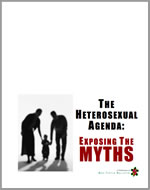 At last, the truth can now be told.
Using the same research methods employed by most anti-gay political pressure groups, we examine the statistics and the case studies that dispel many of the myths about heterosexuality. Download your copy today!
And don‘t miss our companion report, How To Write An Anti-Gay Tract In Fifteen Easy Steps.
 Anti-gay activists often charge that gay men and women pose a threat to children. In this report, we explore the supposed connection between homosexuality and child sexual abuse, the conclusions reached by the most knowledgeable professionals in the field, and how anti-gay activists continue to ignore their findings. This has tremendous consequences, not just for gay men and women, but more importantly for the safety of all our children.
Anti-gay activists often cite the “Dutch Study” to claim that gay unions last only about 1½ years and that the these men have an average of eight additional partners per year outside of their steady relationship. In this report, we will take you step by step into the study to see whether the claims are true.
Tony Perkins’ Family Research Council submitted an Amicus Brief to the Maryland Court of Appeals as that court prepared to consider the issue of gay marriage. We examine just one small section of that brief to reveal the junk science and fraudulent claims of the Family “Research” Council.
 The FBI’s annual Hate Crime Statistics aren’t as complete as they ought to be, and their report for 2004 was no exception. In fact, their most recent report has quite a few glaring holes. Holes big enough for Daniel Fetty to fall through.
“Google” is a trademark of Google Inc.
© Box Turtle Bulletin. All Rights Reserved.
 Posts
Posts  Posts via daily email: