Box Turtle Bulletin
 News and commentary about the anti-gay lobby
“Now you must raise your children up in a world where that union of man and box turtle is on the same legal footing as man and wife…”
News and commentary about the anti-gay lobbyPosts Tagged As: Marriage
May 30th, 2009
The vote on Civil Unions in the Illinois House of Representatives will take place tomorrow, the last day of session. Currently there are 70 Democrats and 48 Republicans in the House. The Governor supports the bill.
May 29th, 2009
 The Boston Globe reports:
A little over a week after the House rejected language Gov. John Lynch had demanded, House and Senate negotiators agreed to a compromise Friday that added one sentence and changed one word in the Senate-passed bill. Negotiators planned to sign off on the final language by Monday, allowing for a vote by the full House and Senate on Wednesday.
Barring any additional unexpected hickups, marriage equality should be in place in New Hampshire by the end of next week.
May 28th, 2009
 While there is debate over the extent to which black Californian voters supported Proposition 8, polls consistently show that there is less support for marriage equality from African Americans than from other ethnic subgroups. While there are undoubtedly old and established cultural bases for antipathy towards homosexuality in general and marriage in particular, these can be overcome.
Part of the lack of support for equality among black voters may be due to a failure to craft the right message. But I believe that a large part was also due to a failure to use the resources that were available to reach and appeal to black voters.
Because while many black voters may not yet see the justice of our cause, many others who are leaders and influential in the Civil Rights movement, those who fought – and still fight – first hand against discrimination and indignity towards black Americans, are stepping forward to speak loudly on our behalf. They see the fight against discrimination to be their cause and they don’t see that fight stopping at the border of race or ethnic heritage.
Today we have two examples.
Julian Bond, the Chairman of the NAACP, sees a link between any effort to marginalize minorities and deny them rights others enjoy and a threat to the equal protection that all citizens should enjoy:
My own marriage feels in no way threatened by gay marriage – any more than its interracial nature threatened those who made my union criminal until 1966. My marriage survived the interracial same-sex marriage I attended last weekend. The couple had legally married in Connecticut, but their hometown Virginia ceremony was witnessed by 200 friends and family, most of them Christians, including the grandfather of one partner who conducted it. It was a rebuke to those who base their opposition to marriage equality on the Bible. Let’s all pray that those who want to block access to the church sanctuary won’t continue to block access to city hall.
The California court has given new meaning to the song’s line “California here I come, right back where I started from.” California law is back where it started, to the detriment of us all.
What is at issue is the arbitrary denial of a civil rite to some – if that’s not a denial of civil rights, I don’t know what is.
 But perhaps more impressive – on an individual level – than Bond’s support, is this report from the New York Times.
State Senator Shirley L. Huntley, a brassy, big-haired Democrat from Queens who opposes same-sex marriage, received a call on Wednesday that left her momentarily stunned.
Maya Angelou was on the line, and she wanted to know if the senator might reconsider her position.
I would have pooped.
In a telephone interview, Ms. Angelou, who has a home in Harlem, said she felt compelled to speak out because she believes that legalizing same-sex marriage is a matter of social fairness — a subject that has been a theme of her writing.
“I would ask every man and every woman who\’s had the blessing of having children, ‘Would you deny your son or your daughter the ecstasy of finding someone to love?\’ ” she said.
Ms. Angelou said she believed that society made gay relationships hard enough without the added burden of making marriage illegal.
Although Sen. Huntley still intends on voting to keep her own personal priveleges and rights while denying them to her gay contituents, I am deeply grateful for Ms. Angelou’s efforts. Along with the efforts of Julian Bond and John Lewis and Coretta Scott King and Mildred Loving and Rev. Eric Lee and Rev. James Lawson and Rev. Peter Gomes and many many others in Black America who are willing to stand up and be known as supporters of equality, not only for race but for orientation as well.
These voices should not and cannot be ignored or underutilized in our efforts to win the hearts and minds of all Americans, not just the liberal white English-speaking ones.
May 28th, 2009
The marriage equality express in New Hampshire was unexpectedly sidetracked last week when some members of the House refused to accept the Governor’s language about religious protections, choosing instead to send the bill to a committee to craft language of their own.
The Nashua Telegraph has an update:
The Senate agreed Wednesday with the House to name a conference committee to craft a compromise on gay marriage.
Last week, the House narrowly turned down religious exemptions to the law that Gov. John Lynch had insisted upon.
House and Senate negotiators will meet and try to come up language acceptable to Lynch, as well as the House and Senate majorities by the time the Legislature meets in session next Wednesday.
Some Republicans in the Senate had sought to send the issue to a nonbinding referendum by the voters. However, New Hampshire’s Courts have found that the state’s Constitution does not allow for the use of such referenda to make legislative decisions. The Democrats in the Senate voted this proposal down.
Let’s hope the drive to make New Hampshire the sixth Marriage State will soon be back on track.
May 27th, 2009
The legislative leadership of Rhode Island is working in conjunction to ensure that the state’s gay citizens are denied equality. (AP)
Bills legalizing gay marriage have been introduced in the Statehouse every year since 1997, but none has been approved by a legislative committee. House Speaker William Murphy and Senate President M. Teresa Paiva-Weed, both Democrats and Catholics, oppose gay marriage, and Republican Gov. Don Carcieri — another Catholic — would likely veto such a measure.
However, they do so against the strong wishes of their constituents.
A Brown University poll showed 60 percent of registered voters in the state said they would support a law allowing gay couples to marry, and 75 percent said they would support a law allowing civil unions. Thirty-one percent said they would oppose a gay marriage law.
The startling figure of 77% of Democrats favor a marriage equality bill. I think it is time that the leaders of the Democratic Party in the state of Rhode Island put the desires of their constituents ahead of the political careers of a few politicians. The need to tell leadership that unless they cease obstructing equality that they will not get the Party’s support or endorsement.
May 27th, 2009
Section 1 of the Fourteenth Amendment to the United States Constitution reads as follows:
All persons born or naturalized in the United States, and subject to the jurisdiction thereof, are citizens of the United States and of the State wherein they reside. No State shall make or enforce any law which shall abridge the privileges or immunities of citizens of the United States; nor shall any State deprive any person of life, liberty, or property, without due process of law; nor deny to any person within its jurisdiction the equal protection of the laws.
This amendment is home to the “Equal Protections Clause” and “Due Process Clause”. And it is under the language of this clause that Theodore B. Olson and David Boies seek to have Proposition 8 determined to be unconstitutional.
Now to me it’s a simple proposition. Gay persons – and couples – are entitled to the priveleges of any other citizen. And, if it up to me, I would probably argue more about how Proposition 8 is an abridgement of my privileges as a citizen than I would about the due process of law. And I’d probably lose.
But regardless of the merits of the arguments, ultimately it isn\’t what I think, or what Olson and Boies think that about the application of these protections, it is what the nine Justices of the Supreme Court think.
It is not possible at this time to know the composition of the court should this suit ever reach it. Several members are quite elderly and some are not in good health and lawsuits of this sort can take years before they are heard.
But we can look to the present composition of the court and make some educated guesses about whether they would find such arguments compelling. To guide us, we can look to two significant previous rulings on gay issues that dealt with equal protections and due process.
In November 1992, the voters of Colorado passed Amendment 2 with 53% of the vote. This amendment to the state constitution disallowed sexual orientation as a basis to “claim any minority status, quota preferences, protected status or claim of discrimination”. The Colorado State Supreme Court invalidated the amendment on the basis that it violated the equal protections clause of the 14th Amendment. The state appealed to the US Supreme Court who, by a 6-3 split, found Amendment 2 unconstitutional, though for a different reason. Justice Kennedy wrote that the state had no rational reason to identify persons by a single trait – create a class – and to then deny them the right to even appeal for protection from the law.
Of those currently on the court, Justices Kennedy, Stevens, Ginsberg, and Breyer voted to overturn Amendment 2. Justice Souter also voted with the majority, but he has tendered his resignation.
Justice Scalia, on the other hand, found Amendment 2 to be “a modest attempt by seemingly tolerant Coloradans to preserve traditional sexual mores against the efforts of a politically powerful minority to revise those mores”. Justice Thomas agreed.
In June 2003, the Supreme Court declared that the sodomy laws of the State of Texas were unconstitutional by a vote of 6-3. Five justices, again Kennedy, Stevens, Ginsberg, Breyer, and Souter, found that it violated due process guarantees, specifically the “substantive due process” right to privacy. Justice O\’Connor based her position on “equal protections”, a position which she conceded raised the issue of marriage rights.
Justice Scalia wrote an angry screed in which he accused the court of having “largely signed on to the so-called homosexual agenda.” Thomas called the law “uncommonly silly” but found no right to privacy in the constitution.
Based on those two decisions, we can assume the following:
And we have three lesser known quantities: Justices Alito and Roberts and judicial nominee Sotomayor. Reputation places the three as conservative, moderate, and liberal, respectively.
Justices have a habit of defying reputation and presumed ideology. However, I think it safest to assume that Justice Alito can be counted as a vote against marriage equality. And there is simply not adequate record to determine whether Roberts or Sotomayor (if confirmed) would be inclined to see protections for gay people in the Constitution, much less marriage rights.
So, we approach the court knowing that two are definitely anti-gay in their rulings, one is likely to be so, four have sympathy to gays who are excluded from due process but may not extend that sympathy to marriage, and two are an unknown quantity. This is not the court that I would like to approach with questions about my rights.
Considering that we have a deck stacked against us, we have to wonder at the wisdom of going to the Supreme Court at this time. Should we lose, it is a greater loss than a state\’s denial of equality. Should the Court reject our argument, not only will it set federal precedent that is likely to require decades to reverse, but it will give guidance to such other state courts as are approached with an appeal to our equality and liberty.
So I concur with Jim and with other prominent gay organizations that our best bet is to appeal to our neighbors and change hearts and minds before we go to the Supreme Court.
May 26th, 2009
Nate Silver, the genius behind FiveThreeEight’s voter trend analysis, has looked at attitudes towards gay marriage in **White voters and Hispanic voters and found them to be virtually identical.
There is a somewhat persistent conservative myth that Hispanic voters are vehemently opposed to gay marriage. Although a majority of Hispanics are probably are opposed to gay marriage — as most (though no longer all) surveys suggest are a majority of Americans in general — Hispanics appear to be no more opposed to gay marriage than are whites.
Silver weighted several recent surveys on the issue and found that nationally Whites and Hispanics support marriage equality at about 47%. Blacks averaged around 31%
California has a disproportionatly large population of Hispanic voters. In the efforts to overturn Proposition 8 by means of initiative, this time round leaders had best not make the mistake of ignoring racial minorities or assuming that they are, by definition, not supportive.
– – – –
** I’m always bemused at the White v. Hispanic classifications as it often leaves my friends in a bit of nowhere land. More than a few have Hispanic ancestory or a Spanish last name but are often fully assimilated into “mainstream” culture. Since Miguel speaks no Spanish, what box is he to tick? Is he culturally any less “white” than, say, my Armenian friends?
May 26th, 2009
From the decision to let Prop 8 stand (pdf):
Nor does Proposition 8 fundamentally alter the meaning and substance of state constitutional equal protection principles as articulated in that opinion. Instead, the measure carves out a narrow and limited exception to these state constitutional rights, reserving the official designation of the term “marriage” for the union of opposite-sex couples as a matter of state constitutional law, but leaving undisturbed all of the other extremely significant substantive aspects of a same-sex couple\’s state constitutional right to establish an officially recognized and protected family relationship and the guarantee of equal protection of the laws.
Or, in other words, “What’s the problem? It’s all the same water. Who cares what fountain it comes from?”

Those who object to my comparison of separate recognition for gay couples to a symbol of racial inqualities in our Nation’s history may wish to heed the eloquence warning of Justice Moreno’s dissent:
The rule the majority crafts today not only allows same-sex couples to be stripped of the right to marry that this court recognized in the Marriage Cases, it places at risk the state constitutional rights of all disfavored minorities. It weakens the status of our state Constitution as a bulwark of fundamental rights for minorities protected from the will of the majority. I therefore dissent.
As civil rights hero John Lewis said in 2003,
I have fought too hard and too long against discrimination based on race and color not to stand up against discrimination based on sexual orientation. I’ve heard the reasons for opposing civil marriage for same-sex couples. Cut through the distractions, and they stink of the same fear, hatred, and intolerance I have known in racism and in bigotry.
Some say let’s choose another route and give gay folks some legal rights but call it something other than marriage. We have been down that road before in this country. Separate is not equal. The rights to liberty and happiness belong to each of us and on the same terms, without regard to either skin color or sexual orientation.
The problem is that there is no such thing as a “narrow and limited exception” to equality. Equality that has exceptions is not equality at all. And narrow and limited exceptions for one in turn justify narrow and limited exceptions for the next minority that falls from favor.
May 26th, 2009
 Levi Strauss and Co. is no shrinking violet when it comes to public support for equality. Levi’s was a leader in getting business organized in opposition to Proposition 8 last year. And now Levi’s is giving their support for marriage equality a higher profile. (NYT)
LEVI\’S is getting in the spirit of the season by dressing its storefront mannequins in white. In Levi\’s-owned stores in New York, Los Angeles, Chicago and San Francisco, that means more than just marking the passing of Memorial Day, the traditional date to begin wearing white: in 20 stores, the mannequins\’ white Levi\’s jeans and shirts are adorned with White Knots, a symbol of solidarity with the same-sex marriage movement.
May 26th, 2009
The Chicago Tribune is reporting
On the same day that the California Supreme Court upheld a ban on gay marriage, an Illinois House committee advanced a measure that at would allow civil unions for same-sex couples in the state.
This is an attachment to the “shell bill” (SB 1716) that we told you about last week.
Harris said he is unsure if he has enough support for the measure to pass the full House. The Senate and the governor also would need to sign off for civil unions to become legal in Illinois. With the legislative adjournment date set for Sunday, Harris is running short of time to win approval for the bill this spring.
The bill’s sponsor, Democratic Rep. Greg Harris of Chicago, said he is still counting votes in the House to determine whether the bill can pass. Sixty votes would be needed for passage.
May 26th, 2009
USA Today has an collection of responses from both supporters and opponents of marriage equality. Interestingly, no one seems pleased.
Supporters of marriage are saddened but most look forward to the day when same-sex marriage is recognized in our state. Senator Diane Feinstein:
I know today\’s decision is a tremendous disappointment for many people. But I also know that the opinions of Californians are changing on this issue, and I believe that equal marriage rights will one day be the law in this state. This is already the case in Connecticut, Iowa, Maine, Massachusetts and Vermont. So, I believe this issue will come before the voters again, and I am very hopeful that the result will be different next time.
Opponents are all indignant that those 18,000 couples who joined before God and man have not been stripped of their legal recognition. Anti-gay activist Mathew Staver:
He said the court’s decision to let stand the 18,000 marriages “makes absolutely no sense and is not consistent with rule of law.” He compared it to the 13th amendment that abolished slavery and noted there were “no grandfather rights” in that and that the same-sex couples’ marriages should not be recognized.
And of course there is the opinion of the raging homophobe who selected the picture to accompany the story. Because nothing embodies the debate over marriage like a picture of a man in a nun’s habit. Really, if it were left up to me, that person would be fired.
May 26th, 2009
A state has an obligation to protect the interests of its citizens. And California has long determined that bigamy is contrary to the state’s interest.
California has a need to ban a current type of marriage that is resulting in bigamy: eternal marriages. Those marriages that are eternal and extend beyond this life into the next leave widows and widowers that remarry in a state of bigamy. This should be stopped.
Therefore, the constitution should be amended so as to make immediately invalid any marriage based on the belief that such marriage would be eternal and any church, institution, or religious body that purports to offer eternal marriage should be “narrowly” excluded from the equal protections provided by the California State Constitution.
That Mormons are the only church to offer eternal marriage is purely coincidental. We are not anti-Mormon-marriage. We simply support the way marriage has been defined for 5,000 years: marriage of living people on earth until death do us part.
All we need to make this important protection of traditional marriage and defend our cherished institution from radical revision and bigamy is the signature of 8% of voters in the last gubernatorial election (695,000) and a majority vote of the people.
Anyone want to start collecting signatures?
May 26th, 2009
As the California Supreme Court has upheld the decision by 52% of voters to restrict the word “marriage” to apply to only those unions that are between a man and a woman, perhaps it’s time to revisit the nomenclature assigned to same-sex unions.
Currently California uses the somewhat dismissive term “Domestic Partnership”. This term, by its very nature, assumes that same-sex unions are defined only in terms of domicile and not in terms of emotion, commitment, love, and the bonds that make two into one.
Similarly “Civil Unions” is a term that, while recognizing the union of two, excludes a very important aspect of the establishment of family. By reminding us that it is but a civil contract, it downplays the participation of faith, family, and community that are such an important part of marriage in our society.
Therefore, I propose that we select a term that allows for celebration of the joining of hearts and lives but which does not include reminders that the parties are less than, limited, and inferior to those in a marriage: Weddings.
The legislature should simply rename “Domestic Partnerships” to be “Weddings”. Then California can have two institutions, marriage and wedding. Yes, they would continue to be “separate but equal”; however, the major distinction would be that marriage would be excluding and discriminatory while wedding would be open to all.
May 26th, 2009
 The California Supreme Court gave us a half-and-half opinion today concerning same-sex marriage in that state. They upheld Proposition 8 as a valid state constitutional amendment, while also holding that the proposition’s passage does not retroactively invalidate the approximately 18,000 same-sex marriage that were solemnized last year. While it’s small consolation, it’s not nothing — especially to those who are married and had a very personal stake in the decision.
Given the tremendous gains we’ve seen in Iowa and the Northeast, this California setback is sobering if not unexpected. But we must remember that the advancement of civil rights for any marginalized group has never been a smooth progression. It has always been a history of fits and starts, advances and setbacks, defeats and victories. Ours has been no different.
So if you might be discouraged, I would encourage you to look at where we are today and compare it to where we started ten years ago. And ask yourself this: Where do you think we will be ten years from now? Just imagining that has me more energized than ever before.
May 26th, 2009
As most in our community expected, the Supreme Court of the State of California has upheld the constitutionality of Proposition 8, the voter initiative that excluded gay and lesbian couples from the equal protections promised in the state Constitution. Same-sex marriages will continue to be disallowed.
Tomorrow we start on the long process of making our case before the people of California and convincing them that equality under the law is worth upholding for everyone, including gay couples.
We will get another initiative on the ballot to reverse the declaration of discrimination that is Proposition 8. And we will win; if not in 2010 then in 2012. We have the advantage of a most moral and judicious position. And time is on our side.
UPDATE: It seems that the 18,000 marriages will remain intact.
The court’s website is unable to handle capacity and so far I’ve not heard from anyone who has seen the opinion. The LA Times is reporting a 6-1 split on the constitutionality of the proposition with only Justice Moreno voting to overturn it.
UPDATE 2: The LA Times reminds us:
Even with the court upholding Proposition 8, a key portion of the court’s May 15, 2008, decision remains intact. Sexual orientation will continue to receive the strongest constitutional protection possible when California courts consider cases of alleged discrimination. The California Supreme Court is the only state high court in the nation to have elevated sexual orientation to the status of race and gender in weighing discrimination claims.
Taken literally, this would then mean that an amendment to the California Constitution to exclude citizens from certain rights based solely on their race would also be constitutional on a state level.
Featured Reports
 In this original BTB Investigation, we unveil the tragic story of Kirk Murphy, a four-year-old boy who was treated for “cross-gender disturbance” in 1970 by a young grad student by the name of George Rekers. This story is a stark reminder that there are severe and damaging consequences when therapists try to ensure that boys will be boys.
When we first reported on three American anti-gay activists traveling to Kampala for a three-day conference, we had no idea that it would be the first report of a long string of events leading to a proposal to institute the death penalty for LGBT people. But that is exactly what happened. In this report, we review our collection of more than 500 posts to tell the story of one nation’s embrace of hatred toward gay people. This report will be updated continuously as events continue to unfold. Check here for the latest updates.
In 2005, the Southern Poverty Law Center wrote that “[Paul] Cameron’s ‘science’ echoes Nazi Germany.” What the SPLC didn”t know was Cameron doesn’t just “echo” Nazi Germany. He quoted extensively from one of the Final Solution’s architects. This puts his fascination with quarantines, mandatory tattoos, and extermination being a “plausible idea” in a whole new and deeply disturbing light.
On February 10, I attended an all-day “Love Won Out” ex-gay conference in Phoenix, put on by Focus on the Family and Exodus International. In this series of reports, I talk about what I learned there: the people who go to these conferences, the things that they hear, and what this all means for them, their families and for the rest of us.
Prologue: Why I Went To “Love Won Out”
Part 1: What’s Love Got To Do With It?
Part 2: Parents Struggle With “No Exceptions”
Part 3: A Whole New Dialect
Part 4: It Depends On How The Meaning of the Word "Change" Changes
Part 5: A Candid Explanation For "Change"
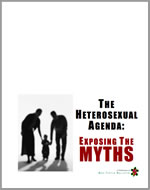 At last, the truth can now be told.
Using the same research methods employed by most anti-gay political pressure groups, we examine the statistics and the case studies that dispel many of the myths about heterosexuality. Download your copy today!
And don‘t miss our companion report, How To Write An Anti-Gay Tract In Fifteen Easy Steps.
 Anti-gay activists often charge that gay men and women pose a threat to children. In this report, we explore the supposed connection between homosexuality and child sexual abuse, the conclusions reached by the most knowledgeable professionals in the field, and how anti-gay activists continue to ignore their findings. This has tremendous consequences, not just for gay men and women, but more importantly for the safety of all our children.
Anti-gay activists often cite the “Dutch Study” to claim that gay unions last only about 1½ years and that the these men have an average of eight additional partners per year outside of their steady relationship. In this report, we will take you step by step into the study to see whether the claims are true.
Tony Perkins’ Family Research Council submitted an Amicus Brief to the Maryland Court of Appeals as that court prepared to consider the issue of gay marriage. We examine just one small section of that brief to reveal the junk science and fraudulent claims of the Family “Research” Council.
 The FBI’s annual Hate Crime Statistics aren’t as complete as they ought to be, and their report for 2004 was no exception. In fact, their most recent report has quite a few glaring holes. Holes big enough for Daniel Fetty to fall through.
“Google” is a trademark of Google Inc.
© Box Turtle Bulletin. All Rights Reserved.
 Posts
Posts  Posts via daily email: