Box Turtle Bulletin
 News and commentary about the anti-gay lobby
“Now you must raise your children up in a world where that union of man and box turtle is on the same legal footing as man and wife…”
News and commentary about the anti-gay lobbyJanuary 16th, 2014
Just when you thought it couldn’t get any more confusing, the Utah State Tax Commission has announced that same-sex couples who receive Federal recognition as “married” for income tax purposes may also file their Utah State Income Taxes jointly.
2013 UTAH INDIVIDUAL INCOME TAX RETURNS
Same-sex couples who are eligible to file a joint federal income tax return and who elect to file jointly, may also file a joint 2013 Utah Individual Income Tax return as provided in Utah Code § 59-10-503. Eligible married couples may file a joint return if they are married as of the close of the tax year. (As of December 31, 2013, the Supreme Court had not yet issued its stay of the District Court’s injunction).
This applies only to the 2013 tax year.
January 16th, 2014
The Civil Society Coalition on Human Rights and Constitutional Law, a coalition of Ugandan civil society and human rights groups, have released a report whichdescribes some of the current problems with Uganda’s existing colonial-era anti-gay laws and the new Anti-Homosexuality Bill which was recently passed by Parliament and is awaiting presidential action. According to Uganda’s largest independent newspaper, Daily Monitor:
“The proposed Anti-Homosexuality Bill despite having elaborate provisions will be difficult to enforce since the evidence required is the same as that required now,” reads the report in part. “The rest of the provisions like the promotion of homosexuality and the nullification of the international instruments will simply, render human rights and public health work impossible, thus making Uganda a pariah state,” the report adds.
The report further says the presence of archaic and repressive laws that cannot be enforced brings an unnecessary financial burden on the tax payer. “Public money spent on the enforcement of such a law at the expense of other developmental projects is not worthwhile,” the report says. Recently Parliament, after years of controversy, passed the Anti-Homosexuality Bill into an Act. It outlines punishments for certain acts of homosexuality with life in prison.
The above NTV report erroneously says that the lifetime prison sentence is reserved only to those convicted of having sex with minors. In fact, the “aggravated homosexuality” clause, which originally proposed the death penalty, is much, much more sweeping. The way its “serial offender” clause is worded, just about anyone can get caught up in the charge.
In a press release, Civil Society Coalition on Human Rights and Constitutional Law outlines additional concerns with the Anti-Homosexuality Bill (PDF: 283KB/2 pages):
Article 21 of the Constitution provides for the right to equality before the law and freedom from discrimination. The Bill will directly discriminate against not only sexual minorities but also persons who do not fight (report) sexual minorities. The effect of this is creating hatred, ridicule, mistrust and suspicion among the populace.
The Bill also seeks to penalise persons who do not report suspects who are engaged in same sex acts. It also creates a burden on the population, who have the duty to report consenting adults who engage in same sex acts or risk being found guilty. In addition, those who “aid and abet” the consenting adults to engage in same sex acts are equally found guilty, including their families
The Bill will interfere in many ways with the privacy of individuals as well as setting a precedent for government censorship of the home, media houses, internal workplace and other places in attempt to arrest homosexuals and stop homosexuality. The right to privacy of persons is provided for under Article 27 of the Constitution which states among many other things that no person shall be subjected to interference with the privacy of that person’s home correspondence, communication or other property.
At the heel of registered success in the promotion of Human rights in Uganda by Parliament through initiation of a Human Rights Committee and Human Rights checklist, this Bill dents the progress as it undermines the fundamental rights of Sexual minorities in Uganda. It entrenches fear and phobia in the minority communities.
The Anti-Homosexuality Bill was rushed through Parliament with an apparent lack of quorum. Nevertheless, the bill is now on its way to President Yoweri Museveni for his assent. According to the Uganda constitution, Museveni has thirty days after his office receives the bill — and we don’t know when that clock starts — to assent or send it back to Parliament. Museveni has said that he will bring the bill before the ruling party caucus for its consideration, but hasn’t given a timetable for doing so.
January 16th, 2014
TODAY’S AGENDA:
Events This Weekend: Arosa Gay Ski Week, Arosa, Switzerland; Aspen Gay Ski Week, Aspen, CO; Bärenpaadiie, Hamburg, Germany; Midsumma, Melbourne, VIC; Mid-Atlantic Leather Weekend, Washington, DC.
TODAY’S AGENDA is brought to you by:

From Vector, a publication of the San Francisco gay rights organization Society for Individual Rights, October 1972, page 29.
Drag performers are so lame these days, lip-synching to Britney Spears and Beyoncé. Back in the day, they used to actually sing and act and dance to real, live music. Today, not only can’t drag queens sing, but even Britney Spears and Beyoncé are lip synching.
TODAY IN HISTORY:
Louisiana Supreme Court Upholds Conviction of Lesbians for “Unnatural Carnal Copulation”: 1967. Convictions of women for “crimes against nature” have been exceedingly rare in our nation’s history, but the Louisiana Supreme Court in 1967 upheld two such convictions. In 1966, Mary Young and Dawn DeBlanc were arrested and charged with “having committed a crime against nature” under Louisiana law during the course of a prostitution sting. A police officer testified in court that he had spoken with DeBlanc over the phone about arranging to meet her and Young at a motel. As they settled on a price for services rendered, DeBlanc said that sometimes they “gave a show” for an additional charge. The evidence at trial for the crime against nature charge was slim: A photo of the girls naked in the motel room when they were arrested and certain comic books in one of the girls’ purses which was labeled obscene. Judge Frank Shea refused to throw out the flimsy evidence, and in stead instructed the jury that the law defining “crimes against nature” included any joining or connection of a genital organ of one person with the mouth of another. He also refused to instruct the jury on laws on entrapment.
Young and DeBlanc were convicted and sentenced to thirty months in the Orleans Parish prison. They appealed the case to the Louisiana Supreme Court on the grounds that the charge was vague. In 1967, the court ruled:
The statute, of course, requires proof of an “unnatural carnal copulation.” As pointed out by this court … this phrase simply means “any and all carnal copulation or sexual joining and coition that is devious and abnormal because it is contrary to the natural traits and/or instincts intended by nature, and therefore does not conform to the order ordained by nature. … Oral copulation by and between two women constituted “unnatural carnal copulation” within statute proscribing such conduct.
[Source: Jonathan Katz. Gay American History: Lesbians and Gay Men in the USA (New York: Thomas Y. Crowell Co., 1976): pp 127-128.]

Photo by Annie Leibovitz
TODAY’S BIRTHDAY:
Susan Sontag: 1933-2004. Her literary career began in fiction, and she considered herself mainly a novelist even it was her essays which made her famous. When “Notes on ‘Camp'” was first published in the Partisan Review in 1964, it established her reputation as a critical thinker in popular culture. That essay has become the reference point for everything we thing about when we think of “camp”: the “so bad it’s good” quality; the celebration of the unnatural, the obvious artifice which fails to conceal deeper truths; the mocking of all that is serious; the playfulness that serves as an answer to moral indignation. Her series On Photography
When she published Illness as Metaphor
Sontag was nothing if not controversial. Easily dismissive of anything she saw as smacking of provincialism — including the provincialisms of intellectual Harvard, Paris, Oxford or New York, making her relationship with the city she called home an uneasy one. “I don’t like America enough to want to live anywhere else except Manhattan. And what I like about Manhattan is that it’s full of foreigners. The America I live in is the America of the cities. The rest is just drive-through.” That was tame. In 1965, she famously remarked that “the white race is the cancer of human history.” She expanded that view in 1967 when she wrote, “America was founded on a genocide, on the unquestioned assumption of the right of white Europeans to exterminate a resident, technologically backward, colored population in order to take over the continent.” In 1968, her anger at the U.S. led her to visit North Vietnam, which she documented in “Trip to Hanoi.” That same year, she visited Cuba and called for a sympathetic understanding of the Cuban Revolution. Critics denounced her for what they saw as a naive sentimentality when it came to Communism. A few years later, Sontag renounced her earlier views, particularly when the Cuban regime imprisoned the poet Heberto Padilla and launched a wave of persecutions against the island’s gay community.
She drew another wave of indignation following the September 11 terrorist attacks, when she wrote in the New Yorker, “Where is the acknowledgment that this was not a ‘cowardly’ attack on ‘civilization’ or ‘liberty’ or ‘humanity’ or ‘the free world’ but an attack on the world’s self-proclaimed superpower, undertaken as a consequence of specific American alliances and actions? … In the matter of courage (a morally neutral virtue): Whatever may be said of the perpetrators of Tuesday’s slaughter, they were not cowards.”
Aware that she was bisexual at during her early teens, Sontag was married from 1950 to 1959, a union which produced a son, David. After her divorce, she had a number of lovers, both male and female. She had been open about her sexuality since 1995. In 2000, she told The Guardian that she had been in love seven times in her life. “No, hang on,” she said.” “Actually, it’s nine. Five women, four men.” The last of those loves was photographer Annie Leibovitz (see Oct 2), a relationship that lasted from the 1980s until the day Sontag died of cancer in 2004. Her New York Times obituary, like most obituaries, said only that she was survived by her son and a younger sister.
If you know of something that belongs on the agenda, please send it here. Don’t forget to include the basics: who, what, when, where, and URL (if available).
And feel free to consider this your open thread for the day. What’s happening in your world?
January 15th, 2014
As we have seen over and over, when it comes to marriage cases, who has standing may play an important role in the outcome. In the Oklahoma decision handed down yesterday, the case may have also hinged to some extent on who could defend the state’s constitutional amendment.
The case started nine years ago and has gone through a number of procedural hurdles since that time. The first of which may have been unexpectedly important.
In 2004, two lesbian couples filed a complaint against the Oklahoma Governor and the Oklahoma Attorney General seeking that the Federal DOMA law and the Oklahoma Defense of Marriage constitutional amendment be overturned.
The Governor and the Attorney General argued that as the issuer of marriage licenses was the County Clerk and that in Oklahoma the clerks are part of the Judiciary branch of government, the plaintiffs lacked standing to sue them. The court disagreed, but in 2009 the Tenth Circuit bought that argument and the Governor and Attorney General were dismissed.
Along with the state’s legal department.
However, the court allowed the plaintiffs to amend their case to name as defendants the Attorney General of the United States (for the federal DOMA side of the case) and the Tulsa County Court Clerk and the State of Oklahoma. The court then dismissed the State of Oklahoma as a defendant leaving only Eric Holder (for the US) and Sally Howe Smith, the clerk.
In 2011, Holder informed the court that the Justice Department would no longer defend the Federal DOMA case, and the House Bipartisan Legal Advisory Group stepped in. And, if this case is in any way similar to comparable cases, BLAG’s defense was likely nominal.
As the Hollingsworth and Windsor cases were advancing to the Supreme Court, the judge held the case in limbo until SCOTUS was heard. Upon announcement, the BLAG defense filed to have the Federal side of the case found moot and for their participation to be dismissed.
Which left the only counsel defending the amendment those who are described in the ruling as
Smith is represented by the Tulsa County District Attorney’s Office and attorneys with an organization known as the “Alliance Defending Freedom.”
So it appears that the county, having found themselves way over their heads in defending the state and federal constitution, calling in the specialists, ADF. And it is true that when it comes to gay issues, the ADF has a truly impressive record. Astonishing, really.
Well, that is, if you look at things from my perspective. The Alliance Defending Freedom (nee Alliance Defense Fund) are losers on a colossal scale. Over and over. State after state. Case after case.
And yet they are trotted out with their tired old disproven defeated arguments to be the best defenders of “tradition” and “children”. For which I am thankful.
January 15th, 2014

Virginia is attempting to join the list of states which ban ex-gay therapy on minors. Text of the bill can be found here. Legislative action is going to happen between now and the end of February and Virginia based survivors of ex-gay therapy are urgently needed to speak in favor of the bill. Anyone interested can testify in person or send a written testimony to be read. The bill is being sponsored by Delegate Patrick Hope and the Alliance for Progressive Values (APV).
The APV is especially interested in anyone who was forced to undergo therapy as a minor. Interested parties should contact Victoria Bragunier of the APV at 804-517-5206
January 15th, 2014
In 2012, the National Organization for Marriage watched in horror as voters in three states approved measures to grant marriage equality to same sex couples and defeated a constitutional amendment in Minnesota to write discrimination into that state’s charter. In 2013, the U.S. Supreme Court, in two separate actions, struck down Section 2 of the Defense of Marriage Act and opened the way for Californians to resume marrying again. That same year, six more states voted to legalize same sex marriage. More recently, federal judges in Utah and Oklahoma have struck down those states’ constitutional bans on marriage equality.
In other words, it’s been a bad eighteen months for anti-gay activists generally and NOM in particular. No wonder NOM, like many others, is shifting its attention overseas. Jeremy Hooper at GLAAD discovered that NOM president Brian Brown has joined the board of directors of CitizenGO. Writes Hooper:
CitizenGO, which is based in Madrid (where Brian recently delivered a speech), is essentially a petitioning platform focused on global issues. In addition to considerable focus on marriage inequality, CitizenGO also promotes and/or directs campaigns in support of speakers who claim that “homosexual activists have played a integral role in the rise of Fascist politics, including Nazism,” against the World Health Organization’s supposed “promotion” of homosexuality, against Canadian pride parades, and much more. As you can see, CitizenGO has its eyes fixed all over the world and on all of the planet’s LGBT people…
CitizenGO even hosts a petition in support of radical international figure Scott Lively—one that describes homosexuality as “morally wrong and harmful to individuals and society.” It’s clear what kind of world CitizenGo is trying to create. It is now all attached to Brian Brown and to NOM.
But wait, there’s more. It turns out that Brian is not just on the board of CitizenGO. Instead, it appears that the organization Brian runs in tandem with NOM, the conservative rallying platform called ActRight, has absorbed CitizenGO as its own. The CitizenGo logo now reads, “CitizenGo: Member of the ActRight Family”.
You won’t be surprised to learn that CitizenGO, along with the Rockford, Illinois-based World Congress of Families, Linda Harvey’s Mission America, is a huge supporter of Russia’s law banning so-called “homosexual propaganda.”
January 15th, 2014
TODAY’S AGENDA:
Events This Weekend: Arosa Gay Ski Week, Arosa, Switzerland; Aspen Gay Ski Week, Aspen, CO; Bärenpaadiie, Hamburg, Germany; Midsumma, Melbourne, VIC; Mid-Atlantic Leather Weekend, Washington, DC.
TODAY’S AGENDA is brought to you by:

Barron Hair Studio, in Studio City, CA. From the Advocate, January 8, 1981, page 4.
A new look for a new year.
Wait. Didn’t I see this guy on Zoolander?

TODAY IN HISTORY:
Torch Song Trilogy Debuts: 1982. The play is actually a collection of three plays by actor/playwright Harvey Fierstein, with each play taking up an act in the final production: International Stud, Fugue in a Nursery, and Widows and Children First!. The thread that ties the three plays together is the central character, Arnold Beckoff, a torch song-singing Jewish drag queen, with each act focusing on a different phase in Beckoff’s life.
The first staging of International Stud took place in February 2, 1978, and deals with Arnold’s troubled relationship with Ed. International Stud is named for a real life gay bar in the 1960s and 1970s, the backroom of which plays a central role in the play. Act Two, Fugue in a Nursery, sees Arnold settling down with Alan and planing to adopt a child. IT’s debut was on February 1, 1979. By the time Torch Song Trilogy opened three years later, Widows and Children First! and an opening soliloquy were added to complete the trilogy, with Act 3 finding Arnold, who is now tragically post-Alan and raising a gay teen and dealing with the teen’s mother-from-hell from Florida.
The four hour long Torch Song Trilogy opened at the Actor’s Playhouse with a star studded cast: Fierstein, Joel Crothers, a young Matthew Broderick as the teen son David, and Estelle Getty as the evil mother. After its run at the Actors’ Playhouse, Torch Song Trilogy moved to the Little Theater Broadway in June, where it ran for 1,222 performances and won two Tonys. It was made into a movie in 1988, starring Fierstein, Anne Bancroft, Matthew Broderick, and Brian Kerwin.

TODAY’S BIRTHDAY:
Loïe Fuller: 1862-1928. Born Marie Louise Fuller outside of Chicago, she began her theatrical career as a child actress and dancer/choreographer in burlesque, vaudeville and traveling circuses. It’s her early career as a dancer where she developed her improvisational dance techniques, and where she learned to combine choreography with silk costumes and multi-colored lights and made her a pioneer of both modern dance and theatrical lighting.
She became famous enough in America, but she didn’t feel appreciated as an actress. When she was warmly received in Paris, she decide to remain there, where she became a regular at the Folies Bergère and her works Serpentine Dance and Fire Dance became signature pieces emblematic of the Art Nouveau movement. She also went on to hold several patents related to stage lighting, including chemical compounds used in color gels, luminescent lighting, and fabrics. Her work proved profoundly influential among a large number of French scientist and artist,s, including Henri de Toulouse-Lautrec, François-Raoul Larche, Henri-Pierre Roche, Auguste Rodin and Marie Curie. She was also responsible for introducing Isadora Duncan to Parisian audiences and advancing the acceptance of modern dance as a serious art form. She devleoped a close friendship with Queen Marie of Romania, and maintained a twenty-year live-in relationship with Gabrielle Block, a Jewish-French banking heiress known for dressing only in men’s suits. Fuller remained in Paris, returning only occasionally to America. She died in Paris of Pneumonia on the first day of 1928 at the age of 65.
In 1899, the Lumière brothers filmed and hand-colored, frame by frame, a performance by an unknown dancer of Loïe Fuller’s Serpentine Dance:
More early filmed versions of Serpentine Dance are available here.

Ivor Novello: 1893-1951. The Welsh screen idol did it all: actor on stage and silent screen, playwright and composer. When the Great War broke out, he wrote the music for the song “Keep the Home Fires Burning” to lyrics written by American Lena Guilbert-Ford. That hit was Novello’s debut in the the entertainment business. In 1916, he was drafted into the Royal Naval Air Service and trained as a pilot, but after crashing twice, he was transferred to central London to work as a clerk. That allowed him to work as a composer for theater during his off hours. That’s when he met actor Bobbie Andrews, who would become Novello’s life partner. He also met Noel Coward, who envied “the magic atmosphere in which (Novello) moved and breathed with such nonchalance”
After the war, Novellow continued to find success in composing for musical comedy. He also began making a career of acting, first on the stage and then in film. He appeared in D.W. Griffith’s The White Rose (1923) and in two early Alfred Hitchcock silent thriller The Lodger (1926) and Downhill (1927). A lucrative contract from a British film company allowed him to buy a country house west of London which he renamed Redroofs, and entertained with little regard for convention. Those parties led to the rise of “the Ivor/Noel naughty set,” named for Novello, Noel Coward, and, shall we say, those sorts of people. During the late 1920s Novello was perhaps the most popular star in British films. In 1930, he took his plays Symphony in Two Flats and The Truth Game to Broadway, where he was offered a contract with MGM. But beyond writing the dialogue for Tarzan the Ape Man (including the famous line, “Me Tarzan, you Jane”), his Hollywood career failed to pan out.
Hollywood’s loss was London’s gain. On his return, he added playwriting to his repertoire of talents, which, along with his compositions, made him a powerhouse of British theater. A string of hits followed through the 1930s and 40s. He died suddenly in 1951, while still at the top of his game, from a coronary thrombosis and with Andrews at his side. Coward wrote in his diary, “Another landmark swept away. Poor, poor Bobbie… he will be utterly devastated.” Thousands of fans lined the streets to give their final goodbyes and his funeral was broadcast live on BBC. Four years later, the British Academy of Songwriters, Composers and Authors (BASCA) established the Ivor Novello Awards for songwriting and composing. The Ivors, as the awards are called, remain the only award that is judged by the writing community, and not by publishers and recording companies.
If you know of something that belongs on the agenda, please send it here. Don’t forget to include the basics: who, what, when, where, and URL (if available).
And feel free to consider this your open thread for the day. What’s happening in your world?
January 14th, 2014
Gov. Mary Fallin reacted to today’s court ruling striking down Oklahoma’s ban on same-sex marriage:
“In 2004, the people of Oklahoma voted to amend the state’s constitution to define marriage as ‘the union of one man and one woman.’ That amendment passed with 75 percent support.
“The people of Oklahoma have spoken on this issue. I support the right of Oklahoma’s voters to govern themselves on this and other policy matters. I am disappointed in the judge’s ruling and troubled that the will of the people has once again been ignored by the federal government.”
Attorney General E. Scott Pruitt also weighed in:
“It is a troubling decision,” Attorney General Scott Pruitt said. “As the Supreme Court recently noted in the Windsor case, it is up to the states to decide how to define marriage, not the federal government. There is a case involving the State of Utah currently pending before the 10th Circuit that is identical to the case in Tulsa. The issue most likely will end up at the U.S. Supreme Court and the outcome will dictate whether Oklahoma’s constitutional provision will be upheld.”
January 14th, 2014
Senior U.S. Federal District Judge Terence C. Kern has struck down the amendment to Oklahoma’s constitution prohibiting same-sex marriage, saying that the ban violates the U.S. Constitution’s Equal Protection clause. But unlike in Utah, Oklahoma’s same-sex couples won’t be rushing to marry anytime soon, as Judge Kern has stayed his ruling pending an appeal.
Oklahoma constitutional amendment banning same-sex marriage was passed by referendum in 2004 when 75% of Oklahomans approved State Question 711 (SQ 711). The amendment states: “Marriage in this state shall consist only of the union of one man and one woman. Neither this Constitution nor any other provision of law shall be construed to require that marital status or the legal incidents thereof be conferred upon unmarried couples or groups.” It also bars the state from recognizing same-sex marriages performed in other states.
The court challenge to the amendment was filed soon after voters approved it. Sharon Baldwin and Mary Bishop sought the right to marry, and Gay Phillips and Susan Barton, who were legally married in California, sought their marriage’s recognition. They sued the U.S. Attorney General seeking to overturn the Defense of Marriage Act entirely (including section 3, which allows states to refuse to recognize marriages performed in other states), and they sued the Tulsa County Court Clerk, Sally Howe Smith, for refusing to issue a licence to Baldwin and Bishop. The Phoenix-based anti-gay group Alliance Defending Freedom (formerly the Alliance Defense Fund) provided lawyers for Smith, and the U.S. House of Representatives’ Bipartisan Advisory Group, under the direction of House Speaker John Boehner (R-OH) intervened on behalf of the U.S. government.
Judge Kern declined to rule on the question of whether Oklahoma was required to recognize marriages from out of state on jurisdictional grounds.
Judge Kern’s reliance on the Windsor case, in which the U.S. Supreme Court struck down part of the Defense of Marriage Act as unconstitutional, was limited to two principles (PDF: 207KB/68 pages):
This Court has gleaned and will apply two principles from Windsor. First, a state law defining marriage is not an “unusual deviation” from the state/federal balance, such that its mere existence provides “strong evidence” of improper purpose. A state definition must be approached differently, and with more caution, than the Supreme Court approached DOMA. Second, courts reviewing marriage regulations, by either the state or federal government, must be wary of whether “defending” traditional marriage is a guise for impermissible discrimination against same-sex couples. These two principles are not contradictory, but they happen to help different sides of the same-sex marriage debate.
Judge Kern then set out to identify the Equal Protection principles that apply to the case, starting with whether Oklahoma’s ban on same-sex marriage discriminates against an identifiable class of people.
The Court defines the relevant class as same-sex couples desiring an Oklahoma marriage license. The Bishop couple has easily satisfied the first element – requiring a showing that Part A intentionally discriminates against this class – for two reasons. First, Part A’s disparate impact upon same-sex couples desiring to marry is stark. Its effect is to prevent every same-sex couple in Oklahoma from receiving a marriage license, and no other couple. This is not a case where the law has a small or incidental effect on the defined class; it is a total exclusion of only one group. …
Second, both the timing of SQ 711 in relation to certain court rulings and the statements in the public domain before passage of SQ 711 raise the inference that it was adopted, at least in part, for the purpose of excluding the class from marriage. SQ 711 originated from legislation entitled the Marriage Protection Amendment, which passed the Oklahoma Legislature as part of House Bill 2259 (“HB 2259”)
Judge Kern then reviewed the history of SQ 711, including public statements by Oklahoma legislators, and determined that:
Exclusion of the defined class was not a hidden or ulterior motive; it was consistently communicated to Oklahoma citizens as a justification for SQ 711. This is simply not a case where exclusion of same-sex couples was a mere “unintended consequence” of the law. Instead, this is a classic, class-based equal protection case in which a line was purposefully drawn between two groups of Oklahoma citizens – same-sex couples desiring an Oklahoma marriage license and opposite-sex couples desiring an Oklahoma marriage license
As for whether the marriage ban serves a rational purpose, the court turned to the arguments used to promote the ban during the 2004 campaign. First, there was the “promoting morality” argument, which Judge Kern dispensed with rather quickly:
The Court recognizes that moral disapproval often stems from deeply held religious convictions… However, moral disapproval of homosexuals as a class, or same-sex marriage as a practice, is not a permissible justification for a law… Preclusion of “moral disapproval” as a permissible basis for laws aimed at homosexual conduct or homosexuals represents a victory for same-sex marriage advocates, and it forces states to demonstrate that their laws rationally further goals other than promotion of one moral view of marriage. Therefore, although Part A rationally promotes the State’s interest in upholding one particular moral definition of marriage, this is not a permissible justification.
Judge Kern then addressed other justifications provided by the State of Oklahoma for the marriage ban: “(1) encouraging responsible procreation and child-rearing; (2) steering naturally procreative relationships into stable unions; (3) promoting ‘the ideal that children be raised by both a mother and a father in a stable family unit;’ and (4) avoiding a redefinition of marriage that would ‘necessarily change the institution and could have serious unintended consequences.'” Kern dealt with those arguments’ pretty directly, and they are a joy to read.
Let’s take them one at a time. Point 1, that banning marriage equality somehow encourages “responsible procreation and child-rearing”:
First, the wealth of scholarly articles in this section of Smith’s brief, which range from William Blackstone to John Locke, simply demonstrate that state-recognized marriages developed in part as a means of encouraging and incentivizing procreation within marriage. … These articles do not provide what is necessary in an equal protection case – that is, a link between the legal classification now being drawn by Part A against same-sex couples and a historical state objective of encouraging procreation to occur within marriage. Traditional exclusion of the disadvantaged group from state-sanctioned marriage does not itself evidence a rational link to the identified goal of promoting responsible procreation within marriage…
During oral arguments in Hollingsworth, Justice Scalia asked Mr. Theodore Olson, counsel for the proponents of Proposition 8, when it became unconstitutional “to exclude homosexual couples from marriage.” …Mr. Olson responded with the rhetorical question of when did it become unconstitutional “to prohibit interracial marriage” or “assign children to separate schools.” As demonstrated by Mr. Olson’s response, the mere fact that an exclusion has occurred in the past (without constitutional problem) does not mean that such exclusion is constitutional when challenged at a particular moment in history. This Court has an obligation to consider whether an exclusion, although historical, violates the constitutional rights of Oklahoma citizens.
…Second, there is no rational link between excluding same-sex couples from marriage and the goals of encouraging “responsible procreation” among the “naturally procreative” and/or steering the “naturally procreative” toward marriage. Civil marriage in Oklahoma does not have any procreative prerequisites. Permitting same-sex couples to receive a marriage license does not harm, erode, or somehow water-down the “procreative” origins of the marriage institution, any more than marriages of couples who cannot “naturally procreate” or do not ever wish to “naturally procreate.” …
…Same-sex couples are being subjected to a “naturally procreative” requirement to which no other Oklahoma citizens are subjected, including the infertile, the elderly, and those who simply do not wish to ever procreate. Rationality review has a limit, and this well exceeds it.
Points 2 and 3 are considered together, that banning marriage equality somehow promotes “steering naturally procreative relationships into stable unions” and encourages “the ideal that children be raised by both a mother and a father in a stable family unit”:
Again, however, the question remains whether exclusion of same-sex couples promotes this interest, or is simply a guise for singling out same-sex couples for different treatment due to “moral disapproval” of a same-sex household with children. Smith has not articulated, and the Court cannot discern, a single way that excluding same-sex couples from marriage will “promote” this “ideal” child-rearing environment. Exclusion from marriage does not make it more likely that a same-sex couple desiring children, or already raising children together, will change course and marry an opposite-sex partner (thereby providing the “ideal” child-rearing environment). …
In addition, Smith has not explained, and the Court cannot discern from any of Smith’s cited materials, how exclusion of same-sex couples from marriage makes it more likely that opposite-sex marriages will stay in tact (thereby remaining “optimal” child-rearing environments). Excluding same-sex couples from marriage has done little to keep Oklahoma families together thus far, as Oklahoma consistently has one of the highest divorce rates in the country.
As for Point 4, the so-called “unintended consequences” to the institution of marriage. Judge Kern quoted from a document supplied by the Witherspoon Institute which supposedly laid out the case that same-sex marriage would harm marriage itself and found:
The “negative impact” argument is impermissibly tied to moral disapproval of same-sex couples as a class of Oklahoma citizens. All of these perceived “threats” are to one view of the marriage institution – a view that is bound up in procreation, one morally “ideal” parenting model, and sexual fidelity. However, civil marriage in Oklahoma is not an institution with “moral” requirements for any other group of citizens… Smith does not ask a couple if they intend to be faithful to one another, if they intend to procreate, or if they would someday consider divorce, thereby potentially leaving their child to be raised in a single-parent home. With respect to marriage licenses, the State has already opened the courthouse doors to opposite-sex couples without any moral, procreative, parenting, or fidelity requirements. Exclusion of just one class of citizens from receiving a marriage license based upon the perceived “threat” they pose to the marital institution is, at bottom, an arbitrary exclusion based upon the majority’s disapproval of the defined class. It is also insulting to same-sex couples, who are human beings capable of forming loving, committed, enduring relationships. “‘Preserving the traditional institution of marriage,'” which is the gist of Smith’s final asserted justification, “is just a kinder way of describing the State’s moral disapproval of same-sex couples.”
After reviewing those four points, Judge Kern found that Oklahoma’s ban on same sex marriage failed the rational basis test. As for the Equal Protection test under the U.S. Constitution:
Against this backdrop, the Court’s task is to determine whether Part A of the Oklahoma Constitutional Amendment deprives a class of Oklahoma citizens – namely, same-sex couples desiring an Oklahoma marriage license – of equal protection of the law. Applying deferential rationality review, the Court searched for a rational link between exclusion of this class from civil marriage and promotion of a legitimate governmental objective. Finding none, the Court’s rationality review reveals Part A as an arbitrary, irrational exclusion of just one class of Oklahoma citizens from a governmental benefit.
Equal protection is at the very heart of our legal system and central to our consent to be governed. It is not a scarce commodity to be meted out begrudgingly or in short portions. Therefore, the majority view in Oklahoma must give way to individual constitutional rights. The Bishop couple has been in a loving, committed relationships for many years. They own property together, wish to retire together, wish to make medical decisions for one another, and wish to be recognized as a married couple with all its attendant rights and responsibilities. Part A of the Oklahoma Constitutional Amendment excludes the Bishop couple, and all otherwise eligible same-sex couples, from this privilege without a legally sufficient justification.
January 14th, 2014
Thirty-four U.S. states ban gay marriage. Which means that if you get gay-married, those states will ignore it and pretend like it didn’t happen. They’re not going to give you any of the benefits of marriage and, as a rule, won’t hold you to any of the obligations of marriage. And, crucially, not one of those states that banned gay marriage will throw you or anyone else in jail because you got yourself gay-married. Not one.
Nigerian did not ban gay marriage. It criminalized it, and made it a felony complete with prison terms of up to fourteen years for anyone getting gay-married, gay-civil-unioned, or entering into gay “adult independent relationships, caring partnerships, civil partnerships, civil solidarity pacts, domestic partnerships, reciprocal beneficiary relationships, registered partnerships, significant relationships, stable unions, etc.” — I’m quoting from the law here. And anyone else who “administers, witnesses, abets or aids the solemnization of a same sex marriage” or civil unions or any of the other above arrangements will be named a felon and imprisoned for up to ten years. No marriage “ban” on the face of the earth does all this. This is criminalization.
The new law also criminalizes “registration, operation and sustenance of gay clubs, societies, organizations, processions or meetings,” with a ten years prison penalty. And police have already proved eager to prosecute the new law. The Associated Press reports:
First the police targeted the gay men, then tortured them into naming dozens of others who now are being hunted down, human rights activists said Tuesday, warning that such persecution will rise under a new Nigerian law.
The men’s alleged crime? Belonging to a gay organization. The punishment? Up to 10 years in jail under the Same Sex Marriage Prohibition Act, which has elicited international condemnation for criminalizing gay marriage, gay organizations and anyone working with or promoting them.
Police arrested four men over the Christmas holidays, beat them and tortured them into giving up names of other gay men. Since then, police have arrested thirty-eight and are looking for 168 more. Undoubtedly they will be pressed to give up more names, and you can see how this can snowball into a pretty major pogrom in no time. In the best case scenario, other more “benign” members of the police force in the notoriously corrupt nation see the new law as yet another opportunity for a shakedown:
Olumide Makanjuola said lawyers for his Initiative For Equality in Nigeria are backing lawsuits of several homosexuals arrested by police without cause. He said police regularly and illegally inspect the cell phones of gay suspects, then send text messages to lure others.
Then the men or women are told they will be charged and their sexual preferences exposed unless they pay bribes. “Some pay 5,000, some 10,000 naira ($30 to $60). Even though they have done nothing wrong, people are scared, people are afraid that even worse things will happen,” Makanjuola said in a recent AP interview.
NGOs in the reproductive health and HIV/AIDS fields fear a massive setback in their efforts to reach some of Nigeria’s more vulnerable populations.
January 14th, 2014
 The state of Virginia has conflicting law. On the one hand, the constitution of the state includes this language:
Only a union between one man and one woman may be a marriage valid in or recognized by this Commonwealth and its political subdivisions. This Commonwealth and its political subdivisions shall not create or recognize a legal status for relationships of unmarried individuals that intends to approximate the design, qualities, significance, or effects of marriage. Nor shall this Commonwealth or its political subdivisions create or recognize another union, partnership, or other legal status to which is assigned the rights, benefits, obligations, qualities, or effects of marriage.
On the other, like most states, Virginia tries to closely conform with Federal tax law. In general, states will start with the federally calculated taxable income and make such revisions and adjustments as are necessary to tweak for local differences.
And the Federal Government now recognizes legal same-sex marriages for federal tax purposes, even if the couple is residing in a state, like Virginia, which does not recognize same-sex marriages. So there’s a conflict.
Some states have resolved this by taking a sort of ‘don’t ask, don’t tell’ approach. They work under the logic that they don’t recognize Sally and Sue as married. But if the Federal Government, for it’s own reasons, has decided to act as though Sally and Sue have a ‘married’ filing status (though, in our non-recognition, we have no idea why), then those two single gals should file their state taxes using the same filing that the Feds (for some unrecognized reason) requires of them.
But failed gubernatorial candidate, Ken Cuccinelli (R), certainly has no desire for his state to allow gay people the same ‘lower taxes’ rights that he champions for heterosexuals. Cuccinelli is one of those ‘small government conservatives’ who believes that the role of government is to monitor and restrict the minutia of your sex life.
And on his last day serving as the Attorney General of the state, he issued an opinion as to the legality of allowing the State Department of Revenue to follow the lead of the Internal Revenue Service:
It is my opinion that a Governor may not direct or require any agency of state government to allow same-sex couples to receive joint marital status for Virginia income tax returns. Such a directive would represent an attempt to exercise legislative powers in violation of the constitutionally mandated separation of powers and would also violate the express terms of Article I, § 15-A of the Virginia Constitution.
Because, you know, Teh Ghey!
January 14th, 2014
I’ve discussed before the odd place that Joel Osteen, pastor of the country’s largest church, has staked out on the issue of homosexuality. It’s not one that many people like. It doesn’t play well into the good guy / bad guy dichotomy that is demanded by the Culture War.
And yet again he has been asked his opinion, and again he has given his answer. (Edge)
“What are your views on homosexuality?” King asked Osteen.
“The same that they’ve been. I believe that scripture says that it’s a sin but I always follow that up by saying you know what, we’re not against anybody,” Osteen replied.
King asked about his theory of the cause of homosexuality. “How can it be if we don’t know what causes it? You don’t know why you’re a heterosexual.”
“There’s a lot of things Larry that I don’t understand- so I just don’t want to preach on it, preach about it,” Osteen replied.
And that’s about as qualified an answer as you can get. He believes that the scripture says its and sin but he has no clue why or what that means.
So he goes with what I thin is a pretty good policy. If you don’t understand something, it’s probably best not to preach about it.
January 14th, 2014
They might not be what you think they are. From the Salt Lake Tribune:

Residents are now evenly split on whether same-sex couples in Utah should be allowed to get state-issued marriage licences — 48 percent for and 48 percent against — and nearly three-fourths (72 percent) said same-sex couples should be allowed to form civil unions or domestic partnerships in lieu of marriage.
January 14th, 2014
TODAY’S AGENDA is brought to you by:

From Michael’s Thing, a New York biweekly bar guide, February 2, 1976, page 70.
Condado is an oceanfront enclave just to the east of the colonial district of Old San Juan. Developed at the turn of the previous century as a haven for wealthy Americans (the Vanderbilts’ summer home is now a hotel), the district got its second wind in the 1950s as a tourist destination. By the 1970s, there were several bars, restaurants and guest houses catering to the gay tourist trade, such as these two clubs on Ashford Avenue.

An unidentified patient at Worcester State Hospital (Photo by Herbert Gehr/Life Magazine, 1949)
THIS MONTH IN HISTORY:
Hormone Treatments Found Ineffective for Altering Homosexuality (Or, More Precisely, Gender Identity): 1941. It’s a good thing this idea was knocked down rather early in the twentieth century. Unfortunately, it took a series of medical experiments on a mental hospital patient (almost certainly without the patient’s consent) to arrive at that conclusion. Worse, in an example which brings to mind the infamous Tuskegee syphilis experiments, the experiments were performed on an African-American patient. According to Dr. Saul Rosenzweig and R.G. Hoskins, working at Worcester State Hospital in Massachusetts, the patient, apparently transgender (in 1941, the idea of gender identity as distinct from sexual orientation was still unknown in the medical literature, which explains why doctors pegged her as homosexual), was admitted to the hospital following the death of her male lover:
The patient, A.D., a male negro of 46, entered the Northampton State Hospital in 1921 and 4 years later was transferred to the Worcester State Hospital with a diagnosis of “constitutional psychopathic personality without psychosis.” …[His symptoms] consisted mainly of seclusiveness, shyness, pronounced effeminacy, and excessive preoccupation with drawing, painting, designing of women’s clothes and similar “artistic” activities. His speech became disjointed and unresponsive and for two years he refrained from leaving his home. He talked of wearing women’s clothes and often went to bed with presumably imaginary ailments. Upon admission to the Worcester State Hospital he showed no pronounced psychotic symptoms.
He is a short, stocky negro who, except for his large masculine genitals, is in every respect a woman. He shows an exaggerated female gait and speech and all the mannerisms of a clinging-vine type of female, spends hours at his toilette, and says he is fond of being well-groomed. With men he is coy, silly, and affected. With the other sex he talks as one woman to another. He daily asks for cathartics and is overinterested in the needs of his lower intestinal tract. He knows he is considered effeminate, but says that that is the way God made him. He further excuses his peculiarities on the ground that he is an artistic genius and therefore entitled to a few eccentricities.
A.D. had been a patient for 20 years with little change in his mannerisms or appearance. What is alarming about this report so far is the admission that A.D. is a long-term mental patient “without psychosis.” It’s hard to imaging what the doctors would be looking for as a sign that A.D. was ready to be discharged, although it’s equally hard to imagine how A.D. would have been able to function in the world if he had been discharged after 21 years of confinement. But of course, the alarm doesn’t end there. Rosenzweig and Hoskins decided that A.D. was the perfect candidate for a series of experiments:
From October 16 to November 10, 1939 he was given orally the potent synthetic estrogen, Stilboestrol (Squibb), in dosage of 5 mgm. three times a week.
On December 6 he received an implant of a 150-milligram tablet of Testosterone (Schering), which was embedded in the subcutaneous tissues beneath the inferior angle of the left scapula.
On December 20, 1939 to February 7, 1940, intramuscular injections were given of a gonadotropic preparation derived from pregnant-mare serum (Anteron-Schering). The dosage was 1 cc. or 250 units twice weekly. Because of an upper respiratory infection medication was omitted during the week of January 11.
An attempt was then made to enhance the responsivity to sex hormones by the use of desiccated thyroid (Armour). This was begun on February 1 at 1 grain daily and continued throughout the remainder of the study.
On February 9, Pituitary Gonadotropic — Pranturon (Schering) — was substituted for the pregnant-mare preparation, also in dosage of 1 cc. twice weekly. At the same time Testosterone Propionate by intramuscular injection was begun in dosage of 50 mgm. twice a week. Both were continued until February 29.
On March 9 another estrogenic preparation was begun, Ayerst Mc-Kenna and Harrison’s Emmenin being used in dosage of 1 teaspoonful three times daily. This was discontinued on March 11.
Finally, from April 6 to 11 another estrogen, Estriol (Lilly), was given in the large dosage, 6.24 mgm. three times a day.
What was the point of all of this bizarre hormonal treatments on A.D.? Rozenzweig and Hoskins believed that homosexuality was caused by an “imbalance of male and female sex-hormone production,” and that by altering that ratio, they hoped to be able to observe changes in A.D.’s behavior. They failed. “No influence upon the behavior or the personality of the patient could be detected.” For Rozenzweig and Hoskins, it was back to the drawing board. But for A.D., we may never know what became of her.
[Source: Saul Rosenzweig & R.G. Hoskins. “A note on the ineffectualness of sex-hormone medication in a case of pronounced homosexuality.” Psychosomatic Medicine 3, no. 1 (January 1941): 87-89.]

50 YEARS AGO: “To Love and Let Love”: 1964. A short essay by Tom Wilson appeared in the January 1964 edition of the Mattachine Review which highlights the generous tolerance that many homosexual men and women felt toward those who were different:
Just because we prefer members of our own sex as love partners is no valid reason why we should persecute or harass men and women who choose to love members of the opposite sex. After all, it is no concern of ours what two adult heterosexuals of sound mind do in the privacy of their own homes so long as they do not prey on minors or flaunt their eccentricities in public, they should not be prosecuted.
I further believe that heterosexuals should be allowed to congregate in public places such as bars, restaurants and clubs, as that is their constitutional right as American citizens. Nor should we frown upon public dancing between men and women, much as we may deplore it as an odious practice. We must learn to be tolerant in these matters.
Furthermore, I believe that heterosexuals should be allowed to serve in the government and the armed forces, without being investigated by the F.B.I. regarding their private lives. I believe this, despite the fact that the majority of Americans involved in security risk situations are heterosexuals. Although it is true that more straight people become involved with the law than homosexuals (paradoxical [sic] as that may sound), this does not justify our unleashing a campaign of prejudice against them. They have many emotional and psychological problems which probably account, in part, for their apparent instability and we should do all we can to “understand” and alleviate their “problem:’
It has not yet been fully determined just what makes a heterosexual. No doubt environment, bed-wetting, broken families, early mother or father fixation, and many other complex problems playa part. Frankly, there has been very little scientific investigation into the origin anddevelopment of the heterosexual, except in the past decade or so, and such research still does not scratch the surface. In any case, it is obvious that most heterosexuals consider themselves normal and would not want to be “cured” (I use the word advisedly) even if there was any legitimate treatment. It is important to emphasize the fact that heterosexuals are not criminals. I have, on occasion, invited them into my own home and some of my best friends are heterosexuals.
…Organizations of heterosexuals and periodicals devoted to their way of life should be allowed full freedom under the lawand their press should be unhampered solong as it does not encourage pen-pals and utilize pornography. Poems and stories involving ‘girl-meets-boy’ themes should, of course, be permitted. and movies-and pIa ys dealing with heterosexual love should not be censored. This is, after all, the twentieth century, and we must progress with the times.
Further, I believe we should fight for the repeal of all laws which penalize sex between heterosexuals (in fact, a “Wilson Report” on this important matter will be the next project your reporter w.illundertake). Many ancient laws, often unenforced it is true, but still on the books, call for penalties up to ten years in prison (and higher in some states) for certain sexual acts between men and women, even if they are marriedI I feel that any type of sex-play between members of the opposite sex is just as natural and right as that between members of the same sex II may not agree with what heterosexuals do, but I will fight to the death their right to do it!
[Source: Tom Wilson. “Love and Let Love.” Mattachine Review 10, no. 1 (January 1964): 4-6.]
If you know of something that belongs on the agenda, please send it here. Don’t forget to include the basics: who, what, when, where, and URL (if available).
And feel free to consider this your open thread for the day. What’s happening in your world?
January 13th, 2014
The New York Times takes on the arguments (three, so far) presented by the state of Utah as to why their ban on same-sex couples marrying is a legitimate state interest. It’s quite funny. Here’s their take on the second argument:
In the Supreme Court, state officials changed tack. They pressed a different argument, one built on a contested premise.
“A substantial body of social science research confirms,” the brief said, “that children generally fare best when reared by their two biological parents in a loving, low-conflict marriage.”
Lawyers for the couples challenging Utah’s ban on same-sex marriage responded that the assertion “is not true.” For evidence, they cited “the scientific consensus of every national health care organization charged with the welfare of children and adolescents,” and listed nine such groups. The view of the groups, the challengers said, “based on a significant and well-respected body of current research, is that children and adolescents raised by same-sex parents, with all things being equal, are as well-adjusted as children raised by opposite-sex couples.”
Utah responded that it would not be swayed by “politically correct trade associations,” referring to, among others, the American Academy of Pediatrics, the American Medical Association and the American Psychiatric Association. “We are not ruled by experts,” the state’s brief said.
Featured Reports
 In this original BTB Investigation, we unveil the tragic story of Kirk Murphy, a four-year-old boy who was treated for “cross-gender disturbance” in 1970 by a young grad student by the name of George Rekers. This story is a stark reminder that there are severe and damaging consequences when therapists try to ensure that boys will be boys.
When we first reported on three American anti-gay activists traveling to Kampala for a three-day conference, we had no idea that it would be the first report of a long string of events leading to a proposal to institute the death penalty for LGBT people. But that is exactly what happened. In this report, we review our collection of more than 500 posts to tell the story of one nation’s embrace of hatred toward gay people. This report will be updated continuously as events continue to unfold. Check here for the latest updates.
In 2005, the Southern Poverty Law Center wrote that “[Paul] Cameron’s ‘science’ echoes Nazi Germany.” What the SPLC didn”t know was Cameron doesn’t just “echo” Nazi Germany. He quoted extensively from one of the Final Solution’s architects. This puts his fascination with quarantines, mandatory tattoos, and extermination being a “plausible idea” in a whole new and deeply disturbing light.
On February 10, I attended an all-day “Love Won Out” ex-gay conference in Phoenix, put on by Focus on the Family and Exodus International. In this series of reports, I talk about what I learned there: the people who go to these conferences, the things that they hear, and what this all means for them, their families and for the rest of us.
Prologue: Why I Went To “Love Won Out”
Part 1: What’s Love Got To Do With It?
Part 2: Parents Struggle With “No Exceptions”
Part 3: A Whole New Dialect
Part 4: It Depends On How The Meaning of the Word "Change" Changes
Part 5: A Candid Explanation For "Change"
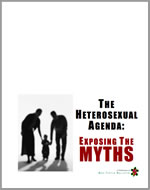 At last, the truth can now be told.
Using the same research methods employed by most anti-gay political pressure groups, we examine the statistics and the case studies that dispel many of the myths about heterosexuality. Download your copy today!
And don‘t miss our companion report, How To Write An Anti-Gay Tract In Fifteen Easy Steps.
 Anti-gay activists often charge that gay men and women pose a threat to children. In this report, we explore the supposed connection between homosexuality and child sexual abuse, the conclusions reached by the most knowledgeable professionals in the field, and how anti-gay activists continue to ignore their findings. This has tremendous consequences, not just for gay men and women, but more importantly for the safety of all our children.
Anti-gay activists often cite the “Dutch Study” to claim that gay unions last only about 1½ years and that the these men have an average of eight additional partners per year outside of their steady relationship. In this report, we will take you step by step into the study to see whether the claims are true.
Tony Perkins’ Family Research Council submitted an Amicus Brief to the Maryland Court of Appeals as that court prepared to consider the issue of gay marriage. We examine just one small section of that brief to reveal the junk science and fraudulent claims of the Family “Research” Council.
 The FBI’s annual Hate Crime Statistics aren’t as complete as they ought to be, and their report for 2004 was no exception. In fact, their most recent report has quite a few glaring holes. Holes big enough for Daniel Fetty to fall through.
“Google” is a trademark of Google Inc.
© Box Turtle Bulletin. All Rights Reserved.
 Posts
Posts  Posts via daily email: