Box Turtle Bulletin
 News and commentary about the anti-gay lobby
“Now you must raise your children up in a world where that union of man and box turtle is on the same legal footing as man and wife…”
News and commentary about the anti-gay lobbyJanuary 13th, 2014
 The Grand Duchy of Luxembourg, a nation a bit smaller than Rhode Island tucked into the corner where France, Germany, and Belgium come together, has been a likely candidate for marriage equality. With a gay Prime Minister, a gay Deputy Prime Minister, about 85% approval, and a mostly-Catholic populace, the question has not been whether this nation will adopt equality, but when. Now it appears that the answer is ‘this year’. (Wort)
Luxembourg Justice Minister Félix Braz announced on Wednesday that the government would vote on the bill this summer and, if approved, it could mean wedding bells for same sex couples before the end of the year.
The Grand Duchy’s Lesbian, Gay, Bisexual and Transgender (LGBT) community welcomed the news.
“We’re very happy about this decision of the new government. We thought initially it could be re-filed again for another couples of months or even years, due to the fact that it might be that the government judges other points on the political agenda more important than this law, ” said LGBT Rosa Lëtzebuerg Asbl president, Gabriele Schneider, adding: “We are indeed very happy to see that it is one of the important points on the agenda of the government continuing working on the law and vote all the necessary steps to have filed it during the year 2014.
The bill had been proposed in 2010 by the previous administration but when power shifted it was delayed as other items took higher priority. Luxembourg currently has a weak couple recognition system similar to the old French PACS.
January 13th, 2014
 If you were unable to attend the discussion with Belinda Carlisle and her son, James Duke Mason, here is video of the event:
and Part Two
January 13th, 2014
Today legislators in Indiana are scheduled to vote on a bill to put a marriage ban into the state constitution. It is likely the last time that a state will undertake such an effort.
In a sign that the public’s appetite for institutionalized discrimination is waning, this bill is facing uncertainty, despite Republicans holding majorities in both houses.
The problem is that for the amendment to be brought about, identical language must be approved by two consecutive legislatures and then approved by popular vote and, in their arrogance, the 2010 legislature went into full ‘ban everything’ mode.
Only a marriage between one man and one woman shall be valid or recognized as a marriage in Indiana. A legal status identical or substantially similar to that of marriage for unmarried individuals shall not be valid or recognized.
Now the ‘no marriage, no civil unions, no other-state recognition, no employment benefits, no nothing, never’ approach seems heavy-handed and cruel. And many moderates and business leaders are warning that such an approach makes the state appear oppressive and hostile, neither of which are good for business.
Left with a start over or risk it choice, Legislative leaders are trying to have it both ways. Starting over would mean that the likelihood of passage of anything would be much lower in four years. And risking it runs the chance of defeat, which would almost certainly be seen as a sign that the nation has tired of anti-gay amendments.
So instead they are trying to “explain” the second half of the amendment language. (News Sentinel)
“I think it’s very advisable to have an expression of legislative intent that accompanies HJR 3 (the proposed amendment),” Bosma said last week. “There are valid questions raised about the second sentence of the amendment.
“It seemed to make a lot of sense to address the issues, but still make it quite clear that civil unions are not allowed — which is the substantially similar or identical language to marriage — and define it as a man and a woman, but remove these concerns people validly are raising in most cases.”
The opposition has pointed out specific situations in which this bill would hurt lives of people in Indiana, such as partners of employees at the state colleges. Which, based on the history of other states going for the “no, no, no, no” approach is true.
The legislative leaders are hoping that by “explaining”, they can confuse the issue enough that the voters will somehow overlook the problems that the bill would bring and the image of their state as the final Hate State. But the business community is not on board and moderates are not letting the leaders get by with such a flimsy card game.
Today is the first test in whether the social conservatives have sufficient grasp on the legislature so as to push the bill through. (abc57)
The amendment vote falls in the hands of the Indiana House Judiciary Committee, a panel of just 13 lawmakers.
All 4 Democrats on the committee are expected to vote it down, but they’ll still need at least 3 of the Republicans to join them in order to defeat the amendment.
If the party is smart, they will kill this bill in committee, promise to bring it back again, and then lose it in the shuffle. The odds are that they will instead taint the image of their party and their state and plop this steaming pile of animus and self-righteousness into the laps of the voters.
UPDATE:
You can watch the hearing here.
So far opponents have included gay Republicans, business groups and chambers of commerce. Actually, some pretty hard-hitters from our side. All either hard-core Republican activists or high-level businesses integral to the economy.
Perhaps one of the most unusual arguments from a very conservative attorney is that because the second sentence is so ambiguous, then the courts will make all future decision and not the legislature.
UPDATE TWO:
Legislator just ate up ADF’s representative by asking for an example of what the second sentence would prohibit. She kept trying to say it would not effect benefits, but couldn’t say what it would do. And the silly girl said “I can say with certainty” only to have it pointed out to her that her assertions disagree with history and have no weight.
UPDATE THREE:
The Judiciary Committee has adjourned and the vote has been delayed.
January 13th, 2014
A Nigerian news outlet is reporting that President Goodluck Jonathan has signed into law a wide-ranging bill which not only criminalizes same sex marriage, but all cohabitation, meetings, gatherings and advocacy by or on behalf of gay people in the country:
The assent to the bill was devoid of fanfare to reduce diplomatic tension, which it may likely attract.
Some foreign embassies were shocked by the development leading to ‘curious’ inquiries from the Federal Government. Despite the inquiries, the Federal Government said there was no going back.
The signed bill says the gays, lesbians in Nigeria will risk a 14-year jail term if they do not retrace their steps and renounce such marriage.
Also, any person who operates or participates in gay clubs, societies and organizations directly or indirectly will earn 10-year imprisonment. Those who administer witness, abet or aid the solemnisation of a same sex marriage are going to bag 10-year jail term.
The bill was quietly signed on January 7. The Nation has more details about the bill itself:
According to some abstracts, obtained by The Nation, the Act reads:
“A marriage contract or civil union entered into between persons of same sex: (a) is prohibited in Nigeria; and (b) shall not be recognized as entitled to the benefits of a valid marriage.
The Act also stipulates the volume of the sanctions awaiting the violators of the new law.
“A person who enters into a same sex marriage contract or civil union commits an offence and is liable on conviction to a term of 14 years imprisonment.
“A person who registers, operates or participates in gay clubs, societies and organizations directly or indirectly makes public show of dame sex amorous relationship in Nigeria commits an offence and is liable on conviction to a term of 10 years imprisonment.
“A person or group of persons who administers, witnesses, abets or aids the solemnization of a same sex marriage or civil union of supports the registration, operation and sustenance of gay clubs, societies, organizations, processions or meetings in Nigeria commits an offence and is liable on conviction to a term of 10 years imprisonment.
“The High Court of a State or of the Federal Capital Territory shall have jurisdiction to entertain matters raiding from the breach of the provisions of this Act.”
As we noted earlier, the bill also broadly defined “civil union:”
“Civil Union” means any arrangement between persons of the same sex to live together as sex partners, and shall include such descriptions as adult independent relationships, caring partnerships, civil partnerships, civil solidarity pacts, domestic partnerships, reciprocal beneficiary relationships, registered partnerships, significant relationships, stable unions, etc.
In other words, any two adults living together can reasonably be accused of violating the law and being subject to spending the next fourteen years in prison.
January 13th, 2014
 When Roger Jean-Claude Mbede of Camaroon sent that text message to another man in March 2011, he was arrested and convicted under a law that provided up to five years’ imprisonment. He was sentenced to three. While in prison he developed a hernia and was given a provisional release on medical grounds in July 2012. He then went into hiding. He died last Friday, after his family removed him from the hospital where he was being treated for his hernia. His lawyer told reporters, “His family said he was a curse for them and that we should let him die.”
Lambert Lamba, a Cameroonian activist who works on behalf of sexual minorities, said Mbede had been out of the hospital for about one month prior to his death and had received no medical care during that time.
“His family said they were going to remove the homosexuality which is in him,” Lamba said. “I went to see him in his village. He could not stand up, he couldn’t speak.”
Neela Ghoshal, senior LGBT rights researcher for Human Rights Watch, called on Cameroonian police to investigate Mbede’s death in light of reports that he may have been barred from receiving medical treatment.
“Roger was a courageous man who became an accidental activist after he was arrested simply for expressing his love for another man,” Ghoshal said.
According to Human Rights Watch, Cameroon prosecutes more people under its anti-gay laws than any other African country.
January 13th, 2014
TODAY’S AGENDA is brought to you by:

From Michael’s Thing, a biweekly New York gay bar guide, February 2, 1976, page 9.
The Haymarket was a rough but popular bar known for its hustlers just a block away from Times Square, back in the day when Times Square itself was still seedy and Disney-free. Haymarket also allegedly (I might emphasize) had mob ties. In 1986 alleged Genovese capo Matty Ianniello was convicted for a skimming profits from several gay bars in New York City, including Haymarket. So I’ve heard. There’s a Starbucks now where Haymarket used to be, next door to a Staples.
TODAY IN HISTORY:
60 YEARS AGO: Unitarian Church Sponsors Symposium on Homosexuality: 1954. The Unitarian Universalist Association has a long history of inquiry on a large number of contentious topics. In 1954, the First Unitarian Church of Miami hosted a forum called “Homosexuality: Cause, Society, and Crime.” According to a write-up in ONE magazine, the nation’s first gay publication, the attendance “broke all existing records.” The panel included Miami Mayor Abe Aronovitz, psychologist Dr. Syvil Marquit (no affiliation was given), Dr. Jack Capschan of the University of Miami’s psychology department, and Dr. Alvin Winder, psychologist for the Veterans Administration. The psychologists generally agreed that homosexuality wasn’t an illness, but they differed on whether it was “curable” or whether society was the problem. Mayor Aronovitz however pleaded ignorance on the subject, saying he was only there because “in his desire to, please, he had instructed his secretary to accept all speaking engagements.”:
He said that there are three or four places in Miami where homosexuals gather, but that the proprietors were not in business to help these people, only to profit monetarily from their suffering. He said that he didn’t want Miami known as a haven for homosexuals or divorce getting or any other criminals, but that homosexuals should not be persecuted or hounded, because they were undoubtedly suffering from a sickness of the mind. To conclude, he added, “They certainly need kindly understanding, but whose rights shall we consider?”
The discussion was then opened to questions from the audience. The first question was “How can we cure homosexuality?” Dr. Kapschan answered with this question, “Is it not possible that instead of sick homosexuals, we have a sick society?” Dr. Marquit added that we must have a wider acceptance of homosexuals. “In other words,” he said, “your sex life is your own business.”
…Then Mayor Aronovitz asked, “I would like to know if there are any individuals who have had the glorous experience of normal sexual relations who prefer homosexual relations?” “I’m sorry to disappoint the Mayor,” answered Dr. Marquit, “but it has been proven that a large percentage of confirmed homosexuals have experienced ‘glorious’ heterosexual relations. Then it was asked “If these, people are to be driven from the bars, beaches, and other gathering places, where would you have them spend their leisure time?” Mayor Aronovitz answered that if society accepted this, it should not be persecuted.
To the question “Is prejudice against homosexuality related to intolerance?” Dr. Kapschan answered, “Yes, research has proven that prejudice is generally against a number of minority groups, not just homosexuality. The authoritarian personality that condemns persons for their homosexual behavior is much more of a threat to society than the homosexual himself. They are psychoneurotics who need psychiatric treatment, not the harmless homosexual who varies from the so-called normal, criticized only insofar as what he does in bed. Prejudice against the homosexual makes an especially good scapegoat for the authoritarian personality.”
ONE’s editors were greatly encouraged by the forum, and hoped that it would “lead to more stimulated discussions by qualified people, sponsored by churches and other civic-minded groups.” Those hopes were short-lived however, as Mayor Aronovitz would go on that year to lead a notoriousanti-gay witch hunt in his city (see Aug 3, Aug 11, Aug 12, Aug 13 (twice that day), Aug 14,Aug 26, Aug 31, Sep 1, Sep 2, Sep 7, Sep 15, Sep 19, Oct 6, Oct 20,Nov 12 and Dec 16).
[Source: Unsigned. “Who’s Sick?” ONE 2, no. 2 (February 1954): 4-5.]

US Supreme Court Issues First Gay Rights Ruling: 1958. It was barely a ruling, just a terse, one-sentence line without even hearing oral arguments. But that was all it took for the US Supreme Court to affirm the rights of the first major gay magazine, ONE, to be distributed by the U.S. Postal Service without its subject matter, homosexuality, being declared obscene. It all began in 1953, when the L.A. Postmaster confiscated copies of the October issue (ironically, the cover story was “You Can’t Print It!”) and claimed that it violated 1873 Comstock Act, which prohibited sending “obscene, lewd, and/or lascivious” material through the mail.
What was considered “obscene” is hard to say. The entire magazine is mild — no photos, no description of sexual activity, nothing that could be remotely considered pornographic, then or now. It did however contain articles which spoke frankly about issues facing gay people, including, in the cover article, the legal tightrope the magazine had to navigate in order to remain in print. ONE sued the postmaster, citing their First Amendment rights to free speech. They lost their case in Federal District Court, with Judge Thurman Clark calling it “filthy and obscene material obviously calculated to stimulate the lust of the homosexual reader.” ONE appealed and lost again at the Ninth Circuit Court of Appeals, which called ONE , “morally depraving and debasing.” And so it was a major surprise — although it shouldn’t have been — when the U.S. Supreme Court ruled unanimously and without even bothering to hear oral arguments that even gay people enjoyed the same protections under the First Amendment as everyone else. Editor Don Slater celebrated the decision in the February 1958 issue: “By winning this decision ONE Magazine has made not only history but law as well and has changed the future for all U. S. homosexuals. Never before have homosexuals claimed their right as citizens.”
You can read the full, fascinating story of how a tiny magazine in Los Angeles beat the incredible odds here.

Jesse Helms Calls Gays “Disgusting People”: 1990. When the three-term Senator from North Carolina stood on the platform at the state fairgrounds before a crowd of 1,700 to announce his intention to run for a fourth term, there was no doubt whatsoever what his platform would be: abortions and gays. “Family values in American are under attack as never before,” he said. “Think about it. Homosexuals and lesbians, disgusting people marching in our streets demanding all sorts of things, including the right to marry each other. How do you like them apples?” Helms won that election, and another one again in 1996 before finally leaving the Senate in 2003. Helms is currently dead.

TODAY’S BIRTHDAY:
Charles Nelson Reilly: 1931-2007. He was a very well respected Broadway actor, director and drama school teacher, but he was best known and beloved for his campy comedic roles and as a panelist on the game show The Match Game. His break on Broadway came in 1960 with Bye Bye Birdie. His part was small, but it opened the door to 1961’s Pulitzer prize-winning musical How To Succeed in Business Without Really Trying. He was also featured in 1964’s Hello, Dolly! Through the 1960s and 70s, he had several comedic guest appearances on television. He was a regular on The Dean Martin Show and made countless appearances on The Tonight Show with Johnny Carson. His campy character and his flamboyant dress marked him as a gay man. He never explicitly acknowledged it, although he would joke about how “butch” he was on The Match Game. No one asked, he didn’t tell, but everyone knew and no one bothered much with keeping the secret. In 2002, he finally discussed his private live in his one-man show Save It for the Stage, which became the basis for the autobiographical independent film, The Life of Reilly. He was too ill to attend its premiere in 2006 at South by Southwest, and he died at home on in 2007.

80 YEARS AGO: Rip Taylor: 1934. I’ll bet you didn’t know this: the King of Confetti, known for his handlebar mustache, wild wigs, crazy props, and compulsive confetti throwing, began his adult life as a page in the U.S. Senate. Seems somehow appropriate, doesn’t it? After being drafted to serve in the Korean War, he came home and began his career as a stand-up comic. During the 1960s and 1970s, he was a regular on several variety and game shows (including Hollywood Squares and The Gong Show), and a voice for Popeye and The Addams Family cartoons. His Gong Show gig led to his own brief program, $1.98 Beauty Show, which was produced by Gong Show executive and host Chuck Barris and was on the air from 1978 to 1980.
His schtick is as an old fashioned gag man, deploying odd props as bad puns, dropping the worst one-liners imaginable, and manically throwing confetti. His show as been a mainstay in Vegas, either as an emcee for a chorus line show or an opening act for Debbie Reynolds, Frank Sinatra, Sammy Davis, Jr., and Ann-Margaret. As a result, he was named Las Vegas Entertainer of the Year for three years in a row in the 1970s. He’s also had a few more serious roles, including as Demi Moore’s boss in Indecent Proposal and in Broadway productions of Oliver!, Peter Pan and Anything Goes. More recently, The “Prince of Pandemonium” and the “Master of Mayhem” has had cameos in Will & Grace, George Lopez, and the first three Jackass movies. In 2006, he made another notable cameo appearance in his home town of Washington, D.C., as the grand martial for the Capital Pride parade. In 2010, he gave another more serious performance for his one-man show It Ain’t All Confetti.
Here’s a clip from 1987:

Edmund White: 1940. He was born in Cincinnati and grew up in Chicago, then studied Chinese at the University of Michigan. He worked as a journalist in New York, then moved to France and settled in as a writer. In 1973, he co-wrote the first edition of The Joy of Gay Sex with psychologist Charles Silverstein, and that set him on his course of what one observer called his dedication to sexual truth-telling. His best known work, A Boy’s Own Story


White is currently a member of the faculty of Princeton University’s Creative Writing Program. His most recent novel, Jack Holmes and His Friend

Nate Silver: 1978. The math whiz, baseball fanatic, poker player, and political polling savant who accurately predicted the outcome of the 2012 presidential election in each of the fifty states and the District of Columbia, wants it to be known that he is not a gay statistician, but a statistician who happens to be gay, while “ethnically straight.” To those who take such identity labels oh so seriously, Silver’s remarks challeneged an established orthodoxy, but one that is becoming increasingly irrelevant to those of Silver’s generation. As he recently explained in a Reddit “Ask Me Anything”:
My quick-and-dirty view is that people are too quick to affiliate themselves with identity groups of all kinds, as opposed to carving out their own path in life.
Obviously, there is also the issue of how one is perceived by others. Living in New York in 2013 provides one with much a much greater ability to exercise his independence than living in Uganda — or for that matter living in New York forty years ago. So perhaps there’s a bit of a “you didn’t build that” quality in terms of taking for granted some of the freedoms that I have now.
And/but/also, one of the broader lessons in the history of how gay people have been treated is that perhaps we should empower people to make their own choices and live their own lives, and that we should be somewhat distrustful about the whims and tastes and legal constraints imposed by society.
Silver is the author of The Signal and the Noise: Why So Many Predictions Fail — but Some Don’t
If you know of something that belongs on the agenda, please send it here. Don’t forget to include the basics: who, what, when, where, and URL (if available).
And feel free to consider this your open thread for the day. What’s happening in your world?
January 12th, 2014
Noted social science expert Mark Regnerus recently warned people against the use of bad statistical data:
Mark Regnerus, a sociologist at the University of Texas in Austin, says something called “confirmation bias” might be at work. In other words, people like statistics that reinforce their beliefs.
His colleagues responded: Read the rest of this entry »
January 12th, 2014
TODAY’S AGENDA:
Events This Weekend:
TODAY’S AGENDA is brought to you by:

From The Los Angeles Advocate, October 1968, p. 20.
What was once a rowdy gay bar is now home to the Tbilisi and Yerevan Bakery.

GMHC’s office in 1983.
TODAY IN HISTORY:
Gay Men’s Health Crisis Founded: 1982. Several dozen men gathered in writer Larry Kramer’s New York apartment to discuss the mysterious “gay cancer” that had been claiming the lives of their friends and lovers, and to figure out how to raise money for research. The group originally thought they were coming together for a one-time thing: persuade a club to hold a benefit, invite a bunch of A-listers to come and donate, give the money to a suitable research organization, and go home. But it quickly became apparent that there was much, much more work to be done. Forced by widespread apathy on the part of the news media, city officials, local health authorities, and even “confirmed bachelor” and barely closeted Mayor Ed Koch, the Gay Men’s Health Crisis (GMHC) quickly went from being an ad-hoc group to organize a fundraiser to a full-fledged charitable service organization to fill the void that the city refused to fill.
GMHC would go on to raise money to provide services and assistance for people with HIV/AIDS, including assistance from a large army of volunteers to meet day-to-day needs like cooking, housecleaning, dog-walking, and transportation to medical appointments, as well as help in navigating the apathetic bureaucratic maze. They also, just as critically, hounded the news medial trying to get attention to the disease. When that mostly failed, GMHC started a crisis hotline, which became one of the organization’s most important avenues for distributing AIDS information in the pre-Internet era. They also distributed material to help educate the general public on the need for safer sex. In these areas, GMHC worked hard to meet the needs that had been, at best, ignored by local and national health authorities and charities (most shockingly, including most faith-based charities). GMHC also battled the overt stigmatization and hostility which grew among well-known public figures, nationally as well as locally.
GMHC quickly established itself as a well-regarded authority for HIV/AIDS education and service. By 1984, the Centers for Disease Control called on GMHC’s help in planning public conferences on AIDS. As the epidemic continued to grow, GMHC expanded its reach by assisting heterosexual men and women, hemophiliacs, intravenous drug users, and children. This past year, GMHC has struggled with funding cuts, controversies over its new office space and the recent departure of its executive director as the organization continues its work as one of the nation’s leading non-profit, volunteer-supported AIDS service and educational organizations.

John Singer Sargent, Self Portrait, 1906.
TODAY’S BIRTHDAY:
John Singer Sargent: 1856. Was he or wasn’t he? Scholars have scratched their heads over that question. He was born in Florence to American parents, who were well off enough to casually travel throughout Europe. Sargent’s drawing skills developed early, and at the age of eighteen he went to Paris to study painting. His early masterpiece, El Jaleo (1882), which portrayed a bare-armed Spanish Gypsy dancer in full movement, was both sensual and exotic — and, therefore, scandalous in the closing days of the Victorian era. Other portraits were similarly controversial. His full-length portrait of New Orleans-born Parisian socialite Virginie Gautreau (1884), depicting her in a strapless gown and a plunging neckline, had much of Europe clutching its pearls.
Almost immediately, Sargent established himself as the defining painter of what would soon become known as the Edwardian era. He worked on the edge between respectability and sensuality. But he also had a commercially successful knack for finding beauty in everyone he painted while simultaneously preserving a candid honesty to his portraits. And just about everyone who was anyone sat for a portrait.

John Singer Sargent, Portrait of Nicola D’Inverno, 1892.
For all of Sargent’s notoriety through his paintings, he was profoundly circumspect in his private life. He was flirtatious with women, but had no significant romantic attachments. He formed deep friendships with men — including Henry James, Oscar Wilde, and Robert Montesquiou, and perhaps most significantly, his assistant of twenty-six years and sometimes model Nicola d’Inverno — but there is no evidence that his relationships went beyond deep friendship.
And yet, the talk has always been there, and it was only amplified when, upon his death in 1925, his family destroyed his personal papers. And that talk centered on his male nudes, much of which were created for his own personal study and enjoyment, and not for public exhibition. In Donna Hassler’s preface in John Esten’s John Singer Sargent: The Male Nudes

John Singer Sargent, Thomas E. McKeller as Apollo, 1921-25.
To Sargent, however, rendering the nude male figure was more than just an academic pursuit… He showed a strong preference for portraying the masculine form throughout his career (few Sargent drawings or paintings of the nude female figure are extant), and his work ranges from a straightforward student study of an unidentified male model wearing an posing strap to an emotionally charged, fully nude drawing of an identifiable male model, Thomas E. McKeller.
As Esten points out, “Like beauty, homoeroticism is in the eye of the beholder.” And many beholders have seen it in Sargent’s paintings. Several of his male nudes made their way into the famous mural in the Rotunda of Boston’s Museum of Fine Arts, some of them, including his sketch of McKeller as Apollo, refashioned into female figures.

Felipe Rose: 1954. You know him as “the Indian” for his appearance as a founding member of the Village People. The son of a Puerto Rican mother and Lakota Sioux father, Rose grew up in Brooklyn where he took up dancing at a very young age. When he was sixteen, he studied dance with the Ballet de Puerto Rico and participated in a Lincoln Center dance recital with the Ballet Company. At the urging of an aught, he began dressing in tribal regalia and exploring Native American influences in dance as an homage to his father’s heritage. He also, at about the same time, began exploring New York’s gay nightlife. Soon after French producer Jacques Morali saw him working as a go-go dance in his “Indian” get-up at a New York gay bar, he recruited Rose into a new singing group in which members wore costumes representing different “masculine” occupations. The Village People scored their first major disco hits, “Macho Man” and “Y.M.C.A” in 1978.
There have been numerous personnel changes in the Village People over the years, but there has only been one Indian. Rose is one of only two only Village People to have never left the group, and with Alex Briley (the G.I/Sailor), he remains one of only two original members.
While the Village People is all camp, Rose takes his Native American heritage seriously. In 2000, he recorded the single “Trails of Tears,” Which was nominated for 3 NAMMYs (Native American Music Awards). He is a member of the Advisory Board of the Native American Music Association.
If you know of something that belongs on the agenda, please send it here. Don’t forget to include the basics: who, what, when, where, and URL (if available).
And feel free to consider this your open thread for the day. What’s happening in your world?
January 11th, 2014
TODAY’S AGENDA:
Events This Weekend:
TODAY’S AGENDA is brought to you by:

From the Advocate, January 11, 1979, page 26.
 BJ’s Carousel in Denver first opened in 1977 and quickly became a hot spot for Denver professionals and blue collar types alike. When the oil boom hit in the early 1980s, the bar became popular with oil workers. But the AIDS crisis, the oil bust, and changing times generally took their toll, and despite being Denver’s longest-running gay bar, BJ’s Carousel finally closed in 2011. The location is now a nautical-themed straight bar called the Dive Inn.
TODAY IN HISTORY:
Britain Lifts Its Ban on Gay Military Personnel: 2000. Once they put their minds to it, there wasn’t much dithering. It just took them a while to put their minds to it. Unlike the U.S. (in theory, anyway), Britain’s ban on gays in the military was complete and total, whether anyone was open about it or not. Anyone was subject to being followed or interrogated by the SIB (Special Investigations Branch) for any suspicion, or even no suspicion at all. In 1997, three gay men and a lesbian sued after they were discharged from the Royal Navy and RAF. Their case went all the way up to the European Court of Human Rights, which ruled in September 1999 that the Ministry of Defense’s policy violated the service members’ human rights.
The following December, the Labour government of Prime Minister Tony Blair announced the Defense Ministry would comply with the ruling. Members of the opposition Conservative Party were appalled. M.P. Gerald Howarth said, “This appalling decision will be greeted with dismay among ordinary soldiers in the armed forces, many of whom joined the services precisely because they wished to turn their back on some of the values of modern society.” Officers predicted sexual mayhem in the barracks or — horrors! — male couples dancing at a mess function. But one month after the announcement was made, the ban was lifted, and all of the fears came to naught. A review two years later across all the branches found widespread acceptance for lifting the ban, and gay and lesbian service members served with distinction in Afghanistan and Iraq alongside their American counterparts who still had to remain hidden and in the closet.
Prop 8 Trial Begins: 2010. Lawyers for the plaintiffs in the lawsuit against the state of California seeking to overturn Proposition 8 began their opening remarks. Attorney Ted Olsen promised to argue the case on three fundamental points:
Olsen and co-counsel David Boies would ultimately prevail and U.S. Federal District Judge Vaughn Walker would rule that Prop 8 was unconstitutional. The case was appealed to the Ninth Circuit Court of Appeals which upheld the lower court’s ruling but on much narrower grounds, namely that once a right has been granted and enjoyed by a class of people, it is unconstitutional to then strip them of that right. The case then went to the U.S. Supreme Court, which decided against ruling issuing a ruling on the merits, but instead held that Prop 8’s proponents, Alliance Defending Freedom (formerly Alliance Defense Fund), didn’t have standing to appeal. This sent the case back to California where Judge Walker’s ruling became the final word.
If you know of something that belongs on the agenda, please send it here. Don’t forget to include the basics: who, what, when, where, and URL (if available).
And feel free to consider this your open thread for the day. What’s happening in your world?
January 10th, 2014
 Randy Weber (R- TX) has yet to make much of a name for himself.
Oh, in addition to his day job as an air conditioner repairman, he also was involved in local Republican committees and on the city counsel of Pearland, Texas. And that was all before being elected to the Texas House of Representatives, where he served for four years.
And when Rand Paul decided to run for Senate Ron Paul decided to retire, Weber won the Republican Party primary for Paul’s seat – after a run-off election. And while Massachusetts’ Mitt Romney did do a bit better than Weeber in his home district, he was nevertheless elected to represent Texas’ 14th Congressional District.
Now, he’s only been in office for a year so he hasn’t really had much time to find the right idea, the vehicle which will define him as a statesman.
He has written one resolution, which would “Expresses the sense of the House of Representatives that the government’s scientific and technical analysis of the potential environmental impacts of the Keystone XL pipeline have repeatedly affirmed its environmental soundness and safety”. But that resolution is currently langering in the House Committee on Science, Space, and Technology, where Wever is a committee member. And that can’t feel good.
And he’s helped 415 Texans through casework and guided 140 families on US Capitol tours. But doesn’t get you headlines.
However, Roddy Wegle has finally found his issue. He has finally found that one position on which he can get in on the ground floor and make a name for himself.
Werber has now sponsored HR 3829: the State Marriage Defense Act of 2014.
And it’s a real doozy. Very timely. And oh so popular among those whom Weber find a common cause.
Though the text of the bill is not yet available, what it would do is require that the Federal Government change the criteria for recognition of same-sex marriages from whether they were legally licensed, performed, and recorded and instead determine Federal recognition on where the couple lived at the moment. Weger’s bill would have the Feds only recognize a marriage if the state of residency recognized the marriage, thus allowing one state to not only invalidate another state’s contracts, but to force the Federal Government to do so as well.
Now this might be a bit tricky. A couple that moved often might find themselves to be married, unmarried, married, single, civil unioned, or completely confused. Move to New York and you’re married. Move to Nevada and you file state taxes jointly but Federal taxes as single. Move to Texas and hope to God that you don’t live near Weber.
But Ronnie Webbe now has gotten some attention. The Family Research Counsel has endorsed his bill, as has the National Organization for Marriage.
And he has co-sponsors; 27 of them (all Republicans). And while many are fellow Texans with whom you may not be familiar, he’s got some big names on his bill including Joe Pitts, Doug LaMalfa, Louie Gohmert, and even Michele Bachmann, whom we all know so well.
But, alas, it looks as though he might not have been as clever as he hoped. Because this move, as timely and hot-button as he might hope, as joyously received by the stalwart defenders of “the family”, still didn’t get his name into the papers.
Oh sure, the gay blog sites took notice. And the far right disseminators of viewpoint and opinion. But otherwise nothing.
Well, okay, not exactly nothing. It is true that the Sacramento Bee did make available on their website the press release which was issued by the FRC, but otherwise the media attention was the same as if Woober farted in the wind.
No New York Times., No Chicago Tribune. No Duluth News Tribune. Not even the wacky, Moony-owned, far right, anti-gay Washington Times ran a story.
And, sadly for Weder, it’s not likely to get better. While the good ol’ boys at the local Elks Lodge may all think his proposal is a fine idea, the Republican Party leadership will bury this dog. They know that the ship has sailed and that equality is the future and they want nothing more than to have the issue behind them. Preferable before 2016 so they can blame President Obama and the Supreme Court and move on to other issues.
Alas, poor Ricky Weevil. Your second try at establishing your legacy doesn’t seem to be panning out so well. But take heart, you have another year. Maybe you’ll find a way to make everyone remember your name.
January 10th, 2014

In another twist in the Utah marriage battle, the Federal Government has weighed in on the legality of the nuptials performed in Utah’s marriage window. (NYTimes)
The Obama administration on Friday said that it would recognize as lawful the marriages of 1,300 same-sex couples in Utah, even though the state government is refusing to do so.
…
“I am confirming today that, for purposes of federal law, these marriages will be recognized as lawful and considered eligible for all relevant federal benefits on the same terms as other same-sex marriages,” Mr. Holder said in the video. “These families should not be asked to endure uncertainty regarding their status as the litigation unfolds.”
This should not be seen as an affront to Utah. It is completely consistent with something that the state’s Attorney General said on Wednesday: (Fox13)
“I want to be clear that we are not saying those marriages are invalid,” Reyes said in an interview Wednesday with FOX 13. “However, as a state we cannot recognize those marriages.”
Reyes insisted that by refusing to recognize the marriages, the state was not effectively invalidating the unions by pointing to other states that recognize same-sex marriages.
“It’s not invalidating it in the same way that if they went to Hawaii, they could potentially apply for benefits there based on the marriage that took place. They can’t be recognized (here),” he said. “There is a very fine distinction, but a very important distinction based on those two things.”
It does, however, help force the hand of the courts a bit. To find that these marriages are invalid and had “never occurred” would be to cause a flood of confusion and administrative nightmares.
Hundreds of couples will be filing Federal income tax returns as married couples, there are likely even some who have made legal changes to their names and who will – by the time of the decision – have signed legal documents or established credit as married couples, and even some may have moved to states in which their marriages are fully recognized and may have availed themselves of state services.
January 10th, 2014
I have a good-hearted friend, the sort of guy who will spend 30 minutes in your kitchen at the end of your dinner party washing your guests’ dishes just to make things easier on you the next day. He posted this on his Facebook page and I thought reading it might be a lovely way to start the weekend:
Today in the gym locker room at work, someone made what I interpreted to be a homophobic comment. It wasn’t the first time, and it wasn’t even from the dude that likes to constantly call people ‘sissy.’ The locker room was full. It was awkward. I thought about saying something, but didn’t. As I felt the embarrassment and anger stew within me, I considered wearing my socks into the shower stall so as not to expose my freshly-painted rainbow toenails. I quickly talked myself out of it. Fuck it, I thought to myself. Off I waltzed barefoot into the stall, determined to enjoy my hot post-workout shower and sing my little lungs out as I do every morning. If the fellas weren’t familiar with the Frozen soundtrack from their daughters, they certainly are after this week. Also, I use the term ‘sing’ loosely.
I stepped out of my shower, still a little disheartened, and was immediately told by one of the guys, “Jake just left but he said he wished everybody around here was as happy as you are.” I stopped and smiled, surprised. I always figured the guys were rolling their eyes at the weirdo belting out girly songs in the shower. Then the guy who made the disparaging comment earlier walked past me and I saw his eyes dart down to my feet. “Well now…” Here we go, I thought, ready to jump on the defensive. I’ve seen a lot of things in my days,” he chuckled, “but never rainbow toes.” I laughed and we proceeded to have a lovely conversation about his daughter, the joy of pedicures, and the value of not taking yourself too seriously. We won’t be going to get sushi and mani/pedis any day soon, but I did make a new gym buddy.
Sometimes the smallest and most seemingly insignificant of events can teach us some of the most valuable lessons. Today I was humbly reminded:
• People can only be as big, or as small, as I allow them the space to be.
• Every moment is a choice. I choose to make each moment an opportunity to learn and to grow.
• Be me. 100%. All the time. No apologies, no excuses, no exceptions.
• Living openly, honestly and unapologetically is the most powerful form of activism and the easiest way to change hearts and minds.
• With discomfort comes challenge, and with challenge comes growth.
• Nobody can accept me unless and until I accept myself – flaws, quirks, shortcomings and all. I am perfectly imperfect.
• I will always be my own worst enemy. It is just as important – if not more – to be kind to myself as it is to be kind to others.
• There is no reality. Only perception thereof. I choose to create an empowering interpretation.
• Rainbow toenails don’t just make me smile.
Happy Friday!
January 10th, 2014
TODAY’S AGENDA:
Events This Weekend:

TODAY IN HISTORY:
Gore Vidal’s “The City and The Pillar” Published: 1948. It turns out that the month of January, 1948 was a rather scandalous month for the American public. On January 5, Sexual Behavior In the Human Male, the first of the two Kinsey Reports, was released. Then just five days later, Gore Vidal’s novel, The City and the Pillar came out. Vidal wrote this novel, his third, at the relatively tender age of twenty-one, and it was the first mainstream novel dealing with homosexuality in its central characters. It was, in its day a kind of a Brokeback Mountain, a coming of age story in which the main protagonist awakens to his sexuality. Gore also smashed the prevailing stereotypes of the day by portraying the central characters as masculine. I guess both books coming out within the space of less than a week was too much for the New York Times. Their review the next day went like this:
Presented as the case history of a standard homosexual, this novel adds little that is new to a groaning shelf. Mr. Vidal’s approach is coldly clinical: there is no real attempt to involve the reader’s emotions, as the author sets down Jimmie’s life story — his first experience during his high school days, his life as a cabin boy, a tennis bum, his adventures in Hollywood and points East. Backdrops are gaudy, and Jimmie’s more ardent acquaintances include a picture star (the idol of a million bobby soxers), a fashionable novelist and members of the armed forces. But the over-all picture is as unsensational as it is boring…
Boring. Perhaps the worst thing that could be said about any novel, if anything was to be said at all. Most papers refused to review it, but a few saw it as a triumph. The Washington Post called it “an artistic achievement” and the Atlantic Monthly said it was “a brilliant exposé of subterranean life.” Despite it’s “subterranean” themes and The New York Times’ great displeasure, The City and the Pillar made it to the best-seller’s list. The Times so thoroughly disliked it that it refused to run ads for it and ignored Vidal’s next five books. Cut off from an important promotion vehicle, Gore resorted to writing mystery novels in the early 1950s under the pseudonym of Edgar Box.
Although the gay characters’ portrayals in The City and the Pillar were generally positive, the tone was dark and the ending tragic, with the main character being murdered by his lover. It’s been widely reported that the publishers forced Vidal to change the ending to an unhappy one, but Gore himself denies this. But twenty years later, when he published the novel again as The City and the Pillar, Revised, Gore changed the overall tone to be less dark and allowed the main character to survive the ending.

Episcopal Church Ordains First Open Lesbian: 1977. Before Bishop Paul Moore of New York ordained Rev. Ellen Marie Barrett as a priest in his Episcopal diocese, there is a point in the service in which the ordaining bishop asks the congregation, “If any of you know any impediment or crime because of which we should not proceed, come forward now, and make it known.” Rev. James Wattley, who was an active opponent of the church’s decision to ordain women to the priesthood, rose to denounce the ordination as a “travesty and a scandal.” He went on: “my objection is for myself alone on the grounds that she is a self-proclaimed lesbian.”
Bishop Moore appeared prepared for the answer. “Attention has been drawn to the ordination because Ms. Barrett has not made a secret of her homosexual orientation,” the Bishop announced. “However, her personal life has never been under criticism. Many persons with homosexual tendencies are presently in the ordained ministry. Ellen Barrett’s candor in this regard is not considered a barrier to ordination. She is highly qualified intellectually, morally and spiritually. … Historically, many of the finest clergy in our church have had this personality structure, but only recently has the social climate made it possible for some to be open about it.”
Rev. Barrett’s ordination sparked another round of controversy in a church still split over its 1976 decision to admit women to the priesthood. Within a month of Barrett’s ordination, nine parishes announced they were leaving the church. In an unusual move, one Florida pastor read out an “excommunication decree” from the altar of his church against Bishop Moore and Rev. Barrett.
The following October, the church’s House of Bishops sought to calm the controversy with a resolution declaring that gay people should not be ordained as priests, saying that such an ordination would “require the Church’s sanction of such a lifestyle not only as acceptable but worthy of emulation.” The House of Bishops also gave a nearly unanimous consent to another resolution to support Bishops who “by their own conscience” refuse to ordain women priests or allow them to serve in their dioceses. But in a 28-62 vote, the House refused to censure Bishop Moore, and in a 49-68 vote refused to advise California Bishop Kilmer Myers against licensing Rev. Barrett in his diocese. Thus the precedent was set, and bishops continued ordaining openly gay priests under the same “conscience” principle which permitted other bishops to bar women from the altar.

TODAY’S BIRTHDAYS:
Johnnie Ray: 1927-1990. When his career broke open in 1951, his highly emotional brand of white R&B earned him the nickname “The Prince of Wails.” His intense performances foreshadowed the raw energy of Rock And Roll which would hit the charts hard a few years later. Ray’s first hits, “Cry,” and “The Little White Cloud That Cried”, were sides A and B of his first single, with both sides dominating the charts for several months. They were followed by a string of a couple dozen top-forty hits, including “Please Mr. Sun,” “Walkin’ My Baby Back Home,” “A Sinner Am I” (all three in 1952), “Such a Night” (1954), “Just Walkin’ In the Rain” (1955), and “Yes Tonight Josephine” (1957).
Ray married in 1952. His wife knew he was gay going in — he had been arrested for soliciting an undercover police officer in Detroit for sex before his career took off — but the aspiring Mrs. Ray was confident she could “straighten him out.” Her efforts came to naught, and they divorced two years later. He also had a close friendship and casual affair with entertainment reporter Dorothy Kilgallen. Despite Kilgallen’s marriage and Ray’s string of male lovers, they remained close until her death in 1964.
 In 1959, Ray was arrested, again in Detroit, and again for for trying to pick up an undercover cop, this time at a bar known as The Brass Rail. Kilgallen stood by him and the jury, comprised entirely of older women, found him not guilty. One juror rushed to comfort him when he fainted upon hearing the verdict.
His popularity in the U.S. took a hit, but he continued to do well in the UK, where his show at the Palladium became legendary. But by the early sixties, his fading star was further dimmed by alcoholism, a bout of tuberculosis and cirrhosis of the liver. By 1963, he had a new manager and first real long term partner, Bill Franklin, who worked to resolve Ray’s health and financial crises, and who got Ray to sober up. In 1968, Ray was appearing on American television again. He opened for Judy Garland’s last two concerts in Denmark and Sweden, followed by several more American television appearances in the early 1970s.
But that comeback didn’t take hold. Ray started drinking again, and Franklin left him in 1976 and cut off all contact a few years later. By the time the 1980s rolled around, gen-X’ers had little idea of who he was except for a line in the 1982 hit “Come On Eileen” by Dexys Midnight Runners. (“Poor old Johnnie Ray sounded sad upon the radio / he moved a million hearts in mono.”) Ray continued performing in small venues until illness and alcoholism overtook him in late 1989. He died of liver failure in 1990.
Here is a performance of “The Little White Cloud That Cried.” Yes, it’s corny, but imagine seeing it in 1951 when the top acts that year included Perry Como, Nat King Cole and Tony Bennett — five years before Elvis.
http://www.youtube.com/watch?v=myu_wBPfpxsAnd by the way, you may notice the clunky hearing aid in the video. He had lost about half of his hearing from an untreated childhood concussion. In 1958, he underwent two surgeries to restore his hearing, but the results were a disaster. He completely lost his hearing in his left ear and sixty percent in his right.

75 YEARS AGO: Sal Mineo: 1939-1976. He was a talented young actor who some say peaked with his first major role as John “Plato” Crawford in Rebel Without a Cause, the 1955 classic staring James Dean and Natalie Wood. That role got him an Academy Award nomination for best supporting actor. He also appeared in another James Dean vehicle Giant as a Mexican boy, and for a while he became typecast as a troubled teen. In 1957, he made a brief stab at pop music, and in 1959, he appeared as the famous jazz drummer Gene Krupa in The Gene Krupa Story. He received another Academy Award nomination for Best Supporting Actor in the epic Exodus in 1960. By the late 1960s, Mineo became one of the first Hollywood actors to acknowledge his homosexuality. He died in 1976, stabbed to death during a mugging as he was walking home from a rehearsal in West Hollywood. He was only 37.
 But back to Rebel Without A Cause. By the time I saw the film for the first time as a teenager in the late 1970s, I had already read a lot about the classic. Critics and observers wrote about the movie’s themes of alienation, aimless adolescence, the ambivalence of impending adulthood — you know, stuff like that And so when the movie appeared on television one night (remember, this was before Netflix, or even VHS rentals), I was unprepared for what looked to be the most obvious theme of the movie: the sexual tension between Sal Mineo and James Dean. At the time I had no idea that Mineo was gay or that Dean was bi. But seeing their chemistry together on the screen, it was so bright, so combustible, so obvious! Well good lord, why wasn’t anybody talking about that? Yeah, I know. I would later find out that others noticed it too. But remember, this was the 1970s and I was growing up in Appalachia. And man, what an eye-opener.
If you know of something that belongs on the agenda, please send it here. Don’t forget to include the basics: who, what, when, where, and URL (if available).
And feel free to consider this your open thread for the day. What’s happening in your world?
January 9th, 2014
 Because the State of Utah’s arbitrary ruling on refusing state services (which had been available) to married same-sex couples just wasn’t wacky enough, the Attorney General has made a new exception. (Republic)
Local clerks in Utah can finish paperwork for same-sex marriages completed before the U.S. Supreme Court issued a temporary halt on Monday, the state’s attorney general said Thursday.
Attorney General Sean Reyes’ office issued the legal advice to county clerks Thursday afternoon.
…
In Weber County, about 30 couples married before the ruling, but their marriage certificates were not completed after county attorneys said to put them on hold.Reyes’ new advice was issued to clear up some confusion and only applies to marriages that were solemnized, his spokeswoman Missy Larsen said.
“As long as the marital ceremony happened prior to the stay, then the marriage can receive documentation,” Larsen said.
…
In the letter sent to county clerks, Reyes said that providing marriage certificates to those who wed while it was still legal is an administrative function, not a legal function, according to Utah law.
And changing a name on a driver’s license, yeah that’s totally legal, not administrative.
While this is very good news for the couples in Weber County as the federal government now can recognize their marriages – at least, maybe – it’s even more arbitrary and wacky than the last decision. Good luck making your case in court, boys.
January 9th, 2014
TODAY’S AGENDA:
Events This Weekend:
TODAY’S AGENDA is brought to you by:

From the Advocate, March 15, 1972, page 9.
TODAY IN HISTORY:
Homosexual Crackdown at the University of Michigan: 1960. The campus paper, the Michigan Daily, headlined its editorial “Homosexual Crackdown of Dubious Value,” and informed the student body that Ann Arbor police had been patrolling campus restrooms, arresting 34 men. The paper dubbed the arrests “seriously questionable with regard to methods, motives, legality and moral implications.” The paper also criticized the expenditure of public funds “to aggravate the psychological problem of the homosexual, first by enticement, then by arrest, arraignment, trial, and perhaps a prison sentence. This is neither a logical way to spend public funds nor a sensitive way to handle a public problem.” Staff writer Thomas Hayden found the police motives odd:
No major incident-such as an attack on a child-triggered it. The police themselves admit no organized ring exists. Since the state law against indecent conduct between males has been on the books for many years, the suddenly renewed enforcement for no specific reason seems curious. It leaves one to guess that an irrational force in Ann Arbor is overly interested in keeping the city “a decent place to live” and that the police, are hypersensitive with regard to the public image.
What’s revealing about the editorial, however, is that writer didn’t tackle the topic because he thought gay people should be left alone more or less like anyone else. Instead, he engaged a much order argument, saying that gay people weren’t criminals who were responsible for their actions, but were mentally ill and couldn’t help what they were doing:
The situation once more illustrates the cultural lag which puts the homosexual under the heading of “criminal” when he is most often an individual with serious psychological difficulties. …What must be questioned most basically is the state statute itself. It simply is not consistent with advances in modern psychiatry. It is based on an absurd conception of homosexuality as the immoral behavior of stable rational individuals. It makes little attempt to understand such individuals as anything other than criminals, and most frightening of all, it sentences them to state prisons where their environment is hardly conducive for cure.
This line of reasoning passed for an “enlightened” viewpoint in 1960, even among many gay people. It would still take a few more years before gay rights activists would directly challenge the homosexuality-as-illness explanation, and even then it was controversial (see Mar 4). Meanwhile, Michigan’s crackdown would have tragic results for those arrested. At least nine pleaded guilty after a judge threatened them with six months in prison if they insisted on a jury trial (see Mar 12), and one man who had been found guilty a week earlier committed suicide two days before he was due in court for sentencing (see Mar 13).
[Source: Hal Call. “Calling Shots.” Mattachine Review 6, no. 3 (March 1960): 18-19.]
If you know of something that belongs on the agenda, please send it here. Don’t forget to include the basics: who, what, when, where, and URL (if available).
And feel free to consider this your open thread for the day. What’s happening in your world?
Featured Reports
 In this original BTB Investigation, we unveil the tragic story of Kirk Murphy, a four-year-old boy who was treated for “cross-gender disturbance” in 1970 by a young grad student by the name of George Rekers. This story is a stark reminder that there are severe and damaging consequences when therapists try to ensure that boys will be boys.
When we first reported on three American anti-gay activists traveling to Kampala for a three-day conference, we had no idea that it would be the first report of a long string of events leading to a proposal to institute the death penalty for LGBT people. But that is exactly what happened. In this report, we review our collection of more than 500 posts to tell the story of one nation’s embrace of hatred toward gay people. This report will be updated continuously as events continue to unfold. Check here for the latest updates.
In 2005, the Southern Poverty Law Center wrote that “[Paul] Cameron’s ‘science’ echoes Nazi Germany.” What the SPLC didn”t know was Cameron doesn’t just “echo” Nazi Germany. He quoted extensively from one of the Final Solution’s architects. This puts his fascination with quarantines, mandatory tattoos, and extermination being a “plausible idea” in a whole new and deeply disturbing light.
On February 10, I attended an all-day “Love Won Out” ex-gay conference in Phoenix, put on by Focus on the Family and Exodus International. In this series of reports, I talk about what I learned there: the people who go to these conferences, the things that they hear, and what this all means for them, their families and for the rest of us.
Prologue: Why I Went To “Love Won Out”
Part 1: What’s Love Got To Do With It?
Part 2: Parents Struggle With “No Exceptions”
Part 3: A Whole New Dialect
Part 4: It Depends On How The Meaning of the Word "Change" Changes
Part 5: A Candid Explanation For "Change"
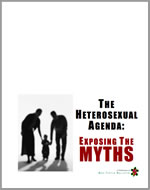 At last, the truth can now be told.
Using the same research methods employed by most anti-gay political pressure groups, we examine the statistics and the case studies that dispel many of the myths about heterosexuality. Download your copy today!
And don‘t miss our companion report, How To Write An Anti-Gay Tract In Fifteen Easy Steps.
 Anti-gay activists often charge that gay men and women pose a threat to children. In this report, we explore the supposed connection between homosexuality and child sexual abuse, the conclusions reached by the most knowledgeable professionals in the field, and how anti-gay activists continue to ignore their findings. This has tremendous consequences, not just for gay men and women, but more importantly for the safety of all our children.
Anti-gay activists often cite the “Dutch Study” to claim that gay unions last only about 1½ years and that the these men have an average of eight additional partners per year outside of their steady relationship. In this report, we will take you step by step into the study to see whether the claims are true.
Tony Perkins’ Family Research Council submitted an Amicus Brief to the Maryland Court of Appeals as that court prepared to consider the issue of gay marriage. We examine just one small section of that brief to reveal the junk science and fraudulent claims of the Family “Research” Council.
 The FBI’s annual Hate Crime Statistics aren’t as complete as they ought to be, and their report for 2004 was no exception. In fact, their most recent report has quite a few glaring holes. Holes big enough for Daniel Fetty to fall through.
“Google” is a trademark of Google Inc.
© Box Turtle Bulletin. All Rights Reserved.
 Posts
Posts  Posts via daily email: