Box Turtle Bulletin
 News and commentary about the anti-gay lobby
“Now you must raise your children up in a world where that union of man and box turtle is on the same legal footing as man and wife…”
News and commentary about the anti-gay lobbyNovember 5th, 2013
Today the Illinois House put our state on the right side of history. #IL4M
— Governor Pat Quinn (@GovernorQuinn) November 5, 2013
I thank Rep. Harris, Sen. Steans and all of the dedicated advocates & members of the GA who took a stand for equal rights in #IL. #Twill
— Governor Pat Quinn (@GovernorQuinn) November 5, 2013
Illinois is a place that embraces all people and today, we are an example for the nation.
— Governor Pat Quinn (@GovernorQuinn) November 5, 2013
November 5th, 2013
Hmm, do we now go to Boystown and party because same sex marriage is legal or do we sit on the couch and watch TV like a married couple?
— LZ Granderson (@Locs_n_Laughs) November 5, 2013
I already sound like grandpa when I tell the youngsters that back in my day we gays had to get married in NYC, Boston, or Des Moines.
— randy r. potts (@thephatic) November 5, 2013
November 5th, 2013
From an Illinois resident:
Arrogance of Liberals: #Illinois becomes 15th state to defy God by creating legal "marriage" based on the perversion of homosexuality. #tcot
— Peter LaBarbera (@PeterLaBarbera) November 5, 2013
November 5th, 2013
 The Illinois House of Representatives has just approved a marriage equality bill in a 61-54 vote. The bill is slightly different from the one passed by the state Senate last February. Earlier today the bill was amended to change its effective date to June 1, 2014, rather than thirty days after signing by the governor. This allowed the required threshhold for passage to drop from 71 votes to 60. The bill will now go back to the Senate for its quick approval — likely before this evening is over — before heading to Gov. Pat Quinn, who has said he is eager to sign it into law.
Eleven Democrats voted against the measure. They were Reps. Daniel V Beiser, John E. Bradley, Kartherine Cloonen, Jerry F. Costello, II, Monique Davis, Mary Flowers, Eddie Lee Jackson, Sr., Charles Jefferson, Frank Mautino, Brandon Phelps, and Sue Scherer. Two others voted “Present” — Reps. Rita Mayfield and Derrick Smith — but because of the sixty-vote threshhold needed for passage during the veto session, their votes were effectively “no” votes.
Three Republicans voted in support of marriage equality. They were Reps. Tom Cross, Ron Sandack, and Ed Sullivan, Jr.
Illinois will become the fifteenth state, plus the District of Columbia, to provide marriage equality for same-sex couples.
Update (5:05 p.m. CST): Barely an hour has passed, and the Senate has given its concurrence to the House bill in a 32-21 vote. It now goes to the governor.
Update (5:30 p.m. CST): The Chicago Sun-Times says, “Administration sources predicted the governor, once the bill arrives on his desk, would hold a bill-signing ceremony within the next week or two.”
November 5th, 2013
This Buzzfeed post quotes Anthony Martinez, executive director of The Civil Rights Agenda, a saying that the Illinois House will vote on the marriage equality bill today. But it then goes on to cite other sources saying that the vote count stands “at 58 or 59,” just shy of the 60 votes needed, and that the exact timing for the vote depends on who is present. So who knows when it will happen. But it does look like there’s some movement:
As lawmakers began Tuesday’s session, Rep. Greg Harris, the chief sponsor of the marriage equality bill in the House, amended its language to change the date the legislation would go into effect, and to seemingly reiterate exemptions for private clubs do not want to host marriages for same-sex couples.
The amendment removes lines including the 30-day effective date, which will allow Harris to pass the bill with only 60 votes instead of 71. Rules dictate that bills passed in this “veto session” like this can go into effect June 1, 2014.
If the amended bill makes it through the House, it will then need to go back to the Senate for its approval, which observers say is no big deal.
Update: Debate has started! You can see the livestream here.
November 5th, 2013
Nearly two years ago, Sen. Mark Kirk (R-IL) suffered a serious stroke. He remained hospitalized for three months and went through rehabilitation for the rest of the year before returning to the Senate in January of this year. But until yesterday, he hasn’t made a floor speech since his return. He broke his silence yesterday when he spoke in favor of cloture for the Employment Non-Discrimination Act (ENDA):
http://www.youtube.com/watch?v=fv6rCUHc5MY
November 5th, 2013
Italian pasta maker Barilla found itself in a big ol’ pot of hot water a month ago when the company’s chief, Guido Barilla, told an Italian radio program, “I would never do an advert with a homosexual family…if the gays don’t like it they can go an eat another brand.” Gays have decided to do just that. Barilla has tried several bumbling attempts at apologizing, particularly Barilla’s American subsidiary, which found itself in the entirely untenable and incredible position of trying to distance itself from its own mothership.
Now the Barilla bosses in Italy are making another stab at making good:
Chairman Barilla, the 55-year-old great grandson of the company’s founder, has since held at least eight meetings with gay organizations and activists both in Italy and in the United States, a market where it is counting on for growth outside its crisis-hit home market.
“Italy is a very insular country, and in cities like Parma it’s even more so,” company spokesman Luca Virginio told Reuters, saying the firm had been shocked by the global backlash.
“The meetings have helped open our eyes and ears to the evolution taking place in the world outside Parma.”
He said the shock could lead to a shift in focus from rosy depictions of traditional Italian family life that have always been the staple of Barilla advertising campaigns.
Barillo has announced an advisory board with American gay activist David Mixner as a member. It’s still way to early to tell whether this represents a real change with the privately-owned company or if it will wind up being nothing more than a marketing campaign. As far as I’m concerned, they can keep the ads showing traditional Italian family life. Just show some gay families from time to time, and not in segregated media. Until I see more visible changes, I personally plan on staying with some of the other brands for the time being.
November 5th, 2013
TODAY’S AGENDA:
 Illinois Legislature Resumes Veto Session: Springfield, IL. The second half of the Illinois legislature’s veto session begins today, giving State Rep. Greg Harris has just three days to call for a vote on the marriage equality bill that has already passed the Senate. Harris has said that he will only call for a vote when it has the sixty votes needed to pass. Some marriage equality supporters are calling for a vote regardless; at least everyone will know where things stand, they reason. Due to some arcania in Illinois law, if the bill passes with 71 votes then it can take effect thirty days after it’s signed into law. Otherwise, it won’t take effect until June 1, 2014. Weird, huh?
TODAY IN HISTORY:
Los Angeles Times Picketed over Refusal to Run Ads With the Word “Homosexual”: 1969. In October, the Homosexual Information Center sponsored the production of a one act play, Geese, followed by a panel discussion at the Coronet Theater on La Cienega Blvd. The Times refused to run an ad for the vent, citing their policy against printing the word “homosexual.” Outraged by the refusal, Don Slater (see Aug 21), John Hanson and Morris Kight met with the Times’ editorial board on October 29. Paul Rothermell, the administrative assistant in charge of advertising, reiterated that the Times was “a family paper” and that no changes would be made to the paper’s longstanding policy. Kight remembered, “They showed us a list that contained child molesters, rapists, axe murderers, homosexuals, and so forth. We asked why we were on that list; we weren’t a part of that. And they stood up and said we could either accept it or not.”
Accept it they didn’t. One week later, the crew returned to the Times headquarters with pickets in hand. According to their press release, “The Times by its attitude shows that it is cold and indifferent to the efforts of homosexuals to improve their legal and social position in America.” The release also noted that the Homosexual Information Center — with Homosexual prominently a part of its name — was a legally chartered California corporation. “The Times might like to forget that there are some 200,000 homosexuals living in the Los Angeles area … these men and women will not go away simply because the Times shuts them out of its advertising vocabulary.”
Local radio and television covered the protest, along with just about every other paper in the Los Angeles basin, eager to embarrass the competition. But the Times didn’t budge. Later that afternoon, the Times’ executive editor, Robert D, Nelson, issued a statement: “The Times cannot accept advertisements which, in our judgment, fail to meet the standards of acceptability which we have established and which apply to all advertising copy. We feel that it must be our responsibility to make the final decisions as to what is acceptable for publication.”
What made the Times’ policy particularly odd is that the previous March, the paper carried a reasonably well-balanced and sympathetic front page story on the Los Angeles gay community. The word “homosexual” appeared in the sub-headline and eleven more times on the front page, as well as scores more times in two more inside pages. Nevertheless, the Times’ advertising policy remained firm for the next six months until, without fanfare, the Times ran an ad in April for the film Song of the Loon, with ad copy that proclaimed it “a homosexual classic” in big, bold type. It’s hard to say exactly what prompted the Times’ about face, but it came out just as Slater learned that the Times was buying the Dallas Times Herald, which also owned KRLD radio and TV, and threatened to organize a letter-writing campaign to the FCC to block the sale.
[Sources: Edward Alwood. Straight News: Gays, Lesbians and the News Media
Todd White. Pre-Gay L.A.: A Social History of the Movement for Homosexual Rights

First Openly Gay Candidate Elected to State Legislature: 1974. Elaine Noble, an “avowed Lesbian” in the parlance of the day, made history when she became the first openly gay candidate to win a seat in a state legislature. She won her seat in the Massachusetts House of Representatives with 59% of the vote. When she decided to run, she was pressured to hide her sexuality. “There was a lot of pressure from some of my supporters in the community not to mention it,” she told reporters after her win. “But I thought it was necessary to state that politically. I mean, we’re not purple, right? … I figured the worst thing that can happen is that I lose.”
And so she listed among her qualifications in her campaign literature her master’s degree from Harvard, her membership in the Women’s Political Caucus, and her radio program “Gay Way” on a local FM station. She focused her campaign on neighborhood issues: crime, health care, housing for the district’s many elderly residents, and neglect in city services. She later described the campaign as “very ugly.” Her windows were shot out, her car was vandalized, and windows were broken out at her campaign headquarters. The harassment continued even after she took office. She had to deal with obscene profanities, and at one time human feces were left in her desk. But when she stood for re-election two years later, she won with almost 90% of the vote.
San Francisco Bans AIDS Discrimination: 1985. The San Francisco Board of Supervisors unanimously passed a measure forbidding the firing or eviction of anyone because they had AIDS, and would prohibit others from requiring AIDS tests. The move came after similar bans were enacted in Los Angeles and West Hollywood.
If you know of something that belongs on the Agenda, please send it here. Don’t forget to include the basics: who, what, when, where, and URL (if available).
And feel free to consider this your open thread for the day. What’s happening in your world?
November 4th, 2013
The Senate has voted 61-30 to invoke cloture on the Employment Non-Discrimination Act (ENDA), setting up what appears to be its assured passage for a final Senate vote on Wednesday. Seven Republicans joined 54 Democrats in voting for cloture. The seven GOP ayes were: Sens. Kelly Ayotte (NH), Mark Kirk (IL), Susan Collins (ME), Orin Hatch (UT), Dean Heller (NV), Rob Portman (OH), and Pat Toomey (PA). Sens. Kirk and Collins were co-sponsors. Heller announced his support earlier today. Sen. Lisa Murkowski (AK) had voiced her support for ENDA but didn’t cast a vote today. Sens. Ayotte and Portman were a last-minute additions. Portman’s son was particularly happy to see his dad’s vote:
Go dad RT @chrisgeidner Sens Portman and Toomey vote yes. Cloture is reached on #ENDA.
— Will Portman (@wdportman) November 4, 2013
Update: Sen. Kirk, who suffered a stroke in January 2012, broke his silence for his first Senate Floor Speech since returning:
“I have been silent for the past two years due to a stroke,” Kirk said. “I’ve risen to speak because I believe so passionately in… ENDA.”
November 4th, 2013
Sen. Dean Heller (R-NV) made the announcement moments ago:
After listening to Nevadans’ concerns about this issue from a variety of viewpoints and after numerous conversations with my colleagues, I feel that supporting this legislation is the right thing to do. Under the leadership of this Governor, as well as the legislature over the past several years, Nevada has established a solid foundation of anti-discrimination laws. This legislation raises the federal standards to match what we have come to expect in Nevada, which is that discrimination must not be tolerated under any circumstance,” said Senator Dean Heller.
Senate passage of the Employment Nondiscrimination Act (ENDA) now looks assured. The House, though, is a completely different story.
November 4th, 2013
 In an op-ed that ran simultaneously this morning in the Bangor Daily News and the Portland Press Herald, Congressman Mike Michaud (D-ME), who has announced his candidacy for Governor against the Tea Party incumbent Paul LePage, has made a major announcement:
Once I jumped to an early lead in the polls, I knew it was only a matter of time before individuals and organizations intent on re-creating the uncertainty that led to our current governor’s election three years ago would start their attacks. Already my opponents have tried to blatantly distort my support for a woman’s right to choose and my tireless commitment to our nation’s veterans.
So I wasn’t surprised to learn about the whisper campaigns, insinuations and push-polls some of the people opposed to my candidacy have been using to raise questions about my personal life. They want people to question whether I am gay.
Allow me to save them the trouble with a simple, honest answer: “Yes, I am. But why should it matter?”
That may seem like a big announcement to some people. For me, it’s just a part of who I am, as much as being a third-generation millworker or a lifelong Mainer. One thing I do know is that it has nothing to do with my ability to lead the state of Maine.
Michaud has represented Maine’s Second Congressional district since 2002. Last August, he announced that he would leave his seat to run for governor. This announcement makes Michaud the eighth openly gay or bisexual member of Congress: seven in the house and one in the Senate. If he is successful in his bid for Maine’s governorship, he will become the first openly gay governor in the U.S.
November 4th, 2013
Several GOP-led states have vowed to resist Defense Secretary Chuck Hagel’s order requiring National Guard to issue ID cards to spouses of Guard members who are in same-sex marriages. Those ID cards are critical for accessing spousal benefits. According to Reuters:
Oklahoma Governor Mary Fallin, the Republican head of the National Governors Association, called on President Barack Obama and Defense Secretary Chuck Hagel to “stop using the National Guard as a pawn in a larger social agenda,” her spokesman, Alex Weintz, said in a statement on Friday.
“The president has made it clear he supports gay marriage. He has the legal authority to order federal agencies to recognize gay marriages. He does not have the legal authority to force state agencies to do so, or to unilaterally rewrite state laws or state constitutions,” Weintz said.
Josh Havens, a spokesman for Texas Governor Rick Perry, said, “Texas Military Forces is a state agency, and as such is obligated to adhere to the Texas Constitution and the laws of this state which clearly define marriage as between one man and one woman.”
Nine states were initially identified as refusing to issue identity cards to same-sex spouses: Indiana, Georgia, Florida, Mississippi, Louisiana, South Carolina and West Virginia. Reuters reports, “Indiana notified the Pentagon on Friday it had begun issuing the cards after a month-long review, a move defense officials said they welcomed.”
Louisiana has also confirmed that they will also defy Sec. Hagel’s order, while Oklahoma Gov. Mary Fallin said she is exploring her legal options. Georgia’s National Guard has said it will ignore Hagel’s order.
November 4th, 2013
Today, the Senate will hold a cloture vote on the Employment Nondiscrimination Act (ENDA). It’s not clear yet whether the votes are there to cross the 60-vote threshold needed to proceed. The Washington Post’s Jeff Lax and Justin Phillips delved into the state-level polls and found widespread support for ENDA, even in such conservative states as Mississippi:
Nearly all recent opinion polls indicate that a large majority of the American public — more than 70 percent — supports efforts to make employment discrimination against gay men and and lesbians illegal. Of course, these national numbers are not what the senators are likely to care about. However, when we use national polls to estimate opinion by state, we find that majorities in all 50 states support ENDA-like legislation (note that in 1996, majorities in only 36 states supported ENDA). Today, public support ranges from a low of 63 percent in Mississippi to a high of 81 percent in Massachusetts. Here’s the graph of the approximate numbers based on our estimates from survey responses:
Intensity of opinion also favors ENDA — people who “strongly favor” a ban on employment discrimination outnumber those who “strongly oppose” it in every state, usually by 20 percentage points or more.
Based on the state-level polls, Lax and Phillips suggest that Sen. Kelly Ayotte (R-NH) would be a good target for the critical sixtieth vote; ENDA enjoys a whopping 77% support in the Granite State.
November 4th, 2013

Testimony continues before the Hawaii House Judiciary and Finance Committees.
TODAY’S AGENDA:
Hawaii Marriage Equality Hearings Continue: Honolulu. HI. Some five thousand people have signed up to testify before the House Judiciary and Finance Committees during the Hawaii legislature’s special session on marriage equality. Marathon hearings have been going on since Thursday, when the Committees met for more than fourteen hours. More sessions on Friday and Saturday pushed the committee sessions past the forty-two hour mark. Lawmakers took a break on Sunday, but hearings will resume again this morning at 11:00 a.m. One point of contention among House lawmakers is whether to add more religious exemptions so that small for-profit businesses with no connections to religious organizations can discriminate against gay couples. Marriage supporters warn that the Senate, which has already approved the bill last week, may balk at the proposed change. Right now, it’s anybody’s guess when the full House will take up the bill, despite a commanding 44-7 Democratic advantage. You can track the bill’s progress here.
U.S. Senate to Vote on ENDA: Washington, D.C. The Senate this evening is scheduled to vote on the Employment Nondiscrimination Act (ENDA), which would ban employment discrimination on the basis of sexual orientation or gender identity. The last time ENDA came to a vote in the Senate, it failed by a single vote. That was in 1996, before it became standard GOP practice to filibuster every single goddamn bill brought to the floor for a vote. Right now, ENDA has the support of the entire 55-member Democratic caucus and four GOP senators — Sens. Susan Collins (R-ME), Mark Kirk (R-IL), Lisa Murkowski (R-AK), and Orrin Hatch (R-UT). In normal times with a working Senate, that would be more than enough to pass the bill, but the GOP hasn’t acted normally since 2008. Will Sen. Rob Portman (R-OH) save the day? I guess we’ll find out tonight.

TODAY IN HISTORY:
California’s Prop 64 To Quarantine People With AIDS Defeated: 1986. Lyndon LaRouche’s name is all but forgotten today, but in the early 1980s the paranoid perennial Presidential candidate was regarded more as a joke than as a serious political thinker, even though he took himself very seriously. LaRouche typically ran as a self-styled Democrat (much to the consternation of real Democrats) while putting forth elaborate conspiracy theories and bizarre economic platforms. During his 1984 campaign, he managed to purchase 14 television spots in which he called Democratic presidential candidate Walter Mondale a Soviet KGB agent, and charged that Henry Kissinger and the Queen of England were in charge of worldwide drug cartels. He lost, of course, but didn’t go away.

Marchers protest Prop 64, known as the LaRouche Initiative, during San Francisco’s Freedom Day Parade, June 29, 1986.
The LaRouchites said that such measures were required because AIDS was “worse than the Black Death” that devastated 14th-century Europe and Asia, and was “more deadly to mankind than a full-scale thermonuclear war.” They also claimed that AIDS had been created by the Soviets — or maybe the International Monetary Fund or maybe the World Bank — to kill “excess eaters” in Africa, and asserted that it could be spread like the common cold through casual contact or through mosquito bites. “A person with AIDS running around is like a person with a machine gun shooting up a neighborhood,” LaRouche told a San Francisco radio program. Health officials denounced LaRouche’s harebrained theories, but LaRouche held his ground. His Biological Holocaust Task Force charged that “AIDS is the first known epidemic which could potentially wipe out the entire human race” and that his detractors were “guilty of one of the most evil cover-ups in medical history.”

Flyer for a LaRouche-sponsored conference in Atlanta, 1992. (Click to enlarge.)
Despite support from Congressman William E. Dannemeyer, Prop 64 lost in a landslide, 71% to 29%. LaRouche brought it back again in 1988 as Prop 69, when it lost by an even wider margin. He also made that AIDS quarantine the centerpiece of his 1988 presidential campaign, but Prop 64 would prove to be his high water mark, such as it was. In October 1986, federal and state agents raided his heavily guarded compound in Loudon County, Virginia and offices in Massachusetts. A federal grand jury indicted LaRouche and several of his associates with credit card fraud and obstruction of justice. In 1988, he was convicted of conspiracy to commit mail fraud, 11 counts of actual mail fraud and a count of conspiring to defraud the IRS, all part of a wider effort to obtain credit card loans in his name and those of his supporters that he had no intention of repaying. LaRouche, true to form, blamed the raid on Raisa Gorbachev, the Soviet Union’s First Lady.
LaRouche served six years in prison, running again for President from prison in 1992. At one time, he shared his cell with televangelist Jim Bakker, who recalled, “to say LaRouche was a little paranoid would be like saying that the Titanic had a little leak.” He still hasn’t gone away. More recently, he posted an image of President Barack Obama as Hitler that began appearing at Tea Party and Town Hall meetings in 2009, and he helped to popularize the fiction that Obama’s health care reform included so-called “death panels.”

Maurice Grossman displays a “No on 102” sign. You can read about Maurice here.
5 YEARS AGO: Voters Approve Prop 8, Two Other Marriage Bans: 2008. Voters in Arizona, California and Florida approved proposed amendments to their respective state constitutions to ban same-sex marriage. Arizona voters approved Prop 102 by a 56-44% margin, reversing the 2006 vote when they turned down a much more restrictive Prop 107 in a 48-52% vote. Prop 107 had proposed banning same-sex marriage and all other forms of recognition for same-sex couples, a provision which proved unpopular with unmarried straight couples. So for 2008, anti-gay forces, with the powerful financial backing of the Mormon Church, returned with a stripped down version that carefully targeted gay couples only, a “clean” ban against same-sex marriage which ultimately proved successful. Meanwhile, voters in Florida also approved an amendment to their state’s constitution banning same-sex marriage “or the substantial equivalent thereof,” by a 62-38% margin, clearing the 60% bar required for passage.
 But the biggest heartbreak came in California, where marriage equality had been the law of the land since May, when the state Supreme Court declared the state’s ban on same-sex marriage unconstitutional. Same-sex marriages began on June 16, even though California’s Secretary of State reported two weeks earlier that marriage equality opponents had turned in enough signatures to place a proposed constitutional amendment banning same-sex marriages on the November ballot. Polls initially looked promising for Prop 8’s failure, but millions of Mormon dollars flooding the state and a decidedly negative, misleading, fear-mongering, (and at times, coercive) campaign by the Yes on 8 Campaign had its effect. California voters ultimately approved Prop 8 by a 52-48% margin. (That same day, those same voters said that farm chickens deserved more humane treatment.) The result was devastating for LGBT people nationwide. For the very first time in history, gay Americans were stripped of a constitutional right that they had won and were exercising. Protests broke out throughout California and the rest of the country.
Two years later, Prop 8 was declared unconstitutional in Federal Court. That decision was upheld by the Ninth Circuit Court of Appeals. In 2013, The U.S. Supreme Court decided not to rule on the case and sent it back to the Ninth Court. Two days later, marriage equality was restored to the Golden State, once and for all.

TODAY’S BIRTHDAY::
80 YEARS AGO: Barbara Grier: 1933-2011. The Cincinnati native came from a colorful family: Her father was a womanizing former small town doctor who became a medical salesman, and her mother was a before-her-time feminist and actress. Her great-grandfather, James Jesse Strang, had five wives and headed a breakaway Mormon sect known as the Strangites which had a somewhat feminist bent. One of Strang’s wives, Grier’s great-grandmother, dressed in men’s clothing and travelled with him as a man on evangelical tours.
Grier herself didn’t fall very far from the family tree. She announced to her mother at the age of twelve that she was a homosexual. As Grier recalled later, her mother corrected her. “Mother said that since I was a woman, I wasn’t a homosexual. I was a lesbian. She also said that since I was twelve I was a little young to make this decision and we should wait six months to tell the newspapers.” That task out of the way, Grier then began collecting lesbian fiction, beginning with her mother’s copy of Radclyffe Hall’s The Well of Loneliness. “Mother gave my wider world validation, Grier said. “It’s a pretty easy jump to see why I began collecting a lesbian fiction a few years later — Mother opened me up to many, many things.”
Shortly after Grier graduated from High School, she met Helen Bennett in the public library and they became partners for the next twenty years in Kansas City. While there, Grier met Jeannette Howard Foster (see Nov 3), who was herself in the process of compiling her groundbreaking bibliography of lesbian literature, Sex Variant Women in Literature. Foster mentored Grier in the art of bibliography, and Grier set about compiling her own extensive bibliographies, including several volumes of The Lesbian in Literature. It was during this time that Grier discovered the Daughters of Bilitis’ magazine The Ladder. “From the first issue I saw, the March 1956 issue, I said this is what I am going to spend the rest of my life doing.” Grier’s memory must have been a little off: The Ladder’s first issue wasn’t until October 1956. But the March 1957 issue inaugurated an important new column called “Lesbiana,” which was a running bibliography of lesbian fiction, non-fiction, drama and poetry, along with a brief overview of each work. Grier wrote a letter to The Ladder, which was published in August of that year offering her own additions for “Lesbiana”:
“I have now received and thoroughly read (and reread) five issues of THE LADDER, and I feel I must write and congratulate you on your magnificent work for us all. I enjoyed your attempt to list and annotate literature in your feature ‘Lesbiana’ most of all, as I know the years of frustration and work involved in collecting a library of gay literature. I now have some 300 works of fiction, poetry and drama, with perhaps 200 devoted to women. Your , column should help many others along the same lines. … I am enclosing with this letter a few additions you might wish for ‘Lesbiana’. …
G.D., Kansas City, Kansas
That anonymous introduction marked the start of fifteen years of Grier (as “Gene Damon”) reviewing lesbian-themed writings in The Ladder, beginning with the following month’s issue which featured her reviews of two works of pulp fiction. She continued contributing book reviews under multiple pseudonyms, including Lennox Strong and Vern Niven (her fifth cousin was British actor David Niven). During the nearly-disastrous 1968 Daughters of Bilitis convention (see Shirley Willer’s bio, Sep 26), Grier was named editor of The Ladder, and she immediately began remaking the magazine to reflect her own priorities. Without consulting with the national board, she dropped the subtitle “A Lesbian Review” and began focusing more on the growing women’s liberation movement. She expanded every section to add more fiction, poetry, and artwork, but cut back publication to six times a year instead of monthly.
But her boldest move occurred two years later when Rita Laporte, DoB’s President, walked into the Daughters of Bilitis office in San Francisco and walked out with the magazine’s production tools, correspondence, archives and, most importantly, its mailing list — all without the board and other officer’s knowledge. Laporte turned those materials over to Grier, and in the following issue (August/September 1970), The Ladder proclaimed itself an independent publication for “all women, that majority of human beings that has known oppression longer than anyone.”
While Laporte did the deed, Grier was suspected of instigating the move. According to Marcia Gallo’s Different Daughters: A History of the Daughters of Bilitis and the Rise of the Lesbian Rights Movement
“It was Barbara’s idea,” (DoB co-founder) Phyllis Lyon insists. She believes to this day that Barbara Grier convinced Rita Laport to help her steal The Ladder. “Rita went to the place where the addressograph plates were made for mailing The Ladder to subscribers.” The small business was one that she and (her partner Del) Martin, along with three other friends, were partners in. One of them, Pat Durham, was there that day Laporte came in asking for the mailing materials. She knew Laport was the president of DOB so gave her the plates when asked. However, “she wondered, and later that same day called us,” Lyon explained. Laporte took the address plates as well as files from DOB’s office and transported all of it to her new home in Sparks, Nevada, near Reno. Although Grier still was editing the magazine from Kansas City, they began producing The Ladder from Nevada in early summer 1970 — away from San Francisco and DOB’s organizational center.
Grier defended the theft as an act of lesbian feminist salvation, explaining that they did it to save The Ladder from the DOB’s institutional weakness. “DOB was falling apart — we wanted The Ladder to survive. But Grier’s actions hastened The Ladder’s doom, now that it was cut off from DOB funding. It lasted another two years before folding in 1972. It barely outlasted the DOB as a national organization. Denied the powerful organizing tool and voice that The Ladder provided, the DOB board vote to disband the national organization and free the local chapters to operate autonomously.
Shortly after The Ladder’s demise, Grier launched Naiad Press, which for the next twenty-five year focused on publishing books “about lesbians who love lesbians, where the girl is not just going through a phase.” Naiad published more than 500 original titles, making it the world’s largest lesbian publisher. It brought back several out-of-print works, including Gertrude Stein’s prose poem “Lifting Belly” and countless classic lesbian pulp fiction titles from the 1950s and 1960s, which sparked an enormous revival of interest in the genre. Among Naiad’s notable works was Jane Rule’s Outlander


In 1985, Grier was given the President’s Award for Lifetime Service from the Gay Academic Union for her work in cataloguing and preserving lesbian literature. In 1991, she and her longtime partner Donna McBride were given the Lambda Literary Award for Publisher’s Service for their work with Naiad Press, and in 2002 they were honored with the Lambda Literary Pioneer Award. Grier’s own collection of lesbian literature is believed to be the world’s largest. Almost fifteen thousand books and several hundred feet of papers is now housed in the James C. Hormel Collection of the San Francisco Library. Grier died of cancer in Tallahassee in 2011 at the age of 78.
[Sources. Unsigned “Lesbiana.” The Ladder 1, no. 6 (March 1957): 12.
“G.D.” Letter to the editor. The Ladder 1, no. 11 (August 1957): 24-25.
Victoria A. Brownworth. “Barbara Grier (1933- ): Climbing the Ladder.” In Vern L. Bullough’s (ed.) Before Stonewall: Activists for Gay and Lesbian Rights in Historical Context
Marcia M. Gallo. Different Daughters: A History of the Daughters of Bilitis and the Rise of the Lesbian Rights Movement

Robert Mapplethorpe, Self-portrait, 1980
Robbert Mapplethorpe: 1946-1989. Nearly banned in Cincinnati, shunned by the Corcoran, denounced by politicians, Mapplethorpe has become a kind of a shorthand for those who see contemporary art as sending civilization to hell in a hand basket and seek to control it. His studio work consisted mainly of rather common subjects: still lifes, orchids, lilies, and celebrities. Lots of celebrities, including Richard Gere, Laurie Anderson, Peter Gabriel, Andy Warhol, and Patti Smith, who Mapplethorpe dated while still trying to figure out how to come to terms with his own sexuality.
It wasn’t until he began putting together the works for his 1989 solo tour The Perfect Moment, that he decided to include, for the first time, some recent photos that he had taken. They included several provocative, sexually explicit images of homoeroticism and BDSM. The American Family Association slammed the National Endowment for the Arts, which had funded the exhibit, which they called “nothing more than the sensational presentation of potentially obscene material.” Congressional leaders threatened to cut funding for the NEA. When that failed, Sen. Jesse Helms (R-NC) introduced an amendment prohibiting the NEA from funding “obscenity,” which cast a chilling effect on the arts for more than a decade.
The Corcoran Gallery in Washington, D.C. had initially agreed to host the travelling exhibit, But on June 12, 1989, it announced its cancellation. That reversal, in turn, generated further public protests from defenders of art and free expression. In one protest, artists and LGBT advocates projected slides of Mapplethorpe’s photos on the museum’s facade. Pop artist Lowell Blair Nesbitt revoked his $1.5 million bequest to the Corcoran and several artists began canceling their own exhibits. The Corcoran’s director, Christina Orr-Cahall, issued a formal statement of apology in September, and resigned the following December.
When The Perfect Moment arrived at the Contemporary Arts Center of Cincinnati in April of 1990, it drew large crowds and considerable controversy. Hamilton county’s prosecutor tried to shut the show down, but the judge ordered the city and county not to interfere with the exhibit. After the show was over, the center and its director, Dennis Barrie, were charged with “pandering obscenity,” in what may well be the first time an art museum has faced criminal charges over the contents of an exhibit. The museum and Barrie were both acquitted.
Mapplethorpe didn’t live to see the controversy over his photos. He died on March 9, 1989 of complications from AIDS at the age of 42.
If you know of something that belongs on the agenda, please send it here. Don’t forget to include the basics: who, what, when, where, and URL (if available).
And feel free to consider this your open thread for the day. What’s happening in your world?
November 3rd, 2013

L-R: Russell Henderson, Aaron McKinney
TODAY IN HISTORY:
Aaron McKinney Found Guilty of Matthew Shepard’s Murder: 1999. After ten hours of deliberation, a jury in Laramie, Wyoming found Aaron McKinney guilty of first-degree murder of Matthew Shepard, after having been acquitted of the higher charge of premeditated first-degree murder. Testimony would begin the next day for the penalty phase to determine McKinney’s eligibility for the death penalty. The jury would ultimately reject that option and McKinney instead drew two consecutive life terms.
McKinney confessed to his role in beating Matthew Shepard with a .357 magnum and tying him to a fence outside of Laramie. After Shepard died from severe brain damage, McKinney’s attorneys spent the trial fighting for a reduced conviction to escape the death penalty. Co-defendant Russell Henderson plea bargained two life sentences without possibility of parole earlier in the year.
TODAY’S BIRTHDAY:
 Jeanette Howard Foster: 1895-1981. A pioneer of what would later be known as lesbian studies, Foster had graduated from Rockford College with a degree in chemistry in 1918. Her biographer, Joanne Passet, said that Rockford College was valuable in contributing “to her health, sense of self and confidence.” Perhaps some of that occurred when, as a junior, she was on the student council deciding the fate of two young women who were judged in a “morals case.” No details were given except that the two women had taken every opportunity to lock themselves together in a dorm room. Foster realized that she was the only one on the student council who didn’t understand the implications of what that might mean. She went to the library and, guessing that the “morals case” reflected something sexual, looked into a copy of Havelock Ellis’s Studies in the Psychology of Sex and discovered that there was a phenomenon called Sexual Inversion in Women.
Recognizing herself in that description, Foster quickly recognized that if it was that difficult for her to find published information about women like herself despite having access to a major university library, how hard would it have been for women in small towns or rural areas to learn anything about others like themselves. Thus began a lifelong passion for compiling a massive bibliography containing everything she could find about female sexuality, a task that was initially made difficult by the very closeted nature of most lesbian and bisexual women. She earned a Ph.D. at the University of Chicago’s Graduate Library School, which opened doors to jobs at libraries and universities across the country, wherever she could have access to libraries which might have examples of lesbian literature. As Passet observed:
In her lifetime, she lived in 17 states and changed jobs frequently in order to gain access to library collections that would advance her research. The gay activist and Professor Karla Jay, who interviewed Foster in the mid-1970s, claims that she would have become a nun if it would have gained her access to lesbian literature in the Vatican Library.
Along the way, Foster became the first librarian for Alfred Kinsey’s Institute for Sex Research at the University of Indiana from 1948 until 1952. By 1956, she was ready to publish the result of more than two decades of research. Sex Variant Women in Literature: A Historical and Qualitative Survey was the first text to systematically document works by and about lesbian, bisexual and cross-dressing women in literary texts. Foster’s choice of title was very deliberate. “I had learned from searching bibliographies a title beginning with the word sex couldn’t be ignored.” As for “variant woman,” she reasoned that because its meaning was “no more than differing from a chosen standard,” it was neither judgmental nor emotionally charged. As if that weren’t groundbreaking enough, Howard Foster published the text under her own name in the immediate wake of the McCarthy era. She also contributed fiction, poetry and reviews to the Daughters of Bilitis’ groundbreaking magazine The Ladder. Much of her fiction and poetry however was published under a variety of pseudonyms because she wanted to preserve her own name’s association with what she regarded as her most important work, her ever-expanding bibliography.
Today, Sex Variant Women in Literature is considered the founding document for an entirely new area of scholarship. Without it, it is certain that so much of lesbian-themed literature would have been lost to history. In 1974, Foster was honored with the 1974 Stonewall Book Award, and her bibliography was reissued the in 1976 and again in 1985. It remains to this day a definitive bibliography for libraries seeking to establish a core collection of lesbian literature. Foster eventually retired to Pocahontas, Arkansas with two other women, where she died in 1981 at the age of 85.
[Sources: Virginia Elwood-Akers. “Jeannette Howard Foster (1895-1981).” In Vern L. Bullough’s (ed.) Before Stonewall: Activists for Gay and Lesbian Rights in Historical Context
Marcia M. Gallo. Different Daughters: A History of the Daughters of Bilitis and the Rise of the Lesbian Rights Movement
Joanne Passet. Sex Variant Woman: The Life of Jeanette Howard Foster

Nothing gay here: Charles Nolte as Billy Bud
Charles Nolte: 1923-2010. His 1947 Broadway debut was in a production of Antony and Cleopatra staring Charlton Heston and Maureen Stapleton, but it was his 1951 appearance as the title role in Billy Budd which earned him critical acclaim, even as those same critics ignored the play’s homoerotic subtext:
Nolte recalls, “Not one of the reviewers, and there were dozens in those days, mention the fact, of course, that Claggart has the hots for Billy Budd, and so did Captain Vere. But what is so fascinating is the fact that you could not discuss it, although everybody knew it. But they had to find ways of obfuscating the basic facts. Making end runs around. Using similes and metaphors. The whole canon of Billy Budd is replete with people trying to avoid saying what is perfectly obvious.”
In 1954, Nolte played opposite Henry Fonda in the premiere of the hit play, The Caine Mutiny Court Martial. After appearing in several live television dramas and four feature films — War Paint (1953), The Steel Cage (1954), and two other uncredited roles in Ten Seconds to Hell (1959) and Under Ten Flags (1960) — Nolte decided to return to his native Minnesota to earn a Ph.D. and teach acting at the University of Minnesota’s Theater Department. He also taught acting at the Guthrie Theater drama school at the Guthrie Theater in Minneapolis. He continued writing plays, including “Do Not Pass Go” which was produced off-Broadway. He also appeared in a local production, this time as an openly gay man in “Exit Strategy,” about two senior citizens who are about to lose their home. Nolte died in 2010 at the age of 86, reportedly while doing what he loved: listening to a recording of one of his favorite operas. He was survived by his partner of over fifty years, former child actor Terry Kilburn.
If you know of something that belongs on the agenda, please send it here. Don’t forget to include the basics: who, what, when, where, and URL (if available).
And feel free to consider this your open thread for the day. What’s happening in your world?
Featured Reports
 In this original BTB Investigation, we unveil the tragic story of Kirk Murphy, a four-year-old boy who was treated for “cross-gender disturbance” in 1970 by a young grad student by the name of George Rekers. This story is a stark reminder that there are severe and damaging consequences when therapists try to ensure that boys will be boys.
When we first reported on three American anti-gay activists traveling to Kampala for a three-day conference, we had no idea that it would be the first report of a long string of events leading to a proposal to institute the death penalty for LGBT people. But that is exactly what happened. In this report, we review our collection of more than 500 posts to tell the story of one nation’s embrace of hatred toward gay people. This report will be updated continuously as events continue to unfold. Check here for the latest updates.
In 2005, the Southern Poverty Law Center wrote that “[Paul] Cameron’s ‘science’ echoes Nazi Germany.” What the SPLC didn”t know was Cameron doesn’t just “echo” Nazi Germany. He quoted extensively from one of the Final Solution’s architects. This puts his fascination with quarantines, mandatory tattoos, and extermination being a “plausible idea” in a whole new and deeply disturbing light.
On February 10, I attended an all-day “Love Won Out” ex-gay conference in Phoenix, put on by Focus on the Family and Exodus International. In this series of reports, I talk about what I learned there: the people who go to these conferences, the things that they hear, and what this all means for them, their families and for the rest of us.
Prologue: Why I Went To “Love Won Out”
Part 1: What’s Love Got To Do With It?
Part 2: Parents Struggle With “No Exceptions”
Part 3: A Whole New Dialect
Part 4: It Depends On How The Meaning of the Word "Change" Changes
Part 5: A Candid Explanation For "Change"
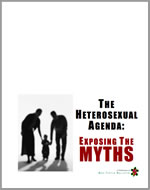 At last, the truth can now be told.
Using the same research methods employed by most anti-gay political pressure groups, we examine the statistics and the case studies that dispel many of the myths about heterosexuality. Download your copy today!
And don‘t miss our companion report, How To Write An Anti-Gay Tract In Fifteen Easy Steps.
 Anti-gay activists often charge that gay men and women pose a threat to children. In this report, we explore the supposed connection between homosexuality and child sexual abuse, the conclusions reached by the most knowledgeable professionals in the field, and how anti-gay activists continue to ignore their findings. This has tremendous consequences, not just for gay men and women, but more importantly for the safety of all our children.
Anti-gay activists often cite the “Dutch Study” to claim that gay unions last only about 1½ years and that the these men have an average of eight additional partners per year outside of their steady relationship. In this report, we will take you step by step into the study to see whether the claims are true.
Tony Perkins’ Family Research Council submitted an Amicus Brief to the Maryland Court of Appeals as that court prepared to consider the issue of gay marriage. We examine just one small section of that brief to reveal the junk science and fraudulent claims of the Family “Research” Council.
 The FBI’s annual Hate Crime Statistics aren’t as complete as they ought to be, and their report for 2004 was no exception. In fact, their most recent report has quite a few glaring holes. Holes big enough for Daniel Fetty to fall through.
“Google” is a trademark of Google Inc.
© Box Turtle Bulletin. All Rights Reserved.

 Posts
Posts  Posts via daily email: