Box Turtle Bulletin
 News and commentary about the anti-gay lobby
“Now you must raise your children up in a world where that union of man and box turtle is on the same legal footing as man and wife…”
News and commentary about the anti-gay lobbyFebruary 4th, 2013

From the man who thought he was going to be president: (World Net Daily – a very appropriate place for Rick Santorum)
Scouting prepares boys and teenagers to be virtuous men in a world that desperately needs men who are brave enough to stand up for those principles, to live by the moral code of the Scout Oath and Law and hold themselves to that standard – whether at the schoolyard or in the boardroom. Scouting may not survive this transformation of American society, but for the sake of the average boy in America, I hope the board of the Scouts doesn’t have its fingerprints on the murder weapon.
The Box of Rocks came out of retirement to note that wacky hyperbole is beneath its dignity.
February 4th, 2013
Self-described Catholic blogger Brandon Vogt recently published Rebuttals to arguments for same-sex marriage. He tries to disprove 10 common same-sex-marriage arguments, but merely highlights the most common mistakes of his own camp. I’m addressing each of his 10 points in separate posts as a kind of back-to-basics review of our opposition.
This time Vogt tries to deal with weakest link in “traditional marriage” reasoning. But the weakness is fatal, and he can’t raise the dead.
Vogt writes:
6. If same-sex couples can’t marry because they can’t reproduce, why can infertile couples marry?
This argument concerns two relatively rare situations: younger infertile couples and elderly couples. If marriage is about children, why does the state allow the first group to marry? The reason is that while we know every same-sex couple is infertile, we don’t generally know that about opposite-sex couples.
Really? That’s the reason? You’re saying you let infertile couples marry simplybecause you don’t know it? That if you did know, then you’d be happy to ban their marriages?
You’re saying if it weren’t for those pesky medical privacy laws, you’d go up to women who’ve had hysterectomies and say, “You! No marriage for you!” When would you do this? When they’re in their hospital beds recovering? A form letter when they got home? Or would you let them get all the way to city hall before you turned them away with a scoffing laugh?
Surely you don’t mean this. Surely you’re not saying the only reason you aren’t so callous and cruel is that it’s not practical!
Oh, but apparently you are:
Some suggest forcing every engaged couple to undergo mandatory fertility testing before marriage. But this would be outrageous. Besides being prohibitively expensive, it would also be an egregious invasion of privacy, all to detect an extremely small minority of couples.
Another problem is that infertility is often misdiagnosed. Fertile couples may be wrongly denied marriage under such a scenario.
I get it. I can hardly believe it, but I get it. You’re willing to let this “extremely small minority of couples” to marry only because stopping them would inconvenience the worthy couples.
But, no, I still don’t buy it. Not only would you have to be a sadist, but there’s also this: you’re willing to let elderly couples marry when we know they’re infertile, so you must not be the monster you appear.
Or are you?
But why does the government allow elderly couples to marry? It’s true that most elderly couples cannot reproduce (though women as old as 70 have been known to give birth). However, these marriages are so rare that it’s simply not worth the effort to restrict them.

Face Palm
Credit: dancerher@deviantart.com
So now you want us to believe you’d be perfectly fine going up to your widowed grandmother and saying, “You! No marriage for you!” and the only reason don’t is that…”it’s simply not worth the effort to restrict them.”
Ha ha ha ha ha ha ha. That’s — wait…
Ha ha ha ha ha ha ha.
That’s funny. Start with the logistics: We already check people’s identification and age when they apply for a marriage license, so there’d be no extra effort there. City clerks might even be relieved — they could just say, “Sorry,” and get back to the rest of their work. One less form to process. Also, if the restriction were enforced, elderly folk might stop showing for licenses altogether. Restricting marriage rights for the elderly would end up saving us a good deal of effort.
At this point I think Vogt is just making up crap in desperate attempt to plug the biggest and leakiest hole in his boat. I’m not saying he’s dishonest. I bet he believes this crap he’s making up, but once again I have to wish: if only we had a word for an aversion to homosexuality so powerful that it interfered with one’s ability to reason!
To be fair, Vogt doesn’t stop there.
Also, elderly marriages still feature the right combination of man and woman needed to make children. Thus they provide a healthy model for the rest of society, and are still capable of offering children a home with a mother and a father.
Okay. To start with, elderly couples are exactly the wrong combination of man and woman needed to make children. I’m not just playing with his words here. If the point is to model the appropriate marital couple for procreation, especially for the next generation, this fails completely. Suppose young children ask, “If marriage is about making babies, then why can grandma marry her boyfriend,” and they’re told “Because grandma and her boyfriend are the right combination for making children.” A sensible child will shut that down with a solid, “Nuh uh!” And a less sensible child will merely be confused — which is exactly what Vogt was trying to avoid in the first place.
As for this notion that an elderly couple is capable of offering children a home with a mother and father, I have to ask: How many of these couples? And for how long? Vogt needs to remember that every single time his side offers us a study on the dangers of same-sex parenting, it turns out the study didn’t analyze same-sex households, but is instead based on opposite-sex households that didn’t hold together, households where the parents were split up by divorce, separation, or death. The science our opponents rely on actually suggests it would be best to place children in a home with a low risk for instability, which means an 80-year-old newlywed straight couple has no advantage over two 35-year-old same-sexers in a long-term relationship.
Perhaps I’ve mocked Vogt too much on this one. To confess, it’s one of my favorite topics: nowhere do our opponents expose their inhumane, ridiculous nonsense as when they’re trying to explains why infertile straight couples can marry while infertile gay couples cannot.
Tomorrow: Will same-sex marriage hurt children?
February 4th, 2013

Boy Scout Handbook, 2nd ed. (1914-1916), with cover art by the famous gay illustrator J.C. Leyendecker.
TODAY’S AGENDA:
Boy Scouts of America Begins Annual Board Meeting: Irving, TX. The Boy Scouts of America’s governing board is set to convene its annual meeting today. One item on the agenda for the three day confab is a proposed elimination of the Boy Scout’s ban on gay scouts and scout leaders, and replacing it with a policy which will allow local troops to decide for themselves whether to discriminate against gay people. There is some disagreement in the LGBT community over whether to support the proposed change or press for a new policy that would prohibit discrimination across the board. Right now, it looks like the incremental approach will win the day — even though it’s not clear exactly which day it will be. We should expect an announcement sometime between today and Wednesday. If I were a betting man, I’d guess today, just so they can settle things once and for all the time being.
TODAY IN HISTORY:
AIDS Cases Discovered from 1976: 1988. Common wisdom today, even with all that we know about the history of the epidemic, still often sets the start of AIDS with the June 1981 report from the Centers for Disease Control and Prevention describing five gay men who had died of a mysterious disease in Los Angeles. When the HIV virus was isolated in 1984 and a test for the virus became available in 1985, several avenues of research opened up to try to figure out where this virus came from. Doctors in Paris and Brussels, who had long been treating wealthy African patients from their former colonies bearing all of the hallmarks of the new disease, pointed to Africa as a possible source for the virus. On February 4, 1988, the New England Journal of Medicine published a report by Dr. Nzila Nzilambi from Kinshasa, Zaire and other doctors from Belgium and the CDC which strongly suggested an African source of the virus, and revealed that AIDS had been a persistent health problem in rural Zaire as early as the mid 1970s.
In 1976, there had been an outbreak of Ebola in the northeastern Zaire province of Équateur along the Congo river. In the course of the medical investigations, hundreds of serum samples were collected from people throughout the area. Those samples remained preserved Zaire and were flown to Atlanta for testing. Investigators then went back out to Équateur in 1986 and collected more samples from as many people as possible, 388 in all. Ninety of them had also been among the 659 samples collected in 1976. Five of the samples from 1976 tested positive for HIV. Two were still alive; one was healthy, but the other was already showing signs of a suppressed immune system. Three were dead. One woman tested positive in 1976 was confirmed dead, “after a prolonged illness characterized by weight loss, fever, cough, and diarrhea” — all common symptoms of diseases associated with AIDS. Another woman “died in 1981 after a long illness associated with fever, weight loss, skin rash, and oral lesions.” Again an apparent death from AIDS. The third was a child who was seven years old in 1976, who in 1981 “died of pneumonia and weight loss at the age of 16.”
The doctors concluded: “The results of our study showed that HIV infection was already present in an isolated area of the Équateur province of Zaire in 1976 and that the prevalence of infection in the general population there did not change significantly over the 10-year observation period.”
If you know of something that belongs on the agenda, please send it here. Don’t forget to include the basics: who, what, when, where, and URL (if available).
And feel free to consider this your open thread for the day. What’s happening in your world?
February 3rd, 2013
TODAY’S AGENDA:
Events This Weekend: Winter Pride, Killington, VT; Midsumma, Melbourne, VIC; Rainbow Reykjavik Winter Festival, Reykjavik, Iceland; Regenbogenball (Rainbow Ball), Vienna, Austria; Gay Whistler, Whistler, BC.

Portriat of Gertrude Stein by Pablo Piccaso
TODAY’S BIRTHDAY:
Gertrude Stein: 1874. I guess you could say she was a bon vivant’s bon vivant. She would say a “rose is a rose is a rose is a rose.” She was, in any case, the embodiment of a life of art, and the art of life. The novelist, poet, and art collected literally defined — and named — the “Lost Generation” of illuminati who frequented the Parisian salons of the early twentieth century. Her art collection was particularly bold, including works by Renoir, Mattise, Picasso, Gauguin, Cézanne, Toulouse-Lautrec, and many other notable impressionists, post-impressionists and other contemporary artists. In 1903, she wrote one of the first personal coming-out stories in her autobiography QED, although it wasn’t published until 1950, four years after her death. Her longtime relationship with Alice Toklas however was nobody’s secret. They met in 1907 and remained together for the rest of Stein’s life. Ernest Hemingway, who himself was among the glitterati at Stein and Toklas’s salons, wrote of Toklas as Stein’s wife, and remarked that when Hemingway and his wife visited, Stein and Hemmingway would visit together and leave the “wives” to chat with each other.
If the pre-war year brought out the best of Stein’s contributions to the arts, her politics during World War II brought out the worst. Her politics always included progressive feminism and anti-patriarchal ideals, but she was also, simultaneously, stridently conservative and reactionary. She hated F.D.R. and publicly supported Generalissimo Francisco Franco during the Spanish Civil War. In 1934, she said in a New Yorker interview that Hitler deserved the Nobel Peace Prize. When Hitler invaded France, she became a supporter of the Vichy leader Philippe Pétain. When she agreed to translate Pétain’s speeches into English, she wrote an introduction comparing him to George Washington. All this, despite Stein’s Jewish parentage. Some have defended her support for Vichy France as a tactic to preserve her own life, yet Stein continued to praise Pétain after the war.
That praise however didn’t last long. Stein died in 1946 from stomach cancer at the age of 72. Toklas survived her by another twenty-one years. They are buried next to each other in Père Lachaise Cemetery in Paris.

Nathan Lane: 1956. He’s been in a few films and television shows, but he’s mainly known for his work on Broadway, with roles in The Producers, Guys and Dolls, and A Funny Thing Happened on the Way to the Forum. His big break though was in film, playing opposite Robin Williams in The Birdcage. He also reprised his Broadway role for the film version of The Producers. When Lane came out to his mother at age 21, she responded, “I’d rather you were dead.” Lane replied, “I knew you’d understand.” When a reporter asked if he was gay, Lane said, “I’m 40, single and work a lot in the musical theater. You do the math.”
If you know of something that belongs on the agenda, please send it here. Don’t forget to include the basics: who, what, when, where, and URL (if available).
And feel free to consider this your open thread for the day. What’s happening in your world?
February 2nd, 2013
2012 was a tough year for the National Organization for Marriage. Will they react by pulling back to moderate their goals, or will they thrash about, careening desperately into greater and greater extremism?
Now we know.
NOM does not want the Boy Scouts of America to allow gay scoutmasters. What this has to do with promoting a healthy marriage culture, I can’t say. But NOM prez Brian Brown is emphatic:
…the Scouts are considering a proposal to abandon their longstanding national policy, and instead leaving the decision of allowing homosexual scout leaders to each individual council.
As we know from the marriage battle, capitulation is not a strategy for preserving our cherished values. When homosexual activists demanded “rights” and “benefits” many well-meaning policymakers responded with “civil unions” and “domestic partnerships,” believing that this “compromise” would preserve marriage while providing tangible benefits for same-sex couples. Though many in the gay community lobbied for these changes, once enacted they quickly adopted a strategy of condemning them as “second class” and used them to successfully file lawsuits redefining marriage.
Even though their supporters have relentlessly pressured the Boy Scouts to admit openly homosexual men as scoutmasters with the responsibility of mentoring America’s youth, the Human Rights Campaign (HRC) now says the “compromise” the Boy Scouts are considering does not go nearly far enough.
They will settle for nothing short of capitulation – homosexuality-affirming troops in every locale across America, tolerating no exceptions, period. Any parent or young man who holds a traditional Judeo-Christian view of sexual morality will be attacked as bigoted and accused of discriminatory conduct. You can imagine the lawsuits that will follow.
The BSA Board of Directors will be voting very soon on this new policy proposal — perhaps as early as Monday — and they are seeking public input into their decision. We need to make it clear that compromising honorable values is no path to organizational victory.
Actually, I can’t imagine the lawsuits that will follow. Despite NOM’s victim project, it’s never shown us a lawsuit in the U.S. based simply on someone holding a traditional Judeo-Christian view of sexual morality. This is their great fundraising fiction. Perhaps that explains why they have such money problems.
Let’s be clear on why Brian’s all a-flutter.
The Boy Scouts are not being required by law to stop discriminating.
They are not instituting a national non-discrimination policy.
They are not recommending that any local council stop discriminating.
They are merely pondering whether to let local councils decide for themselves.
And Brian Brown is freaking out. He’s drawing a battle line here and we should note it. I’ve searched for anything that would make Brian’s argument unique to the Boy Scouts, and I can’t find it. He’s made a case, right or wrong, that it’s a threat to religious liberty for private organizations to have no official policy on anti-gay discrimination. Brian’s reasoning — and correct me if I’m wrong — implies there is only way to protect religious freedom: make sure everybody out there implements and enforces a mandatory policy of discrimination against gay and lesbian people.
This is Dark Ages stuff. In Brian Brown’s utopia, no one will dare sue for anti-gay discrimination because no one will dare reveal themselves as gay. No one will come out to their friends. No one will acknowledge their partner. Because every group, every charity, every employer will have a mandatory no-gay policy. Anything less is “compromising honorable values” and opening good people up to lawsuits just for holding a belief.
And he wonders why we worry about second-class status.
February 2nd, 2013

Today the French Parliament voted on a key element of the marriage bill. (France24)
France’s marriage equality bill cleared its first and main hurdle on Saturday when lawmakers overwhelmingly approved the most important article of the new law, redefining marriage as an agreement between two people of opposite or same sex.
…
The article was approved 249-97, with most deputies from the ruling Socialist Party (PS) voting in favour, and all but one of the conservative UMP party’s representatives voting against. The two far-right National Front (FN) deputies opposed the bill, and the party called on its supporters to join Catholic-driven protests against it.
Such a strong majority suggests that the bill is certain to pass on February 12th.
February 2nd, 2013
Two of the largest and most influential LGBT advocacy groups, the Gay and Lesbian Alliance Against Defamation and the Human Rights Campaign, are in disagreement over the new proposed Boy Scouts of America policy. If the proposal passes, the Boy Scouts would no longer bar gay youth or gay leaders from the organization. Instead, they would allow each unit to decide for itself whether or not gay youth or leaders could participate.
GLAAD finds this to be a good first step in the direction of full inclusion. HRC finds it simply unacceptable that any troop could be allowed to continue excluding gay people. I find myself in agreement with GLAAD.
I guess it comes down to how one defines ‘victory’; whether its a matter of achieving goals or a matter of vanquishing foes.
For me the goal is that those parents, troops, and sponsors who value inclusion and oppose discrimination have the ability and right to live and operate according to their values. This has been their fight as much as our own.
Others will not be inclusive, and should not be forced to be. The values of those who do not want their children to be taught that same-sex relationships are religiously or socially acceptable may not garner our respect, but the right to hold those value should.
And the truth is that we have won the war. In time, all Scout troops will welcome youth and leaders irrespective of their orientation. Many have been clamoring for the chance and many more will find it both easier and financially necessary.
So let us be gracious in our victory, kind to those who see their values rejected, and respectful of their rights. Let’s prove that society has chosen wisely.
February 2nd, 2013
TODAY’S AGENDA:
Events This Weekend: Winter Pride, Killington, VT; Midsumma, Melbourne, VIC; Rainbow Reykjavik Winter Festival, Reykjavik, Iceland; Regenbogenball (Rainbow Ball), Vienna, Austria; Gay Whistler, Whistler, BC.
THIS MONTH IN HISTORY:
Why Should It Be a Crime To Dress As You Please?: 1884. The following letter to the editor appeared in the February 1884 edition of the journal Alienist and Neurologist (an alienist is an archaic term for a psychiatrist). The letter was notable for two reasons. Nearly all letters to the editor were routinely signed, but this one is kept anonymous. And it is also a very rare early example of an American writer, apparently a professional, asking whether those who don’t conform to the rigid gender roles of the day should be left alone (or at least relatively alone) and not treated as a criminal:
MR. EDITOR: — Will you kindly permit me to say a few words about Sexual Perversion, in reply to Dr. Rice’s paper. The latter says that it has but little forensic interest in this country, and I beg to differ with him. In the first place, it is quite generally admitted that lunatics and maniacs are not responsible, and irresponsible people are not to be punished for a thing that they cannot help doing.
When a man dons female attire, or vice versa, he either has an object or he has none. If he has an object, it may be good, bad or indifferent. If it is to conceal past crime, or as an aid to future crime, it is bad, and deserves punishment. If he seeks the disguise to enable him to ferret out a crime, the object is praiseworthy, — detectives are allowed it. In the third case, it must be said that the sole object is pleasure or satisfaction of some sort. Crime may be a pleasure to some, but if we exclude all evil intent, is it not harmless? Another case that resembles, sometimes one and sometimes another of the above, is when it is done for a livelihood; women give this as an excuse, a plea to be allowed men’s dress; men rarely.
Quite a large number of cases are occurring in all large cities, of persons arrested for dressing like the opposite sex. But few are criminals; many are highly respectable and honorable. Should they be punished as criminals? If the object is good, No! If bad, Yes! If neither, what then?
It is self-evident that no sane man will take the pains and go to the expense of obtaining a full set of female attire, and persist in the practice of wearing it until he becomes expert in its uses, initiating himself into all the mysteries of a lady’s toilet, submitting voluntarily to the tortures of tight corsets and high-heeled boots and false hair, hoops, pull-backs and frizzes, unless impelled thereto by some motive stronger than mere mischief. There can be no doubt in my mind that such a miserable being deserves pity rather than punishment. There have been several arrests in this city within five or six years for wearing female attire, and I believe nearly all the victims belonged to that innocent class, since no other object or purpose was ever proved against them.
Why should it be a crime, to dress as you please? The dress itself inflicts punishment enough on its wearer. No one but the wearer is injured, nor need others be any the wiser for it. Certain it is that many of these poor people have suffered severe punishment at the hands of our judges, and with no one bold enough to defend them.
Is it not sad enough that they must suffer daily between two fires — love of this dress, and fear of punishment, which they have known to be swift and certain? Would the world be any the worse for allowing them this little modicum of comfort, the only pleasure they have in life, under proper restrictions? What these restrictions should be I am not prepared to say. Perhaps an asylum or retreat might be provided, where they could resort when these paroxysms came on, and there enjoy (?) in seclusion from the public eye, where the law could not reach them, such indulgences as might be deemed proper, or compelled to follow these practices until they were thoroughly cured of such desires. I know of one case, at least, that would be benefited, perhaps cured, by suitable treatment of this sort. I should be glad to hear the opinion of those of greater experience than myself.
E.J.H.
[Source: E.J.H. (Anonymous) “Correspondence.” Alienist and Neurologist 5 no. 2 (February 1884): 351-352. All italics and parentheticals in the original.]

TODAY’S BIRTHDAY:
Havelock Ellis: 1859.When it came time to chose a career, he chose an unorthodox one for a Victorian Englishman: that of a sexologist. To prepare, he studied to be a physician. When he joined the Fellowship of the New Life, a social group influenced by Emerson and Thoreau, he met Edward Carpenter, whose unabashed homosexuality must surely have been a great influence on him. Another influence: his wife, women’s rights activist Edith Lees, who was openly lesbian, and who insisted on an open marriage, an arrangement to which he readily agreed although he himself was impotent until the age of 60. When in 1896 he co-authored the first installment of his six-volume Studies on the Psychology of Sex, that volume, titled Sexual Inversion became the first English medical textbook on homosexuality. He originally published it in German, and then translated it into English in 1897 in a bid to avoid British censors. German scholars, by then, had already written several influential works on homosexuality, making German the de facto language of sexology. It was thought that by translating a German work, censors might look the other way as they had for other publications of continental origin. They didn’t. A bookseller was prosecuted for stocking Sexual Inversion, but the charges were eventually thrown out.
Ellis can claim several firsts. He was the first to study what we today recognize as transgender identities as a distinct phenomenon from homosexuality. He is also credited for creating the ideas of narcissism and autoeroticism, concepts which were later adopted by psychoanalysis. He is also often credited for introducing the word “homosexual” into the English language, but in fact he hated the word. Made up of a mixture of Greek and Latin roots, he complained, “‘Homosexual’ is a barbarously hybrid word, and I claim no responsibility for it.” He wrote instead about “sexual inversion,” and in ways that no major English writer had done before: as an objective field of study without characterizing it as a disease, immorality or a crime.
If you know of something that belongs on the agenda, please send it here. Don’t forget to include the basics: who, what, when, where, and URL (if available).
And feel free to consider this your open thread for the day. What’s happening in your world?
February 1st, 2013
 In 1981, Hudepohl Beer was beer to Cincinnati as Rolling Rock was to Pittsburgh and Coors to Denver. Locals called it Hudy; it was the brew of Cincinnati’s working class. Its name was emblazoned on the windows of the city’s thousands of “pony kegs” (what locals called the neighborhood small grocery or package store), and the call of its vendors was an iconic part of the soundtrack for every Reds and Bengals’s game at Riverfront Stadium. “Hudaaaay… here!” The vendors called it out in a particular sing-sing, with their voices dipping on the second syllable and trailing off, almost, before punching the air with a sharply rising “here!”
Hudy drinkers that year had much to celebrate when the ever-suffering Bengals were suddenly transformed into a real, honest-to-God Super Bowl contender. Cincinnati suddenly had Super Bowl fever and everyone was sporting the orange and back stripes. The city hadn’t seen that kind of excitement since the Big Red Machine of the mid-1970s. But here they were, going crazy once again, this time over professional football, no less, in what had been a dyed-in-the-wool baseball town.
That winter was blistering cold. The conference championship game at Riverfront Stadium against the San Diego Chargers (Bengals: 27-7) broke the record for the coldest game in NFL history (air temperature: -9°F, wind chill with sustained 27 mph winds: -34°F.) We were tough; those pampered SoCal wimps couldn’t cut it. Notice, I said “we.” A winning football team, particularly one that’s Super Bowl bound, has a way of unifying the most unlikely people, even closeted nerdy engineering student fags like me who knew next to nothing about sports. But that year was different: Quarterback Ken Anderson, the (adorable) wide receiver Chris Collingsworth, Anthony Muñoz, Pete Jackson, Dan Ross. I could recite those name and actually sound like I knew what I was talking about, like never before or since. Look at me, I remember thinking, being all sports fan-ny and shit. And we all joined in with the rallying cry, inspired by the Hudy call we heard at the stadium all our lives: “Hooday! Hooday! Hooday think gonna beat them Bengals?”
Leadups to championship games like this have a way of unifying a community in ways that are nearly impossible by any other means. Cincinnati is a city of neighborhoods, and residents are much more likely to identify themselves accordingly rather than as Cincinnatians. But for one season, whether they were transplanted Appalachians of Lower Price Hill or the old families of Mt. Storm, the down-in-the-heels denizens of Over-the-Rhine or the the urban pioneers of Mt. Auburn, the Proctor and Gamble executives downtown or the auto workers building Camaros in Norwood, the Hudy drinkers of Western Hills or the Chablis sippers in Hyde Park or the disco queens and their Long Island Iced Teas at the Lighthouse discotheque in Clifton, everyone had that moment of common cause. Even on the fractious city council, with the Kennedy-esque Jerry Springer (seriously, I kid you not! What happened since then is still a mystery) and the increasingly arch conserviative Ken Blackburn (now a pundit at the Family “Research” Council), they finally found that one thing they could all agree on.
And during those weeks of universal camaraderie, jocks in the bars would turn to me — me! — and smile — sure, they smiled because they were drunk, and they looked at me just because I happened to be standing in some random direction outside of their huddle, but who cares? — they looked at me, smiled, hoist their Hudys and shouted, “Who dey think gonna beat them Bengals?” Gee, nobody had ever asked me that before. But I knew the answer, along with everyone else, and the entire bar would erupt with “Who dey! Who dey! Who dey think gonna beat them Bengals?”
It turned out the 49ers did, in a heartbreaking Super Bowl in Pontiac, Michigan. The score was 26-21, a score made respectable only by two late Bengals touchdowns in the fourth quarter. Those ’49ers. God, we loved hating them, but they played a good game. And then everything more or less went back to normal in Cincinnati. But for most of an unforgettable football season, everything had changed, and I still get goose bumps writing this.
 This Sunday, the 49ers will play the Baltimore Ravens in Super Bowl XLVII in New Orleans. Ordinarily that should be a great focus of pride and unity for the city and all its residents. But the 49ers seem to be going out of their way to alienate a very significant part of that community. On Tuesday, 49ers cornerback Chris Culliver was on the Artie Lange Show, where he was asked if there were any gay players on the team. Culliver made it very clear that there were none and there wouldn’t be any: “I don’t do the gay guys man. I don’t do that. No, we don’t got no gay people on the team. They gotta get up out of here if they do. Can’t be with that sweet stuff. Nah, can’t be in the locker room man.”
He later apologized, and people started to try to move on. But then suddenly, yesterday, linebacker Ahmad Brooks and nose tackle Isaac Sopoaga, who participated in the ’49ers’ “It Gets Better” video last year — making the ’49ers the first NFL team to make such a video — denied taking part in it:
“I didn’t make any video,” Brooks said. “This is America and if someone wants to be gay, they can be gay. It’s their right. But I didn’t make any video.”When told USA TODAY Sports had seen the video and he was in it, Brooks replied, “I don’t remember that. I think if I made a video, I’d remember it.” He was shown the video on an iPhone.
“Oh, that. It was an anti-bullying video, not a gay (rights) video,” he said.
When told that studies show that the majority of teens who are bullied are harassed over sexual identity issues, Brooks thought for a second. “I know that. I know that,” he said. “Okay, you’re right and I’m wrong. Are you from one of those New York newspapers?”
…Sopoaga, too, denied making the video, even while teammate Will Tukuafu, who overheard the question, tried to refresh his memory. “Yeah, you made that video, remember?” Tukuafu said.
“No,” Sopoaga said. “I never went. And now someone is using my name.” Sopoaga was shown the video. “What was that for?” he asked.
To ask teens to stop bullying other teens because of sexual identity, he was told.
“Yeah, OK,” he said. Would you like to comment on it, he was asked. “No,” he said.
Dan Savage, who spearheaded the “It Gets Better” project, pulled the 49ers’ video from the web site. The 49ers’ organization disavowed Culliver’s earlier comment but has remained silent over the latest controversy. I gotta tell you, I love San Francisco. I love the people, the energy, the night life, the compactness, the walkability, the museums, everything. I even like the Muni. But I am so incredibly thankful I’m not a San Francisco resident right now. If I were, I’d have to find some other way to spend Super Bowl Sunday where I’m not surrounded by people cheering on the ’49ers. And I’d probably yearn for a Hudy and the memories of better times.
February 1st, 2013
TODAY’S AGENDA:
Events This Weekend: Winter Pride, Killington, VT; Midsumma, Melbourne, VIC; Rainbow Reykjavik Winter Festival, Reykjavik, Iceland; Regenbogenball (Rainbow Ball), Vienna, Austria; Gay Whistler, Whistler, BC.
TODAY IN HISTORY:
Los Angeles Police “Purity Squad” Raids Private Party: 1920. Angelinos awoke to an odd story in that day’s Los Angeles Times:
Twenty Los Angeles men, some said the be prominent in social and business circles, were arrested last night by the police at a stag party in the home of Former Mayor Harper and were booked on the charge of social vagrancy.
Seven of the men, including the host, Joseph Harper, 24 years old, are alleged by the officers making the raid to have been gowned in feminine apparel.
The house, at 1128 West Twenty-eights street, was surrounded when the gaiety was at its height.
Just after the police had raided the residence, Ex-Mayor Harper and Mrs. Harper arrived home. They had returned, unexpectedly, from a trip to Bakersfield. Mrs. Harper was prostrated by the incident and became hysterical. Mr. Harper also was overcome with emotion.
…According to Police Sergeant Gifford and the officers of the “purity squad” who conducted the raid, a degenerate orgy was in progress when they entered the house.
Two naval petty officers and two unlisted sailors, whose names were withheld by the police were at the “party” in uniform, it is said.
The four naval personnel were the only ones accorded the courtesy of their names not being released to the press. For everyone else, The Times dutifully noted in the next two paragraphs party-goers’ names, addresses and occupations, with the first paragraph listing the six who were “all taking ‘female’ parts in the party,” and the second listing those who “remained in male attire.” The following day, The Times carried a much more lengthy account:
Two of the score of prisoners were released on bail yesterday, eight of them were ordered held without bail after they failed to pass the medical quarantine examination, and the other ten are being held in various tanks and cells, some still awaiting masculine clothes to take the place of the feminine finery which Purity Squad officers unceremoniously removed from them in the jail.
The ever-diligent Times then went on to list the names, addresses and occupations of everyone who “failed to pass the medical examination for infectious disease,” those who were released on bail, and those who remained in jail. Former Mayer Harper, whose son was released on a $500 bond, told reporters: “I believe absolutely in my son’s innocence. I wouldn’t say that the police are misrepresenting the facts, but I reserve for myself a few opinions along that line.” The Times, having gotten that quick statement out of the way, then went on to describe some of the more titillating details:
Central Police Station buzzed with activity all through the night and the day yesterday. Early in the morning, after Jailer Shand arrived, he and his assistants went upstairs to the big tank and began stripping eight of the “guests” of the female attire in which they had draped themselves.
The dresses, some of them very costly and elaborate, were unceremoniously packed into suit cases and marked as evidence. Some of the men were supplied with bathrobes and others had to content themselves with jail blankets.
The arresting officers yesterday related the details of the raid and the evidence they assert they have to substantiate their charges. News that the party was to take place Saturday night was received about two weeks ago, they stated. At that time, the officers say, there was another party at which some of the men arrested Saturday were present.
Arrangements were made to have some of the officers in the house. While the scheme of the operation was not disclosed, it was whispered yesterday that at least one of the purity squad’s experts was under a bed in one of the rooms, another one was among the original members of the party wearing a uniform, and a third member managed to get into the house at the last hour. The officers say liquor was served int he shape of punch, and that there was music and much hilarity.
In an odd turn two months later, the charges in the Harper raid were dropped due to “confusion” and the fact that an “important witness is said to have disappeared.”

TODAY’S BIRTHDAY:
Langston Hughes: 1902. He was one of the innovators of a new form of poetry: jazz poetry. Born in Joplin, Missouri, he moved to New York City to attend Columbia, but was more interested in the goings-on in Harlem. He traveled throughout the world, and while his writings reflect those travels, he remained rooted in the experience of the Harlem Renaissance. His 1934 collection of short stories, The Ways of White Folks
February 1st, 2013
Self-described Catholic blogger Brandon Vogt recently published Rebuttals to arguments for same-sex marriage. He tries to disprove 10 common same-sex-marriage arguments, but merely highlights the most common mistakes of his own camp. I’m addressing each of his 10 points in separate posts as a kind of back-t0-basics review of our opposition.
I think the traditional marriage folks have really messed up.
One of their biggest bugaboos is that same-sex marriage creates a slippery slope to polygamy. In fact, though, their own rationale for “traditional marriage” makes a strong case for plural marriage. And the “unintended procreation” argument they’ve just offered the Supreme Court? It only compounds the problem.
Let’s start with Vogt’s rebuttal of “our” argument.
5. Same-sex marriage will not lead to other redefinitions.
When marriage revolves around procreation, it makes sense to restrict it to one man and one woman. That’s the only relationship capable of producing children. But if we redefine marriage as simply a loving, romantic union between committed adults, what principled reason would we have for rejecting polygamist or polyamorous — that is, multiple-person — relationships as marriages? Thomas Peters, cultural director at the National Organization for Marriage, doesn’t see one. “Once you sever the institution of marriage from its biological roots, there is little reason to cease redefining it to suit the demands of various interest groups,” Peters said.
This is crazy. It’s not just nonsense. It’s one of those cases where making your argument more clear just makes it more absurd.
Let’s imagine an outsider listening to this, someone with no preconceived notions about polygamy. He hears this talk about marriage’s biological roots, that its purpose is to keep a child’s biological parents together. He learns that some men have children with two different women. And that some women have children with two different men. What would this impartial, logical stranger conclude?
He’d conclude that the man should be married to both women. The woman should be married to both men.
Yes.
And consider this: whenever our opponents pretend to give us “science” about the dangers of same-sex parenting, they’re always citing studies about children from broken hetero homes, children whose biological parents don’t live together. So if you argue that all children should have married biological parents, then you require polygamous marriage.
But let’s be fair. Try to imagine our opponents’ response. They’d argue these case are unfortunate. They go against the world as it should be. They are unintended exceptions. And we don’t build the law around exceptions.
The problem is that our opponents are building their Supreme Court case on exactly the opposite idea. See, they’re desperate to distinguish opposite-sex relationships from same-sexers. But it’s harder now that more same-sexers are having and raising children. So they’ve been forced to focus on another distinction: the fact that only opposite-sex couples can have kids by accident. From their brief to the Supreme Court:
Underscoring the state’s interest in marriage is the undisputed truth that children suffer when procreation and childrearing take place outside stable family units, which is the usual result, unfortunately, of unintended pregnancies outside of marriage… Indeed, a recent study estimates that divorce and unwed childbearing “costs U.S. taxpayers at least $112 billion each and every year, or more than $1 trillion each decade.”… Because same-sex relationships cannot naturally produce offspring, they do not implicate the State’s interest in responsible procreation and childrearing in the same way that opposite-sex relationships do. Same-sex relationships “are thus different, immutably so, in relevant respects” from opposite-sex relationships for purposes of marriage.”
I’m not a lawyer, so I won’t analyze the legal merits of this argument. I’ll simply point out that it’s an argument for polygamous marriage, for getting all those biological parents under the same roof, not shacking up, but group married. If a man can have “unintended pregnancies outside of marriage” with multiple women (and he can), then the state has an interest in promoting his marriage to multiple women — according to this reasoning.
This isn’t a problem for those of us who recognize that marriage is more than a government breeding program, that it’s about having a partner you can depend on, who is committed to you above everyone else — who is the first to lift you up when you fall, to warm you when you are cold, forsaking all others, as long as you live. We don’t have worry about the slippery slope to polygamy. The Marital Biologists do.
This changes the debate. Our opponents chose the arguments they chose. From now on, when they bring up the danger of polygamy, we can turn that burden around and place it on their shoulders. If our opponents are sincere, they can argue against same-sex marriage, or against polygamy, but not against both.
Monday: Vogt contorts himself explaining the difference between infertile opposite-sex and same-sex couples.
Note: I’d love to claim credit for the phrase “government breeding program, but I stole it from a recent commenter and am using it with his permission.
January 31st, 2013
The Wyoming State Senate narrowly defeated a non-discrimination bill. (Trib.com)
The Wyoming Senate rejected a bill today that would prohibit discrimination based on sexual orientation or gender identity.
The standing vote was 13 for the bill and 15 opposed.
January 31st, 2013

Robert Oscar Lopez
Yesterday, I posted this about a couple of unusual Amicus Curiae briefs filed with the U.S. Supreme Court urging the Justices to uphold California’s Proposition 8. One of those briefs, by David Benkof (a self-described gay columnist who opposes same-sex marriage), Robert Oscar Lopez (who describes himself as a bisexual man who was raised by two lesbian mothers and who is currently heterosexually married), and Doug Mainwaring (a man who raised two teenage sons after separating from his wife and coming out gay, and is now back living with his wife), tries to make the case that there is some kind of heretofore undiscovered groundswell of gay people opposing marriage equality. It begins with a statement arguing that “Americans ought not be labeled hateful bigots for opposing redefinition (of marriage).”
I suppose that argument can be made generally, but in Lopez’s case, it’s hard to find another word which would adequately describe his views on the subject. Lopez, an assistant professor in the English Department at Cal State Northridge, posted on this blog last Sunday something that he seems to regard as a major rallying cry. Titled, “Statement: Though I support LGBT dignity, I call on the human rights community to fight human rights violations by LGBT organizations,” it is written in outline form — patterned after other Very Important Declarations which are composed of numbered paragraphs and subparagraphs so that scholars and historians can cite the each Very Important Point without ambiguity. And what a manifesto it is. He begins by arguing that “the democratic process in Western nations and the judicial system of the United States have failed, for over twenty years, to deal in good faith with the bioethical and social-justice problems” posed by LGBT rights advocates. And because of that failure, he calls for some kind of “international intervention”:
II. I state the following without a party affiliation, since I cannot in this case agree with the right wing’s usual resistance to international intervention, nor can I endorse the left wing’s ideology of gay equality, which currently presages a large-scale global human-rights crisis in order to meet the affective demands of gay couples for rights to ownership of children.
…VI. The legal system, academia, the fourth estate, the judicial system, and the political process in the United States have proven themselves inadequate in some cases, grossly negligent in others, totally powerless in some instances, but consistently failing in correcting the human-rights crisis precipitated by the modern LGBT movement and its systematic violation of the rights of children, not only in the United States but also overseas, its continued assault on the dignity of human fatherhood and motherhood, and its increasing complicity with human trafficking, its fraudulent propaganda, its bioethical improprieties, class exploitation, contempt for the democratic process, and violations of the basic principles of free speech, free exercise of religion, and academic freedom.
VII. The time for intervention is now because:1. With the increase in the number of people entering adulthood identifying as gay (see recent Gallup polling), and encouraged by popular culture to acquire children to express their equality, the human rights crisis will worsen. The sheer volume of same-sex couples who view children as an entitlement and who see their need for equality as overriding the rights of others will aggravate the problem.
2. The usual institutions that would normally identify an oncoming human rights crisis and thwart it are malfunctioning in the United States …
Does he want some kind of military or paramilitary intervention? International sanctions? Statement of condemnation from the United Nations? He doesn’t say, but we do know why. In this piece posted the same day at American Thinker, where he links to his manifesto as a supporting document, he describes what he calls “the oncoming human rights crisis… caused by the LGBT movement.” As Lopez sees it, that crisis manifests itself in the children that gay couples are raising, which Lopez calls “human trafficking“:
The movement to liberate same-sex love began because people loved each other. Somehow, through convoluted digressions, it has become a tyrannical octopus seeking to control life and death itself.
The Rubicon was crossed when the gay movement sided with human trafficking; graft-ridden dirty deals with warlords for orphanages; bio-engineering, baby-farming, and emotional deprivation of innocent children by forcing them to replace a biological parent with a fictional same-sex partner. Naturally, any child forced into such a psychically traumatic origin fantasy who feels resentful about it will be cursed by its caretakers as not only ungrateful, but also a homophobe.
Lopez describes himself as the son of a lesbian mother who was raised by two women. In this post that he wrote for the Witherspoon Institute in which he praised the Institute’s flawed Regneres paper claiming to study “gay parents,” Lopez contends that his childhood was marred due to the lack of male role models, and claims that he still fails to pick up on what he calls “unspoken gender cues that everyone around me.” That’s why, he says, “I have trouble in professional settings because co-workers find me bizarre.”
Okay.
But whatever complaints he may have against his moms’, whatever pain, anger, scars and traumas he may have experienced as a child, for all we know, they may be wholly legitimate. But whatever reality in which those pains may be grounded evaporates when he deploys his imagination against gay parents, which he charges with facilitating a new “slave trade“:
…The fight for marriage has never been about marriage. Marriage is the only way to have legal cover and shield themselves from criticism for their bioethical stunts.
Market demand is a powerful thing, and it is growing because of the increase in LGBT couples as well as the cultural messages convincing young gays that they will be given children or else society is oppressing them. Here in Los Angeles, I’ve seen the eerie proliferation of designer babies in gayborhoods, and the increasingly anesthetized reaction of gay couples’ friends. People go to third-world getaways to pick out babies, place ads for surrogates who can give them a certain eye color, and even collaborate with human trafficking. Never forgetful of my own pains as a lesbian’s son in the 1970s, I see the faces of these gay couple’s children, and sometimes, I have to run away and cry. I know the dazed glare, the powerlessness of these children, their helpless desire to please their parents, their fear of showing their parents any sign that the arrangement has been hurtful.
And yet, I can scarcely forget, this is only the beginning. While some say “it gets better,” all signs show that it will grow far worse. LGBT activists have been frustrated so far by the largest Western nations’ resistance to legalizing gay marriage. In this table, a Francophone researcher discusses the gay-marriage statistics from Spain, the Netherlands, Belgium, and Quebec. Remember that France, Germany, Great Britain, and Italy, the more populous nations of Europe, have still resisted full marriage equality. Already in tiny Belgium, 5% of marriages are same-sex. What will happen with the combined populations of Germany, France, Great Britain, Italy, and the United States — 570 million people in all — legalize gay marriage, with 5% of that mass being same-sex couples looking to buy babies?
We are staring into the dawn of a new slave trade. Rather than let the Middle Passage happen and then spend centuries trying to exonerate our nation, we must be “on the right side of history.” Stop gay marriage — not because of hate for gay people, but because the machine that is turning people into chattel must be stopped. The only way to break the cycle and wake everyone up is stop gay marriage.
Benkof, Lopez and Mainwaring write in their brief (PDF: 127KB/ 14 pages) to the Supreme Court, “We believe strongly that opposition to gay marriage need not be rooted in hatred towards gay people” and caution the Court against “brand(ing) the views of millions of Americans ‘discriminatory’ or rooted in animus.” But obviously Lopez’s views are rooted in animus, and a very deep-seated one at that. There’s simply no other way to describe it.
January 31st, 2013
Self-described Catholic blogger Brandon Vogt recently published Rebuttals to arguments for same-sex marriage. He tries to disprove 10 common same-sex-marriage arguments, but merely highlights the most common mistakes of his own camp. I’m addressing each of his 10 points in separate posts as a kind of back-t0-the-basics review of our opposition.
In this fourth rebuttal of “our” arguments, Vogt plays the victim:
4. Same-sex marriage won’t affect you, so what’s the big deal?
Since marriage is a relationship between two individuals, what effect would it have on the rest of us? At first glance, it sounds like a good question, but a deeper look reveals that since marriage is a public institution, redefining it would affect all of society.
Fair enough. But will it affect society in a good way or a bad way?
First, it would weaken marriage. After same-sex marriage was legislated in Spain in 2005, marriage rates plummeted. The same happened in the Netherlands.
Crap — this again? The Netherlands case has been thoroughly debunked: marriage rates were declining there long before same-sex marriage was legalized. And as for Spain, yes, marriage rates did drop in Spain, from 206,000 in 2005 to to 157,000 in 2011. Guess what else happened in that time? Unemployment skyrocketed, from 9% to 22%. And in the under-25 age group, it went from 19% to 47%. Are you surprised marriage rates dropped?
Vogt is guilt of the post hoc ergo propter hoc fallacy: the idea that just because A happened before B, A must have caused B. The world’s more complicated than that. Vogt’s argument requires a blinkered view and a predisposition to blame same-sex marriage for everything.
To his credit, though, he does offer a causal hypothesis:
Redefining marriage obscures its meaning and purpose, thereby discouraging people from taking it seriously.
Unfortunately, he offers this up as if it required no further explanation. He assumes, without evidence, that the “meaning and purpose” of marriage is entirely about biological parenting. But we let elderly people into marriage. Some states have laws that allow first cousins to marry only if they can prove they can’t procreate. If these don’t obscure the “meaning and purpose” of marriage, then why will letting same-sex couples marry cause marriage rates to plummet?
Vogt also fails to explain why a public and passionate fight for marriage rights would lead anyone to think less of the importance of marriage.
Also, when it comes to the impact of same-sex marriage on society, I can’t resist quoting District Court Judge James Ware on whether gay judges have some special stake in Prop 8 that should disqualify them from adjudicating it:
In our society, a variety of citizens of different backgrounds coexist because we have constitutionally bound ourselves to protect the fundamental rights of one another from being violated by unlawful treatment. Thus, we all have an equal stake in a case that challenges the constitutionality of a restriction on a fundamental right.
Beautiful. But back to Vogt. He tries this:
Second, it would affect education and parenting. After same-sex marriage was legalized in Canada, the Toronto School Board —
Stop. Sorry. If Vogt’s talking about the consequences in the US, then he’s got to stick with the US. Other countries, with other legal systems and other constitutions, aren’t relevant here. He does, however, bring up one US consequence:
[R]edefining marriage would threaten moral and religious liberty. This is already evident in our own country. In Massachusetts and Washington, D.C., for instance, Catholic Charities can no longer provide charitable adoption services based on new definitions of marriage.
And he gets it wrong. Catholic Charities can still offer charitable adoption services. They’re simply not allowed to discriminate against same-sex married couples. Here’s how it works. Catholic Charities would sometimes turn down unmarried couples simply because they’re unmarried. There’s no law against that. Once same-sex couples could marry, though, Catholic Charities could no longer discriminate against them, because the only reason for disqualifying such couples is their sexual orientation, and there are laws about that.*
Catholic Charities had to choose between placing kids with same-sex couples — which it previously had done! — and not placing children at all. They chose to stop placing children at all, over the objections of their non-clerical board members.
At this point, our opponents claim: Making the Church recognized a legal marriage as valid, in violation of its doctrine, is a violation of its religious liberty. However…
This is a strange and new idea.
This is a strange and new idea.
This is a strange and new idea.
Yeah, I said it three times. Because it’s a strange and new idea. Charities, employers, and other legal entities simply do not have the right to decide which civil marriages they will honor. Religious employers just don’t have the right to say: I won’t offer you spousal benefits because you’re divorced and remarried; because you’re an interracial couple; because your wife isn’t sufficiently subservient to you.
Another example: The Catholic Church recognizes as valid a marriage between two Baptists performed by a Justice of the Peace. Not so between two Catholics; the Church requires Catholics to be married by priests. But as a matter of law, Catholic Charities cannot treat the two couples differently, because that would be religious discrimination.
So, as a matter of law, when it comes to this notion that religious organizations and employers should get to decide which legal marriages they will recognize, and that not having this right is a violation of their liberty…this is a strange and new idea.
Believe it or not, with all the mistakes Vogt has made, there’s deeper error underlying his argument. He’s acting as if these consequences are a result of same-sex marriage. They’re not. They’re a result of anti-discrimination law. The laws in Massachusetts and DC say you can’t discriminate on the basis of sexual orientation. Take those laws away and all these “problems” disappear. Leave those laws in place, though, and many of the same issues will still come up, because the law forbids service providers from saying, “You’re gay [black/ Jewish/ Armenian/ straight/ Christian/ female, etc.] and I won’t serve your kind.”
So, Brandon Vogt, if you have worries about religious freedom, then go before the public and make the case that any religious person, employer, or institution should be allowed to use their beliefs to discriminate — not just against gays — but against anyone at all. And then I’ll believe you’re sincere.
Though I’ll understand if you think that’s a harder sell.
Tomorrow: In what may be a game-changer for the marriage debate, Vogt tries to show same-sex marriage is a slippery slope to polygamy — only to reveal that his beliefs are the ones that could lead us there!
* Some folks on our side say Catholic Charities of Boston could have continued its discriminatory policies if it had stopped taking government funds. This is incorrect. These discriminatory policies violate Massachusetts law regardless of whether the organization is taking taxpayer money.
UPDATE: This may have changed. See comments.
January 31st, 2013
TODAY’S AGENDA:
International Health and Policy Consequences of Sexual Orientation Change Efforts: New York, NY. The first ever United Nations discussion on the legalities, ethics and science behind the movement promoting sexual orientation change efforts (SOCE) and its relationship to human rights will take place today. This historic panel of experts include: Taiko Kleppe, of the UN Office of the High Commissioner for Human Rights; Dr. Jack Drescher, friend of BTB and author of the APA’s position statement on sexual conversion therapy; Sam Wolfe of the Southern Poverty Law Center; Chaim Levin, a survivor and plaintiff in a lawsuit against conversion therapy; Dr. Rebecca Jordan-Young, Women’s, Gender and Sexual Studies at Columbia University; and Pastor Jay Bakker, son of televangelists Jim and Tammy Faye Bakker and pastor of LGBT-affirming Revolution Church.
Events This Weekend: Winter Pride, Killington, VT; Midsumma, Melbourne, VIC; Rainbow Reykjavik Winter Festival, Reykjavik, Iceland; Regenbogenball (Rainbow Ball), Vienna, Austria; Gay Whistler, Whistler, BC.
TODAY IN HISTORY:
Washington Post Publishes “Those Others: A Report on Homosexuality”: 1965. We often talk about 1969, the year of the Stonewall rebellion, as being the pivotal year in the history of the gay rights movement. We even divide our history into “pre-Stonewall” and “post-Stonewall” areas. But as I’ve been putting these posts together, I’ve come to the conclusion that if one had to pick just one single year in which things truly began to change for gay people, the year to really pay attention to would be 1965, as the events of that year laid the groundwork which allowed the transformation which took place after Stonewall possible. The year already started off with a bang when San Francisco police raided a New Years’ Day party attended by straight couples as well as gay (see Jan 1). For the first time, straight people witnessed first hand the police harassment that gay people experienced on a routine basis. That event would have a lasting impact on city politics.
Another important development came on the last day of that month, on January 31, on a Sunday morning, when Jean M. White, a staff reporter for The Washington Post, was able to accomplish a most remarkable thing. She published the first installment of a five part series titled, “Those Others: A Report on Homosexuality,” which was the first relatively judgment-free, balanced, mostly accurate and sympathetic overview in a major newspaper of what it meant to be gay in the 196os. The first installment began:
This series of articles would not have been written five years ago.
Then, a frank and open discussion of homosexuality would have been impossible. It was a topic not to be mentioned in polite society or public print because lit; could be distasteful, embarrassing and disturbing.
So, like mental illness and venereal disease earlier, homosexuality was stored out of sight in society’s attic, carefully hidden under a blanket of silence — except for snide jokes or oblique allusions.
Now, there is a growing awareness and concern about the problem of homosexuality — brought about in part by a more open and liberal public attitude toward sex in general.In recent years, the subject has been debated debated in the British Parliament, discussed in statements by doctors, lawyers and churchmen and examined, if somewhat gingerly, in the public media.
The conspiracy of silence of the past nurtured myths, misconceptions, false stereotypes and feelings of disgust and revulsion. They still cloud any discussion of homosexuality. But more and more, recognition has come of a need to reappraise our laws — and our attitudes.
This series was quite unlike another series of articles published by The New York Times just two year earlier (see Dec 17). This series focused mainly on male homosexuals “because female homosexuality poses less of a social problem. The Lesbian has been treated more tolerantly by society and seldom comes into conflict with the law.” The first article of the series included a broad overview of the gay community — its organizations, magazines, and the difficulties both of life in the closet and outside of it. It also included a few vignettes of some of the individuals in the D.C. area. Twenty-five year old “David” represented one who lived more or less in the gay community, attending parties and having been a patient at St. Elizabeth’s Psychiatric Hospital “to try to change but ‘it didn’t take.” Another person described in the opening article was for some unknown reason unnamed, but an astute observer today would recognize him as Frank Kameny (see May 21), the late pioneering gay rights advocate:
The astronomer speaks articulately of civil rights and job discrimination and cites studies in anthropology and psychoanalytic theory. Seven years ago he lost his Government job because of a report that he was a homosexual.
“I decided then that I had run long enough,” ‘he recalls. “All of us have to make our own compJ.’omises in life. I decided not to hide any more.”
He fought his job dismissal in the courts. Since then he has appeared before a congressional subcommittee to speak for the local Mattachine Society and has defended homosexuality on radio and television programs.
After long months without work and then a temporary job as a technician, he finally was hired as a physicist a year ago by a private employer, who knows he is a homosexual.
This middle-class homosexual with college degrees deplores the perverts and -queens” and points out that heterosexuals also have their rapists, child molesters, sadists and neurotics. He sometimes drops in at a “gay” bar for conversation and a drink and attends the Mattachine meetings. He has sought a lasting relationship without success.
This is not the type of homosexual that the police generally meet. They know the homosexual as the predatory man who loiters in public men’s rooms. Or they see the man who compulsively seeks a quick partner in the park.
The opening installment of the article continued with a review of Kinsey’s 1948 Sexual Behavior in the Human Male and noted the early emerging debate about whether homosexuality was a mental illness. Four more installments in the series would be published over the next for days. Part two focused on the disagreements among psychologists about whether homosexuality can or ought to be “cured,” and it featured quotations from Sigmund Freud’s 1935 letter to an American mother discounting the possibility of changing her son’s sexuality (see Apr 9). Part three introduced readers to the idea that gay people could be found throughout society and in all professions. Part four explored the legal difficulties that gay men experienced in a country where every state except Illinois and every territory and the District of Columbia criminalized gay relationships (including the North Carolina case where a man was sentenced to a minimum of twenty years — see Jan 8). Part five delved into the federal ban on hiring gay people for government jobs, and the efforts of the Mattachine Society of Washington, D.C., to overturn that ban.
While the series was exceptionally balanced for 1965, it wasn’t entirely free of the typical hangups and prejudices of that era. For example, in Part 3, White wrote:
It is true, however, that homosexuals seem to cluster around certain “arty” professions — the fashion industry, hairdressing, the theater and entertainment world. In fact, there seems to be some basis for the charge of “reverse discrimination” — that homosexuals hire their own kind and set up a “homosexual closed shop.”
But whatever faults may be found in the series by today’s standards, they pale when considering the abject invisibility that the gay community experienced in the 1960s. Which is why this series was so important. At that very moment, gay activists on the East Coast were already coming together to devising strategies for bringing the entire community out of the shadows. Barbara Gittings (see Jul 31), the Philadelphia-based gay rights advocate who edited the Daughters of Bilitis’s magazine The Ladder, praised it as “the most astute, as well as most extensive, coverage so far in U. S. papers. ..The POST’s survey of the conflicting ‘expert’ views of homosexuality is one of the most comprehensive run-downs in print anywhere.”
Not only did most of the series appear in the front page of The Washington Post, but abbreviated versions of it appeared in several other newspapers around the country, including The Providence Sun-Journal in Rhode Island and The Chicago Sun-Times. It would wind up providing a well-timed introduction of gay people to the general public, ahead of a series of protests that would take place later that year.
[Sources: Jean M. White. “Those Others: A Report on Homosexuality.” Washington Post (February 1, 1965): A1.
Jean M. White. “Those Others — II. Scientists Disagree on Basic Nature of Homosexuality, Chance of Cure.” Washington Post (February 1, 1965): A1.
Jean M. White. “Those Others — III. Homosexuals Are in All Kinds of Jobs, Find Place in Many Levels of Society.” Washington Post (February 2, 1965): A1.
Jean M. White. “Those Others — IV. 49 States and the District Punish Overt Homosexual Acts as Crimes.” Washington Post (February 3, 1965): A1.
Jean M. White. “Those Others — V. Homosexuals’ Militancy Reflected in Attacks on Ouster in U.S. Jobs.” Washington Post (February 4, 1965): A1.
Barbara Gittings (as Gene Damon). “Cross-Currents.” The Ladder (April 1965): 19.]
“Suitcase Murderer” Found Guilty: 2005. Witnesses saw Josh Cottrell, 22, and Guinn “Ritchie” Phillips, 36, eating lunch at a restaurant in Elizabethtown, Kentucky, on July 17, 2003. Seven days later, Phillips’s truck and other belongings were found abandoned in southern Indiana. The next day, two fishermen pulled a suitcase out of Rough River Lake, opened it, and found Phillips’s body inside. When police arrested Cottrell on June 27, they charged him with murder and announced they would seek the death penalty in the case. And by all rights he should have been convicted very easily: he confessed to bludgeoning Phillips to death and stuffing him into the suitcase. His own family members even testified that Cottrell planned to kill Philips because he was gay, and lured Phillips into his hotel room where the murder took place.
But in court, Cottrell deployed the gay panic defense. He testified that Phillips came to the motel room uninvited and tried to kiss him and force him into oral sex. Phillips panicked, he claimed, and bludgeoned him to death. His lawyers argued that Cottrell was within his rights to defend himself.
After deliberating for nine hours, the jury returned its verdict. They found Cottrell guilty. Of manslaughter, not murder. Phillips’s brother sized it up this way to a local newspaper: “I think they (the jury) were looking at my brother being a homosexual when they made their decision to pick the lesser charge.” The judge sentenced Cottrell to 20 years in prison, the maximum allowed under the law.

TODAY’S BIRTHDAYS:
Fred Karger: 1950. The political consultant and gay rights activist was largely responsible for drawing attention to the massive Mormon funding of the fight to strip LGBT Californians of their right to marry. Before becoming a gay rights advocate, he was a Republican political consultant at the Dolphin Group, where he worked in the Presidential campaigns of Gerald Ford, Ronald Reagan, and George H.W. Bush. In 2012, he decided to return to presidential politics, launching his own bid for the GOP presidential nomination. His campaign may have seemed quixotic, but Karger is serious about his goal to “open up” the Republican party and to send a message to young people to “stand up and be proud in a tough atmosphere”

Portia de Rossi: 1973. That’s her professional name. Another name she goes by is Portia Lee James DeGeneres. The Australian-born actress is best known for her roles as Nelle Porter on Ally McBeal and as Linsay Bluth Fünke on Arrested Development. She married Ellen DeGeneres in 2008, and on August 6, 2010 she field a petition to take Ellen’s name. She became a US citizen last September.
If you know of something that belongs on the agenda, please send it here. Don’t forget to include the basics: who, what, when, where, and URL (if available).
And feel free to consider this your open thread for the day. What’s happening in your world?
Featured Reports
 In this original BTB Investigation, we unveil the tragic story of Kirk Murphy, a four-year-old boy who was treated for “cross-gender disturbance” in 1970 by a young grad student by the name of George Rekers. This story is a stark reminder that there are severe and damaging consequences when therapists try to ensure that boys will be boys.
When we first reported on three American anti-gay activists traveling to Kampala for a three-day conference, we had no idea that it would be the first report of a long string of events leading to a proposal to institute the death penalty for LGBT people. But that is exactly what happened. In this report, we review our collection of more than 500 posts to tell the story of one nation’s embrace of hatred toward gay people. This report will be updated continuously as events continue to unfold. Check here for the latest updates.
In 2005, the Southern Poverty Law Center wrote that “[Paul] Cameron’s ‘science’ echoes Nazi Germany.” What the SPLC didn”t know was Cameron doesn’t just “echo” Nazi Germany. He quoted extensively from one of the Final Solution’s architects. This puts his fascination with quarantines, mandatory tattoos, and extermination being a “plausible idea” in a whole new and deeply disturbing light.
On February 10, I attended an all-day “Love Won Out” ex-gay conference in Phoenix, put on by Focus on the Family and Exodus International. In this series of reports, I talk about what I learned there: the people who go to these conferences, the things that they hear, and what this all means for them, their families and for the rest of us.
Prologue: Why I Went To “Love Won Out”
Part 1: What’s Love Got To Do With It?
Part 2: Parents Struggle With “No Exceptions”
Part 3: A Whole New Dialect
Part 4: It Depends On How The Meaning of the Word "Change" Changes
Part 5: A Candid Explanation For "Change"
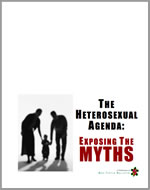 At last, the truth can now be told.
Using the same research methods employed by most anti-gay political pressure groups, we examine the statistics and the case studies that dispel many of the myths about heterosexuality. Download your copy today!
And don‘t miss our companion report, How To Write An Anti-Gay Tract In Fifteen Easy Steps.
 Anti-gay activists often charge that gay men and women pose a threat to children. In this report, we explore the supposed connection between homosexuality and child sexual abuse, the conclusions reached by the most knowledgeable professionals in the field, and how anti-gay activists continue to ignore their findings. This has tremendous consequences, not just for gay men and women, but more importantly for the safety of all our children.
Anti-gay activists often cite the “Dutch Study” to claim that gay unions last only about 1½ years and that the these men have an average of eight additional partners per year outside of their steady relationship. In this report, we will take you step by step into the study to see whether the claims are true.
Tony Perkins’ Family Research Council submitted an Amicus Brief to the Maryland Court of Appeals as that court prepared to consider the issue of gay marriage. We examine just one small section of that brief to reveal the junk science and fraudulent claims of the Family “Research” Council.
 The FBI’s annual Hate Crime Statistics aren’t as complete as they ought to be, and their report for 2004 was no exception. In fact, their most recent report has quite a few glaring holes. Holes big enough for Daniel Fetty to fall through.
“Google” is a trademark of Google Inc.
© Box Turtle Bulletin. All Rights Reserved.
 Posts
Posts  Posts via daily email: