Box Turtle Bulletin
 News and commentary about the anti-gay lobby
“Now you must raise your children up in a world where that union of man and box turtle is on the same legal footing as man and wife…”
News and commentary about the anti-gay lobbyJanuary 30th, 2013
Today the Wyoming House of Representatives failed to pass a domestic partnership bill by a vote of 24 to 34. However, this bill came far closer to passage than many non-Wyomans had expected and gives hope that in the next session such a bill might prevail.
January 30th, 2013
Today the Wyoming Senate Judiciary Committee heard Senate File 0131, a bill which would prohibit discrimination on the basis or sexual orientation and gender identity. The committee approved the bill 4 to 1. (Billings Gazette)
Committee Chairman Sen. John Schiffer, R-Kaycee, voted in favor of the bill. A rancher, Schiffer is a veteran legislator and former president of the Senate.
“This is a piece that fits into the process of implementing what’s in our Constitution, that all people are created equal and have equal rights,” Schiffer said. “This is just part of the process of us as a state maybe maturing, maybe broadening our views.”
Voting yes was Sens. Esquibel (D – 8, cosponsor), Burns (R – 21, cosponsor), Schiffer (R – 22, chairman), Christensen (R – 17). Voting no was Sen. Hicks (R – 11).
January 30th, 2013
Equality Delaware, the advocacy group that won passage of Delaware’s same-sex civil unions bill in 2011, this week ramps up its campaign for full marriage equality with meetings in New Castle and Sussex counties.
Hundreds of supporters are expected to attend the 5:30 p.m. gatherings – today at First & Central Presbyterian Church in Wilmington and Thursday at CAMP Rehoboth on Baltimore Avenue in Rehoboth Beach.
“We believe 2013 is the right time for marriage [equality] in Delaware,” said Wilmington attorney Lisa Goodman, president of Equality Delaware.
This will likely lead to a bill sometime this spring.
January 30th, 2013
Dozens of organizations and individuals have filed Amicus Curiae briefs with the U.S. Supreme Court arguing either for or against California’s Proposition 8. A couple of them are worth looking at, if for no other reason than for their entertainment value. For example, there’s this brief filed by Margie Phelps for Westboro
Baptist Church. Amicus Curiae briefs are expected to follow several conventions, and the ways in which Westboro’s brief observes them is indicative of Westboro’s highly entertaining approach to things.
First, instead of being a brief in support of petitioners (the pro-Prop 8 side) or respondents (the side that wants to overturn Prop 8), Westboro’s brief is filed “in support of neither party.” Okay.
And then there’s the Table of Authorities. A typical brief will be loaded up with citations to case law, along with other citations to “other authorities,” which would include sources like studies, articles, books, speeches, transcripts, etc. Of Westboro’s 66 citations under “Other Authorities,” 36 of them are Bible quotes. Which means that there are several pages with nothing but reproduced bible passages, including five pages devoted to the entire story of Sodom and Gomorrah. (“This historical event described in Genesis 19:1-28, Holy Bible, must be considered at this hour…”) The brief also has a lengthy retelling of the Great Flood (“The description of the complete destruction of all mankind – a population as or bigger than today’s population…”).
And after all that, Westboro concludes:
Same-sex marriage will destroy this nation. If the leaders of this country treat what God has called abominable as something to be respected, revered,and blessed with the seal of approval of the government, that will cross a final line with God. The harm that will befall this nation, when the condign destructive wrath of God pours out on a nation that purposefully, in a calculating manner, institutionalizes marriage licenses for same-sex unions, is the ultimate harm to the health, welfare and safety of the people. The government is duty bound – in this Christian nation – to institute the standard of God on marriage, and pass and uphold laws that forbid same-sex marriage.
By the way, Westboro filed an identical brief for United States v Windsor, which challenges the constitutionality of the Defense of Marriage Act. If nothing else, I guess that ensures both consistency as well as economy.
Another interesting brief (PDF: 127KB/ 14 pages) calling for the court to uphold Prop 8 comes from a man by the name of David Benkoff. It’s been nearly four years since we last heard from him. Here’s how Timothy Kincaid introduced him to BTB readers in 2008:
David Benkof has been getting a bit of attention lately.
And at first glace David appears to be a young gay man who believes that there are better options for gay couples than marriage, that the community should join him in prioritizing other more pressing issues, that the marriage discussion is harming the efforts of gay couples in red states to get recognition for their unions, and that he wants to help. We’d also think that he’s a gay columnist, that he speaks for an influential collection of gay thinkers, and that he is part of the gay and lesbian community and shares our goals and dreams.
None of that is true.
During the Prop 8 campaign, he trotted out his gay/straight/bi/Idunno-guy-against-same-sex-marriage schtick with a web site called “Gays Defend Marriage,” in which he claimed to be a “gay columnist” who was against same-sex marriage. Timothy Kincaid exposed the charade, Benkoff doubled down, and then he abruptly left the scene, saying he “recently learned quite a bit of disturbing information that makes it impossible for me to continue supporting a movement I no longer respect.”
Well, he’s back now. And for this amicus brief, Benkof teamed up with Robert Oscar Lopez (described as a bisexual man who was raised by two lesbian mothers and who is currently heterosexually married), and Doug Mainwaring (a man who raised two teenage sons after separating from his wife and coming out gay.) Again, we see a familiar pattern: people with life credentials which are supposed to demonstrate their connection to the gay community but who are arguing that the gay community needs to be shown its second-class place in society. Lopez has been playing that schtick at the Witherspoon Institute, which sponsored the flawed Regneres paper claiming to study “gay parents.” Lopez contributed an anti-gay tract at the Witherspoon Institute’s web site praising Regnerus’s paper. Mainwaring is a NOM discovery, who wrote in opposition to same-sex marriage in a tea party newsletter and, more recently, in The Christian Post. Their brief includes all of the standard NOM talking points — watered down and polited up, like NOM might be when on its very best behavior — to try to make the impression that there is an undiscovered reservoir of gay people who oppose marriage equality:
Amici come from a variety of families of origin, we have different religious beliefs and we differ among ourselves about whether legislature should redefine marriage to include same-sex couples. We all believe, however, that Americans ought not be labeled hateful bigots for opposing redefinition.
Our position is based on a shared commitment that marriage is society’s institutional expression of a child’s right to a mother and a father. We are not alone. The ongoing debate over marriage in France has prominently featured gay people who support keeping the understanding of marriage as a union of a husband and wife.
We, and they, believe gay people should be free to love and live as they choose but we also recognize that society has a right to express a rational preference for the kind of unions necessary to the survival of the whole society, and to the well-being of children. Some gay, lesbian and bisexual people will benefit from this preference as they marry a person of the opposite sex.
As you can well guess, Benkof and friends are utterly silent about how LGB people might “benefit from this preference.” They just kind of put that out there. The rest of the brief is basically 14 pages of concern trolling amidst a complete absence of actual facts. (Interestingly, they don’t even bother to mention the Regnerus paper.) It’s much like the Westboro brief that way. Birds of a feather…
January 30th, 2013
Self-described Catholic blogger Brandon Vogt recently published Rebuttals to arguments for same-sex marriage. He tries to disprove 10 common same-sex-marriage arguments, but merely highlights the most common mistakes of his own camp. I’m addressing each of his 10 points in separate posts as a kind of back-t0-the-basics review of our opposition.
Vogt’s finally on to something with his third rebuttal. He finds a straw man and digs his pitchfork in with gusto:
3. Everyone has the right to marry whomever he or she loves.
Though catchy, few people truly believe this slogan. Most of us acknowledge there should be at least some limitations on marriage for social or health reasons. For example, a man can’t marry a young child or a close relative.
Oh lord — I agree with Vogt! I don’t think an adult should be allowed to marry a child, and when we say everyone has the right to marry whomever he or she loves, we do nothing but set ourselves up for an obvious rebuttal. It’s not just sloppy rhetoric, it’s rhetoric few people believe, rhetoric that just makes us look dumb. It also allows people like Vogt to rip apart the straw man and pretend we don’t have deeper and more substantive arguments for marriage rights.
Instead of that catchy, damaging slogan, I’d rely on Olson and Boies opening argument from the Prop 8 trial:
That last item is crucial, and it explains why we don’t let adults marry children, who lack the experience or even the basic neural development needed to understand a life-long commitment or to protect themselves from an exploitative adult.
I’ll admit that this 3-point series of propositions doesn’t trip off the tongue as smoothly as the slogan I’m rejecting, so how about this:
If you’re going to deny me the right to marry the person I love, you’d best prove a good reason why!
That’s a statement I can stand by. It has good intuitive appeal, it puts the burden of proof on the other side, and if they ask why that burden lies with them, I can just answer:
Because it’s a free country.
And that’s the crux of it. Which explains why Vogt is just offering up a crock when he says:
So, the real question here is not whether marriage should be limited, but how. To answer that, we must determine why the government even bothers with marriage. It’s not to validate two people who love each other, nice as that is. It’s because marriage between one man and one woman is likely to result in a family with children. Since the government is deeply interested in the propagation and stabilization of society, it promotes and regulates this specific type of relationship above all others.
Sorry, Vogt. In a free country we don’t justify our rights by pointing out their benefit to government or society. It’s the other way around: Government and society exist to secure the rights of individuals, to create an environment that protects our rights of life, liberty, and the pursuit of happiness. You’d imagine that our most vocal opponents (those dwindling conservatives and Tea Partiers still against same-sex marriage) would be the first to take this to heart, but they seem to forget their own rhetoric when it comes to the gays.
That’s enough to wipe out Vogt’s argument, but he says a couple more things worth demolishing. First:
To put it simply, in the eyes of the state, marriage is not about adults; it’s about children. Claiming a “right to marry whomever I love” ignores the true emphasis of marriage.
Here Vogt makes the great mistake so common to his side: He thinks that just because the welfare of children is a true purpose of marriage, it must be the true purpose, as if there exist no others worth considering. And that doesn’t follow at all. Marriage is about adults, too — a fact our opponents always promoted until they started casting around for new ways to work against our rights. As Maggie Gallagher herself wrote long ago:
Marriage is a powerful creator and sustainer of human and social capital for adults as well as children, about as important as education when it comes to promoting the health, wealth, and well-being of adults and communities.
She even called this adult-based case for marriage “equally significant” as the one based on children.
(In case you’re wondering, yes, I do plan to flog this statement of Maggie’s until the marriage debate ends. Neither Maggie, nor Brian Brown, nor anyone else associated with NOM should be allowed to ignore it. In fact, I hope everyone throws Maggie’s research at them until they’re forced to deal with it).
And finally, Vogt gives us this:
Notice that nobody is telling anyone whom he or she can or cannot love. Every person, regardless of orientation, is free to enter into private romantic relationships with whomever he or she chooses.
Are.
You.
Kidding.
I’ll pass over the Protestants and Muslims who call for the criminalization of our relationships and focus on the faith I was brought up, Catholicism. Vogt is Catholic blogger. Not a blogger who happens to be Catholic, but a man whose Catholicism is central to his writerly identity. As such, he ought to know a bit more about the Holy See’s stance on whether a person should be “free to enter into private romantic relationships with whomever he or she chooses.”
While the Vatican doesn’t think we should face criminal penalties merely for being homosexual, it’s always drawn a careful distinction between homosexual persons and homosexual acts. And when it comes to those acts, here’s its response to a UN resolution on decriminalizing homosexuality:
Second, for the purposes of human rights law, there is a critical difference between feelings and thoughts, on the one hand, and behavior, on the other. A state should never punish a person, or deprive a person of the enjoyment of any human right, based just on the person’s feelings and thoughts, including sexual thoughts and feelings. But states can, and must, regulate behaviors, including various sexual behaviors.
And the Holy See goes on to cite laws against acts of pedophilia and incest as clear precedents for such regulation, without explaining that connection, that offensive logical leap.
Of course, we’ve gotten off track here. Vogt’s “We still let you hook up as long as you keep it private,” in no way justifies a ban same-sex marriage. It’s just an irrelevant detour. Sorry, Vogt, but from beginning to end, you’ve made a mess of this one.
Tomorrow: Will same-sex marriage hurt all those decent straight people?
January 30th, 2013
The governing board of the Boy Scouts of America is due to meet next week, when it is expected to end its ban on gay scouts and scout leaders. Already our opponents are asking their supporters to flood Boy Scout headquarters with messages opposing the move. Its important that we do the same. There are four ways to do this:
January 30th, 2013

Jim Nabors and Stan Cadwallader
Jim Nabors, 82, the singer/actor star of the 1960s sitcom Gomer Pyle, USMC married his longtime partner, Stan Cadwallader, 62, in a ceremony in Seattle in December. According to Hawaii News Now:
Nabors declined an on-camera interview but spoke to Hawaii News Now by phone.
“I’m 82 and he’s in his 60s and so we’ve been together for 38 years and I’m not ashamed of people knowing, it’s just that it was such a personal thing, I didn’t tell anybody,” Nabors said. “I’m very happy that I’ve had a partner of 38 years and I feel very blessed. And, what can I tell you, I’m just very happy.”
…Before they were married, Nabors said, “It’s pretty obvious that we had no rights as a couple, yet when you’ve been together 38 years, I think something’s got to happen there, you’ve got to solidify something. And at my age, it’s probably the best thing to do.”
The fact that Nabors is gay was never much of a secret among his co-workers, friends and others who knew him, although he never was formally out in the media. On the other hand, he was among the few gay actors who didn’t play the publicity game of “dating” women for the benefit of papparazzi.
When he worked full-time in Hollywood in the 1960s and 1970s, Nabors said he was open about his homosexuality to co-workers and friends but never acknowledged it to the media until now.
“I haven’t ever made a public spectacle of it. Well, I’ve known since I was a child, so, come on. It’s not that kind of a thing. I’ve never made a huge secret of it at all,” Nabors said.
“This is really no big deal. My friend and I, my partner, we went through all of this 38 years ago,” Nabors added. “So I mean, we made our vows and that was it. It was to each other, but nevertheless, we were a couple.”

The Sylacauga, Alabama, native moved to Los Angeles because of his asthma, where he worked as a film cutter by day and sang in local clubs at night. He also acted in skits in cabaret theater, where he developed a character that would eventually become Gomer Pyle. In those skits, he would sing in a deep, serious baritone before speaking in a high pitched, southern-accented comedic voice. That’s where Andy Griffith discovered him and signed him to a one-episode role on The Andy Griffith Show. His character, auto mechanic Gomer Pyle, proved to be so popular that Nabors soon became a regular for two season. In 1964, Gomer joined the Marines and Nabors got his own spin-off program which ran until 1969.
January 30th, 2013
TODAY’S AGENDA:
Wyoming Senate Committee Considers Non-Discrimination Bill: Cheyenne, WY. Hard on the heels of Monday’s Senate committee hearing which approved a bill for a Domestic Partnership registry for the state’s same-sex couples, The Senate Judiciary Committee will hold a hearing today on SF0131, which would amend Wyoming’s anti-discrimination law to include sexual orientation and gender identity. The hearing begins first thing this morning at 8:00 a.m. in room 302 of the state capital building.
Events This Weekend: Winter Pride, Killington, VT; Midsumma, Melbourne, VIC; Rainbow Reykjavik Winter Festival, Reykjavik, Iceland; Regenbogenball (Rainbow Ball), Vienna, Austria; Gay Whistler, Whistler, BC.
TODAY IN HISTORY:
NY Times Report AIDS Breakthrough: 1996. The AIDS epidemic had raged unchecked for at least fifteen years with very little hope in sight. For countless numbers of people around the world, an AIDS diagnosis was a death sentence. It wasn’t a matter of if, but when. When the drug azidothymidine (AZT, marketed as Retrovir), first approved in 1987, was a nucleoside analog reverse transcriptase inhibitor (or “nuke”), which blocked a particular enzyme associated with HIV. It was virtually the only means for fighting the disease for almost a decade, but it’s effectiveness was sorely limited. In 1995, another “nuke”, Lamivudine (3TC, or Epivir) became available, giving doctors a second option for when patients became unresponsive to AZT. But when taken together, AZT and 3TC seemed to offer an additional “punch” for many people than they did when taken separately.
Then in 1996, an entirely new type of drug, Indinavir (marketed as Crixivan) entered the market. Known as a protease inhibitor, it inhibits another HIV enzyme known as the protease enzyme from functioning. The New York Times wrote a very cautious report on the breakthrough. At a meeting of the Infectious Diseases Society of America, a study was presented which found that when combined with AZT and 3TC, Indinavir reduced the amount of HIV swimming around in patients’ blood by about 99 percent, to levels which were undetectable by standard laboratory tests in 92% of patients. Many among the more than 2,100 scientists at the meeting expressed optimism about the findings, in part because it was one of the few bits of good news about AIDS in a long time,” The Times reported. “But, recalling how they had been wrong about several other initially favorable AIDS findings, leading scientists urged caution.”

As tentative as the initial reports were, the results soon proved unmistakeable. When 3TC joined AZT in 1995 as a viable treatment, there was a noticeable plateau in the number of deaths due to AIDS. But in 1996 when the three-drug cocktail became available, the number of deaths due to AIDS would see its first drop since the epidemic began. And it wasn’t a slight drop either — it was a 20% improvement from the year before. People at death’s door began coming back from the abyss. For some who had prepared to die, finding that they were living again presented an entirely new set of challenges. The emotional whipsaw, dubbed “the Lazarus Syndrome” made restarting a life (including an education, careers, or simply a place to live) that had been systematically dismantled through disease, disability and stigma just one more challenge to surmount while still dealing with the anxiety of wondering if the other shoe was yet to drop.
The three-drug cocktail, which became known as Highly Active Antiretroviral Therapy (HAART), wasn’t a cure, but the breakthrough was undeniable. Further improvements in HAART resulted in more effective combinations and dosages which made adherence much simpler. HAART would eventually transform AIDS from a terminal disease to a chronic disease, albeit still a very serious one. More recent research shows that, thanks to HAART, people with AIDS can now expect a near–normal lifespan. And yet, HAART’s side effects can take a brutal toll on the body, and its cost — ranging from $10,000 to $15,00 a year for a single patient — makes life-prolonging medications a severe financial strain for anyone without insurance or governmental assistance. All of which makes finding a cure still as important as ever.
If you know of something that belongs on the agenda, please send it here. Don’t forget to include the basics: who, what, when, where, and URL (if available).
And feel free to consider this your open thread for the day. What’s happening in your world?
January 29th, 2013
Like much of the planet this week, marriage is being debated in New Zealand. Here’s a bit from that front:
Meanwhile, Michael Roberts of the Church of Jesus Christ of Latter-day Saints told the committee that redefining marriage will have a negative impact on families, children and society.
Green MP Kevin Hague put it to Mr Roberts that the Mormon church has already redefined marriage by banning its former practice of polygamy.
After a lengthy pause, Mr Roberts said the ban resulted from the law “asking us to reconsider that”.
January 29th, 2013
I’ve never really understood at the whole “sister city” concept. As best I can tell, it’s as if you grew up and discovered that your grammar school pen pal was actually a municipality. Really? What on earth did Hoboken want with my lemon-bar recipe?
But, in any case, there certainly are a lot of them and cities tend to take them seriously.
So in that spirit, I share the news that Venice – the City of Canals – (not Venice, CA, the City of What Were You Thinking?) is breaking off cultural relations with St Petersburg – City of Lunatics – because of the Russian city’s legislation curbing gay rights.
Since 2006 Venice and St. Petersburg have engaged in “cultural and other exchanges”, but Venice finally said that if Pete’s gunna be hating the gay, then no more.
The city council invoked Venice’s “history, international prestige and conscience” to refrain from cultural exchanges as long as anti-gay laws are in place.

January 29th, 2013
ProtectMarriage.com, the advocacy group defending a California gay marriage ban now under review by the high court, showed a $2 million deficit in its legal fund at the end of 2011 – the third year in a row that expenses exceeded donations, federal tax records show.
The 2012 accounts are not yet available. ProtectMarriage.com says it has since covered the 2011 shortfall. However, it is still $700,000 short in fundraising for its Supreme Court costs, according to a ProtectMarriage.com attorney, Andrew Pugno. That message has gone out to donors, with some urgency, as the Supreme Court prepares to hear arguments in March in its first thorough review of same-sex marriage.
Andrew Pugno, the nominal attorney for the proponents attributes it to donor fatigue. I see a bigger issue, donor disinterest. By now pretty much everyone knows equality is coming and no one – not even the cardinals – really cares.
It’s not as though Prop 8’s supporters couldn’t easily toss down some serious cash. If the Vatican really and truly believed that gay marriage would lead to the end of civilization, they could pull out their checkbook. Because surely there’s no higher priority than the end of civilization.
And if times are tough and cash is short, it would be easy to liquidate an asset or two. After all, I’m sure that the Getty would happily drop some major dough to get their hands on Michelangelo’s David.
January 29th, 2013
You don’t have to live in Rhode Island or be a Democrat to insist that legislators live up to their duty. So please go sign my petition to remind the members of the Rhode Island Senate that the obstructionist behavior of Sen. Pavia-Weed reflects on all of them and, even, on those Democrats outside the state who assure us that we must vote for their Party if we want equality.
She needs to come to the side of equality or get out of the way. And if she won’t move, she needs to be moved.
Please. It only takes a moment.
January 29th, 2013
The equality bill now has been introduced into the French Paliament and debate is expected to go on for weeks. In a last ditch effort, anti-gay activists have placed banners on the city’s bridges insisting on discrimination and exclusion. (expatica)
Justice Minister Christiane Taubira told parliament as the debate kicked off that introducing gay marriage was “an act of equality”. The government has allowed for the debate to run until February 10 with a vote due two days later.
With opinion polls having consistently shown that a comfortable majority of the French support gay marriage, Hollande could never have anticipated that a promise he made in his election manifesto last year would generate such controversy.
The Socialist Party has the votes to pass the legislation and it is also supported by Communists, Greens and some other centrists.
January 29th, 2013
Self-described Catholic blogger Brandon Vogt recently published Rebuttals to arguments for same-sex marriage. He tries to disprove 10 common same-sex-marriage arguments, but merely highlights the most common mistakes of his own camp. I’m addressing each of his 10 points in separate posts as a kind of back-t0-the-basics review of our opposition.
The second item on Brandon Vogt’s list of “our” arguments is actually a misunderstanding:
2. Same-sex marriage is primarily about equality.
This argument is emotionally powerful since we all have deep, innate longings for fairness and equality. Moreover, history has given us many failures in this area, including women banned from voting and African-Americans denied equal civil rights. The question, of course, is whether same-sex couples are denied equality by not being allowed to marry each other.
Vogt is confused here. Same-sex marriage is not primarily about equality — and certainly not about equality just for the sake of equality — any more than voting rights or freedom of speech are primarily about equality. If that sounds odd, think of it this way: In the U.S., equality under the law is derived from the self-evident premise “that all [human beings] are created equal, that they are endowed by their Creator with certain unalienable Rights, that among these are Life, Liberty, and the Pursuit of Happiness.” In other words:
That’s why I say our equal right to freedom of speech is not primarily about equality. It’s not like we’d be happy with any degree of freedom, small or great, as long as it’s equal among us. No — each of us as a human being has the abundant right to freedom of speech. Equality enters the picture only because we’re all equally human. And that’s true for all our human rights, including the right to marriage.
But I can see why Vogt is confused.. We speak of equality quite a bit, for the very reason he identifies above: “we all have deep, innate longings for fairness and equality.” To deny us equality is to deny us our equal humanity. That makes it a powerful persuader, a great (and true) rhetorical strategy. But that doesn’t mean a desire for equality is our primary reason for demanding marriage rights. As I’ve argued before, we only ask for the rights because we’ve already accepted the responsibilities:
People don’t marry just to take care of their kids. They marry to be responsible for each other: Two are better than one; because they have a good reward for their labour / For if they fall, the one will lift up his fellow: but woe to him that is alone when he falleth; for he hath not another to help him up. It astonishes me how many of our religious opponents are so quick to forget their own Bible when they claim marriage is all about the kids.
Marriage does come with legal rights, but the rights we care most about the ones that help us live up to our responsibilities: the right to be in that hospital room, to provide medical care, to make decisions when your partner cannot, to ensure he can support himself if you are taken, to give your employer an honest reason when you take a personal day for his sake, to live in the same room, the same home, the same country without fearing discrimination or separation.
This is my new mantra: We only ask for the rights because we’ve already accepted the responsibilities. It’s not about equality per se, but about the fact that we’re all equally human. And this effectively demolishes the rest of Vogt’s argument, which is that it’s okay to treat opposite-sex and same-sex couples differently, because society’s only interest in marriage is about biological parenting — a statement that none of our opponents (not even Maggie Gallagher!) truly believe.
Tomorrow: Does everyone has the right to marry whomever he or she loves?
January 29th, 2013

TODAY’S BIRTHDAYS:
Greg Louganis: 1960. During the 1976 Montreal Olympics, he came in second for the tower diving behind Italy’s Klaus Dibiasi. When Dibiasi retired two years later, Louganis won his first world title and was a favorite for the 1980 Olympics. Unfortunately, that was the Moscow Olympics, which the U.S. boycotted overt the Soviet Union’s invasion of Afghanistan. But in the 1984 Olympics in Los Angeles (which the Soviets boycotted in retaliation), Louganis won his gold metals in springboard and tower diving. During the 1988 Seoul Olympics, he hit his head on the springboard during preliminaries, resulting in a concussion. But he went on to earn a gold during the finals. That same year, he tested positive for HIV. He came out as gay in 1995 — where else? — on The Oprah Winfrey Show, and his 1996 memoir, Breaking the Surface


Sara Gilbert: 1975. Kid sister of Melissa Gilbert, Sara is perhaps best known for her role as the sardonic Darlene Conner on the ABC sitcom Roseanne, who was far and away my favorite character on the series (aside, of course, from a minor character played by a very young George Clooney in the first four seasons). Later, Sara juggled her work in Rosanne with studies at Yale where she majored in art photography, with producers accommodating her academic schedule by shooting remote segments in New York. She has had a recurring role on The Big Bang Theory, and in 2010 she became the co-host and executive producer of The Talk. That same year, she came out as a lesbian. She and her former partner, TV producer Allison Adler, separated in 2011 after a ten year relationship and two children.

Adam Lambert: 1982. Critics agreed: he had the talent to win the eighth season of American Idol, but Christian conservatives, appalled by his open sexuality, thought otherwise and mounted a phone campaign to make sure the ‘mo didn’t win. He wound up coming in second place, but his career was set. (Trivia question: does anyone remember who came in first? No fair Googling.) His first studio album, For Your Entertainment

If you know of something that belongs on the agenda, please send it here. Don’t forget to include the basics: who, what, when, where, and URL (if available).
And feel free to consider this your open thread for the day. What’s happening in your world?
Featured Reports
 In this original BTB Investigation, we unveil the tragic story of Kirk Murphy, a four-year-old boy who was treated for “cross-gender disturbance” in 1970 by a young grad student by the name of George Rekers. This story is a stark reminder that there are severe and damaging consequences when therapists try to ensure that boys will be boys.
When we first reported on three American anti-gay activists traveling to Kampala for a three-day conference, we had no idea that it would be the first report of a long string of events leading to a proposal to institute the death penalty for LGBT people. But that is exactly what happened. In this report, we review our collection of more than 500 posts to tell the story of one nation’s embrace of hatred toward gay people. This report will be updated continuously as events continue to unfold. Check here for the latest updates.
In 2005, the Southern Poverty Law Center wrote that “[Paul] Cameron’s ‘science’ echoes Nazi Germany.” What the SPLC didn”t know was Cameron doesn’t just “echo” Nazi Germany. He quoted extensively from one of the Final Solution’s architects. This puts his fascination with quarantines, mandatory tattoos, and extermination being a “plausible idea” in a whole new and deeply disturbing light.
On February 10, I attended an all-day “Love Won Out” ex-gay conference in Phoenix, put on by Focus on the Family and Exodus International. In this series of reports, I talk about what I learned there: the people who go to these conferences, the things that they hear, and what this all means for them, their families and for the rest of us.
Prologue: Why I Went To “Love Won Out”
Part 1: What’s Love Got To Do With It?
Part 2: Parents Struggle With “No Exceptions”
Part 3: A Whole New Dialect
Part 4: It Depends On How The Meaning of the Word "Change" Changes
Part 5: A Candid Explanation For "Change"
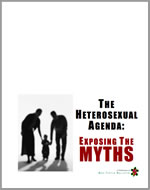 At last, the truth can now be told.
Using the same research methods employed by most anti-gay political pressure groups, we examine the statistics and the case studies that dispel many of the myths about heterosexuality. Download your copy today!
And don‘t miss our companion report, How To Write An Anti-Gay Tract In Fifteen Easy Steps.
 Anti-gay activists often charge that gay men and women pose a threat to children. In this report, we explore the supposed connection between homosexuality and child sexual abuse, the conclusions reached by the most knowledgeable professionals in the field, and how anti-gay activists continue to ignore their findings. This has tremendous consequences, not just for gay men and women, but more importantly for the safety of all our children.
Anti-gay activists often cite the “Dutch Study” to claim that gay unions last only about 1½ years and that the these men have an average of eight additional partners per year outside of their steady relationship. In this report, we will take you step by step into the study to see whether the claims are true.
Tony Perkins’ Family Research Council submitted an Amicus Brief to the Maryland Court of Appeals as that court prepared to consider the issue of gay marriage. We examine just one small section of that brief to reveal the junk science and fraudulent claims of the Family “Research” Council.
 The FBI’s annual Hate Crime Statistics aren’t as complete as they ought to be, and their report for 2004 was no exception. In fact, their most recent report has quite a few glaring holes. Holes big enough for Daniel Fetty to fall through.
“Google” is a trademark of Google Inc.
© Box Turtle Bulletin. All Rights Reserved.

 Posts
Posts  Posts via daily email: