Box Turtle Bulletin
 News and commentary about the anti-gay lobby
“Now you must raise your children up in a world where that union of man and box turtle is on the same legal footing as man and wife…”
News and commentary about the anti-gay lobbyNovember 14th, 2012
 It is no longer news when a city or county adds sexual orientation to the list of items from which employment discrimination is disallowed. But as a reminder of just how mainstream and ordinary it is for a city to commit to this inclusion, this week Grand Island, NE, joined the list.
Grand Island is part of Nebraska’s Third Congressional District which was last under Democratic control in 1961. Nearly 60% consider themselves religious, a third of which are Catholic. This ain’t no bastion of godless liberal hollywood types.
The council voted 6-4 to add the protections. But the Mayor vetoed the ordinance.
Then two of the no votes (including one who was worried that Grand Island might be seen as “gay friendly”) felt the Mayor wasn’t respecting the decision of the Board. So they joined the supporters in overturning the Mayor’s veto.
It’s not a big deal. Grand Island has less than 50,000 residents and the change only impact city employees.
But as a symbol of the significant shift in public opinion just in the past decade, Grand Island tells us where rural conservative America is today. They may pass constitutional amendments denying our rights, but they are coming around.
November 14th, 2012
After years of crying, “Let the people vote!”, the National Organization for Marriage is desperately searching for some way to prove that the votes in Minnesota, Washington, Maine, Iowa, and Maryland don’t really mean anything.
Their latest attempt is to quote from breitbart.com in a post they called, “Breitbart’s Ken Klukowski: “Marriage Still Wins When Equally Funded”:
…given the narrow margins in these races, traditional marriage still wins when equally funded, but a large imbalance of resources for promotion and organizing to mobilize voters can give gay marriage a winning edge.
Perhaps. And if pigs had wings they’d be pigeons. Klukowsi’s quote should alarm rather than console them. It should make them ask, Why was gay marriage so well funded?
How on earth did a tiny group of extreme homosekshul activists fighting for a fringe, perverted cause roundly opposed by the vast majority of decent Americans manage to raise so much more money than the godly folks at NOM and all those wealthy, wealthy churches?
Perhaps it’s no longer a fringe cause. Perhaps it was never perverted. Perhaps those homosekshuls aren’t so extreme. Perhaps support isn’t limited to a tiny group, and the vast majority of decent Americans don’t oppose marriage equality.
Perhaps NOM should stop fantasizing about what they could do with more money and ponder instead why can’t get it.
November 14th, 2012
Earlier this week, the Vatican announced that it wasn’t going to back off in its opposition to marriage equality. In fact, after looking at last week’s marraige equality victories in three states and the defeat of an anti-marriage constitutional amendment in a fourth, the Vatican somehow decided they were actually winning the battle. Now Bill Donohue has added his two-cents’ worth and told Focus On the Family that the Church is never gonna change its mind:
The Catholic Church is not going to change its position on marriage any more than it’s going to change its position on slavery or racism or genocide. These are fixed principles that are there, and those people who are in the Catholic ranks who keep thinking that the Catholic Church may want to change now because the country seems toward gay marriage — really, they’re in the wrong religion. And I think it’s time that our society has to reset its moral compass and think these things through.
November 14th, 2012
 Amidst the many wins for our community – marriage, legislators, and even the first openly gay US Senator (no, a certain bachelor from a southern state doesn’t count) – it was difficult to note all the changes and interesting results of the election. And one story which I had been following was overlooked.
Paul Babeu, the openly gay conservative sheriff of Pinal County, Arizona, was re-elected. Also elected was Lando Voyles, Babeu’s hand-picked candidate for Pinal County Attorney.
This is an interesting turn of events in that it runs counter to presumptions about rural conservatives and anti-gay attitudes.
Paul Babeu sought to leverage his position as Sheriff into a Congressional seat. But in February, the Phoenix New Times – disliking Babeu’s political positions – ran a story on him which was designed to discredit him with his constituents. Assuming that those who supported Babeu would desert him if they knew he was gay, they ran a story about him threatening a former boyfriend with deportation. To their surprise, Babeu immediately acknowledged his orientation – and endorsed marriage equality and open military service – but fought the accusation of misuse of power.
Over the next month, the Phoenix New Times doubled down on their story, regularly adding sensational tidbits, seeming to hope that Pinal County voters would be turned off by seeing their sheriff in his underwear (provided by the ex-boyfriend) or reading his personal text messages. In the process, they veered into blatant homophobia, calling for Babeu to be fired for joining a gay dating site and ratcheting up the implication, “don’t vote for Babeu, see he’s GAY!!” And Babeu eventually dropped out of his congressional race and ran for reelection as Sheriff.
However, by the end of their effort, it seemed increasingly evident that this was a personal vendetta for the New Times and they lost much of their credibility. Rather than discredit Babeu with his constituents, this may have became a moment when they decided that they preferred openly gay, marriage-supporting conservatives to straights who they believed would be less law-and-order. And so not only did they reelect Babeu, but they confirmed his choice for County Attorney. Which, while odd progress, is progress.
It will be interesting to see how this develops.
When gay Democrats began to gain access and influence a few decades back, it was not always with joyous acclaim; there were period of tolerance in which some more conservative or older Democrats may not have supported our rights but were willing to work with specific gay politicians. They were seen as “our gay politician”, accepted despite long-established prejudices. And slowly, through time and familiarity, “our gay politicians” broke down stereotypes and presumptions. Though I’m no fan of Barney Frank, he was effective in transforming many Democratic leaders from being tolerant of “our gay politician” to support for the gay community.
I think that for many Pinal County Republicans, Paul Babeu might be seen “our gay politician”. They may be unsupportive of our community in general and even dislike “those other liberal gay politicians”, but be able to find ownership of this one. I wonder if Babeu can be effective in gradually breaking stereotypes and engendering support.
November 14th, 2012
TODAY’S AGENDA:
Events This Weekend: Hong Kong Gay and Lesbian Film Festival, Hong Kong, China; Mazipatra Queer Film Festival, Prague/Brno, Czech Republic; Pride, Rio de Janeiro, Brazil.
TODAY’S BIRTHDAY:
 Aaron Copland: 1900. Born in Brooklyn to Lithuanian Jewish parents, Copland composed some of the most quintessentially American classical music. Appalachian Spring celebrated American pioneers; Billy the Kid set the open prairie to music; Rodeo sells beef on television (“It’s what’s for dinner”); and Fanfare for the Common Man was, briefly, the theme music for Rick Perry’s ill-fated presidential run, which was ironic that a rabidly anti-gay politician would turn to such patriotic music that was composed by a relatively openly gay man.
Copland’s childhood was a rather typical one for an immigrant family in New York City. His father, who had no musical interest, owned a small department store. It was his mother, brothers and sisters — he was the youngest of five — who were musically inclined. His oldest brother played violin, and a sister gave him his first piano lessons and exposed him to opera. From the age of thirteen, he began formal music lessons. By age fifteen, he decided to become a composer. From 1921 to 1924, Copland went to Paris for further study at the Fontainebleau School of Music. In 1925, he returned to the U.S., and with two Guggenheim Fellowships in 1925 and 1926, he was able to rent a studio apartment where he lived for the next thirty years. He met Alfreid Stieglitz, who introduced him to many of the leading artists of the day: Paul Strand, Ansel Adams, Georgia O’Keefe, and Walker Evans, whose photos inspired Copland’s opera The Tender Land.
Stieglitz’s determination that American artists should reflect “the ideas of American Democracy” had a profound effect on Copland. It also represent a severe challenge. American classical music composers looked to Europe as a model for music composition. All that American had was popular music, folk music and jazz. The challenge for Copland was to show how these so-called “lower” forms of music could be in integral part of classical music. He joined five other like-minded composers to form what was called the “commando unit,” who collaborated in joint concerts to promote their new approach.
Once the depression hit, Copland expanded his horizons again through travels to Europe, Africa and Mexico. When Hitler and Mussolini attacked Spain in 1936, Copland, along with many other artists, were sympathetic to the Spanish Republicans, and many of them had joined the Communist Party. Copland himself didn’t join — he was committed to his refusal to join any party — but he did sympathize with leftist political movements, including his support for the Communist Party USA ticket during the 1936 presidential election, and for Henry A. Wallace’s presidential bid on the Progressive Party ticket in 1948.
This period of political turmoil coincided with some of Copland’s most famous work. In 1939, he completed his first two Hollywood film scores, for Of Mice and Men and Our Town. That same year, he debuted his highly successful ballet Billy the Kid. He followed that with two more acclaimed ballets, Rodeo (1942) and Appalachian Spring (1944), which featured the melody of an old Shaker hymn, “Simple Gifts.” A Lincoln Portrait and Fanfare for the Common Man, both debuted in 1942 as American was entering World War II, have become American patriotic standards.
But the McCarthy era of the 1950s proved difficult. A Lincoln Portrait had been on the program for Eisenhower’s 1953 inaugural concert, but it was withdrawn over controversy over Copland’s earlier sympathies with leftist politics. That same year, he was called to testify before Congress, where he insisted that he had never joined the Communist Party. Ignored during the controversy was Copland’s deeply patriotic music, a neglect which outraged many American musicians.
During the 1950s, Copland’s pace in composition fell off, as new avant garde musical trends became fashionable in the music world. But he did continue to exert a major influence among other American composers, most principally his friend and student, protégé Leonard Bernstein. By the 1960s, he had more or less given up composing and took up conducting. He wasn’t crazy about the idea, but, as he said, “It was exactly as if someone had simply turned off a faucet.” This change in his career gave him the opportunity to guest conduct some of American’s great orchestras, and to record a major part of his canon for posterity. His health deteriorated through the 1980s and he died in 1990 from Alzheimer’s and resipitory failure.
 Albrecht Becker: 1906. Albrecht Becker was an actor and production designer who lived with his parter of ten yeas in Würzburg in Bavaria. In 1935, he came under the notice of the Gestapo when they were investigating another Würzburg resident, Dr. Leopold Obermayer, a Swiss national who was both Jewish and gay. During the course of the Gestapo’s investigation, they found several photos of young men, including Albert Becker, in Obermeyer’s possession. Obermeyer was sent to Manthausen concentration camp, where he ultimately perished. Becker was also tried under Germany’s notorious Paragraph 175 and sentenced to a three year term in Nürnburg Prison. In 1940, he joined the German army and sent directly to the Eastern front where soldiers weren’t expected to survive. But survive he did, and he was able to return to Germany and work in the film industry after the war. He became an internationally recognized photographer, production designer and actor for German television. His story is one of six personal histories recounted in the 2000 documentary, Paragraph 175,
If you know of something that belongs on the Agenda, please send it here. Don’t forget to include the basics: who, what, when, where, and URL (if available).
As always, please consider this your open thread for the day.
November 13th, 2012
From Irish Times
Tánaiste [deputy prime minister] Eamon Gilmore would like to see a referendum on same-sex marriage “as soon as possible”, he said today.
Mr Gilmore said his own view was the “time has come” for marriage of same-sex couples. “I don’t believe we should postpone what is a human right,” he told RTÉ radio.
The referendum would come in advance of Ireland’s upcoming constitutional convention.
November 13th, 2012
The Supreme Court has announced a shift in their calendar. They were scheduled to meet on November 20 to decide whether to hear the challenges to Proposition 8 and the Defense of Marriage Act. Now they will conference on Friday, November 30 and likely announce their decision on Monday, December 3.
November 13th, 2012
Nigeria is rife with a corruption so massive that despite being the world’s forteenth largest oil producer making it 31st in the world in GDP, its per-capita income is just under $3,000 per year. It is fighting a violent insurgency by the Islamist group Boko Haram which threatens to divide the country and plunge it into civil war. Which can mean only one thing. It’s time to go after the gays again:
Lawmakers moved a step closer Tuesday to approving a bill that would harshly crack down on gay rights, including banning same-sex marriage and public displays of affection between homosexual couples.
The bill which has already been approved by the Senate passed a second reading in the House of Representatives with an unanimous vote and will now see a clause-by-clause review in the chamber at an undetermined date.
In September 2011, a bill which would ostensibly ban same-sex marriage was introduced in the Senate. After several more provisions were added and penalties increased, it sailed through in December. As passed by the Senate, the bill doesn’t just ban same-sex marriage. It imposes criminial penalties of ten to fourteen years imprisonment for entering into a marriage or civil union, conducting or witnessing a ceremony, or even performing a public display of affection. It also, by the way, just happens to criminalize any organization which would provide services or advocacy on behalf of gay people. The relevant portions of the bill as passed by the Senate include:
5. (1) Persons who entered into a same sex marriage contract or civil union commit an offence and are each liable on conviction to a term of 14 years imprisonment.
(2) Any person who registers, operates or participates in gay clubs, societies and organisation, or directly or indirectly make public show of same sex amorous relationship in Nigeria commit an offence and shall each be liable on conviction to a term of 10 years imprisonment.
(3) Any person or group of persons that witness, abet and aids the solemnization of a same sex marriage or civil union, or supports the registration, operation and sustenance of gay clubs, societies, organisations, processions or meetings in Nigeria commits an offence and shall be liable on conviction to a term of 10 years imprisonment.
The full text of the bill is here. A final vote in the House would come after a clause-by-clause review. If passed, it would then go to President Goodluck Jonathan for his signature.
Clause by Clause Through Uganda's Anti-Homosexuality Bill
November 13th, 2012

The proposed Anti-Homosexuality Bill, 2009, as published in the official Uganda Gazette on September 25, 2009. (Click to download, PDF: 847KB/16 pages.)
There is now a renewed push by Uganda’s Parliament Speaker Rebecca Kadaga to pass the proposed Anti-Homosexuality Bill before Parliament’s Christmas break. The bill is currently in the hands of the Legal and Parliamentary Affairs Committee.
There has been considerable confusion over what would happen if the bill were to become law. Most of the attention has focused on the bill’s death penalty provision, but even if it were removed, the bill’s other eighteen clauses would still represent a barbaric regression for Uganda’s human rights record. In an update to a series which first appeared last February, we will examine the original text of the bill’s nineteen clauses to uncover exactly what it includes in its present form.
To get an idea of how incredibly expansive the proposed Anti-Homosexuality Bill is, one need go no further than the definitions provided in Clause 1. Please review them carefully, because elsewhere in this series we will note how these definitions will greatly expand the bill’s scope:
1. Interpretation.
In this Act, unless the context otherwise requires –
“authority” means having power and control over other people because of your knowledge and official position; and shall include a person who exercises religious. political, economic or social authority;
“bisexual” means a person who is sexually attracted to both males and females;
“child” means a person below the age of 18 years:
“currency point” has the value assigned to it in the Schedule to this Act;
“disability” means a substantial limitation of daily life activities caused by physical. mental or sensory impairment and environment barriers resulting in limited participation;
“felony” means an offence which is declared by law to be a felony or if not declared to be a misdemeanor is punishable without proof of previous conviction, with death or with imprisonment for 3 years or more.;
“gay”” means a male person who engages in sexual intimacy with another person of the same sex;
“‘gender”” means male or female;
“HIV” means the Human Immunodeficiency Virus;
“homosexual”‘ means a person who engages or attempts to engage in same gender sexual activity;
“homosexuality”‘ means same gender or same sex sexual acts;
“lesbian” means a female who engages in sexual intimacy with another female;
“Minister'” means the Minister responsible for ethics and integrity;
“misdemeanor” means an offence which is not a felony;
“serial offender” means a person who has previous convictions of the offence of homosexuality or related offences;
“sexual act” includes –
(a) physical sexual activity that does not necessarily culminate in intercourse and may include the touching of another’s breast, vagina, penis or anus:
(b) stimulation or penetration of a vagina or mouth or anus or any part of the body of any person, however slight by a sexual organ;
(c) the unlawful use of any object or organ by a person on another person’s sexual organ or anus or mouth;
“sexual organ” means a vagina, penis or any artificial sexual contraption;
“touching” includes touching—
(a) with any part of the body;
(b) with anything else;
(c) through anything;
and in particular includes touching amounting to penetration of any sexual organ. anus or mouth.
“victim” includes a person who is involved in homosexual activities against his or her will.
These definitions may seem innocuous as they stand alone, but as we go through the bill, I want you to keep them in mind because they have the effect of broadening the bill far beyond the scope that most people would assume. To see how this works, we only have to go into the second clause which specifies “the offence of homosexuality”:
2. The offence of homosexuality.
(1) A person commits the offence of homosexuality if-(a) he penetrates the anus or mouth of another person of the same sex with his penis or any other sexual contraption;
(b) he or she uses any object or sexual contraption to penetrate or stimulate sexual organ of a person of the same sex;
(c) he or she touches another person with the intention of committing the act of homosexuality.
(2) A person who commits an offence under this section shall be liable on conviction to imprisonment for life.
The punishment provided by this clause is the same that is already specified under § 145 of the Uganda’s Penal Code, which reads:
Any person who— (a) has carnal knowledge of any person against the order of nature; (b) has carnal knowledge of an animal; or (c) permits a male person to have carnal knowledge of him or her against the order of nature, commits an offence and is liable to imprisonment for life.
The phrase “against the order of nature” has been interpreted throughout the English-speaking world as including homosexuality. But because the British Colonial-era law which Uganda inherited doesn’t provide precise definitions, it has been common practice to require evidence of penetration (for men) or direct genital contact in order to prove an individual’s guilt under this law.
But the new definitions provided in Clauses 1 and 2 greatly open the possibility for conviction to just about anyone who has simply bumped into or brushed up against an accuser who has an axe to grind. Look again at Clause 2, 1.c.: a person, under this clause, can be sent to a Ugandan prison for life for merely “touching” someone. And Clause 1 defines “touching” to include “any part of the body” “with anything else” (a finger? a foot? a ten foot pole?) “through anything.” All of which means that someone can “commit homosexuality” even if they are fully clothed and there is no actual skin-to-skin contact. The sole proof required is that the “touching” took place with the perceived “intention” of committing the act of homosexuality. Sounds crazy, doesn’t it? But just to make sure we’re clear that the bill intends to cast an extraordinarily wider net, go back to the definition of “sexual act” in Clause 1: an act that “does not necessarily culminate in intercourse.”
You can see where this is going, can’t you? With the bar for conviction thus lowered, anyone can be falsely accused of being gay — one can easily imagine rival politicians, business owners and pastors falling prey to such accusations — and it will become virtually impossible for them to prove their innocence.

L-R: Pasters Solomon Male (in the blue shirt), Michael Kyazze and Martin Ssempa in court recently. (Photo via Daily Monitor)
We already know that this will have disastrous real-world consequences. In October, anti-gay pastors Martin Ssempa, Michael Kyazze, Solomon Male and others were convicted of falsely accusing a rival pastor of homosexuality. Their accusations fell apart when they were unable to prove that Pastor Robert Kayanja of the Rubaga Miracle Center Cathedral had engaged in a same-sex sexual act. But if this law had been in place, the result could have been very different. Instead of Ssempa and others being sentenced to perform community service (and milking it for publicity), Kayanja could be rotting in a Ugandan prison for the rest of his life. Or worse.
With these two clauses alone, the Anti-Homosexuality Bill already poses grave dangers for virtually anyone in Uganda who has ever acquired an enemy. Just about anyone can be accused of committing a homosexual act without actually, you know, committing anything close to a homosexual act. And to think we still have sixteen clauses to go.
Clause By Clause With Uganda’s Anti-Homosexuality Bill:
Clauses 1 and 2: Anybody Can Be Gay Under the Law. The definition of what constitutes “homosexual act” is so broad that just about anyone can be convicted.
Clause 3: Anyone Can Be “Liable To Suffer Death”. And you don’t even have to be gay to be sent to the gallows.
Clause 4: Anyone Can “Attempt to Commit Homosexuality”. All you have to do is “attempt” to “touch” “any part of of the body” “with anything else” “through anything” in an act that does “not necessarily culminate in intercourse.”
Clauses 5, 6, 8, 9, and 10: How To Get Out Of Jail Free. The bill is written to openly encourage — and even pay — one partner to turn state’s evidence against another.
Clauses 7, 11, and 14: Straight People In The Crosshairs. Did you think they only wanted to jail gay people? They’re also targeting family members, doctors, lawyers, and even landlords.
Clause 12: Till Life Imprisonment Do You Part. And if you officiate a same-sex wedding, you’ll be imprisoned for up to three years. So much for religious freedom.
Clause 13: The Silencing of the Lambs. All advocacy — including suggesting that the law might be repealed — will land you in jail. With this clause, there will be no one left to defend anyone.
Clause 14: The Requirement Isn’t To Report Just Gay People To Police. It’s To Report Everyone. Look closely: the requirement is to report anyone who has violated any the bill’s clauses.
Clauses 16 and 17: The Extra-Territorially Long Arm of Ugandan Law. Think you’re safe if you leave the country? Think again.
Clause 18: We Don’t Need No Stinking Treaties. The bill not only violates several international treaties, it also turns the Ugandan constitution on its head.
Clauses 15 and 19: The Establishment Clauses For The Ugandan Inquisition. These clauses empower the Ethics and Integrity Minister to enforce all of the bill’s provisions. He’s already gotten a head start.
November 13th, 2012
 Last week’s historic record number of openly LGBT congressional representatives who won their races went up by one when former Democratic State Sen. Kyrsten Sinema (D) was declared the winner of a very close House race to represent Arizona’s Ninth Congressional district. The newly-created district resulting from Arizona’s population gains in the 2010 census includes portions of North Phoenix, Paradise Valley, Scottsdale, Tempe, Mesa, Gilbert, Chandler and Ahwatukee. The latest results from the Secretary of State shows Sinema leading former Paradise Valley mayor Vernon B. Parker (R) by 104,506 (48.24%) to 98,006 (45.24%), with the libertarian candidate, Powell Gammill, picking up 13,835 votes (6.39%). Sinema becomes the first openly bisexual member of the U.S. House of Representatives.
November 13th, 2012
THIS MONTH IN HISTORY:
Marriages Between Women: 1902. The November 1902 issue of the journal Alienist and Neurologist (“Alienist” was a nineteenth century term for psychiatrist) included this brief notice:
MARRIAGES BETWEEN WOMEN.– Two recent cases of marriages between women have been disclosed by the death of the alleged “husband”. (“George” Greene, a well- known citizen of Ettrick, Va.,) who died at the age of 75. The wife called in assistance to prepare the body, when deceased was discovered to be a woman. “He” had been born in England, but came to the United States when a child. “He” early exhibited proclivities for male attire to which the family soon became accustomed. “He” worked for several years as a man and married (at the age of 40) a widow. The couple maintained their relationship without discovery until Greene’s death, at the age of 75.
“William” C. Howard died in Canandaigua, New York, at the age of 50. The refusal of the “widow” and “children” to permit an undertaker to prepare the body for burial led to a coroner’s inquest, which disclosed the fact that “William” was a woman. “William” had early manifested male proclivities. “His” family had been unable to induce “him” to adopt female attire. When a girl on “his” father’s farm “he” donned male attire and took up masculine occupation, taking care of horses and cattle and doing chores. The family ceased to remonstrate with her, at length growing accustomed to her male attire and often joking about the attentions she paid her own sex. She escorted girls to parties and spent money on them freely. Finally she “married” a woman named Dwyer and later adopted two children. The couple took a farm near Canandaigua and settled down quietly.
There was nothing especially feminine in either Greene or Howard; while Howard’s ancestral family knew the real condition of things, they do not seem to have looked upon the relationship as at all abnormal. This would appear to indicate that the relatives of inverts have a certain tolerance for homosexuality. The influence of training at the indifferent periods in the development of homosexuality is suggested by the Howard case. The donning of male attire for convenient purposes may have stimulated a potential inversion previously latent.
[Source: Charles H. Hughes. “Marriages between women.” Alienist and Neurologist 23, no. 4 (November 1902): 498-500.]
If you know of something that belongs on the Agenda, please send it here. Don’t forget to include the basics: who, what, when, where, and URL (if available).
As always, please consider this your open thread for the day.
November 12th, 2012
One of the interesting results of last weeks elections that I heard mostly secondarily was that Puerto Rico had voted to support a move to statehood.
Now, I would like to see Puerto Rico resolve it’s status and I think that statehood is one possibility. It would be difficult for both Puerto Ricans and non-Puerto Ricans for a number of reasons, not the least of which is that this is a nation with a distinct ethnic identity and different language, but it could be accomplished. We have managed the inclusion of a Polynesian kingdom, a religious homeland, a couple republics, and a sparsely populated block of ice; so I’m certain we could find a way to incorporate an island nation in the Caribbean.
I suspect this move would likely skew polling on gay equality negatively and would increase religious adherence statistics. But it would definitely benefit gay Puerto Ricans. And, as a bonus, it would resolve Anita and Rosalia’s musical debate.
But I have long become accustomed to Puerto Rico voting on their future without any clear consensus as to which direction to move in, and I was surprised to hear that over 60% voted for statehood.
And it turns out that they didn’t.
Instead they participated in a political game, an exercise in silliness designed to give advocates of statehood a talking point that had no reflection on reality. (ABC)
The territory question had two parts. The first part asked voters if they favored their current status as a U.S. territory. About 54 percent of voters said no, that they were not happy with the status quo.
From there, everyone could answer a second question that gave three options: statehood, sovereign free association or independence. Sovereign free association is not the same as the current status.
Only about 1.3 million voters answered the second question. Of those, 61 percent chose statehood, 33 percent chose the semi-autonomous choice and 6 percent chose independence, according to the AP. Nearly 500,000 people left the question blank. The population of Puerto Rico is nearly 4 million people.
To give some (very round and extrapolated) numbers:
Roughly 1,800,000 people voted. About 828,000 people like it the way it is. Of those, about 500,000 didn’t answer the second question. Some 328,000 did, listing their second choice.
Around 793,000 chose statehood as either their first or second choice. This is less than half of those voting on the issue of status.
In other words, about 44% of voters selected statehood as their first or second choice, 28% selected some other option as their first or second choice, and 28% selected the status quo as their only choice.
Ultimately the powers that be will decide what they want to do and use whatever means they choose to justify it. But when they tell you that the Puerto Rican people voted by two-thirds in favor of statehood, you can know that you are being snowed.
November 12th, 2012
Uganda’s NTV is normally a reasonably reliable source of information, but this report suggests that the influential independent channel may have become yet another cheerleading outlet promoting the passage of the Anti-Homosexuality Bill. Toward the end of NTV’s coverage of a rally by religious leaders in Uganda’s parliament (featured speakers included former Ethics and Integrity Minister James Nsaba Buturo and M.P. David Bahati, the bill’s sponsor), the announcer attributes the bill’s failure in the Eighth Parliament to pressure from “western countries and wealthy gay activists.” The announcer also describes the bill this way:
2:10: The bill originally proposed a death sentence for adults found guilty of raping young boys, but has since been revised to life imprisonment.
The entire statement is patently false: the death sentence went far beyond those found guilty of “raping young boys.” In fact, a careful reading of the bill’s language makes clear that just about anyone convicted of homosexuality or related crimes (a frighteningly broad category) stands a good chance of being charged with so-called “aggravated homosexuality.”
The second part of the statement, claiming that the death penalty has been shelved, is also a boldfaced lie. In May of 2011, the Legal and Parliamentary Affairs Committee recommended a sly change to the bill, removing the explicit language of “suffer(ing) death,” and replacing it with a reference to the penalties provided in an unrelated law which already exists. That law specifies the death penalty, which means that the Legal and Parliamentary Affairs Committee recommended that the death penalty be retained through stealth. Bahati then went on to claim that the death penalty was removed even though it was still a part of the bill. The Eighth Parliament ended before it could act on the committee’s recommendation. On February 7, 2012, the original version of the bill, unchanged from when it was first introduced in 2009, was reintroduced into the Ninth Parliament. The bill was again sent to the Legal and Parliamentary Affairs Committee. Despite reports to the contrary, the original language specifying the death penalty is still in the bill, and will remain there unless the committee recommends its removal and Parliament adopts that recommendation in a floor vote. To date, that has not occurred.
NTV, which is owned by the same media outlet which publishes Daily Monitor, has generally been a reputable broadcaster. That it should now misrepresent the bill’s penalty while attributing its earlier failure, without evidence, to “wealthy gay activists,” is a distressing turn of events.
November 12th, 2012
In June Mark Regnerus thrust his absurd and fatally-flawed study on the world, claiming that his research clearly revealed that children did better with married parents than with parents of which one had a same-sex relationship, “How Different are the Adult Children of Parents Who Have Same-Sex Relationships?” And anti-gay activists, being little constrained by logic or ethical considerations, pretended that this study (which did not look at same-sex couples) is a scientific condemnation of same-sex couples.
All the while, Regnerus pretended to stand above the fray, never correcting the false interpretations of his study but claiming nevertheless to be the unbiased and honest statistician seeking truth.
 Hogwash.
I don’t know if Regnerus is a bigot or just a self-important fool. But I do know that he knows virtually nothing about gay people and has little interest in doing so. Regnerus doesn’t study gay people, he looks for validation of his presumptions. And, just in case I needed confirmation of that fact, consider his rant objecting to the National Longitudinal Lesbian Family Study.
The NLLFS employs a convenience sample, recruited entirely from announcements posted “at lesbian events, in women’s bookstores, and in lesbian newspapers” in Boston, San Francisco, and Washington, D.C. As the late family sociologist Steven Nock warned, the level of sample bias such an approach introduces is significant. The lesbian parents whose children are being studied are whiter (94 percent), more educated (67 percent college graduates), of higher socioeconomic status (82 percent held professional or managerial positions), and more politically motivated than lesbians who do not frequent such “events” or bookstores, or who live in cities like San Antonio or Kansas City, or in smaller towns across the country.
Regnerus does make a valid point. The NLLFS is not a statistically valid random sample. It is not demographically representational. And it’s findings are, indeed, limited (though valuable). It’s not his noting these limitations that reveals his ignorance and bias, rather the following bald assumption.
And yet all this is not actually why I think it’s time for the NLLFS to shutter its operation. No, the reason is that its sample — 78 kids growing up in activist households — is no longer a source for valid, reliable information.
Wait, what’s that description again?
78 kids growing up in activist households
Got that? To Mark Regnerus, being a lesbian that participates in a study makes one an “activist”.
Now I am sure that if this were a study of, say, children of Catholics who were recruited at Knights of Columbus events, they would just be “people of faith” or “devout Catholics”. He might note the limitations of studying Catholics who were only recruited at such events, but he would certainly not dismiss the kids as “growing up in activist households”.
It appears that Regnerus falls into the group of people who think that gay people fall into two categories: embarrassed and shame-filled individuals who are trapped in a homosexual lifestyle, and ‘homosexual activists’. And if you go to ‘lesbian events’ and, especially if you participate in a study, you are an activist.
And this is a presumption that no one who actually knows anything about lesbians – or human beings – would make. It does suggest a higher level of social consciousness and a willingness to help a researcher and probably even a desire to make the world a more-informed place. And it may well even indicate a confidence that your family can hold its own. However, many people participate in research who are anything but activists.
But ignorance and bias are not holding Regnerus back, he seems to think that he need know nothing about real lesbians to wage his war on statistical lesbians. And his willingness to broadcast his ignorance and bias do not bode well for his professional future or career.
I hope Mark Regnerus is enjoying his moment in the sun. Because it doesn’t take too much discernment to see that his future is running parallel to that of Paul Cameron.
November 12th, 2012
Warren Throckmortin found this report, which suggests that Uganda’s Parliament may pass proposed Anti-Homosexuality Bill sometime in the next two weeks. According to the report:
Speaker (Rebecca) Kadaga committed herself during a meeting with a coalition of religious, political, cultural leaders held at parliament where she said that Uganda is an independent country which operates under its constitution. We should stop dancing on the tune of western countries. We have the right to reject any things which is against our culture.
“Am going to allow Hon Bahati to proceed with his bill and make sure that it is passed within the period of two weeks. As leaders we should listen to the voice of our people. It is our responsibility to protect our country against homosexuality ,our value, culture and character” Speaker Kadaga noted
Elsewhere religious, cultural and political leader said that all homosexual practitioners in Uganda should be killed because homosexual is not allowed in Uganda.
“It is an abomination in Uganda for a man to marry a fellow man and a woman to get married to her fellow woman. We strongly condemn and oppose the devil called homosexuality on our soil. As religious, cultural leaders we urge the Uganda’s brave (Kadaga) to be strong, farm and courageous while fighting Homosexual in Uganda. The Western world should take their moral behaviors away from Africa Uganda in particular” Religious leaders noted.
I am not familiar with Uganda Picks, so I can’t comment on the report’s veracity. Warren Throckmorton writes, “the basic news that the Parliament is set to act on the bill is consistent with what I am hearing from sources in Uganda.” It also confirms a report made earlier this month by Daily Monitor, a much more reputable independent newspaper, which quoted the Legal and Parliamentary Affairs Committee Chair Steven Tashobya as saying that his committee will be ready to report the bill back to the House floor before Parliament breaks for Christmas.
[Update: The Associated Press is now picking up on the story:
Ugandans “are demanding it,” (Kadaga) said, reiterating a promise she made before a meeting on Friday of anti-gay activists who spoke of “the serious threat” posed by homosexuals to Uganda’s children. Some Christian clerics at the meeting in the Ugandan capital, Kampala, asked the speaker to pass the law as “a Christmas gift.”
…”Who are we not to do what they have told us? These people should not be begging us,” Kadaga said of activists who want the bill to become law.]
M.P. David Bahati, the bill’s sponsor, now chairs the ruling party’s caucus in Parliament. But unlike in previous periods of intense discussions about the bill, his present media silence has been conspicuous. Kadaga, a long-time supporter of the bill, appears to have taken the public role of pushing for the bill’s passage. In early 2009, she advocated for for increased criminal penalties for homosexuality. She presided over Parliament in April 2009 in her role as Deputy Speaker when MP David Bahati sought approval to submit an Anti-Homosexuality Bill as a private member’s bill, and she was an early supporter after it was first introduced into Parliament in October. After the previous parliament expired before it could bring the bill up for a vote, Kadega helped to engineer the bill’s reintroduction, with the death penalty intact, in the current Parliament.
If the bill does come back up for a vote, past experience suggests that there will be a great deal of misinformation about what the bill would do. I would suggest you keep these links handy:
Clause By Clause With Uganda’s Anti-Homosexuality Bill:
Clauses 1 and 2: Anybody Can Be Gay.
Clause 3: Anyone Can Be “Liable To Suffer Death”
Clause 4: Anyone Can “Attempt to Commit Homosexuality”
Clauses 5 and 6: Anyone Can Be A Victim (And Get Out Of Jail Free If You Act Fast)
Clauses 7 and 14: Anyone Can “Aid And Abet”
Clauses 8 to 10: A Handy Menu For “Victims” To Choose From
Clauses 11, 14, 16 and 17: Nowhere To Run, Nowhere To Hide
Clause 12: Till Life Imprisonment Do You Part
Clause 13: The Silencing of the Lambs
Clause 14: The Requirement Isn’t Only To Report Gay People To Police. It’s To Report Everyone.
Clauses 15 and 19: The Establishment Clauses For The Ugandan Inquisition
Featured Reports
 In this original BTB Investigation, we unveil the tragic story of Kirk Murphy, a four-year-old boy who was treated for “cross-gender disturbance” in 1970 by a young grad student by the name of George Rekers. This story is a stark reminder that there are severe and damaging consequences when therapists try to ensure that boys will be boys.
When we first reported on three American anti-gay activists traveling to Kampala for a three-day conference, we had no idea that it would be the first report of a long string of events leading to a proposal to institute the death penalty for LGBT people. But that is exactly what happened. In this report, we review our collection of more than 500 posts to tell the story of one nation’s embrace of hatred toward gay people. This report will be updated continuously as events continue to unfold. Check here for the latest updates.
In 2005, the Southern Poverty Law Center wrote that “[Paul] Cameron’s ‘science’ echoes Nazi Germany.” What the SPLC didn”t know was Cameron doesn’t just “echo” Nazi Germany. He quoted extensively from one of the Final Solution’s architects. This puts his fascination with quarantines, mandatory tattoos, and extermination being a “plausible idea” in a whole new and deeply disturbing light.
On February 10, I attended an all-day “Love Won Out” ex-gay conference in Phoenix, put on by Focus on the Family and Exodus International. In this series of reports, I talk about what I learned there: the people who go to these conferences, the things that they hear, and what this all means for them, their families and for the rest of us.
Prologue: Why I Went To “Love Won Out”
Part 1: What’s Love Got To Do With It?
Part 2: Parents Struggle With “No Exceptions”
Part 3: A Whole New Dialect
Part 4: It Depends On How The Meaning of the Word "Change" Changes
Part 5: A Candid Explanation For "Change"
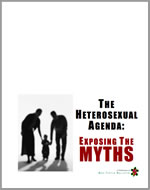 At last, the truth can now be told.
Using the same research methods employed by most anti-gay political pressure groups, we examine the statistics and the case studies that dispel many of the myths about heterosexuality. Download your copy today!
And don‘t miss our companion report, How To Write An Anti-Gay Tract In Fifteen Easy Steps.
 Anti-gay activists often charge that gay men and women pose a threat to children. In this report, we explore the supposed connection between homosexuality and child sexual abuse, the conclusions reached by the most knowledgeable professionals in the field, and how anti-gay activists continue to ignore their findings. This has tremendous consequences, not just for gay men and women, but more importantly for the safety of all our children.
Anti-gay activists often cite the “Dutch Study” to claim that gay unions last only about 1½ years and that the these men have an average of eight additional partners per year outside of their steady relationship. In this report, we will take you step by step into the study to see whether the claims are true.
Tony Perkins’ Family Research Council submitted an Amicus Brief to the Maryland Court of Appeals as that court prepared to consider the issue of gay marriage. We examine just one small section of that brief to reveal the junk science and fraudulent claims of the Family “Research” Council.
 The FBI’s annual Hate Crime Statistics aren’t as complete as they ought to be, and their report for 2004 was no exception. In fact, their most recent report has quite a few glaring holes. Holes big enough for Daniel Fetty to fall through.
“Google” is a trademark of Google Inc.
© Box Turtle Bulletin. All Rights Reserved.
 Posts
Posts  Posts via daily email: