Box Turtle Bulletin
 News and commentary about the anti-gay lobby
“Now you must raise your children up in a world where that union of man and box turtle is on the same legal footing as man and wife…”
News and commentary about the anti-gay lobbyJune 9th, 2006
 Aveline, David. “‘Did I have blinders on or what?’: Restrospective sense making by parents of gay sons recalling their son’s earlier years.” Journal of Family Issues 27, no. 6 (June 2006): 777-802. Abstract available online at http://jfi.sagepub.com/cgi/content/abstract/27/6/777.
We live in a society that operates under what’s called a “heterosexual presumption” — in other words, we tend to assume that someone is straight unless we notice something to suggest otherwise (or unless that person comes right out and tells us). But since many gay people don’t exhibit traits that are stereotypically “gay” — and many others try to pass as straight — learning that someone in fact is actually gay can be quite a shock. Only then do we try to remember clues that we might have missed in the past to try to understand how we might have missed it. David Aveline examines this phenomenon in the June 2006 issue of the Journal of Family Issues.
Dr. Aveline interviewed eighty parents of gay sons. He approached PFLAG, a gay-affirming group of parents, as well as groups that were not gay-affirming such as PFOX (Parents and Friends of Ex-Gays) and other organizations associated with Exodus International. He did this because he wanted to gather information from a wider range of parents since most previous research relied too heavily on gay-affirming parents. Unfortunately, he was only able to get two parents from the “disaffirming” groups. (One facilitator of an ex-gay ministry said that parents in his group were typically ashamed and reluctant to talk to a stranger.) PFLAG parents, on the other hand, were so supportive he had to turn some away. For this reason, this study cannot be generalized to the overall population of parents of gay sons.
Out of this sample, 27.5% said they never suspected their sons were gay, although they were able to remember events which, in retrospect, “should have” clued them in. 62.5% said they not only suspected their sons were gay, but were able to give the child’s age when their suspicions first occurred. The remaining 10% had suspicions, but couldn’t pinpoint a time when they first suspected.
Parents’ stories fell into three broad categories:
Some parents didn’t recall a particular event, saying only that their children were “different” from other boys. Only a few said they associated this “difference” with homosexuality at the time. Most said that they now took this “difference” to be a clue only in hindsight. Some parents noticed when their sons weren’t interested in sports (although this wasn’t true for all sons). Some noticed when their sons chose girls as playmates instead of other boys, while a couple of parents noticed when their sons expressed particular interests in other boys:
“But he just talked about this boy as a girl would talk about a boyfriend or something. And that’s when I just knew. There was just such excitement, you know. He was kind of giddy with this friend person, you know.”
“And I didn’t tell you this. He did tell me when he was in the fifth or sixth grade. He said to me, “Why do I think guys are cute and not girls?” And I said, “Well, I guess if they’re cute, they’re cute. You’re cute, so maybe you think they’re cute.” And I just… It just kind of went right over my head.”
Dr. Aveline however noted that very little of the reported “evidence” actually involved early homosexual expression. These two stories are notable exceptions.
Some parents thought their boys developed “too close” a relationship with girls, while others felt that their relationships with girls weren’t “close enough.” When their boys later reached their teenage years, some dated girls while others didn’t. Parents whose boys dated took it as confirmation that their sons weren’t gay after all. But parents whose boys didn’t date either suspected their sons were gay, or explained it away by citing a lack of time or money, being a late bloomer, or shyness.
Dr. Aveline concluded that although parents reported noticing atypical gender behavior, they often didn’t interpret it in terms of homosexuality. As mentioned at the start, we tend to assume someone is heterosexual unless we have very specific proof otherwise. One parents echoed this, saying “No one of my generation ever imagined that their child would be gay.” But when parents are confronted with proof that their sons are gay, they are then are left with the task of making sense of this new information. That’s when they turn to past events and begin a process of “second-level interpretation,” where they replace the original interpretation with a new one.
Gender roles continue to play an important part of how we interpret homosexuality, despite the blurring of gender roles in society. As women continue to take on a greater range of gender roles, behaviors that were previously considered “masculine” are now accepted for men and women. The same is true for behaviors that are traditionally “feminine.” Parents are increasingly open to these less rigid gender roles, which explains how parents can discount atypical gender behavior in their sons before learning of theirs sons’ homosexuality.
But when parents are confronted with the newly discovered fact that their sons are gay, they tend to revert to more rigid ideas of “typical” gender behavior and seek out past clues based on those ideas. Whether these confirmations are legitimate or not is another matter. Ironically, most of these parents were perfectly able to accept their sons’ atypical gender roles before learning that they were gay. Only afterwards are these evidences taken as clues that their sons were somehow different.
But in fact, their sons are no different than before. What has changed is how parents look at their sons’ childhood activities and behaviors. Unfortunately, Dr. Aveline doesn’t explore whether this change in interpretation affects how these parents see their sons today. This would be an interesting avenue for future research.
Because these participants, by and large, were accepting of their sons’ homosexuality, it’s a shame Dr. Aveline couldn’t get better participation from Exodus or PFOX parents. It would be interesting to understand how parents who don’t approve or accept their sons’ homosexuality interpret past events.
Latest Posts
Featured Reports
 In this original BTB Investigation, we unveil the tragic story of Kirk Murphy, a four-year-old boy who was treated for “cross-gender disturbance” in 1970 by a young grad student by the name of George Rekers. This story is a stark reminder that there are severe and damaging consequences when therapists try to ensure that boys will be boys.
When we first reported on three American anti-gay activists traveling to Kampala for a three-day conference, we had no idea that it would be the first report of a long string of events leading to a proposal to institute the death penalty for LGBT people. But that is exactly what happened. In this report, we review our collection of more than 500 posts to tell the story of one nation’s embrace of hatred toward gay people. This report will be updated continuously as events continue to unfold. Check here for the latest updates.
In 2005, the Southern Poverty Law Center wrote that “[Paul] Cameron’s ‘science’ echoes Nazi Germany.” What the SPLC didn”t know was Cameron doesn’t just “echo” Nazi Germany. He quoted extensively from one of the Final Solution’s architects. This puts his fascination with quarantines, mandatory tattoos, and extermination being a “plausible idea” in a whole new and deeply disturbing light.
On February 10, I attended an all-day “Love Won Out” ex-gay conference in Phoenix, put on by Focus on the Family and Exodus International. In this series of reports, I talk about what I learned there: the people who go to these conferences, the things that they hear, and what this all means for them, their families and for the rest of us.
Prologue: Why I Went To “Love Won Out”
Part 1: What’s Love Got To Do With It?
Part 2: Parents Struggle With “No Exceptions”
Part 3: A Whole New Dialect
Part 4: It Depends On How The Meaning of the Word "Change" Changes
Part 5: A Candid Explanation For "Change"
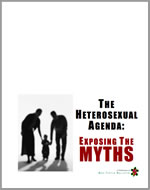 At last, the truth can now be told.
Using the same research methods employed by most anti-gay political pressure groups, we examine the statistics and the case studies that dispel many of the myths about heterosexuality. Download your copy today!
And don‘t miss our companion report, How To Write An Anti-Gay Tract In Fifteen Easy Steps.
 Anti-gay activists often charge that gay men and women pose a threat to children. In this report, we explore the supposed connection between homosexuality and child sexual abuse, the conclusions reached by the most knowledgeable professionals in the field, and how anti-gay activists continue to ignore their findings. This has tremendous consequences, not just for gay men and women, but more importantly for the safety of all our children.
Anti-gay activists often cite the “Dutch Study” to claim that gay unions last only about 1½ years and that the these men have an average of eight additional partners per year outside of their steady relationship. In this report, we will take you step by step into the study to see whether the claims are true.
Tony Perkins’ Family Research Council submitted an Amicus Brief to the Maryland Court of Appeals as that court prepared to consider the issue of gay marriage. We examine just one small section of that brief to reveal the junk science and fraudulent claims of the Family “Research” Council.
 The FBI’s annual Hate Crime Statistics aren’t as complete as they ought to be, and their report for 2004 was no exception. In fact, their most recent report has quite a few glaring holes. Holes big enough for Daniel Fetty to fall through.
“Google” is a trademark of Google Inc.
© Box Turtle Bulletin. All Rights Reserved.
 Posts
Posts  Posts via daily email:
There are no comments for this post.
Leave A Comment