Box Turtle Bulletin
 News and commentary about the anti-gay lobby
“Now you must raise your children up in a world where that union of man and box turtle is on the same legal footing as man and wife…”
News and commentary about the anti-gay lobbyA Commentary
September 7th, 2007
 In 2005 the California legislature passed a bill removing the requirement that marriage only be recognized between persons of the opposite sex. The bill was vetoed by Governor Arnold Schwarzenegger.
Although some activists accused the Governor of appeasing anti-gay factions within his party, I found his arguments to have some merit. The Governor pointed to a provision in law that was created by means of an initiative in 2000 that restricts marriage to only a man and a woman. A proposition cannot be overturned by the legislature.
At debate is exactly what the proposition meant and whether it modifies only marriages in others states or also includes marriages in California. The law prior to the initiative did limit marriage in California to a man and a woman. But it did not specifically exclude same-sex marriages in other states. Thus the proposition added a provision to other-state marriage which would restrict recognition to opposite-sex couples.
Those who favor same sex marriage point to the location of the code modified and argue that Prop 22 only applies to out of state marriage. Those who oppose same-sex marriage argue that the intent of the voters was to ban gay marriage altogether.
Meanwhile there is a case before the California Supreme Court which argues that a ban on same-sex marriage is contrary to the protections of the California Constitution. California’s current domestic partnership laws are indistinguishable from marriage, other than by name.
Schwarzenegger’s position has been fairly consistent. He has no personal objection to same-sex marriage – and will oppose any efforts to retreat from current protections – but is unwilling to sign legislation removing the gender requirements because he believes such a change in marriage law must come from either the courts or the voters overturning Prop 22: if a ban on same-sex marriage is unconstitutional, then the law isn’t needed; if a ban is allowed constitutionally, then the legislature still cannot overturn a vote of the people so therefor it isn’t adequate
“If the ban of same-sex marriage is unconstitutional this bill is not necessary,” he said. “If the ban is constitutional this bill is ineffective.”
The California State Legislature has just voted to send an identical bill back to the Governor. He is expected to veto it.
Ultimately this is little more than symbolic. If signed, the bill will be challenged in court before the ink is dry and will simply be part of the decision that is already in front of the court, a decision that already includes challenges in favor and opposed to Proposition 22. Same-sex marriage will not be advanced or delayed a single day whether or not this bill is signed.
I truly wish that Governor Schwarzenegger would take a symbolic step for equality and sign the bill. It would make a statement that California’s government sees its citizens equally. And I think the Governor has adequate polling to allow him to argue that the will of the people has changed since 2000.
But I suspect he’ll veto the bill. And the community will make a few moderately disapproving statements to the press… and then we’ll all go back to waiting for the Supreme Court to announce their decision.
Latest Posts
Featured Reports
 In this original BTB Investigation, we unveil the tragic story of Kirk Murphy, a four-year-old boy who was treated for “cross-gender disturbance” in 1970 by a young grad student by the name of George Rekers. This story is a stark reminder that there are severe and damaging consequences when therapists try to ensure that boys will be boys.
When we first reported on three American anti-gay activists traveling to Kampala for a three-day conference, we had no idea that it would be the first report of a long string of events leading to a proposal to institute the death penalty for LGBT people. But that is exactly what happened. In this report, we review our collection of more than 500 posts to tell the story of one nation’s embrace of hatred toward gay people. This report will be updated continuously as events continue to unfold. Check here for the latest updates.
In 2005, the Southern Poverty Law Center wrote that “[Paul] Cameron’s ‘science’ echoes Nazi Germany.” What the SPLC didn”t know was Cameron doesn’t just “echo” Nazi Germany. He quoted extensively from one of the Final Solution’s architects. This puts his fascination with quarantines, mandatory tattoos, and extermination being a “plausible idea” in a whole new and deeply disturbing light.
On February 10, I attended an all-day “Love Won Out” ex-gay conference in Phoenix, put on by Focus on the Family and Exodus International. In this series of reports, I talk about what I learned there: the people who go to these conferences, the things that they hear, and what this all means for them, their families and for the rest of us.
Prologue: Why I Went To “Love Won Out”
Part 1: What’s Love Got To Do With It?
Part 2: Parents Struggle With “No Exceptions”
Part 3: A Whole New Dialect
Part 4: It Depends On How The Meaning of the Word "Change" Changes
Part 5: A Candid Explanation For "Change"
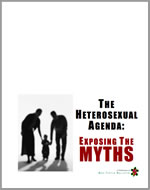 At last, the truth can now be told.
Using the same research methods employed by most anti-gay political pressure groups, we examine the statistics and the case studies that dispel many of the myths about heterosexuality. Download your copy today!
And don‘t miss our companion report, How To Write An Anti-Gay Tract In Fifteen Easy Steps.
 Anti-gay activists often charge that gay men and women pose a threat to children. In this report, we explore the supposed connection between homosexuality and child sexual abuse, the conclusions reached by the most knowledgeable professionals in the field, and how anti-gay activists continue to ignore their findings. This has tremendous consequences, not just for gay men and women, but more importantly for the safety of all our children.
Anti-gay activists often cite the “Dutch Study” to claim that gay unions last only about 1½ years and that the these men have an average of eight additional partners per year outside of their steady relationship. In this report, we will take you step by step into the study to see whether the claims are true.
Tony Perkins’ Family Research Council submitted an Amicus Brief to the Maryland Court of Appeals as that court prepared to consider the issue of gay marriage. We examine just one small section of that brief to reveal the junk science and fraudulent claims of the Family “Research” Council.
 The FBI’s annual Hate Crime Statistics aren’t as complete as they ought to be, and their report for 2004 was no exception. In fact, their most recent report has quite a few glaring holes. Holes big enough for Daniel Fetty to fall through.
“Google” is a trademark of Google Inc.
© Box Turtle Bulletin. All Rights Reserved.
 Posts
Posts  Posts via daily email:
Lynn David
September 7th, 2007
I’ll be back.
And so too will the bill.
cooner
September 8th, 2007
The amount of hatred and bile spewed in the comments section in the SacBee article is just depressing.
And someone even topped off their hatred by pulling out the old “We’re only saying this because we LOVE you and don’t want you to sin” line.
Sigh.
Jim Burroway
September 8th, 2007
Are domestic partnerships really indistinguishable from marriage? For example:
— Would someone married in Massachusetts and move to California automatically be a domestic partner, or would they have to go through some process all over again?
— Are employers required to recognize domestic partners on the same level as married couples?
I’m just asking. These are two things which sprang to mind right away. I really question whether the bill is “not necessary” if the ban is unconstitutional. It’d be good to see the wording of the law which established domestic partnerships in California.
If the law gave a long laundry list of things it made available to same-sex couples, then surely there were things left out. But if it said something like “domestic partnerships shall provide all the benefits and obligations of marriage and shall be recognized as such by everyone in California”, then maybe there’s a case to be made. But even Denmark’s landmark civil partnership law didn’t go that far.
Timothy Kincaid
September 10th, 2007
Jim,
– Would someone married in Massachusetts and move to California automatically be a domestic partner?
I believe so.
– Are employers required to recognize domestic partners on the same level as married couples?
Yes. As are insurance providers.
If the law gave a long laundry list of things it made available to same-sex couples, then surely there were things left out.
There have been little tiny adjustments along the way in obsure areas and they have been (or are being) fixed as they come up.
DPs have been incremental in CA. But I think all known differences have been corrected.
Leave A Comment