Box Turtle Bulletin
 News and commentary about the anti-gay lobby
“Now you must raise your children up in a world where that union of man and box turtle is on the same legal footing as man and wife…”
News and commentary about the anti-gay lobbyJuly 30th, 2009
The Washington Secretary of State has announced the total number of signatures turned in by the anti-gay coalition seeking to block the domestic partnership enhancements enacted by the legislature. With 137,689 signatures submitted, anti-gays only have a 14.2% cushion for error over the 120,577 valid signatures needed. The average historical error rate in Washington State is about 18%. **
WhoSigned.org, along with a couple of other petitioners, has requested that the state provide them with a listing of the names so that they can make it public. Supporters of Referendum 71 claim that signatories should be exempt from laws that require public disclosure of signatories and are suing to keep the names on the list private.
“We have a one-size-fits-all shoe that is going to result in the inappropriate disclosure of petition signers, who will then be exposed to boycotts, threats, harassment and so forth,” Pidgeon said.
Attorney Stephen Pidgeon seems to be unaware of the meaning and purpose for petitions. He seems to think that “stand up and be counted” should not allow for any public consequences for such an action.
A judge has put a temporary restraining order on the state until a hearing is held on Wednesday. Considering that other states have found the listing of anti-gay petitioners to be legal and that the State will be siding with those who wish full disclosure, I think it unlikely that anti-gay advocates will be able to convince the court that they should have special rights.
Meanwhile, the state will move forward with reviewing signatures one by one to determine their validity. They will likely fall about 7,500 short.
Ultimately, Gary Randall and the other organizers have not well served those they claim to represent. The most likely scenario is that there are inadequate signatures for a referendum but those who did sign will be exposed to public scrutiny.
The end result is that some friendships will be ended, some customers lost, some families shattered, and some respect will be lost. Further, the campaign may well be embarassed by a large number of signatories who publicly denounce the campaign and explain that they were fooled and defrauded.
And all for nothing.
** Reader Dan notes below that the proper numbers to compare are not the cushion of 14.2% and the historical error rate of 18%. Rather, we should note the error rate which this petition could have which would allow it to still have sufficient valid signatures. And that is 12.4% of the total signatures submitted.
Comparing this maximum error rate of 12.4% to the historical rate of 18% further solidifies my expectation that this petition will fail to qualify for the ballot.
Latest Posts
Featured Reports
 In this original BTB Investigation, we unveil the tragic story of Kirk Murphy, a four-year-old boy who was treated for “cross-gender disturbance” in 1970 by a young grad student by the name of George Rekers. This story is a stark reminder that there are severe and damaging consequences when therapists try to ensure that boys will be boys.
When we first reported on three American anti-gay activists traveling to Kampala for a three-day conference, we had no idea that it would be the first report of a long string of events leading to a proposal to institute the death penalty for LGBT people. But that is exactly what happened. In this report, we review our collection of more than 500 posts to tell the story of one nation’s embrace of hatred toward gay people. This report will be updated continuously as events continue to unfold. Check here for the latest updates.
In 2005, the Southern Poverty Law Center wrote that “[Paul] Cameron’s ‘science’ echoes Nazi Germany.” What the SPLC didn”t know was Cameron doesn’t just “echo” Nazi Germany. He quoted extensively from one of the Final Solution’s architects. This puts his fascination with quarantines, mandatory tattoos, and extermination being a “plausible idea” in a whole new and deeply disturbing light.
On February 10, I attended an all-day “Love Won Out” ex-gay conference in Phoenix, put on by Focus on the Family and Exodus International. In this series of reports, I talk about what I learned there: the people who go to these conferences, the things that they hear, and what this all means for them, their families and for the rest of us.
Prologue: Why I Went To “Love Won Out”
Part 1: What’s Love Got To Do With It?
Part 2: Parents Struggle With “No Exceptions”
Part 3: A Whole New Dialect
Part 4: It Depends On How The Meaning of the Word "Change" Changes
Part 5: A Candid Explanation For "Change"
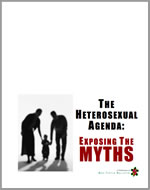 At last, the truth can now be told.
Using the same research methods employed by most anti-gay political pressure groups, we examine the statistics and the case studies that dispel many of the myths about heterosexuality. Download your copy today!
And don‘t miss our companion report, How To Write An Anti-Gay Tract In Fifteen Easy Steps.
 Anti-gay activists often charge that gay men and women pose a threat to children. In this report, we explore the supposed connection between homosexuality and child sexual abuse, the conclusions reached by the most knowledgeable professionals in the field, and how anti-gay activists continue to ignore their findings. This has tremendous consequences, not just for gay men and women, but more importantly for the safety of all our children.
Anti-gay activists often cite the “Dutch Study” to claim that gay unions last only about 1½ years and that the these men have an average of eight additional partners per year outside of their steady relationship. In this report, we will take you step by step into the study to see whether the claims are true.
Tony Perkins’ Family Research Council submitted an Amicus Brief to the Maryland Court of Appeals as that court prepared to consider the issue of gay marriage. We examine just one small section of that brief to reveal the junk science and fraudulent claims of the Family “Research” Council.
 The FBI’s annual Hate Crime Statistics aren’t as complete as they ought to be, and their report for 2004 was no exception. In fact, their most recent report has quite a few glaring holes. Holes big enough for Daniel Fetty to fall through.
“Google” is a trademark of Google Inc.
© Box Turtle Bulletin. All Rights Reserved.
 Posts
Posts  Posts via daily email:
Quo
July 30th, 2009
It should be perfectly obvious that the main reason why gay activists would these names to be revealed is so that they can harrass people they disagree with. Their behavior is sinister and downright scary.
Dan
July 30th, 2009
Tim:
Wouldn’t the cushion be just over 12%? The error rate refers to the number of names disqualified divided by the total number names submitted, no? So if 100 names are submitted, and historically the error rate is 18%, that means that we would expect to see 18 names disqualified.
In the case of R71, 137,689 names were submitted. An error rate of approximately 12.4% brings you down to the threshold of 120,577. Anything more than that and they fall below the minimum.
Dan
July 30th, 2009
Quo:
Perfectly obvious only to you. People could want to know this information for the purposes of boycotting, or to determine the degree to which the petitioners used deception to gather names. There are any number of legal, peaceful responses that an R71 proponent could pursue. It also has some value to political scientists, who have an interest in determining the geography of support for measures like R71.
Looking forward to seeing your posts denouncing any of the real and daily acts violence directed at gay people, including yesterday’s open-air bomb attack in Copenhagen.
Burr
July 30th, 2009
You can’t verify the signatures without making them public record. Are we supposed to just take the secretary of state’s word for it? No. These things need to be transparent. It’s simply a matter of process.
The very act of starting a petition over this is FAR more insidious harassment than being called to task for your immoral behavior in destroying others’ rights.
Jason D
July 30th, 2009
Boycotts are not harassment.
Going up to your coworker/brother-in-law/neighbor and saying “hey, I heard you signed this petition, what’s that about?” is not harassment.
Signing a petition is NOT the same as voting. People seem to think that signing a public record is the same as voting (which is private). It simply is not.
A petition is a public record, and those that sign it are endorsing it, and it’s message. They are taking a public stand for the petition — that’s the whole point of putting their name and address down.
This is a case of people wanting to talk, but not wanting to be criticized. People wanting to stand up for something without having to actually stand up to their opposition.
Timothy Kincaid
July 30th, 2009
Dan,
That’s an interesting question. The cushion is 14.2% but it only allows for an error rate of 12.4%.
So the more relevant issue when comparing to the 18% failure rate is not the size of the cushion but the maximum error rate which could still result in an adequate number of valid signatures.
I’m an accountant. I shouldn’t have missed that.
Brian Murphy
July 30th, 2009
The submitted signature count was 137,689. That gives them a cushion of just 17,112 signatures and would require an invalid signature rate of 12.428% or lower to get on the ballot.
The cleanest data set the WA Secretary of State has had was reportedly around 12% (for I-1033 I believe).
Emily K
July 30th, 2009
you know maybe the reason anti-gays want gays to keep themselves in the closet is because they themselves are so comfortable there. Why else would they want to be able to keep their support of a measure as a member of the public a private matter?
Except that it ISN’T.
Since Quo loves NARTH so much (but also loves coming here to BTB, a blog overrun with gays, gay articles, and gay advertisements) maybe he could cure his queerness once and for all by undergoing the therapies supported by NARTH in their most recent publication. I’ll even send him some salve to soothe the burns he’ll have on his repeatedly electro-shocked member.
Dan, I’m also looking forward to seeing that. But I’m not holding out for it, either.
Timothy Kincaid
July 30th, 2009
quo,
I’m sure you know that reaporting of signatories has taken place in several states. Perhaps you could support your claim by posting real examples of harassment of others who have signed a petition.
And don’t drag up old Prop 8 donor boycotts or other slights, real or imagined. We’re talking signatories.
Surely, surely, if you are willing to claim that Washingtonians are about to be harassed, then you have a good basis on which to make that claim.
Dan
July 30th, 2009
@Brian Murphy
As I understand it, the failure rate of approximately 12% for I-1033 was a record low for WA state. The 18% failure rate is the “typical” outcome, i.e., that number is not just a misleading numerical average derived from averaging a lot of 1% failure rates and a lot of 37% failure rates. In fact, it has never gone lower than 12% and it has occasionally gone into the 20-something percent range.
So assuming that I am correct that R71 has a 12.4% margin of error (and not 14% as the SoS has been saying), then R71 would have to match or beat the record low set by I-1033. But then, they do have Yahweh on their side, so you never know . . .
David C.
July 30th, 2009
There is no reasonable expectation of complete privacy when you sign a publicly circulated petition for the purposes of placing a measure on a ballot where such a process is permitted by law.
In essence, when you sign such a petition, you and the rest of the signatories are representing a position on a measure you wish to see enacted into law. As remarked above, it is essential that signatories be validated as eligible “representatives” of that position to be considered by the people of the state and with that necessarily comes disclosure.
This is analogous to someone running for office, where much of the details of that someone’s past become a matter of public record.
If one thinks that their position on a matter to be taken up for a vote by registered voters is potentially embarrassing to them, they should consider not signing on to represent that position, and instead vote for representatives that will represent their interests and make laws that best suit the citizens of the state where they live.
In short, if you can’t stand the heat, stay out of the kitchen.
Quo
July 30th, 2009
David C,
You might just as well argue that it should be compulsory for people to reveal who they voted for. It’s a lousy idea.
David C.
July 30th, 2009
Umm, no, false analogy.
When you seek to enact (or repeal) a law by petitioning for plebiscite, you are not the same kind of actor as a voter but are instead functioning like a representative to propose legislation. A vote cast in such a referendum is of course, and should remain, secret.
Chris R
July 31st, 2009
David C/Tim –
First, I don’t agree with Quo that this is “scary” — or if this is scary then the right wing is the seventh level of hell by analogy.
That said, I think I agree that the signatures should be kept private. I’m not making a case about how the law is, but how it should be. One of the detriments of us living in a republic rather than a democracy is that we don’t get to vote on every issue — if we did, according to the polls DADT would be gone by now.
But there has to be an up side to that too. It means that there should be a reciprocal distance between me as a voter (or signer — frankly I fail to see a material distinction between a voter and a signer, even in light of your comment above David. That’s not meant to be argumentative, just that I read your argument and disagree.) and the law itself. This distance both forbids me to be able to pass a law myself, and also entitles me to a level of anonymity for weighing in to place something before my delegate.
So overall, I don’t think signatures of this nature should be published (though that certainly doesn’t mean they shouldn’t be able to be verified by a third party for validity).
Penguinsaur
July 31st, 2009
Why dont they want people knowing they signed it? I mean after all, its a totally not hateful act that doesnt actually take any rights from people, is supported by the majority and can be defended with logical and rational arguments. Right? Thats what they keep saying, its not like they’re abunch of pathetic bigots who just dont wanna have to actually give a reason for treating gays like crap.
Ben
July 31st, 2009
@Chris R
I would suggest that we take your idea a step further and do away with voter initiatives. This would insure that there is a proper distance between a voter and the law, and also protect our status at a republic. All legislation could then be funneled, privately, through elected representatives.
An interesting side note, there is no Federal constitutional right to a secret ballot, and the secret (or Australian ballot) did not become the norm in the US until between 1888 and 1891.
elaygee
July 31st, 2009
You forgot that many people will see their name on the list and rightfully declare that they did not sign an anti-gay petition and were told it was something else. That’ll drive the # of valid signatures down even more.
Leave A Comment