Box Turtle Bulletin
 News and commentary about the anti-gay lobby
“Now you must raise your children up in a world where that union of man and box turtle is on the same legal footing as man and wife…”
News and commentary about the anti-gay lobbyFebruary 18th, 2011
The California Supreme Court has now answered a number of questions about the legality of same-sex marriage in California.
Now it will answer one more.
As part of Perry v. Schwarzenegger, the Ninth Circuit Court of Appeals found no provision by which the authors of a proposition could appeal a federal decision if the elected representatives of the state chose not to do so. However, as the State of California is the entity which determines who will represent its interests, it asked the California Supreme Court to determine if California law had some provision by which non-elected representatives could step into the shoes of elected officials and appeal on behalf of the state.
Last week the State Supremes took up the challenge. Opening briefs are due March 14, 2011.
If the CA court finds that there are no substitute-appellant provisions in California law, then the Ninth Circuit is likely to accept that finding and, as there is no one to appeal the decision, uphold Judge Walker’s finding that Proposition 8 violates the equal protections and due process clauses of the US Constitution. This ruling would likely trigger challenges in other states in the Ninth Circuit that are banned by constitutional amendment from recognizing same-sex marriages, particularly the ‘all but the name’ states of Oregon and Nevada.
The Proposition 8 Proponents will, of course, appeal to the US Supreme Court to get standing, but that is unlikely to be granted.
Should the CA Supremes determine that the Proponents can appeal the ruling, then the Ninth Circuit will determine whether Judge Walker’s ruling is correct on its merits.
Latest Posts
Featured Reports
 In this original BTB Investigation, we unveil the tragic story of Kirk Murphy, a four-year-old boy who was treated for “cross-gender disturbance” in 1970 by a young grad student by the name of George Rekers. This story is a stark reminder that there are severe and damaging consequences when therapists try to ensure that boys will be boys.
When we first reported on three American anti-gay activists traveling to Kampala for a three-day conference, we had no idea that it would be the first report of a long string of events leading to a proposal to institute the death penalty for LGBT people. But that is exactly what happened. In this report, we review our collection of more than 500 posts to tell the story of one nation’s embrace of hatred toward gay people. This report will be updated continuously as events continue to unfold. Check here for the latest updates.
In 2005, the Southern Poverty Law Center wrote that “[Paul] Cameron’s ‘science’ echoes Nazi Germany.” What the SPLC didn”t know was Cameron doesn’t just “echo” Nazi Germany. He quoted extensively from one of the Final Solution’s architects. This puts his fascination with quarantines, mandatory tattoos, and extermination being a “plausible idea” in a whole new and deeply disturbing light.
On February 10, I attended an all-day “Love Won Out” ex-gay conference in Phoenix, put on by Focus on the Family and Exodus International. In this series of reports, I talk about what I learned there: the people who go to these conferences, the things that they hear, and what this all means for them, their families and for the rest of us.
Prologue: Why I Went To “Love Won Out”
Part 1: What’s Love Got To Do With It?
Part 2: Parents Struggle With “No Exceptions”
Part 3: A Whole New Dialect
Part 4: It Depends On How The Meaning of the Word "Change" Changes
Part 5: A Candid Explanation For "Change"
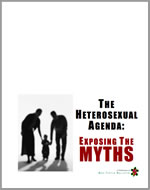 At last, the truth can now be told.
Using the same research methods employed by most anti-gay political pressure groups, we examine the statistics and the case studies that dispel many of the myths about heterosexuality. Download your copy today!
And don‘t miss our companion report, How To Write An Anti-Gay Tract In Fifteen Easy Steps.
 Anti-gay activists often charge that gay men and women pose a threat to children. In this report, we explore the supposed connection between homosexuality and child sexual abuse, the conclusions reached by the most knowledgeable professionals in the field, and how anti-gay activists continue to ignore their findings. This has tremendous consequences, not just for gay men and women, but more importantly for the safety of all our children.
Anti-gay activists often cite the “Dutch Study” to claim that gay unions last only about 1½ years and that the these men have an average of eight additional partners per year outside of their steady relationship. In this report, we will take you step by step into the study to see whether the claims are true.
Tony Perkins’ Family Research Council submitted an Amicus Brief to the Maryland Court of Appeals as that court prepared to consider the issue of gay marriage. We examine just one small section of that brief to reveal the junk science and fraudulent claims of the Family “Research” Council.
 The FBI’s annual Hate Crime Statistics aren’t as complete as they ought to be, and their report for 2004 was no exception. In fact, their most recent report has quite a few glaring holes. Holes big enough for Daniel Fetty to fall through.
“Google” is a trademark of Google Inc.
© Box Turtle Bulletin. All Rights Reserved.
 Posts
Posts  Posts via daily email:
Pomo
February 18th, 2011
I’d rather them decide on the merits of the case because that is what needs to be appealed to SCOTUS to get a final ruiliing that will affect the entire country. Wouldn’t you? Unless of course one assumes the justices won’t rule in our favor yet and it would be better to not bring this topic to them just yet.
Mudduck
February 18th, 2011
You usually play a role, unless you just roll over.
Norm!
February 18th, 2011
I agree with Pomo. The merits of the constitutional argument are more important than the issue of standing.
The scenario that a sole federal judge would have the power to overturn an initiative approved by the voters of the most populous state without opportunity for appeal is very troubling. While I certainly don’t support the Prop 8 advocates, it makes sense that they should have the opportunity to defend their amendment in the state’s absence. The notion that the governor or attorney general can effectively veto the people’s initiative through inaction undermines the entire initiative process.
Also, I can’t wrap my head around the scenario that the CA Supreme Court would uphold Walker’s ruling, but not the standing of one of the parties of the very same ruling.
Timothy Kincaid
February 18th, 2011
Muddick,
Thanks. Some folks have trouble with your, you’re, and yore. I have trouble with roll and role.
Timothy Kincaid
February 18th, 2011
Norm!,
There is opportunity for appeal. And, I would argue, the duly elected representatives of the people (the same ones who voted for the amendment voted for governor and attorney general) have the role and responsibility to determine whether to appeal a legal decision.
And you are mistaken that the governor and attorney general chose inaction. That suggests inattention or lack of concern. They each proactively chose not to appeal stating that they agreed with the court’s ruling.
And then the people elected that attorney general to the governor’s seat and the candidate who campaigned on her opposition to Proposition 8 to the seat of attorney general.
It isn’t as though the people have had no voice in the matter.
Rob San Diego
February 18th, 2011
I love how conservatives bemoan about Judge Walkers single decision on prop 8, yet they celebrate the single Federal Judge’s decision on Obamacare.
Donny D.
February 19th, 2011
I think that passed initiatives shouldn’t be left without defenders in court if public officials choose not to defend them, at least here in California. It makes sense to me that their previous legal or electoral proponents could rightfully serve in that role. I agree with the argument that not letting citizens defend an initiative in the event that government officials decline to do so allows those officials to practice de facto legal nullification.
I have some qualms about relying entirely on those officials at any time because they could always ineptly or intentionally give an initiative a weak defense, but it may be that non-governmental proponents’ ability to file amicus briefs is considered a sufficient safeguard against that possibility.
Amicus
February 19th, 2011
One other thing that the CA Supremes did act on is the PJI’s request to enjoin the California AG to defend Prop8. The Supremes did not overturn CA’s 3rd district, by denying review of the decision.
http://appellatecases.courtinfo.ca.gov/search/case/dockets.cfm?dist=3&doc_id=1953899&doc_no=
Potentially unexpected surprises would be a SCOTUS that takes a different view on the standing issue, no matter how the 9th circuit decides it. They might end up concurring with the 9th circuit, but have different reasons for doing so.
Olsen & Boies might not appeal a 9th circuit decision on _standing_, but perhaps they should… It might be interesting to see how Alito would square his prior decisions on standing with this case.
It’s hard to draw-up a consistent framework for how to apply “standing doctrine”, either for state or federal law, I think. (If you don’t believe me, try it!)
Nevertheless, it does seem that proponents’ assertion/argument is conceptually false, that if there is no standing for appeal, that the the trial decision itself is then to be vacated. Plantiffs (Boies w/ Zarrillo et. al.) had a particularized injury at trial, which gave rise to a proper “case or controversy” (Article III). It’s not clear that Defendant Intervenors (Pugno et. al., with “?”) have a particularized injury on appeal.
That makes sense, right? (It does to me, logically). All done. Cased closed. A good day for “federalist principles” in the courts. Walker’s decision doesn’t become precedent, and that’s good or bad, depending on your perspective of whether federalism is good or bad or whatever.
But, suddenly, we introduce a class/kind of “person” who always has the “right” to appeal, even in Federal Court, the Attorney General, i.e. “We the People”. This magic class is conferred sufficient standing, seemingly outside the “logic” of standing, outlined above, that seems to “make sense”.
So, ask yourself, from a logical perspective of implementing a doctrine on ‘standing’, how do you “create” classes of plaintiffs/defenders, at trial or appeal, who violate the doctrine? Remember, the doctrine of standing is not articulated on who brings the case, but on the question of whether there is a particularized injury of a kind that gives rise to a proper “case or controversy”.
After that, it just goes to pot. Of course, the courts do refuse AGs on appeal for standing, so not _that_ fast to pot (although, again, this is a logical category for argument’s sake, I don’t know how often this occurs, in practice), but consider the following.
It’s not just the AG, but apparently the Governor, who are in the “magic class”, in California (so it seems – I am at the limits on my legal analysis, with that, and know of no cases in which the Governor defended, but the AG didn’t).
That itself, brings up the question of, ‘What happens when members of the magic class disagree with each other?’. Suddenly, one is in a much more complex “doctrine of standing”.
Now how much would you pay? Don’t answer yet! There is more!
The “magic class” is extended to proponents of initiatives. Sometimes this is done on a contingent basis (may or may not be conferred – has to be specifically in the language before the plebiscite). Sometimes it’s absolute (implied right/obligation, ‘goes without saying’).
Now your doctrine of standing has to articulate whether this part of the “magic class” is as “worthy” as the other parts, when they disagree. Different states might answer that differently. In their precedent setting role, do Federal courts just follow whatever is the least common denominator in the most permissive of “magic class” states, allowing “nutjob states” to gain maximal access to the Federal courts?
Now how much would you pay? … Nope. Too soon.
Some states have said that the legislature can be a non-contingent part of the “magic class”.
Summary?
Who knows – I’m not thought through, enough, on it to be clear.
One could easily say, perhaps, that I’ve just imagined a “magic class”, because no such thing exists in civil procedure (no “shortcut” to appeal/trial). But, what is the particularized harm from gay marriage on anyone? Put another way, even if you empowered someone, like the AG or an intervenor, +in general+, couldn’t one still say, in any +particular+ case, there is, nevertheless, no standing?
If you have a proposition that is “in the general interest” or public good, like “clean air/water” or maybe “marriage”, it doesn’t seem that one can conceptually create classes “empowered” litigants and keep a coherent doctrine of standing that requires a particularized harm. (Notice, this seems quite different than a proposition saying, “property taxes should be limited to 2.5% in this state”).
I dunno. I probably should have done more research on the questions, before posting. Read Justice Walkers bits on standing, at a minimum. But, such as it is.
[sorry for the length of this]
Mark F.
February 19th, 2011
Timothy:
I see your point, but imagine that same sex marriage had passed via an initiative, but then a court found it unconstitutional and the state declined to appeal. Still feel good about your legal philosophy? It creates a de facto ability for the executive branch to repeal any initiative. The whole point of an initiative is to have direct democracy and bypass the rest of the government.
Désirée
February 19th, 2011
direct democracy that bypasses the checks and balances of the rest of government is generally a *bad* thing. It’s not like they can simply nullify an initiative they disagree with. It still had to go to court and be declared unconstitutional before the governor or AG could “veto” it. Of course, they did no such thing. They simply let a legal ruling stand. That’s not a “veto.” If you ever want to “blame” anyone for an initiative getting tossed, blame the judge.
The California initiative system is hopelessly broken, this is further proof, and giving initiative sponsors extra legal rights in court does nothing to fix the problem – in fact, it makes it worse by allowing well funded special interest groups to push laws that have been found unconstitutional further through the court system than they otherwise would.
Initiatives rarely make for good law – they are extreme positions, that don’t need to be tempered by the compromises that go on in legislatures, they lack the checks and balances that legislature-written laws have and they can’t be altered or amended by future legislatures with popular vote or lengthy court cases.
For better or worse, we elect politicians to make laws. That’s their job. Sure they suck at it, but the thing is, they are better at it than the general populace.
Désirée
February 19th, 2011
oops – 3rd paragraph sound read “they can’t be altered or amended by future legislatures with*out* popular vote or lengthy court cases.”
Amicus
February 19th, 2011
Désirée, I actually went and looked up the history of CA ballot initiatives, some while back:
http://en.wikipedia.org/wiki/List_of_California_ballot_propositions
I wanted to see how many were statues and how many were changes to the CA Constitution.
I also wanted to see how many were issues of public policy (technical sense of the term: http://en.wikipedia.org/wiki/Public_policy_doctrine) and how many were highly specific, e.g. these four trees will not be cut down, appropriate $100M to save the whales, allow so-and-so to issue a bond for a project.
To play devil’s advocate, which ones were “bad” and which were “good” and why?
I wanted to test the hypothesis that questions of public policy are not fit to go before a plebicite. I’m still in the deciding stage of that assessment.
I also looked up the CA constitution. There are very few restrictions on what kind/type of referendum you can bring. As I recall, only a few things are excluded (http://ballotpedia.org/wiki/index.php/Laws_governing_the_initiative_process_in_California).
I was interested in seeing whether matters of public policy were reserved for the legislature, but they are not.
I do recall that there is/was considerable fight over the wording of the proposition, but I don’t recall whether this was beneficial, ultimately, to a court, who might want to determine the intent of the law. Not being familiar with referenda, I have no idea whether there is more clarity in them in general than, you know, than when the legislature enacts.
Throbert McGee
February 19th, 2011
As my (religious conservative) brother-in-law has observed, “Judicial activism!!” is usually just a coded way for people to whine that “those f*ckers on the Supreme Court handed down a ruling that personally annoys me.”
Richard Rush
February 19th, 2011
Timothy said,
Oh, don’t be concerned. That’s neither here nor
theirthey’rethere.Amicus
February 20th, 2011
BTW, I want to follow-up by pointing to this thread at Volokh.
You can get a sense for how confusing the situation is.
http://volokh.com/2011/02/16/do-prop-8-proponents-have-standing-to-defend-the-law/#comments
I’m going to conjecture that the appellate court seems concerned what happens if they find no standing for proponents.
That might explain why the pursuit of a certification that seems so outre, notwithstanding Ginsbergs **dicta** in Arizonans.
In particular, what happens under California law to Judge Walker’s injunction, the day after? They seem to want to know whether proponents would have standing to continuing fighting in the State’s courts, basically. A fight which might spill back to the Federal District court…?
Consider this exchange at orals:
(In this exchange, I think Boies was just being narrow/precise, because he certainly could augment/amplify his answer that his only expectation is that they could be compelled to follow the law/injunction; but one can nevertheless get a sense of the concern from the bench.]
It is in this context that they brought up the issue of certifying a class for the suit, although how that would help the State/AG defend the injunction is not plain to me, but perhaps it could have.
It is also in this context that issues relating to jurisdiction and constitutional avoidance come up. It’s not plain to me that those aren’t fairly easily dealt with.
Anyway, if you skim Volokh, go armed knowing what a “facial challenge” is, because so many are thinking what Olsen-Boies did was “as applied”.
You also might need some info on the nature of precedent, etc. Easy-to-read outline, here:
http://www.lacba.org/showpage.cfm?pageid=9375
If you come away with a general assessment that a federal lawsuit can be like a chess match, you are like me.
Amicus
February 20th, 2011
If you’re interested in going to the source materials, I can share this (info which took a long time to generate, because I didn’t find a page on Prop8 trial tracker with all the briefs…).
The two opening briefs, which cover standing and jurisdiction; the proponent’s reply brief (11/02/10); the request for certification from the Supremes, and Judge Reinhardt’s ‘special mention’ concurrance (1/4/11) can be found here:
http://www.ca9.uscourts.gov/content/view.php?pk_id=0000000513
Olsen’s brief to the CA Supreme court is here,
via SCOTUS blog
Proponents’ brief to the CA Supreme court is here, also via SCOTUS blog.
Timothy Kincaid
February 21st, 2011
Mark
Sorry for the cut and paste but I think that’s the best way to answer.
I’m still comfortable enough with it. Provided, of course, that the initiative was given a sound defense.
I disagree. It does allow them the ability to confirm a court veto with which they agree, but that is quite a different animal from executive repeal.
Yes. I’m not overly fond of unfettered pure democracy – preferring a more repulican representative approach. But I also appreciate the ability of the people to override the elected legislature.
All that said, I live in California. This is the state that passed initiatives to mandate the space that chickens have in coops, and to ban eating horse meat. Sometimes my fellow citizens aren’t as much interested in reading input or learning facts (something that we at least pretend happens in a legislature) as they are in ‘voting their heart’.
So I don’t hold ‘the vote of the people’ on statutes and points of law (or even on amending the constitution for specific laws) in the highest regard.
For me, the issue is this: the case got a fair hearing (that’s important to me). A judge was clear and detailed and relied on the law in making a judgment. That is a reasonable position at which to say that the matter is settled.
(and were this not marriage, few would think that tossing out one of CA’s very many silly initiatives deserved appeal.)
I would not necessarily fault a governor or attorney general if they wished to appeal this (or any other) decision, provided that it was on matters of law and not to further a homophobic culture (and think that Steve Cooley was VERY mistreated by partisans who lied through their teeth to paint him as a homophobe for saying he would appeal even though he supports same-sex marriage). But I also don’t think that the decision to abide by the court’s ruling is some dereliction of duty.
Timothy Kincaid
February 21st, 2011
Amicus,
Kathleen Perrin has been hosting all the docs on her scribed account.
(much appreciation to her for doing so)
Mark F.
February 23rd, 2011
“But I also don’t think that the decision to abide by the court’s ruling is some dereliction of duty.”
I agree. But I think the supporters of an initiative should have automatic standing to defend it in court if the government declines to do so. I would support a change in the law to make that so, if necessary.
I see no compelling evidence that the laws made by initiative in California (or anywhere) are any better or worse overall then the laws made by the legislature.
Timothy Kincaid
February 23rd, 2011
ARE YOU KIDDING??? Californians passed initiatives to ban eating horse meat and to mandate the size of chicken coops. Seriously.
Oh, wait. You may have a point.
Sigh…. I really do love my state.
Amicus
February 24th, 2011
I’m not sure “any better or worse” is the right metric.
Apart from the AG, why should any group get ‘special rights’ in court, particularly on a matter of the public good?
If some random proponents group has ‘standing’ in court, just because they paid for signatures, then anyone should be able to get such standing, even though they do not have a particularized injury.
Put another way, the cases that got thrown out when people sued over their air and water were being ruined? Those plaintiffs all ought to have had standing, because ‘clean air’ and ‘unpolluted water’ are public goods that everyone has a ‘claim to’, or, in other language, ‘give rise to a special interest’.
I’m not sure one can create a formal set of rules that would have kept Prop8 off the ballot or proponents out of the courts, while allowing other policy issues that seem less like the impermissible ‘vote on minority rights’.
All the same, if one is going to have rules that restrict access to the courts (‘standing doctrine’), it does seem that they ought to be either consistently, uniformly applied, or ‘the system’ looks rigged too much.
http://www.law.cornell.edu/rules/frcp/Rule24.htm
Leave A Comment