Box Turtle Bulletin
 News and commentary about the anti-gay lobby
“Now you must raise your children up in a world where that union of man and box turtle is on the same legal footing as man and wife…”
News and commentary about the anti-gay lobbyDecember 9th, 2011

President Bingu wa Mutharika
Malawi’s Nyassa Times has this as the lede:
President Bingu wa Mutharika has bowed down to pressure by ordering that Malawi Law Commission to review some of the repressive laws including a ban on homosexual acts, Justice Minister Ephraim Chiume has said.
Chiume said provisions of the penal code concerning “indecent practices and unnatural acts” would be reviewed.
“In view of the sentiments from the general public and in response to public opinion regarding certain laws, the government wishes to announce to the Malawi nation that it is submitting the relevant laws and provisions of laws to the Law Commission for review,” he said.
It’s hard to imagine that “sentiments from the general public” are responsible for the government’s announcement. Malawi society, like much of Africa, is both very religious and deeply conservative when it comes to sexual matters, and it is also deeply homophobic as a result. This may explain why it’s the anti-gay law which is the focus of Nyassa Times’s coverage which includes a provocative (for Africa) photo of two men kissing. Buried deeper in the article is this:
The President has ordered the law commission to review some of the laws that were enacted recently including Section 46 of the penal code and Local Courts Act in view of concerns from the general public…” reads the statement in part the release.
However, the press release did not indicate time frame for the review and when it will commence.
Other laws that have ignited a public outcry are the Local Courts Act, which empowered traditional leaders to administer justice beyond their jurisdiction; the Injunctions Bill which restrains Malawians from getting temporary reprieve from courts against government; and the Local Government Act, which empowers the President to call for Local Government Elections “in consultation with the Malawi Electoral Commission”.
That doesn’t tell the whole story either. What Nyassa Times doesn’t fully describe is another law, which was reported this way by Kenya’s Daily Nation (which is owned by the same media company that publishes Uganda’s independent Daily Monitor):
The country’s Justice minister Ephraim Mganda Chiume said that some of the laws set for review include Section 46 of the penal code that empowers the Information minister to ban newspapers.

Malawi police used live ammunition to chase anti-government protesters in Lilongwe on July 20, 2011.
So here’s the broader context. Up to now, Mutharika had begun to emulate the tactics of Zimbabwe’s President Robert Mugabe through strict police crackdowns on demonstrations and opposition groups as well as measures to muzzle the press. Mutharika has even parroted Mugabe’s rhetoric describing gay people as “worse than dogs.” Earlier this year, a Wikileaks cable revealed that the British ambassador warned his London superiors that Malawi’s President was becoming increasingly autocratic and intolerant of criticism. Mutharika responded by proving the ambassador’s point and expelled him. Britain then began cutting aid to Malawi as a result in July 2011.
Which puts Malawi in a particularly precarious position now that the U.S. has announced that the protection of human rights for LGBT people would now become a foreign policy priority. It’s unclear whether Mutharika’s latest move was a direct response to the U.S. announcement or whether it has been coming anyway in an effort to restore British aid. Discussions over the suspension of British foreign aid have been building for several months. And with British Prime Minister David Cameron’s announcement that treatment of LGBT people would affect how Britain directs its foreign aid, the discussions over Malawi’s statutes criminalizing homosexuality were likely already on the table. Now that Malawi is scrambling to get back into the good graces of one major foreign donor, the impoverished nation can ill afford to alienate another.
Latest Posts
Featured Reports
 In this original BTB Investigation, we unveil the tragic story of Kirk Murphy, a four-year-old boy who was treated for “cross-gender disturbance” in 1970 by a young grad student by the name of George Rekers. This story is a stark reminder that there are severe and damaging consequences when therapists try to ensure that boys will be boys.
When we first reported on three American anti-gay activists traveling to Kampala for a three-day conference, we had no idea that it would be the first report of a long string of events leading to a proposal to institute the death penalty for LGBT people. But that is exactly what happened. In this report, we review our collection of more than 500 posts to tell the story of one nation’s embrace of hatred toward gay people. This report will be updated continuously as events continue to unfold. Check here for the latest updates.
In 2005, the Southern Poverty Law Center wrote that “[Paul] Cameron’s ‘science’ echoes Nazi Germany.” What the SPLC didn”t know was Cameron doesn’t just “echo” Nazi Germany. He quoted extensively from one of the Final Solution’s architects. This puts his fascination with quarantines, mandatory tattoos, and extermination being a “plausible idea” in a whole new and deeply disturbing light.
On February 10, I attended an all-day “Love Won Out” ex-gay conference in Phoenix, put on by Focus on the Family and Exodus International. In this series of reports, I talk about what I learned there: the people who go to these conferences, the things that they hear, and what this all means for them, their families and for the rest of us.
Prologue: Why I Went To “Love Won Out”
Part 1: What’s Love Got To Do With It?
Part 2: Parents Struggle With “No Exceptions”
Part 3: A Whole New Dialect
Part 4: It Depends On How The Meaning of the Word "Change" Changes
Part 5: A Candid Explanation For "Change"
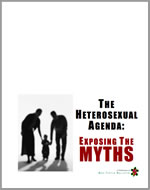 At last, the truth can now be told.
Using the same research methods employed by most anti-gay political pressure groups, we examine the statistics and the case studies that dispel many of the myths about heterosexuality. Download your copy today!
And don‘t miss our companion report, How To Write An Anti-Gay Tract In Fifteen Easy Steps.
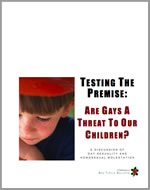 Anti-gay activists often charge that gay men and women pose a threat to children. In this report, we explore the supposed connection between homosexuality and child sexual abuse, the conclusions reached by the most knowledgeable professionals in the field, and how anti-gay activists continue to ignore their findings. This has tremendous consequences, not just for gay men and women, but more importantly for the safety of all our children.
Anti-gay activists often cite the “Dutch Study” to claim that gay unions last only about 1½ years and that the these men have an average of eight additional partners per year outside of their steady relationship. In this report, we will take you step by step into the study to see whether the claims are true.
Tony Perkins’ Family Research Council submitted an Amicus Brief to the Maryland Court of Appeals as that court prepared to consider the issue of gay marriage. We examine just one small section of that brief to reveal the junk science and fraudulent claims of the Family “Research” Council.
 The FBI’s annual Hate Crime Statistics aren’t as complete as they ought to be, and their report for 2004 was no exception. In fact, their most recent report has quite a few glaring holes. Holes big enough for Daniel Fetty to fall through.
“Google” is a trademark of Google Inc.
© Box Turtle Bulletin. All Rights Reserved.
 Posts
Posts  Posts via daily email:
Rob in San Diego
December 9th, 2011
Well we know who is desperate for American Foreign Aid!
Leave A Comment