Box Turtle Bulletin
 News and commentary about the anti-gay lobby
“Now you must raise your children up in a world where that union of man and box turtle is on the same legal footing as man and wife…”
News and commentary about the anti-gay lobbyPosts Tagged As: Britain
March 13th, 2014
Today, registrars across England and Wales began accepting declarations of intent to marry from same-sex couples as major portions of the recently enacted same-sex marriage legislation went into effect at midnight. This means that the first weddings taking place in England and Wales will take place on March 29 following the required 15-day waiting period. There are exceptions to that waiting period:
The official guidance states: “The Registrar General can allow a marriage to take place without the normal 15-day notice period where one of the couple is seriously ill and is not expected to recover, and in other urgent cases such as where a person is due to be deployed overseas in the armed forces. Such marriages of same sex couples will be possible from Thursday, 13 March 2014.”
They won’t however been the first same-sex married couples in England and Wales. Couples who were married overseas got a head start in becoming legal spouses today as their marriages became legally recognized at the stroke of midnight.
Procedures for converting civil partnerships into marriage will be put in place later this year.
Meanwhile, Queen Elizabeth II has given her Royal Assent to Scotland’s same-sex marriage law today. Same-sex marriages in Scotland will become legal sometime later this year.
Northern Ireland remains the only corner of the United Kingdom where there has been no movement on marriage equality. This is despite more than half of residents supporting same-sex marriage, with particularly strong support among Catholics.
March 1st, 2014
Glasgow is set to host the Commonwealth Games this summer, which several athletes and members of the Ugandan government are expected to attend:
Humza Yousaf, Minister For External Affairs, has written to UK Foreign Secretary William Hague detailing the Scottish Government’s gesture to welcome “any Ugandan” persecuted by the new laws.
…With prominent members of the Ugandan government due in Glasgow this summer, the Scottish Government will also meet representatives of LGBT (lesbian, gay, bisexual, and transgender) groups to discuss proposals on handling human rights issues during the event.
…In his letter Mr Yousaf has urged Mr Hague “to offer asylum to any Ugandans who feels threatened or persecuted by the legislation”, adding that “Scotland will play her part in providing asylum for those seeking refuge from this draconian legislation”.
He adds that during the Games “no one from any part of the Commonwealth who visits Scotland will be under any doubt about our values as a welcoming, open and tolerant society”.
A senior source said: “The issue is now so high profile it is hardly something the Scottish Government or anyone involved in the Games can now shy away from.”
February 24th, 2014
The British Foreign Ministry has issued this statement in reaction to Uganda’s enacting the Anti-Homosexuality Bill:
On 24 February 2014 William Hague said:
I am deeply saddened and disappointed that the Anti-Homosexuality Bill in Uganda has been signed into law. The UK strongly opposes all discrimination on any grounds. We question the Bill’s compatibility with Uganda’s constitution and international treaty obligations. There can be no doubt that this Bill will increase persecution and discrimination of Ugandans, as well as damage Uganda’s reputation internationally.
We ask the Government of Uganda to protect all its citizens and encourage tolerance, equality and respect. We will continue to press the Government of Uganda to defend human rights for all, without discrimination on any grounds.
In 2011, British Prime Minister David Cameron warned Uganda that countries which persecute gay people will find their foreign aid budget cut.
July 17th, 2013

Photo via George Takei
Lawmakers cheered as House of Commons Speaker John Bercow said royal assent had been given — one day after the bill to legalize same-sex marriage in England and Wales cleared Parliament. The queen’s approval was a formality and is the last step necessary for a bill to become law.
Marriages are expected to begin sometime in the summer of 2014.
July 16th, 2013
The staunchly anti-gay, ironically-named website Anglican Mainstream has reacted to today’s approval of Britain’s marriage equality bill:
To Think About: SSM, July 2013
July 15th, 2013 Posted in News | Comments OffFirst they came for the Socialists, and I did not speak out, because I was not a Socialist.
Then they came for the Trade Unionists, and I did not speak out, because I was not a Trade Unionist.
Then they came for the Jews, and I did not speak out, because I was not a Jew.
Then they came for me–and there was no one left to speak for me.
Martin Niemoller
Because marriage equality is JUST LIKE THE HOLOCAUST, PEOPLE!
July 16th, 2013
 It’s a done deal. The House of Commons gave its final approval to the bill after minor changes were made by the House of Lords, which approved the bill on Monday. But not before marriage equality opponents tried a last ditch effort to ditch the bill:
Conservative MP David Burrowes had tabled an amendment and was today once again accused of trying to delay implementation of the bill. Pro-equal marriage MPs padded out their speeches so that Mr Burrowes could not propose his amendment.
The amendment he tabled sought to force the government to hold individual public consultations for changes to secondary legislation.
The bill now goes to the Queen for Royal Assent. No monarch has withheld Royal Assent since 1708.
Same-sex marriages are expected to begin in the spring or summer in 2014 in England and Wales only. Legislation to allow marriage equality in Scotland is in its initial stages. There are currently no efforts underway as yet to institute marriage equality in Northern Ireland.
(By the way, when I went to Google Images looking for an appropriate image for this post, I typed “Big Ben Gay” into the search box. This image popped up, accompanied by hundreds of results for Ben Cohen. Which is appropriate when you think about it, since today’s news clears just one more obstacle to our obvious destiny of wedded bliss together.)
July 10th, 2013
The British House of Lords concluded its examination of the Marriage (Same Sex Couples) Bill at the Report Stage, and has scheduled the bill for its Third (and final) Reading on July 15. The Lords turned back several key amendments which would have either wrecked the bill altogether or delayed its implementation.
One “wrecking” amendment which would have created a two-teir marriage law, was withdrawn earlier in the day. Another set of amendments, proposed by Lord Indarjit Singh of Wimbledon would have required that the entire bill be put to voters in England and Wales in an October referendum before it can take effect. After intense debate, during which Lord Singh cited the discredited Regnerus study, he eventually withdrew the amendment before it was called for a vote. And another set of proposed amendments from Baroness Ruth Deech would have extend all tax and other benefits of civil partnerships to all care givers and family members who share a house. Those amendments were soundly defeated in a 267-89 vote.
June 4th, 2013
Following two days of debate, peers in the British House of Lords voted down a proposed wrecking amendment, 390 to 148. The Guardian notes that it is highly unusual to block a vote at second reading and that many of the votes in favor at this stage may merely be in indication by some that they oppose blocking the bill this way. Nevertheless, the comfortable 242 vote margin bodes well for the bill now that it has been forwarded to the Committee Stage. There may still be amendments attached to the bill which would send it back to Commons, but at this stage it looks increasingly certain that the bill will make it into law before next summer.
During the debate, Lord Waheed Alli, an openly gay Muslim Labour peer, congratuated Conservative Prime Minister David Cameron for his “courageous” support for marriage equality:
“I ask you vote for this bill because everyone deserves the right to have their love recognised equally by the state.” Lord Alli added he was “proud” that “so many” Conservative MPs voted for the bill at last month’s third reading in the House of Commons. “There can be no doubt that David Cameron has shown a huge amount of personal courage”, he said.
…He spearheaded the campaign to repeal Section 28, which banned the “promotion” of homosexuality in schools and also fought to equalise the age of consent. It was during a heated exchange with conservative opponents, led by Baroness Young, that he informed his fellow peers that he was gay in April 1999.
In yesterday’s debate, Baroness Liz Barker (Lib-Dem) spoke in favor of the bill and publicly came out of the closet at the same time:
The Liberal Democrat peer, who was among the first to speak, said she had to “declare an interest”. “Many years ago, I had the great good fortune to meet someone,” she said. “She and I have loved each other ever since.”
May 22nd, 2013
Habitat: Generally to be found lurking in the grass roots, especially near local Conservative associations and seaside shopping precincts in the home counties and the south-west. Due to loss of habitat, however, they are increasingly sighted across England, going door to door for Ukip. Extinct in Scotland. (UKIP is the UK Independence Party, an anti-immigrant and euroskeptic party which, according to opinion polls, is now tied with the Conservatives). …
Behaviour in the wild: Antic, with eyes that gyrate as if on swivels. Extremely vocal at this time of year, with a shrill cry, generally a long-winded lament about Britain going to hell in a handcart thanks to immigrants, the aggressive gay community, gay immigrants, out-of-touch ministers, urban metrosexual elites and Europe. Also rails against political correctness, while simultaneously getting offended by the term “swivel-eyed loon”.
Behaviour in captivity: Tame, with a fixed smile and a steady gaze. Call reduced to soft, seemingly reasonable warble. Will patiently explain that hatred of immigrants is nothing to do with racism, nor does a firm stand against gay marriage constitute prejudice. Insists that restoring the economy by slashing public services and killing off growth should take priority over basic equality, for ever.
British Prime Minister David Cameron got into hot water over the weekend when it was reported that an un-named senior member of the government called Conservative grass-roots activists “swivel-eyed loons” over their increasingly strident anti-immigrant and anti-gay stances. With those reports coming just ahead of yesterday’s vote on a marriage equality bill, which, when combined with last week’s refusal by the ruling coalition to call a referendum in remaining in the European Union, are leaving party loyalists openly criticizing their party leader for opening a fracture between the Government and the party’s grass roots.
May 21st, 2013
In the end, it was Labour who saved the day for marriage equality — and for Conservative Prime Minister David Cameron, whose party turned against him in the final vote on the same-sex marriage bill in Commons today. The vote wasn’t close — 366 to 161 — but the Tory vote went against their own party leader, 117-133. Already, British papers are talking about a considerably weakened Prime Minister, who was already playing defense after an associate characterized disgruntled Euro-skeptics and social conservatives in the party as “swivel-eyed loons.” (Nobody does political rhetoric like the British.)
The bill now goes to the House of Lords, where efforts to kill it are expected to continue. If it does manage to survive the upper House, marriage equality may arrive in England and Wales as early as the summer of 2014.
May 20th, 2013
Rebellious Tories were unsuccessful in their last minute attempt to insert a poison pill into the marriage equality bill which is undergoing its report stage in the British House of Commons. Marriage equality opponent MP Tim Loughton (Con), for the first time in his entire political career, decided that gays and straights should be treated under British law — but not through marriage equality itself by by making civil partnerships available to heterosexual couples. Prime Minister David Cameron’s government countered that doing so at this late stage would greatly complicate matters and impose a huge potential cost to the treasury (£4 billion, by the government’s back-of-the-envelope estimate) if all of those unmarried heterosexual couples, widows and widowers suddenly began demanding their pensions. The net effect, said the government, is that the bill would have been returned to its consultation phase and guarantee that it would not be returned to Parliament for another five years or so.
Loughton’s amendment posed a serious threat to the marriage bill as about 150 Conservative MP’s threatened to support it, while many Liberal-Democrat and Labour MPs had long been on record supporting heterosexual access to civil partnerships. Together, they could have very easily attached Loughton’s amendment to the bill and forced its multi-year delay. But Labour Party leaders came in to save the day by offering a change to a clause sponsored by Conservative MP Maria Miller which calls for a review to take place to study potential future legislation to open civil partnerships to heterosexual couples (or, alternatively, to possible abolish civil partnerships altogether). Under Miller’s clause, that review was to take place after five years, but Labour proposed an amendment to allow the review to begin immediately. That compromise allowed Labour and Lib-Dem MP’s to abandon Laughton’s amendment while keeping their commitment to equality for civil partnerships intact. Miller’s clause (known as New Clause 16) cleared the Commons in a 391-57 vote at about 10:15 p.m. BST (5:15 EDT), with the Labour amendment passing by acclamation minutes later. About fifteen minutes later, Loughton’s amendment was defeated in a 375-70 vote.
Earlier in the evening, three other amendments which were proposed by marriage equality opponents also went down in defeat with similar margins. One proposed clause would have allowed registrars to refuse to conduct a same-sex wedding on “conscientious objection” grounds. That clause was defeated 340-150. Another clause, which would have made beleif in marriage as between one man and one woman a “protected characteristic of religion” under the Equality Act of 2010, wend down in a 339-148 vote. (MP Chris Bryant (Labour), a former vicar, objected, saying that the clause was unnecessary because other religious beliefs (virgin birth, transubstantiation, etc.) are also not called out inthe Equality Act.) Another clause, which would have added more exemptions to a clause which prohibits penalties for chaplains and other clergy who refuse to conduct same-sex marriages, was also defeated, 321-163.
There will be more votes tomorrow in the Commons, where the bill will also get its third and final readying before being sent to the House of Lords. According to The Guardian:
The gay marriage bill has survived its greatest threat (so far) in its passage through parliament… There will be further votes in the Commons tomorrow, when the bill will also get a third reading, but the government should win those easily. The next big threat will be in the Lords, where many peers are opposed to the legislation. But the Commons passed the bill at second reading with a majority of 225 and tonight Loughton’s amendment was defeated by a majority of 305. The size of these majorities makes it hard to see how the Lords can block the bill.
May 20th, 2013
TODAY’S AGENDA:
British Parliament Resumes Work on Marriage Bill: London, UK. About 150 Tories poised to enter into full rebellion as Conservative Prime Minister David Cameron’s government pushes ahead to bring up the marriage equality for its report stage in the Commons today. That rebellion is being compounded by an amendment being proposed by marriage equality opponent Tim Loughton, which would grant civil partnerships to heterosexual couples. Cameron’s government accuses Labour MPs of supporting the amendment, which the government says would cost the government £4 billion in pension liabilities and force a delay of up to two years to work out the legalities of implementing civil partnerships across the board, and would therefore become a poison pill which imperils the legislation altogether. But Labour sources told The Guardian that Conservative warnings about the amendment’s costs are “farcical”, saying “They are wrecking this bill themselves and trying to blame others.” If the bill survives today’s Report stage, it will then go on to a third and final reading in Commons before going to the House of Lords for consideration.

Mark Carson
March and Rally In Response to Mark Carson’s Murder: New York, NY. Over the weekend, a gunman shot and killed thirty-two-year-old Mark Carson after being followed by three men shouting anti-gay epithets. Elliot Morales, 32, was arrested and charged with the murder. The LGBT Center will hold a march to the crime scene and a rally. The march will begin at 5:30 p.m. beginning at the Center, 208 W 13th Street, and proceed to West 8th Street and 6th Avenue where the shooting occurred. Several elected officials, LGBT community leaders and allies will be on hand to call for an end to the escalating number of anti-LGBT hate crimes that have been occurring in New York City over the past several weeks. You can find more information at the event’s Facebook page.

L-R: Luc Montagnier and Robert Gallo
TODAY IN HISTORY:
30 YEARS AGO: AIDS Virus Identified: 1983. In a paper published in the US journal Science, a team from France’s Pasteur Institute, led by Luc Montagnier, described a suspect virus which had been isolated in a patient who had died of AIDS. Montagnier’s groundbreaking work led to the determination by US researcher Robert Gallo in 1984 that the virus was indeed the cause of AIDS. Gallo named his virus HTLV-III, and promptly claimed credit for discovering the virus. But the rest of the world began calling it the Human Immunodeficiency Virus, or HIV. A three year acrimonious spat between Gallo and Montagnier ensued over who was the first to discover it. The dispute was finally settled after intensive negotiations resulting in both parties being awarded credit, and everyone lived happily ever after. As it were.

Photo of an Amendment 2 Protest from the Nov. 11, 1992 issue of Out Front.
Romer v. Evans: 1996. On this date, the U.S. Supreme Court handed down the landmark decision striking down Colorado’s Amendment 2 to the state constitution which would have disenfranchised that state’s LGBT citizens from the right to petition their state and local governments for laws banning discrimination. Justice Anthony Kennedy, writing for the majority, rejected Amendment 2 supporter’s arguments that the ban on anti-discrimination laws were meant solely to deny LGBT people “special rights”:
we cannot accept the view that Amendment 2’s prohibition on specific legal protections does no more than deprive homosexuals of special rights. To the contrary, the amendment imposes a special disability upon those persons alone. Homosexuals are forbidden the safeguards that others enjoy or may seek without constraint. They can obtain specific protection against discrimination only by enlisting the citizenry of Colorado to amend the State Constitution or perhaps, on the State’s view, by trying to pass helpful laws of general applicability. This is so no matter how local or discrete the harm, no matter how public and widespread the injury. We find nothing special in the protections Amendment 2 withholds. These are protections taken for granted by most people either because they already have them or do not need them; these are protections against exclusion from an almost limitless number of transactions and endeavors that constitute ordinary civic life in a free society.
…(Amendment 2) is at once too narrow and too broad. It identifies persons by a single trait and then denies them protection across the board. The resulting disqualification of a class of persons from the right to seek specific protection from the law is unprecedented in our jurisprudence. …We must conclude that Amendment 2 classifies homosexuals not to further a proper legislative end but to make them unequal to everyone else. This Colorado cannot do. A State cannot so deem a class of persons a stranger to its laws. Amendment 2 violates the Equal Protection Clause, and the judgment of the Supreme Court of Colorado is affirmed.
Justices John Paul Stevens, Sandra Day O’Connor, David Souter, Ruth Bader Ginsburg, and Stephen Breyer joined Kennedy in the majority opinion.
Dissenting justice Justice Antonin Scalia, joined by Chief Justice William H. Rehnquist and Justice Clarence Thomas, considered Colorado’s attempt to disenfranchise an entire class of people “unimpeachable under any constitutional doctrine hitherto pronounced.” Pointing to the Bowers v Hardwick, the 1986 Supreme Court Decision which declared that sodomy laws were constitutional, Scalia wrote, “If it is rational to criminalize the conduct, surely it is rational to deny special favor and protection to those with a self-avowed tendency or desire to engage in the conduct.” Seven years later, the Court would correct that contradiction in Lawrence v Texas, which finally struck down anti-sodomy laws in the 13 states where such laws were still in effect.

TODAY’S BIRTHDAYS:
Cher: 1946. She started out as one-half of the husband-and-wife singing duo Sonny & Cher with their 1965 hit, “I Got You Babe.” After a string of hits and a popular television series, their marriage ended and Cher’s solo singing career took off. She also became an Academy Award winning actress, winning a Best Actress award for her role in 1987’s Moonstruck. In 2002, Cher began her Farewell Tour, after which she said she would retire from show business. The tour lasted three years, and at some point she re-named it the “Never Can Say Goodbye” Tour. But in 2005, she finally retired the show and retired herself. Then she retired from retirement in February 2008 for a show at Caesars Palace in Las Vegas which lasted until February 2011. A year later, she announced via Twitter that should she would embark on another tour beginning in September 2012. A recent single from the Burlesque soundtrack is fitting: “You Haven’t Seen The Last Of Me
If you know of something that belongs on the agenda, please send it here. Don’t forget to include the basics: who, what, when, where, and URL (if available).
And feel free to consider this your open thread for the day. What’s happening in your world?
February 11th, 2013
This guest post is by Paul Canning, British gay rights activist and, until last year, editor of LGBT Asylum News. He has also written on global LGBT issues for The Guardian.

Labour MP Sadiq Khan.
Last week’s historic vote on gay marriage in the British House of Commons was noteworthy not just for the quality of the speeches, such as this one by MP David Lammy, but also for how Muslim MPs voted.
Five Labour Muslim MPs supported gay marriage as did one Conservative. Three other MPs who could not attend had previously stated their support, two Conservatives and one Labour. Only one Muslim MP, the Conservative Rehman Chisti, joined the scores of MPs citing ‘religious grounds’ in their opposition.
Many MPs explicitly said that they took their orders from the Vatican, or cited Bible verses in the debate. That seven out of eight Muslim MPs did the opposite should be better known. It’s unfortunate that it is not as it would probably surprise many, although it should not.
Muslim MPs only arrived in any numbers in Britain at the last election but both locally in Britain as well as in other Western democracies numerous Muslim politicians have shown themselves to be gay friendly and supportive of LGBT rights. The sole Muslim member of the US House of Representatives, Keith Ellison, has a 100% Rating from the Human Rights Campaign (HRC). HRC President Joe Solmonese calls him “a true champion”.
Although senior Muslim organizations joined the opposition led by the English and Scottish Catholic Churches to the marriage bill, you would hardly know it — a source of anger to some Muslims. In contrast to various Bishops, there have been no headlines about the latest outrageous statement from prominent Muslim clerics claiming that civilization is about to end.
Why not? Perhaps because any assumption that British Muslims are opposed to LGBT equality is somewhat dashed not just by these MPs actions but also by polls. One in 2011 found that British Muslims are more likely to strongly agree with the statement ‘I am proud of how Britain treats gay people’ than are people of no religion. Only Sikhs were more likely to strongly agree.
According to journalist Brian Whitaker:
However much Muslims may disapprove of gay sex, opposing discrimination on principle serves the interests of Muslims and gay people alike.
He notes that the Muslim Council of Britain (MCB), the major representative body, formally declared its support in 2007 for the Equality Act outlawing discrimination on the grounds of sexual orientation.
The MPs who votes for gay marriage supported the position made by the most senior Muslim MP, Sadiq Khan, the Shadow Justice Secretary, who said he voted in favor of the legislation “because I believe that this is fundamentally an issue of equality.”
One, Nadhim Zahawi, made a point in debating a Christian Same-Sex Marriage MP opponent from his own Conservative Party, arguing, like Prime Minister David Cameron has, that:
“I think as Conservatives we should be supporting civil partnerships moving towards marriage between a man and a man, and a woman and a woman, because having a fabric of society that is held together by strong relationships is a conservative value.”
Several of the MPs represent large Muslim communities, such as Rushanara Ali in East London. Her seat was famously won by the anti-Iraq war left-wing MP George Galloway after Labour kicked him out and he formed the Respect Party as an odd coalition between Trotskyists and Muslims. Galloway, now representing a different seat, voted in favor of gay marriage, and that doesn’t seem to have gone down well with East London Respect supporters.
Galloway was accused in the 2010 election campaign by Peter Tatchell of appeasing homophobic sections of the Muslim community. MPs like Rushanara Ali may well see some dirty tricks, and may well lose local support in the 2015 election, because of their gay marriage vote.
Homosexuality and Islam has recently come right to the fore in Britain as an issue for Muslim communities, highlighted by a long running storyline about a gay Muslim character in the top rating soap opera East Enders, as well as numerous stories running on the the BBC’s radio network catering for Britain’s Asian communities.
So it’s not surprising that the Labour MP’s vote is, away from the mainstream media spotlight, causing some consternation, and not just in the UK but also in Pakistan, from where much of Britain’s Muslim population originates.
Online the five are being debated amongst Muslims across social networks with some calling them names like Munkars – angels who test the faith of the dead in their graves – or the ubiquitous Kaffirs.
Others are arguing that, as the writer Abdullah al Andalusi puts it, the MPs actions just shows why voting and Western-style politics is not something that good Muslims should engage in. It’s all corruption. Voting is “intellectual inconsistent with the concept of sovereignty to God alone (not man) but naive, and self-defeating”, he writes.
But there are also many comments like this one wondering why Muslims are in a lather about this issue and not ‘more important’ ones:
Why is it that the Muslim community wakes up and turns their attention to Muslim MPs on non-issues that quite frankly doesn’t really affect their society at large. BUT chooses to sleep when Muslim MPs make efforts to build strategies to improve general society at large that have a direct impact on the Muslim community?
In short, people are comfortable sitting on their sofas bad-mouthing MPs on non-issues but can’t stand up and show support for our Muslim MPs on day-to-day issues that affect them directly. It doesn’t always have to be religious issues you know everyone has a duty to serve society in general regardless of creed.
Please tell me, am I missing something here.
Muslim politicians everywhere in the West have battled assumptions about their political views from Muslims and non-Muslims alike. Kamal Qureshi, a Member of the Danish Parliament, says that:
Because I have a Muslim background people kept expecting me to have a certain attitude. Equal rights were one of my issues, and soon LGBT rights became my issue. I was one of the first people to attend a gay parade in Denmark who was not gay himself. At first there was opposition within the Parliament and even within my own party, but I said that this was an opportunity to make clear if we really believed in equality or if we did not. And after struggle my party (Socialist People’s Party) accepted this.
Gay marriage backer Saqib Ali, a Representative in Maryland, says that his position is nothing to do with his faith in Islam but a decision he made as a politician representing his constituents with and without faith backgrounds:
If I tried to enforce religion by law – as in a theocracy – I would be doing a disservice to both my constituents and to my religion.
After Scottish Muslim clerics called for pro-gay marriage politicians to be voted against, Hanzala Malik, a Labour member of the Scottish parliament, said that although they had every right to their opinions:
People of any community are living in the real world and want more than a single view on faith to be the focus of an elected representative. The Muslim community expects others to give us freedom so why would we deny it to others? And to say this could affect the outcome of the election is just pie in the sky.
Threats of vote-denial or being called names is not, unfortunately, the only risk which some Muslim politicians have taken to support LGBT rights. The Dutch MP Ahmed Marcouch has been called a traitor for his encouragement of integration and his prize winning work promoting gay rights in the Moroccan community in the Netherlands.
In 2004 the Hijab-wearing NDP candidate Itrath Syed in Vancouver was excommunicated along with her parents from her local Mosque, one they had helped to build, because of her politics. In an angry open letter she argued that:
Muslims in Canada must be clear that we can not demand our own equality in Canada, our own rights to be who we are, while also calling for the rights of others to be restricted. If the principle of equality under Canadian law is compromised, it will be compromised for all minority communities.
I am not running for leadership of the Muslim community, I am running for a position in Canadian government. I am not asked about my religious views, I am asked about my views on Canadian law. These are two completely separate things. As we all know because we make those distinctions every day of our lives.
The stories of these pro-gay British Muslim MPs as well as the others I’ve cited as well as many more around Europe deserve to be better known. But it should also be pointed out that, like the British Conservative politician Chisti, there are also others in conservative parties who aren’t supportive of marriage equality — but that’s because of their politics. People like the very prominent Dutch Muslim Christian Democrat MP CoÅŸkun Çörüz.
And then there is Alabama State Rep. Yusuf Salaam, the Democratic politician who introduced a constitutional amendment banning same-sex marriage…
February 8th, 2013
This is a bit late, but well worth listening to:
What I find fascinating is that certain events take on a global importance. As MP Lammy discusses Rosa Parks, you can sense how a tiny moment of personal dignity can change the world.
(thanks Paul)
January 24th, 2013
As expected, the Marriage (Same Sex Couples) Bill was formally introduced in Parliament, kicking off a process which is expected to lead to a second reading on February 5. The legislation will prohibit the Church of England from marrying same-sex couples, but will allow all other religious denominations to provide it if they so choose. According to the BBC, religious groups supporting the bill include Quakers, Unitarians and Reformed Judaism.
The bill will be officially published on Friday ahead of Tuesday’s debate. The bill has divided Conservatives, with David Cameron giving his M.P.s a free vote on the bill. If the bill passes its second reading, it will then go to a committee for further evaluation before returning to the House for its third and final reading. It will then go to the House of Lords.
Featured Reports
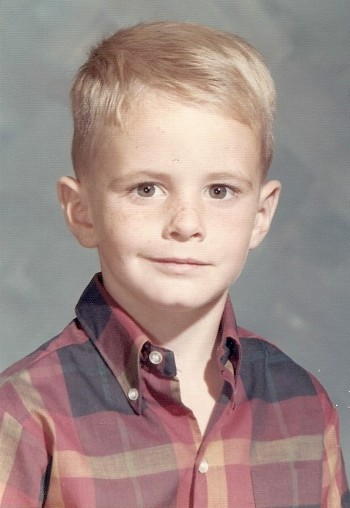 In this original BTB Investigation, we unveil the tragic story of Kirk Murphy, a four-year-old boy who was treated for “cross-gender disturbance” in 1970 by a young grad student by the name of George Rekers. This story is a stark reminder that there are severe and damaging consequences when therapists try to ensure that boys will be boys.
When we first reported on three American anti-gay activists traveling to Kampala for a three-day conference, we had no idea that it would be the first report of a long string of events leading to a proposal to institute the death penalty for LGBT people. But that is exactly what happened. In this report, we review our collection of more than 500 posts to tell the story of one nation’s embrace of hatred toward gay people. This report will be updated continuously as events continue to unfold. Check here for the latest updates.
In 2005, the Southern Poverty Law Center wrote that “[Paul] Cameron’s ‘science’ echoes Nazi Germany.” What the SPLC didn”t know was Cameron doesn’t just “echo” Nazi Germany. He quoted extensively from one of the Final Solution’s architects. This puts his fascination with quarantines, mandatory tattoos, and extermination being a “plausible idea” in a whole new and deeply disturbing light.
On February 10, I attended an all-day “Love Won Out” ex-gay conference in Phoenix, put on by Focus on the Family and Exodus International. In this series of reports, I talk about what I learned there: the people who go to these conferences, the things that they hear, and what this all means for them, their families and for the rest of us.
Prologue: Why I Went To “Love Won Out”
Part 1: What’s Love Got To Do With It?
Part 2: Parents Struggle With “No Exceptions”
Part 3: A Whole New Dialect
Part 4: It Depends On How The Meaning of the Word "Change" Changes
Part 5: A Candid Explanation For "Change"
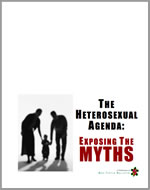 At last, the truth can now be told.
Using the same research methods employed by most anti-gay political pressure groups, we examine the statistics and the case studies that dispel many of the myths about heterosexuality. Download your copy today!
And don‘t miss our companion report, How To Write An Anti-Gay Tract In Fifteen Easy Steps.
 Anti-gay activists often charge that gay men and women pose a threat to children. In this report, we explore the supposed connection between homosexuality and child sexual abuse, the conclusions reached by the most knowledgeable professionals in the field, and how anti-gay activists continue to ignore their findings. This has tremendous consequences, not just for gay men and women, but more importantly for the safety of all our children.
Anti-gay activists often cite the “Dutch Study” to claim that gay unions last only about 1½ years and that the these men have an average of eight additional partners per year outside of their steady relationship. In this report, we will take you step by step into the study to see whether the claims are true.
Tony Perkins’ Family Research Council submitted an Amicus Brief to the Maryland Court of Appeals as that court prepared to consider the issue of gay marriage. We examine just one small section of that brief to reveal the junk science and fraudulent claims of the Family “Research” Council.
 The FBI’s annual Hate Crime Statistics aren’t as complete as they ought to be, and their report for 2004 was no exception. In fact, their most recent report has quite a few glaring holes. Holes big enough for Daniel Fetty to fall through.
“Google” is a trademark of Google Inc.
© Box Turtle Bulletin. All Rights Reserved.
 Posts
Posts  Posts via daily email: