Box Turtle Bulletin
 News and commentary about the anti-gay lobby
“Now you must raise your children up in a world where that union of man and box turtle is on the same legal footing as man and wife…”
News and commentary about the anti-gay lobbyPosts Tagged As: Marriage
April 11th, 2008
Scott Schmidt is at the Log Cabin Republicans Convention, liveblogging California Governor Arnold Schwarzenegger’s address:
Speaking to the Log Cabin Republicans, California Governor Arnold Schwarzenegger came out against a ballot measure circulating in California to add a gay marriage ban to the State Constitution. Stating that he “will always be there to fight against that,” Schwarzenegger made one of his first pubic statements about the initiative constitutional amendment in circulation.
April 11th, 2008
We reported last week that efforts by members of the Arizona state legislature to place an anti-marriage amendment proposal on the ballot was dealt a blow when Rep. Kyrsten Sinema (D-Phoenix) lined up enough votes to tack on a provision to grant certain rights to unmarried couples living together. By tying the two issues together, the proposed amendment became unacceptable to conservative supporters and they voted to kill it altogether.
This morning, the Arizona Daily Star reports that the House Judiciary Committee voted 6-4 to move SCR 1042 to the full House for a second run at trying to constitutionally ban same-sex marriage. If it passes the House this time, it will still require Senate approval to be placed on the ballot for November.
Arizona voters defeated a proposed anti-marriage amendment in 2006. So far, Arizona is the only state to do so.
April 9th, 2008
In January I posted about a poll of Maryland citizens in which 58% supported either marriage equality or civil unions. Noting that the Democratic Party had substantial control over the legislative and executive branches of government, I called on the state to fulfill their duty to their constituents – both gay and straight – and provide those protections to same-sex couples that they supported.
Sadly, what followed was a series of bills, each weaker than the last, that illustrated a lack of support on the part of leadership in both houses.
Well the legislative session has come to an end and the gay community has received some tiny measure of recognition.
Though a gay marriage bill failed, bills that extend rights, regarding, property tax transfers and medical and burial decisions to domestic partners including same-sex couples.
365gay reports that Gov. Martin O’Malley intends on signing the changes.
It appears that the other partial-rights bill, providing inheritance, was just too costly to the state.
Although these provisions are about the least possible, we celebrate their passage and gladly welcome Maryland into the family of states that provide recognition and protection for those families headed by persons of the same sex. And although we did not receive protection equal to that granted to heterosexual couples, we have hopes that gay Marylanders can encourage their representatives to build on the provisions granted and add those protections that are needed.
See also:
Blade Asks What Happened In Maryland
Maryland Passes Limited Rights for Gay Couples
Maryland Balances Budget by Taxing Gay Widows
Maryland Senator Muse Champions Bigotry
Maryland AG Endorses Marriage Equality
Maryland Legislator Calls Anti-Gay Bluff
Maryland Introduces Bill to Legalize Same-Sex Marriage – Are Democrats Committed to Equality?
Maryland Marriage Poll
April 4th, 2008
Editor’s note: Last week, we began a discussion on anthropological views of marriage, with special attention to its implications on same-sex marriage. Patrick Chapman, biological anthropologist and author of the forthcoming book, “Thou Shalt Not Love”: What Evangelicals Really Say to Gays (Haiduk Press: 2008) began the discussion. That post was followed by a response from Glenn T. Stanton, director of Global Family Formation Studies at Focus On the Family and co-author (with Dr. Bill Maier) of Marriage On Trial: The Case Against Same-Sex Marriage and Parenting
I am happy to engage this discussion another round and am thankful to Box Turtle and Professor Chapman for their continued participation.
I see the headline on this exchange as “Anthropologist and Evangelical Researcher Disagree on Much”, which sounds like a good Onion headline. But I do believe this has been an opportunity to let two people with very different views carefully explain their positions and allow others to eavesdrop into and comment on the conversation. That is worthwhile. As we close this exchange, I want to thank Dr. Chapman for his clarity and kindness. And to Box Turtle for hosting the exchange in a very professional, remarkably fair manner. I say that with all sincerity.
Predisposed Bias?
Let me start by addressing an accusation he makes about Focus on the Family at the close of his last post. He says:
The organization, generalizing from Stanton’s methodology and the recent article that began our conversation, is more concerned about fitting anthropological studies into its predisposed bias than an honest appraisal and reporting of the research. (emphasis mine)
Actually NOT doing this is exactly what prompted me to write the paper under discussion. As I explained here in my first response to Chapman, I went to read leading anthropologists a few years ago on their explanation of marriage in light of gender and sex. Let me say this very clearly: I did not find what I went to the texts expecting to find. I went to this literature expecting to find and truly hoping to learn about the great diversity of gender-manifestations I always hear about from my many Women’s Studies friends.
I fully expected to have these anthropologists explain to me either the subtle or overt realities of how we in the West understand male and female are not so in other cultures. To that end, I anticipated they would employ great energy in explaining how our “he/she” categories don’t work in some/many non-Western cultures. But that is exactly what I did not find.
I found relentless talk about male/female and the only qualifiers offers were for 1) class differences for marrying couples in various cultures, and 2) the different tasks male and female perform in various cultures. But these were relentlessly about male and female together and absent of talk about “spectrums” of gender.
Even a full, careful read of a journal article on, as its title explains, “interpreting gender in Bugis society” (a society Chapman referred to as evidence in his first post) offers no explanation of anything but male or female (in either “sex” or “gender”) in the entire article. As previously noted, the article does mention what it calls “male transvestites” but only as a “very small percentage of the population.” If there are other genders among the Bugis, this anthropologist either failed to recognize them or failed to report it. Being a professor from University of Wisconsin, Madison, you think she would be keen to such subtleties if they existed. I understand they are quite sensitive to “heterosexism” at her institution. I will check out the Graham-Davies book that Chapman referred to on the subject.
This leads to perhaps our discussion’s biggest point, the “elephant in the room” that we are both feeling and describing different parts of.
Sex and gender
Chapman concludes from reading my response that I do “not comprehend the implications of, or difference between, sex and gender” and then proceeds to explain it to me. Goodness, anyone who has paid the slightest bit of attention to our national discussion on sex-roles over the past few decades gets the difference. My problem is I just don’t accept all the rhetoric that Gender- and Woman-Studies Departments accept and blather as established truth. I think this new understanding of “gender” is a cultural construct, which I will explain in just a bit.
Chapman then goes on to carefully explain to me that it is a mistake to assume that “all biological males are gendered masculine and all biological females are gendered feminine.” I know what the sentence means, but I don’t know what it means in practice.
Do you really believe that I think there are ways that all men and ways all women act? That is ridiculous. But equally ludicrous is the idea that it is silly-talk to speak of essentially-male or essentially-female qualities, even across cultures. If this were true, we would all need guides to point us to the males and females in cultures different from our own. When I travel around the world, I do this discerning on my own and have never had anyone correct me or had my supposed “ethnocentricism” embarrass me in a cultural faux pas. I have little trouble discerning who the men and women are, even when they are performing outside their “prescribed roles.” Please!
Let’s look at this more closely.
There are two sexes: male and female. I don’t see intersexed persons challenging this, as they are people who are “inter”…between the two, but typically identify relatively well as either male or female. This has been my experience with intersexed people I know. The Intersex Society of North America explicitly does not regard intersex as a third gender.
“Gender” is a much softer, less precise term than “sex”. If we use John Money’s classic, but new-fangled, definition of “sex is what you are biologically; gender is what you become socially”1 gender here is understood to mean how you see yourself and how society forms you with regard to your sex. Given this definition, I would posit that there are some 6.5 billion different genders, because to be honest, we all understand and express our sex in different ways. Let me speak from my experience.
I understand that I live out my maleness in ways very different than many males. In any given sports season, I could not come close to conversing intelligently about how the season is going. I have no interest in hunting, NASCAR or eating chicken wings at Hooters. However, I could tell you what is currently on display at the local museum or what was on Ovation last night. I am like Niles and Frazier Crane. My buddies kid me about this.
As far as household roles, a feminist literature professor, who I liked very much, tried to convince me that I lived by strict gender roles, whether I realized it or not. As proof, she asked me her discussion-ending gotcha-question. “Glenn,” she asked, “who cleans the toilets in your house?” I had to be honest. “My wife has seldom touched a toilet brush in her life.” I told her. I clean the bathrooms. Nor does she mop the floors. She cooks, and I do the dishes. She does the laundry. We both change diapers. We have women who work full-time here at Focus and Family and do so in plain sight without the slightest bit of recrimination from Dr. Dobson. Some of them are even vice-presidents and directors, oh my! Does this mean we are gender-benders?
Being or thinking this way does not mean we are either the least bit confused nor staunchly rigid on what masculinity and femininity are, but only that we recognize there are different ways to be genuinely male or female. But — and this is a huge one — the fact that there are no incarnated golden feminine or masculine archetypes in the world does not mean these two ways of being human don’t exist in real, discernible ways or that we can’t talk meaningfully across cultures about what male and female are, either in what were are physically, biologically and psychically.
This is my problem with this new use of the term “gender.” That it is used as a way to imply that male and female are no longer adequate terms to describe sex-based human experience. I don’t find this in my diverse life experience, nor did it appear to me, that the anthropologists I read did either.
Name-calling and other things…
I was struck in both of Chapman’s responses his ease and confidence in making conclusions for me about what I believe. Professor Chapman, I am many things, but I am neither a naïve realist nor an ethnocentrist. If I were, I would find no value in the work of the anthropologists, for their specialty is explaining to us differing human experiences in diverse cultures.
You also explain, ala Stephanie Coontz, that historically “love is irrelevant” to marriage. This is the silliest thing she says in a book full of silly things. If she wants to say that love has not always been the sole or primary force in marriage that it is today, that point is hard to dispute. But to believe that marriage has always been a relationship solely about either class-cohesion or -advancement or about the transfer of land or material goods is deeply mistaken. The human heart didn’t grow warm in just the past 150 years. It has always felt and reacted to love, rejection and developed jealousy. These have always played a part of human relationships, including marriage and parenting, because it is profoundly human.
Regarding Murdock’s writings and the word “typical” in relation to his explanation of family being “a married man and woman with their offspring.” I read this word to mean it is usually this, while some families are single-parented because of death or desertion and some do not contain children. The reason I came to such a conclusion is that he discusses these different family forms in his book, but not homosexual marriages. The good scholar that he is, he stated the typical and later discussed the atypical. He explained these atypical families as variations on the heterosexual family. I did encounter discussions of same-sex marriage as rare from other scholars, and I address those in my paper.
In the occasions that Chapman cites instances of “same-sex marriage” he explains that couples must represent both female and male social qualities, regardless of their biological sex. I don’t doubt these are socially legitimate marriages, but he explains, “Relationships must follow the heterosexual model” in Samoa. That is the very point I made and when I have encountered the rare instances of same-sex marriage in other cultures. So do we both agree that there are no examples in past human experience, in any culture, is something looking like homosexual marriage where men as men and women as women are allowed to marry each other, regardless of what their “gender” might be? If I understand Chapman’s posts correctly, the societies he mentioned do place gender restrictions here.
Children and Well-Being
Let me end with what I think is the most important point: what this means for children of tomorrow.
First, I did not say that children do better in two-parent homes than single-parent homes. You put those words in my mouth and denounced it as a non-sequitur because SS homes are two-parent. What I do say in many of my books is that children who grow up with their own mother and father do markedly better in every important measure of well-being, compared to their peers growing up in single, cohabiting, step- or divorced homes. Children in SS homes are not, but definition, growing up in homes with their own mother and father.
He mentions the Lamotrek as a society where “same-sex couples” raise children with “no evidence of harm to the children or society.”
Two questions here. 1) What does “couple” mean in this context, especially in your explanation of frequent change of residence in their culture? We have a similar thing in the U.S. with children increasingly being raised by their mother and grandmother in the same home. It happens in other cultures also. The “same-sex couples” in Lamotrek should be clarified. 2) Regarding harm, which you say didn’t exist, was any study done on how these children actually fare compared to children in other family forms? The book you cite was published in 1965 and sociology was just starting to look at how family formation impacts child well-being in the West. It is doubtful Alkire did such an analysis because of this, but also because it is not the anthropologist’s task to make judgments about the quality of what a culture does, but only what it does.
Finally, the numerous research reports coming from sociology and psychology indicating that father-love is more impactful in some important child well-being measures than mother-love does not imply that children with two fathers would do extra better. The fatherhood effect is not cumulative. Scholars who have done work on fatherhood and child development explain that fatherhood is consequential in many ways, but primarily as it contrasts with and complements motherhood in important and unique ways.2
It’s been fun.
Glenn T. Stanton
P.S. Just watched the woman-who-changed-via-hormone-
injections-to-present-as-a-man-and-is-now-pregnant-because-
she-still-has-her-uterus on Oprah today.
References:
1. John Money, “The Concept of Gender Identity Disorder in childhood and adolescence after 39 years,” Journal of Sex and Marital Therapy 20 (1994): 163-77. [BACK]
2. Henry B. Biller, Father and Families: Paternal Factors in Child Development
John Snarey and George Vaillant How Fathers Care for the Next Generation: A Four Decade Study
Ross Parke, Fatherhood
David Popenoe, Life Without Father: Compelling New Evidence That Fatherhood and Marriage Are Indispensable for the Good of Children and Society
See also:
Round 2: Stanton Replies to Chapman
Round 2: Chapman Replies to Stanton
Glenn T. Stanton Responds to Professor Patrick Chapman
An Anthropologist Critiques Focus on the Family’s “Anthropological” Report on Marriage
April 3rd, 2008
UPDATED – See Below
In 2006 Arizona became the first state to vote down an anti-gay marriage amendent to their constitution. That amendment is believed to have been defeated because it extended beyond marriage to ban any form of civil union or domestic partnership, something that hurts many senior citizens.
So this year anti-gay activists were ready to push through the legislature an amendment that would ban only the use of the word “marriage”. This was fully expected to pass and be placed on the ballot in November.
However, an unusual tactic may have been employed to get the bill in the House pulled by its own promoters.
From the East Valley Tribune:
House Speaker Jim Weiers is likely to kill his own measure after Rep. Kyrsten Sinema, D-Phoenix, lined up enough votes to tack on a provision to grant certain rights to unmarried couples living together. That move effectively tied the two issues together — meaning voters who want to make same-sex weddings unconstitutional would be voting for some constitutional rights for gay couples.
From AZCentral
A change to the referendum in the state House of Representatives today would give new legal rights to domestic partners for hospital visitation and medical decision-making, funeral arrangements and inheritance. Because of the change, the measure will not go forward to a final vote, a spokesman for House Speaker Jim Weiers said.
Rep. Steve Yarbrough, R-Chandler, a supporter of the gay marriage ban, said putting the two issues together on the ballot is unacceptable.
Anti-gays often claim that they are not opposed to heath decisions or insurance but simply want to “protect marriage”. Sinema called their bluff and won this round, though only barely.
Sinema’s change passed 28 to 27, with five members absent and not voting. An attempt to strip the amendment off the measure failed on the same lines and the amended version was given preliminary approval, despite opposition from original supporters.
Four Republicans – Reps. Michele Reagan of Scottsdale and Pete Hershberger, Marian McClure and Jennifer Burns of Tucson – joined Democrats in supporting Sinema’s change.
This battle is not over but this vote may indicate that a marriage ban vote in Arizona in November may not be a forgone conclusion. Considering that “absent and not voting” is very very rarely accidental, this coalition may hold together to add the same provision to the Senate bill when it reaches the house.
UPDATE
The Arizona Star is reporting that the Senate version is also dead.
There is another version of the bill awaiting Senate action, this one still in its original form solely to constitutionally define marriage in Arizona as between one man and one woman. But Senate President Tim Bee, R-Tucson, the sponsor of that measure, said Thursday night that he will not bring that bill to the floor.
“I don’t see any point in it,” Bee said. Even if he corrals the 16 votes necessary in his own chamber, he said, the proposal still has to go to the House, where it lacks the necessary support.
The House vote and Bee’s decision constitute a major defeat for foes of gay marriage.
Happy day for gay Arizonans.
The optimist in me can’t help wondering if the vote indicates that there is adequate support in the Legislature to try for a Domestic Partnership law in Arizona.
April 3rd, 2008
 I’ve only found one source for this story, the Catholic News Agency.
According to a report on Lifesitenews.com, a bill has been introduced into the Chilean National Congress to allow homosexuals to “marry” and adopt children.
Officially named the “Bill that Modifies the Civil Code in relation to the Concept of Marriage”, it is being promoted by the Movement for Homosexual Integration and Liberation (MOVILH) and other homosexual groups, and is similar to one that failed in 2003.
I was unable to locate or identify the story they are referencing on Lifesitenews.
April 1st, 2008
Last February, we reported that Oregon’s civil unions law finally went into effect after a last minute court challenge was set aside. That victory however wasn’t enough to deter anti-gay activists from trying to turn back the clock. State Rep. Sal Esquivel, state Senator Gary Georgeand former Sen. Marilyn Shannon filed Initiative Petition 146 Monday with the Oregon Secretary of State to repeal the Family Fairness Act. The group needs to collect 82,769 signatures to put it on the ballot.
This initiative petition joins two others which seek to set aside the new civil unions law. Another initiative seeks to set aside Oregon’s recently enacted anti-discrimination law.
April 1st, 2008
The California organization “Protect Marriage” says it is close to meeting the requirement to place a proposed constitutional amendment to ban same-sex marriage on the ballot. The group says it has collected 881,000 of the 1.1 million signatures it needs to qualify. The deadline is April 21.
April 1st, 2008
Greece is not a leader in gay rights. The conservative Orthodox Church is very influential in the nation and is strongly opposed to gay equality.
Nonetheless, Greece is getting a lot of attention recently surrounding the issue of recognition of gay couples.
First some lesbians found a loophole in civil marriage law and are going to marry with the intent of seeing what happens.
Then Greece has drafted language on domestic partners – but for opposite sex couples only.
Now, however, at least one governmental bureau is considering gay couples:
The Greek Justice Ministry pledged to establish a working group on the rights of gay couples living together, which would “analyze all aspects of the issue, international practice and the existing domestic legal and social framework.”
The move follows a request by the country’s National Commission for Human Rights that proposed a civil union registry that would allow both same-sex couples to marry. Parliament could approve the law in a few months, national media said
March 31st, 2008
Editor’s note: Last week, we began a discussion on anthropological views of marriage, with special attention to its implications on same-sex marriage. Patrick Chapman, biological anthropologist and author of the forthcoming book, “Thou Shalt Not Love”: What Evangelicals Really Say to Gays (Haiduk Press: 2008) began the discussion. That post was followed by a response from Glenn T. Stanton, director of Global Family Formation Studies at Focus On the Family and co-author (with Dr. Bill Maier) of Marriage On Trial: The Case Against Same-Sex Marriage and Parenting
The editors of Box Turtle Bulletin requested that Glenn Stanton and I continue our discussion about marriage. I recognize that Stanton is at a disadvantage in this discussion because I essentially have the “home-field advantage:” his comments will come under much greater scrutiny by Box Turtle Bulletin’s readers than mine. As such, I credit Stanton for his willingness to participate further. However, as an anthropologist I remain in disagreement with his “anthropological” assessment of same-sex marriage.
In a limited space and with limited time, it is difficult to address all of the issues raised in Stanton’s response to my critique. I am concerned about his unscientific methodology, disagree with his comments about the American Anthropological Association, find inadequate, given the context, his explanation for including Colin Turnbull’s biographical information, and find unconvincing his dismissal of anthropological authority: he does not consult artists when trying to rebut definitions of marriage! However, in this round of the discussion Glenn Stanton and I have agreed to focus attention on two important themes: the distinction between gender and sex and the definition of marriage.
Sex and gender
Upon reading Stanton’s response, I am of the opinion he does not comprehend the implications of, or difference between, sex and gender. Sex, a biological entity, and gender, the socially constructed roles we play in society, are not synonyms. The folk belief in American society, which recognizes only two sexes and two genders, is that a person’s sex determines his or her gender: all biological males are gendered masculine and all biological females are gendered feminine. Our language reinforces this “reality:” we say “he” and “she,” implying there are only two sexes and two genders. We have no pronouns for biologically intersex individuals (sometimes called hermaphrodites), or for individuals who are transgender. However, other societies do not necessarily accept our binary construct and interchangeable sex and gender categories.
In the initial critique, I described the five genders recognized by the Bugis of Indonesia.1 Unlike American society, which blurs the distinction between sex and gender, the Bugis separate biological sex (male, female, and intersex) from gender roles, creating the five gender categories. Stanton’s comment that the Bugis situation “Seems pretty binary to me and not very inventive when it comes to expanding the boundaries of the two genders,” demonstrates ethnocentrism: he imposes upon the Bugis an American understanding of gender, dismissing the Bugis’ recognition of the five genders being different. Contrary to Stanton’s belief, the calabai and calalai do not fit into the gender categories of man or woman and are not simply transvestites. While a calabai performs many tasks associated with women, it is the calabai who often provides economically for the husband: a calabai performs some tasks associated with women and others associated with men.
A compounding problem in understanding the difference between sex and gender is that heterosexuality is the most common expression of sexuality. As such, societies normally expect same-sex marriages to conform to the heterosexual model. This heteronormativity and the confusion between sex and gender help explain Stanton’s surprise or disbelief that the Bugis recognize five genders, and why he dismisses the nature of their same-sex marriages. I believe it also lends understanding to his comment that he has
never met anyone who wasn’t either male or female or didn’t present themselves with easily discernible male or female qualities. Out of the eight different genders one student told me about, you would think I would have the privilege of meeting at least one of these non-male/female folks.
There are many individuals who are neither biologically male nor female; they are intersex. Unlike Mr. Stanton, I have met many intersex individuals and many individuals who are considered a third gender in their societies, including Tongan fakaleiti, Hawaiian mahu, and Native American two-spirit. That Stanton has yet to meet one of these individuals indicates to me that they are not comfortable “outing” themselves to him, that he is seeing people through a culturally-conditioned lens, does not accept that which does not fit his worldview, or that his social circle excludes individuals not fitting the socially prescribed categories.
Social construction of homosexuality
It is important to discuss the problems inherent in applying Western terms and concepts to non-Western cultures. We have a different worldview: the words and concepts we use to describe our physical and social environments are not consistent with the words and concepts others use. Generally speaking, when constructing sexuality Western society is concerned with the genitals. If a sexual pair has the same genitals, they are homosexual. If the genitals differ, they are heterosexual. However, most societies are concerned with the gender individuals perform, not the genitals. As such, there are often no recognized homosexuals in their societies, particularly if they accept gender-transformed marriages.
Our term “homosexual” does not fit the categories used in other societies for people who are same-sex oriented. While same-sex oriented individuals apparently exist in every culture, different societies channel them into different socially approved roles: how they construct “homosexuality” and how they categorize who we label “homosexuals” differs. Some societies prohibit the expression of same-sex attractions. Some societies accept it only if it follows a heterosexual gender model. Some societies view only the penetrated male as “homosexual:” the penetrating male is “heterosexual” because he is acting in a manner consistent with his gender norm. Meanwhile, American society is not accepting of gender transformation but is more accepting of egalitarian homosexuality, presumably because heterosexual relationships are commonly gender non-differentiated.
In Samoa there are no homosexuals; but there are fa’afafine. The fa’afafine are biological males who perform many of the tasks of women. However, unlike the gender category representing women, the fa’afafine do not necessarily dress as women and often perform traditional tasks of both men and women. Thus, the fa’afafine do not fit neatly into the gendered man or woman categories. They are a bridge between the two; they represent a third gender. Esera Tuaolo, a former Super Bowl lineman and author of Alone in the Trenches, explains how his American expression of homosexuality is not acceptable in his native Samoan culture because both he and his partner are masculine. While it is acceptable for a fa’afafine to have a socially recognized man as a lover in Samoa, it is entirely unacceptable for a socially recognized man to have another socially recognized man as a lover. Relationships must follow the heterosexual model.
Other Polynesian and Micronesian societies construct sexuality in a similar fashion. In these societies two biological males or two biological females fall in love, marry with full social recognition and acceptance, live together, raise children together, and are integrated into the kinship system. Martha Ward briefly discusses one such marriage in Pohnpei,2 while Alexandra Brewis discusses them on the island of Butaritari.3 Stanton will likely protest that these marriages include gender transformation, but this is irrelevant: the societies recognize the marriages as fully legitimate.
What’s love got to do with it?
Stanton demonstrates naïve realism, the assumption that every culture has a worldview identical to ours, when he demands that we provide examples of
culturally-approved marriage in the anthropological record, similar to the unions we are discussing today, where two men or two women fall in love, marry under the embrace of the community and its mores, set up a home and raise children together and both are accepted as part of the larger kinship group.
If other cultures construct sexuality differently than we do, we cannot expect to find exact equivalents to our expressions of marriage, heterosexual or homosexual. However, it is nonetheless possible to provide meaningful examples that fulfill Mr. Stanton’s basic requirements, as mentioned above with the examples from Pohnpei and Butaritari.
Stanton’s objection is that modern same-sex marriages lack strict gender differentiation. This objection is disingenuous because modern heterosexual marriages lack strict gender differentiation. Modern heterosexual marriages have no historical precedent: only in the last 50 years have they become common. Throughout history same-sex marriages mimic opposite-sex ones: that same-sex marriages in America do so once again is not grounds for banning them. If Stanton uses lack of historical precedent for gender undifferentiated marriages as the basis for rejecting same-sex marriages, then he must reject opposite-sex marriages.
Of interest, Stanton shape-shifts the definition of marriage. His report uses definitions from anthropologists that are inclusive of same-sex marriage because the central feature of marriage is the social and economic ties a marriage creates: biological sex does not matter. In the response to my critique he says: “as Christians, we define marriage as a union of one man and one woman. But biological connection is not a requirement.” If biological connection is not a requirement, then he has no issue with same-sex marriages provided one individual changes his or her performed gender. However, in his report he dismisses as legitimate gender transformed same-sex marriages, recognized by their societies as “one man with one woman.” Stanton then demands examples of same-sex marriage using falling in love, raising children, and living together as the important defining criteria for marriage. If these are the defining criteria for marriage, then most heterosexual marriages throughout history do not qualify. As historian Stephanie Coontz indicates, “not until the late eighteenth century, and then only in Western Europe and North America, did the notion of free choice and marriage for love triumph as a cultural ideal.”4 Historically, traditionally, cross-culturally, marriage is a social and economic union that creates social ties: love is irrelevant, in many societies biological sex is irrelevant, and in some societies even whether a groom is alive is irrelevant.
Stanton also demonstrates a strong predisposed bias. I mentioned that George Murdock’s definition of marriage, which Stanton uses in his report, omits the biological sex of the spouses. In response Stanton states that while Murdock does not specify biological sex when discussing marriage, he does so when discussing the family:
Yes, Murdock uses that gender-unspecific phrase in his explanation. But if you continue reading Murdock a few lines down, you get to the quote that I use, where Murdock explains that family “consists typically of a married man and woman with their offspring.” So he is specific, and there you have it again, that nagging male/female thing, without reference to or qualification of these other elusive gender couplings.
However, Murdock does explicitly qualify his comment with “typically.” Such qualifications are common when modern anthropologists discuss marriage and families because each society constructs them differently and exceptions are inevitable. Furthermore, Murdock uses gendered terms, not terms relating to biological sex.
In addition, Stanton demonstrates ethnocentrism by requiring that marriage be defined on his terms: if a society recognizes same-sex marriages as equal to opposite-sex ones, he dismisses them because they do not match his definition of marriage. However, using his criteria, we must argue that no society in the world has ever had marriage.
We are family
Anthropologists find tremendous variation in how societies form families and households. Anthropologists working in the South Pacific have difficulty keeping track of households because the membership is constantly changing: children in particular frequently change residence. Of interest, one anthropologist reports that nearly 50 percent of children in Lamotrek were adopted.5 Same-sex couples typically adopt and raise children in these societies: there is no evidence of harm to the children or society.
Strangely, Stanton argues that same-sex parenting harms children because studies show that children do better in two-parent homes than in one-parent homes. The argument is a non sequitur: same-sex households are two-parent homes. The studies he uses do not compare two-parent same-sex households to two-parent opposite-sex ones and are therefore irrelevant to the discussion. Stanton’s personal example regarding his wife’s loss of her father when she was young is also a non sequitur. Her grief over the loss of her father is irrelevant to a discussion of two living same-sex parents raising children.
Of interest, Stanton says “Some of these studies indicated father-love was a stronger contributor than mother-love to important positive child well-being outcomes” (emphasis in original). This, of course, implies that children raised by two fathers in a same-sex relationship would fair much better than those raised in a heterosexual family. He argues:
Unfortunately the legalization of same-sex marriage would not help us connect more children with their fathers, but often do precisely the opposite. This is one of the leading reasons why Focus on the Family opposes same-sex marriage, along with no-fault divorce and policies that tend to encourage out-of-wedlock child-bearing.
Opposing same-sex marriage does not prevent children from being raised in same-sex households: the 2000 Census reports over 25 percent of same-sex households have children. Focus on the Family’s opposition to same-sex marriage helps prevent these children from receiving the same financial, health, and emotional benefits children in heterosexual households receive: the opposition hurts innocent children. Stanton implicitly asserts that children with no parents, or with abusive parents, are better off than children with two loving same-sex parents, whose lives have been examined in minutia to ensure they will provide a healthy, stable, and loving home for any adopted children. Of tangential interest, but relevant to Stanton’s quote, Coontz references studies that indicate there is a 20 percent reduction in suicides by married women, a significant drop in domestic violence, and fewer murders of women in states with unilateral divorce.6 Apparently, divorce has its benefits.
Focus on the Family appears more concerned with its political agenda than its religious tenets. The organization opposes legislation benefiting children of same-sex parents. The organization wishes to restrict divorce, which has led to lower violence against women. The organization, generalizing from Stanton’s methodology and the recent article that began our conversation, is more concerned about fitting anthropological studies into its predisposed bias than an honest appraisal and reporting of the research. The organization deceives its readers and misrepresents a respected scientific organization: nearly one month later it has not corrected its claim that anthropologists agree with “traditional” marriage: the American Anthropological Association publicly stated the contrary in 2004.
References:
1. My discussion of the Bugis does not derive from the article referenced by Stanton, but from an ethnography by S. G. Davies, Challenging Gender Norms: Five Genders among the Bugis in Indonesia (Belmont: Thomson Wadsworth, 2007). [BACK]
2. M. C. Ward, Nest in the Wind: Adventures in Anthropology on a Tropical Island, 2nd ed. (Prospect Heights, Illinois: Waveland Press, 2005). [BACK]
3. A. Brewis, Lives on the Line: Women and Ecology on a Pacific Atoll (Fort Worth: Harcourt Brace, 1996). [BACK]
4. S. Coontz, Marriage, a History: How Love Conquered Marriage (New York: Penguin, 2005). The quote is from page 7. [BACK]
5. W. H. Alkire, Lamotrek Atoll: Inter-island Socioeconomic Ties (Prospect Heights, Illinois: Waveland Press, 1965). [BACK]
6. S. Coontz: 293. [BACK]
See also:
Round 2: Stanton Replies to Chapman
Round 2: Chapman Replies to Stanton
Glenn T. Stanton Responds to Professor Patrick Chapman
An Anthropologist Critiques Focus on the Family’s “Anthropological” Report on Marriage
March 31st, 2008
The Irish government is in the process of determining the method it will employ to recognize gay couples. Meanwhile, support for marriage equality has increased in Ireland. Currently,
Pinknews reports on the expected governmental decision.
The Irish government has ruled out gay marriage, claiming that it would require a change to the country’s constitution and a potentially divisive referendum.
Justice Minister Brian Lenihan is expected to bring forward proposals for a form of civil partnerships at the end of this month.
March 28th, 2008
I occasionally come across a pingback which extends a discussion here on BTB in some rather interesting ways. Here’s one I found this morning: anthropology professor Thomas Strong finds the mere fact that anthropology is being invoked in the same-sex marriage debate fascinating:
It’s a fascinating debate to me not necessarily because I am interested in definitions of marriage (though I am) but because of the way that anthropology is invoked by both sides as having authority on the subject. … Anthropologists: Do not despair! Someone still cares what we have to say. Anthropologists are seen to have the last word on human nature and therefore as potentially having knowledge that could settle debate on the topic. … To me what’s interesting is how a moral question appears to be disguised in these debates as a ‘scientific’ one, and therefore the real nature of the conflict gets displaced.
March 27th, 2008
The BBC reports that Mariela Castro, the daughter of new president Raul Castro, is pushing the government to adopt protections for gay people.
The proposed legislation would recognise same-sex unions, along with inheritance rights. It would also give transsexuals the right to free sex-change operations and allow them to switch the gender on their ID cards, with or without surgery.
There are limits: adoption is not included in the bill and neither is the word marriage.
March 26th, 2008
 Hey gay couples, grab your checkbooks. It’s that time of year where you get to pay more than your brother and his wife.
If you are part of a couple, you usually would benefit from filing an income tax return as a married couple. While this is not always the case, it is especially true for those couples in which one of the partners has a much lower income than the other.
Some states have decided that they value their gay citizens and seek to encourage stable families and have changed their laws so as to treat gay couples the same as heterosexual couples in their tax law. Massachusetts, California, Vermont, and Connecticut all allow for couples to file joint tax returns (this may also be the case in New Jersey, New Hampshire, Maine, Washington and Oregon and perhaps for some Rhode Island and New York residents – I haven’t researched every state).
But while this is to be commended and advanced in more states, it isn’t as simple as it seems. The federal government doesn’t care what the states have determined, they only recognize marriage as between a man and a woman. Thus, gay couples get to jump through hoops and make multiple tax returns. This becomes costly whenever you have a complicated return.
For example, a California couple in a Domestic Partnership has to prepare its state return as though they were a married couple. But CA tax law relies on federal tax treatment of certain situations, so this couple often has to prepare a federal income tax return as a married couple in order to apply the appropriate treatment on their state returns.
But they can’t file that federal joint return. The IRS won’t accept it. Instead they have to prepare federal returns as though they were unrelated roommates.
Add in some complexity, such as multiple state returns, and you may end up paying your accountant a much higher rate due to the extra time they incur.
If you can. Some accountants may not be familiar with the procedures at all.
H&R Block, the nation’s largest tax firm, is being sued by the ACLU because their online do-it-yourself system can’t accomodate Connecticut’s civil unions. Connecticut gay couples have to pay about $150 more and go into the H&R Block office in order to get their returns prepared correctly.
So the next time you hear some anti-gay whine about “special rights”, remind them that you pay more for your government than they do.
UPDATE
Reader John brought to my attention one of the stupidest and cruelest inconsistencies.
If your brother receives insurance covering his wife, it’s a tax free benefit. If you receive insurance covering your same-sex spouse, the federal government considers that to be a taxable part of your income. Yes, they actually make you pay income taxes on the amount of health insurance that you receive from your company for your spouse if you are gay.
I guess that concern about Americans without health insurance extends only to heterosexuals.
March 26th, 2008
Editor’s Note: Yesterday, we published Dr. Patrick Chapman’s critique of Glenn T. Stanton’s white paper, “Differing definitions of marriage and family” (PDF: 80KB/10 pages) Today, we are proud to present a guest post by Glenn Stanton in response to Dr. Chapman’s critique. Glenn T. Stanton is the director of Global Family Formation Studies at Focus On the Family. He is also the co-author (with Dr. Bill Maier) of Marriage On Trial: The Case Against Same-Sex Marriage and Parenting
In considering this exchange with Professor Chapman, I think of that popular VISA commercial, but with a different spin:
That is how I feel about this exchange and I am thankful for Box Turtle’s invitation to engage Professor Chapman on my paper comparing definitions of marriage and family used by anthropologists with those used by same-sex marriage advocates. I also greatly appreciate Dr. Chapman’s thoughtfulness and civility of response. As he said, we have exchanged notes in the past and I have enjoyed and benefited from those interactions.
Allow me to begin by explaining my intentions in writing my original report and the methodology I employed in that work.
My Methodology
My work at Focus on the Family affords me the privilege of being able to study, speak and write on why the family matters to human thriving. I have been doing this full-time for the last 15 years. I approach this question sociologically, theologically and anthropologically. One of my tasks is to help ensure Focus on the Family “gets it right” on what we say about why the family is important. Now, we will never “get it right” from everyone’s perspective, but we do want to make sure we don’t say incorrect or irresponsible things. To that end, we try to read widely, studying the leading thinkers in a particular field. We seek to learn from them and see how they inform, challenge or oppose our unapologetically evangelical Christian perspective. We often make adjustments based on reading and interactions with these scholars, strengthening, changing or dropping certain arguments. In this, I rarely make use of anything but academic books and professional journal articles, and when possible, develop relationships with these scholars. I also try to draw from thinkers respected on both sides of an issue. If I find widely respected sources that challenge my thesis, I try to make the reader aware of that. This, I hope, is reflected in my present paper under discussion.
My Influences
Having said that, this comparison paper had two influences. First, the impetus for my paper was David Blankenhorn’s excellent comparison between the definitions of marriage used by anthropologists and SSM advocates in his important book, The Future of Marriage. I was intrigued enough by this comparison that, standing on the shoulders of his work, I explored further.
Additionally, when I was doing research in 2003 for my book, Marriage on Trial (w/ Dr. Bill Maier), I was interested to see how anthropologists understood marriage and parenting across cultures in light of the two streams of humanity: male and female. I took to reading the works of leading anthropologists on the topic and was profoundly struck by what I didn’t find. I expected to find explanations of various cultures that confounded and challenged the binary male/female dyad. I did not find this.
What I found was a relentless explanation of marriage and family consisting of male and female as the core of new families. It did not find observations and explanations of multiple genders, nor did I find broad discussions of different forms of marriage that did not include both male and female. In book after book, article after article, I found discussions of how male and female are central to family in diverse cultures, and how they negotiate family and social life in different ways. An example of this is found in a leading journal article on gender in Bugis society, which Chapman informs us has five genders (!). Susan Bolyard Millar in the opening sentence of her piece explains, “When the Bugis of Indonesia interact in public, the men are generally treated with deference by the women.” And the rest of the article discusses the interactions of these two groups….two groups. Two genders and the only diversion from this is a reference to the calabai who are male transvestites….men who dress as women. 1
Seems pretty binary to me and not very inventive when it comes to expanding the boundaries of the two genders. I hear this “there-are-many-genders” and “gender-is-not-binary” talk every month when I do a same-sex marriage debate on some college campus. Funny thing among all these students who try to hip me to reality: I have never met anyone who wasn’t either male or female or didn’t present themselves with easily discernible male or female qualities. Out of the eight different genders one student told me about, you would think I would have the privilege of meeting at least one of these non-male/female folks. I wait for that day. In the meantime, I went to the anthropologists, who were unable to introduce me to such a person.
What the Comparison Revealed
So, I set out to write a paper showing how anthropologists, at least from my reading, do indeed recognize the fundamental nature of male and female in marriage and family across human cultures. In my research of reading the brightest lights in anthropology on social structure, all I found was male/female dyad talk. Compare this with the leading voices of same-sex marriage advocacy who just simply define marriage with no mention of male or female whatsoever. The absence is stunning. Chapman said these SSM advocates “do not use anthropological definitions.” I don’t expect they would, but the two ways of defining marriage and family have nearly no overlap at all. These advocates create wholly new, foundation-less, experience-free definitions of marriage, acting as if these nouveau definitions are basic, something everyone has always understood as a genderless union between any two or more people. The contrast in definitions between the two communities is not simply one of academics on one side and generalists on the other, but was as stark as any two groups I have experienced. That is all I desired to demonstrate in the paper, that and nothing more. I think that is clear from the paper itself.
But What About the AAA?
Professor Chapman stakes a great deal on the American Anthropological Association’s 2004 statement in support of same-sex marriage, offering that as a debate stopper. First, it should be noted that this statement from this academic organization was not academically motivated, but rather developed in response to President George Bush’s support for a Federal Marriage Amendment. I have little problem with such groups making political statements, but they should issue forth from previously established positions. That is not the case here. I find no indication of the AAA talking up this issue in any form before Bush’s statement. Was it only worth addressing when it became a political issue?
And this very short statement by the AAA makes no reference to any of the “available evidence” that Chapman refers to. You simply have to take their word that the data exists, which seems contrary to the discipline of academic rigor. If there is so much evidence, why not give the reader of the statement the slightest breadcrumb trail to follow? I could find only one short article there (Linda Stone’s) explaining how the anthropological record could be read as to support same-sex marriage. The others are merely op/eds written by AAA members. These were written after the original statement appeared. You would think a serious academic organization would have more to offer a curious, investigative reader.
There are additional concerns I have with the AAA statement, such as it shifting anthropology from a descriptive discipline to a prescriptive, but we can leave that for another day.
Who is Authoritative on Marriage?
Chapman says that Focus on the Family finally “acknowledges anthropological authority in defining marriage” and “that ‘sanctity of marriage’ arguments are not valid.” That is a pretty “binary” way of seeing the discussion. We believe that many disciplines have a voice in helping us understand and practice marriage and one does not eclipse another. If I wrote a paper on how marriage is portrayed in the history of art as a union that binds male and female, which I have dabbled at, could we say that I think artists are the only authoritative voice? Please! I am merely saying artists are a good voice because they uniquely report how people live, just as anthropologists do in their own way.
Miscellany
Before I close, let me address a scattering of Chapman’s other comments.
First, he seeks to correct me in that many of the anthropological quotes I employ “avoid specifying the biological sex of the spouses” and he offers an example from George Murdock (who, by the way, is “Elvis” among anthropologists who study family forms and social structures). To this end, Chapman quotes Murdock that marriage is a relationship “between a sexually associating pair of adults.” Yes, Murdock uses that gender-unspecific phrase in his explanation. But if you continue reading Murdock a few lines down, you get to the quote that I use, where Murdock explains that family “consists typically of a married man and woman with their offspring.” 2 So he is specific, and there you have it again, that nagging male/female thing, without reference to or qualification of these other elusive gender couplings.
He also says in my recognizing the rare occurrences of woman/woman marriage, I “effectively change” Focus on the Family’s “one biological man with one biological woman” definition of marriage. There is nothing to change. For starters, as Christians, we define marriage as a union of one man and one woman. But biological connection is not a requirement. Also, while we believe that male/female monogamy is the ideal marriage arrangement, no one can miss that many cultures practice polygamy, which leads to women being treated as objects to be collected. On this, Professor Chapman and I agree.
Additionally, Chapman states a few times that “many cultures throughout the world traditionally accept same-sex marriage” while offering no evidence of any of these cultures, just like the AAA. He does mention the Bugis having many genders and marriage being restricted only to those of “different gender categories.” But Millar’s work, which I referenced above, speaks only of male and female among the Bugis and Chapman informed us that the Bugis indeed have restrictions on same-gender marriage.
Has Homosexual Marriage Ever Existed in a Culture?
I have noted the absences of specifics from the professionals, but my paper does refer the reader to specific examples of woman-woman marriages, as the anthropologists call to them. But these are very unique and rare marriages arranged to serve the purposes of the heterosexual family and the community. They cannot be called homosexual in that the unions are strictly pragmatic – to provide offspring to the contracting woman – and are not emotional or sexual. The same is true for the Native American berdache, which neither of us has addressed in this exchange. When we examine these supposed “same-sex” marriages existing in human experience, there is always more to the story. Contrary to the AAA, I find no corresponding reference to true homosexual, culturally-approved marriage in the anthropological record, similar to the unions we are discussing today, where two men or two women fall in love, marry under the embrace of the community and its mores, set up a home and raise children together and both are accepted as part of the larger kinship group. I would be interested in learning of one.
Are Mothers and Fathers Merely Optional?
The most concerning of Chapman’s remarks are those that imply that male and female are able to perform the tasks of mother and father interchangeably, or that other extended family members can effectively replace a mother or father. This is certainly not true in heterosexual fatherless homes, and it has yet to be proven that mom’s lesbian lover can effectively replace a father, regardless of how caring and kind she might be.
If any person in any family has a belly-button, they also have a mother and father somewhere. And a wealth of research flowing from our nation’s three-decade experiment in fatherlessness strongly indicates that it is nearly impossible to replace the necessary influence and contributions a father makes to healthy child-development. 3 In the hundreds of studies I have read on this subject, I have not seen one which explains that the love of another family member can replace the contributions a father makes, no matter how vested and caring the love. My wife lost her father at age nine. The super-abundant love of her mother and sisters was a treasure, but could not replace the hole her absent father left in her life. In addition, the journal Child Development explains, “A review of the survey literature reveals no evidence that nonresident father involvement benefits children.” 4 Drive-by fathering is not fathering.
An analysis of over 100 studies on fatherhood and child-development outcomes found that having a loving and nurturing father was as important for a child’s happiness, well-being, and social and academic success as having a loving and nurturing mother. Some of these studies indicated father-love was a stronger contributor than mother-love to important positive child well-being outcomes. 5
The breadth and strength of this research on the irreplaceable influence of fathers for healthy child development is what compelled the Clinton and then Bush Administrations to both develop and execute smart federal programs to encourage greater father involvement in the United States. The research revealing that children who grow up without their fathers — regardless of the resultant family-form — face a number of serious life challenges was too great for either Administration to ignore.
Unfortunately the legalization of same-sex marriage would not help us connect more children with their fathers, but often do precisely the opposite. This is one of the leading reasons why Focus on the Family opposes same-sex marriage, along with no-fault divorce and policies that tend to encourage out-of-wedlock child-bearing.
With that, I offer sincere thanks to Box Turtle and Professor Chapman for the nice and thoughtful exchange.
Peace,
Glenn T. Stanton
PS. My mention of Colin Turnbull’s life story was simply to illustrate that he was not an anthropologist who was boxed-in by a “heterosexist” view of life and living in Virginia in his mixed-race relationship made him keenly aware of this issue of injustice.
References:
1. Susan Bolyard Millar, “On Interpreting Gender in Bugis Society,” American Ethnologist, 10 (1983): 477-493, p. 477. [BACK]
2. George Peter Murdock, Social Structure, (New York: The MacMillan Company, 1949), p. 1. [BACK]
3. Michael E. Lamb, “Fathers: The Forgotten Contributors in Child Development,” Human Development 18 (1975): 245-266.
Paul R. Amato and Fernando Rivera, “Paternal Involvement and Children’s Behavior Problems,” Journal of Marriage and the Family 61 (1999): 375-384;
Ronald P. Rohner and Robert A. Veneziano, “The Importance of Father Love: History and Contemporary Evidence,” Review of General Psychology 5.4 (2001): 382-405;
Natasha J. Cabrera, et al., “Fatherhood in the Twenty-First Century,” Child Development 71 (2000): 127-136. [BACK]
4. Cabrera, et al., 2000, p. 130. [BACK]
5. Rohner and Veneziano, 2001. [BACK]
See also:
Round 2: Stanton Replies to Chapman
Round 2: Chapman Replies to Stanton
Glenn T. Stanton Responds to Professor Patrick Chapman
An Anthropologist Critiques Focus on the Family’s “Anthropological” Report on Marriage
Featured Reports
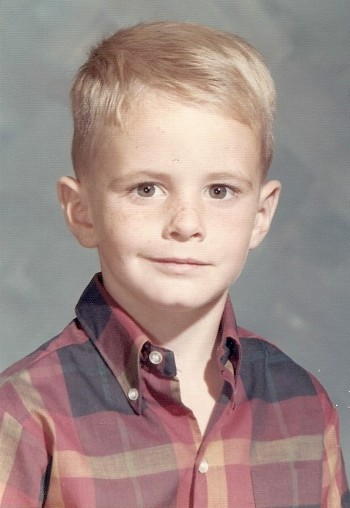 In this original BTB Investigation, we unveil the tragic story of Kirk Murphy, a four-year-old boy who was treated for “cross-gender disturbance” in 1970 by a young grad student by the name of George Rekers. This story is a stark reminder that there are severe and damaging consequences when therapists try to ensure that boys will be boys.
When we first reported on three American anti-gay activists traveling to Kampala for a three-day conference, we had no idea that it would be the first report of a long string of events leading to a proposal to institute the death penalty for LGBT people. But that is exactly what happened. In this report, we review our collection of more than 500 posts to tell the story of one nation’s embrace of hatred toward gay people. This report will be updated continuously as events continue to unfold. Check here for the latest updates.
In 2005, the Southern Poverty Law Center wrote that “[Paul] Cameron’s ‘science’ echoes Nazi Germany.” What the SPLC didn”t know was Cameron doesn’t just “echo” Nazi Germany. He quoted extensively from one of the Final Solution’s architects. This puts his fascination with quarantines, mandatory tattoos, and extermination being a “plausible idea” in a whole new and deeply disturbing light.
On February 10, I attended an all-day “Love Won Out” ex-gay conference in Phoenix, put on by Focus on the Family and Exodus International. In this series of reports, I talk about what I learned there: the people who go to these conferences, the things that they hear, and what this all means for them, their families and for the rest of us.
Prologue: Why I Went To “Love Won Out”
Part 1: What’s Love Got To Do With It?
Part 2: Parents Struggle With “No Exceptions”
Part 3: A Whole New Dialect
Part 4: It Depends On How The Meaning of the Word "Change" Changes
Part 5: A Candid Explanation For "Change"
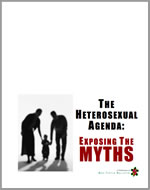 At last, the truth can now be told.
Using the same research methods employed by most anti-gay political pressure groups, we examine the statistics and the case studies that dispel many of the myths about heterosexuality. Download your copy today!
And don‘t miss our companion report, How To Write An Anti-Gay Tract In Fifteen Easy Steps.
 Anti-gay activists often charge that gay men and women pose a threat to children. In this report, we explore the supposed connection between homosexuality and child sexual abuse, the conclusions reached by the most knowledgeable professionals in the field, and how anti-gay activists continue to ignore their findings. This has tremendous consequences, not just for gay men and women, but more importantly for the safety of all our children.
Anti-gay activists often cite the “Dutch Study” to claim that gay unions last only about 1½ years and that the these men have an average of eight additional partners per year outside of their steady relationship. In this report, we will take you step by step into the study to see whether the claims are true.
Tony Perkins’ Family Research Council submitted an Amicus Brief to the Maryland Court of Appeals as that court prepared to consider the issue of gay marriage. We examine just one small section of that brief to reveal the junk science and fraudulent claims of the Family “Research” Council.
 The FBI’s annual Hate Crime Statistics aren’t as complete as they ought to be, and their report for 2004 was no exception. In fact, their most recent report has quite a few glaring holes. Holes big enough for Daniel Fetty to fall through.
“Google” is a trademark of Google Inc.
© Box Turtle Bulletin. All Rights Reserved.
 Posts
Posts  Posts via daily email: