Box Turtle Bulletin
 News and commentary about the anti-gay lobby
“Now you must raise your children up in a world where that union of man and box turtle is on the same legal footing as man and wife…”
News and commentary about the anti-gay lobbyPosts Tagged As: Marriage
March 25th, 2008
We told you earlier that Utah legislators decided that Salt Lake City could not use the term “Domestic Partnership” on its couples registry. They’ve now picked a name: Mutual Commitment Registry.
In order to qualify for the registry, individuals must be in a committed relationship and responsible for each other’s welfare. In addition, registrants must demonstrate financial interdependence, be over 18 years old, competent to contract and share a primary residence in Salt Lake City.
So now when you travel across the nation on vacation, depending where you spend the night you might be married, civilly unioned, domestically partnered, mutually committed, or legal strangers. So travel safely, pack your documents, plan your route carefully, and make sure you don’t need hospital services in a hate state.
March 25th, 2008
Editor’s Note: The following is a guest post by Patrick M. Chapman, biological anthropologist and author of the forthcoming book, “Thou Shalt Not Love”: What Evangelicals Really Say to Gays (Haiduk Press: 2008).
I was honored when Glenn Stanton, Director of Family Formation Studies at Focus on the Family, asked me to provide a critical review of his recent Focus on the Family report, “Differing definitions of marriage and family: comparing and contrasting those offered by emerging same-sex marriage advocates and classic anthropologists.” (PDF: 80KB/10 pages) I have had previous positive encounters with Mr. Stanton and appreciate his openness to professional criticism. I am also grateful that Box Turtle Bulletin offered to make our discussion public.
As indicated in the title, Stanton’s report compares and contrasts the anthropological understanding of marriage with definitions provided by various same-sex political advocates, apparently to undermine the case for same-sex marriage. I find the report significant for several, presumably unintended, reasons:
Allow me to elaborate on these points.
Appeal to anthropological authority
It is true that the same-sex marriage advocates quoted in the report do not use anthropological definitions. However, they do not claim to be experts and do not use their definitions to restrict other people’s access to marriage. As such, I am not very concerned with their definitions, particularly because the anthropological understanding of marriage, which is based on how it is expressed cross-culturally and over time, is inclusive of same-sex marriages. This is demonstrated in that many of the quotes Stanton provides avoid specifying the biological sex of the spouses. For example, Stanton references George Peter Murdock’s 1949 definition, suggesting marriage is “between a sexually associating pair of adults.”
While Stanton highlights that many same-sex marriage advocates do not employ an anthropological understanding of marriage, he neglects to mention this is also the case for those who oppose same-sex marriage. For example, Focus on the Family’s definition of marriage is contrary to anthropological reality. Many cultures throughout the world traditionally accept same-sex marriage; opposite-sex marriages are often arranged, not based on love, and polygamous. Polygyny, one man with more than one wife, is by far the most commonly preferred form of marriage; polyandry, one woman with more than one husband, also exists. In many societies that prefer polygyny to monogamy, the wife is often viewed as the husband’s property. This helps explain why polygyny is considered immoral in Western society: it often reduces women to the level of property.
What is particularly important with Stanton’s report is the recognition that anthropologists are the experts when it comes to understanding and defining marriage. As such, it increases the importance of the American Anthropological Association’s 2004 official statement condemning marriage amendments that exclude same-sex marriages from official recognition. Anthropologists recognize that same-sex marriage is one of the many legitimate forms of marriage practiced in cultures throughout the world. Stanton’s selective application of anthropology suggests to me that he is more concerned with Focus on the Family’s political agenda than promoting an honest, accurate, and representative definition for marriage.
The non-sanctity of marriage
In his summary of how anthropologists define marriage, Stanton states they are “informed by how marriage is largely universal, transcending culture, law, religion, time and social development” (I presume he refers to technological complexity here – all societies have a high development of social complexity, although not all are technologically complex). Marriage is largely universal, “transcending” the various aspects and dimensions of culture, but it is constructed differently by different societies. The forms marriage takes are varied, ranging from monogamous to polygamous, from same-sex to opposite-sex, and from same-states of being to differing-states of being: some cultures recognize “ghost marriages” where a living individual marries a dead one. Marriage often involves sexual activity, although this is obviously by no means a requirement. Anthropologists recognize marriage is primarily a social and economic union that serves many and varied purposes, evidenced by the various quotes Stanton provides.
I find it significant that Stanton specifies marriage “transcends” religion. Although marriage is sometimes incorporated into religious traditions and practices, it is not religious in nature, evidenced by religion’s omission in the definitions provided by Stanton. Thus, arguments promoting the “sanctity of marriage,” suggesting it is a religious institution with an inherently religious quality, are not supported anthropologically. This is a refreshingly honest acknowledgment from Focus on the Family.
Same-sex marriage is traditional
In the report’s appendix Stanton highlights one form of the same-sex marriages found in many traditional African cultures. The marriages are modeled on heterosexual ones in that one of the individuals performs the tasks of the other gender, and is often recognized as being the other gender by society. This situation is a common expression of traditional same-sex marriages throughout the world. Significantly, the cultures recognize the marriages as equal, using the same term for both same-sex and opposite-sex marriages.
However, Stanton argues the same-sex marriages “are not similar in nature or spirit of same-sex families being proposed today,” primarily because of the gender transformation component. Gender transformation is often necessary because traditional societies usually sharply delineate gender roles: men perform one set of activities while women perform a separate set. Thus, in order to have a properly functioning household in a same-sex marriage, a biological male must often perform the activities of a woman, or a biological female those of a man: same-sex households mimic opposite-sex ones. However, although an individual may perform the tasks of the opposite sex, and may even be identified as the other gender by society, the individual may retain gender qualities considered to be consistent with his or her biological sex: a male performing the tasks of a woman may remain masculine in other ways, and a female performing those of a man may remain feminine.
Modern American society does not strictly delineate gender roles: it is common in opposite-sex marriages and relationships for both men and women to contribute economically, attend to the needs of the children, manage the household, and so forth. Thus, modern American same-sex marriages and relationships once again mimic opposite-sex ones. Importantly, as historian Stephanie Coontz indicates in “Marriage, a History”, there are few precedents for the modern American expression of opposite-sex marriage. Therefore, if lack of historical precedent is to be used as justification for banning same-sex marriage, as Stanton seems to imply, then modern opposite-sex marriages should also be banned. Regardless, it is refreshing to have Focus on the Family finally admit that same-sex marriage is not a new phenomenon.
Gender and children
I assume from other Focus on the Family literature that Stanton raises the argument about the gender transformation because of the belief that children need parents of different sexes to become properly socialized: a belief that is flawed for several reasons.
First, gender does not inherently correspond to biological sex. Stanton acknowledges this in his discussion of the gender transformation in some same-sex marriages. A biological male is able to perform the gender of a woman and a biological female is able to perform the gender of a man. Of relevance, the Bugis of Indonesia recognize five genders: two of which are masculine, two feminine, and one androgynous. The Bugis allow marriage between two masculine individuals, two feminine individuals, a masculine with a feminine individual, two biological males, two biological females, and a biological male with a biological female, always provided the spouses belong to different gender categories: the androgynous gender is excluded from marriage.
Second, gender expression, as opposed to gender norms, is highly varied within a society and between societies. Gender is not binary: masculinity and femininity exist on a continuum. Even in American society there are some fathers who are masculine and some who are feminine, some mothers who are feminine and some who are masculine. Thus, there is no guarantee that opposite-sex parents will express the differing gender norms, or that same-sex parents will express only one gender norm. Furthermore, cross-culturally, gender norms for males and females demonstrate tremendous variation, highlighting that men can be protectors, providers, and nurturers, as can women.
Third, a child is neither socialized by, nor learns gender from only the parents. As acknowledged in Stanton’s report, marriage is an important component of a family, but the family includes more than just parents and children: there are also grandparents, aunts and uncles, cousins, and sometimes even co-wives or co-husbands and their relations. In other words, families include both male and female. As such, children raised by parents in a same-sex, same-gendered marriage still have family members of different sexes and genders. Furthermore, the society at large plays a significant role in socializing a child into its gender norms. For example, any child who watches Disney movies learns the traditional American gender expectations for a male and female: a society’s gender expectations and instruction are impossible to avoid because gender is so strongly infused into society. Finally, in traditional societies that allow same-sex marriage, the couples raise children who demonstrate no social or developmental problems.
Interestingly, as demonstrated by his discussion in the appendix, Stanton effectively changes Focus on the Family’s “one biological man with one biological woman” definition of marriage to “one gendered man with one gendered woman.” However, once again this definition is not inclusive of the varied forms of marriage found cross-culturally. Regardless, I find it significant that because of the anthropological evidence, Stanton apparently recognizes that Focus on the Family’s definition of marriage is flawed.
Long-lasting relationships
In footnote 11 Stanton provides biographical information on the famous anthropologist Colin Turnbull. Turnbull, a “British-American” as Stanton calls him, had a 30-year homosexual relationship with an African-American man, both of whom died of AIDS-related complications. I find Stanton’s admission that Turnbull and his partner had a long-lasting relationship to be important because Focus on the Family often uses the supposedly “transient nature” of gay male relationships to justify banning same-sex marriage.
However, I ask of what relevance is the biographical information to Stanton’s report? The differing ethnicity of Turnbull and his partner is irrelevant: if the partner had been white or Turnbull black, I doubt Stanton would have mentioned it. That they died of AIDS-related complications is irrelevant: had Turnbull been a heterosexual who died of AIDS-related complications, I doubt this would have been mentioned. Certainly Stanton does not provide marital, racial, or death-related information for the other anthropologists he quotes. Turnbull’s sexual orientation is also not relevant. Perhaps Stanton mentions it because he incorrectly presumes that Turnbull’s argument implies the sole validity of opposite-sex marriages, and having a homosexual say this would supposedly add credence to Stanton’s unanthropological view of marriage.
However, this is not the case. Turnbull is correct in his assessment that being an adult normally includes making a living, being married, raising a family, and assuming “ritual” responsibilities that benefit society, the family, and the individual. Turnbull is also correct in stating that marriage has been an important or essential component in the continuity of societies and social orders. However, none of Turnbull’s comments indicate that only heterosexuals and opposite-sex marriage serve these purposes to the exclusion of homosexuals and same-sex marriage. So I ask again, of what relevance to the argument is Turnbull’s sexual orientation, long-term and interracial relationship, or manner of death? Regardless, I find refreshingly honest Focus on the Family’s admission that gay men are capable of having relationships lasting 30 years.
Concluding remarks
Finally, I would like to address the summary of the anthropological view of marriage provided at the start of Stanton’s report. All eight itemized points apply to both same-sex and opposite-sex marriages. Both types of marriage provide for the continuation of a people and culture. Both pair-bonds serve the good of the nuclear and extended families, and the larger community. Both focus on the rights and responsibilities of the family members. Both provide for the needs of children and adults. Both represent the complex relationships found in a community. Both are included in the near universal, yet varied expressions of marriage that transcend culture, law, religion, and time. Finally, the remaining two items on the list, which focus on the male and female components – issues related to gender, not biological sex – are as equally relevant for modern opposite-sex marriages as they are same-sex marriages.
As more cultures have been studied and data gathered, the anthropological understanding of marriage has altered over the past century, becoming more generalized and more inclusive. Drawing upon the available evidence, the American Anthropological Association condemns efforts to restrict marriage solely to opposite-sex couples.
I welcome Glenn Stanton’s report. In it Focus on the Family finally acknowledges anthropological authority in defining marriage, that “sanctity of marriage” arguments are not valid, the existence of same-sex marriages in traditional societies, that biological sex is not an important consideration in defining marriage, and that gay males are capable of long-lasting and stable relationships.
As an addendum, I call upon Focus on the Family to acknowledge they deceived their readers when they recently said anthropologists agree with the so-called “traditional definition of marriage” and issue a public apology and correction. They must honestly inform their readers that the American Anthropological Association has previously and publicly condemned attempts to exclude homosexuals from marrying, declaring that marriage, as defined cross-culturally, is inclusive of same-sex marriages. A failure to do so simply reaffirms the view that Focus on the Family is more concerned about its political agenda than its Christian identity.
See also:
Round 2: Stanton Replies to Chapman
Round 2: Chapman Replies to Stanton
Glenn T. Stanton Responds to Professor Patrick Chapman
An Anthropologist Critiques Focus on the Family’s “Anthropological” Report on Marriage
March 22nd, 2008
Although marriage equality, civil unions, and full domestic partnerships have been blocked from consideration by the Maryland Senate, three bills that would offer some protections for gay couples have been allowed out of committee.
Medical Decisions: would allow domestic partners to make medical and funeral decisions for each other, share a nursing home room and visit at their hospital bedsides.
This bill has received preliminary approval. Thank you.
Joint House Ownership: allow domestic partners to avoid paying recordation and transfer taxes when adding each other to home deeds.
This bill has received preliminary approval. However, it was first amended to remove commercial property.
But not everyone thinks that this is a good idea.
“Do you really want to encourage people to shack up and not commit to each other?” Sen. Alex X. Mooney, a Frederick County Republican, asked his colleagues. “This whole bill is a loophole.”
No, Senator Mooney, we WANT people to commit. That’s why we support marriage for gay couples – rather than oppose it like you do. Comments like this make you seem like a blithering idiot.
Inheritance: exempt domestic partners from inheritance taxes.
This one isn’t likely to pass.
The reason?
Sen. Ulysses Currie, chairman of the Budget and Taxation Committee and a Prince George’s County Democrat, said the inheritance tax would be a harder sell because it affects the state’s budget, which has been strained by deficits and a waning economy.
OK. Let me understand this, Senator Currie.
The reason that Maryland cannot treat gay couples like straight couples is because it needs the greiving gay widows to pay for the government’s budget problems.
Really?
You can’t treat gay people equally because you want gay people to pay higher taxes?
You have got to be kidding me!
See also:
Blade Asks What Happened In Maryland
Maryland Passes Limited Rights for Gay Couples
Maryland Balances Budget by Taxing Gay Widows
Maryland Senator Muse Champions Bigotry
Maryland AG Endorses Marriage Equality
Maryland Legislator Calls Anti-Gay Bluff
Maryland Introduces Bill to Legalize Same-Sex Marriage – Are Democrats Committed to Equality?
Maryland Marriage Poll
March 20th, 2008
Last Tuesday, Focus On the Family’s Glenn Stanton explained to us why CitizenLink unceremoniously changed their entire “anthropologists agree” article. Given what we know now, it appears that CitizenLink’s thin veil of “professional journalism” has utterly disintegrated. I know of no professional news service that completely re-writes their article. In fact, I know of at least one blogger who makes its own corrections very public for all the world to see.
Stanton also said this:
Ex-Gay Watch insinuated that the paper was cobbled together quickly to answer the complaints generated from the first article. Not quite. I worked on this research for quite a few weeks.
Ex-Gay Watch’s David Roberts and David Rattigan both disputed Stanton’s charge in comments left here at Box Turtle Bulletin. Rattigan also set the record straight on Ex-Gay Watch:
Ex-Gay Watch in fact made no reference (even indirectly) to the paper, and focused solely on the Citizenlink article. A commenter made the suggestion Stanton refers to, which may have confused him.
March 19th, 2008
The so-called “Professional journalists” at CitizenLink are at it again. They’re claiming vindication over a new pamphlet (PDF: 132KB/6 pages) by the American Psychological Association. That pamphlet repeats what we’ve been saying for quite some time: Nobody knows what “causes” homosexuality. According to the APA:
There is no consensus among scientists about the exact reasons that an individual develops a heterosexual, bisexual, gay or lesbian orientation. Although much research has examined the possible genetic, hormonal, developmental, social and cultural influences on sexual orientation, no findings have emerged that permit scientists to conclude that sexual orientation is determined by any particular factor or factors. Many think that nature and nurture both place complex roles…
The mere mention of developmental roles is tiny sliver of a silver lining that has Exodus vice president Randy Thomas and Focus On the Family’s Glenn Stanton very excited:
“They are starting to have the integrity of reporting accurately about the condition of homosexuality,” said Randy Thomas, executive vice president of Exodus International. “We find this to be a very exciting move and hope that it indicates future movement toward recognizing that people can and do overcome homosexuality.”
Glenn Stanton, director of global family formation studies at Focus on the Family, said the brochure has an activist bent, but he sees a ray of hope.
“This doesn’t mean that we’ve completely succeeded in all the things that we’ve wanted to,” he said, “but it’s a move in the direction that we’ve wanted them to move in, and I think that’s very positive news.”
CitizenLink, Stanton and Thomas chose to focus on one lone paragraph and ignore the rest of the six-page document, including topics like the role of prejudice in LGBT’s lives and well-being, the importance of “coming out,” the nature of same-sex relationships, gay parenting — and, oh yes, this:
All major national mental health organizations have officially expressed concerns about therapies promoted to modify sexual orientation. To date, there has been no scientifically adequate research to show that therapy aimed at changing sexual orientation (sometimes called reparative or conversion therapy) is safe or effective. Furthermore, it seems likely that the promotion of change therapies reinforces stereotypes and contributes to a negative climate for lesbian, gay, and bisexual persons.
Nope. Instead, CitizenLink advises readers to go to Love Won Out to learn more. What they might learn is, in fact, more stereotypes which contribute to that negative climate the APA is talking about.
March 19th, 2008
The Pittsburg Post-Gazette is reporting that an anti-gay bill to amend the state’s constitution to permanently exclude same-sex couples from marriage has passed the Judiciary Committee of the Senate.
Over the protests of Sens. Jay Costa Jr., D-Forest Hills, and Jane Earll, R-Erie, the committee voted 10-4 to approve Senate Bill 1250 and send it to the Appropriations Committee, its next stop before it hits the Senate floor.
This proposed amendment is arrogant and punitive in that it not only reserves the privileges of marriage to heterosexuals but it also prohibits this legislature or future legislatures from providing civil unions or any other functionally equivalent consideration:
No union other than a marriage between one man and one woman shall be valid or recognizeds as marriage or the functional equivalent of marriage by the Commonwealth.
Not content to “protect marriage”, these anti-gays also want to ensure that gay couples cannot get equivalent workplace benefits, establish next-of-kin, visit their sick or make end of life decisions for their partner of decades, or many of the other accommodations that can be established by “functional equivalents”. This isn’t good government. It isn’t good religion. It’s bigotry and cruelty dressed up as piety.
To enshrine discrimination into the state’s constitution, this bill must do the following
The gay marriage ban has a long way to go. The bill must be approved not only by the current General Assembly, but also by the 2009-10 Legislature, whose members will be elected in November. If both sessions of the Legislature approve it, the amendment would go to a statewide referendum in November 2009.
Currently, the Senate has a Republican majority of 29 to 21.
In the Judiciary, only two Democrats and two Republicans voted against the bill. And in addition to the three Democrats who voted for the anti-gay bill in Judiciary, two others are listed as sponsors. In total 25 of the 50 Senators have either voted for or endorsed this amendment, fairly ensuring its passage should it reach the floor of the Senate.
The House has a narrow Democratic majority of 102 to 101. But as we have often seen, a Democratic majority in one house is not an assurance that anti-gay bigotry will be thwarted.
Now is the time for Pennsylvania gays to contact their legislators, especially those in the House of Representatives. We need every Democrat to hold fast against institutionalized discrimination. We need every fair-minded Republican to recognize that even if they don’t favor marriage equality, this amendment is over-kill. The “functional equivalent” clause proves that this is discrimination for the point of discrimination, not a measure to “protect” marriage.
March 18th, 2008
I received this email this afternoon from Glenn Stanton, explaining the events surrounding the recent CitizenLink change:
Yes, it looks like Focus on the Family did a sneaky bait and switch on the anthropology article that has been discussed at the BoxTurtle. And it would be a much easier world to fight the culture war in if everyone from the religious right were slippery tricksters and all homosexuals were sex-saturated profligates. But such is not the case, we are all not so easily pigeon-holed. Reality is far less exciting than accusation.
The original article was published before I reviewed it and I was disappointed to see the final piece online. It didn’t come close to communicating my work comparing the definitions anthropologists and leading same-sex marriage advocates use for describing and understanding what marriage is. I shared my concerns with the the CitizenLink editors and they welcomed my corrections. My main concerns were that the original article didn’t link to the whitepaper that the article itself was about. Ex-Gay Watch insinuated that the paper was cobbled together quickly to answer the complaints generated from the first article. Not quite. I worked on this research for quite a few weeks.
The original title — “Anthropologists Agree on Traditional Definition of Marriage” — bothered me for two reasons. One, I appreciate that no scientists in any discipline totally “agree” on anything. Two, “traditional” is far too imprecise a term to use when talking about marriage and family as a humanly universal phenomenon. Same with the conclusion attributed to me that “there’s a clear consensus among anthropologists” on what marriage is. Admittedly, “consensus” is a word that cannot be used in relation to any community of scientists. There is not even literal consensus among scientists on Newton’s Law, for goodness sakes. Science’s strength is it’s ability to constantly question. The editors kindly incorporated the changes I recommended. The second story reflects those changes. That’s the story. Sorry to disappoint the conspiracy theorists.
I have been invited by the editors of the BoxTurtle Bulletin to respond to a critique of my paper by a real-life anthropologist, which I am happy to do and look forward to a spirited and hopefully intelligent and informed exchange.
Yes, that’s right. Glenn Stanton and real-life anthropologist Patrick M. Chapman will be discussing Stanton’s paper, “Differing Definitions of Marriage and Family” (PDF: 80KB/10 pages) on this very web site. Stay tuned.
This article is the opinion of the author and does not necessarily reflect the opinions of other authors at Box Turtle Bulletin
March 15th, 2008
 Those who are regular readers know my frustration with the Democratic Party in Maryland. They have allowed one anti-gay legislator to dictate the level of discrimination that the state will impose on its gay citizens.
Let me be clear. Most Republicans in the state are far worse, many seeking to ban equality through revision to the state constitution. And some even oppose letting couples in a long term relationships make medical decisions for each other.
On the Senate floor yesterday, Republicans said that allowing an unmarried couple who have been partners only a short time to trump parents or children in crucial life-and-death medical decisions struck them as irresponsible.
“How far are we going to go?” asked Sen. Alex X. Mooney (R-Frederick). “Let’s not put domestic partners above the family. Let’s put them after.”
But that isn’t all that surprising from the Party that brought us Sally Kern. Such attitudes, however, are supposed to not prevail in the Democratic Party. Yet it is the Democratic Party leadership that has placed power in the hands of a man who blocked the chance of Senators to even consider marriage equality or civil unions.
Religious objections proved the determining factor in a key, evenly split Senate committee that a marriage or civil unions bill needed to clear before getting to the floor. The swing vote was C. Anthony Muse, a Prince George’s County Democrat who was lobbied intensely by gay rights advocates and lawmakers to pass a civil unions bill. But Muse, pastor of an evangelical Christian church in Upper Marlboro, said he ultimately was bound by biblical teachings that say only men and women should marry. The bills are likely to languish without a vote.
There will be a vote taken on some piece-meal rights such as health care decisions or inheritance. But Muse was not content in allowing gay people to make determinations about their own health without taking the opportunity to champion bigotry.
yesterday, he voted for several Republican-sponsored changes to the medical decision-making measure, including one that would have barred public schools from teaching about domestic partnerships. The changes were rejected. Muse said he is unsure how he will vote when the Senate takes a final vote on the bill next week.
I do not doubt that Senator Muse has experienced discrimination in his lifetime. But that does not excuse him for doling it out to those citizens that he dislikes.
And it’s time for the Democratic Party in Maryland to recognize that those minority legislators, be they gay or black or whatever, who campaign against the rights of other minorities, be they gay or black or whatever, are engaging in bigotry and have no place in any position of authority.
Senator Muse needs to feel the consequences of his homophobia. And as long as the Maryland Democratic Party continues to allow Muse to stand in the way of equality, they will receive no respect from me.
See also:
Blade Asks What Happened In Maryland
Maryland Passes Limited Rights for Gay Couples
Maryland Balances Budget by Taxing Gay Widows
Maryland Senator Muse Champions Bigotry
Maryland AG Endorses Marriage Equality
Maryland Legislator Calls Anti-Gay Bluff
Maryland Introduces Bill to Legalize Same-Sex Marriage – Are Democrats Committed to Equality?
Maryland Marriage Poll
March 14th, 2008
 In 1996 Norway became one of the first nations to offer recognition of same-sex couples. Since then, several nations have gone further, removing gender restrictions from marriage laws, thus eliminating the separate-but-equal status of gay couples.
First was the Netherlands in 2001, followed by Belgium in 2003. Then Canada and Spain raced for next in line in 2005, followed by South Africa in 2006.
Now Norway has introduced legislation that would make them the sixth nation to provide marriage equality.
Norway already has a so-called “partnership law” that has allowed homosexuals to form legal domestic partnerships. Now they likely will be able to marry, with all the rights that entails, since the government has a majority in parliament and the law is expected to win approval.
After over a decade of experience with same-sex couples, the minister in charge of children’s and family issues, Anniken Huitfeldt, has come to a conclusion.
“The new law won’t weaken marriage as an institution,” Huitfeldt claimed. “Rather, it will strengthen it. Marriage won’t be worth less because more can take part in it.”
But Norway’s legislature had better hurry if they want to take sixth place. Sweden is rushing for that spot.
March 14th, 2008
Focus On the Family may be trying to bob and weave through the sleight of hand of undisclosed re-writing, but their second effort isn’t much better. When they first changed the article, they left the original title intact (“Anthropologists Agree on Traditional Definition of Marriage.”) Since then, they changed the title to read, “Classic Anthropology at Odds with New Same-Sex Definitions of Marriage and Family.” When they keep changing their article to respond to ongoing criticisms, it’s hard to keep track of exactly what they’re trying to say.
Nevertheless, we contacted Dr. Patrick M. Chapman, a real live anthropologist and author of the upcoming book “Thou Shalt Not Love”: What Evangelicals Really Say to Gays (Haiduk Press, 2008), and asked him if he wanted to give Stanton’s latest rewrite a second look. When Dr. Chapman wrote his latest response, Stanton’s article still appeared under its original title. Here is Dr. Chapman’s response:
Focus on the Family Responds to Anthropologists
By Patrick M. Chapman, PhD
In a March 3, 2008 CitizenLink article, Focus on the Family suggested that “Anthropologists Agree on Traditional Definition of Marriage.” The organization was quickly rebuked by individual anthropologists and by the American Anthropological Association, the nation’s largest association of anthropologists. In his letter to Focus on the Family Damon Dozier, the AAA’s Director of Public Affairs, addressed “the gross misrepresentation of the position of the anthropological community on gay marriage.” Dozier added:
“I am alarmed and dismayed at this example of irresponsible journalism and deliberate misrepresentation of the anthropological community. In the future it is my hope that your organization will accurately and honestly convey and communicate the views and interests of the AAA, its 11,000 members, and the social science community at large.”
Presumably as a result of the criticism, Focus on the Family rewrote the article, retaining only the first two sentences but leaving the title and date unchanged. Despite having been informed of the official position of the anthropological community, Focus on the Family continues to deliberately misrepresent anthropologists. As Dozier told Focus on the Family, in 2004 the AAA released an official position statement indicating that anthropologists and the anthropological evidence do not support the supposedly “traditional” definition of marriage being used by conservative religious groups.
Instead, the rewritten article quotes Focus on the Family’s Glenn Stanton: “if you look at the work of leading anthropologists through the past century, one is struck by the consistent understanding of marriage and family as a social unit that brings together male and female.” Stanton references anthropologist Suzanne Frayser, who suggests:
“Marriage is a relationship within which a group socially approves and encourages sexual intercourse and the birth of children … Marriage is not usually a transaction confined to the bride and groom. It extends beyond them, to include members of their own families or kin group.”
While marriage is a means of regulating the birth of children, a couple does not have to give birth to a child in order to be considered married. Furthermore, Frayser does not mention the biological sex of the spouses. To explain why this is important, allow me to quote from the 8th edition of Conrad Phillip Kottak’s introductory textbook Cultural Anthropology. Kottak defines marriage as a “Socially approved relationship between a socially recognized male (the husband) and a socially recognized female (the wife) such that the children born to the wife are accepted as the offspring of both husband and wife” (emphasis mine). The husband is a “socially recognized male.” In other words, the husband is not necessarily a biological male, he portrays the gender of a male by acting like a man: the wife portrays the role of a female, whether or not the wife is a biological female. Kottak’s definition highlights that traditional marriages are often heterogendered, even when they are not heterosexual.
In Marriage, a History, Historian Stephanie Coontz discusses how in the last 100 years Western opposite-sex marriages have shed the traditional gender dichotomy. The roles of the husband as provider and wife as maintainer of the household are no longer rigidly separated. As such, opposite-sex marriages in Western society are now often homogendered: either partner can do the work traditionally assigned to either the male or the female. Not surprisingly, same-sex relationships once again mimic the opposite-sex ones: they are now homogendered as well. As such, if opposite-sex couples can enter into homogendered marriages, then why should same-sex couples be banned from marrying because they also have homogendered relationships, particularly when same-sex couples were often allowed to marry when they had heterogendered relationships?
Despite the reprimand from the AAA, Focus on the Family continues to misrepresent the anthropological community on the issue of marriage and also demonstrates a complete ignorance of anthropological concepts and evidence. They need to repent of their “deliberate misrepresentation” of the anthropological community and honestly state the anthropological consensus does not support Focus on the Family’s assumed “traditional” definition of marriage.
Dr Patrick M Chapman is an anthropologist and author of the upcoming book “Thou Shalt Not Love”: What Evangelicals Really Say to Gays (Haiduk Press, 2008).
March 14th, 2008
Update: I’ve changed the title of this post based on Glenn Stanton’s explanation.
Last week, we reported on Focus On the Family’s Glenn Stanton’s Citizenlink article in which he claimed that “anthropologists agree” that there is only one definition of what constitutes marriage and family. That article, when it first appeared on March 3, looked like this:
Anthropologists Agree on Traditional Definition of Marriage
‘A family is a unit that draws from the two types of humanity, male and female.’
There are two definitions of marriage in today’s culture — one of them has been around for centuries; the other is brand new.
Glenn Stanton, director of global family formation studies at Focus on the Family, said there’s a clear consensus among anthropologists.
“A family is a unit that draws from the two types of humanity, male and female,” he said. “Those two parts of humanity join together, create new life and they both cooperate in the legitimization of the child, if you will, and the development of the child.”
Maggie Gallagher, co-founder and president of the National Organization for Marriage, said gay activists want to change the definition of marriage because they say the traditional definition is irrational and bigoted.
“What does that mean down the road, if the idea that our ideas about marriage and about sexual morality generally make us the exact equivalent of bigots?” she asked.
“You can’t have a professional license in this country — you can’t be a physician, a social worker, a teacher, a lawyer, a psychotherapist, a marriage counselor — if you’re openly racist.”
That article prompted three sharp rebukes from real anthropologists, including the American Anthropological Association itself. Now it looks like Glenn Stanton has responded by re-writing the article and giving it a new title. This is how that same article appears now:
Classic Anthropology at Odds with New Same-Sex Definitions of Marriage and Family
‘A family is a unit that draws from the two types of humanity, male and female.’
There are two understandings of marriage in today’s culture — one of them has been around for centuries; the other is brand new.
According to a new research report, Glenn Stanton, director of global family formation studies at Focus on the Family, said, “if you look at the work of leading anthropologists through the past century, one is struck by the consistent understanding of marriage and family as a social unit that brings together male and female. The comparison between this diverse and learned understanding with the paper-thin, ahistorical and acultural definitions offered by leading same-sex proponents is stark. The former show great understanding and complexity, while the latter shows immense creativity.”
Stanton cited anthropologist Suzanne Frayser’s definition of marriage in her 1985 book, Varieties of Sexual Experience :
“Marriage is a relationship within which a group socially approves and encourages sexual intercourse and the birth of children… Marriage is not usually a transaction confined to the bride and groom. It extends beyond them, to include members of their own families or kin group.”
Stanton also cited same-sex “marriage” activist Evan Wolfson’s definition:
“Marriage is what we use to describe a specific relationship of love and dedication to another person.”
“The ways leading anthropologists and the brightest same-sex marriage advocates define marriage are breathtaking.” Stanton said. “This comparison should show us that the gay ‘marriage’ experiment is exactly that, without any rootedness in human experience.”
This new article retains its original publication date and URL, leading the casual reader to believe that this is how the article originally appeared. There is no notice anywhere that there were ever any changes or corrections. CitizenLink has often tried to portray themselves as “professional journalists” without actually behaving as professionals or as journalists.
When Box Turtle Bulletin makes a correction or an update, you’ll know it. There will be strikeouts, apologies, explanations, maybe even a poor excuse here or there. But regardless of the circumstances, we have nothing to hide. I believe that this level of transparency is indispensable to the task of keeping ourselves honest. Unlike CitizenLink, we don’t try to promote the delusion of infallibility. When we need to revise something, we make sure we do it in a way that everyone can know about it. That is what ethical discourse is all about.
CitizenLink however operates under their own set of rules. Their lack of transparency is more evidence that as far as Focus is concerned, the message is more important than honesty or the truth.
March 12th, 2008

The Age brings us the story:
GAY and de facto couples will be able to formally register their relationships in Victoria after the Legislative Assembly last night passed historic legislation.
The bill will be passed in the upper house, with Labor, the Greens and several Liberals certain to support it.
This registry is not marriage and is significantly less significant than the civil unions legislation proposed in the Australian Capital Territory.
March 10th, 2008
One of the standard threats made against any politician that supports gay equality – especially marriage equality – is that the voters will get their revenge at the ballot box.
And after Spain legalized marriage between same-sex couples, the Catholic Church and the more conservative Popular Party vowed to change the law. And the Popular Party sought to make the decision by the Socialist Party’s Prime Minister José Luis RodrÃguez Zapatero a campaign issue.
But Zapatero won, with his party picking up additional seats in parliament. The Washington Post credits his social policies:
But voters turned out in force to endorse the progressive social agenda that Zapatero championed in his first term — including new laws on women’s rights, divorce and gay marriage — and returned him to office for another four years.
As the economy in Spain has been crumbling, the Popular Party changed directions mid-stream and sought to reframe the debate as one about fiscal policy. It would appear that their anti-gay posturing had already poisoned their message.
March 8th, 2008
Manuela Albuquerque, recently retired City Attorney of the City of Berkeley, analyzed the questions of the California Supreme Court Justices and predicts that they will invalidate opposite-sex restrictions on marriage.
The opinion will likely be authored by Justice Werdegar and it will garner a minimum of three other votes from the Chief Justice, and Justices Kennard and Moreno. (It takes four votes for a majority opinion on this seven-member court.) It is quite possible that the opinion will be unanimous because the three remaining justices are having analytical difficulty finding a conceptual rationale to uphold the opposite-sex restriction even though, from their questions, it appears that they are troubled at the prospect of striking it down.
Albuquerque provides concise, easy to read definitions of the factors the judges have to consider. I hope she’s right.
March 8th, 2008
Brazzil Magazine has a story about a married couple treated in an abhorrent manner:
Timothy J. Coco and Genésio J. Oliveira Jr. were forcibly separated last August when the U.S. Department of Homeland Security (DHS) ordered Oliveira to leave the country after a five-year battle to obtain legal status.
Though they are legally married in Massachusetts, the State Department treats gay couples with contempt. The Defense of Marriage Act of 1996 declared that the federal government would discard 200 years of state-defined marriage precedent and recognize only those state-sanctioned marriages that are between a man and a woman.
But anti-gays should walk cautiously.
Separation from one’s loved ones is a fear that lies deep within us all. Indeed, the images of husbands and wives being driven away from each other was a powerful weapon in the hands of those who fought against the evil of American slavery. And as more people find empathy with their gay friends and neighbors, the forced separation of married couples begins to appear as the behavior of villains and a tyrants.
So I warn the bigots and homophobes: In your drive to “protect marriage”, you are behaving abominably and without restraint. But some day decent people will see one of your acts of inhumanity and say, “No more!”
And it may well be the forced separation of legally married persons that tips the scales.
Featured Reports
 In this original BTB Investigation, we unveil the tragic story of Kirk Murphy, a four-year-old boy who was treated for “cross-gender disturbance” in 1970 by a young grad student by the name of George Rekers. This story is a stark reminder that there are severe and damaging consequences when therapists try to ensure that boys will be boys.
When we first reported on three American anti-gay activists traveling to Kampala for a three-day conference, we had no idea that it would be the first report of a long string of events leading to a proposal to institute the death penalty for LGBT people. But that is exactly what happened. In this report, we review our collection of more than 500 posts to tell the story of one nation’s embrace of hatred toward gay people. This report will be updated continuously as events continue to unfold. Check here for the latest updates.
In 2005, the Southern Poverty Law Center wrote that “[Paul] Cameron’s ‘science’ echoes Nazi Germany.” What the SPLC didn”t know was Cameron doesn’t just “echo” Nazi Germany. He quoted extensively from one of the Final Solution’s architects. This puts his fascination with quarantines, mandatory tattoos, and extermination being a “plausible idea” in a whole new and deeply disturbing light.
On February 10, I attended an all-day “Love Won Out” ex-gay conference in Phoenix, put on by Focus on the Family and Exodus International. In this series of reports, I talk about what I learned there: the people who go to these conferences, the things that they hear, and what this all means for them, their families and for the rest of us.
Prologue: Why I Went To “Love Won Out”
Part 1: What’s Love Got To Do With It?
Part 2: Parents Struggle With “No Exceptions”
Part 3: A Whole New Dialect
Part 4: It Depends On How The Meaning of the Word "Change" Changes
Part 5: A Candid Explanation For "Change"
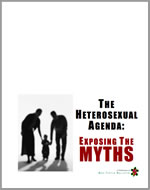 At last, the truth can now be told.
Using the same research methods employed by most anti-gay political pressure groups, we examine the statistics and the case studies that dispel many of the myths about heterosexuality. Download your copy today!
And don‘t miss our companion report, How To Write An Anti-Gay Tract In Fifteen Easy Steps.
 Anti-gay activists often charge that gay men and women pose a threat to children. In this report, we explore the supposed connection between homosexuality and child sexual abuse, the conclusions reached by the most knowledgeable professionals in the field, and how anti-gay activists continue to ignore their findings. This has tremendous consequences, not just for gay men and women, but more importantly for the safety of all our children.
Anti-gay activists often cite the “Dutch Study” to claim that gay unions last only about 1½ years and that the these men have an average of eight additional partners per year outside of their steady relationship. In this report, we will take you step by step into the study to see whether the claims are true.
Tony Perkins’ Family Research Council submitted an Amicus Brief to the Maryland Court of Appeals as that court prepared to consider the issue of gay marriage. We examine just one small section of that brief to reveal the junk science and fraudulent claims of the Family “Research” Council.
 The FBI’s annual Hate Crime Statistics aren’t as complete as they ought to be, and their report for 2004 was no exception. In fact, their most recent report has quite a few glaring holes. Holes big enough for Daniel Fetty to fall through.
“Google” is a trademark of Google Inc.
© Box Turtle Bulletin. All Rights Reserved.
 Posts
Posts  Posts via daily email: