Box Turtle Bulletin
 News and commentary about the anti-gay lobby
“Now you must raise your children up in a world where that union of man and box turtle is on the same legal footing as man and wife…”
News and commentary about the anti-gay lobbyPosts Tagged As: Marriage
June 26th, 2015
Justice Anthony Kennedy wrote the 5-4 decision striking down bans against marriage equality across the nation. Gay and Lesbian couples now stand as equals before the law with their heterosexual friends and relatives in every respect. In the lead case of Obergefell v. Hodges, the U.S. Supreme Court overturned a Sixth Circuit Court of Appeals decision upholding marriage bans in four states. From the syllabus:
(p1): Held: The Fourteenth Amendment requires a State to license a marriage between two people of the same sex and to recognize a marriage between two people of the same sex when their marriage was lawfully licensed and performed out-of-State.
(p4): …The right of same-sex couples to marry is also derived fromthe Fourteenth Amendment’s guarantee of equal protection. The Due Process Clause and the Equal Protection Clause are connected in a profound way. Rights implicit in liberty and rights secured by equal protection may rest on different precepts and are not always coextensive, yet each may be instructive as to the meaning and reach of the other. This dynamic is reflected in Loving, where the Court invoked both the Equal Protection Clause and the Due Process Clause;and in Zablocki v. Redhail, 434 U. S. 374, where the Court invalidated a law barring fathers delinquent on child-support payments frommarrying.
“Traditional marriage” is both timeless and constantly changing, as are attitudes towards gay people. From the majority opinion:
(p6): The ancient origins of marriage confirm its centrality, but it has not stood in isolation from developments in law and society. The history of marriage is one of both continuity and change. That institution—even as confined to opposite-sex relations—has evolved over time. For example, marriage was once viewed as an arrangement by the couple’s parents based on political, religious, and financial concerns; but by the time of the Nation’s founding it was understood to be a voluntary contract between a man and a woman. See N. Cott, Public Vows: A History of Marriage and the Nation 9–17 (2000); S. Coontz, Marriage, A History 15–16 (2005). As the role and status of women changed, the institution further evolved. Under the centuries-old doctrine of coverture, a married man and woman were treated by the State as a single, male-dominated legal entity. See 1 W. Blackstone, Commentaries on the Laws of England 430 (1765). As women gained legal, political, and property rights, and as society began to understand that women have their own equal dignity, the law of coverture was abandoned. See Brief for Historians of Marriage et al. as Amici Curiae 16–19. These and other developments in the institution of marriage overthe past centuries were not mere superficial changes. Rather, they worked deep transformations in its structure, affecting aspects of marriage long viewed by many as essential. See generally N. Cott, Public Vows; S. Coontz, Marriage; H. Hartog, Man & Wife in America: A History (2000).
These new insights have strengthened, not weakened, the institution of marriage. Indeed, changed understandings of marriage are characteristic of a Nation where new dimensions of freedom become apparent to new generations, often through perspectives that begin in pleas or protests and then are considered in the political sphere and the judicial process.
This dynamic can be seen in the Nation’s experiences with the rights of gays and lesbians. Until the mid-20th century, same-sex intimacy long had been condemned as immoral by the state itself in most Western nations, a belief often embodied in the criminal law. For this reason, among others, many persons did not deem homosexuals to have dignity in their own distinct identity. A truthful declaration by same-sex couples of what was in their hearts had to remain unspoken. Even when a greater awareness of the humanity and integrity of homosexual persons came in the period after World War II, the argument that gays and lesbians had a just claim to dignity was in conflict with both law and widespread social conventions. Same-sex intimacy remained a crime in many States. Gays and lesbians were prohibited from most government employment, barred from military service, excluded under immigration laws, targeted by police, and burdened in their rights to associate.
…This Court first gave detailed consideration to the legal status of homosexuals in Bowers v. Hardwick, 478 U. S. 186 (1986). There it upheld the constitutionality of aGeorgia law deemed to criminalize certain homosexual acts. Ten years later, in Romer v. Evans, 517 U. S. 620 (1996), the Court invalidated an amendment to Colorado’sConstitution that sought to foreclose any branch or political subdivision of the State from protecting persons against discrimination based on sexual orientation. Then, in 2003, the Court overruled Bowers, holding that lawsmaking same-sex intimacy a crime “demea[n] the lives of homosexual persons.” Lawrence v. Texas, 539 U. S. 558, 575
In discussing the Due Process aspects of the case, Kennedy tackles Scalia’s beloved “original intent” arguments:
The nature of injustice is that we may not always see it in our own times. The generations that wrote and ratified the Bill of Rights and the Fourteenth Amendment did not presume to know the extent of freedom in all of its dimensions, and so they entrusted to future generations a charter protecting the right of all persons to enjoy liberty as welearn its meaning. When new insight reveals discord between the Constitution’s central protections and a received legal stricture, a claim to liberty must be addressed.
Kennedy reaffirmed the court’s finding in Loving v. Virginia, which struck down bans on interracial marriage, that marriage is a fundamental right. He also reaffirmed his eloquent statement in Windsor about the profound meaning marriage has for the children of same-sex marriages:
(p15): Excluding same-sex couples from marriage thus conflicts with a central premise of the right to marry. Without the recognition, stability, and predictability marriage offers, their children suffer the stigma of knowing theirfamilies are somehow lesser. They also suffer the significant material costs of being raised by unmarried parents,relegated through no fault of their own to a more difficult and uncertain family life. The marriage laws at issue herethus harm and humiliate the children of same-sex couples. See Windsor, supra, at ___ (slip op., at 23).
(p17): There is no difference between same- and opposite-sex couples with respect to this principle. Yet by virtue oftheir exclusion from that institution, same-sex couples are denied the constellation of benefits that the States have linked to marriage. This harm results in more than just material burdens. Same-sex couples are consigned to aninstability many opposite-sex couples would deem intolerable in their own lives. As the State itself makes marriageall the more precious by the significance it attaches to it,exclusion from that status has the effect of teaching thatgays and lesbians are unequal in important respects. It demeans gays and lesbians for the State to lock them outof a central institution of the Nation’s society. Same-sex couples, too, may aspire to the transcendent purposes ofmarriage and seek fulfillment in its highest meaning.
The limitation of marriage to opposite-sex couples may long have seemed natural and just, but its inconsistency with the central meaning of the fundamental right tomarry is now manifest. With that knowledge must come the recognition that laws excluding same-sex couples fromthe marriage right impose stigma and injury of the kind prohibited by our basic charter.
(p18): The right to marry is fundamental as a matter of history and tradition, but rights come not from ancient sources alone. They rise, too, from a better informed understanding of how constitutional imperatives define a liberty that remains urgent in our own era. Many who deem same-sex marriage to be wrong reach that conclusion based ondecent and honorable religious or philosophical premises,and neither they nor their beliefs are disparaged here. But when that sincere, personal opposition becomes en- acted law and public policy, the necessary consequence is to put the imprimatur of the State itself on an exclusion that soon demeans or stigmatizes those whose own liberty is then denied. Under the Constitution, same-sex couples seek in marriage the same legal treatment as opposite-sexcouples, and it would disparage their choices and diminishtheir personhood to deny them this right.
Kennedy also gave a nod to some of the fear-mongering among marriage quality opponents, who have falsely claimed that churches will be “forced” to marry same-sex couples:
(p27): Finally, it must be emphasized that religions, and those who adhere to religious doctrines, may continue to advocate with utmost, sincere conviction that, by divine precepts, same-sex marriage should not be condoned. The First Amendment ensures that religious organizations and persons are given proper protection as they seek to teach the principles that are so fulfilling and so central to theirlives and faiths, and to their own deep aspirations to continue the family structure they have long revered. The same is true of those who oppose same-sex marriage for other reasons. In turn, those who believe allowing same-sex marriage is proper or indeed essential, whether as a matter of religious conviction or secular belief, may engage those who disagree with their view in an open and searching debate. The Constitution, however, does not permit the State to bar same-sex couples from marriage on thesame terms as accorded to couples of the opposite sex.
He concludes:
No union is more profound than marriage, for it embodies the highest ideals of love, fidelity, devotion, sacrifice, and family. In forming a marital union, two people become something greater than once they were. As some of the petitioners in these cases demonstrate, marriage embodies a love that may endure even past death. It would misunderstand these men and women to say they disrespect the idea of marriage. Their plea is that they dorespect it, respect it so deeply that they seek to find its fulfillment for themselves. Their hope is not to be condemned to live in loneliness, excluded from one of civilization’s oldest institutions. They ask for equal dignity in the eyes of the law. The Constitution grants them that right.
The judgment of the Court of Appeals for the Sixth Circuit is reversed.
It is so ordered.
June 25th, 2015

The state of Guerrero (Acapulco) in Mexico has announced that it will no longer enforce its ban on same-sex marriages.
In real terms, this means that Guerrero will not enforce the ampero process which requires the first five couples in a state to hire a lawyer, go to court, and get official permission to marry.
June 25th, 2015
Chief Justice John Roberts: Yes.
Antonin Scalia: No.
Anthony Kennedy: Yes.
Clarence Thomas: No.
Ruth Bader Ginsberg: Yes.
Stephen Breyer: Yes.
Samuel Alito: No.
Sonia Sotomayor: Yes.
Elena Kagan: Yes.
 That’s one of my two predictions for how the Supreme Court will rule on Obergefell v. Hodges, the lead lawsuit for a slew of marriage equality cases before the Court. My second prediction is that the ruling will come down tomorrow. (Note: I’m not so sure about tomorrow as I was earlier this morning. See below.) Here’s my thinking:
6-3: Chief Justice Roberts joins the five-person majority. If the Chief Justice is in the majority, then he has the prerogative to write the ruling or assign it to someone else in the majority. If the Chief Justice is not in the majority, then the task falls to the most senior justice in the majority to either write it himself/herself or assign another justice in the majority to write the opinion.
In my mind, this is critical. Roberts didn’t join the majority in Windsor v. US, so Kennedy ended up writing the opinion declaring that the portion of the Defense of Marriage Act which barred the Federal government from recognizing legal same-sex marriages was unconstitutional. It didn’t address the constitutionality of marriage bans, but look what happened anyway: courts all over the country began using Windsor to strike down those marriage bans right and left. Some of those courts took Windsor to mean that heightened scrutiny applies, or at least was allowed. There is the similar potential, depending on how Obergefell is written, for its effects to reach far beyond the question of marriage itself. It may enshrine, eliminate, or clarify the applicability of heightened scrutiny for LGBT people in other cases, as just one example. Or it may have other follow-on effects, depending on how it’s written. If Roberts has an interest in limiting Obergefell’s effects on other cases, then he may well want to keep the majority opinion out of Kennedy’s hands. Otherwise, the Court goes 5-4 and Kennedy gets to write the opinion — or pass it along to one of the even more liberal Justices.
Now of course Roberts may have other reasons for joining the majority. In today’s Obamacare ruling, he apparently did so in order to write an expansive ruling rather than a narrower one. A narrower ruling, for example, might have left Obamacare intact but the interpretation of the contested phrase “established by the states” up to the IRS. That would allow a future Republican President to order the IRS to interpret the clause differently. But Roberts took that possibility out of the hands of future Presidents by ruling that the intent of Congress when it passed Obamacare was for the subsidies to apply to all states. It’s possible that Roberts may want to take the opportunity to ensure Obergefell is similarly expansive, although I haven’t seen anything to suggest that he would be inclined to do this. But even if he doesn’t, if he sees this marriage equality case as one of the defining rulings of the Roberts Court — as were the two Obamacare cases that he wrote the opinions for — then he may well want to take this opportunity to be a part of that legacy.
So that’s how I get to 6-3.
And I get to 6-3 for both questions: whether gay marriage bans are unconstitutional (yes, 6-3) and whether states must recognize same-sex marriages from other states (yes, the same 6-3, although I guess it might be mooted by the first question). I don’t see a split decision here. If the Court rules against the first question while upholding the second, then it really doesn’t solve anything. In fact, chaos will reign because of the decision. By my count, marriage decisions in about 23 states (I could be off here) and Guam would be rolled back, leaving the status of thousands of marriage licenses in limbo and scores more lawsuits in the making. And that means that the Supreme Court would almost certainly have to address this issue all over again. I just don’t see the Court going against the overwhelming majority of Federal judges while inviting more headaches for itself. Besides, to arrive at this kind of a split decision, they’d more or less have to say that at least a portion of Windsor was “wrongly decided.” I just don’t see them borrowing a phrase like that from Lawrence, which struck down sodomy laws nationwide in 2003, to do something like this.
Friday: Why Friday? Well, Obamacare was today, and since the Court tries to keep each decision day limited to one major decision (and whatever relatively minor decisions which happen to be ready), then there’s no way the marriage case was going to happen today. I actually think that if they were going to strike Obamacare down, they probably would have waited until Monday because of the tremendous fallout. But since it was being upheld, it was a pretty safe move for the court to put it up today. But that necessarily meant that Obergefell would get pushed off.
So why tomorrow and not Monday? Well, the Court doesn’t operate in a hermetically-sealed chamber, unaware of what’s going on around it. June 26 has been a very auspicious day for pro-gay rulings: Lawrence on June 26, 2003, and Windsor on June 26, 2013. Also, Pride is this weekend for a huge number of cities around the world. Considering that the court could have just as easily selected Tuesday, June 30 as an extra decision day, June 26 just seems to be the most likely. That way, everybody gets to talk about it over the weekend and the Court can cleanly dispose of the three or four remaining cases on Monday (depending on how many other cases they release tomorrow) and go home for the summer.
Update: There’s a strong argument against a Friday ruling: the Charleston funerals take place tomorrow. I hadn’t thought of that when I wrote this. I suspect that Friday was chosen as a decision day with Obergefell in mind, but now I’m not so sure it’ll happen.
Grounds?. Equal protection? Due Process? Both? Something else? On that question, I’m on much shakier ground. I don’t really have a prediction here. But you have the rest: 6-3, tomorrow (tentatively). What’s yours?
June 24th, 2015
The Parliament in New South Wales is controlled by the same coalition of political parties as the nation’s Parliament, the Liberal Party and the National Party of Australia. It has just voted to encourage the federal Parliament to have “a respectful debate that is tolerant of all views”, or in other words, to allow a free vote.
The vote was unanimous and was supported by Premier Mike Baird. (Sydney Morning Herald)
[Independent Sydney MP Alex ] Greenwich called on the federal government to “stop delaying the inevitable”.
“The Liberal Party claims to be the party of “individual freedom” and a free vote should be its default position on this issue,” he said.
This move increases the pressure on Prime Minister Tony Abbott to allow a free vote on the issue.
And it undoubtedly pisses off Sydney Archbishop Anthony Fisher. I wonder if more letters are forthcoming.
June 24th, 2015

A number of Australian and global businesses have been putting pressure on the Australian government to support marriage equality. Representing some of the biggest players in the Australian economy, they have been jointly running advertisements in papers announcing their support and asking other businesses to join them.
This obviously concerns the Catholic Church, which opposes equality. But its response is baffling. (ABC)
The Catholic Church in Sydney is sending letters to companies that publicly support same-sex marriage, expressing its “grave concern” about their stance.
The Archdiocese of Sydney has targeted some of the 150 businesses that put their names and logos to recent newspaper advertisements supporting gay marriage.
While it’s a bit odd that they write the letters at all, it’s the language and tone that are perplexing.
“It is… with grave concern that I write to you about the Marriage Equality for Australians campaign,” it reads.
“You are publically supporting a strategic, political and well-funded campaign designed to pressure the Federal Government into changing the Marriage Act.
“For corporations to speak on such issues… is indeed overstepping their purpose and it is to be strongly resisted.”
I can’t imagine that anyone opening a letter from the Catholic Church informing them that they are “overstepping their purpose” is going to receive that news without objection. And after the Church has been yowling about marriage for months, to tell someone else that they should not express an opinion reveals a level of arrogance that is astounding.
The Church then includes a not-so-subtle threat
“You may be aware that the Catholic Archdiocese of Sydney is a significant user of goods and services from many corporations, both local and international,” it reads.
Needless to say, the company providing ABC with the story was not amused. Nor were they inclined to back away from their support.
Maurice Blackburn principal Liberty Sanger said she was not sure what the intention of the letter was, but either way the law firm would not be intimidated.
“Now it may well be that their intention was to try and frighten us into not participating in the debate,” she said.
“If that was the objective, well it’s had… obviously had the opposite effect.
This heavy-handed tone deaf missive might have been effecting in the 1500’s. But I very much suspect that it has only earned ill will from the businesses in Australia, along with the Australian people.
June 18th, 2015
The Southern Baptist Convention held its annual meeting in Columbus, OH, earlier this week and the theme seemed to be gay marriage. As Jonathan Merritt noted,
SBC president Ronnie Floyd preached a fiery sermon declaring, “the Supreme Court of the United States is not the final authority, nor is the culture itself, but the Bible is God’s final authority about marriage and on this book we stand.” At a press conference on Wednesday, leaders released a letter signed by 16 past denominational presidents–including my father, James Merritt, who presided from 2000 to 2002–stating, “we will not accept, nor adhere to, any legal redefinition of marriage issued by any political or judicial body including the United States Supreme Court.” And the denomination’s political arm released a legal guide for churches, schools, and ministries to protect themselves as culture grows more comfortable with same-sex marriage.
But the most significant action was a resolution passed by the denomination declaring their ‘public witness’ opposing the rights of other citizens to marry. And, as far as resolutions go, it’s a mess.
It starts with a bunch of whereas statements, the first two of which show such astonishing ignorance of scripture that I marvel that they can be claimed with a straight face.
WHEREAS, God in His divine wisdom created marriage as the covenanted, conjugal union of one man and one woman (Genesis 2:18–24; Matthew 19:4–6; Hebrews 13:4); and
WHEREAS, The Baptist Faith & Message (2000) recognizes the biblical definition of marriage as “the uniting of one man and one woman in covenant commitment for a lifetime,” stating further, “It is God’s unique gift to reveal the union between Christ and His church and to provide for the man and the woman in marriage the framework for intimate companionship, the channel of sexual expression according to biblical standards, and the means for procreation of the human race”;
Yes, the carefully selected scriptures do discuss marriage between a man and a woman. The first is one of the variations of the Creation Myth presented in Genesis (it is paired with the more commonly recognized seven day timeline of creation/evolution).
Then the Lord God said, “It is not good for the man to be alone. I will make a helper as his complement.”
So the Lord God formed out of the ground every wild animal and every bird of the sky, and brought each to the man to see what he would call it. And whatever the man called a living creature, that was its name. The man gave names to all the livestock, to the birds of the sky, and to every wild animal; but for the man no helper was found as his complement.
So the Lord God caused a deep sleep to come over the man, and he slept. God took one of his ribs and closed the flesh at that place. Then the Lord God made the rib He had taken from the man into a woman and brought her to the man. And the man said:
This one, at last, is bone of my bone
and flesh of my flesh;
this one will be called “woman,”
for she was taken from man.This is why a man leaves his father and mother and bonds with his wife, and they become one flesh.
Which is a lovely parable, but it says nothing about marriage being “the covenanted, conjugal union of one man and one woman.” In fact, as far as this tale is presented, the man and the woman didn’t enter into any covenanted union at all.
The second scriptural passage is Jesus’ rejection of divorce, in which he quotes Genesis.
“Haven’t you read,” He replied, “that He who created them in the beginning made them male and female,” and He also said:
“For this reason a man will leave
his father and mother
and be joined to his wife,
and the two will become one flesh?So they are no longer two, but one flesh. Therefore, what God has joined together, man must not separate.”
And at that point the Baptists quickly slam their Bible shut, lest they accidentally read the 12th verse of Matthew 19, in which Jesus rejects binary gender definitions.
But irrespective of whether the discussion of eunuchs can be distanced from the Baptists’ selection, again this text is not definitional. Jesus is quoting Genesis to reject the cruel practice of dumping wives after the new wears off and leaving them (at that time) without any financial security. He wasn’t defining marriage.
The third biblical reference is even less supportive of the whereas assertion.
Marriage must be respected by all, and the marriage bed kept undefiled, because God will judge immoral people and adulterers.
I see no “biblical definition” there.
And the reason that Baptists can’t actually point to a passage in scripture in which it defines marriage as “the uniting of one man and one woman in covenant commitment for a lifetime” is because such passages don’t exist. A scholar of the sacred texts in ancient times would likely be highly amused at such a definition and find it to be a rare family structure, rather than indicative of God’s commands or expectations.
Let’s consider what most familiar marriages and family structures looked like in the Bible as shown in the Bible stories.
Other than Isaac and Noah, I can’t think offhand of any biblical marriages or biblical family structures that are of the sort that would be allowed in a Southern Baptist church today.
But lest there be any lingering confusion about the definition of marriage as “one man and one woman”, the early Christian church did, indeed, lay out what the requirements were for marriage. But only for some. Titus 1:5-6
For this cause left I thee in Crete, that thou shouldest set in order the things that are wanting, and ordain elders in every city, as I had appointed thee: If any be blameless, the husband of one wife, having faithful children not accused of riot or unruly.
The bishops (elders) of the church were to be the husband of one wife. By this reference we know that there were some in the church – not appointed bishops – that were not (nor expected to be) husbands of one wife.
Irrespective of what one believes about the value of restricting marriage to heterosexual unions, claiming that one man / one woman marriages are in any way “biblical”, much less defined as such in the Bible, is self-delusion and absurdly so.
But it isn’t just in the Whereas clauses that this declaration falls apart. The Resolved clauses are no better:
1. RESOLVED, That the messengers to the Southern Baptist Convention meeting in Columbus, Ohio, June 16–17, 2015, prayerfully call on the Supreme Court of the United States to uphold the right of the citizens to define marriage as exclusively the union of one man and one woman; and be it further
2. RESOLVED, That Southern Baptists recognize that no governing institution has the authority to negate or usurp God’s definition of marriage; and be it further
3. RESOLVED, No matter how the Supreme Court rules, the Southern Baptist Convention reaffirms its unwavering commitment to its doctrinal and public beliefs concerning marriage; and be it further
4. RESOLVED, That the religious liberty of individual citizens or institutions should not be infringed as a result of believing or living according to the biblical definition of marriage; and be it further
5. RESOLVED, That the Southern Baptist Convention calls on Southern Baptists and all Christians to stand firm on the Bible’s witness on the purposes of marriage, among which are to unite man and woman as one flesh and to secure the basis for the flourishing of human civilization; and be it finally
6. RESOLVED, That Southern Baptists love our neighbors and extend respect in Christ’s name to all people, including those who may disagree with us about the definition of marriage and the public good.
[numbering my own]
Reading the second and first resolved paragraphs together leaves a very confused message. Basically the SBC is claiming that the Supreme Court has no authority over marriage and also begs them to let anti-gay states ban equality. They reject the court’s authority while requesting that the court rule as they wish.
Similarly the fourth, fifth and sixth paragraphs are incompatible. In the sixth they declare their love and respect to all people, but in resolve number 4 and 5, they basically assert that Baptist clerks and cake bakers should refuse service to gay people.
What these Baptists fail to realize is that their declaration is inherently lacking in “love and respect”. It is directed externally, declaring what courts should do, what gay people should not do, and defending their own rejection of their neighbors.
The only way this can be seen as “love and respect” is through the notion that whatever Christians do, regardless of how cruel, is by definition “loving” and that the difficulties that they place on others is “for their own good”.
Ultimately, this resolution has no weight. They can “not adhere to” any “legal redefinition of marriage” that they choose, be it marriages between gays, mixed-race couples, or those of different faith. They can “stand firm on the Bible’s witness” (as they see it) all they like. They can defend to the death their right to believe whatever they want to believe. They can reject the authority of courts to their heart’s content.
But in practicality, marriage equality is coming. And they can do nothing to stop it.
And this messy, contradictory, self-congratulatory statement of self-righteousness is not likely to serve them well as they go about the business of trying to evangelize to a nation that finds their rejection and exclusion to be morally reprehensible.
June 11th, 2015

Although Chihuahua is perhaps known most for a tiny dog, it is actually Mexico’s biggest state – roughly the size of Michigan – placed alongside New Mexico and Texas. It is also the latest Mexican state to lift all restrictions to same-sex marriage. (proceso badly translated by google)
The government of Cesar Duarte Jaquez decided not to put more obstacles to marriages between same sex and from now on married couples who request them.
Chihuahua joins Quintana Roo (Cancun) and Coahuila (the state to Chihuahua’s east also bordering Texas) as states in which marriages are now immediately available. In the remainder of Mexico, couples may still need to go to court to get an amparo (civil rights ruling), but the outcome of the ruling is assured to be positive.
June 11th, 2015
In May the North Carolina legislature passed Senate Bill 2, a bill designed to allow individual Magistrates to give up conducting marriages and to allow assistant Registrars to give up issuing marriage licenses. Republican Governor Pat McCrory vetoed the bill, saying that public officials who swear to perform the duties of their office should not be exempt from doing so.
On June 2nd, the state Senate voted to override the Governor’s veto and today the House did the same. So the bill becomes law.
Here’s what it does:
While this is seen as an affront to our community, it is not clear that it will have much real impact on same-sex couples seeking marriage. The provisions require that licenses be issued and marriages be conducted and it probably matters little whether any specific Magistrates or Assistant Register of Deeds individually participate.
And it should be noted that the state has been issuing marriage licenses and conducting marriages since October 2014, and things appear to be going smoothly. I suspect that the offices of the various Registers of Deeds and Magistrates have by now pretty much identified ways to comply with the law without any serious loss of religious freedom or significant inconvenience to marrying parties. I doubt much will change.
June 11th, 2015

On May 27th I wrote an article in which I said that it appears to me that Charlotte anti-gay activist Michael Brown has taken the step from truth-spinner and fact-bender to blatant liar for repeating the false claim that the Yes Campaign supporting marriage in Ireland was funded by an American billionaire.
There is a difference between funding organizations with an ideological bent and who seek a social position, and funding an actual campaign for a referendum. This is a clear distinction and one that Michael Brown knows well.
On June 3rd, World Net Daily presented a commentary by Brown in which he attempts to set the record straight.
He spends several paragraphs patting himself on the back for conducting “the gold standard” of anti-gay activism and attempting to place the label of dishonesty on me instead of himself. For example, I describe his pack of annual protesters as “a red shirt mob” but he assures the readers at WND that they are “fine Christian men, women and children, including grandmas and grandpas”. Ya know, that sort of thing.
As for the meat of my argument, I predicted Brown’s response well.
Now Brown and others may say that this is splitting hairs, a mere technicality. They might argue that because Mr. Feeney funded organizations that advocate for marriage equality, he is funding the campaign in a more general sense. He’s not actually funding buttons and flyers and posters, maybe, but he’s helping fund groups that are pro-gay so it’s all the same really.
Which was exactly how Brown responded.
Not only is this hair-splitting, but it has been clearly documented that the push to redefine marriage in Ireland goes back more than a decade, with much of the groundwork laid by Atlantic Philanthropies, through which Feeney donated millions.
In other words, Brown claims that back when same-sex couples could marry only in the Netherland, Belgium, Ontario, and Massachusetts, a billionaire in New Jersey concocted a decade long scheme in which he would bring about marriage equality not in his own state or country, but in what was possibly the most Catholic nation on the planet, Ireland. I’ll let you decide if you think that is likely.
Oh I suppose that if your worldview is such that efforts to protect children from bullying equals “the homosexual indoctrination of your kids” or if you believe that casting demons out of a gay person can turn them straight then you can convince yourself of anything.
Now it is true that marriage equality is part of the overall drive for equality and inclusion. And though I think that no one, Feeney included, dared to dream that in 2015 two dozen countries would have marriage equality, full equality and inclusion of LGBT people into the fabric of daily life has always been the long goal. And Feeney has, for many years, given to groups in Ireland who support the goals of the community.
But the claim Brown repeated is flatly false. It’s an assertion that illegal contributions paid for a vote in which those who support his exclusionary and rejecting view of society lost and lost badly. In telling “what really happened in Ireland” he insisted that “Ireland was not ready for the massive influx of gay activist funding from America”. In other words, the only reason they lost is because the Yes Campaign broke the law and accepted a American gay money.
And it is interesting (and telling) that no where in Brown’s rebuttal does he admit that this accusation is untrue, choosing instead to double-down by implying, suggesting, hinting that what he really meant was based in fact.
Without this decade-long effort (which Kincaid cannot possibly believe was not part of a larger plan, leading up to the “Yes” campaign), it is almost certain that Ireland would not have voted 62 to 38 percent to redefine marriage.
This is what my Irish supporter was trying to convey when she wrote, “We tried so hard to prevent it, but were up against every political party and up against millions of U.S. dollars that were being poured into the yes campaign. American billionaire, Chuck Feeney alone contributed over $24 million.”
Again, without massive American funding over a period of more than 10 years, the campaign would likely have failed.
Which isn’t quite the same thing as that unexpected “massive influx of gay activist funding from America”, is it? So I guess there was no sneaky influx of foreign gay activist money that “Ireland was not ready for”, was there? But that doesn’t much matter to Brown.
Repeat the lie, imply it was true in what was ‘trying to be conveyed’, conflate the timeline, and the average WND reader will walk away believing that Feeney dumped $24 into the Yes Campaign. End result: the desired deception.
Meh. Liars will lie. Prevaricators will be truth-benders.
But as for me, I will readily admit that one part of my commentary is not correct. And for that I apologize.
I called Michael Brown a pastor. He insists that he is not a pastor. And let the record so state.
June 10th, 2015

Tony Campolo is a speaker and author and is highly influential in the side of evangelical Christianity that prioritizes social justice and charity. He has long been supportive of gay people, but his position on marriage was that the government should honor only civil unions for all and let churches decide for whom to conduct marriages. And he has been, for some time, a bit ambiguous about what he believes the church should do.
This week he revised his position.
It has taken countless hours of prayer, study, conversation and emotional turmoil to bring me to the place where I am finally ready to call for the full acceptance of Christian gay couples into the Church.
For me, the most important part of that process was answering a more fundamental question: What is the point of marriage in the first place? For some Christians, in a tradition that traces back to St. Augustine, the sole purpose of marriage is procreation, which obviously negates the legitimacy of same-sex unions. Others of us, however, recognize a more spiritual dimension of marriage, which is of supreme importance. We believe that God intends married partners to help actualize in each other the “fruits of the spirit,” which are love, joy, peace, patience, kindness, goodness, faithfulness, gentleness and self-control, often citing the Apostle Paul’s comparison of marriage to Christ’s sanctifying relationship with the Church. This doesn’t mean that unmarried people cannot achieve the highest levels of spiritual actualization – our Savior himself was single, after all – but only that the institution of marriage should always be primarily about spiritual growth.
This casts the role of same-sex marriage not as acceptable, but as a spiritual good, a blessing to the couple and the church. He cites his experiences with gay Christian couple, and watching how they function, as influential to his change of thinking.
This is no inconsequential endorsement.
June 8th, 2015

It’s now 8:00 am on Tuesday morning in Guam and marriage licenses are now available to same-sex couples.
Congratulations to Loretta Pangelinan and Kathleen Aguero and all the other same-sex couples who now have access to equality.
June 8th, 2015
Texas Governor Greg Abbott will tell you that be absolutely supports traditional marriage and wants to protect that treasured definition. And so will every GOP legislator in that state.
But somehow the legislature managed to end the legislative session without passing any bills that would in any way hinder marriage equality coming to Texas after the Supreme Court rules later this month. And Abbott has now responded to demands that he call a special session for them to do so. (WOAI)
“I do not anticipate any special session,” he told News Radio 1200 WOAI. “They got their job done on time, and don’t require any overtime.”
A cynical soul might conclude that the Texas GOP passed exactly the number of bill protecting traditional marriage that they wanted to pass. None. Such a person might even think that the Texas GOP is far more concerned with the demands of the Texas business community, which has opposed such bills as bad for business, than they are the demands of the Texas Eagle Forum or Americans for Truth About Homosexuality.
June 6th, 2015
One of the odder early moments in the 2016 primary season was a week or two in which the presumed GOP candidates were asked whether they would go to the same-sex marriage of a close friend or family member. And in what seemed to be a weird effort to play both sides, several responded that while they oppose the legal recognition of same-sex marriages, they’d happily attend the wedding of someone they love.
But, as it turned out, they weren’t necessarily being cynical. Wisconsin Gov. Scott Walker had already attended a gay wedding reception and Ohio Gov. John Kasich had RSVP’d and had plans to attend.
So maybe it’s a thing.
It does seem a bit hypocritical, but I suppose one can simultaneously hold the position that society is better off restricting marriage to traditional couples while also celebrating your friend’s happiness. Politicians have certainly held stranger positions.
In any case, Walker and Kasich are not alone. Nebraska Governor Pete Ricketts is staunchly defending the state’s ban on marriage equality, insisting that the only a vote of the constituents should bring about equal protection under the law. But while he’s holding firm against gay marriage in Nebraska, he’s attending one in Illinois. (Omaha.com)
Ricketts will attend the wedding of his sister, Laura Ricketts. She is marrying Brooke Skinner, a brand strategist for Twitter.
Laura Ricketts was one of the leaders in the gay-rights movement in Chicago and was active in pushing for the legalization of gay marriage in Illinois, which took effect last year.
It would be reasonable to object to the idea of a politician opposing equality and then showing up for the ceremony. But I can’t help but think that this is positive. It’s hard to hold a continued objection once you’ve been a part of a lovely and touching and beautiful ceremony.
And who knows, maybe this is the tool that is needed not only for them to confront this issue on a personal level, but also to explain an eventual change of heart.
June 5th, 2015

Mexico has a complicated judicial system, particularly when it comes to civil rights. Rather than single marriage rulings that apply broadly to all citizens, individual couples get an amparo which relates specifically to their case. However, once five amparos have been issued in a state, precedent is established and then marriage equality has reached that state.
Or something like that.
Well it now appears that the rule of five also applies on a federal level. (Buzzfeed)
The Supreme Court and several lower courts have already ruled in almost every state that same-sex couples have the right to marry under the Mexican constitution. But because of the Mexican court system’s often confusing technicalities, none of those decisions have been binding in future cases. Theoretically, any court could rule against a couple who has sued for the right to marry even though there have been many cases decided in favor of others couples.
That is no longer true. On Wednesday, Mexico’s Supreme Court issued the first blanket statement that laws prohibiting same-sex couples from marrying are unconstitutional in every state — what is known as “generic jurisprudence.”
…
This is not the first time the court had resolved a case with that exact sentence. But Colima is the fifth state in which the court had used this language, and five is a magic number in the Mexican system. Along with rulings from Oaxaca, Baja California, Sinaloa, and the State of México, the Colima ruling forms a new “generic jurisprudence” binding on judges issuing rulings in all the states of Mexico.
This does not necessarily mean that marriage licenses will now be handed out by every jurisdiction across the nation, but it means that every legal challenge will now have the same result. Perhaps it can be seen as a technicality that sets a two step process for obtaining a marriage license.
But as each state reaches five amparos (which are now assured) that state will be obligated to issue licenses. Or, in other words, the sixth same-sex couple to marry in a Mexican state will not have to go through the step of a legal challenge. And some states already have reached this threshold.
It may be that we can now say that same-sex marriages are now available across all of Mexico – though perhaps not yet full equality.
June 5th, 2015

Guam is an island about the size of the Hawaiian island of Molokai located between Papua New Guinea and Japan, east of the Philippines. It was a subject of Spanish colonization from 1668 until 1898 when ownership was transferred to the United States as a spoil of the Spanish-American War.
The island is an unincorporated territory of the United States. It is self governed with a Governor and Senate elected by the population of about 160,000 residents, but comes under the federal jurisdiction of the Ninth Circuit Court of Appeals. Politically it is considered to be fairly conservative.
In April of this year, Loretta Pangelinan and Kathleen Aguero filed a lawsuit claiming that the ruling by the Ninth Circuit in favor of marriage equality set precedent for Guam. The Attorney General agreed with the suit and refused to defend the island’s law restricting marriage to opposite sex couples.
Governor Eddie Calvo, a Republican, said that he would not issue marriage licenses to same-sex couples without either an act of the Legislature or a ruling by the court. So yesterday, his counsel went to court and basically begged Federal Judge Frances Tydingco-Gatewood to issue a ruling bringing the territory into compliance with the Ninth Circuit.
Tydingco-Gatewood issued an order Friday (last evening by continental US time) (ABC)
Guam has become the first U.S. territory to recognize gay marriage after a federal judge struck down the prohibition.
U.S. District Court Chief Judge Frances M. Tydingco-Gatewood issued the decision after a hearing Friday morning local time. It goes into effect at 8 a.m. Tuesday, when gay couples can begin applying for marriage licenses, the Pacific Daily News reported.
Judge Tydingco-Gatewood was appointed by President George W. Bush in 2006. She is the first female Chamorro (indigenous) chief judge.
Guam is the first US Territory to recognize same-sex marriages. There is currently a lawsuit in Puerto Rico which is under the jurisdiction of the First Circuit Court of Appeals. But while all of the states in the First Circuit have marriage equality, this was achieved at the state level either through a challenge to the state constitution (Massachusetts), through legislation (New Hampshire and Rhode Island), or by referendum (Maine) so there is no precedent.
Featured Reports
 In this original BTB Investigation, we unveil the tragic story of Kirk Murphy, a four-year-old boy who was treated for “cross-gender disturbance” in 1970 by a young grad student by the name of George Rekers. This story is a stark reminder that there are severe and damaging consequences when therapists try to ensure that boys will be boys.
When we first reported on three American anti-gay activists traveling to Kampala for a three-day conference, we had no idea that it would be the first report of a long string of events leading to a proposal to institute the death penalty for LGBT people. But that is exactly what happened. In this report, we review our collection of more than 500 posts to tell the story of one nation’s embrace of hatred toward gay people. This report will be updated continuously as events continue to unfold. Check here for the latest updates.
In 2005, the Southern Poverty Law Center wrote that “[Paul] Cameron’s ‘science’ echoes Nazi Germany.” What the SPLC didn”t know was Cameron doesn’t just “echo” Nazi Germany. He quoted extensively from one of the Final Solution’s architects. This puts his fascination with quarantines, mandatory tattoos, and extermination being a “plausible idea” in a whole new and deeply disturbing light.
On February 10, I attended an all-day “Love Won Out” ex-gay conference in Phoenix, put on by Focus on the Family and Exodus International. In this series of reports, I talk about what I learned there: the people who go to these conferences, the things that they hear, and what this all means for them, their families and for the rest of us.
Prologue: Why I Went To “Love Won Out”
Part 1: What’s Love Got To Do With It?
Part 2: Parents Struggle With “No Exceptions”
Part 3: A Whole New Dialect
Part 4: It Depends On How The Meaning of the Word "Change" Changes
Part 5: A Candid Explanation For "Change"
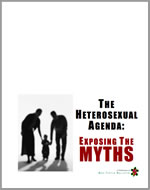 At last, the truth can now be told.
Using the same research methods employed by most anti-gay political pressure groups, we examine the statistics and the case studies that dispel many of the myths about heterosexuality. Download your copy today!
And don‘t miss our companion report, How To Write An Anti-Gay Tract In Fifteen Easy Steps.
 Anti-gay activists often charge that gay men and women pose a threat to children. In this report, we explore the supposed connection between homosexuality and child sexual abuse, the conclusions reached by the most knowledgeable professionals in the field, and how anti-gay activists continue to ignore their findings. This has tremendous consequences, not just for gay men and women, but more importantly for the safety of all our children.
Anti-gay activists often cite the “Dutch Study” to claim that gay unions last only about 1½ years and that the these men have an average of eight additional partners per year outside of their steady relationship. In this report, we will take you step by step into the study to see whether the claims are true.
Tony Perkins’ Family Research Council submitted an Amicus Brief to the Maryland Court of Appeals as that court prepared to consider the issue of gay marriage. We examine just one small section of that brief to reveal the junk science and fraudulent claims of the Family “Research” Council.
 The FBI’s annual Hate Crime Statistics aren’t as complete as they ought to be, and their report for 2004 was no exception. In fact, their most recent report has quite a few glaring holes. Holes big enough for Daniel Fetty to fall through.
“Google” is a trademark of Google Inc.
© Box Turtle Bulletin. All Rights Reserved.
 Posts
Posts  Posts via daily email: