Box Turtle Bulletin
 News and commentary about the anti-gay lobby
“Now you must raise your children up in a world where that union of man and box turtle is on the same legal footing as man and wife…”
News and commentary about the anti-gay lobbyPosts Tagged As: Marriage
June 4th, 2015

Earlier this week the Alabama Senate came up with a proposal to eliminate the issuance of marriage licenses and instead honor marriage contracts between individuals. They saw this as a way to prevent mass insurrection from probate judges who do not want to treat all citizens equally, should the US Supreme Court rule for marriage equality. (AL.com)
It was an attempt to prevent chaos from ensuing if the Supreme Court legalizes gay marriage this summer, [Rep. Greg Albritton, R- Bay Minette] said.
“My goal is not to protect a group,” Albritton said. “My goal is to protect the state.”
But chaos will ensue. Because the Alabama House killed the bill.
The legislation passed in the Senate, but it won’t go before the House for consideration. It failed 8-3 in the House Judiciary Committee.
So yeah, there will be probate judges who refuse to do their job. Some will quit. Some will whine. And the Alabama State Supreme Court – led by Chief Justice Roy Moore – will likely issue edicts of varying degrees of lunacy determined to “protect” these people from having to apply the law equally to all citizens.
But in the end, after the tantrums die out, Alabama will comply with the law of the land.
June 2nd, 2015
Fellow Texans, I am proudly standing here to humbly see.
I assure you, and I mean it – Now, who says I don’t speak out as plain as day?
And, fellow Texans, I’m for progress and the flag – long may it fly.
I’m a poor boy, come to greatness. So, it follows that I cannot tell a lie.
Ooh I love to dance a little sidestep, now they see me now they don’t –
I’ve come and gone and, ooh I love to sweep around the wide step,
Cut a little swathe and lead the people on.
The musical Best Little Whorehouse in Texas parodied the Texas style politician as a good ol’ country boy with the skill of bamboozling the public with words but never quite saying or doing anything concrete. And this past month, life has mirrored art.
For much of May, the legislature in Texas has been in a whirl of rhetoric about the Lone Star State’s autonomy, upstanding morals, and objection to them gays ruining the sanctity of marriage. No less than 23 bills were presented all designed to either hinder gay marriage, derail gay rights, or just insult gay people. But other than one bill, no legislation seemed to get passed.
First there was a big show of whether Republicans could rush through the pile of bills before the deadline or if Democrats could run out the clock before a bill could be passed that would block funds for the issuance of marriage licenses to same-sex couples. And, whew, it was a squeaker but the clock ran out.
But boy-oh-boy did those Republicans take a stance after the fact. They issued a letter telling the public in no uncertain terms that they pledged to continue to support traditional marriage and the flag and apple pie. A strongly worded letter, mind you.
And there there was the scare that the Republicans in the Senate would revive that bill or some other bill to stick it to the gays. And, by golly, they found the perfect vehicle on which to attach an amendment protecting the sanctity of marriage: some House bill having to do with county administration.
But, darn it, it turns out to everyone’s surprise that the author of the bill in the House was a Democrat and a firm supporter of marriage equality. And he let it be known that he’d pull the bill if they did. So that just didn’t work out.
Well! Gosh! What a disappointment!
But let it be known that they did get one bill passed. And it was a real crowd-pleaser. Senate Bill 2065
A religious organization, an organization supervised or controlled by or in connection with a religious organization, an individual employed by a religious organization while acting in the scope of that employment, or a clergy or minister may not be required to solemnize any marriage or provide services, accommodations, facilities, goods, or privileges for a purpose related to the solemnization, formation, or celebration of any marriage if the action would cause the organization or individual to violate a sincerely held religious belief.
Whew, what a victory. Now pastors don’t have to conduct gay marriages. And if the First Amendment to the US Constitution is ever repealed, Texas will have this bill right here protecting pastors from conducting sacraments contrary to their faith.
Of course, it’s all just window dressing. Meaningless gestures designed to keep the anti-gay rabble happy.
For, as we now know, the Texas Republicans in the legislature never intended to pass anti-gay legislation. Because as much as they love to wave the Lone Star Flag and quote the Bible, the legislators in Texas don’t answer to the religious right. They have an entirely different constituency.
Mark McKinnon, chairman of the GOP group Texas Wins, has a piece today in Politico Magazine explaining how Big Business in Texas came down squarely on the side of their gay employees. And no one can run for office these days without either Big Business or Big Union money.
The Lone Star State just wrapped its legislative session, which included two “religious freedom” constitutional amendments. Learning from what happened in the above states, industry groups and major businesses went out pre-emptively — let me say that again: pre-emptively — before such bills made it too far in the Legislature. The conservative state chamber of commerce, the Texas Association of Business, took the lead.
The amendments “would devastate economic development, tourism and the convention business,” said Bill Hammond, TAB’s CEO. “One has to look no further than Indiana to realize what a detriment this would be, and how hard it would be to sell Texas to the rest of the country. The Super Bowl [in Houston in 2017], the Final Four, all those things would be at risk in Texas if this were to become part of our Constitution.”
More than 250 Texas companies — American Airlines, Dell, Texas Instruments, Dow Chemical, the Dallas Mavericks — went on record with a general pledge in support of treating gay and transgender Texans fairly and equally under the law — and that welcoming and inclusive communities are essential to their bottom line.
Both amendments in the Texas Legislature died a quick death.
But boy has it been fun watching them all dancing a little sidestep and all the activist, right and left, swaying along to the music.
June 2nd, 2015
Last week, the North Carolina Senate and House both passed a bill which would allow individual magistrates (but not all magistrates in a county) to forego conducting civil marriages for all couples, gay or straight. Republican Governor Pat McCrory vetoed the bill, saying that public officials who swear to perform the duties of their office should not be exempt from doing so.
But the legislature may well be redefining the duties of office. (Reuters)
The Republican-led state Senate reached the three-fifths majority needed to override McCrory’s veto in a 32-16 vote. The legislation now goes back to the Republican-controlled state House of Representatives, which passed it last week by a margin wide enough to override the veto.
As discussed earlier, this bill could result in an inconvenience to all couples, gay or straight, in some counties. But it does not appear to me to be a tool for invidious discrimination and would likely hold up in court.
June 2nd, 2015
At some point this month the Supreme Court of the United States will rule on Obergefell v Hodges and determine whether states may exclude same-sex couples from marriage rights and recognition. And the legislators in Alabama seem to join the rest of the nation in the presumption that the court will rule for equality.
But they don’t like it one bit.
Already the Alabama Supreme Court has postured and pretended to think that their opinions overrule the federal judiciary system. But everyone knows that won’t hold up for long.
So now the state legislature has taken a page from Oklahoma’s playbook and come up with another notion: do away with marriage licenses altogether. Senate Bill 377 has passed the State Senate by a vote of 22 to 3 and is moving on to the House.
BE IT ENACTED BY THE LEGISLATURE OF ALABAMA:
Section 1.
(a) Effective July 1, 2015, the only requirement to be married in this state shall be for parties who are otherwise legally authorized to be married to enter into a contract of marriage as provided herein.
…
(h) Effective July 1, 2015, any requirement to obtain a marriage license issued by the judge of probate is abolished and repealed.
So instead of obtaining a license, couples would fill out a contract form and file it with the clerk after the fact.
I don’t see much advantage that this would give those who oppose equality. It would, I suppose, remove the “permission” aspect of the state authorizing same-sex marriages in advance, and it would allow judges of probate the ability to not sully their hand by giving marriage licenses to people they hate. But they would still have to process and file the contract and same-sex couples would receive all the rights of marriage.
It is entirely possible that the State of Alabama will argue that any ruling in Obergefell applies only to marriage licenses, not marriage contracts. And if they do, the judicial jokesters in the state Supreme Court will rubberstamp that nonsense with glees.
But such a tactic would only delay the process for the amount of time it takes for a federal judge to issue to issue a ruling and the Circuit and Supreme Courts to refuse to stay the ruling.
Despite the unconventionality of the proposal, libertarian minded people may find value in “getting the state out of the marriage business” and those who are not religious or formal may find the civil contract to be less laden with pomp and tradition than a license.
But I suspect most Alabamians, gay or straight, will just find uncertainty with the process and may feel that their marriages have become devalued. And it could cause some confusion for couples, gay or straight, who rely on licenses as evidence of marriage for insurance, federal filings, or other purposes.
While this bill, should it pass the House and be signed by the Governor, could be an inconvenience to everyone. But it isn’t likely to be an effective tool for denying equality to same-sex couples.
May 28th, 2015
Since writing about the increased impetus towards marriage equality in Australia, further signs of its inevitability have shown.
After Australian Opposition leader Bill Shorten filed his intent to present a marriage bill, Prime Minister Tony Abbott appears to have realized what a vote on such a bill might mean to his party. If the nation, which supports marriage equality by at least a two to one margin, were to perceive this to be a partisan identified issue (as, well, it is) that could be damaging. (Sydney Morning Herald)
Prime Minister Tony Abbott has hinted that same-sex marriage should be brought before Parliament via a cross-party bill, in a major shift in his language on the reform.
“If our Parliament were to make a big decision on a matter such as this, it ought to be owned by the Parliament and not by any particular party.”
The general interpretation of this message is that Abbott will be giving a conscience vote to the Liberal MPs. He also seems to imply that any marriage bill would need to come from a coalition including members of his party so as to avoid the impression that when marriage comes, it will have been a Labor victory. To Shorten’s credit, he appears to be willing to achieve the goal irrespective of who gets the credit.
Abbott appears not to be the only conservative in Australia who is acknowledging that it is now time to bring about marriage equality in the Land Down Under. Rob Stott at BuzzFeed has an excellent compendium of comments by conservatives either endorsing equality or recognizing its immediate likelihood.
May 27th, 2015

Anti-gay activist and Charlotte pastor Michael Brown has long been fond of demonstrating his contempt for gay people, his callousness towards bullying, and his astonishing arrogance as to his own discernment of truth. He will twist and turn any factlet that he encounters and has less credibility than your ordinary used car salesman, but generally he has, in our interactions, avoided demonstrably false declaration of observable facts.
Not so today.
In a desire to “explain” the decision of the people of Ireland to include gay Irish citizens fully into civil life – or to do so in a way that demonizes gay people (his favorite tactic) – Brown repeats a lie and calls it “absolutely right”.
In a hit piece hosted by Family Research Counsel’s American Family Research’s OneNewsNow, Brown pushed his theme of “tried and true tactics of bullying, intimidation, media bombardment, aggressive activism, and massive U.S. funding” by the horrible horrible gays. And as evidence, he presents a letter that he claims is from “a woman who supports our ministry and lives in Ireland”:
We tried so hard to prevent it, but were up against every political party and up against millions of US dollars that were being poured into the yes campaign. American billionaire, Chuck Feeney alone contributed over $24 million.
See there! Americans paid for the Yes campaign! Feeney gave $24 million!
Except that isn’t true. Not even close. It’s a false statement presented by The Irish Catholic and the National Catholic Register and other opponents of equality in an effort to conflate social pressure efforts with a political referendum so as to suggest that the results are not valid. For example:
Between 2004 and 2014, Feeney’s foundation virtually created the gay-rights movement in Ireland, with direct investment of more than $17 million and priceless indirect support, according to Breda O’Brien, a Catholic columnist at The Irish Times, research compiled on the blog Yes Funding Exposed and Atlantic Philanthropies’ own website and reports.
Wow, that certainly sounds damning. Except that the referendum hasn’t been going on since 2004. And most of the funds had nothing at all to do with same sex marriage.
Here’s what happened: Mr. Feeney and many others both in and outside Ireland have contributed over the years to various groups, including those who have the goals of advocating for gay Irish people. And part of their efforts include public outreach to change hearts and minds as to how one treats your gay son, niece, or neighbor. And, over time, part of that discussion included the notion that civil services should be offered to gay people on the same terms as straight people, including the rights of marriage.
In 2010, the government set in place civil unions so as to offer rights without the prestige of marriage. They argued that the nation’s constitution prohibited same-sex marriage and only through a vote of the people could that be change.
Then, a few years ago, a referendum was set by the government and scheduled for 2015. Campaigns were created to support or oppose the referendum.
But Ireland bans foreign contributions to political referendums. And, after accusations by the No Campaign, the press made inquiries. (TheGuardian)
Atlantic Philanthropies declined to answer questions about the claims, but backers of the yes campaign firmly rejected them. They said their group adhered to the strict rules on campaign funding set up by Ireland’s Standards in Public Office (Sipo) commission. The Sipo register of lobby groups shows that at least 10 of the pro-gay marriage organisations have fully complied with its rules, including a ban on foreign donations.
Brian Sheehan, the co-director of pro-gay marriage group Yes Equality, said: “Atlantic Philanthropies are not funding the Yes Equality referendum campaign. Yes Equality is fully funded through its supporters organising fundraising initiatives throughout Ireland.
“In addition we ran a crowdfunding campaign to raise monies for our poster, bus tour and booklet campaigns. All elements of the Yes Equality campaign are appropriately registered with the Standards in Public Office commission. Yes Equality is entirely dependent on generous small donations from around the country. The average donation made to Yes Equality has been €70.”
Get that? The Yes Campaign registered it’s fund with an oversight agency and the media verified their compliance. Feeney’s funds may have gone to various groups, but none went to the Yes Campaign.
Now Brown and others may say that this is splitting hairs, a mere technicality. They might argue that because Mr. Feeney funded organizations that advocate for marriage equality, he is funding the campaign in a more general sense. He’s not actually funding buttons and flyers and posters, maybe, but he’s helping fund groups that are pro-gay so it’s all the same really.
But that is nonsense. A contribution to Amnesty International is not a contribution to the Yes Campaign. A contribution to a Child and Family Agency is not a contribution to the Yes Campaign. Even if some members of each group – like most Irish – voted Yes.
It makes as much sense to say that anyone who has given to the Catholic Church in Ireland is “funding the No Campaign”. After all, Catholic Bishops called for the adherents to go to polls and vote No.
There is a difference between funding organizations with an ideological bent and who seek a social position, and funding an actual campaign for a referendum. This is a clear distinction and one that Michael Brown knows well.
But, as is becoming more and more the case with anti-gay activists, honesty holds little currency. And it appears to me that Michael Brown has taken the step from truth-spinner and fact-bender to blatant liar.
UPDATE: Michael Brown has issued a rebuttal in which he states that he is not a pastor.
May 26th, 2015

There is no question but that Ireland is serving as inspiration around the globe. And one person feeling the pressure is Australia’s Prime Minister, Tony Abbott.
Abbott is the head of the Liberal Party (which is considered the more conservative of significant parties) and is in a coalition government with the Liberal National Party, the National Party, and the Country Liberal Party. And though Abbott vehemently opposes marriage equality, he recognizes that a large majority of the country, most of the opposing parties, and a growing number of his own party are equality supporters.
And in this upcoming week, the process towards marriage will begin. (gaystarnews)
Australian Opposition leader Bill Shorten has become the first leader of a major political party to put forward legislation to allow same-sex marriage in Australia just days after more members of the conservative wing of his party announced they now would vote in favor of marriage equality.
Shorten, leader of the Australian Labor Party, put his intention in writing earlier today, giving notice to the Parliament that he will table such a bill when the House of Representatives meets on Monday.
The success of the bill may depend on the outcome of a conscience vote decision.
Australia, like many multi-party countries, employs block voting where all delegates of the same party cast identical votes. Unlike in the US where every legislator is always free to vote their conscience on any issue (though they may pay politically for bucking the party leaders), in Australia legislators can only veer from the party position with permission.
The success of the bill depends on how the parties approach the vote.
If the Liberals do not allow a conscience vote, all their votes go to oppose equality and the bill cannot pass. If the Liberal do allow a conscience vote and Labor votes as a block, the bill is expected to pass.
But if both sides allow a conscience vote, the numbers are quite close. There are enough Liberal supporters and enough uncertainty to make it too close to call. But Liberal Minister of Communications Malcolm Turnbull is bullish on the bills success. (skynews)
Cabinet minister Malcolm Turnbull expects parliament to legalise same-sex marriage before the end of the year.
‘I have never seen a social issue which has changed attitudes as rapidly as this one,’ he said, adding his feeling was that legislation was ‘very likely to pass’.
And in response to questions from media today, Prime Minister Abbott seems to be offering some hope.
Prime Minister Tony Abbott says there will be a ‘very full, frank and candid and decent’ debate inside the Liberal partyroom about legalising same-sex marriage.
Mr Abbott was responding to a Labor move to introduce a private member’s bill to parliament next week with a likely vote later in the year.
‘It is an issue where decent people can differ,’ the prime minister told reporters in Canberra on Wednesday.
At some point, nearer to a vote, Liberal MPs would debate the issue in their party room.
The outcome of the party room decision will likely determine whether marriage equality comes to the Land Down Under this year.
May 26th, 2015

Following on the heels of Ireland is Greenland where the country’s legislature has just voted to allow same-sex couples to marry, with a wide margin. Greenland, an autonomous country within the Kingdom of Denmark, is mostly a giant mass of ice and snow and most of the 56,000 residents are Inuit.
In 1996 Greenland adopted Denmark’s domestic partnership laws. However, when Denmark upgraded to marriage equality in 2012, Greenland did not go along. In February it was announced that a bill to do so would be brought this spring.
The bill which passed today also gives adoption rights and will go into effect on October 1, 2015.
May 26th, 2015

The National Organization for Marriage’s Brian Brown is furious about the Irish vote for marriage equality and is childishly lashing out at Ireland’s citizens and political parties for not structuring their country’s laws in accordance with his wishes. But perhaps he should add himself to the list of whom to blame.
One of the stronger elements of the vote was the citizenry’s national identity. This was the Irish people voting in Ireland or Ireland’s laws. And there was a great deal of pride as a people that this was a collective and national decision absent foreign involvement.
But both sides of the debate accused the other as having been funded by outside sources, especially by American organizations. And while both sides denied the accusation, evidence against the No campaign was publicized shortly before the vote:
One of the no side’s strongest supporters in the US is the lavishly funded National Organisation for Marriage (NOM). In a letter to supporters around the world, it has urged evangelical Christians to visit keepmarriage.org, which is campaigning for a no vote.
“Just like in campaigns for marriage here in America,” the letter says, “slanted public opinion polls become fodder to influence and depress supporters of marriage. This is happening in Ireland. If [the no campaign] can manage to pull off a victory, it will be a tremendous boost to the cause of marriage worldwide. Please do what you can to bring awareness to their efforts.”
Foreign contributions to lobby groups during referendums in Ireland are banned. But the “please do what you can” language used by NOM hints at an effort to thwart the law.
Also hurting the No campaign’s image was the use of stock photos in their advertising, a tactic regularly employed by NOM. While the Yes campaign made a point of using real Irish supporters, the No side selected as their primary campaign image a photo of a young couple with a baby, who turned to the media to declare that not only do they not live in Ireland, they are both ardent marriage equality supporters.
The fact that NOM was associated with the No campaign served only to give that campaign some flavor as a non-Irish import. And to the extent that NOM advised the No side on it’s campaign and image, their efforts backfired.
May 22nd, 2015
Today Ireland votes on whether to amend their constitution to allow same-sex marriage. And while this is a simple matter, allowing gay people to avail themselves of full inclusion in society, it is seen as something larger: a chance for Ireland to do something no other nation has done, vote as a people for marriage equality.
For many young Irish this has become more than an issue about the rights of gay people, it has become a statement on how they view their ethnic heritage and their place in the world.
So much so, that many who are living abroad are making effort to get back to Ireland to vote in the referendum. Using the Twitter hashtag #hometovote, a good many young Irish are documenting their efforts to travel back from places as far away as Africa, Asia and the Americas to be part of this monumental change.
May 22nd, 2015
Irish voters today will consider a very important question, the outcome of which would make available a very important institution to larger numbers of Irish citizens: whether to lower the minimum age from 35 to 21 for those running for President.
I have no idea how that referendum will go since it’s hard to find any polling data on this important question. That’s because everyone is talking about the other question on today’s ballot, whether to enshrine marriage equality for same-sex couples in Irish law. On that question, one major poll (PDF: 1.1MB/5 pages) commissioned for The Sunday Independent shows the yes vote for marriage equality outpaces the opposition by 69% to 31% — but that is after excluding the undecideds:
But as always, there is more to this than meets the eye. Let’s look at the figures including the potential floating voters – they account for nearly one in four. On this basis, support for the plebiscite is just over half (53pc – down significantly by thirteen points), whilst the No side has shifted marginally upwards by three to 24pc.
…Much has been said about the “silent No” vote. In light of the UK election, and the “Shy Tory” theory, this may be the case for some. Even still, the Yes side’s lead seems unassailable. The fear for them will not be the silent No vote, but rather the danger of complacency, and the effect this will have on turnout.
With headlines assuring the public that the marriage referendum enjoys wide support, the actually turnout will be key. If turnout is low — especially if younger people fail to cast their ballots — then it will likely disproportionately affect the yes vote. Another wild card is Irish expats, who will also have a say. This trainload of expats from London looks promising, and the #hometovote hashtag is trending on Twitter. Turnout looks good in the early going, but with the high number of undecideds, this one isn’t in the bag. Polls will be open until 10:00 p.m. IST. Vote counting begins Saturday at 9:00 a.m. IST (4:00 a.m. EDT), with solid returns expected about three to four hours later. The Irish Times is live-blogging it here.
May 21st, 2015
Through much of the spring, anti-gay politicians in Alabama have been trying to thwart Federal Judge Ginny Granade’s ruling that the state ban on same-sex marriage violates the US Constitution. And one of the ways they have sought to do so is to pretend to misunderstand the impact of the ruling. The elected officials, along with the state Supreme Court, decided that her ruling only applied to the specific plaintiffs in the case.
So marriage advocates have gone back to Judge Granade and requested that the case be expanded to a class action and that it apply to all couples in all counties of the state. Today Granade ruled. (AL.com)
A federal judge in Mobile on Thursday applied her ruling striking down Alabama’s same-sex marriage ban to all 68 probate judges in Alabama but delayed it from taking effect until the U.S. Supreme Court rules on the gay marriage issue.
Although the judge did not make her ruling immediate, she did address the silliness of the Alabama Supreme Court.
“It is true that if this Court grants the preliminary injunction the probate judges will be faced with complying with either Alabama’s marriage laws that prohibit same-sex marriage as they have been directed by the Alabama Supreme Court or with complying with the United States Constitution as directed by this Court,” Granade wrote. “However, the choice should be simple. Under the Supremacy Clause, the laws of the United States are ‘the supreme Law of the Land.'”
She added, “Judge Davis and the other probate judges cannot be held liable for violating Alabama state law when their conduct was required by the United States Constitution.”
May 20th, 2015

As trends go, that’s a the largest one-year jump since 2011, when a majority of Americans supported marriage equality for the first time. We are quickly closing in on the day when twice as many Americans will support marriage equality as those who don’t. When looking at the political affiliation cross-tabs, you can see a very sharp divergence based on party affiliation:

Another trend worth watching this political season:
About a quarter of Americans (26%) say they vote for a political candidate solely based on his or her stance on gay marriage. Many others say it is but one of several important factors (43%). … Those who are opposed to gay marriage are a good deal more likely to say that a candidate’s stance on the issue can make or break whether that candidate receives their vote (37%) than those who are supportive of gay marriage (21%). And both are more likely to say the issue is a defining factor than they have been in the past.
The margin of sampling error is ±5% at the 95% confidence level. The surveys were done with a 50/50 split between landline contacts and cell phone contacts.
May 19th, 2015
 A minister in Prattville, AL, has been fined and sentenced to jail time for trying to uphold religious beliefs about same-sex marriage. But neither the Alliance Defending Freedom nor the Family Research Counsel nor any other defender of religious freedom has come to her aid or spoke in her defense.
On February 9, 2015, marriage equality came to Alabama. And on that day Autauga Probate Judge Al Booth decided that he wasn’t going to allow marriages to be conducted in his office anymore.
Unitarian Universalists have a long history of social justice activism, and Anne Susan DiPrizio, as a Unitarian minister, believed it to be within the practice of her faith to offer matrimony services to two women who had just received a marriage license. When told that she could not conduct same-sex marriages in the Probate Office, DiPrizio refused to leave. So she was hauled to jail.
Yesterday she heard her sentence. (Montgomery Advertiser)
Anne Susan DiPrizio, 44, of the 300 block of Cambridge Street, entered the plea before Judge Ben Fuller, but not before some delays and judicial wrangling. He gave her 30 days in the Autauga Metro Jail, and then suspended the sentence in place of 6 months unsupervised probation. Fuller also ordered her to pay a $250 fine and other associated court costs.
I’m not suggesting that DiPrizio should have defied the probate judge or sought to perform religious services where they were not allowed or welcomed. But it’s worth noting that amidst all the hue and cry turning cake bakers into martyrs in the name of religious freedom, here is an actual ordained minister who was jailed and fined for seeking to practice her faith and support same-sex marriage.
May 17th, 2015
 Despite massive street protests by devout conservative Catholics, in May 2013 France legalized same-sex marriage.
As the battle for marriage equality in the US has progressed, it appears to me that increasingly the most significant opponent to equality has become the Catholic Church. Certainly other faith groups are in opposition and conservative politicians remain aggressive and hostile, but from an organizational perspective or visible force, groups like the Southern Baptist Church or the Assemblies of God have stepped away from the limelight on this issue, preferring to espouse their views in the pulpit rather than the newspaper.
With Catholic bishops headlining anti-equality rallies and with dioceses publicly firing teachers, it seems to me that an evolution of perception may be occurring.
At the beginning of the battle, it was often perceived that this was a matter of people of faith verses homosexuals and their secular advocates. However, after several mainline churches stepped up their advocacy, that picture changed.
The next image – driven largely by the Bush Campaign of 2004 – was that this was a fight between Republicans and Democrats. And, to an extent, this still remains true. But within the Republican Party there has been a great softening on the issue.
And as the battle has become an international struggle, US politics cannot define the combatants. Not even the right v. left accurately depicts the lines, with Conservatives in the UK and elsewhere siding with equality.
More and more the vocal opposition has narrowed until it appears that the single global voice consistently falling on the side of exclusion and rejection is the Catholic Church or, more accurately, the Catholic hierarchy and their conservative Catholic supporters (lay Catholics in the US and in “Catholic countries” are often largely supportive of equality).
I think that it is clear that there is a strong movement towards increasing acceptance of gay people – and their family units – within the community of faith both in the US and globally. But too often this is loudly and publicly rejected by Catholic leaders who see it as contrary to teachings of the Church.
For example, this week a Catholic PFLAG mom had organized a multi-denominational conference about welcoming gay people into the body of faith. But at the last minute, the Bishop of Charlotte, SC, refused to allow the meeting within Catholic space.
Myers Park Baptist church stepped in offering a last minute change of venue.
“We are a part of a network of other Baptist churches who have covenanted together to welcome and affirm all regardless of sexual orientation or gender identity. When the news broke about the bishop, members of our LGBT community reached out. If there’s any church in Charlotte that should be hosting this, it’s us,” said Chrissy Williamson with Myers Park Baptist Church.
The take-away is that irrespective of local parish support, the Catholic Church’s power structure remains hostile and rejecting.
But I wonder whether the Catholic Church’s increasingly leading role has not allowed for more acceptance in non-Catholic circles. As opposition to gay marriage becomes more and more a “Catholic thing”, perhaps this will free some Protestants to be more supportive than they might otherwise be.
As noted above, massive street protests in France were largely identified as Catholic. Joining them were prominent US Catholic anti-equality voices such as Brian Brown from the National Organization for Marriage. The struggle there was largely Conservative Catholics v. Everyone Else.
I wonder whether this, in some measure, played into the decision today of France’s main Protestant church to allow blessing of same-sex unions. (France24.com)
The United Protestant Church of France, which counts around 250,000 members across the country, adopted the reform during a national synod held in the Mediterranean city of Sète meant to coincide with the International Day Against Homophobia and Transphobia.
Ninety-four representatives of the protestant group voted in favour of the measure, with only three voting against it, a church spokesman told the press on Sunday.
It may well be that by ratcheting up the argument that one must vote against equality because “this is our doctrine”, the Catholic Church may have caused others to recognize “but it may not be mine”.
I don’t think by any means that this means that the Southern Baptists or other conservative denominations in the US are going to change policy on gay unions any time soon.
But I do know that for many Protestants, “what the Catholics do” is reason enough to bring into question ideological or theological positions. And hardcore positions on contraception and divorce have been weakened rather than strengthened in Protestant circles by being so closely tied to Catholic dogma. Perhaps the obstinance of some like Bishop Cordileone may prove to be in our favor.
Featured Reports
 In this original BTB Investigation, we unveil the tragic story of Kirk Murphy, a four-year-old boy who was treated for “cross-gender disturbance” in 1970 by a young grad student by the name of George Rekers. This story is a stark reminder that there are severe and damaging consequences when therapists try to ensure that boys will be boys.
When we first reported on three American anti-gay activists traveling to Kampala for a three-day conference, we had no idea that it would be the first report of a long string of events leading to a proposal to institute the death penalty for LGBT people. But that is exactly what happened. In this report, we review our collection of more than 500 posts to tell the story of one nation’s embrace of hatred toward gay people. This report will be updated continuously as events continue to unfold. Check here for the latest updates.
In 2005, the Southern Poverty Law Center wrote that “[Paul] Cameron’s ‘science’ echoes Nazi Germany.” What the SPLC didn”t know was Cameron doesn’t just “echo” Nazi Germany. He quoted extensively from one of the Final Solution’s architects. This puts his fascination with quarantines, mandatory tattoos, and extermination being a “plausible idea” in a whole new and deeply disturbing light.
On February 10, I attended an all-day “Love Won Out” ex-gay conference in Phoenix, put on by Focus on the Family and Exodus International. In this series of reports, I talk about what I learned there: the people who go to these conferences, the things that they hear, and what this all means for them, their families and for the rest of us.
Prologue: Why I Went To “Love Won Out”
Part 1: What’s Love Got To Do With It?
Part 2: Parents Struggle With “No Exceptions”
Part 3: A Whole New Dialect
Part 4: It Depends On How The Meaning of the Word "Change" Changes
Part 5: A Candid Explanation For "Change"
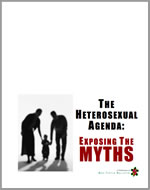 At last, the truth can now be told.
Using the same research methods employed by most anti-gay political pressure groups, we examine the statistics and the case studies that dispel many of the myths about heterosexuality. Download your copy today!
And don‘t miss our companion report, How To Write An Anti-Gay Tract In Fifteen Easy Steps.
 Anti-gay activists often charge that gay men and women pose a threat to children. In this report, we explore the supposed connection between homosexuality and child sexual abuse, the conclusions reached by the most knowledgeable professionals in the field, and how anti-gay activists continue to ignore their findings. This has tremendous consequences, not just for gay men and women, but more importantly for the safety of all our children.
Anti-gay activists often cite the “Dutch Study” to claim that gay unions last only about 1½ years and that the these men have an average of eight additional partners per year outside of their steady relationship. In this report, we will take you step by step into the study to see whether the claims are true.
Tony Perkins’ Family Research Council submitted an Amicus Brief to the Maryland Court of Appeals as that court prepared to consider the issue of gay marriage. We examine just one small section of that brief to reveal the junk science and fraudulent claims of the Family “Research” Council.
 The FBI’s annual Hate Crime Statistics aren’t as complete as they ought to be, and their report for 2004 was no exception. In fact, their most recent report has quite a few glaring holes. Holes big enough for Daniel Fetty to fall through.
“Google” is a trademark of Google Inc.
© Box Turtle Bulletin. All Rights Reserved.
 Posts
Posts  Posts via daily email: