Box Turtle Bulletin
 News and commentary about the anti-gay lobby
“Now you must raise your children up in a world where that union of man and box turtle is on the same legal footing as man and wife…”
News and commentary about the anti-gay lobbyPosts Tagged As: Marriage
January 20th, 2010

Prop 8 protest in November 2008
“It is my understanding that it will be put on the Order of the Day (agenda) Thursday and put it up for a vote on Friday,” said Sen. Brian Taniguchi, chairman of the Judiciary Committee.
This bill was essentially killed in the last days of the last session by amending it to include the unnecessary wording, “It is not the Legislature’s intent to revise the definition or eligibility requirements of marriage.” That strategic effort bought the legislature nearly another year to do nothing.
Because the bill had a start date as of the first of the year, there is some question as to whether it would be valid or would require another amendment. Some senators appear to be pretending that such a technical amendment would be reason to vote against the bill.
However, the award for bald disingenuousness, for unbridled cynicism, for smarmy condescension goes to former Senate President Robert Bunda:
“It is totally about solemnizing civil unions, and I think what gay people are really seeking is same-sex marriage,” Bunda said.
“I hope we just defer the whole thing. We have more important issues, like the budget.”
Yes, Mr. Bunda, we want equality. But that hasn’t been presented as an option, has it? And you would oppose such a bill were it to come up, wouldn’t you, cuz treating all citizens equally just isn’t important enough.
And, in the meantime, I still have not heard back from the DNC as to why they have said absolutely nothing to encourage the virtually entirely Democratic legislature to pass the civil unions bill. Good thing I wasn’t holding my breath.
January 19th, 2010
Thanks to Courage Campaign and FireDogLake for liveblogging.
Today’s testimony started with San Diego Mayor Jerry Sanders. He stated his conservative credentials: Republican, previously police chief. Sanders talked about his lesbian daughter Lisa and how he came to believe that domestic partnerships were not adequate.
Sanders spoke about the city’s resolution to support marriage equality and why he unexpectedly decided to sign it rather than veto it (liveblog paraphrase):
I struggled for a long time since I took the position. But the night before that video, I invited some LGBT friends over to tell them I was going to veto. I was shocked at the hurt that they showed when I told them. One friend said that we interact with you as a family. They felt that their children deserved married parents. I could see the harm that I would do with the veto. This was a night not about politics, but about the depth of their emotions. That created part of the emotion in the video. I realized how much it hurt for them.
Sanders’ part of the testimony is interesting. It appears that he is there to show that one can be supportive of the community and acting without hatred and yet have your judgment and behavior clouded by prejudice. He sees that his previous view of domestic partnerships as being “good enough” was a prejudiced view even though he was not motivated by hatred.
In cross-examination, the Proposition 8 supporting attorney Brian Raum proposed several other motivations for supporting the propositions: religion, biological family preference, procreation, history. In each, Sanders came back to these reasons being grounded in prejudice.
The next witness was M.V. Lee Badgett, a professor of economics at the University of Massachusetts Amherst. She has an extensive curriculum vitae in matters surrounding the economics of same-sex marriage and is the research director of the Williams Institute for Sexual Orientation Law and Public Policy at UCLA School of Law and also the directer of the Center for Public Policy and Administration at the University of Massachusetts Amherst.
She argued four points:
· Prop 8 inflicts substantial economic harm on same-sex couples residing in CA and their children.
· Permitting same-sex couples to marry will not adversely affect different-sex couples, children, or the institution of marriage.
· Same-sex couples are similar to different-sex couples in most economic and demographic respects
· Prop 8 imposes substantial economic losses on Californa and its counties and municipalities.
Badgett testified that gay couples benefit economically more from marriage than domestic partnerships and that gay couples are far more likely to enter a marriage than a domestic partnership. She took data from Massachusetts’ married same-sex couples and showed that couples and children greatly benefited from marriage.
Badgett studied the behavior and treatment of heterosexual married couples after Massachusetts allowed marriage equality and found that there were no negative consequences.
We now find out why Professor Douglas Allen withdrew as a witness. It appears that he was to tell the court that since marriage equality came to the Netherlands that the total number of marriage decreased. However, he also noted that it was part of a greater trend rather than an effect of marriage equality. Badgett used Allen’s testimony to argue that comparison to Massachusetts is more reasonable than comparison to a foreign nation.
(It seems that the Proposition 8 supporters’ decision to withdraw two thirds of their witnesses in order to bury their testimony may not have been successful. The portions most beneficial to the Olson/Boies team are being presented.)
In cross-examination, Chuck Cooper noted that even during the period in which same-sex couples could marry, some people elected domestic partnerships. Badgett said that she didn’t know if perhaps they did both. (While this might seem glib, I can easily see a couple registering immediately to get the coverage while they were planning their wedding or fearing their marriage would become invalid through Prop 8).
Cooper tried hard to suggest that gay people prefer domestic partnerships and don’t really want marriage. And he challenged Badgett’s numerical accuracy. He did a lot of quibbling about numbers (18,130 v. an estimate of 18,000). Badgett dismissed the variances and reiterated that hundreds of millions of dollars would be lost by the state for not allowing marriage equality.
Cooper made up some hypothetical situations and tried to get Badgett to explain variances between his hypotheticals and her estimates. Much of the cross examination appears to be an exercise in obfuscation, seeking to have Badgett justify old estimates made on some assumptions without allowing for the fact that those assumptions were impacted by later events.
Cooper tries to have fun with math by trying picking dates and comparing marriage rates and children out of wedlock in the Netherlands. He tried to intimate that marriage equality caused the Dutch to value marriage less.
However, Badgett points out that legalizing gay marriage had no statistically valid impact on this trend and his graphs look the same before marriage equality as they do after. Cooper sought to find measures of difference that were minuscule and find meaning in them.
In redirect, Boies showed that Cooper’s selection of 1994 as a start point was hand picked to try and present a false impression. Badgett presented a chart going back to 1960 which proved that the decline in marriage rates in the Netherlands was part of a long trend and was not impacted by the legalization of same-sex marriage. Further, he showed trends of heterosexual marriage and divorce in Massachusetts that, if causal, would be an argument for marriage equality.
(I know that the information I’m receiving is filtered through the eyes and ears of those who sympathize with the plaintiffs. But, even so, it is does appear that the defense is ill prepared and is making foolish blunders. Why talk about the Netherlands if it doesn’t prove your point and why present charts if they are only going to be shown to be falsely constructed?)
January 18th, 2010
 The very Republican trial to overturn Proposition 8 is about to become even more so. Jerry Sanders, the Republican mayor of San Diego will be on the stand tomorrow (SD Union-Trib)
San Diego Mayor Jerry Sanders will testify on Tuesday in the federal case about whether states can ban same-sex marriage.
…
“He’s testifying essentially on his experience on the issue and why he believes marriage equality is important from a government perspective,” [spokesman Darren] Pudgil said.
This commentary is the opinion of the author and is not necessarily that of other authors at Box Turtle Bulletin.
January 18th, 2010
I support the right of individuals to get their jollies in pretty much any way that is safe, consensual and adult. As long as you aren’t harming me or anyone else, I don’t care if you get turned on by boots and a sling or a french maid’s outfit. Simply because I might find your fetish to be silly and better suited for a Halloween costume doesn’t mean I think it should be any less legal.
However, if your thing is kink, while I support your rights, you should in turn respect how your behavior impacts my rights. Here are a few should-be-obvious rules to consider:
Now you’d think that common sense would somehow suggest that maybe, just maybe, you aren’t the right person to testify if you put a bullet in someone’s brain four days before, but apparently this never occurred to Bruce Lavallee-Davidson.
You see, Bruce was playing with some buddies on April 18, 2009 when, ooopsie, someone got shot. (Washington Post)
The fatal shooting happened after [victim Fred] Wilson, Lavallee-Davidson and a third man had been smoking pot, consuming the party drug GBL, huffing aerosol inhalants and having sex over a 12-hour period in the basement of Wilson’s Colonial home in a middle-class neighborhood two blocks from the ocean.
Defense lawyer Tom Hallett told jurors the men had been using guns as part of their sexual play and that the victim was a thrill seeker who may have slipped a bullet into the .44-caliber Rossi revolver unbeknownst to Lavallee-Davidson, who’d previously checked to make sure the gun was unloaded.
Jurors deliberated less than an hour before returning their guilty verdict in Cumberland County Superior Court. Manslaughter carries a maximum sentence of 30 years in state prison in Maine. Because a gun was involved, the minimum sentence is four years, Marchese said.
Yeah, how do you explain that to your “partner” when you get home?
But Bruce thought to himself, I think I’ll go testify in favor of marriage equality. Cuz that’s what I need right now.
So that’s what Bruce did. On April 22, there he was at a public hearing telling the world just how much marriage was important to his life, how much he and his partner were committed.
Umm, no. Bruce is going to be committed, but not in the way he intended. And, of course, there’s nothing quite so juicy to an anti-gay activist than tying our marriage rights to his insane irresponsible druged out lethal orgy.
So if, by chance, you happen to be a guy whose idea of “marriage” is drug fueled sexcapades with strangers in which you kill someone, I don’t really care how much you think its just a spiffy idea to go represent me and my community and argue for my rights. Don’t.
January 18th, 2010
 Judge Vaughn Walker sought to have Perry v. Schwarzenegger taped and released on YouTube.
But those who are defending Proposition 8 in federal court claimed that their witnesses feared for their personal safety. They were skurrred that their names and faces might become known to radical militant roaming bands of marauding gay activist who would call them “bigots” and make them feel bad. The Supreme Court of the United States listened to their claims of mild inconvenience (dressed up as intimidation and harassment) and moved to strike cameras from the court so as to protect their identity.
But now the trial will be brought to YouTube without the faces and voices of anti-gay witnesses. Actors will play their part. (On Top Magazine)
After the Supreme Court blocked video broadcast of the federal trial to decide the constitutionality of a gay marriage ban last Wednesday, freelance journalist and filmmaker John Ireland decided he’d produce his own version and post it on YouTube.
“People want to see this drama unfold and there is a tremendous narrative that was propelled by that first day of testimony,” Ireland told On Top Magazine on Sunday. “This is the first time that gay and lesbian people have talked about their lives in federal court. It’s historic from that point of view.”
Ireland said he’s basing his storytelling on the accounts of bloggers present at the trial that started last Monday in a San Francisco courtroom.
The first day of testimony should be available on YouTube on Tuesday.
So far we have no reports that the actors playing the witnesses are frightened that their faces may become known. They don’t appear to be skurrred at all.
And we do not yet know whether the fact that others will be playing their roles, thus providing a face to their testimony other than their own, has given the supporters of Proposition 8 any comfort. But somehow I suspect that being skurrred about recognition had little importance in the decision of four of their six witnesses to drop out of the case.
I think they would be just as uncomfortable hearing their words come from the voices of actors. When you know that you base your position on deceit and animus, your shame is the same.
January 18th, 2010
Today I emailed the DNC:
This week the legislature in Hawaii will be considering Civil Unions legislation. As the HI legislature is virtually all Democratic, can you please direct me to the statements in which the DNC has encouraged the Hawaiian legislature to uphold the standard of the Party and vote for equality? I don’t seem to be able to find them online.
I wonder if I’ll get a response. They may be too busy honoring Dr. King’s dream for equality and civil rights.
January 16th, 2010
Although the voters in the state of Washington have long since elected to reaffirm the legislature’s decision to provide Domestic Partner benefits equal to marriage to same-sex couples, the issue over whether the signatories are public information is still unresolved. On Friday the Supreme Court announced that it would take up the issue. (LA Times)
The high court will consider whether Washington state officials can release more than 138,500 names on a petition seeking a vote on overturning the state’s domestic partnership rights.
Protect Marriage Washington, which unsuccessfully opposed the law giving gay couples expanded rights, wants to shield from disclosure the signers of the petition for a referendum on that law. The group says it fears harassment by gay rights supporters, some of whom have vowed to post signers’ names on the Internet.
The objection to making the names public is based on the often asserted but rarely supported reports of “threats”, “intimidation”, and “retaliation”.
In case you don’t speak the lingo of anti-gay activists, “retaliation” is when gay customers find out that the profits from their purchases are being used to take away their rights and freedoms and refuse to continue to patronize the business establishments that harm them. “Intimidation” is when gay citizens, their friends, and their families discover that their neighbors want to harm them and consequently snub, shun, or speak disparagingly to those who are actively trying to harm their lives.
“Threats” tend not to exist at all outside of vague and highly improbable internet venting or solely in the fevered imagination of those who want to see themselves as victims.
Anti-gays genuinely believe that gay people should be barred from knowing who seeks to do them harm and, if they should find out, are not entitled to object.
January 16th, 2010
 Hawaii’s recognition of gay couples has led a wild and erratic path. If the state’s relationship with it’s gay citizens were a romantic affair, it could be summed up in one word: drama!
When Hawaii’s Supreme Court determined in 1993 that denying marriage to same-sex couples was discriminatory, it shocked America. Although some gay folks had been fighting for decades for the ability to protect their families and honor their commitments, to most people – gay or straight – this was unexpected and foreign.
However, the court did not demand immediate implementation. It granted a period in which the state could build a case justifying the discrimination and showing that it was not unconstitutional. But in 1996 the court rejected the state’s justification and declared that denying marriage to same-sex couples was unconstitutional in the state. But they held off requiring implementation until appeal was heard.
And during the five year delay the anti-gay marriage industry was started. In 1996, the federal government passed the Defense of Marriage Act which, for the first time, asserted that the federal government would not recognize the rights of states to control marriage and family law (many “state’s rights advocates” found that their anti-gay biases were far stronger than their professed principles).
And in 1998 in Hawaii, the first “protect marriage” constitutional amendment was passed. But, unlike those which would follow, this amendment does not define marriage; rather, it defines who is entitled to define marriage:
The legislature shall have the power to reserve marriage to opposite-sex couples.
And the legislature had already done so.
However, in an effort to offer some pretense of equality in hope of avoiding being required to honor same-sex marriages, in 1997 the legislature had created a reciprocal beneficiary scheme. It wasn’t much consolation.
A reciprocal beneficiary can be comprised of any two people unable to marry (brother/sister for example) who fill out a form. The regulations that this registration impacts are minimal and the attorney general declared that the most significant benefit, workplace medical insurance, was not required to be recognized by private business.
Thus, while Hawaii has had “recognition” since 1997, it is not of much use and not often elected.
Due to the unique nature of the Hawaii amendment, there is no bar on the legislature passing marriage equality or civil unions legislation. And civil unions bills have been introduced with little reception for years.
But in 2009 a bill was introduced which received support. House Bill 444 would provide all of the rights, benefits, and privileges of marriage but under a civil union structure. The union would be conducted (rather than simply filing a clerical form) by clergy or a judge, similar to marriage. Civil unions would be limited to same-sex couples and exclude family members.
The hopes for the bill were high. It passed the House Judiciary Committee on February 5, 2009 by a vote of 12-0. It passed the full House on February 12, 2009 by a vote of 33-17. Then it went to the Senate.
Where it sat in a divided Senate Judiciary Committee.
Finally on May 7, 2009, one day before the end of the legislative session, the full Senate voted to pull the bill from the committee. But this was not to vote on HB 444; rather, it was to amend HB 444 to clarify that Hawaii was most definitely not granting marriage to same-sex couples and that this was a second-class status and to also amend the bill to allow opposite-sex couples to enter civil unions.
By amending the bill so close to the end of the session, there was no chance that the House could respond to the revised version and therefore the bill was killed for a year. Senators afraid of voting were granted a reprieve until the following year’s session.
Now that reprieve is over. (Washington Post)
When Hawaii legislators reconvene on Wednesday, all eyes will be focused not on teacher furloughs that has resulted in the nation’s shortest school year or the state’s $1 billion budget deficit, but legislation that would allow same-sex couples to form civil unions.
Supporters are cautiously optimistic of the bill’s passage. But anti-gay activists are planning a big rally for Sunday in hopes that their display of animus towards their gay neighbors and support for institutionalized discrimination will intimidate potential supports into betraying their ideals during an election year.
The Hawaii legislature is comprised almost exclusively of Democrats. The Senate has 23 Democrats and 2 Republicans, and the House split is 45-6. This is an internal Party decision.
And if the bill is passed, it will then go the Republican Governor Linda Lingle who, while encouraging the legislature to delay the bill until some other time, has refused to say whether she will sign or veto the legislation.
January 16th, 2010
Thanks to liveblogging from Courage Campaign and FireDogLake.
Today began with testimony from Dr. Michael Lamb, Head of the Department of Social and Developmental Psychology at Cambridge University. Michael McGill led the questioning. Dr. Lamb is highly qualified, prolific, and respected in the areas of child development and devolopmental psychology.
In the 1970’s Dr. Lamb began with the assumption that a father-mother household was better. His views changed based on his research. By the 90s this change was accepted in the field.
Articles document conclusively that children raised by gay or lesbian parents are just as likely to be well adjusted as those raised by heterosexual parents. This is based on a great volume of study of children of different ages and further buttressed by results that affect children of broader range of children.
Studies conducted include both convenience samples and representative samples, longitudinal and cross-section. Over 100 studies have been taken. All mental health organizations agree.
Lamb refuted some of the pseudo-scientific claims of Prop 8 proponents, including the use of the term “gender disorientation pathology” in a Ron Prentice email repeating “21 Reasons why Gender Matters” (Perhaps those listed at NARTH). This term is not used in psychology.
Lamb refutes the canard that gays and lesbians are more likely to be child abusers, nor are their children likelier to be gay (though they are likelier to reject sex-stereotypical occupations).
Lamb dismisses Dr. Joe Nicolosi (ex-gay proponent) and his notions that childen of gay couples are going to be emotionally and socially traumatized. He says that adopted and artificially conceived children are as likely to be well adjusted as those raised by natural parents. He says that the only one in the field of child psychology who holds that view is David Blankenhorn.
In cross-examination, David Thompson for Prop 8 has Lamb admit he’s a “committed liberal”. Thompson tried to get Lamb to agree that science and research only give the results that government wants and that there is a vast liberal conspiracy to make scientific results be what the liberals want them to be. He references the East Anglia climate control scandal. This is an insult to anyone with a brain.
Thompson argued that men are cretins (he referenced Homer Simpson) and women are weak little caretakers. Liveblog synopsis:
Women spend more on children than men. Some occupations are specific to genders. Men are more likely to perpetrate sexual abuse than women. Step fathers more likely to molest children, abuse children than women. Molestation is bad for kids. Evidence that men who are married to women drink and gamble. You are not saying that men and women are completely interchangeable.
(My favorite argument so far:) Men can\’t breast feed. Breast feeding clearly has benefits for children. (yup, well that settles it, children whose mothers can’t breast feed them should be left out for the wolves.)
Thompson read an article in which Lamb stated that biological parents were more important than involvement in raising the children; it was written in the 1970s. He quoted Lamb stating that it was disconcerting that fathers’ roles were devalued; Lamb was a grad student. Thompson read from Lamb’s The Role of Fatherhood in Childhood Development, 1976 version.
Lamb: Citations are to 1961, two from 1950s, one from 1965. We\’ve had a lot of research since that was written. As you\’ve pointed out, there have been subsequent editions of this book, that have updated these citations.
Thompson reminds Lamb that he described David Blankenhorn’s book as “most provocative commentary published in 1995”. Lamb said that Blankenhorn thought his review was negative.
Thompson somewhat desperately tried to get Lamb to agree that having both a male and a female in the house is essential to good childhood development. Lamb didn’t play along.
(At this point we discover that a few witnesses for Prop 8 have been withdrawn because of “fear for their personal safety”. But wasn’t that why there is no video recording? Personal fear? Or is it that those witnesses realized that their peers would find out what they had testified through bloggers and knew that they would be mocked and reviled in their professional fields for selling their soul to the cause of discrimination and injustice. After lunch, Boutrous pointed out to the court that the witnesses who were skurrrred of being recognized dropped out after the SCOTUS said they didn’t have to be televised. He said that in pre-trial he predicted they would drop out because they were afraid of what they would have to say during cross-examination.)
Quite a bit of time was taken establishing that children do better in homes with both parents rather than with a single parent. Much emphasis that step-fathers are more likely to sexually abuse than genetic fathers. Lamb continues to point out that they are comparing heterosexuals to heterosexuals.
I get the impression that Thompson is out of his element. At one point he objects that the US Census is not a random sample. Lamb points out that if a sample includes the entire population, it’s better than a random sample. Thompson tries to argue that studies of gay people are faulty because they only study those who identify as gay; he seems not to notice that if we are talking about marriage, there aren’t going to be many non-LGBT-identifying folk who marry a person of the same sex.
After lunch the judge asked Lamb why adopted children seek out their natural parents. Lamb said it was due to a natural curiosity about where they came from and not due to maladjustment. Walker then asked about priest abuse in the Catholic Church. Lamb clarified that it was predominantly heterosexual and that gay abuse occurs at about the same rate as heterosexual sexual abuse.
During Thompson’s efforts to discredit the rather extensive research on the subject, he looks for anything that was not included to suggest that it throws all of the evidence out the window. His stabs include the financial resources of grandparents, the genetic intelect of the children, the educational achievement of grandparents, etc. He tries to sound incredulous that these studies didn’t include these less obvious factors. What comes out in court, however, is the rather extensive number of factors that actually have been considered.
He cites Walter Shum of Kansas State Universite. Lamb dismisses Shum by saying, “I\’ve seen it before. It was published in a journal where one has to pay to have it published, so it\’s not really considered part of the literature. But I have seen it in past cases.”
(A non-peer reviewed pay-to-get-published article? Gee, where have we seen that before?)
Thompson is trying to get Lamb to agree that only middle class gay and lesbian families were studied. And that the control groups of straight parents in the studies were not necessarily limited to married biological parents.
I’m wondering at the extent of this effort. I assume that is because when Blankenhorn argues that heterosexuals are better – based on his opinion – then Prop 8 will argue that we can just ignore all research whatsoever and go on Blankenhorn’s opinion. It’s just one opinion against another. While that might work well in a media campaign, I wonder if it’s effective strategy to present to a judge.
Further, it appears that Thompson knows far less about the “gotchas” that he wants to drop on Lamb. He appears to have forgotten the first rule of jury testimony, don’t ask a question to which you do not know the answer. He also confused references to studies as being separate studies and seems not to know what meta-analysis is.
Thompson says, “We\’re trying to show that optimal way to raise kids is in heterosexual households.”
(Yes, Mr. Thompson, you are trying to show that. Unfortunately for you, the science isn’t behind you.)
In redirect, McGill has Lamb clarify that the largest comparative studies included census data and thus compared gay couples (married and unmarried) with heterosexual couples (married and unmarried) and that gay children did not fare worse.
McGill then plays deposition tape of Dr. Marks, a Prop 8 witness that withdrew “cuz he’s skurrrrred of the cameras”. It seems Marks made a wise decision. In the tape he contradicted himself and ends up – in this clip – undermining his assertion that biological families are preferable.
McGill had Lamb read a portion of his review of Blankenhorn’s book illustrating how it was not favorable.
Lamb concludes by testifying that the field shares his conclusions because of the consistency of the outcome of hundreds of studies. Outliers which are not replicated don’t change conclusions based on cumulative work.
In one final dig about Lamb being a “liberal” and donating to PBS:
McGill: Did the corporation on public broadcasting affect your opinion in this case?
Lamb: No, it did not.
To end the day, Helen Zia, an Asian-American told the story of her life. She talked about discrimination and fear. She spoke of the humiliation of signing up for the first local domestic partnerships in San Francisco at the window where dog licenses were issued. She talked about how marriage changed her life. Her Chinese grandmother finally had a word to describe Leah, her wife. Her in-laws now saw her brother as extended family. She spoke of cruelty and hostility she experienced in Oakland during the Prop 8 election season.
Chu: How does getting married change things.
Zia: In most immediate sense, it was in how our families related to us. When we first got married. We have a niece, 2 years old, only known us Auntie Helen and Auntie Leah. WHen she saw Leah and me, she gave us a big hug, said, Auntie Leah, now you\’re really my auntie. I thought, well, you\’ve always known her as your auntie. Somehow it made a difference. It made a difference to our parents. When you say you\’re a domestic partner. When people say “who\’s this person?” I can\’t count the number of times who said “Partner in what business.” We\’d say “partners in life.” Often it was bewilderment. What business is life, od yo umean life insurance. It\’s a matter of how our families relate to people. For me to show up at every event. People ask who\’s she. For her 90-something auntie to say, here\’s Leah\’s friend. She must be a really good friend, suddently there were able to say, Helen is my daughter in law. My mother is an immigrant from China. She dosent\’ get waht partner is. I would be around her, I could hear them say, sometimes in Chinese, sometimes in English, that\’s Helen\’s friend. Then it changed, she would say, this is my daughter-in-law. Whether they got it or not, you don\’t insult someone\’s wife, you don\’t insult someone\’s mother. We\’re not partners in life or in some business. It changed things on a huge level. Marriage in how it affected our families. Our families related to each other differently. Marraige is joining of two families. My family and Leah\’s family now relate to each otheer differently. My brother lived about 5 minutes away from Leah\’s father when he was still alive, in those 15 years, they didn\’t make an effort. After we were married, Leah\’s father would stop by, drop things off. My brother is quite active in HI, Leah\’s brother\’s wife, my sister in law. Has a sister who runs in same circles. He will now say she\’s my in-law.
And this ended the day. The case will resume Tuesday morning. The plaintiffs expect to end testimony on Wednesday.
It is difficult to predict how long it will take the Prop 8 defendants to present their testimony now that four of their six witnesses have dropped out cuz they’re skurrred of the evil homosexual menace that will hunt them down and piddle in their petunia. All, it might be noted, after the SCOTUS gave in to their demands of no televising and no video at all outside of a live-feed to another room inside the same courthouse.
Somehow I think they really wanted to lose the battle over the cameras. As we saw from Dr. Marks’ video deposition, their witnesses may be far more worried about their own inadequacies and dents in their reputation than they are about marauding bands of drag queens and dykes on bikes chanting, “we’re here, we’re queer, you’re a bigot, get used to it” while they try to order a latte at their local Starbucks.
I suspect that they wanted an excuse to drop their witnesses so they could use this to appeal the trial of fact. But the SCOTUS may have unintentionally called their bluff and left them with only the flimsiest of wacky excuses (“we were skurrred of the evil homosexuals in the overflow room; they might hit us with their laptops). And now they only have two witnesses who are willing to be cross-examined.
January 14th, 2010
 Emmett C. Burns, Jr. has an evil scheme to deprive Maryland of love. Same-sex, long-term, committed, til death do us part love, to be exact. And he knows just how to do it.
No, Mr. Burns is not building a solar shield over the town of Springfield. He’s not bribing Homer to ignore safety precautions with donuts fried in the rendered fat of endangered species. But it is a plan as nefarious. (WTOP.com)
A Baltimore County delegate is sponsoring legislation that would prohibit Maryland from recognizing gay marriages validated by other states or countries.
Del. Emmett C. Burns Jr.’s measure would also declare that marriages between individuals of the same sex are against the public policy of the state of Maryland.
I can almost see him rubbing his hands exclaiming “excellent“.
I’m not sure why Mr. Burns is so worried about marriage. Perhaps he thinks that with rights and equality, Smithers may find internal peace and contentment and no longer be his toady.
But whatever the reason, his evil plan must be foiled.
(oh, and isn’t it strange how he looks even scarier when he’s not a cartoon)
January 14th, 2010
Again, thanks to liveblogging by Courage Campaign and FireDogLake
The day starts with testimony from Edwin A. Egan, Chief Economist for San Francisco. His job includes determining the economic impact of legislation.
His argument: marriage equality means more married couples. Those who marry tend to accumulate wealth, spend more, increase property values, etc. Married individuals also engage in healthier behavior which leads to greater productivity and a positive economic influence.
Egan also discussed how companies treat marriages differently from domestic partnerships when it comes to heath care.
(This direction be an argument unique to San Francisco in which, due to demographics, economic influences on the gay population can have a significant impact on the city’s economy as a whole. It may be difficult for Prop 8 to argue that such an impact is immaterial to a city like SF)
Egan discussed direct economic benefits to the city from legal marriages (event costs, hotel, restaurant). He noted that if DOMA were lifted, income taxes per couple would be reduced on average by $440, some of would be spent in the city thus increasing sales taxes and improving the economy.
In cross-examination, Peter Patterson challenged some of Egan’s calculations.
First he tries to present the idea that all of those who wish to marry already did so in the narrow window. This argument is strangely and poorly crafted by arguing that because there were few appointments for marriages in November (when marriage was not legal) then there was no demand.
Patterson made points by noting that Egan bases his three year projection on the rate of marriages during last summer, not allowing a drop off for a lessening of “pent-up demand”. Further, he argues that Egan’s estimates assume that over 100% of current couples would marry within two years (he does not allow for new couples or couple migration).
Egan may have redeemed himself by showing that his assumptions about marriage expenditures and guests are based on conservative estimates (spend 25% of what straight marriage spend and only 10% of guests from out of town).
Patterson argues that while same-sex marriages may increase, opposite-sex marriages may decrease. (This may actually be true for the short window in a city like SF. There may have been limited marriage facilities and resources and some straight folk may have waited until after the marriage window. Over time, the laws of supply and demand would provide for adequate marriage resources)
In redirect, Egan clarifies that despite dispute over the numerical accuracy of his calculation, marriage would increase health coverage and that, coupled with marriage expenditures, would financially benefit the city.
In the afternoon, Dr. Ilan H. Meyer, Associate Professor of Clinical Sociomedical Sciences at Columbia University\’s Mailman School of Public Health, testified about the stigma and prejudice gay and lesbians individuals face in society. Christopher Dusseault is plaintiff’s counsel for this section.
Meyer argues that societal stigma assigns gay people the roll of not desiring intimate relationships and being incapable of them. Society defines intimate relationships to mean marriage, husband, wife, family and community to the exclusion of gay people. (Think The Boys in the Band)
As illustration, Dusseault has Meyer read from Everything You Wanted to Know About Sex, But Were Afraid to Ask:
What about all the homosexuals who live together happily for years?
What about them? They are mighty rare birds among the homosexual flock. Moreover, the “happy” part remains to be seen. The bitterest argument between husband and wife is a passionate love sonnet by comparison with a dialogue between a butch and his queen. Live together? Yes. Happily? Hardly.
Meyer argues that domestic partnerships do not have the same social meaning as marriages and thus Proposition 8 imposes structural stigma. He talks about social stressors, both event (a bad thing happens) and non-event (something expected and looked forward to does not happen). Because all children expect to marry some day, denying marriage to gays is a non-event stressor. Meyer identified the processes that create minority stressors as prejudice events, expectations of rejection and discrimination, concealing–not being out, and internalized homophobia.
Some stressors may have little real impact, such as filling out a form, but “the form evokes social disapproval and rejection and memories of events, including large events that have happened in the past.” So travel, banking, vehicle registration, many simple things have minority stressors with great impact.
And actual abuse need not occur for the person to experience stressors.
Many times people avoid situations, or swallow those situations of slurs and just move on because they don\’t want to get into a fight, but the anticipation causes stress.
All of the additional sexual minority stressors lead to increased risk and disease.
Dusseault: Do you have a view if mental health outcomes for gay and lesbian in CA would improve if Prop. 8 were not law?
Meyer: Yes. Consistent with my work and findings that show that when people are exposed to more stress than less stress they are more likely to get sick, consistent with a law that says to gay people you are not welcome here, your relationships are not valued vs. the opposite has significant power. Clearly it\’s not the only thing that determines prejudice and discrimination, but it\’s a major factor.
Al Wilson cross-examined Meyer for Prop 8. Wilson tried to identify disagreement between studies and to identify exceptions between theory expectation and results.
In particular, he focused on old studies (this does seem to be a consistent but inexplicable tactic of the Prop 8 side in this trial)
Wilson: Well, were your studies inconsistent with older studies?
Meyer: No. I would say the older studies were inconsistent with my new findings.
Wilson tried very hard to get Meyer to discount his own findings. He tried to dismiss the sample size but Meyer used meta analysis. He tried to argue that population definition is impossible, but Meyer pointed out that all populations are difficult to define
You\’re trying to suggest it\’s some big problem. It\’s not. The population is elusive in every study. This is the first step of trying to study. If I wanted to study men, I\’d have to define the cohort, age, location, etc. What is a Latino? Do you include Mexicans or Puerto Ricans? The first step is to define the general population and then the sampling population.
(Meyer seems to be quite good)
Wilson: Could you ask someone if they were African American ever or were last year?
Meyer: Yes. That does vary. There are people who move into the US as Caribbean, their parents do not describe themselves as black, but after their kids socialize do say they are African American. Identities change and are responsive to the social context, but how people refer to themselves might change.
Meyer: well attraction is very fluid. Woman might say another woman is attractive, but that doesn’t make her a lesbian. for example, if you want to measure race by skin tone, you’ll have a different result than by identity. That’s why I don’t use attraction, but sometimes use identity. when you’re measuring HIV risk, you need to ask about behavior to assess exposure.
(This is an interesting response. If racial definitions were based solely on skin tones, I’ve met quite a few Latinos and even some African Americans who have fairer skin than I do. I once had one fellow lecturing me about discrimination against ‘brown people’ until I held my arm up against his. Yet my ethnic heritage and overall appearance tends to lead me to identify as “Caucasian” while theirs leads to minority ethnic identities. And discrimination and its inherent stressors are not based on either skin hues or internal attractions, they are based on internal and external identities.)
Wilson spent quite a lot of time in discussing why some racial minorities do not experience as poor mental health as might be expected within the models (the answer is because of being raised and nurtured in and supported by racial minority communities). He seemed to be dancing around the idea that gays are mentally deficient.
Wilson tried to make a peculiar (and specious) argument that if domestic partnerships stigmatize, then why would pro-gay groups have ever supported them? (Duh, because they stigmatize less than having nothing, never, ever)
In redirect, Dusseault had Meyer clarify the distinctions between racial stressors and sexual minority stressors (communities, as noted above). He also cleared up the distinction that domestic partnerships stigmatize, though not to the same extent as no recognition.
Yes, what it means that you can\’t have either, the message is even more severe. If a state doesn\’t offer marriage, it\’s great stigma, but if a state offers domestic partnerships it\’s almost like saying go to the back of the bus.
Over all, Meyer’s testimony (as liveblogged) seemed strong.
January 14th, 2010
At trial today it came out that the supporters of Proposition 8 had appealed to have the taping of the trial terminated. They do not want any record of their argument to be retained beyond the bare minimum.
The judge countered that he needed the taping for his purposes and that it would not be televised. Chuck Cooper seemed content with that.
This is good news. As long as a tape is recorded, there is always a hope that some future legal argument can make this recording available to the world. If not now, then this evidence will undoubtedly be useful for social historians looking back upon this time of legal discrimination.
January 14th, 2010
A motion for summary judgment is when you tell the court that the law is so obviously on your side that a trial would be a waste of time and request that you be declared the victor up front. Litigants on both sides of an issue often request summary judgment just as a matter of practicality, but it is generally only granted if there is little question as to the outcome of a case.
The coalition of anti-gay religious leaders headed by Bishop Harry Jackson seeking to force a referendum to oppose marriage equality filed a motion for summary judgment. So did the District of Columbia.
Today Judge Judity N. Macaluso found for the District (pdf):
ACCORDINGLY, for the reasons stated above, it is this 14th day of January 2010, hereby
ORDERED, that “Petitioners\’ Motion for Summary Judgment,” filed November 20, 2009, is DENIED. It is further
ORDERED, that Petitioners\’ request for a writ in the nature of mandamus is DENIED. It is further
ORDERED, that “District of Columbia\’s Motion to Dismiss, or in the Alternative, for Summary Judgment,” filed December 18, 2009, is GRANTED. It is further
ORDERED, that Summary Judgment is entered in favor of the District of Columbia Board of Elections and Ethics and the District of Columbia.
January 13th, 2010
Again much appreciation to Courage Campaign for their liveblogging (along with others in the media). As the US Supreme Court has decided that, for now anyway, the proceedings will take place out of the sight of the public, their contribution to creating an informed public is of immense value.
The Defense\’s cross-examination of History Professor George Chauncey continued. Prop 8’s David Thompson sought to get Chauncey to agree that gay people are not really subject to discrimination. This is an attempt to battle Olson/Boies’ goal of establishing sexual orientation as a subject suspect class and thus more highly protected from discrimination.
(Because race is a subject suspect class, the legal assumption is that any discrimination against them is probably unconstitutional. Left-handedness, not currently an oppressed minority subject to regular and insidious discrimination, is not a suspect class and therefore they need to prove that any specific discrimination against them is unconstitutional).
Thompson also sought to get Chauncey to agree that not everyone who opposes marriage (e.g. our “fierce advocate”) does so out of bigotry. He attempted (unsuccessfully) to get Chauncey to agree that a portion of the gay community opposed marriage and therefore supported Proposition 8. Chauncey responded, “The right to marry evolved and became a more widespread and deeply held goal of the gay and lesbian community.”
In redirect Terri Stewart had Chauncey draw parallels between the growing desire in the gay community for marriage to that of the black community who did not seek desegregation when they were simply seeking basic existence.
She had him illustrate that while some faiths were supportive there was strong religious animosity to gay people. Chauncey read from statements from the Vatican and the Southern Baptist Convention. Their point is that sincere religious objection to gay equality can be based in stereotypes and bigotry, just as were sincere religious objections to racial equality.
And then we find out exactly why Hak-Shing William “Bill” Tam sought to be removed from the case. Stewart played a tape of their deposition of Mr. Tam. It seems that Mr. Tam was invited to be an integral part of the campaign focusing on outreach to Asians. He raised substantial amounts of money and orchestrated rallies. He wrote to Asian language newspapers and produced flyers.
One flyer claimed that the San Francisco city government was under the control of homosexuals who wanted to legalize sex with children. Tam feared not only same-sex marriage, but children would learn about gay people and then become gay themselves. Tam seemed to believe that Proposition 8 would stop gay couples from being able to adopt.
Next to testify was Dr. Letishia Peplak, a social psychologist from UCLA with extensive credentials on same-sex relationships. She is an expert on four issues: (a) marriage brings important benefits, (b) relationships between same-sex and heterosexual couples are similar, (c) gay couples who can marry have the same benefits, (d) gay marriage will not harm heterosexual marriage.
Peplak testified that same-sex relationships are very similar to opposite-sex relationships in terms of stability, durability, process, and level of love.
She said that while there is no evidence, it’s been suggested that homosexual relationships are shorter. She also testified that heterosexual co-habitation relationships are shorter than married relationships. She reported a study that married same-sex couples in Massachusetts reported being more committed and to having more benefits.
Nicole Moss questioned Peplak in cross-examination. Moss argued that a 25 year old article shows that gay men are less monogamous than heterosexual married men. Peplak points out that is an “oldie” from a time when gay relationships were secretive. Moss continues with outdated studies of non-representative sample groups.
Peplak has said that she is not an expert on relationships in foreign nations, but Moss presented statistics on marriage in Belgium and the Netherlands. In Belgium 5% of gay couples marry compared to 42% of heterosexual couples. In the Netherlands, 8% of gay couples and 43% if straight couples marry. (I hope that the plaintiffs have statisticians that can speak to the meaning of these numbers and whether they accurately explain current marriages as opposed to cumulative marriages).
Peplak notes the discrepancy with the Massachusetts numbers and speculates that American gay couples may be more pro-family.
In redirect, Peplak notes that studies about lack of monogamy were from a time when there were neither marriage nor domestic partnerships.
Overall, I’m not getting the impression that Peplak was a stellar witness.
January 12th, 2010
Salt Lake City’s ABC affiliate KTVX reports that documents from the LDS Church concerning their efforts at passing California’s Proposition 8 may well end up in the Prop 8 trial after all:
Again, according to our sources, the San Francisco City Attorney, Dennis Herrera, requested, perhaps, as many as 1,500 copied documents about the LDS Church’s opposition to gay marriage. The documents reportedly deal with the LDS Church’s earlier efforts to defeat gay marriage movements in other states, efforts going back a number of years. Herrera, coincidentally, has been admitted as co-counsel in the California federal case to over-turn the ban on gay marriage.
Featured Reports
 In this original BTB Investigation, we unveil the tragic story of Kirk Murphy, a four-year-old boy who was treated for “cross-gender disturbance” in 1970 by a young grad student by the name of George Rekers. This story is a stark reminder that there are severe and damaging consequences when therapists try to ensure that boys will be boys.
When we first reported on three American anti-gay activists traveling to Kampala for a three-day conference, we had no idea that it would be the first report of a long string of events leading to a proposal to institute the death penalty for LGBT people. But that is exactly what happened. In this report, we review our collection of more than 500 posts to tell the story of one nation’s embrace of hatred toward gay people. This report will be updated continuously as events continue to unfold. Check here for the latest updates.
In 2005, the Southern Poverty Law Center wrote that “[Paul] Cameron’s ‘science’ echoes Nazi Germany.” What the SPLC didn”t know was Cameron doesn’t just “echo” Nazi Germany. He quoted extensively from one of the Final Solution’s architects. This puts his fascination with quarantines, mandatory tattoos, and extermination being a “plausible idea” in a whole new and deeply disturbing light.
On February 10, I attended an all-day “Love Won Out” ex-gay conference in Phoenix, put on by Focus on the Family and Exodus International. In this series of reports, I talk about what I learned there: the people who go to these conferences, the things that they hear, and what this all means for them, their families and for the rest of us.
Prologue: Why I Went To “Love Won Out”
Part 1: What’s Love Got To Do With It?
Part 2: Parents Struggle With “No Exceptions”
Part 3: A Whole New Dialect
Part 4: It Depends On How The Meaning of the Word "Change" Changes
Part 5: A Candid Explanation For "Change"
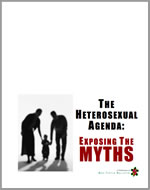 At last, the truth can now be told.
Using the same research methods employed by most anti-gay political pressure groups, we examine the statistics and the case studies that dispel many of the myths about heterosexuality. Download your copy today!
And don‘t miss our companion report, How To Write An Anti-Gay Tract In Fifteen Easy Steps.
 Anti-gay activists often charge that gay men and women pose a threat to children. In this report, we explore the supposed connection between homosexuality and child sexual abuse, the conclusions reached by the most knowledgeable professionals in the field, and how anti-gay activists continue to ignore their findings. This has tremendous consequences, not just for gay men and women, but more importantly for the safety of all our children.
Anti-gay activists often cite the “Dutch Study” to claim that gay unions last only about 1½ years and that the these men have an average of eight additional partners per year outside of their steady relationship. In this report, we will take you step by step into the study to see whether the claims are true.
Tony Perkins’ Family Research Council submitted an Amicus Brief to the Maryland Court of Appeals as that court prepared to consider the issue of gay marriage. We examine just one small section of that brief to reveal the junk science and fraudulent claims of the Family “Research” Council.
 The FBI’s annual Hate Crime Statistics aren’t as complete as they ought to be, and their report for 2004 was no exception. In fact, their most recent report has quite a few glaring holes. Holes big enough for Daniel Fetty to fall through.
“Google” is a trademark of Google Inc.
© Box Turtle Bulletin. All Rights Reserved.
 Posts
Posts  Posts via daily email: