Box Turtle Bulletin
 News and commentary about the anti-gay lobby
“Now you must raise your children up in a world where that union of man and box turtle is on the same legal footing as man and wife…”
News and commentary about the anti-gay lobbyPosts Tagged As: Marriage
January 29th, 2009
The South American country of Colombia recognizes a legal vehicle called “common-law marriage”. It is a means by which two people who are living as married are considered married even though they may not have gone through a ceremony or registered with the state.
In Colombia, common law marriages are between those who have lived together for two years or more in a permanant union and neither of whom are married either to each other or anyone else. Until yesterday, they also needed to have been between a man and a woman.
But on Wednesday, the courts of Colombia determined that same-sex couples living together could also have all of the rights of common-law marriage.
The court’s ruling means that civil and political rights such as nationality, residency, housing protection and state benefits will now be granted to same-sex partners.
This was an extension of an earlier decision. In February 2007 the Courts granted property and inheritance rights and in April 2008 added pension and health benefits.
In June 2007, the Colombian legislature attempted to enact civil unions but were thwarted by intense pressure from the Catholic Church and by an unusual political ploy.
Ironically, had civil unions been put in place in 2007, the courts may not have decided as they did. Now to the extent that heterosexual common-law couples are said to be married, so too are same-sex couples.
January 28th, 2009
In 2007, the state of Washington introduced Domestic Partnerships. Last year they included additional coverage. This year they are taking the final steps (Seattle Times)
The 110-page bill makes changes to all remaining areas of state law where currently only married couples are addressed. The bill would add same-sex domestic partners to state statutes ranging from labor and employment to pensions and other public employee benefits.
Both of the sponsors, Sen. Ed Murray, D-Seattle and Rep. Jamie Pedersen, D-Seattle, seem confident. Last year’s upgrade passed the House 62-32 and the Senate 29-20. HB 3104 enjoyed bipartisan support in both houses (all of the Democrats plus five Republicans) and no supportive Republicans lost re-election due to their vote.
January 27th, 2009
 Last week we told you that the legislature in Hawaii may consider marriage equality this year. Now it seems that civil unions are much likelier in the short term. In fact, the decision on whether to enact civil unions may fall to one man.
In the House, 32 of the 51 representatives have already signed onto legislation that would allow for civil unions (Honolulu Advisor):
Same-sex couples who obtain a license could have their civil union performed by a judge, retired judge or member of the clergy. Partners who enter into civil unions would have the same rights, benefits and protections under state law as married couples. The state would also recognize civil unions, domestic partnerships or same-sex marriages validly performed in other states.
Same-sex couple legislation has been held up in the past in the House Judiciary Committee, but it appears that the chairman has the votes this year to advance the bill to the full House where it has overwhelming support. The potential problem this year is on the Senate side in the Judiciary and Government Operations Committee.
On the six-member committee, Taniguchi, state Sen. Dwight Takamine, D-1st (Hamakua, S. Hilo), and state Sen. Clarence Nishihara, D-18th (Waipahu, Crestview, Pearl City), are supportive of civil unions. State Sen. Mike Gabbard, D-19th (Kapolei, Makakilo, Waikele), and state Sen. Sam Slom, R-8th (Kahala, Hawai’i Kai), are opposed.
This may leave the rights of thousands of gay men and women in Hawaii in the hands of one man.
The potential swing vote on the committee is state Sen. Robert Bunda, D-22nd (North Shore, Wahiawa), who has opposed same-sex marriage in the past but said he will keep an open mind on civil unions.
Personally, I think that there is a much stonger argument to be made for marriage in Hawaii than for civil unions. While I think that a great many gay men and women would travel to the island state to become legally married – bringing with them family, friends, and lots of tourist dollars – civil unions are not as likely to encourage such an economic boon.
But many many couples in Hawaii are in urgent need of the rights and protections that civil unions can bring. And if Robert Bunda cannot be convinced of the fairness and wisdom of civil marriage, we need to do what we can to encourage him to take the steps he can take today.
Take a moment to think of friends or family in Hawaii and ask them to contact Sen. Bunda and politely remind him that the protection and care of the citizen and his rights is the first responsibility of a legislator.
Robert Bunda
22nd Senatorial District
Hawaii State Capitol, Room 202
415 South Beretania Street
Honolulu, HI 96813
phone 808-586-6090; fax 808-586-6091
e-mail senbunda@Capitol.hawaii.gov
January 21st, 2009
In November we reported that Sweden is on track to have legal same-sex marriages by May of this year. Now legislation has been entered to make the change.
January 21st, 2009
 Hawaii is unique in its approach to marriage rights for its gay residents.
In 1993, Hawaii’s Supreme Court was the first to determine that it was discriminatory to deny marriage licenses to same-sex couples. However, the court did not rule immediately for marriage. The case returned to trial court to allow the State to argue whether its reasons for discrimination were justifiable within the framework of the State Constitution. This allowed anti-gay forces time to push through an amendment to the Constitution which then rendered the decision moot.
In 1998, Hawaii was the first state to adopt a “defense of marriage” constitutional amendment, which passed with 69% approval. But unlike the amendments that followed, this constitutional change did not ban same-sex marriage; rather, it stated “The legislature shall have the power to reserve marriage to opposite-sex couples.”
And so they did.
But Hawaii did not leave its gay people without some small measure of recognition. They created a unique system of recognition with also has not been repeated elsewhere: reciprocal benefits.
Any two adults – whether a romantic couple, siblings, friends, or any other configuration – can register for a reciprocal beneficiary relationship and receive such benefits as hospital visitation, and healthcare decisionmaking. However, unlike marriage, civil unions, or domestic partnerships, these are not viewed as a single legal entity and there seem to be no obligations of mutual support or protection.
But the amendment also allows the legislature to change its mind and no longer reserve marriage to opposite-sex couples. And the AP is reporting that the legislature is likely to consider just such a move this spring.
Hawaii lawmakers convene a new session Wednesday in which they expect to consider legalizing gambling, recognizing gay marriage and preserving Hawaiian lands. The session runs through May 7.
Hawaii, whose economy relies to a large extent on tourism, is feeling the economic crunch. Let’s hope that the legislature, which is almost unanimously Democratic, will decide that becoming a gay wedding destination spot could be a way to simultaneously advance personal liberties and help the financial condition of the state.
January 13th, 2009
 Normally gay and lesbian ski bunnies would have been shooshing down the slopes in Park City, Utah this past weekend. But organizers had to cancel the event. (Park City Utah’s Park Record”
One of the ski week’s organizers, John Harriot, a bisexual who lives in West Hollywood, Calif., said six people had registered for the trip. Approximately 50 would have signed up beforehand in a typical year, and 150 or so people would have attended.
While a reduction in participation might reflect a downturn in the economy, a full scale abandment of the trip of this sort can only been understood to be a reaction to Mormon support for Proposition 8. And more than most activism, this reduction suggests to me that there has been a fundamental core change in the gay community.
It is fairly easy to get gay bars, gay businesses, or gay organizations to join a community endeavor. But like any demographic, its much harder to get individuals to change their life habits. And when you’re taking away someone’s ski trip, you really need to be convincing.
But the passage of Proposition 8 changed us.
January 13th, 2009
 During Barack Obama’s 2008 run for the White House, he was asked at the HRC/Logo forum about his position on same-sex marriage. His responses went like this:
…I am a strong supporter not of a weak version of civil unions, but of a strong version, in which the rights that are conferred at the federal level to persons who are part of the same sex union are compatible. When it comes to federal rights, the over 1,100 rights that right now are not being given to same sex couples, I think that’s unacceptable, and as president of the United States, I am going to fight hard to make sure that those rights are available.
…
My view is that we should try to disentangle what has historically been the issue of the word “marriage,” which has religious connotations to some people, from the civil rights that are given to couples, in terms of hospital visitation, in terms of whether or not they can transfer property or Social Security benefits and so forth. … I…would continue to support a civil union that provides all the benefits that are available for a legally sanctioned marriage. And it is then, as I said, up to religious denominations to make a determination as to whether they want to recognize that as marriage or not.
Generally, he was supportive of what he called “strong civil unions,” but he did not want to call a same-sex union a marriage. Even though he opposed Prop 8, his reluctance to address marriage directly gave Prop 8 supporters an opening to mischaracterize his position to African-American and other voters in California.
 But there was a time however when Obama felt differently and wasn’t afraid to say so. In a Windy City Timeshas a special inaugural edition, they combed through their archives for material from Obama’s 1996 Illinois State Senate race.
The first item from their archives was a questionnaire sent to Obama by IMPACT, which was Chicago’s main LGBT political action committee. On question 7 of the questionnaire, IMPACT asked about same-sex marriage in the state of Illinois. Obama’s answer went like this (his handwritten answer in boldface):
7. Do you endorse the Marriage Resolution, a statement to of support for the right of same-gender individuals to marry:
Because marriage is a basic human right and an individual personal choise.
RESOLVED, the state should not interfere with same-gender couples who chose to marry and share fully and equally in the rights, responsibilities and commitment of civil marriage.
…
I would support such a resolution.
During the same campaign, the Outlines newspaper (which later merged with Windy City Times) sent a questionnaire as well. Obama’s typewritten response to question three was more direct:
I favor legalizing same-sex marriages, and would fight efforts to prohibit such marriages
By the time then-State Sen. Obama was running for the U.S. Senate however, his position shifted. In a 2004 interview with Windy City Times, his answer morphed into the one which is familiar today:
I am a fierce supporter of domestic- partnership and civil-union laws. I am not a supporter of gay marriage as it has been thrown about, primarily just as a strategic issue.
I think that marriage, in the minds of a lot of voters, has a religious connotation. I know that’s true in the African-American community, for example. And if you asked people, ‘should gay and lesbian people have the same rights to transfer property, and visit hospitals, and et cetera,’ they would say, ‘absolutely.’ And then if you talk about, ‘should they get married?’, then suddenly …
…
What I’m saying is that strategically, I think we can get civil unions passed. I think we can get SB 101 passed. I think that to the extent that we can get the rights, I’m less concerned about the name. And I think that is my No. 1 priority, is an environment in which the Republicans are going to use a particular language that has all sorts of connotations in the broader culture as a wedge issue, to prevent us moving forward, in securing those rights, then I don’t want to play their game.
In 2008, there was no mention of his position on same-sex marriage as being a “strategic” position. That part of his answer has been dropped altogether. Otherwise, his message has been consistent since 2004. But it’s sadly a far cry from where he first started.
January 13th, 2009
The efforts to overturn Proposition 8 on constitutional grounds has been joined by California’s labor representatives:
More than 50 labor organizations, including United Healthcare Workers and the California Labor Federation, will file amicus brief in lawsuits to overturn ban on same-sex marriage.
The listing of participating parties is impressive. And while I’m not particularly shocked by the support from the Screen Actors Guild or the Association of Flight Attendants, I’m happy to see ironworkers, cement masons, and teamsters giving their support to our cause as well.
January 13th, 2009
From an Equality Maine press release:
At a State House press conference today, EqualityMaine and several coalition partners unveiled a bill that would extend civil marriage rights to same-sex couples in Maine.
The bill, titled “An Act to Prevent Discrimination in Civil Marriage and Affirm Religious Freedom,” is sponsored by Sen. Dennis Damon (D-Hancock).
January 12th, 2009
 …Except when his people call back an hour later to say he’s not.
The San Francisco Chronicle’s Joe Garofoli was talking with Ted Haggard last week about an HBO documentary, about his fall from grace. That documentary, “The Trials of Ted Haggard,” which will premiere on January 29, documents the rise and fall of one of American’s Evangelical leaders in a scandal of gay sex and methamphetamines.
As Garofoli explains it, he and Haggard were talking about his former church and how they could have used his fall from grace as an example on preaching forgiveness. He also said that he thought the church is blowing other opportunities to reach out in other areas:
“I think we’re blowing it right here in California with the No. 1 way evangelical believers are communicating their belief are things like Prop. 8,” Haggard told The Chronicle Friday.
…
“I think the government should recognize the union between people whether they’re gay or not in whatever the language they choose, whether they call it a marriage or a civil union, it’s up to them. If the government is going to be in the business of recognizing people grouped together as couples, then they need to that across the board. It’s a big change for me.”
“It’s not a change in my view of civil liberties. I’ve always believed this. It’s a change in semantics. I’m saying prior to the crisis, I would defend marriage as the sacred term for the church to use for heterosexual monogamous couples. Now I’ve broadened that and said it’s not worth having a war over the definition of a word. I believe that under civil law people should be respected. And it should be equality under the law. So either the government needs to get out of recognizing that couples are together and make everybody file the same tax returns, etc. Or they need to recognize all of them. I don’t think it’s wise for the government to separate based on what goes on in a person’s bedroom.”
Sounds great, right? Except an hour later an HBO publicity person called. Haggard wanted to clarify that he wasn’t saying he was for gay marriage.
Haggard recently acknowledged that “I have struggled and continue to struggle from time to time with same sex attraction.” How sad. He is struggling all over the place between what he thinks and what he knows.
A man divided against himself cannot stand.
January 12th, 2009
 I don’t know how I forgot to mention this earlier this month, but on January 1, 2009, Norway became the sixth nation to offer marriage equality nationwide.
Netherlands – 2001
Belgium – 2003
Canada – 2005
Spain – 2005
South Africa – 2006
Norway – 2009
January 7th, 2009
 Brad Pitt is one of the most beautiful men alive, coupled to one of the sexiest women on the planet, successful, rich, and famous. He’s also a competent actor, a decent guy, not a diva, committed to helping the less fortunate, a good family man, and – of all things – an activist for gay equality. There is no shortage of reasons to love Brad Pitt.
But here’s one more (W magazine):
“People who are against gay marriage do not understand the very freedoms that they themselves are enjoying,” he argues. “What if someone said, ‘Sorry, no Christianity here? No Judaism. Certainly no Mormons.’ No one would stand for that, and I wouldn’t allow anyone to say that either. I’d fight them in the same way.”
January 7th, 2009
The New York Times is reporting that the three dissident Senators – including anti-gay Ruben Diaz – have given their support to Malcolm Smith.
Mr. Smith’s staff announced Tuesday night that he had struck a deal with three dissident Democrats who had refused to support him — Rubén DÃaz Sr. and Pedro Espada Jr., both of the Bronx, and Carl Kruger of Brooklyn. The three men made a theatrical entrance into Mr. Smith’s office shortly before 7 p.m., joining a meeting of other Senate Democrats an hour after it began, signaling that they were ready to throw their support to Mr. Smith.
Although Diaz claims that he received assurances that there would be no gay marraige vote, Smith says no deal was made. In fact, no deal was necessary:
“There are still five or six votes against the bill in the Democratic conference,” said Senator Jeffrey D. Klein, who represents parts of Bronx and Westchester County. He insisted that same-sex marriage was not discussed at all among Democrats on Tuesday.
“And I certainly don’t know five or six Republicans who are going to vote for it,” Mr. Klein added. “Everybody understands that.”
This commentary is the opinion of the author and does not necessarily reflect that of other authors at Box Turtle Bulletin.
January 7th, 2009
It disturbs me that forty years after the death of Dr. King we still as a nation seem incapable of having frank discussions about race. And this seems to me to be particularly true within the gay community.
When exit polls reported that African Americans had voted in favor of Proposition 8 by a ratio of 70 to 30 percent, gays tended to respond in one of two ways. A small number of persons seemed to see this as some vindication of their own personal racial animus. But nearly all other gay writers, bloggers, and opinion spouters immediately sought to dismiss, discount, or deny this figure and what it had to say.
There was a lot of creative talk about outreach and errors and even some race-based self-justification. But what seemed to be lacking was much honest discussion about those truths that all seem to want to overlook:
This week the National Gay and Lesbian Task Force has released a report that seems to exist for the sole purpose of discounting the second fact. Now, I’ve long since come to see the NGLTF as more of an agent of spin than an advocate for honesty so it didn’t surprise me much that their report seemed more appropriate on the stage of a prestidigitator than in a news report.
But I couldn’t ignore this slanting of the story. Mainstream news sites jumped right on this, making such bizarre (and completely false) statements as this from Oakland Tribune reporter Josh Richman:
Neither African-Americans nor any other ethnicity were disproportionately in support of Proposition 8, which changed California’s constitution to ban same-sex marriage, according to a study of election results and post-vote surveys released Tuesday.
While the NGLTF report said no such thing, it did make two astonishing claims about the black vote:
The justification for the first assertion consists mostly of “because I want it to be true”. The NGLTF compares polling before and after the election to the exit poll and declared it to be an outlier. What they fail to notice is that the polling before the election predicted the failure of Prop 8 and the exit polls got it right.
Then they provide a graphic to support their claim:

This chart represents an analysis of the voters in four counties in which most black Californians live. This would seem to me to be a pretty reasonable way to verify whether exit polls got it right. But in order to gain value from such an analysis, one needs to avoid making claims that appear wacky from even the simplest glance.
The line you see on this graphic is a running-mean smoother, a way of showing a pattern in data. I don’t have access to the raw data, but something strikes me as peculiar about this line.
An “arithmetic mean” is what most folks think of as an average of numbers. You add up the totals and divide by the number of items. Considering this, take a glance at the right end of the chart – that which shows the larger percentage of African-Americans in the voting precinct. Does it look to you as though the line represents a mean average of the data points?
Unfortunately, I don’t have the skill or experience to refute the methodology of their line, but I will say that it does not, on the surface, appear to present a visual representation of Yes votes in the precincts shown.
NGLTF does admit that “a slight but unmistakable relationship exists between the proportion of a precinct’s voters who are African American and support for Proposition 8”. And they estimate that between 57 and 59% supported Proposition 8.
But that just doesn’t make any mathematical sense. In their Table 1, they lay out their breakdown of ethnic voting:

Well sorry, but those numbers don’t get us to 52.3% support. One of those ethnic demographics is understated.
Frankly, were this from a source I consider more credible, I’d delight in the reduction. I would very much like to believe that a majority of black voters are like the straight black folk I know who were all horrified that Prop 8 won. But based on the available information, I just don’t see the justification for this reinterpretation of history.
But what troubles me most about the NGLTF report is what they next assert: “much of African Americans’ support for Proposition 8 can be explained by the fact that blacks tend to be more religious than Californians as a whole”.
I do not know the credibility of the survey on which they rely for the claim, but I am pretty much willing to accept that African American Californians attend church more regularly than do other ethic groups. However, the graphic provided by NGLTF to show that religion is the reason that blacks voted disproportionately in favor of Prop 8 actually suggests exactly the opposite:

If the above chart is accurate, religion played less of an impact on the black church-goer than on any other demographic. And non-religious blacks were 12% more likely to favor Proposition 8 than non-religious whites. To suggest that it was religion rather than ethnically-shared community values that most strongly determined the outcome of the black vote requires a trip down the rabbit hole.
NGLTF then goes on to discuss how, as a whole, religion, party affiliation, conservative identification, and age are more important to predicting the state’s support for anti-gay positions than is race. There is no doubt that these played a great role. No one is surprised that conservative evangelical Republicans overwhelmingly voted for Proposition 8.
But all of that is a smoke screen. Because it is also true that liberal non-religious Democrats overwhelmingly voted against Proposition 8 … unless they were black.
And if the only difference between the voting patterns of liberal Democrats can be traced to their ethnic identity, then it requires magical thinking to say that ethnic identity is not an important factor.
Some of you, no doubt, are already crafting a reply calling me a racist. And, sadly, some are giggling while feeling justified for anti-black biases. Both of those responses are pointless (and wrong) and get us nowhere.
The fact is – regardless of how much NGLTF would wish otherwise – that the gay community does not truly have a strategic alliance with black voters. We do not have African American support. We can fully expect that unless something drastically changes, future votes on gay equality will have large percentages of African Americans voting against our rights.
Now there are a number of things we could do.
We could make a concerted effort to strategize and find allies for a long-term plan to educate and influence the African American community to recognize that discrimination based on sexual orientation is no more admirable than discrimination based on race. We know that many leaders, from Coretta Scott King and Mildred Loving to John Lewis and Al Sharpton, have been open to learning this message.
But we also know that there is a strong and unapologetic voice of harshest homophobia that has no hesitation in using race as a justification for denying that gay and lesbian Americans deserve civil equality. If we seek change, it cannot be haphazard or hesitant. It will be no picnic and we have to be willing to offend some who believe that they own the concept of civil rights and not be afraid to be called racist by those who oppose us.
Or we could also just write off this subset of the population and hope that we can sway enough whites and Asians to outweigh the African American vote. But while it may be pragmatic for winning an election, this approach strikes me as particularly cold. It not only leaves another generation of young black gay men and women growing up in a community that has pockets of severe hostility, but it also dismisses a lot of otherwise decent people as not being worth our time or effort.
There are no easy answers. And I don’t even begin to know how to go about approaching this issue in a way that is productive or appropriate.
But the one response that I believe is the height of foolishness is to say, as did NGLTF, “differences seen among racial and ethnic groups in support for Proposition 8 … do not merit the amount of attention they have received”. Ignoring it won’t make this issue go away.
January 2nd, 2009
2008 was an exciting year – with both highs and lows – for marriage equality. But the upcoming year is likely to be exciting as well. Here are a discussions and some projections about the direction of marriage equality in 2009.
Of course, my crystal ball is probably no better tuned into the future than yours, but here are my guesses and some states to watch.
California: In March, the California State Supreme Court will hear arguments as to whether Proposition 8 is a valid amendment to the state constitution.
The relatively close margin on the vote coupled with the dominance of political positioning in opposition to the amendment will provide the court with the sort of political cover that could allow them to judge in favor of equality. Further, as the state moved from a 61.4% opposition in 2000 to a 52.3% in 2008, jurists may hesitate to uphold an initiative that can predictably be contrary to the wishes of the majority of Californians within the next few years.
Additionally, there is little threat of voter reprisal for three of the justices who ruled favorably on In Re Marriage Cases. Carlos Moreno and Kathryn Werdegar are not up for a confirmation vote until 2014 and Joyce Kennard is safe until 2018. Chief Justice Ronald George is due for confirmation in 2010, but as he is already Enemy Number One to anti-gay activists it’s unlikely that this will weigh much in his decision.
Interestingly, Ming Chin – a dissenting vote on marriage in May – may feel pressure from two fronts in his consideration of this case. Chin is up for confirmation in 2010 and it would be naïve to think that he is not aware of the political backlash and massive organization that resulted from the outcome of Proposition 8. I think he is aware that his decision, either way, will engender a movement to oppose his confirmation. Additionally, Chin, as an Asian American, may recognize that the stripping of fundamental rights – whether or not he initially supported them – from a protected minority can establish a precedent that has long legs and severe consequences.
This is difficult to call, but I think that I will cautiously predict that the CA Supreme Court finds that a fundamental right cannot be removed from a suspect class by means of a majority vote. I will go so far as to say that I would not be surprised to see a greater than 4-3 split on this issue.
Should, however, the Court rule against equality, be prepared for state-wide protests and for the creation of a political machine to collect signatures to get a reversal amendment on the ballot in 2010 as well as to deny reconfirmation of Supreme Court Justice Ming Chin.
Iowa: The state Supreme Court heard arguments this month on whether the state’s ban on same sex marriage is unconstitutional. They should announce their decision at some point within the first half of the year.
Although a Midwestern agricultural state, Iowa is not necessarily conservative. And the Supreme Court has a tradition of early progressive action. The notions articulated in California’s In Re Marriages about fundamental rights and suspect class may feel comfortable to Iowa justices.
I’m not making a call on this one. But should equality prevail, there is no initiative process in Iowa. Those seeking to overturn the decision would either have to rely on a constitutional amendment occurring by means of a majority vote in two consecutive legislatures (unlikely with the current Democrat legislature) and a popular vote in 2012 at the earliest. Alternately, the citizens could vote for a constitutional convention in 2010, which is rather unlikely.
New York: This state is situated to be the first state to voluntarily select marriage equality, should it so choose. The state Assembly has already voted favorably and the Governor is supportive; the only glitch is a handful of Democratic Senators who are seeking to hold up the confirmation of the Democratic Senate Leader in order to oppose marriage equality and advance their own political profile.
I predict that ultimately Senator Smith will become the Senate Majority Leader. And I think that the shenanigans of Senator Diaz have not endeared him to Smith or many in the Democratic Caucus. No doubt some Senators would like nothing better than legalizing gay marriage and conducting the first one on the sidewalk outside Diaz’ house.
However, with Diaz and two others (at least) balking, marriage equality cannot be achieved in New York without some Republican support. Interestingly, this comes at a time when the G.O.P. in the state is seeking to shed it’s anti-gay image. Currently, Log Cabin Republicans are active in both NYC and in the Hudson Valley and several Assembly Republicans voted in favor of marriage last year. And their relationship with the Party has been improving recently.
So while Dean Skelos, incoming Senate Minority Leader, will not support the effort, opposition to the bill will not be in the form of fiery homophobia and there will not be threats of reprisals against any Republican Senators that break rank and support marriage equality.
Frankly, I don’t think that New York has the votes in the Senate. And there may be reluctance on the part of legislators and the gay community to jump before enough votes are committed. So even though the Democratic Party ran on the issue of passing marriage equality in the Senate and even though much of the change in power came from gay support, I think we should not expect marriage in New York in 2009.
One factor that may influence this, however, is the action of New York’s neighbors (see discussion below). Should a New England state move to marriage equality, that might be a bit influential and supportive. But if it looks like New Jersey will legalize marriage, state pride may push New York legislators to twist arms and get this on the books.
New Hampshire: The state has had Civil Unions for a year and already there are expressions of discontent and a move to legalize full marriage. Last week, State Rep. Jim Splaine, D-Portsmouth, submitted a bill to legalize marriage.
However, Governor John Lynch opposes this effort and even if those who voted for civil unions all favor marriage, they do not have the votes to override a veto.
I predict that this bill will not make it to the floor for a vote.
Vermont: This state has had civil unions for eight years with no discernable negative consequences. A commission reported in April 2008 that marriages would provide many tangible and intangible benefits that are not achieved through civil unions. While this came too late for action in 2008, there will be a vote in 2009 whether to legalize marriage.
Governor Jim Douglas has stated his opposition to the bill but he’s not indicated whether he would veto the legislation or allow it to become law without his signature.
My guess is that this legislation will stall, eventually pass, but be vetoed by the Governor. But a public outcry in favor of marriage could result in Douglas passively letting the bill become law.
Maine: There is a relatively below-the-radar movement to bring marriage equality to a vote in the Maine Legislature in 2009. Whether or not successful, anti-gay activists are likely to try for a constitutional amendment in 2010. I have no predictions on this.
New Jersey: New Jersey has had civil unions for two years. But a commission released this month reported that civil unions were not adequate to address the needs of gay couples and recommended that marriage be instituted. A poll in August 2008 found that over half of New Jersey residents prefer marriage equality and nearly 60% would be accepting of the decision if the legislature were to enact gay marriage, especially if the commission recommended the change.
Governor Jon Corzine responded to the report by stating that marriage should be legalized in the state “sooner rather than later”. Legislative leaders are saying that the issue is a matter of “when” and not “if” marriage equality would be legislated. They may be seeking to feel the direction of the political wind as all of the legislators and the Governor are up for election in 2009.
Working towards equality, the NY Times editorialized on the 20th that New Jersey politicians should live up to their principles.
I tentatively predict that the legislature will vote early in 2009 for marriage equality.
New Mexico: In 2008 the Senate Judiciary Committee tabled efforts to pass a Domestic Partnership bill which had passed the state House. However, efforts may have more favorable conditions in 2009.
The New Mexico Independent is reporting that HB21/SB12, a bill to provide all the rights and responsibilities of marriage to registered partners, will be considered shortly after the legislature reconvenes in later this month. The success of this bill will depend to a great extent on Senate committee assignments.
I predict that this measure will pass and that Governor Bill Richardson will sign it into law.
Other states: I predict that some states other than those listed above will address marriage or couple recognition. Perhaps Washington will act on marriage or a Plains State will provide a domestic partnership or other registered benefits scheme. Alternately, emboldened by Proposition 8, some anti-gays may begin efforts to pass constitutional bans in other states.
Featured Reports
 In this original BTB Investigation, we unveil the tragic story of Kirk Murphy, a four-year-old boy who was treated for “cross-gender disturbance” in 1970 by a young grad student by the name of George Rekers. This story is a stark reminder that there are severe and damaging consequences when therapists try to ensure that boys will be boys.
When we first reported on three American anti-gay activists traveling to Kampala for a three-day conference, we had no idea that it would be the first report of a long string of events leading to a proposal to institute the death penalty for LGBT people. But that is exactly what happened. In this report, we review our collection of more than 500 posts to tell the story of one nation’s embrace of hatred toward gay people. This report will be updated continuously as events continue to unfold. Check here for the latest updates.
In 2005, the Southern Poverty Law Center wrote that “[Paul] Cameron’s ‘science’ echoes Nazi Germany.” What the SPLC didn”t know was Cameron doesn’t just “echo” Nazi Germany. He quoted extensively from one of the Final Solution’s architects. This puts his fascination with quarantines, mandatory tattoos, and extermination being a “plausible idea” in a whole new and deeply disturbing light.
On February 10, I attended an all-day “Love Won Out” ex-gay conference in Phoenix, put on by Focus on the Family and Exodus International. In this series of reports, I talk about what I learned there: the people who go to these conferences, the things that they hear, and what this all means for them, their families and for the rest of us.
Prologue: Why I Went To “Love Won Out”
Part 1: What’s Love Got To Do With It?
Part 2: Parents Struggle With “No Exceptions”
Part 3: A Whole New Dialect
Part 4: It Depends On How The Meaning of the Word "Change" Changes
Part 5: A Candid Explanation For "Change"
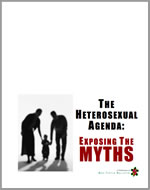 At last, the truth can now be told.
Using the same research methods employed by most anti-gay political pressure groups, we examine the statistics and the case studies that dispel many of the myths about heterosexuality. Download your copy today!
And don‘t miss our companion report, How To Write An Anti-Gay Tract In Fifteen Easy Steps.
 Anti-gay activists often charge that gay men and women pose a threat to children. In this report, we explore the supposed connection between homosexuality and child sexual abuse, the conclusions reached by the most knowledgeable professionals in the field, and how anti-gay activists continue to ignore their findings. This has tremendous consequences, not just for gay men and women, but more importantly for the safety of all our children.
Anti-gay activists often cite the “Dutch Study” to claim that gay unions last only about 1½ years and that the these men have an average of eight additional partners per year outside of their steady relationship. In this report, we will take you step by step into the study to see whether the claims are true.
Tony Perkins’ Family Research Council submitted an Amicus Brief to the Maryland Court of Appeals as that court prepared to consider the issue of gay marriage. We examine just one small section of that brief to reveal the junk science and fraudulent claims of the Family “Research” Council.
 The FBI’s annual Hate Crime Statistics aren’t as complete as they ought to be, and their report for 2004 was no exception. In fact, their most recent report has quite a few glaring holes. Holes big enough for Daniel Fetty to fall through.
“Google” is a trademark of Google Inc.
© Box Turtle Bulletin. All Rights Reserved.
 Posts
Posts  Posts via daily email: