Box Turtle Bulletin
 News and commentary about the anti-gay lobby
“Now you must raise your children up in a world where that union of man and box turtle is on the same legal footing as man and wife…”
News and commentary about the anti-gay lobbyFebruary 20th, 2014
NTV Uganda recaps events since President Yoweri Museveni’s announcement that he will sign the Anti-Homosexuality Bill, and reports that about 20% of Uganda’s budget is funded by donor money. In response to statements from donor countries that their aid would be jeopardized by the Anti-Homosexuality Bill, State Minister for Regional Affairs Asuman Kiyingi said, “What I’ve heard from the public… is that Ugandans are willing to forfeit the support that the donors are giving if it means that the support is conditioned on sacrificing their values. But I’m sure we’re going to find a middle ground.”
Kiyingi’s belief that there will be a “middle ground” with respect to foreign aid suggests that Museveni feels more confident that he won’t suffer severe international consequences if he signs the bill. Uganda has raised its strategic profile in the past couple of years, well-positoned geographically and sharing borders with Rwanda, Congo and Southern Sudan. Uganda provides peacekeeping (and sometimes not so peacekeeping) troops to Southern Sudan and Somalia, and regularly meddles in guerrilla fighting in Congo. Uganda is also central to that battle against the murderous Lord’s Resistance Army, and it receives a great deal of military technical assistance from the U.S. in that fight. This morning, Daily Monitor’s Daniel K. Kalinaki explains what all of that means:
Museveni also understands the centres of power in America. The White House and the State Department might be critical of him and his decisions but he has been around long enough to understand that the CIA and the Defence Department often deal in the cold rational reality of real-politick.
Thus while cuts in military support to the UPDF would hurt, there would be grave concerns for the Pentagon if Uganda were to withdraw its troops from Somalia, for instance. Museveni understands that US national security comes first, ahead of everything else. As long as he is willing to put boots on the ground to keep the regional peace and support the war against terror, he will always have friends at the Pentagon willing to help him manage his relations with the State Department.
There are also a number of internal political considerations that likely went into Museveni’s decision. Again, Kalinaki:
It is telling that President Museveni announced his intentions at a meeting of NRM MPs amidst a plot to endorse him as the sole party candidate for the 2016 elections. In signing, he gives the MPs a blank cheque. Having forced Prime Minister Amama Mbabazi on the defensive, he also cuts from underneath Speaker Rebecca Kadaga one of her populist planks within Parliament.
Mbabazi and Kadaga both were believed to be vying to challenge Museveni for the party’s nomination in 2016. This moves places Mbabazi on the defensive because he was the most vocal in pointing out that Parliament passed the Anti-Homosexuality Bill without a quorum. At the time, Mbabazi appeared to be speaking for Museveni, since Museveni himself had argued against the bill’s passage, and complained about the lack of quorum Speaker Kadaga in a letter written a week after the bill’s passage. Museveni’s sudden U-turn left Mbabazi stranded out on a very weak political limb. At the same time, Kadaga, who sought to build her political legacy on the Anti-Homosexuality Bill, is now seeing the oxygen being sucked out of the room with Museveni’s announcement. Mbabazi signed on to endorse Museveni’s 2016 bid, but Kadaga didn’t.
Kalinaki also points out that the political costs for signing the bill are minimal when compared to the benefits:
First, he is exercising power without responsibility for his actions; he is signing a Bill he never wanted, passed by Parliament against his advice, and on the recommendation of scientists. It wasn’t me, he could easily say. Secondly, Museveni must surely know that several lawyers have lined up to challenge the constitutionality of the law; one of them, your columnist hears, is Mr Fox Odoi, who spent many years doing legal work for the President and remains close to the inner circle.
Such a challenge would hold up the law in the courts for at least a couple of years. If the courts uphold it, it wasn’t me, the President would say. If they strike it down, it still wasn’t him. Throw in a few more years on appeal in the Supreme Court and you have a Bill all dressed up with nowhere to go.
A man like Museveni doesn’t stay in power for twenty-eight years as he has without either brute force or cynical cunning. Museveni prefers the latter but isn’t afraid of the former. It is, after all, how he came to power in the first place. So the question now is whether Museveni was correct in minimizing the political costs to signing the bill or did he misjudge? The Human Rights Campaign’s Chad Griffin wants the U.S. to up the political costs to Museveni. He has called on the U.S. to withdraw its ambassadors to Uganda and Nigeria, which recently recently enacted similarly draconian anti-gay legislation:
“The Ugandan and Nigerian governments’ decisions to treat their LGBT citizens like criminals cannot be accepted as business as usual by the U.S. government. We urge Secretary Kerry to recall both Ambassadors for consultations in Washington to make clear the seriousness of the situation in both countries,” said HRC President Chad Griffin.
February 20th, 2014
TODAY’S AGENDA:
Events This Weekend: Cape Town Pride, Cape Town, SA; National Student Pride, London, UK; Telluride Gay Ski Week, Mountain Village, CO; Elevation: Utah Gay Ski Week, Park City, UT; Arctic Pride, Rovaniemi, Finland; Bear Essentials, Sydney, NSW; Sydney Mardi Gras, Sydney, NSW; Regenbogenball (Rainbow Ball), Vienna, Austria.
TODAY’S AGENDA is brought to you by:

From Michael’s Thing, a bi-weekly gay bar guide, August 2, 1976, page 7.
The Barefoot Boy Disco was immensely popular from about 1974 to about 1978 or 1979 (near as I can tell) that launched the careers of quite a number of major DJs of the era. Disco queen and former porn star Andrea True, whose “More, More, More” in 1976 became part of the disco canon, name-checked the Barefoot Boy in her 1977 single “New York, You Got Me Dancing” (“Dancing the night away / Oh what a joy at the Barefoot Boy”). The club late became Zeus (or Barefoot Boy at Club Zeus). It then became Stix in the early 1980s. A residential tower now stands where they once danced the night away.
TODAY IN HISTORY:
Marcus Welby, M.D. Episode “The Other Martin Loring” Airs: 1973. Marcus Welby was America’s favorite doctor, and Marcus Welby, M.D. was the first program to hit number one in the Nielsen ratings for the perpetually struggling ABC. But America’s favorite doctor made a bad call in its fourth season when it aired an episode titled “The Other Martin Loring.” The episode centers around Loring, who consults Dr. Welby for being an alcoholic, overweight, depressed and diabetic. Relax, take it easy, don’t work too hard, Welby tells Loring. That night, Loring who goes home to his wife, who demand a divorce and custody of their son. When he threatens to countersue, Mrs. Loring says she won’t “hold anything back.” He later collapses under the strain and under Welby’s care again. One thing led to another, including a drunk-driving car accident. Eventually, Welby figures out that Loring is gay. Welby’s advice: Loring had a “serious illness” and he should suppress his desires and see a psychiatrist because his “tendencies” were “degrading and loathsome.”
Shortly before the episode’s scheduled air date, a script was leaked to the Gay Activist Alliance, which organized a protest of two dozen demonstrators at ABC’s New York headquarters. Another group of thirty activists entered the building, guided by a detailed map provided by someone within the network, and took over the thirty-ninth floor offices of the network’s top executives. “It was one of the first big actions we took,” Ron Gold, GAA’s media director, later recalled. “It was also one of the biggest mistakes we made. ABC offered to set up a meeting for two of us with their standards and practices person and the president of the network if the rest of us would go away. But we were afraid that we were going to get screwed over so we said no. That was very foolish because we didn’t get to talk to anybody. They thought we were crazy — and to a certain extent we were. But we were also justifiably paranoid.”
Other protests broke out in Los Angeles when the episode aired, and gay activists tried to launch a nationwide advertiser boycott. But the boycott fizzled, largely because the fractious gay activist community didn’t have the means to communicate with each other effectively, let alone to the general public. In a sense, LGBT-advocacy was still in its infancy, learning the ways of effective demonstration and publicity. But they were quick learners. More than a year later, when Marcus Welby, M.D. would air another homophobic episode (see Oct 8), gay activists were better prepared, and their actions would lead to seventeen ABC affiliates dropping that episode, and at least seven major sponsors pulling out.

TODAY’S BIRTHDAYS:
William Lygon, 7th Earl Beauchamp: 1872-1938. He succeeded his father as Earl at the age of eighteen when his father died of a heart attack during dinner in 1891. That was the start of a very prodigious political career. He became mayor of Worcester in 1895, and was given the post as Governor of New South Wales, Australia in 1899, while still only twenty-seven. But here, his inexperience showed. He was unpopular due to a series of gaffes, including the time he referred to Australia’s “birthstain” as a penal colony. Bored with the assignment, Beauchamp returned to Britain in 1900. In 1902, he joined the Liberal Party and married Lady Lettice Grosvenor. The couple would go on to have three sons and four daughters. When the Liberals came to power in 1905, Beauchamp took on a series of posts in the government, and he served as Liberal Leader in the House of Lords from 1924 to 1931.
Stories had circulated since the 1920s about parties Beauchamp threw at Walmer Castle. But it would be a return trip to Australia in 1930 that would be his undoing, as he was accompanied during the two month trip by young Liberal MP, Robert Bernays, who was also Beauchamp’s lover. Hugh Grosvenor, the Tory Duke of Westminster, was a staunch foe of the Liberals and, more to the point, developed a deep and abiding hatred for his brother-in-law. He summoned his sister and laid the evidence of Beauchamp’s homosexuality before her and urged her to divorce her husband. She never did file for divorce, but she left him immediately. The Duke also demanded that Beauchamp’s children testify against him, but they refused. Finally, the Duke took his information to King George V, who was shocked at the allegation. “I thought men like that shot themselves,” he muttered.
It appeared Beauchamp’s arrest and trail by the House of Lords was imminent. But there was one problem: during the depths of the Great Depression, the House of Lords was increasingly looked upon as a place of idleness and privilege, prompting calls for its abolition. A scandal like this would only worsen the its reputation. Also, Beauchamp was personally close to the King — he had carried the Sword of State at William’s coronation and served as Steward of the Household. Also, the King’s son, George, was seeing one of Beauchamp’s daughters, although that relationship soon ended. The King intervened, and sent three envoys to persuade Beauchamp to resign from all of his official posts and leave England by midnight.
Beauchamp fled England that night, taking a boat to the continent and traveling to the German spa town of Wiesbaden. His plan, which he had disclosed to two of his daughters before leaving, was to commit suicide by overdose. His children took turns traveling weeks at a time to Wiesbaden to remain with him at all times, watching over him. It was finally Hugh, his second son (and who was also gay) who finally persuaded his father from taking his life.
After recovering his wits at Wiesbaden, Beauchamp moved to Paris, Venice, Sydney and San Francisco, constantly moving between the four cities. The closest city to a home to him was perhaps Sydney, where he spent most of his time and was tempted to buy a house. But after Hugh’s death in 1936, Beauchamp was allowed to return to England to bury his son at the ancestral home of Madresfield Court, staying only a few days for fear of arrest. But the following year, shortly after George V’s death and George VI’s coronation, the charges were finally dropped and Beauchamp was allowed to go home for good. He died in 1938 of cancer while traveling to New York. His children remained loyal to him to the very end.
The Earl of Beauchamp is generally believed to have been model for Lord Marchmain in Evelyn Waugh’s novel, Brideshead Revisited.

Joseph McCarthy and Roy Cohn
Roy Cohn: 1927-1986. Could there be a more despicable character in all of gay history? The Columbia Law grad showed signs of legal brilliance early, having been admitted to the bar at twenty-one, becoming an Assistant U.S. attorney in Manhattan and playing a prominent role in the prosecution of Julius and Ethel Rosenberg in 1951. In 1952, Sen. Joseph McCarthy (R-WI) appointed him as chief counsel to the Senate Permanent Subcommittee on Investigations on the recommendation of FBI chief J. Edgar Hoover, where Cohn became known for his aggressive questioning of suspected Communists. Cohn brought in his good friend, David Schine as consultant to McCarthy’s staff. But when the young and handsome Schine was drafted into the army in 1953, Cohn embarked on a private campaign to ensure special treatment for Schine — light duties, extra leave, an exemption from overseas assignment — and threatened to “wreck the Army” if they didn’t accede to his demands. The bitter irony of all this is that while Cohn was pursuing special treatment for his special friend, McCarthy’s witch hunt extended beyond communists to also include gay people (See, for example, Mar 14, Jul 2, Sep 7).

Roy Cohn and David Schine on the cover of Time.
By 1954, McCarthy’s anti-communist and anti-gay witch hunt extended to the Army, which decided to fight back. During one exchange during a committee hearing, the Army’s head counsel, Joseph Welch, asked a McCarthy staffer about the origin of a photo of Schine and Army Secretary Robert Stevens, which had been doctored to omit the presence of Air Force Colonel Jack Bradley. Welch asked the staffer sarcastically, “Did you think it came from a pixie?” McCarthy interjected, “Will counsel (Welch) for my benefit define– I think he might be an expert on that– what a pixie is?” Welch responded, “Yes. I should say, Mr. Senator, that a pixie is a close relative of a fairy.” Others in the chamber who were in on the rumors, broke into laughter. Cohn later called the remark, “malicious,” “wicked,” and “indecent.”

Roy Cohn, four months before he died in 1986.
Cohn later forced to resign from McCarthy’s staff due to growing outrage over his tactics. He returned to New York and entered private practice, where his clients included mafia figures, the New York Yankees, the Roman Catholic Archdiocese of New York, and Studio 54 owners Steve Rubell and Ian Schrager. He was friends with Barbara Walters (she served as his “beard” for a while), columnist Walter Wenchell, and North Carolina Sen. Jesse Helms. While publicly closeted and working actively against gay rights, he partied at the best gay bars and threw lavish parties in New York and Provincetown. In 1984, he was diagnosed with AIDS. He used his connections to jump to the head of the line for treatment with the then-scarce and experimental AZT. By the time he died in 1986, he maintained his public denial both of his homosexuality and his disease — he said it was “cancer.” In Tony Kushner’s Angels In America, Cohn is portrayed as a power hungry, self-loathing hypocrite who is dying of AIDS while haunted by the ghost of Ethel Rosenberg. Cohn’s name is also on a panel of the AIDS memorial quilt. It reads, “Roy Cohn: Bully, Coward, Victim.” A fitting eulogy if there ever was one.
If you know of something that belongs on the agenda, please send it here. Don’t forget to include the basics: who, what, when, where, and URL (if available).
And feel free to consider this your open thread for the day. What’s happening in your world?
February 19th, 2014
Last week the Kansas House of Representatives passed a broad and sweeping bill to “protect the religious beliefs” of individuals and businesses who object to same sex marriage and who wish to discriminate against gay couples. In addition to providing that businesses need not provide the commercial trappings of marriage to gay couples, it also allowed individuals – whether in a private capacity or as an employee of a business or even a civil servant – the right to claim religious exemption from providing the services of their company or of the state. In a final ‘gotcha’, it excluded same sex couples from the right within the state to sue for discrimination.
The Kansas House, comprised mostly of Republicans, voted 72 to 49 for the bill. What happened next is interesting.
As could be expected, civil libertarians, civil rights activists, and supporters of gay equality all decried the bill. And legal scholars pointed out that after Romer v Evans, excluding a class of individuals from the right to legal recourse was on it’s face unconstitutional.
But, nevertheless, most pundits expected the Kansas Senate, also controlled by Republicans, to pull out a big rubber stamp and join in on the bacchanalia of bigotry.
Surprisingly, they did not.
It seems that the GOP Senators, unlike the GOP Representatives, took a look at their political alliances, their hope for a future reputation, and the implications of this bill on the Republican brand, saw this for what it was: an invitation to treat gay people cruely. And the bill now appears dead. (NY Times)
Susan Wagle, a conservative Republican who is president of the Kansas Senate, raised opposition to the House measure, saying she had “grown concerned about the practical impact of the bill” and “my members don’t condone discrimination.”
Ms. Wagle was backed by Senator Jeff King, the chairman of the Judiciary Committee, who said he would not hold hearings on the House bill.
But it was not merely Wagle’s conscience that led to the bill’s demise. It was also the objections of Business and Religion.
As written, the bill would put employers – especially small businesses – in an awkward and complicated and likely expensive position. Staffing would be based on the personal beliefs of employees rather than on the needs of the market and in a less-than-stellar economy this was a burden that could kill a company with only a few employees.
Opponents included the Kansas Chamber of Commerce, which said that the measure could lead to increased costs for businesses. The chamber took particular exception to a provision in the bill that said that if an employee of the government or “other nonreligious entity” objected to providing a service based on religious beliefs, the employer would have to find another employee to fill in or find some other way to provide the service.
Businesses were “not interested in getting into these guessing games as to someone’s intent and whether a strongly held religious belief is legitimate or not,” said Mike O’Neal, the president of the chamber.
And the claim about “protecting religious beliefs” was damaged by strong opposition to the bill by some religious groups. The Episcopal Church led the religious opposition in the strongest terms. (HuffPo)
For Episcopalians, our faith is unequivocal. Our Baptismal Covenant asks, “Will you seek and serve Christ in all persons, loving your neighbor as yourself? Will you strive for justice and peace among all people and respect the dignity of every human being?” Promising to strive for justice and peace among all people and to respect the dignity of every human being requires us to be adamantly opposed to legislation that does none of these things.
Our biblically based faith calls us to live out the command of Jesus Christ to love one another. You cannot love your fellow Kansans and deny them the rights that belong to everyone else.
And they were not alone. Less conservative churches are now increasingly speaking up to counter the message that faith is universally anti-gay. (UPI)
Many ministers in the state oppose the bill and say it has nothing to do with religious freedom. Kate McGee of Presbyterian Trinity Church in Topeka, Aaron Roberts of Colonial Church in Prairie Village and Chad Herring of John Knox Kirk in Kansas City, Mo., joined forces Friday to lobby against it.
McGee said religious beliefs should not be codified in Kansas law.
“If businesses rejected sinners, they would have no customers,” McGee said. “They themselves wouldn’t be able to shop in their own businesses. Where does it stop?”
Some form of bill may yet arise in the Kansas Senate. Sen. King has said that while no substitute bill is in the wings, he’ll hold hearings to see if any additional protections are needed. But it is a sign of our eminent equality that Business, Religion, and the GOP Senate aligned to kill this anti-gay bill.
February 19th, 2014
Longtime BTB readers may remember the formerly-anonymous blogger who went by the moniker GayUganda, Dr. Paul Semugoma. He formally revealed his identity in 2012 while in Washington D.C. for that year’s International AIDS Conference, where he spoke passionately about the challenges of confronting HIV/AIDS in a country where rampant homophobia makes it dangerous for LGBT people to disclose themselves to their doctors. He had, by then, moved to South Africa where he had applied for residency.
Today, there are reports that he is currently in detention in South Africa and facing deportation back to Uganda. One source says that “despite a High Court order to stay the deportation, he was taken to airport, where he refused to leave voluntarily.” Here is a full release from earlier in the day from South Africa’s Treatment Action Campaign:
(19 FEBRUARY) Dr Paul Nsubuga Semugoma a Ugandan medical doctor and human rights activist has been under arrest for the past 48 hours and is facing the threat of deportation to his country of birth.
A group of South African human rights organisations are urgently attempting to halt his deportation as Paul is “wanted” in Uganda for his activism around lesbian, gay, bisexual and transgender (LGBT) issues in his country.
Paul has been in the forefront with the Ugandan Parliament in fighting the Anti-homosexuality Bill, were he presented how the bill not only is a human rights infringement but also a health access dilemma to the Men who have Sex with Men (MSM) community. The human rights situation in Uganda has deteriorated, and the LGBT community is particularly vulnerable at this time.
Paul is at risk should he be deported to Uganda. One of his close friends David Kato was murdered in 2011 and he felt he was not so safe anymore and decided to move to South Africa with his partner where he has been a volunteer doctor at Anova Health Institute for the past three years, working specifically with MSM.
Paul’s special skills application has been pending since March 2012. His application was lost twice by the Department of Home Affairs, a case was lodged and he was requested to re-apply in which he did in April 2013 and again in August 2013. Paul was allowed to travel using his official passport and a receipt from the department. After several trips in and out of South Africa, Paul returned from a meeting in Zimbabwe earlier this week and was arrested.
Lawyers yesterday managed to get a court order to halt the threatened deportation and to order his release. However last night immigration officials unlawfully refused to release him. As a result his lawyers are returning to the South Gauteng High Courttoday to secure another order for his release.
Activists will gather at the court today in support of Paul’s release.
THIS STATEMENT IS RELEASED UNDER THE BANNER OF THE SA NATIONAL AIDS COUNCIL CIVIL SOCIETY SECTOR, TREATMENT ACTION CAMPAIGN, SONKE GENDER JUSTICE, ANOVA HEALTH INSTITUTE, COALITION OF AFRICAN LESBIANS and SECTION 27
More from AVAC: Global Advocacy for HIV Prevention:
Thank you for the rapid outpouring of support! A couple of actions you can take:
- Social media campaigns are being organized using the social media hashtags #JusticeforPaulSemugoma and #freepaul. We encourage you to help raise the profile of the situation on Facebook, Twitter, and with any relevant media contacts.
- The Coalition of African Lesbians is encouraging partners to contact some of the officials with jurisdiction over the situation. Visit: https://www.facebook.com/CoalitionCAL for more information.
- For those based in Johannesburg, 2014 AVAC Fellow Yvette Raphael wrote in about a protest that is being organized at OR Tambo International Airport. Contact Yvette at yvetteraphael8@gmail.com for more information.
The Ugandan Parliament has passed the Anti-Homosexuality Bill that would not only further criminalize homosexuality with life imprisonment, but would also criminalize providing services to LGBT people or engaging in any advocacy on their behalf. President Yoweri Museveni has announced that he will sign that bill into law. This will make Dr. Semugoma a three-times criminal: he’s gay, he’s a doctor providing health care to LGBT people, and he’s an advocate.
February 19th, 2014
Uganda’s neighbor to the east has been spared some of the more excessive displays of anti-gay hatred commonly found along its western border. That may be about to change:
Five MPs have declared an onslaught on homosexuality, which includes rallying the public to arrest gay people where police fail to act.
Through a newly formed parliamentary caucus, the lawmakers will also be rallying their colleagues in Parliament to fully enforce relevant parts of the law that prohibits gay practice.
The caucus to fight gayism in Kenya was launched on Tuesday to coordinate all plans and activities meant to fight it.
It was announced in Parliament just a day after US President Barack Obama issued a statement urging Ugandan President Yoweri Museveni not to sign into law a Bill banning gayism in the neighbouring country.
The MPs want the National Security Committee of the National Assembly to summon the Attorney-General, the Director of Public Prosecutions and the Registrar General of Companies to explain how gay practice continues to thrive in the country despite being prohibited in the laws of the land.
Mr Irungu Kang’ata (Kiharu), Mr Julius Ndegwa (Lamu West) Mr John Njoroge (Kasarani), Mr Clement Wambugu (Mathioya) and Mr Stephen Kinyanjui (Kinangop) said they will lobby Kenyans to maintain harsh anti-gay laws and Parliament to tighten the current law.
Kenya’s colonial-era sodomy law currently provides up to fourteen years’ imprisonment upon conviction. Daily Nation warns that the MPs are “stoking intolerance“:
It may well be that they are alarmed by some recent cases of high-profile personalities coming out of the closet and the growing visibility of gay rights campaigns.
However, one must also wonder whether the group has its priorities right. It is probable that the MPs have been inspired by the strong anti-gay laws passed in some African countries, notably neighbouring Uganda.
It is also likely that they want to make a statement aimed at American President Barack Obama, who has become a stringent critic of the Ugandan laws.
If that is the case, then it should be apparent that the MPs’ caucus is inspired more by the need to score political propaganda points rather than to safeguard sexual morality. It is true that Kenya has laws against homosexual sex, but the MPs cannot demand that people be jailed merely because they declare that they are gay.
Kenyan gay rights activist Denis Nzioka worries that pressure may be building for Ugandan- or Nigerian-style anti-gay legislation. And as with Uganda, he sees American Evangelical influence as part of the problem:
Consider, for example, Project SEE , an American organisation, that has been campaigning against homosexuality and abortion in Kenya. They took things further in 2008/9 when they designed posters calling for the murder of the then most visible gay activist at that time, David Kuria.
…In 2011/12, I was able to detail the influence – subtle at first – of American evangelical churches in the rising anti-gay wave that is sweeping Kenyan in 2014.
The East Africa Center for Law and Justice waded into the homosexuality arena when it published several articles – from 2010 – on homosexuality. Clearly leaning towards not accepting homosexuality, the heavily US Evangelical funded, supported organsiation continued with its anti-gay literary all through to 2013 .
The East Africa Center for Law and Justice is an overseas branch of the American Center for Law and Justice, which was founded by Pat Robertson and is currently headed by Jay Sekulow. Political Research Associates’ Kapya Kaoma reported on the ACLJ and EACLJ (and another ACLJ affiliate in Zimbabwe) in 2010:
As in many other African countries, Kenya’s colonial-era penal code already criminalized gay sex; however, the constitution that the Parliament submitted to Kenyans for ratification in August 2010 was silent on homosexuality while barring discrimination of any kind. The EACLJ feared that would create a loophole for homosexuality (and the local LGBT community agreed). The proposed constitution also protected access to abortions deemed medically necessary to protect the health of the woman, which Jordan Sekulow characterized as “abortion on demand” to CBN News’ Morning program. He added that ACLJ was “trying to educate people on this [abortion on demand] because the government of Kenya is saying that this is not what it means; but we know how it plays in courts.” Despite their efforts and investing “tens of thousands” of dollars (according to Sekulow), the ACLJ and its allies were unable to change the draft or defeat the constitution at the polls in August 2010.
Yet even these minor concessions to protecting LGBT persons and women’s lives cannot stand, according to the director of the East African Center for Law and Justice.”The current constitution promotes gay rights and abortion,” Joy Mdivo, the executive director, told PRA. “We are working on going to court over those two issues. We shall also carry out further civic education to warn people of the dangers of homosexuality and abortion in Kenya.”
February 19th, 2014
TODAY’S AGENDA:
Events This Weekend: Cape Town Pride, Cape Town, SA; National Student Pride, London, UK; Telluride Gay Ski Week, Mountain Village, CO; Elevation: Utah Gay Ski Week, Park City, UT; Arctic Pride, Rovaniemi, Finland; Bear Essentials, Sydney, NSW; Sydney Mardi Gras, Sydney, NSW; Regenbogenball (Rainbow Ball), Vienna, Austria.
TODAY’S AGENDA is brought to you by:

From The Advocate, March 5, 1981, page 25
From what I can gather, the Express may have closed sometime in the 1990s, and perhaps re-opened as Deja Vu, and then it became the Express again in 2002 when the club’s last owners bought the business. They kept it going until January, 2013.

Deputies check patrons’ identification during a raid at Hazel’s Inn.
TODAY IN HISTORY:
Raid on Hazel’s Inn: 1956. San Mateo County Sheriff Earl Whitmore, accompanied by deputies, Army military police, state Alcoholic Beverage Control agents and members of the California Highway Patrol, began the raid by striding into Hazel’s Inn, a gay bar in Sharp Park, south of San Francisco, and announced simply, “This is a raid!” Patrons were ordered to line up in single file and pass before a group of officers at the rear of the door. Those who were recognized by undercover agents as being gay were ordered to step to one side and loaded into a waiting van outside. About 88 of the 200 or more patrons were singled out and taken away to be fingerprinted, their mug shots taken, and charged with vagrancy for being a “lewd and dissolute person” and for committing “acts outraging public decency” — common misdemeanor charges used against those deemed to be engaging in “immoral” acts, which in this case was, basically, being caught in a gay bar. The bars owners were also charged with operating a dance establishment without a license (some patrons were seen dancing to a jukebox).
Sheriff Whitmore told the press, “The purpose of the raid is to make it very clear to these people that we won’t put up with this sort of thing.” The American Civil Liberties Union of San Francisco’s Executive Secretary Ernest Besig took exception to that reasoning. “As far as can be ascertained, none of the patrons of the tavern were misbehaving or breaking any laws when the arrests occurred,” he wrote in the chapter’s newsletter. “The complaint seems to be that these men were making the tavern a ‘hang-out.’ Of course, there is no law against that, so long as their activity was lawful. …The ACLU is investigating the matter and the local staff counsel will appear on behalf of some of the alleged homosexuals at the court hearing.”
Those who were arrested were told by law enforcement officers and their bail bondsmen that if they forfeited bail, all further proceedings would be dropped. Thirty took the deal and on March 1, the remaining 57 were arraigned. About 30 entered not guilty pleas and requested jury trials, which were set for March 26 and 27. The judge offered to reduce the charge to disorderly conduct in exchange for guilty pleas, and all but three took him up on that offer. (I don’t have any further information on what happened to the three who didn’t.)
[Sources: Unsigned. “Civil Liberties Union looks into mass arrests.” Mattachine Review 2, 2nd special issue (March 1956): 4-5.
Unsigned. “American Civil Liberties Union acts to appeal California’s lewd vagrancy laws after convictions resulting from mass raids and arrests.” Mattachine Review 2, no. 3 (June 1956): 3-4, 36.]

15 YEARS AGO: Billy Jack Gaither Murdered: 1999. The thirty-nine year old Sylacauga, Alabama resident was beaten to death with an axe handle, covered with kerosene, and burned on a pile of old tires. His attackers said that he had propositioned them, so killing him was the only logical thing to do.
On February 19, Billy Gaither went to The Tavern, a Sylacauga nightclub, where he had been friends with the owner, Marion Hammond, for twenty years. Gaither was a regular there, if he wasn’t at the Tool Box in Birmingham forty miles away. Hammond remembered that he was nonchalant about his sexuality. ” If they walked over to Billy Jack and they say, ‘Are you gay?’ he’d say, ‘Yes, and I love it.’ You couldn’t hurt his feelings on it, so we wasn’t worried about it.”
Another regular, Steve Mullins, 25, also started to hang out at the Tavern. His presence wasn’t so benign. He sometimes showed up wearing racist t-shirts and harassing African-American customers. He was known locally as a wannabe tough-acting skinhead. “He tried to walk around like a bully, but he wasn’t,” Hammond said. “He was mostly talk.” His buddy, a construction worker named Charles Butler, Jr., was quieter.
Gaither had a reputation for getting along with pretty much everyone, so nobody’s eyebrows were raised when Gaither left The Tavern that night with Mullins and Butler. The three drove to a remote area where Mullins and Butler beat Gaither, stuffed him into the trunk, and went for supplies: kerosene, matches, an axe handle and old tires form Mullins’s home. They then drove to the banks of Peckerwood Creek in neighboring Coosa County. They poured kerosene on the tires and set them ablaze. Then they pulled Gaither out of the trunk of his car. He tried to stand up and they beat him with the ax handle, cut his throat, and threw him onto the pile of burning tires. They moved Gaither’s car to another dirt road and set it on fire. It was found the next day.
After spending a night in jail for an unrelated offense, Butler went to police to tell them about the murder, saying God told him to confess. Butler claimed the gay panic defense, telling the police, “Well, sir, he started talking, you know, queer stuff, you know, and I just didn’t want no part of it.” Mullins also confessed, with the two blaming each other for taking the lead in the killing, but neither expressing remorse. In June, Mullins pled guilty to capital murder to avoid the death penalty and agreed to testify against Butler, who was also found guilty. he victim’s father, Marion Gaither, had asked that Mr. Butler not be sentenced to death, saying, “I can’t see taking another human beings life, no matter what.” Both men were sentenced to life with out parole.

Lisa Pond (left) and Janice Langbehn (second from right) with three of their four children as they prepared to board an RFamily cruise ship.
Miami Hospital Denies Access to Partner of Dying Patient: 2007. Janice Langbehn, her partner of nearly 18 years, Lisa Pond, and three of their four children flew from Oregon to Miami to board a cruise Miami to the Bahamas. But Pond suffered a brain aneurysm while in Miami before they could board the ship. Pond was rushed to Jackson Memorial Hospital, where a social worker told Langbehn that they were in an “anti-gay state” and that they needed legal paperwork before Langbehn could see Pond. But even after a friend in Olympia faxed the legal documents showing that Pond had authorized Langbehn to make medical decisions for her, Langbehn was refused permission to visit Pond or to make any medical decisions. She was even refused basic information about Pond’s condition. It was only because of the intervention by a Catholic priest who was called to perform last rites that Langbehn was able to spend a few minutes with Janice before she died.
After Pond died, the cold shoulder continued. Hospital officials refused to provide Langbehn with Pond’s medical records, and the county refused to provide her with Pond’s death certificate, items needed for their two children’s Social Security benefits. Langbehn sued, but a Federal Judge dismissed the lawsuit, based on the narrow fact that Pond was in the trauma unit where rules about visitation were more restrictive. “The court’s decision paints a tragically stark picture of how vulnerable same-sex couples and their families really are during times of crisis,” said Beth Littrell, Staff Attorney in Lambda Legal’s Southern Regional Office based in Atlanta. After the Judge’s ruling, President Barack Obama ordered new regulations on hospital visitation rights for same-sex couples for all facilities receiving federal Medicare or Medicaid funds. Those new rules went into effect in 2010. In 2011, Janice Langbehn was named one of thirteen honorees of the 2011 Presidential Citizens Medal, the nation’s second-highest civilian honor.
If you know of something that belongs on the agenda, please send it here. Don’t forget to include the basics: who, what, when, where, and URL (if available).
And feel free to consider this your open thread for the day. What’s happening in your world?
February 19th, 2014
The Canadian government has threatened to cut diplomatic ties with Uganda if the Anti Homosexuality bill is signed into law. Ugandan Ambassador Alintuma Nsambu says he was summoned on Monday by the Canadian Foreign Affairs Minister to explain why Canada should not take that step. Nsambu says if signed, several western countries could isolate Uganda.
February 18th, 2014
Remember back at a time when, if anyone were to stand up for gay people, they would be accused of being gay themselves? It’s been a long time since that’s been a common occurrence here in the U.S., although I’m sure it still happens. In Uganda, however, it happens in the papers. The tabloid, Red Pepper, which has a long history of dangerous anti-gay “outings,” has taken that tactic when a popular singer, Keko, criticized President Yoweri Museveni’s announcement that he will sign the Anti-Homosexuality Bill. Red Pepper says Keko took to social media saying, “If Sevo signs the anti-homosexuality bill, we are always going to be third world. Development is tolerance.” And then promptly “outed” her:
“Keko was seen comfortably seated with Sheeba Kalungi,” says Red Pepper
For over the years it has been rumored that female rapper Keko is a lesbian.
It has been claimed that the singer is in a gay relationship with fellow singer Sheeba Karungi, and actually stay together in a rented apartment in Kiwatule.
Neither of the two has ever denied the allegations. And now Keko has almost confirmed these allegations by blasting the president over the anti gay bill.
I put “outed” in quotes because I know nothing about Keko. I have no idea whether she’s gay, straight, or anywhere in-between. While I can understand that for the sake of visibility, that kind of detail would matter. But in a country like Uganda, that’s a first world luxury that gay people can’t afford. Here, the retaliation isn’t in the “outing,” but something far more sinister where being called a lesbian is an accusation of criminal activity rather than just a description of someone’s romantic leanings.
The Anti-Homosexuality Bill will criminalize all advocacy by or on behalf of LGBT people with five to seven years’ imprisonment. Any day now, Keko’s tweet may become a criminal offense. But until that day comes when official sanctions can be applied, rags like the Red Pepper will be happy to provide plenty of unofficial sanctions.
February 18th, 2014
In the above clip from NTV Uganda, President Yoweri Museveni’s press secretary Tamale Mirundi responds to US President Barack Obama’s statement blasting Museveni for agreeing to sign the Anti-Homosexuality Bill. Mirundi tells reporters that Museveni “cannot be intimidated.” On the question of foreign aid, Mirundi said, “we can do without that aid.”
February 18th, 2014

National Security Adviser Susan Rice’s Tweeted on Sunday saying, she “Spoke at length with President Museveni last night to urge him not to sign anti-LGBT bill.” In a following Tweet, she echoed Obama’s statement, adding: “Told him it will be huge step backward for Uganda and the world.” Uganda’s independent Daily Monitor this morning provided some additional information on that conversation:
Barely 24 hours after his Kyankwanzi pronouncement, the President was already facing the “battle” with the American National Security Adviser, Ms Susan Rice, calling Mr Museveni to express her government’s and Mr Obama’s reservations on the matter.
According to the Foreign Affairs Permanent Secretary, Ambassador James Mugume, the Americans had called to offer “further evidence” that homosexuality is a natural behaviour in contradiction with what the local scientists had presented.
“We are discussing with the US government. We are waiting to see what they have [to present]. I am told that the Americans have some materials and evidence that they feel were left out by our scientists,” Mr Mugume said in a telephone interview yesterday.
Asked when the US was scheduled to table the said evidence, Ambassador Mugume could not give a clear time-line, only saying: “It will not take a lot of time. It will be soon.”
You can read Uganda’s “scientific report” here.
February 18th, 2014
TODAY’S AGENDA is brought to you by:

From the Advocate, March 3, 1983, page 44.
If you’ve been enduring weeks of repeated snowstorms and much-below-normal temperatures, now might be a good time to book a trip to Key West for some fun-in-the-sun relief. Key West has long been known as a very gay friendly location, with a good number of resorts and guest houses catering the the gay and lesbian markets, with many of the resorts for gay men being clothing optional. In 1983, the Lighthouse Court advertised itself as “an exquisitely relaxed compound.” The Lighthouse Court is still in business, but it has changed a bit since then. In 2005, it was mentioned in a New York Times article asking “Is Key West Going Straight?“: “You can feel the change at the Lighthouse Court, a popular – some would say notorious – gay-only Whitehead Street guesthouse that recently went ‘all welcome,’ the local euphemism for accepting heterosexual guests as well as gays.”

John Sholto Douglas, 9th Marquess of Queensberry
TODAY IN HISTORY:
Marquess of Queensbury Accuses Oscar Wilde of Being a “Somdomite”: 1895. British playwright Oscar Wilde was dining at the Albermarle Club when the Marquess of Queensbury left a calling card with the porter. It read, “To Oscar Wilde posing as a somdomite.” The misspelling may have been the product of Queensbury’s rage over the relationship between Wilde and his son, Lord Alfred “Bosie” Douglas. Queensbury had ferocious arguments with his son, trying to get him to stop seeing Wilde, but Bosie refused. Queensbury even threatened to go public with what he knew, but Bosie refused to back down. So on February 18, 1895, Queensbury followed through on his threat.
This action led to a long string of events which eventually led to Wilde’s disgrace, imprisonment, exile in France, and early death. Perhaps all that could have been avoided if Wilde had decided not to sue Queensbury for libel. His friends advised him against it, but he may have felt he had little choice. Having been called out publicly like that, declining to sue might be taken as an admission of guilt. Unfortunately, Wilde’s libel case collapsed when Queensbury’s lawyer asked whether he had ever kissed Walter Grainger in greeting. “Oh, dear no,” Wilde replied, “He was a peculiarly plain boy. He was unfortunately extremely ugly. I pitied him for it.”
Queensbury’s lawyer pounced on Wilde’s admission that attraction was the reason he didn’t kiss him. In short order, Wilde lost the case, and was charged with gross indecency. Wilde’s first criminal trial ended in a hung jury but the second one resulted in Wilde’s conviction and sentence to two years at hard labor.

British Quakers Publish “Toward a Quaker View of Sex”: 1963. A report published by an influential group of eleven Quaker scholars challenged what it considered a hidebound view of sexuality among Christians. The groundbreaking report insisted on the basic similarity of homosexual and heterosexual emotional experience and placed the two on an equal moral footing, insisting that the morality be judged by the same standard.
“Surely it is the nature and quality of a relationship that matters,” the authors wrote. “One must not judge by its outward appearance but by its inner worth … We see no reason why the physical nature of a sexual act should be the criterion by which the question whether or not it is moral should be decided. An act which expresses true affection between two individuals and gives pleasure to them both, does not seem to us to be sinful by reason alone of the fact that it is homosexual.”
The report asserted that “sexuality, looked at dispassionately, is neither good nor evil — it is a fact of nature.” it also explored the meaning of morality itself. “It seems to us,” the report continued,” that morals, like the Sabbath, were made for man, not man for morals, and that as society changes and modes of conduct with it, we must always be searching below the surface of human behavior, to discover what is in fact happening to people, what they are seeking to express, what motives and intentions they are satisfying, what fruits good or bad, they are harvesting.”
Towards a Quaker View of Sex was not an official Quaker statement on sexuality. But because it was published by the Literature Committee of the Friends Home Service Committee, it would prove to be a profoundly influential document among Quakers for the next several decades. You can read the full report here (PDF: 117KB/7 pages).
North American Conference of Homophile Organizations (NACHO) Forms: 1966. Following the success of the East Coast Homophile Organizations’ (ECHO) efforts to organize several gay rights groups for coordinated actions (see Oct 10), forty activists from the East and West Coasts, the Midwest and Texas met in Kansas City for a planning conference for what would become the first attempt at a national coalition of gay rights groups. Fifteen organizations were represented at the Kansas City meeting which was moderated by the Rev. Clarence A Culwell, a straight UCC minister who headed the San Francisco-based Council of Religion and the Homosexual (see Jan 1). The conference agreed to sponsor public meetings in several cities for Armed Forces Day, May 21, to discuss gays and the draft. It also agreed for a follow-up meeting in San Francisco in August to solidify the organization and plan further actions.
If you know of something that belongs on the agenda, please send it here. Don’t forget to include the basics: who, what, when, where, and URL (if available).
And feel free to consider this your open thread for the day. What’s happening in your world?
February 17th, 2014
There’s a larger debate right now taking place in Ukraine over the question of the country’s future direction: will they look to the West or Russia. That larger debate, of course, isn’t settled, as the country continues to be rocked by protests against the pro-Russian government. While that is going on, LGBT activists in Ukraine sound the warning that the nation’s Parliament will consider six draft laws regarding homosexuality, with many of those proposals sounding eerily similar to those already adopted in Russia:
In particular, the last phase of passing the Draft Law No.0945 (former 8711) entitled “On the Introduction of Changes to Certain Legislative Acts of Ukraine (regarding the protection of the right of children to a safe information environment)” will be soon held. It will include the presentation of profile Committee on Freedom of Speech and Information, headed by Mykola Tomenko, on withdrawal of this draft law from further consideration.
The Draft Law No.1155 entitled “On the Prohibition of Propaganda of Homosexuality Aimed at Children” of authorship by Vadym Kolesnichenko is also ready for discussion. This draft law could easily be adopted in the first reading. In any way this is exactly what was suggested for consideration of the Parliament within the draft resolution introduced by the profile Committee on Legislative Support of Law Enforcement, headed by Andriy Kozhemyakin.
It is also planned to conduct the last phase of passing the Draft Law No.2133 entitled “On amendments to some legislative acts (about non-admittance of adoption of Ukrainian citizens by individuals who are in same-sex marriages)”, introduced by MPs from Svoboda Party Igor Miroshnichenko and Alexander Mirny. Profile Committee on Family Affairs considers it necessary to undergo the draft law for follow-up revision
Gay-Alliance Ukraine says that additional legislation is being proposed to remove sexual orientation from the country’s anti-discrimination laws. Those laws had been passed by the previous government of ex-Prime Minister Mykola Azarov. Another draft resolution would withdraw Ukraine from prior agreements with the European Union dealing with “implementing legalization of same-sex relationships,” despite the fact that the agreements currently do not address same-sex relationships.
February 17th, 2014
TODAY’S AGENDA is brought to you by:

From Michael’s Thing, August 2, 1976, page 18.
Not be confused with the more famous Sandpiper on Fire Island, this Staten Island disco was often known as Carmine’s Sandpiper. It wasn’t a gay bar per se — I’m led to understand there were no gay bars in Staten Island at that time, though I’m open to correction — but the Sandpiper was known as a very gay friendly venue since the 1950s. Located in a frame house on a residential street, the Sandpiper was a modest bar during the week, but hosted DJ’s and drag shows on the weekend. Sometime in the 1970s, the Sandpiper became Club Brazil, a full-on gay bar and popular disco. The building has since been torn down and replaced by a cookie-cutter duplex.
TODAY IN HISTORY:
Laredo D.A. Defends City’s Reputation: 1953. The District Attorney for Laredo, Texas, defended his fair city’s reputation against allegations made by a Mexican newspaper in Nuevo Laredo, just a cross the border, that there were homosexual activities taking place on the American side of the line. D.A. James Kazen was responding to a series of articles by El Manaña, a morning daily with wide circulation in both communities, which claimed that many prominent citizens of Laredo were involved in homosexual activities, and promised to run a list of names in a future article. Kazen denounced the stories as “wholly untrue,” and successfully appealed to Judge R.D. Wright to reconvene a grand jury to investigate the reports. Kazen did acknowledge that there were homosexuals on the streets of Laredo — but only four, and two of them were outsiders who had only recently moved to town.
Chicago Police Raid Lesbian Bar: 1961. Chicago police, like New York Police, were always raiding gay bars, often for the same reasons. As in New York, gay bars in Chicago tended to have mob connections, and police raids were planned according to whether the proper protections were paid to the proper officers on the force. While the raids were a routine feature of gay life in Chicago, each one nevertheless was added insult to the daily difficulties of gay life. In March of 1961, a Chicago woman who went by the name of Del Shearer (a pseudonym she used throughout her career in activism) wrote to the Daughters of Bilitis’ newsletter The Ladder to describe the latest insult:
On February 17, shortly before midnight, the police arrested some 52 people, herded them off to a Chicago jail, and charged them with presence in a disorderly house. According to Illinois statutes, all “owners, agents, and occupants” thereof are subject to arrest. First, not all were arrested. It was determined by the arresting officers on the basis of “fly fronts” who was to be taken in — “fly fronts” which were made in women’s slacks by legally owned and operated manufacturers are not illegal and thus they do not constitute disorderly conduct. Second, on the night this raid occurred, there was no apparent violence, disturbance of the peace, disorderly assembly, or legal violation. At the station those women wearing “fly fronts,” regardless of whether they wore lipstick, long hair, or earrings, were made partially to undress in order to determine whether they wore jockey shorts. (I suppose they will now be charged with indecent exposure.) It now appears that those arrested at the discrimination of the police are to appear in courts in March, where they will face the charge against them.
Though I do not wish to go into the details of their fifteen-hour detention period, I will say that the conditions of the lockup itself, as well as their treatment, violated more than a few Illinois laws.
After briefly describing the raid — we don’t know what bar was raided on that night — Shearer then went on to vent her frustration with the general feeling of resignation the gay community had about the raids:
Gay people have let their fears overpower their conscience. They’re afraid of publicity and newspapers, of public condemnation and the loss of their families’ love. They’re afraid of the big, black, threatening cloud that hangs above each and every one.
The object of the homosexual to live without fear of discrimination and persecution will never be attained without a fight. If the gay element wants its freedom, it has no choice but to fight, for freedom in this country or any country is not a thing given or guaranteed to anyone who does not hold it in highest esteem. The word fight is a frightening word.
Gay people, like many Americans, think in terms of jobs, money, reputation, and prestige. Like most Americans, they feel these are more important than either ethics or morals. For this reason, they seem to be primarily concerned about their own necks. Not only have they lost sight of their own rights, but they seem completely to have forgotten homosexual posterity. No legal miracle is going to free us or those who come after us.
If we ever hope to win our battle, we must fight. First, we must unshackle ourselves from fear, for it alone is our omnipresent enemy. We fear sacrifice, though sacrifice is called for. In any war — physical, social, civil, or international — both sides suffer; in the course of warfare, before or after, all involved must suffer. We are afraid to suffer in battle, though it may well be that our sufferings will be augmented a thousand times if we do not fight. If we do not fight, we will continue in ever-increasing numbers to be made the target of society’s and the police’s blows. We will continue to be ridiculed, persecuted, denied our legal rights, and falsely prosecuted at the command of our discriminating master. Are we to be bound as children by the fear which disorganizes us? Are we to think as children of the world filled with honey trees and sugarplum trees, where we will live happily ever after? We are a minority group and because we are, we consider ourselves orphans of society, without parents to protect us and without love. Orphans grow up, though, as we must. When they realize that they have to look out after their own interests, the sky becomes the limit. Our case is not radically different.
…Homosexuals everywhere have been made the scapegoat of society. The prejudices held against us are in most cases built out of sight of the very same scientific findings and theories with which Americans in this scientific age so cleverly rationalize their behavior — but not that of their fellow man. How long will we sit quietly and watch society kindle the flames beneath the stakes on which we burn with our own legal and moral rights?
Shearer went on to found a Chicago chapter of the Daughters of Bilitis later that year. In 1964, she was the only woman to appear among five panelists for a televised two-hour discussion on WBKB (Channel 7, which later became WLS-TV). Shearer also served as the national vice president for the Daughters of Bilitis. But there were limits to how far she was willing to take the fight. She resigned from the DOB governing board in 1965 due to her strong disagreement “at this time or in the very near future” with the tactic of picketing by East Coast homophile groups (see Apr 17, May 29, Apr 18, Jun 26, Jul 4, Jul 31, Sep 19, and Oct 23). And with her resignation, she also left the homophile movement entirely.
“Chicken And Bulls” Blackmail Ring Busted: 1966. A massive, multi-state blackmail ring stretching from Chicago to New York To North Carolina was broken with the arrest of nine extortionists, with eight more being sought. As The New York Times reported, the gang employed “chickens” (including college students and at least one bodybuilder) who posed as young gay men who would allow themselves to be picked up by other gay men, usually travelling businessmen, to go back to the hotel. Once there, the “chicken” would beat and rob their victims and leave. A few hours later, other men — the “bulls” — posing as policemen would arrive at the hotel for another shakedown. Saying that they had arrested a homosexual prostitute with the victim’s wallet in his possession, the “police” needed to victim to go to the station to make a statement. Fearing exposure, the victim would often offer a bribe to the “police” to make the whole problem go away. In another version of the shakedown, “police” would burst into the hotel room just when the men were in a compromising state of undress, and the shakedown would begin with the threat of arrest.
The gang’s success hinged on several factors: homosexuality was illegal everywhere except Illinois, and even there the mere threat of being publicly exposed was enough to induce the victim to do just about anything to avoid having his reputation, career and family life ruined. The ring’s longevity — it would later be revealed that it had been in operation for about a decade — was further aided by the fact that none of the victims went to the police. And why would they? They already thought they were dealing with the police. Actual police corruption was so rampant, with many of them operating their own blackmail schemes using many of the same tactics, victims had no way to tell the fake cops from the real.
To further add to the confusion, some members of the gang actually had police connections, allowing the gang to imitate police officers with a great deal of precision. John J. Pyne, the ringleader of the gang, was a retired Chicago policeman. In his home, the FBI found police badges and identification papers for almost every state, along with a variety of blank arrest warrants, charge sheets and extradition forms from several jurisdictions. As the investigation and trials unfolded over the next two years, investigators would learn that millions of dollars were extorted from over a thousand victims. The victims themselves were no lo-lifes. They included university deans, professors, military officers (including a navy admiral and two generals), several well-known actors, TV personalities (including, it’s been said, Liberace, who refused to testify before a grand jury for fear of ruining his career), and at least one U.S. Congressman. Their boldness knew no limits. Twice, they confronted Rep. Peter Frelinghuysen (R-NJ) in his Capitol Hill office, took him to a private plane to fly to New Jersey, and brought him directly to a bank where he paid a total of $50,000. They pulled a prominent surgeon out of an operating room, forcing his colleague to finish the surgery. They even went into the Pentagon and escorted Admiral William Church out of the building and to a bank where he handed over $5,000. Church later committed suicide to avoid testifying before a grand jury against his blackmailers.
Church’s suicide (and Liberace’s reticence) was indicative of the greatest problem that the FBI and New York Police Department faced in trying to break the case: almost none of the victims were willing to talk to police, let alone testify. If there is a silver lining in the whole affair, is is probably the fact that investigators had to figure out how to set aside their own prejudices, and through persistence and discretion, build a foundation of trust between themselves and the victims. The Mattachine Society was enlisted as a go-between so that victims might feel less exposed. Some judges, where they could, allowed victims to testify anonymously, or allowed victims to testify about the blackmail without going into any sexual details. These accommodations were a complete turnaround from the way law enforcement and the courts had dealt with gay people during the Lavender Scare of the 1950s. Press coverage was also markedly different. With the roster of victims including the cream of society, it was much easier to portray them with considerable sympathy. As one law enforcement official told The Times, “Extortion of money from well known persons who are homosexual or bisexual is a persistent problem. We want to alert these people who come from all walks of life that such extortion schemes exist and we want to impress upon them also that New York City detectives are no part of this disgusting racket.”
Over the next two years, various members of the ring were tried, with most found guilty and sent to prison. Pyne was sentenced to two consecutive 20-year federal prison terms. Weightlifter John Fellabaum, a ringleader who posed as a muscle-bound “chicken,” angered the judge when he forced a witness, an antiques dealer from Maine, to take the stand and publicly out himself, after which Fellabaum immediately changed his plea to guilty. The judge was outraged. “I have been sentencing people for twenty-seven years and it has been a a long time since I have come upon a case that was so revolting as your case. I think you are so steeped in filth that as I read the report I cringed, and my flesh crept as I read the depth of inequity to which you allowed yourself to sink.”
[Sources: William McGowan. “The Chicken and the Bulls” Slate (July 11, 2012). Available online here.
Angus McLaren. Sexual Blackmail: A Modern History

TODAY’S BIRTHDAY:
Friedrich Alfred Krupp: 1854-1902. Fritz had every advantage available to one born to Germany’s most prominent industrialist family. Named for his grandfather who founded the family firm in 1811, and heir to the vast steelmaking, mining, and armaments conglomerate assembled by his father, young Fritz, at the relatively young age of 33, stepped in as head of the Krupp empire when his father suddenly died. Under Fritz, the Krupp firm developed nickel steel which would revolutionize battleship armor and cannons, and created a shipbuilding works which would go on to build Germany’s first U-Boat in 1906. Fritz also cultivated a very close working relationship and personal friendship with the Kaiser, Wilhelm II, which proved especially fruitful. His wealth and business acumen was such that crowned heads of state often negotiated contracts with him personally, while his tact and charm allowed him to resolve touchy problems whenever they arose.
Fritz’s first love though wasn’t business, but oceanography, a hobby he would pursue throughout his life. Because of poor health, he frequently traveled to the Mediterranean where he could indulge his hobby, along with another — young, exotic men. From 1898, he took up a semi-permanent residence on Capri, where he could pursue both pleasures, well out of sight of his wife and family. He was also generous with the local community, so much so that the Capri council made him an honorary citizen.
But because the burdens of business required him to spend a considerable amount of time in Berlin, he sent several of his favorites to the Hotel Bristol and arranged for their employment there with the understanding that when he was in town, they were to attend to him rather than their duties. The men quickly proved unsuitable to their tasks.
Between his time in Capri and the men he had stashed away in Berlin, stories began to leak out in the Italian press, and insinuations began to make their way into the German papers in 1902. As the stories began to leak out, Krupp’s wife was confined to a mental asylum — whether it was due to her distress or to ensure her discretion, it’s hard to say. Finally, on November 15, the Social Democratic magazine Vorwärts published an article, titled “Krupp in Capri, which boldly accused Krupp of homosexuality, including his fondness for Adolfo Schiano, an 18-year-old barber and amateur musician.
Krupp requested an audience with the Kaiser, but one week later, on the day they were to meet,, Krupp was found dead in his home, apparently of suicide, although the circumstances surrounding his death were never revealed. No autopsy was ever performed, and Krupp’s body was placed in a closed casket. Within days, Krupp’s wife was released from the asylum; her sanity apparently was miraculously restored. In a speech at Krupp’s funeral, the Kaiser denounced the Social Democrats for “lying” about Krupp’s homosexuality. His heirs then launched a libel suit against Vorwärts, but it was quietly dropped a short time later.
If you know of something that belongs on the agenda, please send it here. Don’t forget to include the basics: who, what, when, where, and URL (if available).
And feel free to consider this your open thread for the day. What’s happening in your world?
February 16th, 2014
Uganda’s NTV has posted video of President Yoweri Museveni’s announcement that he will sign the Anti-Homosexualty Bill at his ruling party caucus this weekend in Kyankwanzi.
There’s more in this broadcast of the program NTV at ONE. Skip ahead to the 25:39 mark:
http://www.youtube.com/watch?v=r0loONiXm8EFebruary 16th, 2014

Uganda’s President Yoweri Museveni
That’s the political question being asked today. Ugandan President Yoweri Museveni is very well aware of the hit he’ll be taking internationally by giving his assent to the draconian legislation. A few months after the bill’s 2009 introduction amid international outcry, Museveni told his ruling party caucus that the government should “go slow” with the bill, citing foreign policy concerns. Later that year, Museveni’s cabinet reported that they had “rejected” the private member’s bill sponsored by M.P. David Bahati. His cabinet tried to repeat that assertion again in 2011. When the bill passed last December, Museveni lashed out at House Speaker Rebecca Kadaga for rushing it through without a quorum, and just four weeks ago he told representatives from the Robert F. Kennedy Center for Justice and Human Rights that he would not give his assent to what he called a “fascist” bill.
So why the turnaround? A Ugandan opposition paper thinks it’s purely a matter of domestic political calculations:
The Observer Editor Richard M Kavuma believes the president may have been guided by political calculations. Because he was keen to win over MPs on key issues such as denying suspects bail on certain offences, Kavuma said, the president may have decided to sign the popular bill as a concession.
“But it is also true that some of the president’s people may challenge the legislation in court and given Uganda’s largely progressive Constitution, they may get the bill declared unconstitutional,” Kavuma said.
“That way the president comes out looking good to his anti-gay electorate, while the judges will take the flak from Uganda’s generally Christian conservative population.”
Kavuma added: “Because the law is likely to fail anyway, the president may have found the political cost of signing the bill to be much lower than that of maintaining his locally ‘anti-people’ stance. On the contrary, he will be praised across churches, shrines and mosques if he signs the bill.”
According to this analysis, there’s virtually no political cost in the short term domestically, and, if it plays out in court the way Kavuma believes, there’s no long term political cost either. In other words, it’s the most cynical plan conceivable. Nobody loses, except of course Uganda’s LGBT citizens, who don’t count in this calculation anyway.
The Observer also notes that Museveni’s announcement, made at a ruling party caucus this weekend, may have been aimed at tamping down internal challengers who may themselves have presidential aspirations. Museveni is all but assured to announce his run for re-election in 2016, when he will have already spent some thirty years as the country’s leader following a 1986 civil war.
Featured Reports
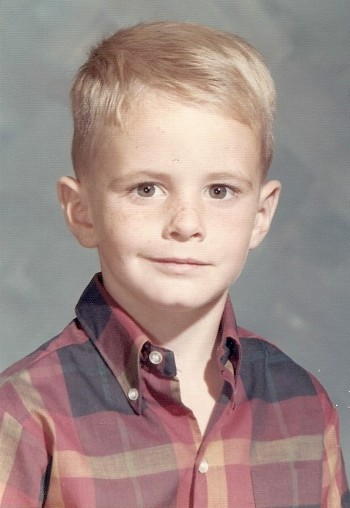 In this original BTB Investigation, we unveil the tragic story of Kirk Murphy, a four-year-old boy who was treated for “cross-gender disturbance” in 1970 by a young grad student by the name of George Rekers. This story is a stark reminder that there are severe and damaging consequences when therapists try to ensure that boys will be boys.
When we first reported on three American anti-gay activists traveling to Kampala for a three-day conference, we had no idea that it would be the first report of a long string of events leading to a proposal to institute the death penalty for LGBT people. But that is exactly what happened. In this report, we review our collection of more than 500 posts to tell the story of one nation’s embrace of hatred toward gay people. This report will be updated continuously as events continue to unfold. Check here for the latest updates.
In 2005, the Southern Poverty Law Center wrote that “[Paul] Cameron’s ‘science’ echoes Nazi Germany.” What the SPLC didn”t know was Cameron doesn’t just “echo” Nazi Germany. He quoted extensively from one of the Final Solution’s architects. This puts his fascination with quarantines, mandatory tattoos, and extermination being a “plausible idea” in a whole new and deeply disturbing light.
On February 10, I attended an all-day “Love Won Out” ex-gay conference in Phoenix, put on by Focus on the Family and Exodus International. In this series of reports, I talk about what I learned there: the people who go to these conferences, the things that they hear, and what this all means for them, their families and for the rest of us.
Prologue: Why I Went To “Love Won Out”
Part 1: What’s Love Got To Do With It?
Part 2: Parents Struggle With “No Exceptions”
Part 3: A Whole New Dialect
Part 4: It Depends On How The Meaning of the Word "Change" Changes
Part 5: A Candid Explanation For "Change"
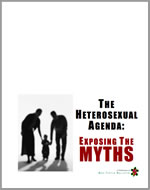 At last, the truth can now be told.
Using the same research methods employed by most anti-gay political pressure groups, we examine the statistics and the case studies that dispel many of the myths about heterosexuality. Download your copy today!
And don‘t miss our companion report, How To Write An Anti-Gay Tract In Fifteen Easy Steps.
 Anti-gay activists often charge that gay men and women pose a threat to children. In this report, we explore the supposed connection between homosexuality and child sexual abuse, the conclusions reached by the most knowledgeable professionals in the field, and how anti-gay activists continue to ignore their findings. This has tremendous consequences, not just for gay men and women, but more importantly for the safety of all our children.
Anti-gay activists often cite the “Dutch Study” to claim that gay unions last only about 1½ years and that the these men have an average of eight additional partners per year outside of their steady relationship. In this report, we will take you step by step into the study to see whether the claims are true.
Tony Perkins’ Family Research Council submitted an Amicus Brief to the Maryland Court of Appeals as that court prepared to consider the issue of gay marriage. We examine just one small section of that brief to reveal the junk science and fraudulent claims of the Family “Research” Council.
 The FBI’s annual Hate Crime Statistics aren’t as complete as they ought to be, and their report for 2004 was no exception. In fact, their most recent report has quite a few glaring holes. Holes big enough for Daniel Fetty to fall through.
“Google” is a trademark of Google Inc.
© Box Turtle Bulletin. All Rights Reserved.

 Posts
Posts  Posts via daily email: