Box Turtle Bulletin
 News and commentary about the anti-gay lobby
“Now you must raise your children up in a world where that union of man and box turtle is on the same legal footing as man and wife…”
News and commentary about the anti-gay lobbyMay 21st, 2013
 TODAY’S AGENDA:
British Commons To Vote On Marriage Bill: London, UK. Yesterday’s failed attempt by marriage equality opponents to derail the same-sex marriage bill in the House of Commons revealed a rather large rift among Prime Minster David Cameron’s fellow conservatives which may, in the long run, undermine his leadership within the party and of the nation. But in the short term, and thanks to a strong intervention by Labour leader Ed Miliband, the marriage equality bill survived rebel Tories’ attempt to place a poison-pill clause into the legislation. Today, Commons will complete its work on the bill’s Report stage and take a final vote for the Third Reading. If yesterday’s votes are any indication, the bill should pass in Commons by a healthy margin and be sent to the House of Lords, where further opposition is expected. But given the strong support the bill has enjoyed in Commons, observers expect that the Lords will choose not to block the bill. Gay couples may be able to marry in England and Wales by the summer of 2014.

TODAY IN HISTORY:
White Night: 1979. On this date, Dan White was found guilty in the shooting death of San Francisco Supervisor and LGBT advocate Harvey Milk and Mayor George Moscone. Unfortunately, he was found guilty of voluntary manslaughter instead of first-degree murder, and sentenced to a paltry seven years in prison. (He would only serve five.) The jury bought the defense arguments that White was suffering from diminished capacity due to depression and an overload of junk food, a defense that has since been derided as the “Twinkie defense.”
The gay community was already angry with the police and fire department, which had raised money for White’s defense. That anger boiled over when the verdict was announced, leading to rioting at City Hall. Police officers — their badges were covered with black tape to prevent identification — broke up the riot. Later that night, San Francisco police staged a retaliatory raid on a gay bar in the Castro, shouting “”dirty cocksuckers” and “sick faggots” while attacking patrons and shattering a large plate glass window. For the next two hours, police officers indiscriminately attacked passers by on the street. Later that night, a freelance reporter overheard a group of police officers celebrating at a downtown bar. “We were at City Hall the day [the killings] happened and we were smiling then,” one officer said. “We were there tonight and we’re still smiling.” Gay leaders refused to apologize for the riot at city hall, and an investigation into police misconduct in the Castro and City Hall ended without any charges being filed.
10 YEARS AGO: Wesleyan University Offers Specialized Transgender Housing: 2003. Wesleyan University of Middletown, Connecticut announced that it would become the first American college to offer special housing option to accommodate transgender students. Incoming freshmen will have the option of living in a new “gender-blind” floor of a dormitory without specifying their gender. According to the new university policy, those who choose to live in the gender-blind area “will be assigned a roommate without the consideration of gender.” Mike Whaley, dean of student services, estimated that there were twelve to fifteen transgender students on the 3,000 student campus. But after opposition and obstruction from other members of the administration, the transgender housing policy was very nearly scrapped a year later when the dean in charge of student housing refused to pair students who were not of the same “biological gender.” Finally, with input from mental health professionals and transgender advocates, a new policy was implemented in 2010.
CT Adds Gender Identity To Hate Crime Law: 2004. Connecticut governor John Rowland signs legislation which adds gender identity to the state’s hate crime law. The act makes Connecticut the eight state in the nation to provide hate crime protections for gender identity.

TODAY’S BIRTHDAYS:
Raymond Burr: 1917. He started out as a stage actor, landing on Broadway in 1941 for Crazy with the Heat. It didn’t take long for him to switch to the silver screen for the film noir classic Raw Deal. He was adept at playing the heavies, as an aggressive prosecutor in A Place In the Son, and as the murder suspect in Alfred Hitchcock’s Rear Window. But he is best know for his two long-running television roles, in Perry Mason (1957-1966) and Ironside (1967 -1975). Like most gay actors, Burr rarely spoke about his private life. His official biography listed three marriages, but later investigations could only verify the second one. What has been verified is that Burr enjoyed a long 35-year relationship with his partner, Robert Benevides, who he met on the set of Perry Mason. Benevides was not only his life-long partner until Burr’s death in 1993, but together they owned an orchid business(orchids were one of Burr’s passions) and then a vineyard. Benevides still operates the the Raymond Burr vineyards.

Frank Kameny: 1925. Easily one of the giants of the American gay rights movement, Frank Kameny fell into it when he was fired from his job as an astronomer with the Army Map Service in 1957 because of his homosexuality (see Dec 20). Kameny took on the U.S. Civil Service Commission and argued his appeal all the way up to the Supreme Court, which refused to hear his case. They missed out on quite case. Kameny wrote his own petition to the Supreme Court, in which he denounced the government’s ban on hiring gay people as “a stench in the nostrils of decent people, an offense against morality, an abandonment of reason, an affront to human dignity, an improper restraint upon proper freedom and liberty, a disgrace to any civilized society, and a violation of all that this nation stands for.”
 Throughout his lifetime, Kameny placed himself in the middle of many first in the gay rights movement. He founded the Washington D.C. chapter of the Mattachine Society in 1961, a group which distinguished itself for its aggressiveness. In 1965, Kameny helped to organize the first gay rights protest in front the White House (see Apr 17), the Pentagon (Jul 31), the U.S. Civil Service Commission, and Philadelphia’s Independence Hall (see Jul 4). That same year, Kameny published a ground-breaking essay which declared the gay rights movement’s independence from the mental health professions and its shoddy pseudo-scientific research on homosexuality, proclaiming, “We are the true authorities on homosexuality” (see May 11). That bold, landmark declaration proved a turning point from or the gay rights movement, which soon shifted from a position of deference to professional authorities who declared that gays were mentally ill, and toward an eight year struggle to convince the American Psychiatric Association to remove homosexuality from its list of mental disorders (see Dec 15). In 1968, Kameny created the slogan“Gay is Good,” and in 1971, he was the first openly gay candidate for Congress (see Feb 22).
Kameny has been recognized as a national treasure; his papers are now a part of the Library of Congress, and the Smithsonian holds several of Kameny’s picket signs and other artifacts in its collection. His home is now recognized as a D.C. Historic Landmark, and in 2009, he received an official apology for his firing from the Office of Personnel Management. He passed away in 2011 at the age of 86.
If you know of something that belongs on the agenda, please send it here. Don’t forget to include the basics: who, what, when, where, and URL (if available).
And feel free to consider this your open thread for the day. What’s happening in your world?
May 21st, 2013
It looks as though the Connecticut Yankee Council of the Boy Scouts of America just said “the hell with it” and decided that it wasn’t going to kowtow to the dictates of Utah.
Scouting in the Connecticut Yankee Council is open to all youth and adults who subscribe to the values of the Scout Oath and Law regardless of their personal sexual orientation. All our Scouts and leaders must display the highest levels of good conduct and any sexual conduct within Scouting is unacceptable. Our charter partners retain the responsibility to select the best possible leadership for their units consistent with their moral values.
I wonder how this plays with the new ‘compromise’ imagined into existence by leaders hoping that no one notices exactly what it says to gay youth. I somehow doubt that they are going to kick out a quarter of Connecticut. And I very much doubt that they will be the only region in open defiance of the ‘gay adults are dangerous’ policy.
May 21st, 2013
 Two years ago, the General Assembly of the Church of Scotland allowed congregations to choose gay or lesbian ministers. Now it has expanded that to include ministers in same sex relationships.
In a compromise, it confirmed the majority’s traditional view of sexuality as being the position of the denomination while allowing more liberal congregations freedom to follow their conscience. ABC
Albert Bogle, who proposed the motion, said it was a compromise to move the debate between the traditionalists and revisionists forward.
“My motion is to be permissive and to allow those who want to do this to do it. But I want to affirm the position of the Church of Scotland in the historic tradition of the church,” he said. “It will give everyone what they want but it will keep us together.”
Due to the Presbyterian structure of the church, the decision now goes back to local areas (presbyteries) for confirmation.
May 20th, 2013
Rebellious Tories were unsuccessful in their last minute attempt to insert a poison pill into the marriage equality bill which is undergoing its report stage in the British House of Commons. Marriage equality opponent MP Tim Loughton (Con), for the first time in his entire political career, decided that gays and straights should be treated under British law — but not through marriage equality itself by by making civil partnerships available to heterosexual couples. Prime Minister David Cameron’s government countered that doing so at this late stage would greatly complicate matters and impose a huge potential cost to the treasury (£4 billion, by the government’s back-of-the-envelope estimate) if all of those unmarried heterosexual couples, widows and widowers suddenly began demanding their pensions. The net effect, said the government, is that the bill would have been returned to its consultation phase and guarantee that it would not be returned to Parliament for another five years or so.
Loughton’s amendment posed a serious threat to the marriage bill as about 150 Conservative MP’s threatened to support it, while many Liberal-Democrat and Labour MPs had long been on record supporting heterosexual access to civil partnerships. Together, they could have very easily attached Loughton’s amendment to the bill and forced its multi-year delay. But Labour Party leaders came in to save the day by offering a change to a clause sponsored by Conservative MP Maria Miller which calls for a review to take place to study potential future legislation to open civil partnerships to heterosexual couples (or, alternatively, to possible abolish civil partnerships altogether). Under Miller’s clause, that review was to take place after five years, but Labour proposed an amendment to allow the review to begin immediately. That compromise allowed Labour and Lib-Dem MP’s to abandon Laughton’s amendment while keeping their commitment to equality for civil partnerships intact. Miller’s clause (known as New Clause 16) cleared the Commons in a 391-57 vote at about 10:15 p.m. BST (5:15 EDT), with the Labour amendment passing by acclamation minutes later. About fifteen minutes later, Loughton’s amendment was defeated in a 375-70 vote.
Earlier in the evening, three other amendments which were proposed by marriage equality opponents also went down in defeat with similar margins. One proposed clause would have allowed registrars to refuse to conduct a same-sex wedding on “conscientious objection” grounds. That clause was defeated 340-150. Another clause, which would have made beleif in marriage as between one man and one woman a “protected characteristic of religion” under the Equality Act of 2010, wend down in a 339-148 vote. (MP Chris Bryant (Labour), a former vicar, objected, saying that the clause was unnecessary because other religious beliefs (virgin birth, transubstantiation, etc.) are also not called out inthe Equality Act.) Another clause, which would have added more exemptions to a clause which prohibits penalties for chaplains and other clergy who refuse to conduct same-sex marriages, was also defeated, 321-163.
There will be more votes tomorrow in the Commons, where the bill will also get its third and final readying before being sent to the House of Lords. According to The Guardian:
The gay marriage bill has survived its greatest threat (so far) in its passage through parliament… There will be further votes in the Commons tomorrow, when the bill will also get a third reading, but the government should win those easily. The next big threat will be in the Lords, where many peers are opposed to the legislation. But the Commons passed the bill at second reading with a majority of 225 and tonight Loughton’s amendment was defeated by a majority of 305. The size of these majorities makes it hard to see how the Lords can block the bill.
May 20th, 2013
That’s what this report from Windy City Times suggests:
Sponsors have until May 31 to pass the “Religious Freedom and Marriage Fairness Act,” which would allow all couples, regardless of their gender, to marry. Failing that deadline, the bill’s passage would be delayed for months. LGBT groups pushing for the bill say they are ready to see it come up for a vote.
“I have absolutely no doubt we’re going to be done with this by May 31,” said Jim Bennett, Midwest regional director for Lambda Legal. “I believe that this bill is going to pass.”
Bennett declined to give a specific vote count, but said that he expected the bill could be called and passed any day. Rick Garcia, policy advisor for The Civil Rights Agenda, said he thinks the bill has the 60 votes needed for passage in the House.
The Illinois Senate passed the bill on Valentine’s Day in a 34-21 vote, but the House’s chief Sponsor Greg Harris has held off calling for a vote until there are enough votes to pass it. Gov. Pat Quinn has said that he will sign the bill into law.
May 20th, 2013
TODAY’S AGENDA:
British Parliament Resumes Work on Marriage Bill: London, UK. About 150 Tories poised to enter into full rebellion as Conservative Prime Minister David Cameron’s government pushes ahead to bring up the marriage equality for its report stage in the Commons today. That rebellion is being compounded by an amendment being proposed by marriage equality opponent Tim Loughton, which would grant civil partnerships to heterosexual couples. Cameron’s government accuses Labour MPs of supporting the amendment, which the government says would cost the government £4 billion in pension liabilities and force a delay of up to two years to work out the legalities of implementing civil partnerships across the board, and would therefore become a poison pill which imperils the legislation altogether. But Labour sources told The Guardian that Conservative warnings about the amendment’s costs are “farcical”, saying “They are wrecking this bill themselves and trying to blame others.” If the bill survives today’s Report stage, it will then go on to a third and final reading in Commons before going to the House of Lords for consideration.

Mark Carson
March and Rally In Response to Mark Carson’s Murder: New York, NY. Over the weekend, a gunman shot and killed thirty-two-year-old Mark Carson after being followed by three men shouting anti-gay epithets. Elliot Morales, 32, was arrested and charged with the murder. The LGBT Center will hold a march to the crime scene and a rally. The march will begin at 5:30 p.m. beginning at the Center, 208 W 13th Street, and proceed to West 8th Street and 6th Avenue where the shooting occurred. Several elected officials, LGBT community leaders and allies will be on hand to call for an end to the escalating number of anti-LGBT hate crimes that have been occurring in New York City over the past several weeks. You can find more information at the event’s Facebook page.

L-R: Luc Montagnier and Robert Gallo
TODAY IN HISTORY:
30 YEARS AGO: AIDS Virus Identified: 1983. In a paper published in the US journal Science, a team from France’s Pasteur Institute, led by Luc Montagnier, described a suspect virus which had been isolated in a patient who had died of AIDS. Montagnier’s groundbreaking work led to the determination by US researcher Robert Gallo in 1984 that the virus was indeed the cause of AIDS. Gallo named his virus HTLV-III, and promptly claimed credit for discovering the virus. But the rest of the world began calling it the Human Immunodeficiency Virus, or HIV. A three year acrimonious spat between Gallo and Montagnier ensued over who was the first to discover it. The dispute was finally settled after intensive negotiations resulting in both parties being awarded credit, and everyone lived happily ever after. As it were.

Photo of an Amendment 2 Protest from the Nov. 11, 1992 issue of Out Front.
Romer v. Evans: 1996. On this date, the U.S. Supreme Court handed down the landmark decision striking down Colorado’s Amendment 2 to the state constitution which would have disenfranchised that state’s LGBT citizens from the right to petition their state and local governments for laws banning discrimination. Justice Anthony Kennedy, writing for the majority, rejected Amendment 2 supporter’s arguments that the ban on anti-discrimination laws were meant solely to deny LGBT people “special rights”:
we cannot accept the view that Amendment 2’s prohibition on specific legal protections does no more than deprive homosexuals of special rights. To the contrary, the amendment imposes a special disability upon those persons alone. Homosexuals are forbidden the safeguards that others enjoy or may seek without constraint. They can obtain specific protection against discrimination only by enlisting the citizenry of Colorado to amend the State Constitution or perhaps, on the State’s view, by trying to pass helpful laws of general applicability. This is so no matter how local or discrete the harm, no matter how public and widespread the injury. We find nothing special in the protections Amendment 2 withholds. These are protections taken for granted by most people either because they already have them or do not need them; these are protections against exclusion from an almost limitless number of transactions and endeavors that constitute ordinary civic life in a free society.
…(Amendment 2) is at once too narrow and too broad. It identifies persons by a single trait and then denies them protection across the board. The resulting disqualification of a class of persons from the right to seek specific protection from the law is unprecedented in our jurisprudence. …We must conclude that Amendment 2 classifies homosexuals not to further a proper legislative end but to make them unequal to everyone else. This Colorado cannot do. A State cannot so deem a class of persons a stranger to its laws. Amendment 2 violates the Equal Protection Clause, and the judgment of the Supreme Court of Colorado is affirmed.
Justices John Paul Stevens, Sandra Day O’Connor, David Souter, Ruth Bader Ginsburg, and Stephen Breyer joined Kennedy in the majority opinion.
Dissenting justice Justice Antonin Scalia, joined by Chief Justice William H. Rehnquist and Justice Clarence Thomas, considered Colorado’s attempt to disenfranchise an entire class of people “unimpeachable under any constitutional doctrine hitherto pronounced.” Pointing to the Bowers v Hardwick, the 1986 Supreme Court Decision which declared that sodomy laws were constitutional, Scalia wrote, “If it is rational to criminalize the conduct, surely it is rational to deny special favor and protection to those with a self-avowed tendency or desire to engage in the conduct.” Seven years later, the Court would correct that contradiction in Lawrence v Texas, which finally struck down anti-sodomy laws in the 13 states where such laws were still in effect.

TODAY’S BIRTHDAYS:
Cher: 1946. She started out as one-half of the husband-and-wife singing duo Sonny & Cher with their 1965 hit, “I Got You Babe.” After a string of hits and a popular television series, their marriage ended and Cher’s solo singing career took off. She also became an Academy Award winning actress, winning a Best Actress award for her role in 1987’s Moonstruck. In 2002, Cher began her Farewell Tour, after which she said she would retire from show business. The tour lasted three years, and at some point she re-named it the “Never Can Say Goodbye” Tour. But in 2005, she finally retired the show and retired herself. Then she retired from retirement in February 2008 for a show at Caesars Palace in Las Vegas which lasted until February 2011. A year later, she announced via Twitter that should she would embark on another tour beginning in September 2012. A recent single from the Burlesque soundtrack is fitting: “You Haven’t Seen The Last Of Me
If you know of something that belongs on the agenda, please send it here. Don’t forget to include the basics: who, what, when, where, and URL (if available).
And feel free to consider this your open thread for the day. What’s happening in your world?
May 20th, 2013
Mark Carson
Shortly after midnight Friday night, Mark Carson, 32, was gunned down in New York’s West Village by an assailant shouting anti-gay epithets. Police identified the shooter as Elliot Morales, 33. Morales and two other men were apparently looking for a fight in Greenwich Village:
Sources said Carson and his 31-year-old friend were dressed in tank tops and cut-off shorts with boots. Look at these f—–s,” one of the suspect’s crew barked at the pair. “What are you, gay wrestlers?”
The two groups exchanged words, but Carson and his pal decided it was better to walk away. But as they turned the corner, the suspect and one of his cohorts confronted the pair again and taunted them by shouting “f—-t” and “queer,” Police Commissioner Raymond Kelly said.
One of the bigots got nervous and ran away as the suspect asked the two gay men, “Do you want to die here?” Kelly said. Suddenly, the suspect whipped out a silver .38-caliber revolver and shot Carson in the face. The shooter ran away as Carson collapsed on the sidewalk.
As Carson was rushed to the hospital where he was pronounced dead on arrival, police arrested Morales just four blocks away:
Around 4 a.m., a police officer, responding to a radio alert of the shooting, came across the alleged gunman and apprehended him. The suspect turned over a silver Taurus .38-caliber six-shot revolver, according to police.
Police later identified the suspect as Elliot Morales, 33. Police said the suspect had forged identification and they used facial recognition technology to determine his true identity.
Morales faces a charge of second-degree murder as a hate crime, authorities said.
The identities of the suspect’s two companions — at least one of whom Kelly said left the suspect before the shooting — are still not known.
According to the New York Times, Morales has served more than ten years in prison for robbery, and had refused to answer any questions for several hours, until he was finally identified through facial recognition. He was arraigned on Sunday in Manhattan Criminal Court, and ordered held without bail. Police have also questioned the other two men who were with Moralies, but they say that the two men were questioned as witnesses, not suspects. Their identities have not been released.
Morales and the other two had apparently spent at least part of that night targeting gay men in the Village for a confrontation:
According to Mr. Kelly, the gunman was in the neighborhood with two other men shortly before midnight when he urinated in front of the Annisa bar and restaurant on Barrow Street at West Fourth Street.
The man then went inside and angrily confronted the bartender with antigay slurs, the police said, pulling up his gray hooded sweatshirt, and revealing a silver revolver in a shoulder holster. He threatened the bartender that if he called the police, he would be killed, the police said.
The man and two companions then headed south on the Avenue of the Americas and ran into Mr. Carson and another man at West Eighth Street, the police said.
Police Commissioner Kelly describe the murder as a hate crime:
Kelly said that the killing appeared to be “a hate crime, a bias crime.” There were no words that would aggravate the situation, and the victim did not know the perpetrator, he said.
According to Kelly, there have been 22 bias-motivated events this year. That’s up “significantly” from 13 this time last year.
Local LGBT leaders had been concerned about the increasing anti-gay violence taking place over the past several weeks. Last Wednesday, leaders staged an anti-hate crimes protest rally outside of Madison Square Garden. Hundreds turned out for a vigil at the scene of the murder Sunday night. The LGBT Center will hold a march to the crime scene on Monday afternoon.
May 19th, 2013
TODAY’S AGENDA:
Pride Events Today Chisinau, Moldova; Düsseldorf, Germany; Hannover, Germany; Kraków, Poland; Long Beach, CA; New Hope, PA; Oklahoma City, OK;.
AIDS Walks Today: Minneapolis, MN; New York, NY.
Other Events This Weekend: Harvey Milk Day, various locations and dates.

TODAY IN HISTORY:
Oscar Wilde Released from Prison: 1897. This date in history ended a two-year ordeal for Oscar Wilde, which began in 1895 when he was denounced as a homosexual by the Marquess of Queensbury. Wilde, who was involved with the marquess’ son, Alfred Douglass, sued the Marquess for libel but lost the case when evidence supported the marquess’ allegations (see Apr 5). Because homosexual behavior among men was still considered a crime in England, that evidence led to Wilde’s arrest. His first trial resulted in a hung jury, but a second jury in 1895 sentenced him to two years of hard labor (see May 25). Wilde was imprisoned in Pentonville and then Wandsworth prisons in London. The regime consisted of “hard labour, hard fare and a hard bed.” Ill with dysentery and weakened from hunger, Wilde collapsed during Chapel, bursting his right ear drum. He spent two months in the infirmary, and his health never fully recovered.
He was later transferred to Reading prison, where he wrote a 50,000 word letter to Douglass. He wasn’t allowed to send the letter, but he was permitted to take it with him when he was released. The letter, since named De Profundis was published in 1962’s Complete Letters of Oscar Wilde. It reads, it part:
When first I was put into prison some people advised me to try and forget who I was. It was ruinous advice. It is only by realising what I am that I have found comfort of any kind. Now I am advised by others to try on my release to forget that I have ever been in a prison at all. I know that would be equally fatal. It would mean that I would always be haunted by an intolerable sense of disgrace, and that those things that are meant for me as much as for anybody else – the beauty of the sun and moon, the pageant of the seasons, the music of daybreak and the silence of great nights, the rain falling through the leaves, or the dew creeping over the grass and making it silver – would all be tainted for me, and lose their healing power, and their power of communicating joy. To regret one’s own experiences is to arrest one’s own development. To deny one’s own experiences is to put a lie into the lips of one’s own life. It is no less than a denial of the soul.

DC Police Estimate 3750 “Sex Perverts” in Federal Government: 1950. The following United Press article appeared in newspapers nationwide:
3750 Perverts Listed on Payroll
Senate Republican Leader Kenneth S. Wherry said today that Washington police estimate there are 3750 sex perverts in the Government here.
In a report to a Senate Appropriations Subcommittee, Senator Wherry said police authorities testified that 300 to 400 State Department employees are “suspected or allegedly homosexual.”
The Nebraskan also said that Washington police reported they have uncovered “what purported to be a plan of Communists to sabotage and damage” Washington in case of war with Russia; that a Red Fifth Column is using sex degenerates for subversive purposes; and that “there are 1000 bad security risks” in Washington.
The report gave no details on the purported plot to sabotage Washington.
The New York Times had a more in-depth account, which revealed that Washington Police Lieutenant Roy Blick testified that his estimate of 300 to 400 gays employees in the State Department was based on “a quick guess”:
This, he said at one point, was a “quick guess,” in the sense that it was based upon his experience that arrested persons not connected with the State Department would sometimes say: “Why don’t you go get so-and-so and so-and-so? They all belong to the same clique.”
“By doing that,” Lieutenant Blick added, “their names were put on the list and they were catalogued as such, as the suspect of being such.”
Springfield, OR, Voters Approve Anti-Gay Ordinance: 1992. About three years earlier, Vietnam vet, ex-hippie and born-again Christian by the name of Lon Mabon had formed the Oregon Citizens Alliance (OCA) with support from the Oregon branch of Pat Roberston’s Christian Coalition. By 1991, budding firebrand Scott Lively joined the group, where he had quickly earned his reputation for being a loose canon. In October 1991, the photographer Catherine Stauffer attended a church meeting where the OCA was previewing a videotape it had cobbled together in preparation for a campaign in support of a series of local anti-gay ballot measures across the state. Lively ejected Stauffer from the meeting forcefully, by throwing her against the wall and dragging her across the floor. She sued Lively and OCA. The jury determined that Lively was guilty of using unreasonable force and awarded Stauffer $20,000.
OCA’s ballot measures were far reaching. They would prohibit “promoting, encouraging or facilitating homosexuality, pedophilia, sadism or masochism” — restrictions which would (aside from equating homosexuality with pedophilia) determine such basic community issues as which books could be accepted into the local library and which groups could access city facilities, including streets and parks. They would also institute a double standard: for example, OCA would be allowed to hold meetings in city buildings, while Parents and Friends of Lesbians and Gays (PFLAG) would not.
Those ballot measures found their first success in Springfield, a more conservative working-class suburb of Eugene, which is home to the University of Oregon. On 1992, voters there approved a proposed city charter amendment, Ballot Measure 20-80, by a 54-46 margin. City Councilman Ralf Walters, was elated. “What this means is that Springfielders have shown their commitment to traditional family values. They want to maintain Springfield as a terrific place to raise a family, and they don’t want their leaders and public institutions to promote as an alternative lifestyle.”
But Mayor Bill Morrisette, an outspoken opponent of the measure, was more cautious. “I think there’s more to the city of Springfield than this particular question of sexual orientation. It certainly would be a mistake for the OCA to think if they win this that they’ve got a lock on the city.” Planning Commission member Tom Atkinson, who helped lead the opposition, said the vote “does stamp Springfield with Hate City USA. I just don’t believe that it’s true about Springfield. The low turnout really makes me believe the real will of the people of Springfield was not expressed tonight.”
Even though similar vote in Corvallis failed by a wide margin, OCA’s Scott Lively saw the Springfield vote as a prophetic omen for future ballot measures in the state. “The votes in Springfield — and Corvallis, too, even though it failed there — vindicate our position that traditional family values are shared by a large number of people in this state. The attempt by the opposition to equate the simple ‘no special rights’ message with hatred and bigotry was a lie, and the people of Springfield proved it.”
OCA’s victory in Springfield gave Mabon and Lively all the encouragement they needed to place a similar proposal to amend the state constitution with similar language. But Springfield would prove to be their high water mark. Following a nasty state-wide campaign led by Lively and the OCA, Measure 9 was defeated by voters just nine months later (see Nov 2). Meanwhile, Springfield’s new law was challenged in court, and in 1995 the Oregon Court of Appeals ruled that a state law passed in 1993 pre-empted local governments on gay rights issues.
[Sources: Jim Burroway. “Lively’s Lies: A Profile of Scott Lively.” Political Research Associates (March 1, 2011). Available online here.
Ann Portal. “Voters approve anti-gay measure.” Eugene Register-Guard (May 20, 1992): 1A. Available online here.
Randi Bjornstad. “OCA issue hinged on ‘special rights’.” Eugene Register-Guard (May 21, 1992): 1A. Available online here.
Paul Neville. “Appeals court deals setback to gay rights foes.” Eugene Register-Guard (April 13, 1995): 1A. Available online here.]

TODAY’S BIRTHDAY:
Peter Wildeblood: 1923. In 1954, Peter Wildeblood was a diplomatic correspondent for London’s Daily Mail in 1953, when he was sentenced to 18 months’ imprisonment for homosexual offenses. In essence, he was convicted of refusing to be ashamed. Wildeblood has one of four men caught up in the so-called “Montagu Case,” named for Lord Montagu (see Oct 20), whose beach house was raided by police on a tip that a homosexual orgy was taking place. Montagu had offered Wildeblood the use of the beach house, and Wildeblood in turn invited two friends from the RAF, his lover Edward McNally and John Reynolds. Montagu’s cousin, Michael Pitt-Rivers, had also joined the group.
Wildeblood later said that the whole affair had been “extremely dull,” while Montague elaborated, “We had some drinks, we danced, we kissed, that’s all. But McNally and Reynolds turned Queen’s Evidence and claimed that “abandoned behavior” had occurred. Wideblood was charged with “conspiracy to incite certain male persons to commit serious offences with male persons,” among other charges, and was sentenced to eighteen months’ imprisonment.
After his release, Wildeblood considered his battle only half over. Just as he proclaimed his homosexuality during his trial, he published his audacious, ground-breaking memoir Against the Law, which revealed his experiences during his arrest and trial, and the appaling conditions of his imprisonment. He also described being on the receiving end of popular scorn when news of his arrest hit the papers:
That night, a woman spat at me. She was a respectable looking, middle-aged, tweedy person wearing a sensible felt hat. She was standing on the pavement as the car went by. I saw her suck in her cheeks, and the next moment a big blob of spit was running down the windscreen.
This shocked me very much. The woman did not look eccentric or evil; in fact she looked very much like the country gentlewomen with whom my mother used to take coffee when she has finished her shopping on Saturday mornings. She looked thoroughly ordinary, to me. But what did I look like to her? Evidently, I was a monster.
The following year, Wildeblood came out with another book, A Way of Life, which included twelve essays describing various gay people he had come in contact with. This helped to put a human face on the hitherto faceless “homosexuals.” Wildeblood’s two books also helped to inform the Wolfenden Report, which in 1957 recommended the decriminalization of homosexual acts in Britain. But those recommendations wouldn’t be acted upon for another ten years (see Jul 28).
Wildeblood went on to become a television producer and writer, first for Granada Television, and then CBC Toronto. He became a Canadian citizen in the 1980s, and died in Victoria, British Columbia in 1999.
If you know of something that belongs on the agenda, please send it here. Don’t forget to include the basics: who, what, when, where, and URL (if available).
And feel free to consider this your open thread for the day. What’s happening in your world?
May 18th, 2013
 One day after the Constitutional Council declared that the marriage equality and adoption bill passed constitutional muster, French President François Hollande has signed the bill into law. This makes France the fourteenth nation worldwide and the ninth in Europe to legalize same-sex marriage. Justice Minister Christiane Taubira said the first same-sex marriages could take place as early as June.
In an apparent reference to ongoing sometimes-violent protests against the bill (another major protest is scheduled for May 26 in Paris), Hollande said, “I will ensure that the law applies across the whole territory, in full, and I will not accept any disruption of these marriages.”
May 18th, 2013
TODAY’S AGENDA:
Pride Events This Weekend: Brussels, Belgium; Chisinau, Moldova; Düsseldorf, Germany; Hannover, Germany; Kraków, Poland; Long Beach, CA; New Hope, PA; Oklahoma City, OK; Springfield, IL.
AIDS Walks This Weekend: Buffalo, NY; Orlando, FL; Minneapolis, MN; New York, NY; Poughkeepsie, NY.
Other Events This Weekend: Harvey Milk Day, various locations and dates.

Jack Baker and James McConnell applying for a marriage license in Minneapolis.
TODAY IN HISTORY:
Marriage In Minnesota: 1970. Mike McConnell met Jack Backer in 1966 on a blind date at a Halloween party in Oklahoma where they were both 24-year-old grad students. On Baker’s 25th birthday, they became “betrothed,” as they put it, in a private ceremony, and moved in together. They moved to Kansas City, Missouri, and that’s when they met activists Barbara Gittings and Frank Kameny. “That’s what lit our fires of pride,” recalled McConnell. “These fine people were willing to say, ‘Look, I’m as good as anybody else.’ That’s all I needed to hear.”
In April, 1970. McConnell accepted a job at the University of Minnesota’s library and and Baker enrolled as a first year law student. Three weeks later, on this date in 1970, the couple applied for a marriage license in Minneapolis. Their presence caused a minor stir among nervous office workers. Baker told them, “If there’s any legal hassle, we’re prepared to take it all the way to the Supreme Court. This is not a gimmick.” There were legal hassles. Not only were the denied a license, but the university fired McConnell when news of their application hit the papers. A federal judge blocked McConnell’s firing. He called the episode “rather bizarre, but concluded that “An [sic] homosexual is after all a human being and a citizen…. He is as much entitled to the protection and benefits of the laws… as others.” Unfortunately, that decision was reversed on appeal, and the U.S. Supreme Court refused to take up the case.
Meanwhile a state judge, ruling on the marriage case itself, sided with county officials and ordered them not to issue a license. While McConnell and Baker appealed that decision, McConnell legally adopted Baker in August 1971, which allowed them at least some of the benefits of marriage (inheritance, medical decision-making, even reduced tuition for Baker). That same year, they managed to obtain a marriage license from a clerk in Blue Earth County, Minnesota and were married by a Methodist minister on September 3. But in October, the Minnesota Supreme Court ruled in Baker v. Nelson that state law prohibits same-sex marriage, the U.S. Supreme Court dismissed an appeal “for want of a substantial federal question,” Baker v. Nelson became an established precedent.
In 2012, Minnesotans defeated a proposed constitutional amendment, placed on the ballot by a Republican-controlled legislature, that would have permanently barred same-sex marriages in the state. Voters also elected a Democratic-Farm-Labor (DFL, the state Democratic party’s name in Minnesota) majority in both houses of the legislature. Last week, Gov. Mark Dayton (DFL) signed a marriage equality bill into law. That law goes into effect on August 1. Meanwhile Baker and McConnell live a quiet life together, well out of the spotlight, in Minneapolis.
[Source: Joyce Murdoch and Deb Price. Courting Justice: Gay Men And Lesbians V. The Supreme Court

Therapist Warns of Homosexual Epidemic: 1970. New York psychiatrist Charles Socarides warned the nation’s physicians in the May 18, 1970 edition of the Journal of the American Medical Association, that “Homosexuality is a medical disorder which has reached epidemiologic proportions; its frequency of incidence surpasses that of the recognized major illnesses in the nation.” Socarides, who had appeared three years earlier on the infamous CBS documentary “The Homosexuals” (see Mar 7), had become a nationally-recognized authority on the so-called “disease” of homosexuality and its cure, and so his article in the AMA’s prestigious journal carried considerable weight. Socarides chided his fellow physicians for not taking the new epidemic seriously:
Attempts to obfuscate the fact that homosexuality is a medical problem have not been met head on by those most qualified to clarify the situation. Only in the consultation room does the homosexual reveal himself and his world. No other data, statistics, or statements can be accepted as setting forth the true nature of homosexuality. All other sources may be heavily weighted by face-saving devices or rationalizations or, if they issue from lay bodies, lack the scientific and medical background to support their views. The best that can be said for the well-intentioned but unqualified observer is that he is misguided because he does not have and can not apply those techniques which would make it possible to discern the deep underlying clinical disorder or to evaluate the emotional patterns and interpersonal events in the life of a homosexual.
Socarides distinguished between two types of homosexuals: the “obligatory” and the “episodic.” Only the former were true homosexuals as he put it. “The latter is characterized by isolated homosexual acts without the stereotypy, the compulsivity, of the former.” As for the former:
There is a high incidence of paranoia or paranoid-like symptomatology in overt homosexuals. This is related to the medical fact that overt obligatory homosexuality is either a fixation or regression to the earliest stages of ego development. As a result, archaic and primitive mental mechanisms belonging to the earliest stages of life characterize the homosexual’s behavior. Also, homosexuality, obligatory or not, can be seen in the schizophrenic in his frantic attempt to establish some vestige of object relations as an expression of the fragmented and disorganized psychic apparatus with which he has to struggle.
Socarides argued that because homosexuals were suffering from a mental illness, they should not be penalized legally for consensual activities “so long as it is not accompanied by antisocial or criminal behavior.” Despite increasing calls to decriminalize homosexuality, homosexual behavior was still criminalized in every state except Illinois (see Jul 28). Socarides cautioned that ” any change in the legal code should be accompanied by a clearcut statement as to the nature of obligatory homosexuality, its diagnosis as a form of mental illness, and a universal declaration of support for its treatment by qualified medical practitioners.” And only those “qualified medical practitioners,” he concluded, were qualified to pass judgment whether gay people were sick:
It is vitally important to realize this fundamental point: the diagnosis of homosexuality can not be self-made, imposed by jurists, articulated by clergy, or speculated about by social scientists. … If the homosexual is to be granted his human right as a medical patient, issues which becloud his status should be clarified. Above all, the homosexual must be recognized as an individual who presents a medical problem.
The whole issue of homosexuality must be transformed into one more scientific challenge to medicine which has time and again been able to alleviate the plaguing illnesses of man. With this respected leadership on the part of the physician, we will see a surge of support for the study and treatment of the disorder by all the techniques and knowledge available through the great resources and medical talent of the United States.
[Source: Charles W. Socarides. “Homosexuality and medicine.” Journal of the American Medical Association 212, no. 7 (May 18, 1970): 1199-1202.]

First Published Report Of New “Exotic” Disease Among New York Gays: 1981. June 5, 1981 is typically cited as the date of the first published report on a new disease which would become known as AIDS, when the Centers for Disease Control and Prevention published a notice concerning five previously healthy gay men in Los Angeles who died from rare infections which were normally easily curable (See Jun 5).
But the first published report actually appeared in a New York gay newspaper a month earlier, tucked inside an issue of the New York Native on page seven. Dr. Lawrence Mass, who wrote a regular health column for the small weekly, had heard rumors of several new exotic diseases striking down gay men in Gotham. Some were coming down with a rare kind of a skin cancer that had previously only affected older Jewish or Mediterranean men. Others were stricken with a rare form of pneumonia which typically only appeared in people with severely suppressed immune systems such as cancer patients undergoing chemotherapy and transplant recipients. There were also a host of other odd diseases that gay men were coming down with, but so far nobody had figured out that there might be a single cause to link them all together.
After Mass was assured by the Centers for Disease Control in Atlanta that there was no evidence of an emerging “gay cancer,” Mass wrote an article titled, “Disease Rumors Largely Unfounded,” which began:
Last week there were rumors that an exotic new disease had hit the gay community in New York. Here are the facts. From the New York City Department of Health, Dr. Steve Phillips explained that the rumors are for the most part unfounded. Each year, approximately 12 to 24 cases of infection with a protozoa-like organism, pneumocystis carinii, are reported in the New York City area. The organism is not exotic; in fact, it’s ubiquitous. But most of us have a natural or easily acquired immunity.
“What’s unusual about the cases reported this year,” Mass explained, “is that eleven of them were not obviously compromised hosts. The possibility there exists that a new, more virulent strain of the organism may have been ‘community acquired.'” But Mass reported that there was not enough evidence (yet) to make a clear connection between the new disease and the gay community.
It wouldn’t be long before that link was made. Chroniclers of the AIDS crisis now recognize Dr. Mass as being the first to write about the emerging epidemic in print. Dr. Mass went on the help found the Gay Men’s Health Crisis, and was the principle author of the organization’s Medical Answers About AIDS through four revisions spanning ten years.

Papa Choux’s defiant ad stating they “will never allow this charade.” (Click to enlarge.)
CA Supreme Court Upholds Decision for Lesbians Denied Restaurant Seating: 1984. On January 13, 1983, Zandra Rolon and Deborah Johnson made dinner reservations at Papa Choux, a very elegant Los Angeles restaurant. They specifically reserved a “Romantic Booth” in the restaurant’s Intimate Room, which featured sheer curtains around the booths, strolling violinists, and a measure of privacy. When they arrived for dinner, they were seated at the reserved booth, at first, but then they were told that they had to move. The manager told them, falsely, that a city ordinance prohibited such seating.
The couple filed suit, and were represented by civil rights attorney Gloria Allred, who told reporters, “We intend to end this dinner discrimination and give Papa Choux’s their just desserts.” Papa Chou’s owner, Seymour Jacoby, countered with a newspaper ad declaring that “Papa Choux’s will never allow this charade. It would certainly make a mockary of true romantic dining.” But Rolon and Johnson won, and the case was upheld on appeal.
On May 18, 1984, the California denied the restaurant’s request for a hearing, and Jacoby took out another ad saying that “true romantic dining died on this date.” Allred countered, “This is not the death of romance. It is the death of discrimination.” A few days later, about 100 or so bar customers gathered for a “wake” as the restaurant closed its six curtained booths.
 TODAY’S BIRTHDAYS:
Patrick Dennis: 1921. His 1955 novel, Auntie Mame: An Irreverent Escapade
Dennis married in 1948 and had two children. He struggled with his bisexuality and was said to have been a fixture in Greenwich Village. He tried to commit suicide at one point, and after years of leading a double life, he decided to leave his family after he had fallen in love with another man. By the 1970s, his novels fell out of favor and out of print. His caviar tastes and extravagant nature, not unlike those of his quasi-fictional Mame, soon had him flat broke. He began a second career as a butler, and a rather anonymous one at that. He worked at the estate of Ray Kroc, founder of McDonalds, where it is said that his employers had no idea who he really was.

Top: Don Bachardy and Christopher Isherwood. Bottom: Isherwood sitting for Bachardy
Don Bachardy: 1934. He met the famous writer, Christopher Isherwood (see Aug 26), on Valentine’s day when he was eighteen and Isherwood was 48, and they remained together as partners until Isherwood’s death in 1986. Bachardy still lives in the house they shared together in Santa Monica. It’s a shame that virtually every biography about Bachardy starts with that association with the acclaimed author because he is a talented painter in his own right. He studied at the Chouinard Art Institute in Los Angeles and the Slade School of Art in London. His first one-man exhibition was held in 1961 at London’s Redfern Gallery. Most of his work is portraiture, and several of his sketches appeared in Isherwood’s novels.
If Bachardy was sometimes overshadowed by his relationship with Isherwood, he seems to have come to terms with it. But it did pose problems between them earlier in their relationship. During a particularly difficult period when Bachardy was studying in London, they almost broke up. Isherwood imagined what it would be like to live without Bachardy, and wrote A Single Man in which Bachardy’s character was already dead before the novel began. If you know the novel’s story, the result is not a happy one.
But they did remain together, and were life-long collaborators as artists and as a couple, sharing in each other’s successes. As Bacardy explained in the 2007 documentary Chris & Don. A Love Story:
I don’t take any credit for what’s happened to me in my life. It all seems fate — my destiny and Chris’s destiny. We were actually exactly what the other wanted and needed, whether we knew it or not. Well, Chris knew it. I didn’t for a long time …. I know that Chris would agree that the last ten years or so were our best — not the early years when we were younger and beautiful, but the later years when we really just enjoyed each other’s company and worked together in a variety of ways. It all just enhanced our basic unity — unity with each other, our harmony.
They continued collaborating, even as Isherwood was dying of cancer, when Bachardy would sketch him every single day, sometimes nine or ten times. “Chris was in a lot of pain towards the end,” he told The Sunday Times. “But he had sat for me so often over the years, and I knew this was something we could still do together. Each day, I could be with him intensely for hours on end.” On the day he died, Bachardy kept working on a sketch, a sketch of the man’s body with whom he had spent his entire adult life. “Chris would have been proud of me,” he said in the documentary. “He’d have said ‘that’s what an artist would do.’ And that’s what an artist did.”
[Source: Chris Freeman. “Lives in Art: Isherwood and Bachardy.” The Gay & Lesbian Review Worldwide 15, n0. 5 (September-October 2008) 30-33.]
If you know of something that belongs on the agenda, please send it here. Don’t forget to include the basics: who, what, when, where, and URL (if available).
And feel free to consider this your open thread for the day. What’s happening in your world?
May 17th, 2013
In just one two-week span, three states — Rhode Island, Delaware and Minnesota — have approved marriage equality. But the “fair and balanced” Fox News only devoted one minute of coverage for Rhode Island and Minnesota combined, and ignored Delaware altogether. But on the day before Rhode Island’s vote, Fox’s Bill O’Reilly devoted more than three minutes to a speech by an obscure Russian lesbian journalist who said “it’s a no-brainer that the institution of marriage should not exist.”
May 17th, 2013

Click to enlarge.
Remember when Civil Unions were the viable alternative to marriage equality? Robert Jones and Daniel Cox of the Public Religion Research Institute explain that those days are quickly drawing to a close:
The changing political composition of civil union supporters shows that the center of gravity of this debate has shifted significantly. The civil union option has moved from being a middle way dominated by political moderates a decade ago to one that is, today, most attractive to political conservatives. And looking ahead, there is evidence that the civil union option may have a limited future, at least if younger Americans are any indication. When given a three-way choice, civil unions are the least popular option among Millennials (Americans born after 1980). Only slightly more than 1-in-10 (13%) Millennials prefer civil unions, while 67% say they support allowing gay and lesbian people to marry, and 15% oppose any legal recognition of a gay couple’s relationship.
May 17th, 2013
 Orthodox priests led a mob of anti-gay extremist in a violent confrontation with LGBT rights marchers in the Georgian capitol of Tbilisi in observance of the International Day Against Homophobia and Transphobia. Georgian police, which had been charged with protecting the pro-gay march, were forced to evacuate the fifty marchers onto buses as 10,000 Orthodox Christians began pressing against police lines:
But heavy police cordons failed to contain furious anti-gay activists led by priests, who rushed to the new gay parade location. Upon breaking into the public garden, the agitated crowd engaged in a violent pursuit, beating and throwing stones at all the people who were thought to be representing and advocating for the minorities.
At least 28 people were injured in clashes, and 14 of them hospitalized, Georgian Minister of Health David Sergeenko said. A journalist suffering blunt force trauma to the head and a passer-by who had his leg broken were among the injured.
On Wednesday, Prime Minister Bidzina Ivanishvili said that LGBT people “have the same rights as any other social groups” in Georgia. When Georgian authorities announced that they would provide protection for the pro-LGBT rally after last year’s violent confrontations, Georgian Patriarch Ilya II said that the rally would be “an insult to Georgian morals” and described homosexuality as an “anomaly and illness.” According to the BBC,:
The Patriarch is by far the most respected public figure in Georgia, with approval ratings consistently at around 90%. All the anti-gay demonstrators our correspondent spoke to said the Patriarch’s comments had inspired them to attend Friday’s protest, which was organised with the help of Orthodox priests.
May 17th, 2013
France’s Constitutional Council turned back a challenge by marriage equality opponents and gave its approval to the marriage bill passed by the National Assembly in April. After the historic vote, opponents appealed to the Constitutional Council in a final attempt to derail the measure before it goes to President François Hollande for his signature. According to The Local:
France made history on April 23 when it became the 14th country to vote gay marriage into law but opposition UMP deputies referred the bill to the Council, which has the right to throw it out if it is against the country’s constitution.
However “Les Sages” as the council members are known has suggested they would not intervene with the wishes of parliament and on Friday they stuck to their word.
A statement by the council said that gay adoption did not automatically mean the “right to a child” and that the “interest of the child” would be the overriding factor in such cases.
Hollande has said that he may sign the bill as soon as tomorrow. Marriages will begin sometime in June.
May 17th, 2013
TODAY’S AGENDA:
 International Day Against Homophobia and Transphobia (IDAHO): Worldwide. The day is observed with conferences and workshops around the world to devise strategies to improve the legal and cultural standing of LGBT people. Other activities are aimed at drawing media attention to homophobia and transphobia, and lobbying for equal rights. Events are scheduled throughout the world, including Russia and several Middle-Eastern and African nations, many of which treat gay relationships as felonies. According to the IDAHO Comittee’s Facebook page:
1.5 billion people still live under regimes that deny the simple right to love. 45 million people, the size of the population of Spain, are considered criminals under these laws.
This year, the Secretary General of the United Nations, Ban Ki-Moon will join the mobilizations for the International Day against Homophobia and Transphobia with a statement for the International IDAHO Conference taking place in The Hague, in presence of H.M. Queen Maxima.
May 17 was chosen to coincide with the anniversary of the World Health Organization’s removal of homosexuality from its list of mental disorders (see below).
Pride Events This Weekend: Brussels, Belgium; Chisinau, Moldova; Düsseldorf, Germany; Hannover, Germany; Kraków, Poland; Long Beach, CA; New Hope, PA; Oklahoma City, OK; Springfield, IL.
AIDS Walks This Weekend: Buffalo, NY; Orlando, FL; Minneapolis, MN; New York, NY; Poughkeepsie, NY.
Other Events This Weekend: Harvey Milk Day, various locations and dates.
TODAY IN HISTORY:
Gays Cured Worldwide: 1990. It’s amazing that it took so long, but the World Health Organization finally removed homosexuality from the tenth edition of the International Statistical Classification of Diseases and Related Health Problems (also known as ICD-10). It took the WHO nearly seventeen years to catch up with the American Psychiatric Association, and when they did they followed the APA’s same cautious approach by including the diagnosis of “Ego-Dystonic Sexual Orientation,” for those who were troubled by their homosexuality. That diagnosis served as a loop-hole allowing therapists to continue to try to “cure” gay people of a mental disorder that no longer existed. The APA removed that diagnosis from its list of mental disorders in 1987. It is still in the WHO’s list of disorders.

Massachusetts Begins Issuing Same-Sex Marriage Licenses: 2004. Six months earlier, the Massachusetts Supreme Judicial Court, in a 4-3 ruling, found that the state could not bar same-sex couples from marrying and gave the legislature 180 days to “take such action as it may deem appropriate” before issuing licenses to gay couples (See Nov 18). The state Senate responded by asking whether civil unions would suffice, but the four justice who made up the majority of the original decision wrote, “”The dissimilitude between the terms ‘civil marriage’ and ‘civil union’ is not innocuous; it is a considered choice of language that reflects a demonstrable assigning of same-sex, largely homosexual, couples to second-class status.”
Republican Gov. Mitt Romney issued a statement supporting an amendment to the state constitution which would have banned both same-sex marriage and civil unions (reversing a 2002 campaign promise that he had made to gain the endorsement of the Log Cabin Club of Massachusetts) but the legislature narrowly defeated it. The second proposal, a compromise amendment which would have banned marriage equality only,” mustered enough support, with Romney’s reluctant support (he still preferred the first proposal) to be held for a second vote a year later (proposed constitutional amendments require 25% support in two consecutive years before being passed on to voters). Meanwhile, the legislature took no action to implement the court’s decision.
On May 17, the day the court’s decision was due to go into effect, Gov. Romney cited a 1913 law prohibiting non-residents from marrying in Massachusetts if the marriage would not be valid in their home state, and instructed town clerks to deny marriage licenses to out-of-state gay couples. The 1913 law, which had been enacted to block interracial marriages for out-of-state couples subject to Jim Crow laws in their home states, hadn’t been enforced in decades.
When the compromise proposed constitutional amendment came up for a second vote in 2005, Gov. Romney withdrew his support, saying that it confused voters who wanted to ban both same-sex marriage and civil unions. The measure lost the necessary support in the legislature. Romney then backed a revival of the first proposed amendment which would have banned marriage and civil unions both, but that proposal failed to gain the necessary 25% support in the state legislature in 2006. Romney left office in 2007, and the so-called “1913 law” was repealed in 2008.
IOC Allows Trans People To Compete In Assigned Gender: 2004. The International Olympic Committee ruled that post-operative transgender people will be able to compete in events in Athens according to their self-identified gender, provided the new gender is legally recognized and the athlete is two years into post-operative hormonal therapy. IOC Medical Commission Chairman Arne Ljungqvist announced the rule change in response to the increasing numbers of transgender athletes attempting to qualify for Olympic competition. “Although individuals who undergo sex reassignment usually have personal problems that make sports competition an unlikely activity for them, there are some for whom participation in sport is important,” he said. The IOC’s rule change came about after it become apparent that case-by-case evaluations were insufficient. Transgender advocates criticized the post-operative requirements, noting that many athletes cannot afford the surgeries where national or private health insurance doesn’t cover it.

TODAY’S BIRTHDAYS:
Howard Ashman: 1950. Playwright and lyricists, Ashman first achieved acclaim for his collaboration with Alan Menken on Little Shop of Horrors. That collaboration put the songwriting duo on a course for greater hits to come. In 1986, Ashman wrote the screenplay for the film adaptation and wrote the lyrics for two new songs, “Some Fun Now” and “Mean Green Mother From Outer Space.” The latter of two received an Academy Award nomination. In 1989, he was co-producer, lyricist and occasional writer for Disney’s The Little Mermaid. It was his idea to give Sebastian the Crab a Jamaican accent, and the calypso song, “Under the Sea,” earned Ashman and Menkin the 1989 Oscar for Best Original Song. Asman died in 1991 of complications from AIDS shortly after completing work on the Disney films Beauty and the Beast and before he could complete Aladdin. Ashman was posthumously named a Disney Legend in 2001, and Beauty and the Beast is dedicated to him. Ashman was survived by his partner, architect William Lauch.

Annise Parker: 1956. The Houston native had worked for over 20 years in the oil and gas industry as a software analyst, but she was never far from public service. In 1986, she was president of the Houston GLBT Political Caucus, which is the South’s oldest LGBT organization. Taking the position at the height of the AIDS scare was daunting “It was a scary, very different time,” she said. “The two most visible lesbian activists in Houston were myself and Sue Lovell (who later became a City Council member). We had regular death threats, our tires slashed, vandalism.”
But the narrow focus of LGBT politics wasn’t a good fit for her. “I was bored with gay stuff,” she said. “I threw myself just as hard into 10 years of neighborhood activism.” That neighborhood activism led to her becoming president of the Neartown Association in 1995, and in 1997 she won an at-large seat on Houston’s City council, making her the first openly gay individual elected to citywide office in Houston. In 2003, she won her bid to become city controller, the second highest office in city government. But her greatest triumph came in 2009, when she overcame blistering attacks from anti-gay groups to win the race to become Houston’s mayor on December 12, 2009. When she assumed office on January 2, 2010, Houston became the largest U.S. city ever to have an openly gay mayor. She won a second term in 2011.
If you know of something that belongs on the agenda, please send it here. Don’t forget to include the basics: who, what, when, where, and URL (if available).
And feel free to consider this your open thread for the day. What’s happening in your world?
Featured Reports
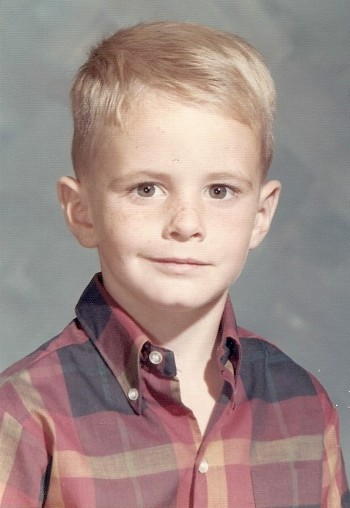 In this original BTB Investigation, we unveil the tragic story of Kirk Murphy, a four-year-old boy who was treated for “cross-gender disturbance” in 1970 by a young grad student by the name of George Rekers. This story is a stark reminder that there are severe and damaging consequences when therapists try to ensure that boys will be boys.
When we first reported on three American anti-gay activists traveling to Kampala for a three-day conference, we had no idea that it would be the first report of a long string of events leading to a proposal to institute the death penalty for LGBT people. But that is exactly what happened. In this report, we review our collection of more than 500 posts to tell the story of one nation’s embrace of hatred toward gay people. This report will be updated continuously as events continue to unfold. Check here for the latest updates.
In 2005, the Southern Poverty Law Center wrote that “[Paul] Cameron’s ‘science’ echoes Nazi Germany.” What the SPLC didn”t know was Cameron doesn’t just “echo” Nazi Germany. He quoted extensively from one of the Final Solution’s architects. This puts his fascination with quarantines, mandatory tattoos, and extermination being a “plausible idea” in a whole new and deeply disturbing light.
On February 10, I attended an all-day “Love Won Out” ex-gay conference in Phoenix, put on by Focus on the Family and Exodus International. In this series of reports, I talk about what I learned there: the people who go to these conferences, the things that they hear, and what this all means for them, their families and for the rest of us.
Prologue: Why I Went To “Love Won Out”
Part 1: What’s Love Got To Do With It?
Part 2: Parents Struggle With “No Exceptions”
Part 3: A Whole New Dialect
Part 4: It Depends On How The Meaning of the Word "Change" Changes
Part 5: A Candid Explanation For "Change"
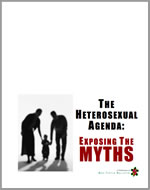 At last, the truth can now be told.
Using the same research methods employed by most anti-gay political pressure groups, we examine the statistics and the case studies that dispel many of the myths about heterosexuality. Download your copy today!
And don‘t miss our companion report, How To Write An Anti-Gay Tract In Fifteen Easy Steps.
 Anti-gay activists often charge that gay men and women pose a threat to children. In this report, we explore the supposed connection between homosexuality and child sexual abuse, the conclusions reached by the most knowledgeable professionals in the field, and how anti-gay activists continue to ignore their findings. This has tremendous consequences, not just for gay men and women, but more importantly for the safety of all our children.
Anti-gay activists often cite the “Dutch Study” to claim that gay unions last only about 1½ years and that the these men have an average of eight additional partners per year outside of their steady relationship. In this report, we will take you step by step into the study to see whether the claims are true.
Tony Perkins’ Family Research Council submitted an Amicus Brief to the Maryland Court of Appeals as that court prepared to consider the issue of gay marriage. We examine just one small section of that brief to reveal the junk science and fraudulent claims of the Family “Research” Council.
 The FBI’s annual Hate Crime Statistics aren’t as complete as they ought to be, and their report for 2004 was no exception. In fact, their most recent report has quite a few glaring holes. Holes big enough for Daniel Fetty to fall through.
“Google” is a trademark of Google Inc.
© Box Turtle Bulletin. All Rights Reserved.
 Posts
Posts  Posts via daily email: