Box Turtle Bulletin
 News and commentary about the anti-gay lobby
“Now you must raise your children up in a world where that union of man and box turtle is on the same legal footing as man and wife…”
News and commentary about the anti-gay lobbyFebruary 8th, 2012
 For the past 134 years The Living Church has been speaking to Episcopalians – especially those of the Anglo-Catholic “high church” wing – on matters of faith. In the January 29 edition, there is a fascinating article entitled “Tradition, Novelty, and the Need for Discernment” by David Newheiser, which reinspects what tradition has to say about same-sex marriage.
Those who appreciate a scholarly and thoughtful approach will enjoy this article. Here’s a taste:
The relevant question for faithful Christians is thus not whether Paul would have affirmed homosexual marriage: on the basis of the conceptual apparatus he had available, he would have been able to grasp neither the concept homosexual nor the Nicene affirmation that the Son is “of one substance” with the Father. Even if, as is likely, he would have been alarmed on both counts, this does not settle the issue, for the force of Paul’s teaching may point toward developments that he would not have expected. Just as Athanasius argued that the teaching of Scripture recommends ways of speaking that the authors of Scripture would not have recognized, it may be that the fidelity to tradition requires new ways of thinking about the status of same-sex unions.
I don’t always find that an article changes my perspective or opens new ways of thinking. But after reading Newheiser’s piece I came away with a new understanding of tradition.
Theological responses to same-sex marriage are no more longstanding and traditional than theological responses to online dating or sexting. Tradition is more than just “doing what we did before” when there is no “before” with which to compare. Rather, the church should utilize another tradition, that of applying discernment to questions before it. And that is, indeed, an old and established tradition.
February 8th, 2012
Those who are losing the battle to keep gay citizens relegated to second class status and denied civil equality have a new mantra: “they called me a bigot!”
And, as Rick Santorum illustrated in his comments about yesterday’s Ninth Circuit ruling upholding Judge Walker’s finding that Proposition 8 is a violation of the US Constitution, this claim need not have even the flimsiest of filaments of truth for the martyr’s song to be played.
http://www.youtube.com/watch?v=48t25kjIrBAThe Ninth Circuit decision yesterday said that marriage, if you believe in traditional marriage, between a man and a woman and exclusively that, you are in fact, the only reason you could possibly believe that, is because you are a bigot. That there is no rational basis for you to have marriage as an institution between a man and a woman. There, there’s no, no rational basis. Your belief of marriage between a man and a woman is purely irrational based on hatred and bigotry. That’s what they just wrote.
No. That’s not what they wrote. Not even close.
What the court said was that the State of California could not discriminate in the providing of services to gays and lesbians without a rational basis. And that a rational basis needed to be tied to a legitimate government goal. They didn’t say that any person who opposes equality is irrational, just that there was no legitimate goal which could be rationally tied to the proposition.
But even assuming that Santorum has forgotten anything that he may have incidentally picked up at law school (yeah, he actually went to law school) about rational basis and is every bit as stupid as he appears to be, he simply cannot justify the “hatred and bigotry” claim.
Actually, what the court said was:
Ultimately, the “inevitable inference” we must draw in this circumstance is not one of ill will, but rather one of disapproval of gays and lesbians as a class. “[L]aws singling out a certain class of citizens for disfavored legal status or general hardships are rare.” Romer, 517 Ë.Ã. at 633. Under Romer, we must infer from Proposition 8’s effect on California law that the People took away from gays and lesbians the right to use the official designation of ‘marriage’—and the societal status that accompanies it—because they disapproved of these individuals as a class and did not wish them to receive the same official recognition and societal approval of their committed relationships that the State makes available to opposite-sex couples.
This is an accurate assessment. Disapproval and a desire not to give the same official recognition. No reference to hatred or bigotry and no name calling at all.
Either Santorum is astonishingly stupid, an unabashed liar, or accidentally let slip his own personal motivations.
February 8th, 2012
The Washington State House of Representatives has just passed the marriage bill 55-43. Now it goes to Governor Chris Gregoire for signature.
Anti-equality activists have until June 2 to gather 120,000 valid signatures. If they do so, the bill will go to the voters for confirmation or repeal in November. If they do not, the bill becomes law and gay couples in Washington will gain equal status.
But marriage equality is not without it’s difficulties. Now poor devoutly Catholic little ol’ lady wedding cake bakers will have to shoulder the burden of figuring out how to market to the gay community without their priest finding out.
UPDATE:
Three Democrats voted no and two Republicans supported equality.
Rep. Maureen Walsh, R-College Place, said that the bill was a matter of equality.
“Why in the world would we not allow those equal rights to those individuals who are truly committed to each other in life?” she asked. She noted that her daughter told her she was gay a few years ago.
“Nothing’s different,” she said. “She’s still a fabulous human being. And some day, by God, I want to throw a wedding for that kid.”
And that is the true face of equality: Mothers saying, “when are you going to settle down and get married?” and “but you’ve always loved fuchsia and it makes such lovely a bridesmaids color.”
Kidding aside, i love being able to report bipartisan support for equality. It may only be two or three or four in each vote, but it means that we are making strides into the hearts of the people and that our rights and equality are judged less on partisan divisive deal-making or deal-breaking and more by the promises offered in our constitution.
But God I long for the day when “and it got Republican support” will be seen as peculiar and obvious.
February 8th, 2012
Three legislators have introduced a bill in the Illinois House to enact marriage equality. This bill, which comes a year after the state enacted Civil Unions, may not have been presented with the expectation of passage, but as a means to introduce the notion and begin conversation.
February 8th, 2012
This is how you do it:
February 8th, 2012
This NTV Uganda report quickly covers most of the clauses of the Anti-Homosexuality Bill, and, unusual for Ugandan media, focuses on opposition to the bill from Ladislaus Rwakafuzi, a senior human rights lawyer, and Pepe Julian Onziema of Sexual Minorities Uganda.
One interesting tidbit is the report that the Anti-Homosexuality Bill was referred again to the Legal and Parliamentary Affairs Committee. If true, that would be an interesting development. During the Eighth Parliament, the bill languished in the committee for more than a year before it was quickly rushed to the floor or Parliament with a report recommending a few cosmetic changes.
If this bill was in fact sent back to the same committee, it could mean one of two things: It could be bottled up there again as it was before, or the committee could quickly act to bring the bill back out to the floor for a final vote based on its earlier inconsequential recommendations. There is, right now, considerable pressure inside Uganda for the latter step, if for no other reason than as an act of defiance against international condemnation.
February 8th, 2012
Auntie Beeb is recklessly confused again:
The BBC’s Joshua Mmali in the capital, Kampala, says Mr Bahati, the primary backer of the bill, has confirmed the draft legislation has changed in one fundamental way.
Those found guilty of “aggravated homosexuality” – defined as when one of the participants is a minor, HIV-positive, disabled or a “serial offender” – would no longer face the death penalty, as originally proposed.
No no no no no no NO! A thousand times no! The death penalty has not been dropped!
The bill’s proponents have been claiming that line for more than two years, even though no action has been taken whatsoever to remove the provision. The BBC has done this before, and they’ve allowed blatantly false statements by M.P. David Bahati, the bill sponsor, go unchallenged. They were wrong then and they are wrong now. It’s incredible that such irresponsible and incompetent reporting can persist in the mainstream media.
But then, what do you expect of a news organization which asks the question, “Should homosexuals face execution?”
February 8th, 2012
The St. Petersburg city legislature passed the second of three readings today a bill which prohibits “public actions aimed at promoting sodomy, lesbianism, bisexuality, and transgender minors” and the “uncontrolled dissemination of public information” including “misconceptions about the social equivalence of traditional and nontraditional marriage.” On the second reading, the bill approved today includes fines that are significantly higher than those provided in the original bill. Individuals convicted under the law will be fined 5,000 rubles (US$167) and organizations will be fined 500,000 rubles (US$16,698), a figure which will effectively shut down St. Petersburg’s LGBT organizations including a prestigious international film festival. The vote was 31-6.
February 8th, 2012
 It was a huge night for Sen. Rick Santorum, whose triple-play win last night seems to show that Republican primary voters and caucus voters are still looking for that anybody-but-Mitt candidate. And it was that dissatisfaction with the presumptive nominee that allowed Santorum to dominate the field like a man on a dog.
In Missouri’s primary, Santorum captured his biggest win with 55% of the vote, more than twice as much as Gov. Mitt Romney’s 25% showing. Rep. Ron Paul came in at 12%, and 4% selected “uncommitted,” which can be read either as a Newt Gingrich vote (Gingrich failed to qualify for Missouri’s ballot) or as “none of the above.” Santorum scored a total shutout in Missouri, winning every single county in the state.
Missouri’s primary election is an oddity. There are no delegates up for grabs. In fact, the voting there is largely meaningless because the delegates won’t be selected until the state party convention on April 21, and there is no relationship between last nights votes and how the party’s state delegates are ultimately chosen. Missouri GOP leaders are free to heed or ignore last night’s vote altogether. So how well last night’s results will translate into delegates remains an open question.
But in the Minnesota and Colorado caucuses, the fight for delegates was real, and Santorum had a similarly spectacular night there as well. In Minnesota, Santorum pulled in 45% of the vote and six delegates. Paul came in second with 27% of the vote (3 delegates), followed by Romney at 17% (2 delegates) and Gingrich at 11% (1 delegate). Yes, you read that right: Paul beat Romney in Minnesota. And like in Missouri, Romney didn’t win a single county in Minnesota either.
But the real surprise was Colorado, where Romney was expected to do well. Instead, Santorum took the state with 40% of caucus voters (earning 5 delegates) against Romney’s 35% (4 delegates), followed by Gingrich’s 13% (2 delegates) and Paul’s 12% (1 delegate).
The worst loser of the night would have to be Gingrich. He had a terrible showing, which is bound to have an impact to his already troubled fundraising. Santorum, on the other hand, may be able to use these wins to convince Republican voters to give him another look — and GOP anybody-but-Mitt donors somewhere else to put their money.
But speaking of money, Romney’s drubbing shows that there are limits to how far nearly-unlimited financial resources can go. Romney’s win last week in Florida had pundits believing that it was now his election to lose. It now looks like Midwesterners are thinking maybe he should. Lose, that is.
February 8th, 2012
TODAY’S AGENDA:
Washington House to Vote on Same Sex Marriage: Olympia, WA. The Washington House of Representatives this afternoon will take up S.B. 6239, the bill to provide marriage equality in the Evergreen State, beginning at 1:00 p.m. PST. Rep. Jamie Pedersen (D-Seattle) says the has 54 to 56 votes to pass the bill in the 98 member house. The same bill passed the state Senate last week on a 28-21 vote. Gov. Chris Gregoire has promised to sign the measure into law when it reaches his her desk, while anti-gay opponents vow to collect the 120,000 signatures needed by the June 6 deadline to prevent the law from taking effect and place a referendum to overturn it on the November 6 ballot.
Russian “Ban-The-Gay” Bill Returns for Final Reading: St. Petersburg, Russia. The proposed anti-gay law prohibiting “public actions aimed at propaganda of pederasty, lesbianism, bisexuality, and transgenderism among minors” is expected to be brought up today in St. Petersburg’s city legislature today for the second, and possibly final, hearing. If passed, the bill will outlaw all public events by or on behalf of LGBT people, and will severely restrict publicizing anything related to LGBT rights or providing assistance. Similar laws have been passed in Kostroma, Ryazan and Arkangelsk regions. There have been reports that the Moscow city government and the Russian State Duma may consider similar bills.
Celebrations This Weekend: Belgian LGBT Film Festival, Brussels, Belgium; Regenbogenball (Rainbow Ball), Vienna, Austria; Whistler Ski Week, Whistler, BC.
If you know of something that belongs on the agenda, please send it here. Don’t forget to include the basics: who, what, when, where, and URL (if available).
And feel free to consider this your open thread for the day. What’s happening in your world?
February 7th, 2012

A Mormon family with two wives and nine children, about 1889
The LDS Church has responded to the Prop 8 ruling:
The Church of Jesus Christ of Latter-day Saints regrets today’s decision. California voters have twice determined in a general election that marriage should be recognized as only between a man and a woman. We have always had that view. [Emphasis mine.]
Ahem.
February 7th, 2012
M.I.A.
Jim,
I hate to say it, but I’m not surprised…
The courts have ruled against the Family once again.
California’s Proposition 8, the ballot referendum to preserve real marriage as one man and one woman, has been ruled illegal by the 9th Circuit Court of Appeals.
But it’s not over yet my friend.
Allies of the Family are already moving to appeal this decision to a higher court.
…I am proud to say that Public Advocate will be standing by to assist them in any way possible in the coming months and years.
Right. I’m sure your allies are waiting breathlessly by the phone for your assistance. As far as I can tell, he’s had zero involvement in California. Nevertheless…
P.S. Please prayerfully consider chipping in with a donation of $10 or more to help Public Advocate fight for traditional values.
February 7th, 2012
Mitt Romney does it old school, via a press relase:
“Today, unelected judges cast aside the will of the people of California who voted to protect traditional marriage. This decision does not end this fight, and I expect it to go to the Supreme Court. That prospect underscores the vital importance of this election and the movement to preserve our values. I believe marriage is between a man and a woman and, as president, I will protect traditional marriage and appoint judges who interpret the Constitution as it is written and not according to their own politics and prejudices.”
Newt Gingrich, via Twitter:
“Court of Appeals overturning CA’s Prop 8 another example of an out of control judiciary. Let’s end judicial supremacy”
Rick Santorum, also via Twitter:
“7M Californians had their rights stripped away today by activist 9th Circuit judges. As president I will work to protect marriage.”
Ron Paul:
“…“
Press Secretary Jay Carney on behalf of President Obama:
“I’m not going to comment on litigation particularly as here where we are not party to it, but the president’s positions on these issues writ large are well known, and he’s long opposed divisive and discriminatory efforts to deny right and benefits to same-sex couples.”
On the flip side, former GOP Presidentical candidate, current Libertarian Party Presidentical candidate and former New Mexico Gov. Gary Johnson tweeted:
“Prop 8 – Sometimes a Court gets it right”
February 7th, 2012
There has been speculation (including my own) that New Hampshire Republicans don’t want to stir a hornets nest and reverse a marriage law that has been accepted and is now supported by a strong majority of New Hampshire residents. So far, they have avoided the issue by being far too occupied with advancing legislation that they believe will help their economy.
But now the Ninth Circuit Court of Appeals may have given them an ideal excuse. They can now say that while they had no obligation to advance marriage equality, now that the state has done so taking it away is an impermissible violation of the Fourteenth Amendment. So until that has been addressed by the Supreme Court, they’d best not reverse the law.
If, as I am guessing, they are looking for an excuse. And I rather suspect that our allies in the Democratic Party have already mentioned it.
February 7th, 2012
Here are the key points from the decision of the Ninth Circuit Court of Appeals upholding Judge Walker’s finding that Proposition 8 violates the Fourteenth Amendment of the US Constitution.
Standing and Recusal
Because the State of California, via the state Supreme Court, has found that the Proponents have standing then the Ninth will respect that decision.
Judge Walker had no need to recuse himself simply because he is gay and may at some point wish to marry.
These decisions were unanimous.
Impact on marriages
This is a decision that effects California only. The unique circumstances in the state allowed for a narrow focus.
Marriages do not resume. The stay on the ruling remains while the Proponents appeal this decision on up the ladder.
The scope
The decision does not discuss whether denying of marriage violates the Constitution, but only whether taking away marriage is a violation. It notes that “Whether under the Constitution same-sex couples may ever be denied the right to marry, a right that has long been enjoyed by opposite-sex couples, is an important and highly controversial question” but does not seek to answer that question.
The court did not look beyond a ‘rational basis’ to determine their decision. No protected class status was considered.
Proposition 8 violated the Equal Protection Clause of the US Contitution.
What the case is about
The only impact of Proposition 8 was to carve out a narrow exception to the constitutional rights of gay people, restricting the designation of the word “marriage”. All sides agree that there is a unique meaning and special value to the designation “marriage”.
The Ninth focused on that very limited exclusion – the nomenclature – not to minimize the impact of Prop 8 but to understand it’s very significant value: “That designation is important because ‘marriage’ is the name that society gives to the relationship that matters most between two adults.” The state-enacted incidences of marriage are not it’s defining characteristics; the state applies rules based on marriages but these are only “manifestations of the recognition that the State affords.”
The best line: “Had Marilyn Monroe’s film been called How to Register a Domestic Partnership with a Millionaire, it would not have conveyed the same meaning as did her famous movie, even though the underlying drama for same-sex couples is no different.”
The most important statement of what marriage is:
The official, cherished status of ‘marriage’ is distinct from the incidents of marriage, such as those listed in the California Family Code. The incidents are both elements of the institution and manifestations of the recognition that the State affords to those who are in stable and committed lifelong relationships. We allow spouses but not siblings or roommates to file taxes jointly, for example, because we acknowledge the financial interdependence of those who have entered into an “enduring” relationship. The incidents of marriage, standing alone, do not, however, convey the same governmental and societal recognition as does the designation of ‘marriage’ itself. We do not celebrate when two people merge their bank accounts; we celebrate when a couple marries. The designation of ‘marriage’ is the status that we recognize. It is the principal manner in which the State attaches respect and dignity to the highest form of a committed relationship and to the individuals who have entered into it.
The logic
There were three arguments presented for establishing the unconstitutionality of Prop 8: 1) Due Process guarantees the fundamental right to marry; 2) excluding same-sex couples but allowing opposite sex couples is a violation of Equal Protections; 3) the Equal Protections Clause protects minority groups from being targeted for the deprivation of existing rights.
The third argument is by far the most narrow. And the Appeals Court held to the principle that if a more narrow decision can resolve the issue, that the broader questions which might apply to more circumstances are left unanswered.
The Ninth found the removal of existing rights to be an important question. “The context matters. Withdrawing from a disfavored group the right to obtain a designation with significant societal consequences is different from declining to extend that designation in the first place, regardless of whether the right was withdrawn after a week, a year, or a decade. The action of changing something suggests a more deliberate purpose than does the inaction of leaving it as it is.”
And this characteristic made it uniquely applicable to the Romer decision (Colorado’s Amendment 2). This commonality is that it need not be a fundamental right that is selectively taken away (non-discrimination policies are not guaranteed by the constitution); it need only be that an existing privilege be curtailed to harm a politically unpopular group. Having enjoyed an equal status, a group cannot be selected for removal of that status.
The court looked at four possible reasons for the state to remove the rights of gay persons to marry: : (1) furthering California’s interest in childrearing and responsible procreation, (2) proceeding with caution before making significant changes to marriage, (3) protecting religious freedom, and (4) preventing children from being taught about same-sex marriage in schools.
But here is where the actual impact of Proposition 8 comes into play. In order to be rationally related to the [after the fact created] goals of the Proponents, Proposition 8 would have had to had some impact on the laws relating to those goals. It did not. Thus it simply isn’t rational to think that relegating gay people to a lesser status would accomplish responsible procreation.
And as the circumstances are not about allowing marriage but in taking it back, the question of rational reason changes. It may be possible that the state could believe that granting special rights to heterosexuals might add luster to the institution of marriage and thus further the state’s interest in responsible procreation. But to argue that luster is added to the institution by kicking gays out is merely animus, not rational thought.
Proceeding with caution certainly had no relationship to Prop 8. It was not a cautious consideration of whether marriage equality had merit, but a post-haste removal of rights.
Protecting religious freedom has even less reality as a basis; the objections over religious freedom related to non-discrimination laws – which, incidentally, require that domestic partnerships be given the same consideration as marriage. Similarly, what is taught in schools was not impacted by Prop 8; those are education code issues.
Which only leaves disapproval of gay people as a class as the basis for Prop 8’s passing. Which is something that every one of us knows, regardless of what the lawyers say.
And, as Lawrence notes, laws designed to place gay people on a lesser status are an invitation to subject them to public and private discrimination. Such laws enact nothing more or less than a judgment about the worth and dignity of gays and lesbians as a class. Which is not a legitimate government interest.
Dissent
Judge Randy Smith (Republican, Mormon) agreed on the standing and recusal issue but not on the unconstitutionality of Proposition 8. However, what is most notable in his dissent is that it feels tentative and hesitating and rather than blast the majority for their views, Smith just isn’t ready to agree.
Ultimately, I am not convinced that Proposition 8 is not rationally related to a legitimate governmental interest. I must therefore respectfully dissent.
There is not a single sentence that demeans gay people or even suggests that same-sex marriage is in any way an undesirable goal. And he doesn’t put up a fiery defense.
He notes that the circumstances of Proposition 8 are not identical to 1971’s Baker case. He notes that a federal court challenge to the State’s powers to regulate marriage can be appropriate (quoting Loving). And he notes that the question is whether there is any rational foundation for the discrimination.
Interestingly, Smith quotes many of the same passages as the majority. And he seems to agree with many of the terms of the debate: the narrow scope, that animus played a role, that this is a situation of the removal of existing rights. However, he reaches a different conclusion; or, at least, is not brought to the same one.
The question he seeks to answer is
… whether withdrawing from same-sex couples the right to access the designation of marriage, alone, rationally relates to the responsible procreation and optimal parenting rationales.
Smith answers it this way:
Here, the people of California might have believed that withdrawing from same-sex couples the right to access the designation of marriage would, arguably, further the interests in promoting responsible procreation and optimal parenting.
It doesn’t matter that the assumptions are erroneous, he states, just arguable. He recognizes that the assumptions are based partly in bias, but still gives broad leeway to the presumption of validity.
Smith’s error is, I believe, in applying rules relating to a distinct and measurable body of legislature to a broad nebulous 14 million voter population. They are not the same.
A legislative body may well consider factors such as responsible procreation and the responsibilities of the state. But voters do not consider themselves to be “the state” and pay little attention to its responsibilities. They simply address the culture and their desires to expand or limit their neighbors’ abilities to do things.
To assume that some significant percentage of the voters might have believed that withdrawing from same-sex couples the right to access the designation of marriage would further the interests in promoting responsible procreation and optimal parenting requires a suspension of disbelief that exceeds anything any sci-fi movie promoter might dream of. This is not just unrealistic, but laughably so.
But that is what Smith presents.
In totality, it comes across as, “Well, I see your point, and gosh, but I’m just not sure, guys. Let’s have restraint. Let’s not rock the boat.”
Other interesting items of note
The Ninth confirmed (or noted, perhaps) that because the California voters had passed an amendment to the civil code limiting marriage to one man and one woman, the legislature could not enact equality, thus validating Gov. Schwarzenegger’s position.
They note that prejudice need not be based in animus. It may simply be based in long-standing sincerely held private beliefs. It’s the difference between disapproving of someone and wishing them harm. They concluded that Californians did not enact Proposition 8 out of ill will, simply out of disapproval of gays and lesbians as a class. This is an interesting distinction. It takes the wind out of NOM’s “they call us bigots” claim.
None of them wanted to take on or even discuss the merits of Olson/Boies’ argument that stricter scrutiny is called for in anti-gay discrimination cases.
Featured Reports
 In this original BTB Investigation, we unveil the tragic story of Kirk Murphy, a four-year-old boy who was treated for “cross-gender disturbance” in 1970 by a young grad student by the name of George Rekers. This story is a stark reminder that there are severe and damaging consequences when therapists try to ensure that boys will be boys.
When we first reported on three American anti-gay activists traveling to Kampala for a three-day conference, we had no idea that it would be the first report of a long string of events leading to a proposal to institute the death penalty for LGBT people. But that is exactly what happened. In this report, we review our collection of more than 500 posts to tell the story of one nation’s embrace of hatred toward gay people. This report will be updated continuously as events continue to unfold. Check here for the latest updates.
In 2005, the Southern Poverty Law Center wrote that “[Paul] Cameron’s ‘science’ echoes Nazi Germany.” What the SPLC didn”t know was Cameron doesn’t just “echo” Nazi Germany. He quoted extensively from one of the Final Solution’s architects. This puts his fascination with quarantines, mandatory tattoos, and extermination being a “plausible idea” in a whole new and deeply disturbing light.
On February 10, I attended an all-day “Love Won Out” ex-gay conference in Phoenix, put on by Focus on the Family and Exodus International. In this series of reports, I talk about what I learned there: the people who go to these conferences, the things that they hear, and what this all means for them, their families and for the rest of us.
Prologue: Why I Went To “Love Won Out”
Part 1: What’s Love Got To Do With It?
Part 2: Parents Struggle With “No Exceptions”
Part 3: A Whole New Dialect
Part 4: It Depends On How The Meaning of the Word "Change" Changes
Part 5: A Candid Explanation For "Change"
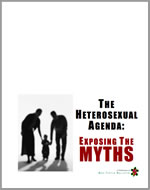 At last, the truth can now be told.
Using the same research methods employed by most anti-gay political pressure groups, we examine the statistics and the case studies that dispel many of the myths about heterosexuality. Download your copy today!
And don‘t miss our companion report, How To Write An Anti-Gay Tract In Fifteen Easy Steps.
 Anti-gay activists often charge that gay men and women pose a threat to children. In this report, we explore the supposed connection between homosexuality and child sexual abuse, the conclusions reached by the most knowledgeable professionals in the field, and how anti-gay activists continue to ignore their findings. This has tremendous consequences, not just for gay men and women, but more importantly for the safety of all our children.
Anti-gay activists often cite the “Dutch Study” to claim that gay unions last only about 1½ years and that the these men have an average of eight additional partners per year outside of their steady relationship. In this report, we will take you step by step into the study to see whether the claims are true.
Tony Perkins’ Family Research Council submitted an Amicus Brief to the Maryland Court of Appeals as that court prepared to consider the issue of gay marriage. We examine just one small section of that brief to reveal the junk science and fraudulent claims of the Family “Research” Council.
 The FBI’s annual Hate Crime Statistics aren’t as complete as they ought to be, and their report for 2004 was no exception. In fact, their most recent report has quite a few glaring holes. Holes big enough for Daniel Fetty to fall through.
“Google” is a trademark of Google Inc.
© Box Turtle Bulletin. All Rights Reserved.

 Posts
Posts  Posts via daily email: