Box Turtle Bulletin
 News and commentary about the anti-gay lobby
“Now you must raise your children up in a world where that union of man and box turtle is on the same legal footing as man and wife…”
News and commentary about the anti-gay lobbyJune 29th, 2010
The Greater Phoenix Gay and Lesbian Chamber of Commerce is not pleased that the Human Rights Campaign is discouraging gay individuals and couples from traveling to Arizona or doing business with Arizona gay businesses. And they have been frustrated in their attempts to get HRC to consider their concerns. (FoxNews)
“They haven’t even read SB 1070. … They don’t even really know what’s going on around here,” Joseph Gesullo, chairman of the Phoenix gay chamber, said of the organizations calling for boycotts. “It’s really just hurting the people of Arizona.”
Gesullo has been able to negotiate with another group, the National Gay and Lesbian Chamber, who has expressed support for Arizona’s gay business operators.
But Gesullo said the Human Rights Campaign has “absolutely” resisted requests to tone down the boycott. He accused the group of kowtowing to Latino advocacy groups as well as the Service Employees International Union and expressed concern that the move would discourage gay and lesbian couples from visiting Arizona. That, in turn, hurts the hundreds of Phoenix businesses that count themselves as chamber members, he said.
And Gesullo may not be completely incorrect.
[Human Rights Campaign spokesman Fred Sainz] denied that the Human Rights Campaign launched the boycott just because the SEIU wanted it, but said there’s nothing wrong with working as a “coalition.” He said there’s a strong connection between those who support Arizona’s immigration law and those “who would bring similar harm” to the gay, lesbian, bisexual and transgender community.
While I’m not sure a boycott will have any effect on businesses or interests that oppose gay equality, it is likely to keep away many who might shop in a gay business or contribute to a gay cause.
It is always fascinating when gay organizations put the interests of outside members of a coalition ahead of the interests of gay individuals and organizations. I wonder if those coalition partners would do the same?
June 29th, 2010

When the Kansas City Star ran a web article about NY gay pride accompanied by a photo of a nude man on a bike in San Francisco, I wrote to the Star to express my discontent. Derek Donovan, the Readers’ Representative responded to clarify how the picture came to be and to give me a little lesson about what is an appropriate illustration for gay pride.
I did not agree.
Here is my less-than-friendly original comment:
Really, KC Star?
The best possible picture to accompany a story about this year’s gay pride parade in New York City was a picture of a nude guy on a bike from last year’s pride in San Francisco? What kind of irresponsible hateful jerk decided to try and trash gay people universally by tying this picture to the entire community? I’m sure he’s really proud of his little homphobic effort
Here is Mr. Donovan’s much-more-polite response:
Dear Mr. Kincaid,
The letters editor shared your note with me, since it pertains to how The Star covers the news. That photo came directly from The Associated Press, where it was posted online automatically. When a Web editor at KansasCity.com noticed it, he removed it. Wire content rotates in and out of KansasCity.com automatically every day without an editor’s hand, as it does on many news sites.
However, I’m going to play devil’s advocate here. That man in the photo was indeed a participant in the pride parade, as were a number of others in skimpy and outlandish costumes. It’s the journalist’s job to document what goes on — and that includes images that some people don’t want to see. A column from the National Gay and Lesbian Journalists Association says:
“Some photojournalists may feel like ignoring the femme boys, the butch girls and all those drag queens on Rollerblades. That’s just as wrong as making them the entire focus of coverage.”
Full column:
http://www.nlgja.org/publications/articles/dotinga_pride.htm
Some gay people love pride events, and others disdain them. Some are ambivalent. The Society of Professional Journalists’ code of ethics says to “Tell the story of the diversity and magnitude of the human experience boldly, even when it is unpopular to do so.”
The bottom line (no pun intended) is that the man in the photo chose to appear nude in the parade. And again, an editor removed the image when he saw it. I don’t really think the word “homophobic” is applicable here, but I will include your comments in my weekly report to the publisher, vice presidents and the entire newsroom.
Best wishes,
Derek Donovan
Readers’ representative
The Kansas City Star
And this is my rebuttal
Derek,
Thank you for your response. And let me state up front that I am appreciative of the Star’s decision to remove the deceptive picture from accompanying and illustrating your article.
However, in playing devil’s advocate, I think you failed to closely read your own position or apply it to the situation.
Yes, the NGLJA does advise:
“Some photojournalists may feel like ignoring the femme boys, the butch girls and all those drag queens on Rollerblades. That’s just as wrong as making them the entire focus of coverage.”
In other words, don’t color the story to portray a false impression. The man on the bike, as the only picture provided, became the entire focus of coverage. He became the sole image of Gay Pride, regardless of the fact that the article was about the New York gay pride parade – and he was from an entirely different type of gay pride parade 3,000 miles away (New York and San Francisco have sharply different gay cultures and their parades have both different messages and different meaning).
And NGLJA follows that advice with this:
“Photos that only show stereotypical images of gays and lesbians without reflecting the diversity of our community have rightly caused anger for many years,” Poller said. “But at the same time, it’s good to remember what the day is about, what the event feels like. Pride is loud and boisterous and fun, and the published photos should reflect that.”
Was that picture loud, boisterous or fun? No. Only to the person who got a chuckle from tying this image to the gay community as a whole.
And was it honest, true or a fair representation of pride? Again, no.
Readers had no way to know that this man on his bike was extremely atypical for gay pride parades. Indeed, he would not have been allowed to ride nude in the vast overwhelming number of pride parades, including the subject of your article.
The Society of Professional Journalists’ code of ethics says to “Tell the story of the diversity and magnitude of the human experience boldly, even when it is unpopular to do so.”
This picture did not tell the story of diversity and magnitude. This was not an inclusive photograph showing several floats, a marching band or two, some drag queens, and a few go-go dancers. Rather this was a picture that focused on a single individual and, by default, portrayed him as representative.
Based on the criteria you stated, the AP – and the Star – failed miserably.
And I’m troubled by your failure to see the problem with the decision to use this photograph. This was not an accidental happenstance.
Yes, the man in the photo chose to appear nude in the parade. But someone else chose to photograph him, to put him on the wire, and to allow the picture to represent gay pride.
To understand my point, ask yourself this question: would you not feel shame for accompanying a story about the MLK march or Saint Patrick’s Day parade or the Lotus festival with a picture that sought to stereotype the participants in a negative way? Would you not be embarrassed if the coverage of a Tea Party rally deliberately pictured a person who, say, was missing teeth?
We would recognize these images as attempts to demean. And they would be.
So let’s not pretend that there was no intent on someone’s part to portray gay people and gay pride parades in as outlandish a way as possible. To do so discredits an otherwise credible response.
Again, thank you for your reply. I am taking the liberty of sharing it with my readers.
Timothy Kincaid
June 29th, 2010
Alexis Okeowo at Vanity Fair discloses:
Though widespread international criticism, especially from the United States, derailed the bill in its original form and forced Uganda to drop its death-penalty provision, parliament is set to discreetly pass amendments that would prevent all residents and local and international non-profit organizations from “promoting,” advocating, or associating any of their activities with homosexuality.
The punishment would effectively end all health and sexuality programs geared towards gays and lesbians, allow the government to round up and punish activists at will, and make it essentially illegal for gays to exist.
“I don’t think it’s going to be withdrawn, I don’t think it’s going to stay on the shelves, I think it’s going to pass,” [LGBT Advocate Frank] Mugisha tells me bluntly and calmly as he sips from his soda at an open-air bar in Kampala, the capital of Uganda. “We know now that they’re working on something new—they want to water the bill down and raise it again in a new form.” The bill’s most controversial elements—those criminalizing sexual practices or an H.I.V./AIDS diagnosis—are being scrapped to deflect the attention of critics so that the rest of the bill can pass. Parliament, which opened in early June, will be discussing the measure this week.
This appears to confirm earlier reports suggesting that Uganda’s political leaders will try to pass portions of the draconian Anti-Homosexuality Bill quietly and in piecemeal form so as to escape notice from critics. One report indicated that the Cabinet subcommittee tasked with examining the bill observed that Clause 13, the section outlawing “promotion of homosexuality” had “some merit.” It is this provision that health care workers point to as potentially criminalizing providing health services to LGBT people.
The fact that Parliament is expected to take up the measure again this week suggests that, despite the Cabinet’s recommendations, the bill has experienced a new lease on life. Jeff Sharlet, author of The Family: The Secret Fundamentalism at the Heart of American Power, recently wrote that the bill’s sponsor, David Bahati, along with his assistant, Pastor Julius Oyet, were “ecstatic at what they perceived as [American pastor Lou] Engle’s strong support of the bill.” Their ecstasy was stoked by Engle’s rally in Kampala held on May 2. Engle is on record as supporting criminalization of homosexuality, along with measures “to not allow it to be legalized, so to speak, so then it just spreads through the legal system of the nation.”
June 29th, 2010
In yesterday’s commentary about the Christian Legal Society’s attempts to get recognition by Hastings Law School, I noted that the Supreme Court seems to have identified gay people not in terms of behavior but as a distinct class of people:
The court confirmed its position that attempts to differentiate between behavior and identity (in religious terms, “love the sinner, hate the sin”) as distinctions without difference
…
While it may be premature and reaching to draw such a conclusion, it appears that the court seems to be in agreement that sexual orientation is a matter of people and not a matter of behavior.
It appears that Ted Olson, lead Theodore Boutrous, counsel in Perry v. Schwarzenegger, made the same observation. He has written a letter to Judge Walker advising him of the court’s decision and encouraging him to consider it in his decision whether to find Proposition 8 to be in violation of the US Constitution.
In Christian Legal Society, the Supreme Court definitively held that sexual orientation is not merely behavioral, but rather, that gay and lesbian individuals are an identifiable class. Writing for the Court, Justice Ginsburg explained: “Our decisions have declined to distinguish between status and conduct in this context.” Slip op. at 23 (citing Lawrence v. Texas, 539 U.S. 558, 575 (2003); id. at 583 (O’Connor, J., concurring in judgment); Bray v. Alexandria Women’s Health Clinic, 506 U.S. 263, 270 (1993)). This confirms that a majority of the Court now adheres to Justice O’Connor’s view in Lawrence, where she concluded that “the conduct targeted by [the Texas anti-sodomy] law is conduct that is closely correlated with being homosexual” and that, “[u]nder such circumstances, [the] law is targeted at more than conduct” and “is instead directed toward gay persons as a class,” id. at 583 (O’Connor, J., concurring in judgment) (emphasis added). See also Romer v. Evans, 517 U.S. 620 (1996) (treating gay and lesbian individuals as a class for equal protection purposes). The Court’s holding arose in response to Christian Legal Society’s argument that it was not discriminating on the basis of sexual orientation, but rather because gay and lesbian individuals refused to acknowledge that their conduct was morally wrong. The Court rejected that argument, holding that there is no distinction between gay and lesbian individuals and their conduct.
Poor ProtectMarriage. Almost all of their witnesses had to be pulled after failing miserably in depositions (one was called as a witness for the plaintiffs). Their sole witness was unqualified and actually hurt their cause. They had to change their “reason” for the proposition time after time (including within closing arguments). And now their argument against heightened scrutiny just skipped out the door.
If they weren’t defending discrimination based on animus and founded in a smug assumption of superiority, I might almost feel sorry for the supporters of Proposition 8.
June 29th, 2010
 The New York Democratic leadership is at war. With itself. Again.
This time Governor Paterson and the legislature are battling over control of the state’s budget. Paterson, a Democrat, is vetoing spending and tax hikes while the House and Senate, led by Democrats, fear that Paterson’s methods will set a precedent that will shift power to future governors. And as the Democratic Party holds a very narrow majority in the Senate, any defections can turn the whole thing over to Republicans in the Senate to advance their spending priorities.
So Ruben Diaz, one of the less ethical players in Albany, has taken opportunity of the situation and threatened to deny his vote to Democrats in the legislature unless he be allowed to dictate tax policy for gay couples.
Same-sex marriages conducted in New York State are not recognized. However, if another state allows same-sex marriage, then New York will honor and recognize that marriage. Thus, those who marry in Connecticut, Vermont, Massachusetts, New Hampshire, Washington D.C., or Iowa can return home as a happily married couple.
But that doesn’t mean that all things are equal. For example, couples do not have the right in the State of New York to file a joint tax return. The state says, in effect, “Yes, we recognize that you are a married couple, but lie and tick the “single” box and pay the higher tax rate.”
So Assemblyman Daniel O’Donnell proposed an amendment to the appropriations bill to allow legally recognized same-sex married couples to file their state income taxes in exactly the same manner as opposite sex couples. Well that was just too much for Senator Diaz.
Because Diaz answers to his God. Or his ego… which might be the same thing. But anyway, his theocratic impulses tell him that God wants gay people to pay higher taxes.
“That’s something I’m not comfortable with and we are working on it,” said Sen. Ruben Diaz Sr., concerned about a provision allowing married same-sex couples to file joint tax returns. “Right now we are working something out….we have 32 Democratic senators. Next year we may have 34. We might have 30. Next year things might change. As long as we have 32, as long as we have 32, each member should be respected.”
Earlier, Diaz Sr. stormed out of conference saying “stupid, stupid, stupid.” A few minutes after saying the above, he said he had the provision excised from the budget bill.
As usual, the leadership caved to Diaz.
June 29th, 2010
 Alan P. Medinger, former Executive Director of Exodus International (the office’s title has now been changed to President) and former Executive Director of Baltimore/Washington-based Regeneration Ministry passed away on Monday morning. He is survived by his wive, Willa, two daughters and a son, and several grandchildren.
Medinger is probably best known for his book, Growth into Manhood: Resuming the Journey
For me, a couple of those factors were decisions that I made quite early in life. I have a vivid memory of lying in bed one night as a young boy, listening to my parents fight, and saying to myself quite smugly, “They can never hurt me. No one will ever hurt me.” I believe that I made a decision that night to never be emotionally vulnerable. As a consequence of that decision, until my conversion years later, I would never be free to truly love anyone.
Medinger claimed to have experienced a sudden, miraculous “healing” from homosexuality on November 26, 1974 as a result of prayer. He started Regeneration in 1979. He was the first Executive Director of Exodus International, and he held that position until 1985.
In Medinger’s writings, he would occasionally reference several of the more unsavory characters in the anti-gay political movement. In Growth into Manhood, he refered to Holocaust revisionist Scott Lively’s book, The Pink Swastika, as source material for evidence of the “super-warrior” type of gay man:
Another type is the man who exalts manhood to the extreme. At the same time, he denigrates womanhood, and as an outgrowth of this, he sees a man (usually a younger man or teenage boy) as a more desirable sexual partner. This type of man seldom shows any deficit in manhood. To the contrary, he may be the warrior or super-man type. This phenomenon was seen in the ancient Greeks and Romans and more recently in the Nazis. There may be an element of love for the younger man who is the object of the older man’s attractions, but the older man seems driven by male idolatry rather than gender emptiness.
The core thesis of Lively’s book is that homosexuality was at the root of the Nazi party, and that the natural consequence of equal rights for LGBT people in society would be the return of violent fascism. This theme, which has been rejected by every reputable historian, is the relentless focus of the entire book.
Medinger also cited discredited “researcher” Paul Cameron, for example, in this Regeneration newsletter of 1994 in which he cited Cameron’s widely discredited “obituary study” to claim that gay men only live, on average, to age 41.
A multi-part video interview series with Michael Bussee, co-founder of Exodus International turned critic.
June 29th, 2010
Even today Exodus ministries are somewhat of a free-for-all. Operating under the guise of “pastoral counseling” lay ministry leaders at Exodus programs are free to engage in pseudo-therapy as well as a slew of religious exercises from distributing testimonials at gay bars to exorcisms.
In today’s video Exodus International co-founder Michael Bussee explains that at the time of Exodus’ founding he had the most formal mental health training of anyone in the organization… he was in a masters program. Bussee admits his program at Exodus was successful at creating a safe, confidential, therapeutic environment but he never successfully found the secret to making people straight.
Lastly, Bussee details what he believed went on at Exodus’ various other member ministries across the country.
[full transcript after the jump]
June 28th, 2010
The Texas GOP needed 632 words to talk about all the many ways they want to legislate against LGBT Texans, including the reimposition of laws to throw gay people in jail. Which just goes to show what we’ve always known about Texans: they’re full of hot air. Montana’s GOP essentially says the same thing, but displays the directness and economy of words that the folks in Big Sky country are known for:
Homosexual Acts
We support the clear will of the people of Montana expressed by legislation to keep homosexual acts illegal.
There’s a silver lining though. They don’t seem interested in jailing anyone who conducts a same-sex marriage ceremony. But looking at the bigger picture, those mere twenty words are still saying the same thing. They want your gay butt in jail.
June 28th, 2010
It seems that the National Organization of Marriage has been gradually slipping off message. Long pretending that “we don’t hate homosexuals”, NOM tried to keep up the image that they were just opposed to same-sex marriage (for the children, you know). But it seems that Maggie Gallagher and Brian Brown have found the effort of appearing pleasant to be daunting (or perhaps less financially fulfilling) because recent comments seem to be veering closer and closer to plain old anti-gay animus and playground meanness.
Now Jeremy at Good_As_You has (along with blogger Matt Algren) identified an affiliation between NOM and their new strategist, anti-gay activist Louis J. Marinelli III. The language and claims of Mr. Marinelli bring NOM into a whole new category. Here are a few of the tweets that Marinelli has recently made on NOM’s behalf.
Those who wish to promote homosexual behaviour are encouraging people to shorten their life spans. Homosexuality is not a healthy lifestyle.
(We debunked the “shorten lives” claim)
#nevertrust activists of the homosexual agenda – they are deceitful people who care only about themselves and not what’s best for society!
It is clear that Maggie and Brian have decided to link their organization to the most radical and extreme segments of the anti-gay movement. They are now taking on the tone of spiteful slurs and villification of the gay community.
But really, is it all that surprising?
When someone dedicates their life to fighting against your rights, freedom, liberty and equality, it isn’t out of love. It just isn’t
This commentary is the opinion of the author and does not necessarily reflect that of other authors at Box Turtle Bulletin.
June 28th, 2010
From the Chronicle
An ideologically split Supreme Court ruled Monday that a law school can legally deny recognition to a Christian student group that won’t let gays join, with one justice saying that the First Amendment does not require a public university to validate or support the group’s “discriminatory practices.”
The court turned away an appeal from the Christian Legal Society, which sued to get funding and recognition from the University of California’s Hastings College of the Law. The CLS requires that voting members sign a statement of faith and regards “unrepentant participation in or advocacy of a sexually immoral lifestyle” as being inconsistent with that faith.
I have mixed feelings about this decision, partly because the SCOTUS agreed with the Ninth Circuit that
The parties stipulate that Hastings imposes an open membership rule on all student groups—all groups must accept all comers as voting members even if those individuals disagree with the mission of the group. The conditions on recognition are therefore viewpoint neutral and reasonable.
In reading the decision, we must keep in mind that this is not a ruling on CLS’ policies, but on whether Hastings’ policies are constitutional.
On the one hand, I strongly object to the gay students at Hastings having to pay student fees which are in turn funneled to an organization that excludes them from membership. I am troubled by the growing sense of entitlement which many anti-gay religious groups seem to be adopting from which they demand that society not only follow the rules of their sect but be required to fund them as well.
And this decision confirms the right of a school – even a public school – to establish and uphold non-discrimination policies. An opposite ruling might lead to assumptions that schools cannot make any restrictions on anti-gay discrimination.
But, on the other hand, I fear that broad interpretation may lead to an inability for any organization to control its own identity.
Would, for example, the Clara Foltz Feminist Association be subject to a take-over by religious conservatives who can then vote that the club take positions which oppose reproductive rights and assert that a woman is to be subject to her husband? Could the Hastings Jewish Law Students Association become the missionary arm of Jews for Jesus – or of the Scientologists, for that matter? Can the new motto of the Environmental Law Society become “Drill, baby, drill”.
While this may seem unlikely, it is not unheard-of for a student organization to be hijacked for petty school politics, or even as a lark. The court, however, did not think that such concerns were reasonable.
CLS also assails the reasonableness of the all-comers policy in light of the RSO forum’s function by forecasting that the policy will facilitate hostile takeovers; if organizations must open their arms to all, CLS contends, saboteurs will infiltrate groups to subvert their mission and message. This supposition strikes us as more hypothetical than real.
…
Students tend to self-sort and presumably will not endeavor en masse to join—let alone seek leadership positions in—groups pursuing missions wholly at odds with their personal beliefs. And if a rogue
student intent on sabotaging an organization’s objectives nevertheless attempted a takeover, the members of that group would not likely elect her as an officer.
I have personal experience which contradicts the court’s assumption. And Justice Alito’s dissent does not find the idea to be nonsensical.
But from a practical perspective, the greatest impact of this decision will be limited to those religious campus organizations who eject, reject, or limit gay students. The national Christian Legal Society will have to choose to go off-campus at many law schools (those with non-discrimination policies) or to revise its policies.
But other organizations may be immediately impacted as well, if to a lesser extent. As I recall, my fraternity required that its members believe in God, though that was interpreted broadly, could be “acknowledged symbolically”, and seemed to have no measurable influence on daily life. But it would seem that this “religious belief” requirement could also be a reason for exclusion of this group from meeting on campus or having recognition of any form.
Although in minority, Alito argued that a policy demanding that all organizations ‘accept all comers’ (whether or not selectively enforced) places a great burden on those who meet based on commonly shared religious beliefs, regardless of where they exist on the religious spectrum.
There are religious groups that cannot in good conscience agree in their bylaws that they will admit persons who do not share their faith, and for these groups, the consequence of an accept-all-comers policy is marginalization.
But, other than its immediate impact on this one Christian group and other similar groups, the court’s decision may also tell us a few more things than simply what is allowable school policy. And while I have some concerns about the court’s interpretation of freedom of speech and association, they are countered by concerns about compulsory fees being withheld and distributed to organizations that some students cannot join. So, for me, the most interesting aspects of this case can be found in the way in which justices view gay people.
1. This decision may give us clues as to whether the court is sympathetic to religious exclusion of gay people from society. In this match up of non-discrimination policies v. the religious liberty to exclude gay people, the court chose not to let religious belief trump orientation.
2. The case was closely decided, 5-4. Justice Ginsberg wrote the decision and was joined by Justices Stevens, Kennedy, Breyer, and Sotomayor. The dissent was written by Alito and joined by Scalia, Roberts, and Thomas.
Much of Alito’s objection focused on the distinction between whether Hastings’ refusal to offer Registered Student Organization status was based in an “accept all comers” principle or a Non-Discrimination Policy. He asserted that (irrespective of stipulation) at the time of rejection the school did indeed “permi[t] political, social, and cultural student organizations to select officers and members who are dedicated to a particular set of ideals or beliefs” and only decided that this was an “accept all comers” policy after the fact.
Alito noted that many organizations limited members to those who agree with their positions (e.g. the pro-life group, the Democratic Caucus) and at least one had race-based restrictions (La Raza). They were required to change these provisions only after CLS was rejected for membership, illustrating that “that Hastings had no accept-all-comers policy until this litigation was well under way.”
3. The court contrasted this decision from that which allowed the Boy Scouts to exclude members.
CLS may exclude any person for any reason if it forgoes the benefits of official recognition. The expressive-association precedents on which CLS relies [as opposed to limited public forum], in contrast, involved regulations that compelled a group to include unwanted members, with no choice to opt out. See, e.g., Dale, 530 U. S., at 648 (regulation “forc[ed] [the Boy Scouts] to accept members it [did] not desire”
…
Application of the less-restrictive limited-public-forum analysis better accounts for the fact that Hastings, through its RSO program, is dangling the carrot of subsidy, not wielding the stick of prohibition.
This would suggest that cities who wish to limit their public subsidies to only those organizations that do not discriminate are free to do so. Indeed, this seems to directly contradict the decision of the jury in Philadelphia.
In his rebuttal, Alito found this case to be exactly similar to Dale in that the policy forces organizations to accept members with whom it does not wish to associate. He dismissed the funding possibilities as inconsequential and only a small part of the case.
4. The court confirmed its position that attempts to differentiate between behavior and identity (in religious terms, “love the sinner, hate the sin”) as distinctions without difference:
To bring the RSO program within CLS’s view of the Constitution’s limits, CLS proposes that Hastings permit exclusion because of belief but forbid discrimination due to status. See Tr. of Oral Arg. 18. But that proposal would impose on Hastings a daunting labor. How should the Law School go about determining whether a student organization cloaked prohibited status exclusion in belief-based garb? If a hypothetical Male-Superiority Club barred a female student from running for its presidency, for example, how could the Law School tell whether the group rejected her bid because of her sex or because, by seeking to lead the club, she manifested a lack of belief in its fundamental philosophy?
This case itself is instructive in this regard. CLS contends that it does not exclude individuals because of sexual orientation, but rather “on the basis of a conjunction of conduct and the belief that the conduct is not wrong.” Brief for Petitioner 35–36 (emphasis deleted). Our decisions have declined to distinguish between status and conduct in this context. See Lawrence v. Texas, 539 U. S. 558, 575 (2003) (“When homosexual conduct is made criminal by the law of the State, that declaration in and of itself is an invitation to subject homosexual persons to discrimination.” (emphasis added)); id., at 583 (O’Connor, J., concurring in judgment) (“While it is true that the law applies only to conduct, the conduct targeted by this law is conduct that is closely correlated with being homosexual. Under such circumstances, [the] law is targeted at more than conduct. It is instead directed toward gay persons as a class.”); cf. Bray v. Alexandria Women’s Health Clinic, 506 U. S. 263, 270 (1993) (“A tax on wearing yarmulkes is a tax on Jews.”).
Here, interestingly, Alito dismisses the majority’s logic as “because it is easier to enforce.” He does seem to accept distinction between identity and behavior, but not in a way which argues that gay people are only “folks who engage in certain behavior.” Rather, he seems to agree that gay people, as such, exist but that they, like Muslims, Atheists, and those Christians who believe significantly different doctrines than those of CLS, should be able to be excluded by a club which is based on certain shared religious beliefs.
In fact, while Alito questioned (in a footnote) what might possibly be meant by religious status (as opposed to religious belief) in terms of immutable characteristics, he seems to have no question about what sexual orientation status may mean. Nor does the dissent suggest that orientation is mutable or inconsequential.
While it may be premature and reaching to draw such a conclusion, it appears that the court seems to be in agreement that sexual orientation is a matter of people and not a matter of behavior.
5. The dissent was not homophobic. Indeed, Alito seemed far less interested in why CLS was excluding members than he was in their right to do so without being marginalized based on their viewpoint. His was a freedom of expression argument rather than an upholding of morals and standards argument.
As Roberts, Thomas, and Scalia did not write separate dissents, we cannot know their motivations. However, this is in tone far from that of Scalia in Lawrence v. Texas, and to me hints as a certain mellowing that may be occurring on the conservative end of the bench. Or, at least, I hope that is what it suggests.
6. And finally, the justices illustrate that legal findings need not be boring or dry. Stevens, in his concurring opinion, gets points for the best quote:
“In the dissent’s view, by refusing to grant CLS an exemption from the Nondiscrimination Policy, Hastings violated CLS’s rights, for by proscribing unlawful discrimination on the basis of religion, the policy discriminates unlawfully on the basis of religion.”
June 28th, 2010
 Marchers from St. Francis Xavier, a gay-welcoming Catholic church which had been participating in New York City’s Gay Pride parade for several years, were forbidden by NYC Archbishop Timothy Dolan from marching with a banner identifying their parish’s name in last weekends parade. Their response? They marched with a blank banner. Here’s CNN’s coverage:
June 28th, 2010
 The senior statesman of the U.S. Senate, West Virginia’s Sen. Robert Byrd (D) has died at 3 a.m. this morning. The conservative Democrat was the longest serving member of Congress. He was elected to the Senate in 1958 for the first of nine terms. He had served six years in Congress before that.
Sen. Byrd was hospitalized last week for what was thought to be heat exhaustion, but his health continued to decline over the weekend.
According to the New York Times obituary:
But the post that gave him the most satisfaction was chairman of the Appropriations Committee, with its power of the purse — a post he gave up only last year as his health declined. A New Deal Democrat, Mr. Byrd used the position in large part to battle persistent poverty in West Virginia, which he called “one of the rock bottomest of states.”
He lived that poverty growing up in mining towns, and it fueled his ambition. As he wrote in his autobiography, “Robert C. Byrd: Child of the Appalachian Coalfields
” (West Virginia University Press, 2005), “it has been my constant desire to improve the lives of the people who have sent me to Washington time and time again.”
Byrd’s commitment to improve the lives of LGBT West Virginians, however, was considerably lower in priority. President Clinton wrote in his autobiography, “My Life
According to West Virginia law, Byrd’s successor will be appointed by Gov. Joe Manchin III (D). Ambiguities in the law make it unclear as to whether a special election will be required before Byrd’s term ends in 2012.
June 27th, 2010
From asiaonenews
Iceland Prime Minister Johanna Sigurdardottir married her long-time partner on Sunday as a new law legalising homosexual marriages came into force.
Sigurdardottir, in her late 60s, formally married writer Jonina Leosdottir after the couple submitted a demand for their civil union to be transformed into a marriage, the RUV broadcaster said.
Iceland’s parliament on June 12 unanimously adopted legislation allowing gay marriage, in a law that came into force on Sunday.
June 27th, 2010
Is Peter LaBarbera working for the Kansas City Star?
Seems like it. For some reason, the KC Star decided that an article about today’s Gay Pride parade in New York City should be accompanied by this photo, from last year’s pride parade in San Francisco.
And, of course, this is the photo that pops up on Google News to illustrate the 973 news articles about Gay Pride events around the world. Stanley Cup? nope. Ernie Banks? not a chance. The elected officials or PFLAG or health services or even baton twirlers or drag queens? un-uh. This year’s image for Gay Pride is a year old picture of a nude man on a bike.
Oh goodie.
UPDATE: The picture appears to have disappeared from the KC Star website.
June 26th, 2010
When the Evangelical Church in America decided to give congregations the authority to be accepting of gay ministers, some outside partners were not pleased. And some feared that this would impact the church’s alliances with other Christian denominations.
But at least one, the Reformed Church in America, has decided that this is not an issue that is significant enough to sever relationships. (Christian Post)
“Cutting ties with the ELCA over their Assembly’s narrow decision would witness to the world that Christians will fight and divide themselves from one another, and break the bonds of Christian fellowship, over such an ethical difference,” RCA spokesman Paul Boice told The Christian Post last year.
Still, the RCA voted to express concern with the actions and to direct a panel to discuss and explore the ELCA’s human sexuality statement with representatives from the ELCA “in the spirit of ‘mutual affirmation and admonition’ called for in the Formula of Agreement.” The panel will report on the progress of the dialogue to the General Synod in 2011.
RCA delegates also approved a resolution that invites the ELCA, the Presbyterian Church (U.S.A.), the United Church of Christ and the Christian Reformed Church to join in a “consultation on the interpretation and use of Scripture in moral discernment and ethical decision making.”
This may be an indication that the Reformed Church may be moving further and faster than I imagined. The UCC is proactively supportive of our community and the ELCA is cautiously accepting (and perhaps more now that those who define their faith in terms of their opposition to gay people have packed up and stomped out). And as the Presbyterian Church (USA) seems to be moving closer each year, this alliance may prove to be the beginning of a unified Christian repudiation of homophobia within the faith.
Featured Reports
 In this original BTB Investigation, we unveil the tragic story of Kirk Murphy, a four-year-old boy who was treated for “cross-gender disturbance” in 1970 by a young grad student by the name of George Rekers. This story is a stark reminder that there are severe and damaging consequences when therapists try to ensure that boys will be boys.
When we first reported on three American anti-gay activists traveling to Kampala for a three-day conference, we had no idea that it would be the first report of a long string of events leading to a proposal to institute the death penalty for LGBT people. But that is exactly what happened. In this report, we review our collection of more than 500 posts to tell the story of one nation’s embrace of hatred toward gay people. This report will be updated continuously as events continue to unfold. Check here for the latest updates.
In 2005, the Southern Poverty Law Center wrote that “[Paul] Cameron’s ‘science’ echoes Nazi Germany.” What the SPLC didn”t know was Cameron doesn’t just “echo” Nazi Germany. He quoted extensively from one of the Final Solution’s architects. This puts his fascination with quarantines, mandatory tattoos, and extermination being a “plausible idea” in a whole new and deeply disturbing light.
On February 10, I attended an all-day “Love Won Out” ex-gay conference in Phoenix, put on by Focus on the Family and Exodus International. In this series of reports, I talk about what I learned there: the people who go to these conferences, the things that they hear, and what this all means for them, their families and for the rest of us.
Prologue: Why I Went To “Love Won Out”
Part 1: What’s Love Got To Do With It?
Part 2: Parents Struggle With “No Exceptions”
Part 3: A Whole New Dialect
Part 4: It Depends On How The Meaning of the Word "Change" Changes
Part 5: A Candid Explanation For "Change"
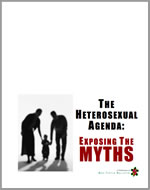 At last, the truth can now be told.
Using the same research methods employed by most anti-gay political pressure groups, we examine the statistics and the case studies that dispel many of the myths about heterosexuality. Download your copy today!
And don‘t miss our companion report, How To Write An Anti-Gay Tract In Fifteen Easy Steps.
 Anti-gay activists often charge that gay men and women pose a threat to children. In this report, we explore the supposed connection between homosexuality and child sexual abuse, the conclusions reached by the most knowledgeable professionals in the field, and how anti-gay activists continue to ignore their findings. This has tremendous consequences, not just for gay men and women, but more importantly for the safety of all our children.
Anti-gay activists often cite the “Dutch Study” to claim that gay unions last only about 1½ years and that the these men have an average of eight additional partners per year outside of their steady relationship. In this report, we will take you step by step into the study to see whether the claims are true.
Tony Perkins’ Family Research Council submitted an Amicus Brief to the Maryland Court of Appeals as that court prepared to consider the issue of gay marriage. We examine just one small section of that brief to reveal the junk science and fraudulent claims of the Family “Research” Council.
 The FBI’s annual Hate Crime Statistics aren’t as complete as they ought to be, and their report for 2004 was no exception. In fact, their most recent report has quite a few glaring holes. Holes big enough for Daniel Fetty to fall through.
“Google” is a trademark of Google Inc.
© Box Turtle Bulletin. All Rights Reserved.
 Posts
Posts  Posts via daily email: