Box Turtle Bulletin
 News and commentary about the anti-gay lobby
“Now you must raise your children up in a world where that union of man and box turtle is on the same legal footing as man and wife…”
News and commentary about the anti-gay lobbyJune 26th, 2010

Last August the Evangelical Lutheran Church in America voted to revise its policy on sexuality to allow member congregations freedom to decide for themselves whether they would now accept ministers in committed same-sex relationships. Conservatives predicted schism.
To date only a few dozen churches have left the denomination over the decision, but the “conflict” is enticing to news sources so each disgruntled congregation receives breathless coverage. Less dramatic, but no less important, was a decision this week by the Northeastern Pennsylvania Synod. (readingeagle.com)
Delegates failed to approve a resolution that would have petitioned the Evangelical Lutheran Church in America churchwide assembly at its next meeting in 2011 to rescind actions of 2009 relating to persons in “publicly accountable, lifelong, monogamous, same-gender relationships.”
An exact vote tally was not yet available, but the Rev. Catherine A. Ziel, executive associate of synod Bishop Samuel Zeiser, said the resolution was resoundingly defeated.
June 26th, 2010

 Defying a ban on gay rights marches by city authorities, several LGBT advocates were arrested at a Pride demonstration in front of the State Hermitage Museum. According to Reuters, two to three dozen advocates showed up in front of the famous landmark with banners and chanted, “Homophobia is the country’s shame.” At least five people were arrested (six, according to the Associated Press).
St. Petersburg authorities had denied permission to hold a Pride demonstration for five different locations. In order to try to get around the ban, LGBT advocates used stealth tactics similar to those used in Moscow last month in an attempt to avoid the police. The media were not informed until the very last minute.
Immediately following the march’s breakup, a small group of ultra-right activists arrived at the square to attack the protesters. A small number of them were arrested for “hooliganism” as well.
June 25th, 2010
From InfoSurHoy
Chilean Sen. Andrés Allamand of the Renovación Nacional Party said he plans to introduce legislation creating civil unions for unmarried couples – regardless of whether they are of the same sex – and give them the same rights as married couples. The series of laws, called Acuerdo de Vida en Común (AVC), would enable homosexual couples to have the same social security rights that are only granted to heterosexual couples but does not legalize gay marriage.
June 25th, 2010
Sports Illustrated writer, Jeff Pearlman, writes about the message that the Chicago Cubs are making by sending their most iconic symbol to Chicago Gay Pride.
The team could have enlisted any former player without a peep of complaint from the community. Here’s Dwight Smith waving to the crowd! Or Ray Burris! Or Mike Maksudian! It could have just sent the float along with Biff, the 19-year-old eager-to-please PR intern. Hell, the Cubs could probably get by merely contributing the float and a box of donuts. But by putting forth Banks, an iconic Hall of Famer and one of the classiest men to ever grace the diamond, the Cubs have made a bold and powerful statement that, even in the oft-closed-minded world of professional team sports, homophobia no longer has a place.
June 25th, 2010
 In a truly mind-boggling decision, a judge in Minneapolis has decided that an anti-gay activist must be allowed to distribute anti-gay literature within the park which the gay pride event has rented from the city.
A federal judge ruled Friday that a restraining order would violate Johnson’s First Amendment rights.
The city’s park system fought Pride Fest in court.
Since the Fest is held in a public park, attorneys for the Minneapolis Park and Recreation Board argued on Johnson’s behalf, although they insisted they were merely trying to clarify the rules and were not advocating one viewpoint over another.
To recap, just so we know the law,
BUT
Yeah. And we’re the ones who they say want “special rights.”
UPDATE: WCCO provides additional information:
In a footnote, Tunheim proposed a compromise in which Twin Cities Pride could designate content-neutral “free speech zones” where anyone could distribute literature or display signs.
Pragmatically, they may be smart to allow such a zone. It would minimize disturbances and confrontations and would allow those who are there to seek a space where they can feel safe and free from hostility can avoid the area.
Johnson, of course, doesn’t want to be restricted in any way.
June 24th, 2010
When Greg Kai sent a letter on Hawaii Business Roundtable letterhead asking Hawaii Governor Linda Lingle to veto the state’s civil unions bill, he probably thought that he was giving the impression that he was speaking for the state’s business community. But his letter did not go unchallenged. (Star Advertiser)
The Human Rights Campaign, the nation’s largest gay civil rights group, which is based in Washington, D.C., sent two activists to the islands to help respond to the Roundtable’s veto request.
Tony Wagner, the Human Rights Campaign’s western regional field director, said the group had initially targeted contacts at national companies that are members of the Roundtable. Five national companies — including Starwood, Time Warner and Marriott — publicly broke with the Roundtable last Thursday.
“Once the snowball starting rolling, then we started hearing from a number of other companies that were represented on (the Roundtable),” Wagner said.
In all, more than 20 companies and executives responded. (Pacific Business News)
After that letter circulated, at least 20 HBR members distanced themselves from the HBR’s veto recommendation, including Time Warner Cable and Starwood Hotels & Resorts Worldwide Inc.
Now Kai is trying to assert that the Roundtable “opposes any form of discrimination, including based on race, religion, political or sexual orientation” and has taken no position on civil unions. It’s all about the “technical issues”, he’s still trying to claim, but the organization members aren’t happy that Kai’s technical concerns are giving them a PR nightmare.
I think it will be a long time before Mr. Kai again attempts to use his employment with the Hawaii Business Roundtable to engage in anti-gay activism.
And in the meanwhile the public perception is that, unlike Mr. Kai, the business community in Hawaii has no problem with HB444, the civil unions bill.
June 24th, 2010
Last September we discussed an interesting debate taking place within the Mormon faith over the role and response of same-sex attracted Mormons.
Some, like NARTH past president Dean Byrd, argued that Mormons must strive for reorientation in order not to “limit the atonement.” But Ty Mansfield, a same-sex attracted observant Mormon, argued that orientation is unlikely to change and that he shouldn’t be expected to take up an impossible task.
But now there appears to be a new twist. Mansfield appears to have married on May 22 to a lovely young woman (that was the scheduled date, I assume it happened). And, in what must be a first, someone put up a website called “Danielle Don’t Do It” to try and change Danielle’s mind. It seems that they deduced from Mansfield’s writings that their love was lacking in romantic and sexual attraction.
I’m not sure what to think about this. Some men do find this sort of arrangement to be adequate and it certainly seems to be expected within Mormon circles. But last weekend I had the opportunity to hear Dr. Amity Pierce Buxton, founder of the Straight Spouse Network, who detailed the pain and trauma that can result from a straight woman marrying a gay man.
But I guess Danielle went into this marriage with her eyes open.
June 24th, 2010
 Newly elected Atlanta Mayor Kasim Reed (about whom I have expressed concerns in the past) is using his position to attract attention to National Testing Day this Sunday. (Journal Constitution)
“This is a disease that impacts all of the city,” Reed had said at a press conference earlier to urge widespread testing. “That is why I am going to participate and be tested as well.”
After a battery of medical questions, the technician handed the mayor an oral swab and instructed him on how to conduct the test – basically gathering saliva.
“Oh,” Reed said. “It is like brushing my teeth.”
And with that, it was over.
Twenty minutes later, the mayor would learn his status.
I appreciate Mayor Reed’s decision to heighten awareness about the ease and availability of testing for HIV. Most new infections are tied to a lack of knowledge about the HIV infected partner’s status and studies show that those who detect the virus early and seek treatment live longer healthier lives.
Those who are not absolutely certain about their status should follow Reed’s example.
June 24th, 2010
The European Court of Human Rights in Strausboug has determined that members of the Council of Europe need not offer marriage equality if they do not wish to do so. The decision was made on a suit against Austria by a same-sex couple. (Guardian)
In a key judgment issued today, the European Court of Human Rights ruled on a complaint of a homosexual couple in Austria who were denied the right to marry. Although very recently (January 2010) Austria created the possibility to enter into a Registered Partnership for same-sex couples, marriage still is not possible. The applicants in this case, Schalk and Kopf, complained both under article 12 (right to marry) and article 14 (prohibition of discrimination) in conjunction with article 8 (right to private and family life). The court found no violation of their human rights, although it was very divided on the issue of discrimination (four votes against three in holding that Austria did not discriminate).
The court found that same-sex couples fall within the definition of family life and that “they are in a relevantly similar situation to a different-sex couple as regards their need for legal recognition and protection of their relationship.” However, because Austria had (mid case) enacted a civil unions law, they fell within the wide margin of leniency which the court found that member states have in the precise way in which they recognize same-sex unions.
As best I can tell, the Court did appear to suggest that some measure of recognition and protection for same-sex unions is required. It will be interesting to see whether this decision will be interpreted as a decision that compels member states to offer some measure of recognition, as many of the 47 nations – including Italy, Greece, the Baltic States and most of Eastern Europe – do not.
June 24th, 2010
From the Chicago Tribune:
A Wisconsin appeals court says gay parents do not have full parental rights when it comes to their adopted children.
The court ruled Thursday against a woman who was seeking guardianship of two adopted children for whom she acted as a stay at home mother for years.
Cuz it’s in the interest of the kids, ya know.
Sigh.
June 24th, 2010
Within the past few years there has been a push to publicize the names of those who sign anti-gay petitions. This does not sit well with anti-gay activists who count on anonymity to collect signatures and get propositions on ballots.
People are less likely to add their name if they think that their neighbor, the lady who bags their groceries, or the guy who mows their law will know that they did so. It is far easier to harm those around you if can do so secretly.
So when the state of Washington was ready to release the names of the signatories for Referndum 71, a petition to block domestic partnership rights, anti-gay activists sued. They claimed that they have a first amendment right to free speech and that they have the right to make this speech anonymously. The state countered that they need transparency in elections and that those who seek to legislate laws must be visible and accountable.
Much of the argument on the part of anti-gays was that the identities of those who signed the petition must be kept secret to shield them from the ookie-spookie gays who are hostile and violent. They claimed that they might lose customers if those customers learned that they wanted to deny them equality or that they might face disapproval from neighbors or others who learned of their efforts to enshrine discrimination.
It now appears, however, that the US Supreme Court did not find that argument convincing. (SeattlePI)
The Supreme Court ruled Thursday that the names of people who signed petitions in an attempt to overturn a new gay rights law in Washington must be made public, a victory for state officials who said the case was a test of open government laws.
So soon the names will be available. Use them responsibly and with restraint.
Update (Jim Burroway): If I read the decision correctly (PDF: 383KB/67 pages), it looks like the Supreme Court only ruled on whether the requirement for disclosure violates the first amendment:
But the question before the Court at this stage of the litigation is whether disclosure of referendum petitions in general violates the First Amendment. Faced with the State’s unrebutted arguments that only modest burdens attend thedisclosure of a typical petition, plaintiffs’ broad challenge to the PRA (the Washington Public Records Act) must be rejected. But upholding the PRA against a broad-based challenge does not foreclose success on plaintiffs’ narrower challenge inCount II, which is pending before the District Court.
According to the Supreme Court Opinion, “Count II of the complaint alleges that ‘[t]he Public Records Act is unconstitutional as applied to the Referendum 71 petition because there is a reasonable probability that the signatories of the Referendum 71 petition will be subjected to threats,harassment, and reprisals.'” That challenge appears to still be working its way through the lower courts.
June 24th, 2010
He leaned in and whispered, “I love her! She’s so funny. She’s just like Ellen DeGeneris!”
My new acquaintance was right. She was very engaging and had us all in stitches, which might at first seem incongruous for a workshop on dealing with discouragement. But that was the approach Christine Sneeringer took at the Exodus Freedom Conference in Irvine, California. I decided to attend that conference in June 2007 because I wanted to get a first-hand look at what Exodus International looked like to those who seek to change their own sexuality. So there I was, listening and laughing at Christine’s talk about her difficulties in “coming out of lesbianism” before becoming director of Ft. Lauderdale-based Worthy Creations, an Exodus member ministry. A lot of her tips consisted of a steady stream of Bible verses, which my friend dutifully called up and notated on his brand new first-generation iPhone’s Bible app. My new friend, who had moments ago plopped himself down in the seat next to me, exuded an easy charm and likability that blew away every image of a cowering, sniveling and self-loathing “struggler” (that’s what they call themselves and each other; I never heard the word “ex-gay” at the conference) that I was burdened with when I decided to attend the conference. In fact, he was not much different from any other young gay man who you’d run into in West Hollywood or the Castro.
The same was pretty much true for most of the 700 people who attended Exodus’ signature annual conference. As you would find in WeHo or the Castro, the conference attendees tended to skew younger (twenties and thirties mostly), were mostly white, and predominately male. And the Exodus conference had another thing in common with WeHo and the Castro: For five nights and days, Concordia University, a private Lutheran-affiliated (Missouri Synod) campus, was transformed into the gayest gathering in all of Orange County. And I don’t mean that in a condescending, snarky sense, but rather in a revelatory sense, one that I hadn’t expected.
I began to draw this conclusion early on Tuesday evening as people filtered into the main hall for the opening plenary session. I quickly determined that there were two broad categories of people taking their seats. The first group consisted of veterans of previous conferences. They had made lots of friends at those conferences and they were eager to meet up again. It was sort of like a summer camp reunion. Every once in a while, you’d hear someone let out a squeal of excitement when they suddenly spotted a friend from across the room. They’d then race over to hug and greet their friends and excitedly catch up on old times, jazz hands and all. I was surprised at how quickly they let their guard down. As all gay men come in so many varieties, so do the strugglers. Some are more butch while others are more effeminate. But here, it seemed that no one bothered to hide whatever embarrassing mannerisms or speech that would otherwise come naturally to them and cause no end of grief among their outside peers. This was another surprise, because it contradicted the emphasis on gender-conforming appearances and behaviors that many ex-gay programs strive to instill.
The second group filtering in were the first-timers. They were easy to spot because they had that look of fear in their eyes that we all have experienced — the fear and shame that they would be discovered as being gay. They were visibly nervous, and you could tell that they remained on guard until the opening program was underway.
But then something magical happened. When Exodus Vice President Randy Thomas took the stage as M.C. you could see a sense of relief wash over this second group. If you’ve never seen Thomas in the flesh, well let me just say that he’s not exactly the most masculine man I’ve ever seen. And for this crowd, that worked wonders. Thomas was very confident, campy and genuinely funny — a natural-born entertainer. He really did a great job at setting these first-timers at ease. Thomas deliberately mixed his sports metaphors to signal to the crowd that he couldn’t have possibly cared less about any of it. He joked about show tunes, fashion, Project Runway, shopping – you name it, as the audience roared with laughter in self-recognition. He even made a few gentle lesbian toolbelt and softball jokes, all in very good fun and affection. And as the evening wore on, I could sense a wave of relief washing over the first-timers. It was as if half the room collectively exhaled.
I found it easy to identify their sense of relief. It reminded me of the first time I walked into a gay bar. It appeared to have dawned on them that – finally! – this is a place where they can be themselves. They no longer had to worry about where their wrists went or how they crossed their legs or what expression or tone escaped from their mouths. For many of them, this was probably the first time in their lives that they were surrounded by so many people who were exactly like them! Which was the same thought I had during my first visit to a gay bar. I remember looking around and thinking to myself, “They are all gay, just like me!” When these first timers warmed to the conference, they appeared to have a similar yet critically different thought: “They are all gay and don’t want to be, just like me!”
There was one other thing that surprised me – and I don’t know why this should have surprised me either. The conference was, on balance, actually a lot of fun. I can’t say that I had that much fun exactly. I was there to just be quiet and learn what the conference was all about. For me, it was more of a work assignment, a sort of an anthropology project. But the live music (Yes, Christian Broadcasting Network personality Sheila Walsh even sang “Somewhere Over the Rainbow”!) the jokes, the camaraderie between sessions, and the surprisingly honest conversations that took place between and among the strugglers during meals and breaks told me that this wasn’t going to be the gloomy and punitive event I expected to find.
Exodus International presents many faces to the world. To those who are outside of the ex-gay movement, Exodus is best known for its engagement in the culture war. I had experienced that face first hand when I attended their Love Won Out conference five months earlier in Phoenix. Parts of that face crept into the Freedom Conference from time to time, particularly in workshops that were aimed at parents and at those who were of a more activist bent. Some of the parents’ workshops I attended were particularly egregious. One workshop leader, a San Fransisco-based therapist by the name of Robert Brenan, was very good at confirming every fear and angry thought that crossed those parents’ minds. “Every young man or woman out there who is seeking that fulfillment of a homosexual relationship is depressed,” he confidently told them. I guess Exodus and their affiliated speakers wanted to make sure they stayed in line. And Michael Brown spoke at a plenary session in which he exhorted the crowd to fight against “pitched attack from hell” against the moral fabric of the culture at large, saying that a Christian should value the cause more than he values his own life. It was a message that these strugglers took to heart. It seemed to give their sense of deprivation a divine purpose and gave them a means of shouting out their frustrations against those who saw no reason to struggle as they did. Which goes to show that rabbles can be roused anywhere.
But those were exceptions, and they were so glaring because most of the conference appeared to steer clear of culture-war rhetoric. This was particularly true in programs which were tailored for strugglers themselves – and this was the vast majority of workshops and events of the conference. This is where Exodus presented a very different face from what I had seen before.
And again, this shouldn’t be too surprising. As longtime readers of this web site know, Exodus is very good at adapting its message to different audiences. And with this particular audience, when you strip away all the layers – the Christian commitments, the shared belief that homosexuality was morally deficient, the internalized shame for being gay – they were still in the end a gay audience, and often a savvy one at that. That meant that Exodus has much less room to bullshit them than they would their parents or the general public. That’s not to say that the strugglers weren’t laboring under a lot of false expectations. Many of them were, and those expectations were reinforced at that conference. But there were limits as to how far Exodus could go.
And so, for example, they had a workshop on AIDS. Exodus understands that because this audience is, fundamentally, a gay one, some of them are living with HIV/AIDS. So any hint of AIDS stigma was completely forbidden. I didn’t attend that particular workshop, but in talking with others who did, they said that it was generally very good and sensitive, albeit from a distinctly Christian point of view. These were guys who themselves were involved with health care and HIV/AIDS, so I tend to believe their assessment is probably reasonably accurate. They said it was devoid of condemnation, although the safe-sex advice was relegated to how you might protect your future spouse should you someday marry. (One struggler said he was disappointed that they didn’t talk much about effective outreach and care for people with AIDS in the gay community. But since I wasn’t there I can’t say whether I would have agreed with that particular criticism.) While AIDS might be brought up in other venues as a reason why one should become ex-gay, that was never mentioned here, at least as far as I was able to observe.
But you could really see the limits of how far Exodus could push whenever a workshop flopped. John Smid’s workshop on masturbation – about how you should never masturbate again for as long as you live – had the jock sitting next to me slamming his notebook shut and muttering under his breath, “This is bullshit!” Another struggler brought Randy Thomas’ workshop on “Warring World Views and our Redemptive Response” to a screeching halt when he angrily denounced some of the anti-gay preachers who were featured on a compendium of video greetings that was shown on opening night. “When I was in the lifestyle, they were the ones that caused the most harm, the most anger, the most pain between me and my family.” He couldn’t finish, and instead broke down crying. All talk of “warring world views” suddenly became moot. The only thing that mattered now was comforting this young man who had experienced so much pain from his own church, pain that came flooding back at him during the workshop. This was a shared pain that everyone in that group could identify with. Myself included.
And there were other, much lighter notes that reminded me that the conference attendees were very much my people. Take poor Tim, for example. I have no idea whether he’s actually gay or not, but he should be. He was the divinity grad student who was called upon at the last minute to deliver a workshop called “Secrets of Men: Understanding Masculinity.” God was he hot! He spent a lot of time in the gym, and he knew how to buy clothes which, modestly yet snugly, showed off his hard work in the best possible light. And this stud was going to talk about the “secrets of men!” Bonus!
Needless to say, the room was packed to overflowing. And poor Tim, someone forgot to set up the A/V projector, which meant that he couldn’t show his PowerPoint presentation and videos. After about a half hour, he sheepishly announced that they would have to reschedule the workshop. He was so cute. He apologized profusely and everyone, of course, forgave him. When Randy Thomas later announced an alternate time during what should have been a break period, we selflessly sacrificed our break and again filled every seat, this time in an even larger room. I guess word had spread. The presentation itself turned out to be extremely silly: videos of football players patting each other on the butt while Tim solemnly announced, “That is an example of an appropriate, non-sexual masculine touch.” But that was secondary to the real attraction of the workshop: his arms, his chest, his own inappropriately-pattable butt in his tight-fitting Dockers. I think if he had needed to reschedule again, nobody would have minded.
And that brings me right back to the point I really want to make. Regardless of whatever images we’ve conjured of what an ex-gay “struggler” looks like, those images are often more a product of fiction than fact. They are also often products of ex-gays who go on to try to publicly proclaim their own heterosexuality, a proclamation that is typically less than credible. Yes, I saw that too. On opening night before the conference, there were news cameras roaming the grounds. And standing before one of them was a man in his mid-fifties who looked like an aged Rod Stewart clone from 1978, but with the mannerisms of Paul Lynde. “Of course I’m straight!” he squealed as he leaned into the camera. “If you don’t believe me, ask my wife!”
Fortunately, those examples were mercifully rare. Most of the people I talked to were full of hope, but they also recognized the very serious challenges that lay ahead of them. And so the best way to regard these strugglers is to think of them as our gay brothers and sisters, because that’s really who they are. And for most of them, that is what they ultimately will be. If the research that was paid for and supported by Exodus International has any validity, then of the approximately 700 people who attended that conference three years ago, a quarter to just under half of those strugglers are no longer struggling today. And in a few years, the dropouts and “failures” will reach two-thirds of the group that I saw that year.
I saw quite a few strugglers there who I’m sure have come out of the experience just fine. There are others however who I still remember and worry about. I worry about the handsome young man from Sacramento who, at age 25, was an unmarried father and a drug addict. “I only feel gay and act out when I’m high,” he told me. “Acting out” is ex-gay parlance for having gay sex. He hoped that if he could get a handle on his addiction that his homosexuality would somehow disappear. “I’m only gay when I’m high,” he kept repeating.
I think about the young man from Chicago who was there with his wife. They had two small children, the youngest just a few months old. On opening night, Exodus International president Alan Chambers raised the possibility that some people’s sexual orientation might not change and challenged them to persevere anyway. I asked him what he and his wife thought of that. “She’s very scared,” he said. “She cried all night. She kept asking me, ‘What if you don’t change?’ I don’t know. There aren’t any guarantees. All I can do is try.”
I worry, too, about an older gentleman who said that he wasn’t ex-gay, but was a church volunteer accompanying two other ex-gays from New Mexico. I asked him how he became interested in the ex-gay movement. I don’t recall his answer, only that he said that he spent so much time in this ministry that his wife divorced him. “That’s okay,” he said without a hint of regret. “God freed me so I can spend more time in the ministry.” That was odd. I’d never heard anyone credit God for their divorce before, let alone be grateful for it. That conversation left me with way more questions than answers.
And I think about the father from St. Louis who was there with his teenage son. His son had come out to him a year earlier. Since then, the father had read every Exodus- and NARTH-recommended book he could get his hands on. He had just finished one of Joseph Nicolosi’s books. Nicolosi believes that male homosexuality is caused by a poor relationship between the father and the son. The father was wracked with guilt. “It cut through my heart like a knife,” he confided, with his eyes welling up with tears. Because I was there to observe and not participate, I had made a rule for myself that I would not try to offer any advice. I broke that rule here. I reminded him that his son loved and trusted him enough to come out to him, and to share with him perhaps the most personal and potentially embarrassing aspect of his still-young life. He took a huge risk in doing that. I told him that my father had died when I was in college, long before I was able to come out to him. In one very key way, this father and son were no longer strangers, and that he was lucky that they shared that kind of trust. He told me he really hadn’t thought of that, and it seemed to give him a better perspective on his relationship with his son. I wonder how they’re doing now.
It’s three years later, and today is the first full day of the 2010 Exodus Freedom conference. This year’s conference is a day shorter than it was when I attended. For this conference, they have returned to Concordia University in Irvine, and once again, the campus will be the gayest place in Orange County. I really wanted to go. Maybe I, too, could catch up on old friends and acquaintances, just to see how they’re doing – if they’re still around. I wonder if my friend’s iPhone still has his Bible app, or if that app has now been replaced with Grindr. Unfortunately, commitments conspired to make such a trip impossible. Oh well, maybe next year.
June 24th, 2010
Tonight’s episode of Soledad O’Brien’s In America will feature a special called “Gary and Tony Have a Baby.” The special follows Gary Spino and Tony Brown as they form a family through surrogacy. It will air tonight at 8 pm EDT. Check your local listings for details.
June 23rd, 2010
After the legislature passed House Bill 444 to allow for the creation and recognition of civil unions in the State of Hawaii, the executive director of the Hawaii Business Roundtable sent a letter recommending that Governor Lingle veto the bill.
Choosing not to express ways in which, if any, the Roundtable as impacted by the bill, the letter chose instead to justify their call for veto in terms of vague “questions” that have “implications” and “complexities” involving ERISA. Were Hawaii the first state to consider civil unions, their letter might have merit. But considering that several states have already resolved the ERISA “complexities”, the letter signed by executive director Gary K. Kai takes on the overtones of bigotry cloaked in terms of reasonableness.
Kai claimed that the letter had “broad support among its membership” and was the consensus of the group. But after Honolulu Civil Beat posted a copy of the letter and the membership list of the organization, several prominent Hawaii businesses were quick to distance themselves from Kai’s letter. (Star Advertiser)
Meanwhile, five more Hawaii Business Roundtable members have distanced themselves from the organization’s call to Lingle to veto the civil unions bill. The companies are:
» Alexander & Baldwin Inc., which released a statement yesterday that it did not participate in any discussion regarding the bill.
» Foodland, which said to supporters that it had no part in asking for a veto of the bill.
» Hawaii Pacific Health, which in a letter to civil union supporters said it does not endorse the letter.
» Kaiser Foundation Health Plan and Hospitals Inc., which sent a letter to Lingle, citing the company’s policies on nondiscrimination.
» Kyo-ya Company LLC, which said in a letter to supporters and Lingle that it was “disappointed” with the letter.
These were not alone. (Star Advertiser)
Hawaii Medical Service Association, the state’s largest health insurer, and Hawaii National Bank were the latest Business Roundtable members to speak out, saying they were not informed of the letter until after it became public. Five Roundtable members issued statements Thursday disassociating themselves from the letter.
Robert P. Hiam, HMSA president and chief executive officer, said the insurer takes a strong stance on the issue.
“Our organization opposes discrimination on any basis, and in keeping with that philosophy, had we been consulted on this matter, we would not have supported the decision to call for a veto of HB (House Bill) 444,” Hiam said in a letter to Carolyn Martinez Golojuch, president of the equal-rights group PFLAG-Oahu, who made the statement public.
But Kai – using a common ploy of anti-gay activists – claims that he doesn’t oppose civil unions in general, just these civil unions.
“Unfortunately, the use of the word veto has become equivalent to some, as a position against civil unions,” Kai wrote.
Funny, that. Further, Mr. Kai claims that he has the support of the executive committee of the Hawaii Business Roundtable. To date there are no news reports that the executive committee members disagree. They are:
David Carey
President & CEO
Outrigger Enterprises
H. Mitchell D’Olier
President & CEO
Kaneohe Ranch Company
Donald G. Horner
President & CEO
First Hawaiian Bank
Allan Landon
President & CEO
Bank of Hawaii
Constance Lau
President & CEO
HEI
Dee Jay Mailer
Chief Executive Officer
Kamehameha Schools
Nate Smith
President
Oceanic Cablevision Inc.
Arthur A. Ushijima
President & CEO
Queens Health Systems
Allen Uyeda
President & CEO
First Insurance Co of Hawaii
Harry Saunders
President
Castle & Cook Hawaii
Considering the nature of some of the businesses represented on the executive committee, I am not convinced that Mr. Kai’s desire to oppose these civil unions is as supported as he supposes. Banks and hotels, for example, do not like it when customers think that they support discrimination and executives of corporations tend to look for ways to earn loyal employees, not harm their lives.
Further employers often take into consideration that corporate positions or actions on the part of executives that appear to be hostile to gay people can make a significant impact on a jury should any future discrimination claims be brought against the company. This can be seen as establishing a hostile work environment and condoning discrimination by supervisors.
If any of our readers work for or do business with these companies am certain that each and every one of these officers would love nothing more than to hear from you inquiring if they support Mr. Kai’s letter and share his ojection to these civil unions. And if so, I am convinced that they would like to hear in detail exactly why it is that you have “questions” that have “implications” and “complexities” involving doing continued business with their companies.
June 23rd, 2010
The Pride Parade in Croatia seems to have gone off without much problem. Yes, the neo-Nazis protested (they seem not to have read Scott Lively’s Pink Swastika), but riot police were on hand to protect the marchers. Check out some great pictures and commentary here.

Featured Reports
 In this original BTB Investigation, we unveil the tragic story of Kirk Murphy, a four-year-old boy who was treated for “cross-gender disturbance” in 1970 by a young grad student by the name of George Rekers. This story is a stark reminder that there are severe and damaging consequences when therapists try to ensure that boys will be boys.
When we first reported on three American anti-gay activists traveling to Kampala for a three-day conference, we had no idea that it would be the first report of a long string of events leading to a proposal to institute the death penalty for LGBT people. But that is exactly what happened. In this report, we review our collection of more than 500 posts to tell the story of one nation’s embrace of hatred toward gay people. This report will be updated continuously as events continue to unfold. Check here for the latest updates.
In 2005, the Southern Poverty Law Center wrote that “[Paul] Cameron’s ‘science’ echoes Nazi Germany.” What the SPLC didn”t know was Cameron doesn’t just “echo” Nazi Germany. He quoted extensively from one of the Final Solution’s architects. This puts his fascination with quarantines, mandatory tattoos, and extermination being a “plausible idea” in a whole new and deeply disturbing light.
On February 10, I attended an all-day “Love Won Out” ex-gay conference in Phoenix, put on by Focus on the Family and Exodus International. In this series of reports, I talk about what I learned there: the people who go to these conferences, the things that they hear, and what this all means for them, their families and for the rest of us.
Prologue: Why I Went To “Love Won Out”
Part 1: What’s Love Got To Do With It?
Part 2: Parents Struggle With “No Exceptions”
Part 3: A Whole New Dialect
Part 4: It Depends On How The Meaning of the Word "Change" Changes
Part 5: A Candid Explanation For "Change"
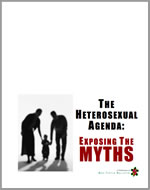 At last, the truth can now be told.
Using the same research methods employed by most anti-gay political pressure groups, we examine the statistics and the case studies that dispel many of the myths about heterosexuality. Download your copy today!
And don‘t miss our companion report, How To Write An Anti-Gay Tract In Fifteen Easy Steps.
 Anti-gay activists often charge that gay men and women pose a threat to children. In this report, we explore the supposed connection between homosexuality and child sexual abuse, the conclusions reached by the most knowledgeable professionals in the field, and how anti-gay activists continue to ignore their findings. This has tremendous consequences, not just for gay men and women, but more importantly for the safety of all our children.
Anti-gay activists often cite the “Dutch Study” to claim that gay unions last only about 1½ years and that the these men have an average of eight additional partners per year outside of their steady relationship. In this report, we will take you step by step into the study to see whether the claims are true.
Tony Perkins’ Family Research Council submitted an Amicus Brief to the Maryland Court of Appeals as that court prepared to consider the issue of gay marriage. We examine just one small section of that brief to reveal the junk science and fraudulent claims of the Family “Research” Council.
 The FBI’s annual Hate Crime Statistics aren’t as complete as they ought to be, and their report for 2004 was no exception. In fact, their most recent report has quite a few glaring holes. Holes big enough for Daniel Fetty to fall through.
“Google” is a trademark of Google Inc.
© Box Turtle Bulletin. All Rights Reserved.
 Posts
Posts  Posts via daily email: