Box Turtle Bulletin
 News and commentary about the anti-gay lobby
“Now you must raise your children up in a world where that union of man and box turtle is on the same legal footing as man and wife…”
News and commentary about the anti-gay lobbyJanuary 16th, 2010
Thanks to liveblogging from Courage Campaign and FireDogLake.
Today began with testimony from Dr. Michael Lamb, Head of the Department of Social and Developmental Psychology at Cambridge University. Michael McGill led the questioning. Dr. Lamb is highly qualified, prolific, and respected in the areas of child development and devolopmental psychology.
In the 1970’s Dr. Lamb began with the assumption that a father-mother household was better. His views changed based on his research. By the 90s this change was accepted in the field.
Articles document conclusively that children raised by gay or lesbian parents are just as likely to be well adjusted as those raised by heterosexual parents. This is based on a great volume of study of children of different ages and further buttressed by results that affect children of broader range of children.
Studies conducted include both convenience samples and representative samples, longitudinal and cross-section. Over 100 studies have been taken. All mental health organizations agree.
Lamb refuted some of the pseudo-scientific claims of Prop 8 proponents, including the use of the term “gender disorientation pathology” in a Ron Prentice email repeating “21 Reasons why Gender Matters” (Perhaps those listed at NARTH). This term is not used in psychology.
Lamb refutes the canard that gays and lesbians are more likely to be child abusers, nor are their children likelier to be gay (though they are likelier to reject sex-stereotypical occupations).
Lamb dismisses Dr. Joe Nicolosi (ex-gay proponent) and his notions that childen of gay couples are going to be emotionally and socially traumatized. He says that adopted and artificially conceived children are as likely to be well adjusted as those raised by natural parents. He says that the only one in the field of child psychology who holds that view is David Blankenhorn.
In cross-examination, David Thompson for Prop 8 has Lamb admit he’s a “committed liberal”. Thompson tried to get Lamb to agree that science and research only give the results that government wants and that there is a vast liberal conspiracy to make scientific results be what the liberals want them to be. He references the East Anglia climate control scandal. This is an insult to anyone with a brain.
Thompson argued that men are cretins (he referenced Homer Simpson) and women are weak little caretakers. Liveblog synopsis:
Women spend more on children than men. Some occupations are specific to genders. Men are more likely to perpetrate sexual abuse than women. Step fathers more likely to molest children, abuse children than women. Molestation is bad for kids. Evidence that men who are married to women drink and gamble. You are not saying that men and women are completely interchangeable.
(My favorite argument so far:) Men can\’t breast feed. Breast feeding clearly has benefits for children. (yup, well that settles it, children whose mothers can’t breast feed them should be left out for the wolves.)
Thompson read an article in which Lamb stated that biological parents were more important than involvement in raising the children; it was written in the 1970s. He quoted Lamb stating that it was disconcerting that fathers’ roles were devalued; Lamb was a grad student. Thompson read from Lamb’s The Role of Fatherhood in Childhood Development, 1976 version.
Lamb: Citations are to 1961, two from 1950s, one from 1965. We\’ve had a lot of research since that was written. As you\’ve pointed out, there have been subsequent editions of this book, that have updated these citations.
Thompson reminds Lamb that he described David Blankenhorn’s book as “most provocative commentary published in 1995”. Lamb said that Blankenhorn thought his review was negative.
Thompson somewhat desperately tried to get Lamb to agree that having both a male and a female in the house is essential to good childhood development. Lamb didn’t play along.
(At this point we discover that a few witnesses for Prop 8 have been withdrawn because of “fear for their personal safety”. But wasn’t that why there is no video recording? Personal fear? Or is it that those witnesses realized that their peers would find out what they had testified through bloggers and knew that they would be mocked and reviled in their professional fields for selling their soul to the cause of discrimination and injustice. After lunch, Boutrous pointed out to the court that the witnesses who were skurrrred of being recognized dropped out after the SCOTUS said they didn’t have to be televised. He said that in pre-trial he predicted they would drop out because they were afraid of what they would have to say during cross-examination.)
Quite a bit of time was taken establishing that children do better in homes with both parents rather than with a single parent. Much emphasis that step-fathers are more likely to sexually abuse than genetic fathers. Lamb continues to point out that they are comparing heterosexuals to heterosexuals.
I get the impression that Thompson is out of his element. At one point he objects that the US Census is not a random sample. Lamb points out that if a sample includes the entire population, it’s better than a random sample. Thompson tries to argue that studies of gay people are faulty because they only study those who identify as gay; he seems not to notice that if we are talking about marriage, there aren’t going to be many non-LGBT-identifying folk who marry a person of the same sex.
After lunch the judge asked Lamb why adopted children seek out their natural parents. Lamb said it was due to a natural curiosity about where they came from and not due to maladjustment. Walker then asked about priest abuse in the Catholic Church. Lamb clarified that it was predominantly heterosexual and that gay abuse occurs at about the same rate as heterosexual sexual abuse.
During Thompson’s efforts to discredit the rather extensive research on the subject, he looks for anything that was not included to suggest that it throws all of the evidence out the window. His stabs include the financial resources of grandparents, the genetic intelect of the children, the educational achievement of grandparents, etc. He tries to sound incredulous that these studies didn’t include these less obvious factors. What comes out in court, however, is the rather extensive number of factors that actually have been considered.
He cites Walter Shum of Kansas State Universite. Lamb dismisses Shum by saying, “I\’ve seen it before. It was published in a journal where one has to pay to have it published, so it\’s not really considered part of the literature. But I have seen it in past cases.”
(A non-peer reviewed pay-to-get-published article? Gee, where have we seen that before?)
Thompson is trying to get Lamb to agree that only middle class gay and lesbian families were studied. And that the control groups of straight parents in the studies were not necessarily limited to married biological parents.
I’m wondering at the extent of this effort. I assume that is because when Blankenhorn argues that heterosexuals are better – based on his opinion – then Prop 8 will argue that we can just ignore all research whatsoever and go on Blankenhorn’s opinion. It’s just one opinion against another. While that might work well in a media campaign, I wonder if it’s effective strategy to present to a judge.
Further, it appears that Thompson knows far less about the “gotchas” that he wants to drop on Lamb. He appears to have forgotten the first rule of jury testimony, don’t ask a question to which you do not know the answer. He also confused references to studies as being separate studies and seems not to know what meta-analysis is.
Thompson says, “We\’re trying to show that optimal way to raise kids is in heterosexual households.”
(Yes, Mr. Thompson, you are trying to show that. Unfortunately for you, the science isn’t behind you.)
In redirect, McGill has Lamb clarify that the largest comparative studies included census data and thus compared gay couples (married and unmarried) with heterosexual couples (married and unmarried) and that gay children did not fare worse.
McGill then plays deposition tape of Dr. Marks, a Prop 8 witness that withdrew “cuz he’s skurrrrred of the cameras”. It seems Marks made a wise decision. In the tape he contradicted himself and ends up – in this clip – undermining his assertion that biological families are preferable.
McGill had Lamb read a portion of his review of Blankenhorn’s book illustrating how it was not favorable.
Lamb concludes by testifying that the field shares his conclusions because of the consistency of the outcome of hundreds of studies. Outliers which are not replicated don’t change conclusions based on cumulative work.
In one final dig about Lamb being a “liberal” and donating to PBS:
McGill: Did the corporation on public broadcasting affect your opinion in this case?
Lamb: No, it did not.
To end the day, Helen Zia, an Asian-American told the story of her life. She talked about discrimination and fear. She spoke of the humiliation of signing up for the first local domestic partnerships in San Francisco at the window where dog licenses were issued. She talked about how marriage changed her life. Her Chinese grandmother finally had a word to describe Leah, her wife. Her in-laws now saw her brother as extended family. She spoke of cruelty and hostility she experienced in Oakland during the Prop 8 election season.
Chu: How does getting married change things.
Zia: In most immediate sense, it was in how our families related to us. When we first got married. We have a niece, 2 years old, only known us Auntie Helen and Auntie Leah. WHen she saw Leah and me, she gave us a big hug, said, Auntie Leah, now you\’re really my auntie. I thought, well, you\’ve always known her as your auntie. Somehow it made a difference. It made a difference to our parents. When you say you\’re a domestic partner. When people say “who\’s this person?” I can\’t count the number of times who said “Partner in what business.” We\’d say “partners in life.” Often it was bewilderment. What business is life, od yo umean life insurance. It\’s a matter of how our families relate to people. For me to show up at every event. People ask who\’s she. For her 90-something auntie to say, here\’s Leah\’s friend. She must be a really good friend, suddently there were able to say, Helen is my daughter in law. My mother is an immigrant from China. She dosent\’ get waht partner is. I would be around her, I could hear them say, sometimes in Chinese, sometimes in English, that\’s Helen\’s friend. Then it changed, she would say, this is my daughter-in-law. Whether they got it or not, you don\’t insult someone\’s wife, you don\’t insult someone\’s mother. We\’re not partners in life or in some business. It changed things on a huge level. Marriage in how it affected our families. Our families related to each other differently. Marraige is joining of two families. My family and Leah\’s family now relate to each otheer differently. My brother lived about 5 minutes away from Leah\’s father when he was still alive, in those 15 years, they didn\’t make an effort. After we were married, Leah\’s father would stop by, drop things off. My brother is quite active in HI, Leah\’s brother\’s wife, my sister in law. Has a sister who runs in same circles. He will now say she\’s my in-law.
And this ended the day. The case will resume Tuesday morning. The plaintiffs expect to end testimony on Wednesday.
It is difficult to predict how long it will take the Prop 8 defendants to present their testimony now that four of their six witnesses have dropped out cuz they’re skurrred of the evil homosexual menace that will hunt them down and piddle in their petunia. All, it might be noted, after the SCOTUS gave in to their demands of no televising and no video at all outside of a live-feed to another room inside the same courthouse.
Somehow I think they really wanted to lose the battle over the cameras. As we saw from Dr. Marks’ video deposition, their witnesses may be far more worried about their own inadequacies and dents in their reputation than they are about marauding bands of drag queens and dykes on bikes chanting, “we’re here, we’re queer, you’re a bigot, get used to it” while they try to order a latte at their local Starbucks.
I suspect that they wanted an excuse to drop their witnesses so they could use this to appeal the trial of fact. But the SCOTUS may have unintentionally called their bluff and left them with only the flimsiest of wacky excuses (“we were skurrred of the evil homosexuals in the overflow room; they might hit us with their laptops). And now they only have two witnesses who are willing to be cross-examined.
January 15th, 2010

Stephen Monjeza and Tiwonge Chimbalanga in the dock at their trial.
The trial against Steven Monjeza and Tiwonge Chimbalanga, who were arrested by Malawi police last month following a traditional engagement ceremony in Blantyre, began this week with the prosecutor for South Dickens Mwambazi telling the court that they had a total of seven witness. Four witnesses testified on Monday:
One of the state witnesses was Jean Kamphale, owner of Mankhoma Lodge, where the two suspects had their engagement ceremony.
Kamphale said Chimbalanga confessed to having sex with partner Monjeza to both herself and the police when they picked them on December 28, last year.
“After the media published the story about the two’s engagement, I felt having been deceived by Tionge who for a long time claimed to be a woman.
“He therefore offered to undress so that we could prove the truth of his claims. But after some resistance to show us his genitals, Tionge finally allowed Nyazayi Piringu, Flony Frank and I to see his organ, which to our surprise and contrary to his claims that it was feminine, was male in nature,” Kamphale said.
Tiwonge Chimbalanga identifies as a woman.
The other three witnesses on Monday denied having evidence that the accused had sex before they were arrested. Evidence of sexual penetration is required under Malawi law for conviction. Monjeza and Chimbalanga were reportedly threatened with humiliating physical examinations by the prosecutor’s office. There are also charges that the two have been beaten by police and fellow prisoners. They were denied bail.
In more troubling news, the trial was expected to resume on Wednesday to hear testimony from the last three witnesses, but Chief Resident magistrate Nyakwawa Usiwausiwa adjourned the case because, according to the Nyasa Times, Tiwonge was sick, providing no more details. But The Times of London more fully describes this outrageous and humiliating development:
Tiwonge Chimbalanga, who has spent more than a week in one of the country\’s most congested prisons, vomited and stumbled onto the dusty court floor just before the case was due to start.
As he lay on the ground he was jeered by members of the public who had crowded in to watch what has become a cause célèbre and a test case for gay rights in the African nation.
“Auntie Tiwo ali ndi mimba” — or “Auntie Tiwo is pregnant” — people said.
With no one to assist him, Mr Chimbalanga, 20, dressed with a traditional dotted red and yellow striped wrapper around his waist and a red top, finally managed to stand and was allowed to leave to clean himself up.
A few minutes later he re-emerged with a mop and a pail to clean the vomit from the court floor — a chore that women in Africa typically have to perform even when they are sick.
The two face fourteen years imprisonment if they are convicted.
January 15th, 2010
If any part of Uganda’s draconian Anti-Homosexuality Bill becomes law, that nation will be well on its way to becoming a pariah state for its gross violations of human rights. The UN High Commissioner on Human Rights has weighed in:
UN rights chief Navi Pillay on Friday urged the Ugandan government to scrap an anti-homosexuality bill which is to be put before parliament, saying that it was “blatantly discriminatory.”
“The bill clearly breaches international human rights standards, as it is blatantly discriminatory,” said Pillay in a statement.
…”It is extraordinary to find legislation like this being proposed more than 60 years after the adoption of the Universal Declaration of Human Rights … made it clear this type of discrimination is unacceptable,” she added.
Calling on Uganda to “shelve (the) draconian draft bill,” Pillay warned that the bill could seriously hurt the country’s reputation.
Click here to see BTB\’s complete coverage of the past year\’s anti-gay developments in Uganda.
January 15th, 2010
National Public Radio has a great piece this morning examining the role played by three American activists in the current anti-gay debacle playing out in Uganda. Here is probably the best observation I’ve seen to date on American evangelical responses to the Ugandan efforts to wipe LGBT people off the map:
Jim Naughton, a former canon in the Episcopal Diocese of Washington, D.C., says their message plays one way in the U.S., but differently in a place like Uganda. And they should have known.
“If you go to countries where there’s already a great deal of suspicion and maybe animosity towards homosexuals, and begin to tell people there, ‘Well, actually these people are child abusers, they’re coming for their children, that they’re the scourge that is being deposited on you by the secular West,’ you’re gonna get a backlash.” Naughton says it’s like “showing up in rooms filled with gasoline, and throwing lighted matches around and saying, ‘Well, I never intended fire.‘”
Many U.S. evangelicals, including (Scott) Lively, say they are “mortified” by the death penalty provision. Naughton doesn’t buy it.
“I think if they were mortified, they would have been mortified immediately,” he says. “Instead they were mortified — oh, two, three months into the campaign against this thing, when it was getting real traction.”
You can see Lively’s “fire” — actually he calls it his “nuclear bomb” — here.
There is, of course, one notable exception. Dr. Warren Throckmorton was publicly mortified as soon as he heard about plans for the anti-gay conference put on by Holocaust revisionist Scott Lively, Exodus International board member Don Schmierer, and International Healing Foundation’s Caleb Lee Brundidge last March. He has since been a tireless critic of that conference and the ensuing Anti-Homosexuality Bill. He also gets his due on the NPR report, while questioning the silence of other prominent ministries with close ties to Uganda.
If (Saddleback pastor Rick) Warren was slow to condemn the bill, other Christian conservatives have yet to do so, says Warren Throckmorton, who teaches psychology at Grove City College and has been monitoring U.S. evangelical response. He says some of the Christian groups most publicly tied to Uganda have been the quietest. Joyce Meyer Ministries, Oral Roberts University, the College of Prayer in Atlanta — all have close ties and declined to express reservations about the death penalty.
“Silence is often interpreted as consent,” says Throckmorton, who is himself a conservative evangelical. “So I think those kinds of responses may lead those individuals in Uganda to think that perhaps what [they’re] doing really is according to the evangelical faith.”
The NPR report ends with a claim that Uganda’s President Yoweri Museveni “called for the bill to be withdrawn.” While many have jumped to that conclusion, the fact is that Museveni was careful not to call for its withdrawal, and it is not clear that he will.
Click here to see BTB\’s complete coverage of the past year\’s anti-gay developments in Uganda.
January 15th, 2010
Last December, we reported that Ugandan Pentecostal pastor Martin Ssempa had announced a nationwide anti-gay rally for January 19. A few days later, two more religious leaders joined that call for a rally to support for the draconian Anti-Homosexuality Bill. Now Reuters is reporting that Ssempa, who has close ties to several American evangelical groups as well as Uganda’s president Yoweri Museveni, has announced a”million-man” march for February 17. It’s unclear whether this is a re-scheduling of the January 19 rally or an additional one.
Click here to see BTB\’s complete coverage of the past year\’s anti-gay developments in Uganda.
January 15th, 2010
Uganda’s independent Monitor reports that the Speaker of Uganda’s Parliament Edward Ssekandi insists that, despite President Yoweri Museveni’s call for a “discussion” of the Anti-Homosexuality Bill due to international outrage and the prospect of forfeiting badly needed donor aid, the bill will go forward in Parliament:
Uganda's Speaker of Parliament, Edward Ssekandi
Mr Ssekandi said: “There is no way we can be intimidated by remarks from the President to stop the Bill. This Bill was officially tabled in Parliament and was subsequently committed to a committee for scrutiny. The President has a right to express his views like any other people who have petitioned me.”
He added: “This was a private members\’ Bill and if the Executive wants to bring their views they are free. The Constitution is clear, it doesn\’t allow people of the same sex to get married and what we are looking for in the Bill is (basically) the penalty and the process should continue.”
When Museveni announced to the Executive Council of the ruling National Resistance Movement (NRM) that his Cabinet would sit down with fellow party member MP David Bahati to discuss the wide-ranging and draconian bill, many observers saw it as a signal that the bill would be withdrawn. But since then, we’ve noticed that while Uganda’s state-owned media gave Museveni’s remarks prominent play (the state-owned New Vision, the country’s largest daily newspaper, has mostly ignored the Anti-Homosexuality Bill until now), it has also been extremely cautious about reporting what the implications of his remarks might be. Meanwhile Bahati has remained defiant, insisting that he will proceed in pushing the so-called “kill-the-gays” bill through Parliament, and now it appears that the Parliament’s Speaker has Bahati’s back.
Museveni justified his announced intervention by telling the NRM gathering that the repercussions of the bill has gone beyond the borders of Uganda and has become a ign policy issue. But Voice of American yesterday reported that Uganda’s Foreign Affairs Minister Henry Okello Oryem now denies that the government is backing away from the draconian legislation because of foreign policy implications:
Foreign Affairs Minister Henry Okello Oryem
The minister said the president’s remarks to party members was in response to a recent war of words in the media between senior government officials over the gay bill, with one minister stating the government’s position was that the bill was “not necessary.”
“What the president was trying to say was that when it comes to those kind of issues that are related to the current issues relating to homosexuality – will aid be cut, will it affect our relations with other countries, and so forth – nobody has the right to comment on those matters except him as the president, and then it will be integrated by the Foreign Affairs [ministry],” said Oryem.

President Yoweri Museveni
So what’s happening? It’s hard to know. Uganda is effectively a one-party state (Museveni’s NRM controls more than two-thirds of Parliament) and Museveni is about to begin his twenty-fifth year in power. In many ways, he rules as a strongman, closing radio stations and declaring opposition demonstrations “illegal” whenever it suits him. Uganda’s 1995 Constitution (PDF: 459KB/a whopping 192 pages!) calls for an “independent” Electoral Commission, but all seven members of the commission are appointed by the President. The constitution originally called for term limits on the President, but that was amended in 2005 to remove those limits and allow Museveni to run for a third term in 2006.
In fact, with the NRM dominating Parliament as it does, Museveni can change the constitution pretty much at will, and there are suspicions that he may do so again to gain a further advantage in the upcoming 2011 elections. The NRM, not surprisingly, has already named him as their candidate for a fourth term. Assuming he wins and completes that term, he will have held power for thirty-one years. Uganda has not had a peacful change of government since its independence in 1962. Museveni came to power after overthrowing his predecessor in a civil war in 1985. Museveni’s predecessor, Milton Obote, came to power following an invasion from Tanzania in 1979 which overthrew Idi Amin. Despite the U.S. Congress having mandated that the State Department closely scrutinize the upcoming elections, few people expect a peaceful change in government next year.
None of these are the hallmarks of a transparent, functioning democracy. And yet, NRM appears to be a rather fractious party these days. In addition to competing statements on the Anti-Homosexuality Bill from various NRM ministers even after Museveni spoke on the subject, delegates at the NRM gathering openly challenged Museveni on his preferences for appointing fellow members of his Ankole tribe to key positions and steering the country’s resources to western Uganda, his home area.
Unlike his predecessors, Museveni seems to tolerate a measure of dissent, but this tolerance only goes so far and it extends to those areas which are useful to him. While he has no qualms about banning demonstrations by opposition parties and deploying a huge show of force to prevent them from taking place, Museveni has been remarkably “tolerant” of announced massive anti-gay rallies. Pentecostal pastor Martin Ssempa, who has close ties to several American evangelical groups as well as to Museveni and the First Lady (who also happens to hold a seat in Parliament), has just announced a”million-man” march for February 17 in support of the Anti-Homosexuality Bill.

President Yoweri Museveni
So let’s not be fooled into thinking that Uganda is a free-wheeling and fully functioning democracy. It isn’t, and Museveni holds all of the cards where the future of the Anti-Homosexuality Bill is concerned. And we must not forget this, because Museveni may point to those appearances of an open and functioning democracy as an excuse for refusing to prevail upon Bahati to withdraw the Anti-Homosexuality Bill, even though this is something which Museveni could very easily do without breaking a sweat.
The danger then, is that we may see a “compromise” in the works, which would be just as disastrous for human rights as having the bill become law unchanged. To see what I mean, consider what the bill does now. If passed, it would:
There can clearly be no “compromise.” Should even one provision of this bill survive, it would still represent a disastrous setback for human rights in Uganda. It could also, not surprisingly, become a powerful tool that Museveni could deploy against his political opponents with devastating effect.
In 1999, Museveni ordered a campaign of mass arrests under the current anti-gay law. “I have told the CID (Criminal Investigations Department) to look for homosexuals, lock them up and charge them,” he announced. Several people were jailed. Five men and women who had formed Right Companion, a fledgling LGBT group, were beaten and tortured by police and the women were sexually abused. Others fled the country in fear. The survival of any part of this proposed bill will result in anti-gay pogroms which will make 1999 look like child’s play.
Click here to see BTB\’s complete coverage of the past year\’s anti-gay developments in Uganda.
January 14th, 2010
 Emmett C. Burns, Jr. has an evil scheme to deprive Maryland of love. Same-sex, long-term, committed, til death do us part love, to be exact. And he knows just how to do it.
No, Mr. Burns is not building a solar shield over the town of Springfield. He’s not bribing Homer to ignore safety precautions with donuts fried in the rendered fat of endangered species. But it is a plan as nefarious. (WTOP.com)
A Baltimore County delegate is sponsoring legislation that would prohibit Maryland from recognizing gay marriages validated by other states or countries.
Del. Emmett C. Burns Jr.’s measure would also declare that marriages between individuals of the same sex are against the public policy of the state of Maryland.
I can almost see him rubbing his hands exclaiming “excellent“.
I’m not sure why Mr. Burns is so worried about marriage. Perhaps he thinks that with rights and equality, Smithers may find internal peace and contentment and no longer be his toady.
But whatever the reason, his evil plan must be foiled.
(oh, and isn’t it strange how he looks even scarier when he’s not a cartoon)
January 14th, 2010
A day after the President hinted that repeal of Don\’t Ask Don\’t Tell may be part of the 2010 defense authorization bill, news comes out that hints that the Pentagon may decide to be recalcitrant on the issue. The Navy Times says
Lawyers for the nation\’s senior military officer are recommending a delay of at least a year in beginning the process to repeal the ban on openly gay military service, which could push a decision by Congress to the middle of the next presidential election.
This may be Mullen’s own perspective. It appears that some in the Pentagon disagree.
Other advisers at the Pentagon, however, argue that lifting the ban would not cause unmanageable problems or divisions among the uniformed military, according to two U.S. officials.
Mullen’s position may be due to a lack of support in the military’s top leadership. It seems some choose not to agree with the idea of lifting the ban. The New York Times reported
A one-page memorandum drafted by staff members as a discussion point for the meeting said that the chiefs could adopt the view that “now is not the time” because of the continuing wars in Iraq and Afghanistan and that the military would be better off delaying the start of the repeal process until 2011.
But what troubles me, perhaps more than their position on institutionalize discrimination, is the apparent assumption that the Military is a separate institution that answers only to itself. Its leadership will decide whether to implement the policies on which the electorate chose a president and it will dictate policy to the representatives of the people, rather than the other way around.
Joint Chiefs legal advisers recommended delaying the start of the repeal process into 2011, with the Pentagon sending a proposed replacement law to Congress by late summer of that year. That would be after the White House says it will begin bringing troops home from Afghanistan, and a few months before all U.S. forces are due to leave Iraq.
Congress would follow with debate lasting six months to a year, the legal advisers wrote, meaning repeal would be unlikely until 2012.
I know that Congress is deferrential to the Pentagon on military matters. As they well should be. But it troubles me that the presumption is that the military leadership would write legislation about when and if gay Americans can be free and equal and send it over for formalization. There are few countries whose history does not include lessons about what happens when the military sets itself outside civilian control and gets comfortable with the idea of making national decisions.
January 14th, 2010
Again, thanks to liveblogging by Courage Campaign and FireDogLake
The day starts with testimony from Edwin A. Egan, Chief Economist for San Francisco. His job includes determining the economic impact of legislation.
His argument: marriage equality means more married couples. Those who marry tend to accumulate wealth, spend more, increase property values, etc. Married individuals also engage in healthier behavior which leads to greater productivity and a positive economic influence.
Egan also discussed how companies treat marriages differently from domestic partnerships when it comes to heath care.
(This direction be an argument unique to San Francisco in which, due to demographics, economic influences on the gay population can have a significant impact on the city’s economy as a whole. It may be difficult for Prop 8 to argue that such an impact is immaterial to a city like SF)
Egan discussed direct economic benefits to the city from legal marriages (event costs, hotel, restaurant). He noted that if DOMA were lifted, income taxes per couple would be reduced on average by $440, some of would be spent in the city thus increasing sales taxes and improving the economy.
In cross-examination, Peter Patterson challenged some of Egan’s calculations.
First he tries to present the idea that all of those who wish to marry already did so in the narrow window. This argument is strangely and poorly crafted by arguing that because there were few appointments for marriages in November (when marriage was not legal) then there was no demand.
Patterson made points by noting that Egan bases his three year projection on the rate of marriages during last summer, not allowing a drop off for a lessening of “pent-up demand”. Further, he argues that Egan’s estimates assume that over 100% of current couples would marry within two years (he does not allow for new couples or couple migration).
Egan may have redeemed himself by showing that his assumptions about marriage expenditures and guests are based on conservative estimates (spend 25% of what straight marriage spend and only 10% of guests from out of town).
Patterson argues that while same-sex marriages may increase, opposite-sex marriages may decrease. (This may actually be true for the short window in a city like SF. There may have been limited marriage facilities and resources and some straight folk may have waited until after the marriage window. Over time, the laws of supply and demand would provide for adequate marriage resources)
In redirect, Egan clarifies that despite dispute over the numerical accuracy of his calculation, marriage would increase health coverage and that, coupled with marriage expenditures, would financially benefit the city.
In the afternoon, Dr. Ilan H. Meyer, Associate Professor of Clinical Sociomedical Sciences at Columbia University\’s Mailman School of Public Health, testified about the stigma and prejudice gay and lesbians individuals face in society. Christopher Dusseault is plaintiff’s counsel for this section.
Meyer argues that societal stigma assigns gay people the roll of not desiring intimate relationships and being incapable of them. Society defines intimate relationships to mean marriage, husband, wife, family and community to the exclusion of gay people. (Think The Boys in the Band)
As illustration, Dusseault has Meyer read from Everything You Wanted to Know About Sex, But Were Afraid to Ask:
What about all the homosexuals who live together happily for years?
What about them? They are mighty rare birds among the homosexual flock. Moreover, the “happy” part remains to be seen. The bitterest argument between husband and wife is a passionate love sonnet by comparison with a dialogue between a butch and his queen. Live together? Yes. Happily? Hardly.
Meyer argues that domestic partnerships do not have the same social meaning as marriages and thus Proposition 8 imposes structural stigma. He talks about social stressors, both event (a bad thing happens) and non-event (something expected and looked forward to does not happen). Because all children expect to marry some day, denying marriage to gays is a non-event stressor. Meyer identified the processes that create minority stressors as prejudice events, expectations of rejection and discrimination, concealing–not being out, and internalized homophobia.
Some stressors may have little real impact, such as filling out a form, but “the form evokes social disapproval and rejection and memories of events, including large events that have happened in the past.” So travel, banking, vehicle registration, many simple things have minority stressors with great impact.
And actual abuse need not occur for the person to experience stressors.
Many times people avoid situations, or swallow those situations of slurs and just move on because they don\’t want to get into a fight, but the anticipation causes stress.
All of the additional sexual minority stressors lead to increased risk and disease.
Dusseault: Do you have a view if mental health outcomes for gay and lesbian in CA would improve if Prop. 8 were not law?
Meyer: Yes. Consistent with my work and findings that show that when people are exposed to more stress than less stress they are more likely to get sick, consistent with a law that says to gay people you are not welcome here, your relationships are not valued vs. the opposite has significant power. Clearly it\’s not the only thing that determines prejudice and discrimination, but it\’s a major factor.
Al Wilson cross-examined Meyer for Prop 8. Wilson tried to identify disagreement between studies and to identify exceptions between theory expectation and results.
In particular, he focused on old studies (this does seem to be a consistent but inexplicable tactic of the Prop 8 side in this trial)
Wilson: Well, were your studies inconsistent with older studies?
Meyer: No. I would say the older studies were inconsistent with my new findings.
Wilson tried very hard to get Meyer to discount his own findings. He tried to dismiss the sample size but Meyer used meta analysis. He tried to argue that population definition is impossible, but Meyer pointed out that all populations are difficult to define
You\’re trying to suggest it\’s some big problem. It\’s not. The population is elusive in every study. This is the first step of trying to study. If I wanted to study men, I\’d have to define the cohort, age, location, etc. What is a Latino? Do you include Mexicans or Puerto Ricans? The first step is to define the general population and then the sampling population.
(Meyer seems to be quite good)
Wilson: Could you ask someone if they were African American ever or were last year?
Meyer: Yes. That does vary. There are people who move into the US as Caribbean, their parents do not describe themselves as black, but after their kids socialize do say they are African American. Identities change and are responsive to the social context, but how people refer to themselves might change.
Meyer: well attraction is very fluid. Woman might say another woman is attractive, but that doesn’t make her a lesbian. for example, if you want to measure race by skin tone, you’ll have a different result than by identity. That’s why I don’t use attraction, but sometimes use identity. when you’re measuring HIV risk, you need to ask about behavior to assess exposure.
(This is an interesting response. If racial definitions were based solely on skin tones, I’ve met quite a few Latinos and even some African Americans who have fairer skin than I do. I once had one fellow lecturing me about discrimination against ‘brown people’ until I held my arm up against his. Yet my ethnic heritage and overall appearance tends to lead me to identify as “Caucasian” while theirs leads to minority ethnic identities. And discrimination and its inherent stressors are not based on either skin hues or internal attractions, they are based on internal and external identities.)
Wilson spent quite a lot of time in discussing why some racial minorities do not experience as poor mental health as might be expected within the models (the answer is because of being raised and nurtured in and supported by racial minority communities). He seemed to be dancing around the idea that gays are mentally deficient.
Wilson tried to make a peculiar (and specious) argument that if domestic partnerships stigmatize, then why would pro-gay groups have ever supported them? (Duh, because they stigmatize less than having nothing, never, ever)
In redirect, Dusseault had Meyer clarify the distinctions between racial stressors and sexual minority stressors (communities, as noted above). He also cleared up the distinction that domestic partnerships stigmatize, though not to the same extent as no recognition.
Yes, what it means that you can\’t have either, the message is even more severe. If a state doesn\’t offer marriage, it\’s great stigma, but if a state offers domestic partnerships it\’s almost like saying go to the back of the bus.
Over all, Meyer’s testimony (as liveblogged) seemed strong.
January 14th, 2010
Uganda’s largest independent newspaper Daily Monitor reports that U.S. Trade Representative Kirk Wyden has written a letter to Secretary of State Hillary Clinton on Tuesday recommending that she review Uganda’s trade status with the US if the Anti-Homosexuality Bill becomes law.
Daily Monitor has also seen a letter written by the US Trade Representative Ron Kirk Wyden to Secretary of State Hillary Clinton on January 12, saying: “I strongly urge you to communicate immediately to the Ugandan government, and President Yoweri Museveni directly, that Uganda\’s beneficiary status under AGOA (African Growth and Opportunity Act) will be revoked should the proposed legislation be enacted.”
The letter adds: “Beneficiaries of Agoa must meet certain eligibility criteria, one of which is to not engage in “gross violations of internationally recognised human rights.”
Under Agoa, signed in 2000, Uganda like several other sub-Saharan African states, got leeway to export products, duty-free, to the US market.
On that same day, Sen. Ron Wyden (D-OR), chair of the Senate finance Committee\’s subcommittee on International Trade, Customs and Global Competitiveness, issued a statement threatening Uganda with loss of preferential trade relations if that nation proceeds with passing the wide-ranging and draconian Anti-Homosexuality Bill.
Click here to see BTB\’s complete coverage of the past year\’s anti-gay developments in Uganda.
January 14th, 2010
At trial today it came out that the supporters of Proposition 8 had appealed to have the taping of the trial terminated. They do not want any record of their argument to be retained beyond the bare minimum.
The judge countered that he needed the taping for his purposes and that it would not be televised. Chuck Cooper seemed content with that.
This is good news. As long as a tape is recorded, there is always a hope that some future legal argument can make this recording available to the world. If not now, then this evidence will undoubtedly be useful for social historians looking back upon this time of legal discrimination.
January 14th, 2010
A motion for summary judgment is when you tell the court that the law is so obviously on your side that a trial would be a waste of time and request that you be declared the victor up front. Litigants on both sides of an issue often request summary judgment just as a matter of practicality, but it is generally only granted if there is little question as to the outcome of a case.
The coalition of anti-gay religious leaders headed by Bishop Harry Jackson seeking to force a referendum to oppose marriage equality filed a motion for summary judgment. So did the District of Columbia.
Today Judge Judity N. Macaluso found for the District (pdf):
ACCORDINGLY, for the reasons stated above, it is this 14th day of January 2010, hereby
ORDERED, that “Petitioners\’ Motion for Summary Judgment,” filed November 20, 2009, is DENIED. It is further
ORDERED, that Petitioners\’ request for a writ in the nature of mandamus is DENIED. It is further
ORDERED, that “District of Columbia\’s Motion to Dismiss, or in the Alternative, for Summary Judgment,” filed December 18, 2009, is GRANTED. It is further
ORDERED, that Summary Judgment is entered in favor of the District of Columbia Board of Elections and Ethics and the District of Columbia.
January 14th, 2010
We’ve been noticing the prominent yet cautious and non-committal coverage by Uganda’s state-owned media of President Yoweri Museveni’s comment that his cabinet will “discuss” the Anti-Homosexuality Bill with sponsor MP David Bahati. While Uganda’s independent media interpreted those remarks as being a “nail in the coffin” and suggested the bill would be withdrawn, Uganda’s state-owned media has refrained from encouraging that speculation.
As further evidence that the bill may be headed to a “compromise” position rather than withdrawn entirely, we have this clip sent in by an anonymous BTB reader. It shows Uganda’s state-owned UBC television airing public reactions to the prospect that the bill might be withdrawn. If this is to be taken as a tea-leaf, it’s not an encouraging one.
Click here to see BTB\’s complete coverage of the past year\’s anti-gay developments in Uganda.
January 14th, 2010
Uganda’s independent NTV Television maintains a YouTube channel, but unfortunately not all NTV news reports get uploaded. An anonyous BTB reader in Uganda sent this clip from the January 13 broadcast of “NTV Tonight.” It includes reactions from MP David Bahati, sponsor of the Anti-Homosexuality Bill, to President Yoweri Museveni’s remarks that his cabinet will “discuss” the bill with Bahati. Bahati responds:
“We welcome the comment of the president on this bill and the need to engage with cabinet to ensure that we have a fine piece of legislation that will protect our children, defend our traditional family as we know it, between a man and a woman.”
Interviewer: “Are you intimidated by the pressure that is mounting?”
Bahati: “As pressure intensifies, we are also intensifying prayer and we are happy that the religious leaders are engaged in this matter.”
Click here to see BTB\’s complete coverage of the past year\’s anti-gay developments in Uganda.
January 14th, 2010
Uganda’s independent newspaper The Monitor reports that members of the opposition Uganda People’s Congress continue to voice their objections to the Anti-Homosexuality Bill:
Mama Miria Obote, the party president, told journalists yesterday during a press briefing at party headquarters in Kampala that the Bill should be withdrawn since there already laws that governs homosexuality.
“This Bill was tabled to disrupt our donors. This is unfortunate because half of our budget comes from these donors so we need their support. We cannot afford to put in place laws that will distract the flow of funds into the state because it is what we solely depend on,” she argued.
A party spokesman pins the blame for the bill not on MP David Bahati, who introduced the private member’s bill into Parliament, but squarely on President Yoweri Museveni:
Mr Yonasani Kanyomozi, the party\’s National Chairman, told Daily Monitor that the government was directly involved in formulating the Bill but disguised it as Mr David Bahati\’s, the MP who proposed it. “This is not Bahati\’s Bill; it is a government Bill which was put in place to distract the public from the government\’s corruption cases.”
Yesterday, former Ugandan ambassador Olara A. Otunnu, who served under Milton Obote’s government before it was overthrown in a civil war by Museveni, announced his opposition to the Anti-Homosexuality Bill, calling it a violation of basic human rights. He is believed to be angling for the UPC’s nomination for the presidency for the 2011 elections. He survived what he calls an assassination attempt last month when his car was struck by a jeep belonging to the Presidential Guard Brigade.
Just before Christmas, the UPC’s Secretary General Chris Opaka spoke on television against the draconian anti-gay bill. He said, “The state has no business with what people do in their bedrooms. What two consenting adults do, the state has no business… absolutely! It is discriminatory.”
Click here to see BTB\’s complete coverage of the past year\’s anti-gay developments in Uganda.
Featured Reports
 In this original BTB Investigation, we unveil the tragic story of Kirk Murphy, a four-year-old boy who was treated for “cross-gender disturbance” in 1970 by a young grad student by the name of George Rekers. This story is a stark reminder that there are severe and damaging consequences when therapists try to ensure that boys will be boys.
When we first reported on three American anti-gay activists traveling to Kampala for a three-day conference, we had no idea that it would be the first report of a long string of events leading to a proposal to institute the death penalty for LGBT people. But that is exactly what happened. In this report, we review our collection of more than 500 posts to tell the story of one nation’s embrace of hatred toward gay people. This report will be updated continuously as events continue to unfold. Check here for the latest updates.
In 2005, the Southern Poverty Law Center wrote that “[Paul] Cameron’s ‘science’ echoes Nazi Germany.” What the SPLC didn”t know was Cameron doesn’t just “echo” Nazi Germany. He quoted extensively from one of the Final Solution’s architects. This puts his fascination with quarantines, mandatory tattoos, and extermination being a “plausible idea” in a whole new and deeply disturbing light.
On February 10, I attended an all-day “Love Won Out” ex-gay conference in Phoenix, put on by Focus on the Family and Exodus International. In this series of reports, I talk about what I learned there: the people who go to these conferences, the things that they hear, and what this all means for them, their families and for the rest of us.
Prologue: Why I Went To “Love Won Out”
Part 1: What’s Love Got To Do With It?
Part 2: Parents Struggle With “No Exceptions”
Part 3: A Whole New Dialect
Part 4: It Depends On How The Meaning of the Word "Change" Changes
Part 5: A Candid Explanation For "Change"
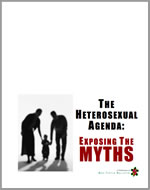 At last, the truth can now be told.
Using the same research methods employed by most anti-gay political pressure groups, we examine the statistics and the case studies that dispel many of the myths about heterosexuality. Download your copy today!
And don‘t miss our companion report, How To Write An Anti-Gay Tract In Fifteen Easy Steps.
 Anti-gay activists often charge that gay men and women pose a threat to children. In this report, we explore the supposed connection between homosexuality and child sexual abuse, the conclusions reached by the most knowledgeable professionals in the field, and how anti-gay activists continue to ignore their findings. This has tremendous consequences, not just for gay men and women, but more importantly for the safety of all our children.
Anti-gay activists often cite the “Dutch Study” to claim that gay unions last only about 1½ years and that the these men have an average of eight additional partners per year outside of their steady relationship. In this report, we will take you step by step into the study to see whether the claims are true.
Tony Perkins’ Family Research Council submitted an Amicus Brief to the Maryland Court of Appeals as that court prepared to consider the issue of gay marriage. We examine just one small section of that brief to reveal the junk science and fraudulent claims of the Family “Research” Council.
 The FBI’s annual Hate Crime Statistics aren’t as complete as they ought to be, and their report for 2004 was no exception. In fact, their most recent report has quite a few glaring holes. Holes big enough for Daniel Fetty to fall through.
“Google” is a trademark of Google Inc.
© Box Turtle Bulletin. All Rights Reserved.


 Posts
Posts  Posts via daily email: