Box Turtle Bulletin
 News and commentary about the anti-gay lobby
“Now you must raise your children up in a world where that union of man and box turtle is on the same legal footing as man and wife…”
News and commentary about the anti-gay lobbyMarch 17th, 2010
Virtually all of our reporting over Uganda has been mostly limited to the international furor over the draconian Anti-Homosexuality Bill that has been introduced before Uganda’s Parliament. Last week, I discussed some of the possible reasons for Parliament’s slow movement on the bill, which had been presented as being so urgent and a high priority. Now other events in Uganda which threaten to overwhelm the government are likely to take center stage for quite a while. While it is possible that these events may prove to be enough of a distraction to allow the anti-gay bill to quietly slip through, it is more likely that the government may have more important things to worry about for the time being.
The Ugandan government has its hands full on several fronts all of the sudden. Earlier this month, there was the tragic landslide in Bududa district, which has resulted in at least 300 deaths. President Yoweri Museveni’s government has come under harsh criticism for its slow response to the tragedy. Then on Monday night of this week, two Makerere University students were shot and killed by security guards at a university dormitory. Local police quickly moved to arrest the shooter and disarm the rest of the guards, but that hasn’t gone very far to quell massive demonstrations which have engulfed the campus of Uganda’s largest university. Both students were Kenyans, which adds an international element to the shootings. Kenya has formally protested the killings.

Map of Uganda, with the Buganda kingdom shown in green (Click to enlarge).
As bad as all of that is, it may prove to be a minor distraction compared to the dangerous developments that are now unfolding in the traditional kingdom of Buganda. Uganda is divided into several such traditional kingdoms, with the kingdom of Buganda being nominally headed by a traditional king (known as a Kabaka) and his cabinet. Their positions have cultural significance, but under Uganda’s constitution they hold no political power. Nevertheless, the Kabaka, Ronald Muwenda Mutebi II, is widely revered and respected among the Baganda. Tensions between the Kabaka and Museveni have been building ever since the Ugandan government blocked the Kabaka from visiting the disputed Kayunga district just outside of Kampala last September. Several days of intense rioting broke out, and the government shut down several radio stations operated by or sympathetic to the Kabaka. Dozens were reportedly killed, and more than 400 arrested and detained by police.

The Kasubi Tombs
Those tensions are about to flare again.
The Kasubi Tombs are the royal tombs for four previous Kabakas. The royal enclosure at Kasubi hill was first built in 1881, and was built in the traditional Baganda style with wood frame and thatched roof. The tombs were declared a UNESCO World Heritage Site in 2001, and they remain an important spiritual and political site for the Baganda people.
Last night, the historic Tombs went up in flames, in what is widely believed to be an arson fire. According to Uganda’s Daily Monitor:
Kasubi Tombs burning (Joseph Kiggundu / Daily Monitor)
Hundreds of Kingdom subjects, some prostrating, crying and screaming, gathered in front of the embers. The grass-thatched hut was completely destroyed within minutes, leaving the skeletal brick wall. The burial grounds, revered by the Baganda, are 128 years old.
Witnesses said the blaze started around 8:30pm. One woman, Lydia Nabambulide, said she heard “a loud explosion” behind the tombs, just before the fire began. She said: “I saw a white box wrapped in something like bark cloth and it looked strange.”
A white numberless pickup truck reportedly emerged from the tombs shortly after the fire broke out, Mr Andrew Jjuko said, quoting Boda Boda [motorcycle taxi] men who were at the scene.
The Kabaka has already made a visit to the ruined tombs, as has President Museveni, but not before soldiers fired live rounds into a crowd of hundreds who had gathered at the tombs to grieve and block the President’s visit. Two are dead, with the more five injured being treated at Kampala’s main hospital. [Update: Uganda’s The Independent puts the death toll at five.]
Anne Mugisha puts this tragedy into context:
The mind of a Muganda might grasp the idea of an exiled king, even a king denied the right of passage through his own kingdom — they were well prepared for such incidents by the history of tension between their kingdom and central government. Nothing has prepared the Baganda for an attack on this significant symbol of their culture. African cultures show great respect for the dead and all burial grounds are sacred. Kasubi tombs was that much more sacred because it is a burial ground for the kings. This attack will be understood by many as an attempt to destroy their culture.
…And so if someone torched Kasubi tombs last night, who will stop them from torching the palace at Bulange? Have they not already torched the King’s own school in Buddo? How many arsonists have been brought to trial since this wave of arson hit the country. Who is answerable for these fiery crimes? If someone torched Kasubi last night they also torched the spirit of Buganda and an invisible line has been crossed by Uganda as a nation. We have entered a dark, fiery, and smoky place that feels my heart with fear for the Kingdom and the country as a whole.
Meanwhile, this morning’s Daily Monitor reports that rioting at Makerere University continues unabated.
Latest Posts
Featured Reports
 In this original BTB Investigation, we unveil the tragic story of Kirk Murphy, a four-year-old boy who was treated for “cross-gender disturbance” in 1970 by a young grad student by the name of George Rekers. This story is a stark reminder that there are severe and damaging consequences when therapists try to ensure that boys will be boys.
When we first reported on three American anti-gay activists traveling to Kampala for a three-day conference, we had no idea that it would be the first report of a long string of events leading to a proposal to institute the death penalty for LGBT people. But that is exactly what happened. In this report, we review our collection of more than 500 posts to tell the story of one nation’s embrace of hatred toward gay people. This report will be updated continuously as events continue to unfold. Check here for the latest updates.
In 2005, the Southern Poverty Law Center wrote that “[Paul] Cameron’s ‘science’ echoes Nazi Germany.” What the SPLC didn”t know was Cameron doesn’t just “echo” Nazi Germany. He quoted extensively from one of the Final Solution’s architects. This puts his fascination with quarantines, mandatory tattoos, and extermination being a “plausible idea” in a whole new and deeply disturbing light.
On February 10, I attended an all-day “Love Won Out” ex-gay conference in Phoenix, put on by Focus on the Family and Exodus International. In this series of reports, I talk about what I learned there: the people who go to these conferences, the things that they hear, and what this all means for them, their families and for the rest of us.
Prologue: Why I Went To “Love Won Out”
Part 1: What’s Love Got To Do With It?
Part 2: Parents Struggle With “No Exceptions”
Part 3: A Whole New Dialect
Part 4: It Depends On How The Meaning of the Word "Change" Changes
Part 5: A Candid Explanation For "Change"
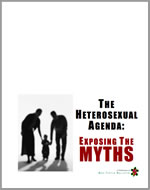 At last, the truth can now be told.
Using the same research methods employed by most anti-gay political pressure groups, we examine the statistics and the case studies that dispel many of the myths about heterosexuality. Download your copy today!
And don‘t miss our companion report, How To Write An Anti-Gay Tract In Fifteen Easy Steps.
 Anti-gay activists often charge that gay men and women pose a threat to children. In this report, we explore the supposed connection between homosexuality and child sexual abuse, the conclusions reached by the most knowledgeable professionals in the field, and how anti-gay activists continue to ignore their findings. This has tremendous consequences, not just for gay men and women, but more importantly for the safety of all our children.
Anti-gay activists often cite the “Dutch Study” to claim that gay unions last only about 1½ years and that the these men have an average of eight additional partners per year outside of their steady relationship. In this report, we will take you step by step into the study to see whether the claims are true.
Tony Perkins’ Family Research Council submitted an Amicus Brief to the Maryland Court of Appeals as that court prepared to consider the issue of gay marriage. We examine just one small section of that brief to reveal the junk science and fraudulent claims of the Family “Research” Council.
 The FBI’s annual Hate Crime Statistics aren’t as complete as they ought to be, and their report for 2004 was no exception. In fact, their most recent report has quite a few glaring holes. Holes big enough for Daniel Fetty to fall through.
“Google” is a trademark of Google Inc.
© Box Turtle Bulletin. All Rights Reserved.

 Posts
Posts  Posts via daily email:
Ben in Oakland
March 17th, 2010
All of these bad things are clearly God’s punishment for homophobia and the musaveni regime. The message could not be clearer.
Dawn/FFL
March 17th, 2010
I was thinking the same thing as Ben
Perhaps all this toil and trouble come from a lack of love for one’s brother, sister and neighbor.
I guess if Robertson can spout it, so can I.
Aaron
March 17th, 2010
I think this is so unfortunate. It looked like beautiful tomb I would have liked to have visited. I don’t understand people who destroy cultural icons just for the sake of it. *sigh*
God bring peace on that country.
Paul in Canada
March 17th, 2010
“Absolute power corrupts absolutely”. The history of African nations post-colonialism is a sad and desperate tale of the worst in human nature.
Frijondi
March 17th, 2010
Since the Kabakas have some moral authority, and don’t appear to be in the pocket of The Family, it might be a good thing if they ousted Museveni and formed the United Kingdoms of Uganda. Then the country could develop along more traditional lines, which might lead to greater stability. And whatever traditional values in that region are, I am pretty sure they are better than what either Doug Coe or Scott Lively has been promoting.
David
March 17th, 2010
Celebrating any one prejudice consistently reinforces all prejudices – it may well be that the celebration of homophobia in Uganda has had the byproduct of revitalizing ethnic prejudices there as well.
werdna
March 17th, 2010
It’s not strictly LGBT-related, but I’m glad you posted about these sad events, Jim. Despite the frustration we feel reading the news about the anti-gay bill, I think it’s important to remember that the furor in Uganda is in no small part a way for the government to distract people (at home and abroad) from its own abysmal failings. I feel nothing but sympathy for the vast majority of Ugandans who continue to suffer under the feckless and corrupt Museveni regime.
@Aaron-I suspect that many of the buildings at the Kasubi Tombs will be rebuilt (though not soon). The parts that were open to tourists were all thatch buildings and were regularly re-built anyway. The artifacts which were destroyed are tragically lost forever, of course.
As Anne Mugisha wrote in the post Jim quotes, the symbolism of the fire at such a significant site is profound and has disturbing implications for the future of tribal relations within Uganda.
John
March 17th, 2010
Corrupt dictatorships aren’t voted out of office. In those situations, power almost always changes hands violently. We’ll see if the current violence is the beginning of the end for Museveni.
However, it is unlikely that Museveni will be replaced by someone who is better.
CPT_Doom
March 17th, 2010
This ethnic tension really highlights the dangerous rhetoric that Scott Lively engaged in during last year’s conference. He used the Rwandan genocide as an example of how LGBT people can spread violence throughout a country (using IIRC, his debunked “the Nazis were gay” argument). Seeing Uganda has similar ethnic tensions to that other African country literally sent chills down my spine. How easy would it be for an anti-LGBT witch hunt turn into a nightmare of ethnic cleansing?
Burr
March 17th, 2010
Very easy. Just say one ethnic group is full is homosexuals, and you’re off to the killing fields.
Where are all the proud homophobic Ugandans now? Aren’t you proud that your country is such an unmitigated disaster? You should be happy that your politicians’ priorities are centered on killing more people for arbitrary reasons instead of finding more ways to protect them. Bravo.
Paul in Canada
March 18th, 2010
Reminds me of a comment that Ssempa left on BTB stating that anti-gay rhetoric was based in cultural history – uh huh – so would he also proudly declare that racial hatred and murder of fellow Africans is part of their cultural history?
How sad to see the leaders in Africa be totally consumed with power and self-entitlement at the cost of so many fellow African’s lives! Their actions continue to demonstrate their complete lack of basic human dignity, respect, moral compass and intelligence.
Leave A Comment