Box Turtle Bulletin
 News and commentary about the anti-gay lobby
“Now you must raise your children up in a world where that union of man and box turtle is on the same legal footing as man and wife…”
News and commentary about the anti-gay lobbyPosts Tagged As: Marriage
February 22nd, 2010

CPAC Poll results. Click to enlarge.
This is bad news for Maggie Gallagher and the folks at the National Organization for Marriage. According to this straw poll (PDF: 14 pages), nobody at this weekend’s Conservative Political Action Conference (CPAC) listed banning same-sex marriage as their first priority, and about 1% listed it as their second choice. Maybe that helps explain the boos directed toward Ryan Sorba on Saturday. More than half the votes were cast by people 25 years old or younger, which bodes well for the future.
February 18th, 2010
Opponents of same-sex marriage often claim that allowing marriage equality would be the first skid down the slippery slope to polygamy. Of course, there’s no evidence to support that assertion. In fact, quite the contrary. A Christian country that is considering the legal murder of gay people is going to the mat to protect marriage between one man and any number of wives:
The state (Uganda) on Thursday moved to protect the principal that a man can have more than one wife. The Attorney General\’s office has responded to a petition seeking to nullify the practice of polygamy by arguing that polgymay is protected by the Constitution under Article 37.
…But Attonery General Khiddu Makubuya stated in his response to the petition, that the law does not stop two consenting adults to choose the marriage of their choice. He said polygamy was protected under Article 37 of the Constitution which gives everyone the right “to belong, practice, enjoy, profess and promote any culture, tradition and religion of his or her own choice.”
Well, not just any culture, tradition and religion…
Click here to see BTB\’s complete coverage of recent anti-gay developments in Uganda.
February 17th, 2010
The Roman Catholic Archdiocese of Washington, D.C., has ended its foster-care program in response to the District’s move toward marriage equality. Catholic Charities turned their 80-year-old foster care program over to the National Center for Children and Families on February 1. Catholic Charities CEO Edward Orzechowski said that he believes the other social service programs run by the group will continue to operate as long as they don’t recognize the validity of same-sec relationships:
Asked if that meant looking at ways to avoid paying benefits to same-sex partners or ways to write benefits plans so as not to characterize same-sex couples as “married,” Orzechowski said “both, and.”
“Now we’re in a position where we need to scrutinize everything,” he said. “From our point of view, it’s important that we don’t in any way compromise our religious teaching.”
February 17th, 2010
The New Hampshire House resoundingly rejected two anti-gay measures. In a 210-109 vote, the House voted to reject a bill which would have repealed the state’s same-sex marriage law. That vote followed a 201-135 vote to reject a proposed constitutional amendment that would have redefined marriage in that state by restricting it to between one man and one woman. That vote fell far below the two-thirds majority needed to advance to the Senate.
February 16th, 2010
The legalization of same-sex marriage in Portugal has now passed its second hurdle. (Vancouver Sun)
Portuguese lawmakers Thursday definitively adopted legislation legalising homosexual marriage, although President Anibal Cavaco Silva, a practising Roman Catholic, must give final approval.
The bill will now go to President Anibal Cavaco Silva for signature. It is expected that if he vetoes the bill, there will be an override.
February 15th, 2010
Last week the Republicans in the Iowa Senate went through the motions of pretending that they were going to pull an anti-gay marriage bill out of committee. Two Democrats joined them in their public demonstration of anti-gay activism.
Now the Republicans in the House have taken their stand. Four Democrats joined them: Dennis Black of Grinnell, Keith Kreiman of Bloomfield, Rich Olive of Story City and Joe Seng of Davenport all signed the petition.
February 13th, 2010
BTB contributors talk about the new “gay couples study” showing over half of participants are in “open” relationships — and the DADT repeal. Listen below or subscribe to the podcast on iTunes (click here, then click “subscribe” in the iTunes window).
[audio:http://gabrielarana.podbean.com/mf/web/wt73zd/podcastings.mp3](One of our users suggested that we provide a direct link to the podcast audio. For those of you who want to download the audio directly, here it is.)
February 12th, 2010
On Tuesday, New Hampshire Representative Nancy Elliot decided that a discussion over repealing the state’s marriage equality law could be spiced up a bit by a little discussion about anal sex.
QUEERTY.COM nancy elliot new hampshire from Queerty on Vimeo.
Rep. Nancy Elliot: We heard in this hearing one of the people came to testify and they said that this is not normal. And I had to think about it a while. Y\’know, what are we talking about?
And so, I started thinking, and we\’re talking about taking the penis of one man and putting it in the rectum of another man, and wiggling it around in excrement. And I had to think, I\’m not sure, would I allow that to be done to me? All of us, if something happened to you, would you let that happen to you?
Is that normal? Is that something that we want to portray as the same as the ‘one flesh union\’ between a man and a woman? I dunno.
Um, then, I started to think, I remember when we were having the testimony, people were saying that um, it was brought up that this would rise to the schools and I\’m thinking, “No, no. No no, that won\’t happen.”
Well I heard yesterday from a mother that in the fifth grade, in Nashua, they were giving um, they were given as part of their classroom instruction, naked pictures of two men showing presentation of anal sex.
Chairman David Cote: Representative Elliot, let\’s keep our discussion directly to the bill and not…
Elliot: This is directly to the bill!
Cuz, because we have made a marriage on same sex, they are now teaching it in the public schools. They are showing our fifth graders how they can actually perform this kind of sex.
And they are condoning, they are saying, “It\’s normal and this is something that you may want to try.” That is the context of the lesson, that this is something that you, as fifth graders, may want to try.
I see it as a real problem in our society. I see it as a real affront to our citizens that their children are suspected to this.
And so I think that it is important that we revisit what we did. We made a mistake. We should repeal it.
Oh, my.
It certainly would be newsworthy if ten year-olds were being encouraged to try anal sex. But it now appears that the telephone call that Nancy Elliot was talking about receiving may have occurred at some point when she forgot to wear her tinfoil hat. (Nashua Telegraph)
Superintendent Mark Conrad said that school officials have asked all elementary school principals about the claim. Conrad said there is no evidence to substantiate Elliott\’s comment and no parents have called to complain.
“We don\’t have any information that this has occurred,” Conrad said Friday.
February 12th, 2010
– Lady Gaga, Speechless
 This Sunday is St. Valentine’s Day, a time for romance and love. And, perhaps, a time to reflect on the value of your relationship.
In a recent post, we analyzed the claims made about how half of gay marriages are not monogamous and found that the sample was not adequate to tell us anything whatsoever about gay marriages. But it did engender a lengthy and heated discussion about the prevalence of monogamy in the community. And various positions were argued from the perspective of the experiences of those opining.
As we saw, while the readership at Box Turtle Bulletin is very diverse, many readers experienced a very emotional connection to the commentary. Several shared their own relationship structure.
Which got me wondering: is your own perspective on monogamy set in stone? If your beloved came to you on Sunday and asked you to change your agreement, how flexible could you be?
If you strongly believe that an open relationship is healthier and that outside sexual release keeps you stronger, could you give it all up to please the one you love? And if you think that a relationship built on monogamy and fidelity is sacred and smart, how would you react to your Valentine if they expressed a desire, or even a need, to have extra-relationship experiences?
(Please be courteous to others and as respectful of their choices as you wish them to be of yours.)
February 11th, 2010
Gordon Fox, the majority leader in the Rhode Island House of Representatives has just been elected Speaker of the House. (Projo.com)
Gordon D. Fox was elected as the state’s first black and openly gay House Speaker, moments after West Warwick Democrat Willliam J. Murphy relinquished the helm on Thursday.
Murphy, a fellow Democrat, was an ardent foe of marriage equality and helped ensure that the issue never reached a vote on the floor. Fox was non-specific about any sort of time-frame, but it is clear that he favors marriage equality for the state.
He has been guarded about where he stands on some of the more volatile issues the 2010 legislature is likely to face, including casino gambling and gay marriage.
An openly gay man, Fox says he is “in a long-term relationship, but not officially married … When I get married, I would like to do it in my home state.”
Fox said he was reluctant to make a hard-and-fast commitment to bring the issue to the House floor for a vote after Murphy leaves, without “a lot of internal discussions.” But, “we should have equal marriage rights in Rhode Island … That would definitely be something on a personal level I would like to see.”
The decision may rest, in part, on the results of the upcoming gubernatorial elections. Fox may be reluctant to expend political capital if he fears that an equality bill would be vetoed. (SJ Merc)
Both Democrats running for governor and former Sen. Lincoln Chafee, an independent candidate, will publicly pledge to sign a gay marriage bill if elected, gay rights activists said Monday.
Attorney General Patrick Lynch and General Treasurer Frank Caprio, the Democrats, and Chafee have been invited to make their promise public at a Statehouse rally scheduled for March 3, said Kathy Kushnir, executive director of Marriage Equality Rhode Island.
Kushnir said Republican candidate John Robitaille has not returned her calls, although Robitaille said he was never contacted by Kushnir’s group. He opposes gay marriage but would consider supporting a domestic partnership system for gay couples.
In any case, it is likely that Rhode Island will move in the direction of couples recognition in the fairly near future.
February 10th, 2010
As expected, the irresponsible coverage of SF State University’s gay couples study by the New York Times continues to be trumpeted on anti-gay media. Today the Baptist Press picked up the story and ran with
Study showing lack of gay monogamy could impact nation’s marriage debate
About half of all male homosexual couples have sex outside of the relationship with the approval of the partner, according to a new study out of San Francisco that some say should have a dramatic impact on the nation’s debate over “gay marriage.”
Anti-gay activists are ready and willing to extrapolate from “couples” to “gay marriage” without even blushing.
“The study demonstrates clearly what we’ve been arguing: That gays bring a different definition to marriage,” Glenn T. Stanton, a sociologist who is the director for family formation studies at Focus on the Family, told Baptist Press. “And it’s not just a different definition that male and female become optional, but that monogamy becomes optional as well. They are coming into marriage with a wholly different view of marriage than anybody has — left, right, conservative, liberal…. They come in with that understanding of openness. These are people who come into marriage with a wholly different and really radical definition of what marriage is about.”
You can bet Stanton will use this as his leading point in his debates from now on.
(The claims made about the study are false. It does not show that “half of all male homosexual couples have sex outside of the relationship with the approval of the partner”.)
February 10th, 2010
One of the primary purposes of Box Turtle Bulletin is analysis and fact-checking of anti-gay rhetoric. And perhaps the largest component of that is to review “studies” that relay astonishing “facts” about gay people and to determine whether they have any basis in fact.
Sometimes these are efforts conducted by anti-gay activists seeking to support their presumptions, but more often it is misrepresentation of legitimate work. One such misrepresentation has been making the rounds purporting to show that gay couples reject monogamy.
For several years, Sean Beougher and Colleen Hoff of the Center for Research on Gender and Sexuality at San Francisco State University have been looking sexual agreements among gay men. This interest was generated by incidences of HIV transmission within relationships and a desire to understand how sexual agreements relate to this phenomenon.
But analysis of investment of couples into agreements and how that correlates with adherence (which impacts transmission within relationships) doesn’t make sexy headlines. So when the New York Times’ Scott James reported on this study, he decided to talk about something else entirely:
Many Successful Gay Marriages Share an Open Secret
A study to be released next month is offering a rare glimpse inside gay relationships and reveals that monogamy is not a central feature for many. Some gay men and lesbians argue that, as a result, they have stronger, longer-lasting and more honest relationships. And while that may sound counterintuitive, some experts say boundary-challenging gay relationships represent an evolution in marriage — one that might point the way for the survival of the institution.
New research at San Francisco State University reveals just how common open relationships are among gay men and lesbians in the Bay Area. The Gay Couples Study has followed 556 male couples for three years — about 50 percent of those surveyed have sex outside their relationships, with the knowledge and approval of their partners.
The sensational (but as I’ll illustrate, flatly untrue) statement that monogamy is not a central feature for many gay relationships is exciting and sure to elicit conversation. But it just wasn’t defamatory enough for those who wish to portray gay people as sex-crazed and incapable of commitment.
Conservative NewsMax reported:
Study: Gay Marriage Involves More Outside Relationships
A federally-funded study by San Francisco State University that followed 556 local male couples for three years found that half “have sex outside their relationships, with the knowledge and approval of their partners,” according to The New York Times.
…
On its website, the Center describes the importance in conducting the study as revolving around the fact that “gay and bisexual men in relationships engage in substantially higher rates of unprotected” homosexual activity than do “single men with their casual partners.”
A commentary on GetReligion.org took the opportunity to say
I\’m not sure if the description of the study\’s findings is written up as well as it could be. If 50 percent of those surveyed have sex outside their primary relationship with the knowledge and approval of their partners, that\’s an utterly fascinating, and newsworthy statistic. Still, I\’m curious about the remaining half. What percentage of those surveyed have sex outside of their primary relationship but don\’t have the knowledge and/or the approval of their partners? It seems like a key piece of information.
…
Certainly there\’s at least one person in the world who thinks that sex with multiple partners is not the key to a successful marriage, right? And I\’m not just talking about advocates of traditional marriage vows, or advocates of spousal fidelity.
…
The bottom line, though, is that this study breaks news. Really interesting and important news.
And even gay sites got on board with this notion with Edge Magazine running the headline, Surprise! Lots of Gay Marriages Are \’Open\’, and Dan Savage declaring Half of All Gay Couples Non-Monogamous (though Edge did note some caveats).
But those who delight in denouncing the hedonistic sex-driven homosexuals and their non-monogamous marriages share a problem with those gays who may champion the abandonment of the heteronormative demands of conformity and spearhead the evolution of marriage: this study tells us nothing whatsoever about gay marriage and little about monogamy within gay relationships as a whole.
In order for a study to report on the characteristics of a population, it must be representative of that population. If a study selects a convenience sample rather than a statistically valid sample, the non-representative demographics of the sample cannot be presented as a “finding”.
For example, if I went to Dodger Stadium, i might find a sample which was useful to tell me whether Dodger fans think Dodger Dogs taste better than garlic fries, but I could not claim that my sample proves that 80% of all baseball fans support the Dodgers. That is simply a non-representative demographic of my sample, not a finding of my study.
So to see if this study supported the claim that half of gay marriages are open (non-monogamous), I contacted the study authors and obtained previously published information that reveals the sample methodology. I do not have all of the data on which the final study is to be reported, but the sampling methodology was consistent.
Let’s look at how the sample for this study was constructed and how that differs from the population as a whole.
Definition of relationship:
To be eligible participants had to have been at least 18 years old, have been in a their current relationship for at least 3 months, have knowledge of their own and their partner’s HIV status, be fluent in English, and be residents of the San Francisco Bay Area.
All were men. Contrary to James’ breathless reporting (and the example with which he started his article) the researchers said nothing about lesbian relationships. They were excluded.
The study was conducted in several phases and the details of each is not available, but the sampling methods were consistent. The breakout for Study 2 found that only 13% of participants identified as being married (perhaps the 2004 San Francisco variety) and only a third had made any sort of public commitment.
It is ludicrous to suggest that a study which includes three month long relationships without any public commitment is informative about marriage. The average length of the relationships was 7 years (more or less) but the median length was about three years earlier (half of the relationships were less than 4 years in length), suggesting that there were a few very long relationships and many much shorter ones.
The way this study has been reported, it has been suggested that gay relationships are more likely to be open than straight relationships, but no comparison was made and I’m not aware of any study that looked at the level of fidelity in three-month-old heterosexual relationship and pretended that they were representative of straights as a whole.
As the research was not applied separately by relationship structure or length, this study says nothing about gay marriage or even domestic partnerships. And any use of the results which makes (or even implies) a comparison to straight relationships is bogus and irresponsible.
Location and social perspective of the population sampled:
It must be emphasized that gay men living in the San Francisco Bay Area are not representative of gay men as a whole. In fact, it would be difficult to identify a group of gay men less representative of the US gay population.
Significant factors in the consideration of monogamy surely must include attitudes about sexuality and whether one’s general approach is more conservative or liberal overall. Additionally, the perspectives of the community in which one lives most certainly effect the values that one adopts.
While I cannot point to a study and state with certainty that those who view themselves as “conservative” are more likely or less likely to value monogamy, I can state that selecting only participants from the SF area sharply skews the sample towards those who identify as “liberal” and significantly under-represents a sizable segment of the gay community.
The means of reaching participants:
Active and passive recruitment strategies were implemented in community settings. Field research staff reached potential participants either by handing out study postcards or placing flyers and postcards in gay-identified social venues such as bars, clubs, and cafes, as well as in community health and HIV and AIDS service organizations and by placing advertisements in gay-oriented publications, Web sites, and listserves.
Recruitment materials contained text describing the study as “one which examines important relationship dynamics associated with HIV.” Recruitment strategies were designed to produce a diverse sample in terms of race or ethnicity as well as serostatus.
Recruitment in bars and clubs and on listserves skews the sample towards those who are actively seeking sexual connections. While some gay people go to bars solely for social interaction, monogamous couples that do not regularly go to bars or look at Craigslist were far less likely to hear of this study.
Additionally, this study was more likely to attract those who were interested in how relationship dynamics impact HIV transmission. I think it is a reasonable assumption that, on average, couples committed to monogamy might not have the same interest level as those who have open relationships.
The demographics of the sample:
For two of the studies, 41% of the participants were HIV positive (Study 3 had 32%). While this may be advantageous to a study which seeks to look at sexual agreements, it is not representative of the population of San Francisco, and has almost no reflection of the gay male population at large. Only about 12% of gay men in the United States are infected with HIV.
While this is undoubtedly useful for looking at variances of agreement structure among sero-concordant and discordant couples, claiming a blended rate of monogamy as though it were reflective of the community would be bad science.
This study found that couples which were both HIV negative were far more likely to establish monogamy than those in which one or both parties were positive. So by significantly over-representing HIV positive participants, the percentage who embrace monogamy were skewed downward.
About half of the sample had a bachelors degree (more than 20% had a post-graduate degree). Yet only about 43% were employed full time, with another 10-12% employed part time and 9-12% self employed. I don’t know whether there is a correlation between employment and valuing monogamy, but I think that we can all agree that 35% unemployment is not reflective of gay men as a whole, especially in the mid 2000’s when the participants were questioned.
About half of the men made less than $30,000 per year, with only a quarter making over $60,000. The average salary for San Francisco Bay Area jobs is about $65,000 and it is absurd to assume that gay men make, on average, less than half of their heterosexual counterparts.
I do not have adequate research at hand to correlate gay male monogamy (or fidelity) with employment or economic position. However, I believe that social position can influence relationship structure so it is a reasonable assumption that a study which is skewed towards a lower economic status may not accurately reflect the extent to which gay male couples as a whole value monogamy.
Conclusion:
The Gay Couples Study does reveal valuable information about the formation of sexual agreements among gay couples. For example, it reveals that gay men are almost universally talk about monogamy and fidelity and define the rules of their relationship. This seems true regardless of the structure, length, or investment into the relationship. And research into breached agreements and how it impacts HIV transmission is essential to targeting prevention efforts.
But in my opinion, Scott James’ statement that “New research at San Francisco State University reveals just how common open relationships are among gay men and lesbians in the Bay Area” may be among the most irresponsible reporting I’ve ever seen. The study says nothing whatsoever about lesbians and it tells us little about “just how common open relationships are” among anyone. It’s pure sensationalism and shoddy journalism.
But the real culprits are those who saw this study and decided that it says something about, for example, gay couples marrying in Iowa or New Hampshire. This was either lazy response or a deliberate attempt to fraudulently demonize gay couples for political gain.
In short, those reporting on this study got it wrong. If there is any story here, it would be that a study of San Francisco bay area gay male couples, a sample which was highly skewed to include many participants who are less likely to value monogamy and which defined “couples” to include those who have been dating as little as three months, still found that half of them set monogamy as the agreement for their relationship.
February 9th, 2010
In a publicity stunt (send money) Republicans in the Iowa legislature tried to pull from committee legislation that would begin the process of changing the state constitution to ban gay marriage. As expected, the Democrat controlled House and Senate both said, “no thanks, dead in that committee is fine with me.”
However, we should be appreciative of the Republicans. After all, this effort revealed two Democrats who hate equality so much that they were willing to defy party loyalty and vote to pull the bills from committee. They are Senator Tom Hancock and Representative Dolores Mertz.
Gay Iowans, and indeed all Iowans who believe that each citizen is entitled to equal treatment under the law, are invited to find and support primary opponents for these two legislators.
February 8th, 2010
When the Iowa Supreme Court determined that denying state services based on sexual orientation was unconstitutional and that the State of Iowa must provide marriage equality, you could almost slice the glee of the Iowa Republican Party. Finally, there was an issue which they could use to perhaps increase their influence and maybe even win a few elections. So they because the “no gay marriage” party.
Last year they made several attempts at getting an anti-gay marriage constitutional amendment up for a legislative vote and were unsuccessful. They chortled that Democrats would be sorry come election time.
But as it has turned out, running opposed to gay marriage has not proven to be a winning strategy. To their surprise, Iowans couldn’t care less about stopping gay folk from marrying. Literally.
The Des Moines Register conducted a poll of Iowans asking, “The state Legislature can address large and small issues during the course of the session. For the following issues, please tell me if you think the issue does or does not deserve the Legislature’s limited time.” Banning gay marriage did not make the cut; only 36% thought it was worth the time discussing.
Not only was it not deemed worthy of legislative time, of the six issues that Iowans were questioned about, addressing gay marriage concerned them the least. Iowans were more concerned about payday loans and puppy mills than they were about whether same-sex couples married.
This lack of interest appears to be reflected in a change in strategy in the campaigns of Republicans running for the party’s nomination for governor. Just a brief while ago they were all running to see who could be more extreme and reactionary.
Bob Vander Plaats pledged to halt such weddings with an executive order (an authority the governor does not wield) while Chris Rants declared that he’d veto every bill that reached his desk until the legislature voted on a constitutional amendment to ban marriage equality. Most of them supported calling for a constitutional convention so they wouldn’t have to wait for two sessions and a popular vote.
Only former governor Terry Branstad, also an opponent of gay marriage, chose not to run as a raving loon. Branstad took a more nuanced approach and expressed recognition of the difficulties that gay couples face when denied certain rights.
But that has changed. The race now appears to be between Branstad and Vander Plaats, and the latter has now discovered a different campaign strategy. (Register)
I\’ve talked to Vander Plaats from time to time, but hadn\’t really seen him out on the stump since last fall. His speeches used to give prime attention to conservative issues and gay marriage. This time, he focused entirely on job creation, state spending and education. Nobody even asked about the social issues.
I mentioned to him afterward that was a significant change from last summer, when he told me in an interview that he thought the election would hinge on two issues: gay marriage and the state smoking ban.
“Did I say that?” he asked. Yes, I told him.
“Campaigns always evolve, no doubt about it,” he said. (He didn\’t mention the smoking ban at all today.)
Yes, there is no doubt that campaigns evolve, especially when the voters care less about your pet issue than they do about monitoring dog breeders.
February 5th, 2010
 Last July we reported that Albania, a secular Muslim Balkan nation, was considering legalizing same-sex marriage. The Prime Minister announced his party will propose a law making the change.
Sadly, this did not come to be. However, a law was passed which outlawed discrimination. (PinkNews)
A gay rights law passed in Albania yesterday will outlaw homophobic discrimination but will not allow same-sex marriage.
The law gives protection to citizens against discrimination on grounds of gender, race, colour, ethnicity, religion and sexual orientation.
This change, though disappointing, was welcomed. (Reuters)
‘This law is not simply a fulfilment of requirements that Albania has undertaken for European Union integration and visa liberalisation. Above all, it is a victory for democracy and for human rights for all Albanians,’ the LGBT community said. The group hoped that Berisha would eventually keep his promise to legalise same-sex marriage.
Altin Azizaj, who runs the Children Rights Centre and had fought with parliamentarians over the role of a commissioner to monitor the law, said public and, most importantly, private institutions were now bound to respect human rights.
Featured Reports
 In this original BTB Investigation, we unveil the tragic story of Kirk Murphy, a four-year-old boy who was treated for “cross-gender disturbance” in 1970 by a young grad student by the name of George Rekers. This story is a stark reminder that there are severe and damaging consequences when therapists try to ensure that boys will be boys.
When we first reported on three American anti-gay activists traveling to Kampala for a three-day conference, we had no idea that it would be the first report of a long string of events leading to a proposal to institute the death penalty for LGBT people. But that is exactly what happened. In this report, we review our collection of more than 500 posts to tell the story of one nation’s embrace of hatred toward gay people. This report will be updated continuously as events continue to unfold. Check here for the latest updates.
In 2005, the Southern Poverty Law Center wrote that “[Paul] Cameron’s ‘science’ echoes Nazi Germany.” What the SPLC didn”t know was Cameron doesn’t just “echo” Nazi Germany. He quoted extensively from one of the Final Solution’s architects. This puts his fascination with quarantines, mandatory tattoos, and extermination being a “plausible idea” in a whole new and deeply disturbing light.
On February 10, I attended an all-day “Love Won Out” ex-gay conference in Phoenix, put on by Focus on the Family and Exodus International. In this series of reports, I talk about what I learned there: the people who go to these conferences, the things that they hear, and what this all means for them, their families and for the rest of us.
Prologue: Why I Went To “Love Won Out”
Part 1: What’s Love Got To Do With It?
Part 2: Parents Struggle With “No Exceptions”
Part 3: A Whole New Dialect
Part 4: It Depends On How The Meaning of the Word "Change" Changes
Part 5: A Candid Explanation For "Change"
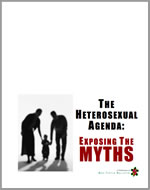 At last, the truth can now be told.
Using the same research methods employed by most anti-gay political pressure groups, we examine the statistics and the case studies that dispel many of the myths about heterosexuality. Download your copy today!
And don‘t miss our companion report, How To Write An Anti-Gay Tract In Fifteen Easy Steps.
 Anti-gay activists often charge that gay men and women pose a threat to children. In this report, we explore the supposed connection between homosexuality and child sexual abuse, the conclusions reached by the most knowledgeable professionals in the field, and how anti-gay activists continue to ignore their findings. This has tremendous consequences, not just for gay men and women, but more importantly for the safety of all our children.
Anti-gay activists often cite the “Dutch Study” to claim that gay unions last only about 1½ years and that the these men have an average of eight additional partners per year outside of their steady relationship. In this report, we will take you step by step into the study to see whether the claims are true.
Tony Perkins’ Family Research Council submitted an Amicus Brief to the Maryland Court of Appeals as that court prepared to consider the issue of gay marriage. We examine just one small section of that brief to reveal the junk science and fraudulent claims of the Family “Research” Council.
 The FBI’s annual Hate Crime Statistics aren’t as complete as they ought to be, and their report for 2004 was no exception. In fact, their most recent report has quite a few glaring holes. Holes big enough for Daniel Fetty to fall through.
“Google” is a trademark of Google Inc.
© Box Turtle Bulletin. All Rights Reserved.
 Posts
Posts  Posts via daily email: