Box Turtle Bulletin
 News and commentary about the anti-gay lobby
“Now you must raise your children up in a world where that union of man and box turtle is on the same legal footing as man and wife…”
News and commentary about the anti-gay lobbyJuly 10th, 2012
TODAY’S AGENDA (Ours):
Press Conference on US Domestic AIDS Policy: Washington, D.C. A press conference featuring leading national experts on domestic policy efforts to fight HIV/AIDS will be held tomorrow at 10:00 a.m. at the National Press Club in Washington, D.C. This is just one of several events which will lead up the the XIX International AIDS Conference, which will be held in the United States later this month for the first time in history now that the HIV travel ban has been lifted. This briefing for reporters will assess current federal policy issues including the implementation of health care reform and funding that would impact the fight against AIDS. Speakers include: Carl Schmid of The AIDS Institute, A. Cornelius Baker of the National Black Gay Men’s Advocacy Coalition, Julie Scofield of the National Alliance of State and Territorial AIDS Directors, and Ronald Johnson of AIDS United.
TODAY’S AGENDA (Theirs):
Family “Research” Council’s Values Bus Tour: Richmond, VA. The Family “Research” Council, an SPLC-certified hate group, continues its Values Bus Tour in conjunction with the Heritage Foundation through the the Old Dominion. Today’s stop is in Richmond for a Conservative Coalition meeting at the Virginia Institute for Public Policy from 10:00 to 11:45 a.m. The bus will remain on hand for a press conference titled, “Conservative Women Leaders Speak Out,” to held at the Virginia Institute from 12:15 to 1:15 p.m.
TODAY IN HISTORY:
A Discovery of a Very Extraordinary Nature: 1766. The following story was reported in the July 10, 1766 issue of London’s Gentleman’s Magazine:
A discovery of a very extraordinary nature was made at Poplar, where two women had lived together for six and thirty years, as man and wife, and kept a public house, without ever being suspected; but the wife happening to fall sick, and die, a few years before she expired, revealed the secret to her relations, made her will, and left legacies to the amount of half what she thought they were worth. On application to the pretended, she at first endeavoured to support her assumed character, but being closely pressed, she at length owed the fact, accommodated all matters amicably, put off the male, and put on the female character, in which she appeared to be a sensible well-bred woman, though in her male character she had always affected the plain plodding alehouse-keeper. It is said they had acquired in business money to the amount of £3000. Both had been crossed in love when young, and had chosen this method to avoid further importunities.
[From Ian McCormick’s Secret Sexualities: A Sourcebook of 17th and 18th Century Writings
Texas Editorial: “We’ll Take Gays Over the KKK”: 1985. It all began in 1984, when the Dallas/Ft. Worth suburb of Arlington was having a problem at Randol Mill Park. It seems that the popular park had become a well-known venue for men (often heterosexually married men) to solicit sex with other men. After a year’s worth of stepped up patrolling and enforcement by Arlington police, the Mid-Cities Daily News reported, “We have not heard nearly as much about the problem as last year.” But for whatever reason, the Klan was still excited over queers in the park. The Klan’s “exalted cyclops” announced that his group would be holding a picnic at the part — sans white sheets — to send a message that gays weren’t welcome. The Daily News responded, “Given the choice between sharing a park with homosexuals or a bunch of white-sheeted, racist, hate-peddling losers, we think we would prefer the homosexuals.”
Well sure, given the choice.
When the Klan held their picnic three days later, Scott Patrick, the exalted cyclops of the Garland klavern, sounded disappointed with what he found. ” I expected the situation to be a little more blatant. I’m sure all the publicity kept it out.” That left him with no choice but to complain about other groups. “Would you believe I actually had a Jew ask if a Jew could come to one of our meetings,” he told a reporter. “I said ‘no.’ A Jew would have about as much chance of attending as a nigger. You’ve got to admit they aren’t as intelligent as we are.”
TODAY’S BIRTHDAYS:
 Jerry Herman: 1931. The American composer and lyricists is best known for his scores for the Broadway hits Hello Dolly! (1964), Mame (1966) and La Cage aux Folles (1983). The latter earned Herman a Tony for best musical. His most famous song, “Hello Dolly!”, knocked the Beatles from #1 in 1964 when Louis Armstrong recorded it. “When they passed out talent,” Carol Channing said, “Jerry stood in line twice.”A 2008 PBS documentary about him reported that Herman was diagnosed HIV-positive in 1985 when that diagnosis was an automatic death sentence. He was lucky, and is among of the fortunate few to live to see the lifesaving “cocktail” become available in 1995. The AIDS epidemic wiped out half the original La Cage aux Folles chorus before the show’s final run, but the show’s signature anthem “I Am What I Am” can still bring audiences to their feet with its call for dignity and integrity in the face of bigotry and fear.
 Neil Tennant: 1954. With bandmate Chris Lowe, he was one half of the electronic dance duo Pet Shop Boys. Their first single, “West End Girls,” was actually recorded twice. The first version was released in 1984 and became a club hit in New York, San Francisco and Los Angeles. Go figure. After the duo signed with EMI, they re-recorded the song, and it became a 1986 number one hit in the U.S. and the U.K. Tennant was coy about rumors over his sexuality throughout the 1980s, but he finally came out in a 1994 interview with a UK gay magazine. Pet Shop Boys are still going strong. On March 14, 2011, they released a double CD of the complete three-act ballet score for The Most Incredible Thing
If you know of something that belongs on the agenda, please send it here. Don’t forget to include the basics: who, what, when, where, and URL (if available).
And feel free to consider this your open thread for the day. What’s happening in your world?
July 9th, 2012

National Cathedral in Washington, DC
After two years of study, input, discussion and careful consideration, the Episcopal Church had crafted the language of liturgy for uniting same-sex couples. The church has in the meanwhile allowed the blessing of marriage in states where it is legal and the blessing of other forms of unions elsewhere, with or without legal standing, but it has not had formal language across the church.
The new liturgy, The Witnessing and Blessing of a Lifelong Covenant, closely follows the church’s marriage liturgy but does not use the word “marriage”. (Though, undoubtedly it will be referred to as marriage and will likely adopt that language in the future). Combined with the ability of a bishop to authorize civil pronouncement of marriage in equality states, this subtle distinction will likely be lost on all but the technical minded.
The Episcopal Church is bicameral in it’s legislature, with liturgical rites requiring the approval of both Bishops and Lay bodies. Today the first step was accomplished. (msnbc)
Episcopal bishops approved a resolution to create a liturgy for same-sex unions Monday during the Church’s 77th General Convention in Indianapolis, with 111 votes in favor and 41 opposing.
The proposal was amended to disallow coercion or penalty to any bishop, priest, deacon or lay person who either supports or opposes the change, thus giving some comfort to more conservative Episcopalians (and to more supportive members of conservative dioceses).
This new liturgy give formal Episcopal blessing – whether in Massachusetts or Alabama – to same-sex couples with all of the pomp and formality that a stain-glassed, hundred-year-old, wood pewed, Episcopal church can bring. And believe me, that is saying quite a lot. Aunt Thelma can’t help but shed a tear or two.
An excerpt:
In the name of God,
I, N., give myself to you, N.
I will support and care for you:
enduring all things, bearing all things.
I will hold and cherish you:
in times of plenty, in times of want.
I will honor and keep you:
forsaking all others,
as long as we both shall live.
This is my solemn vow.
If rings are to be exchanged, they are brought before the Presider, who prays
using the following words
Let us pray.
Bless, O God, these rings
as enduring signs of the covenant
N. and N. have made with each other,
through Jesus Christ our Lord. Amen.
The two people place the rings on the fingers of one another, first the one, then
the other, saying
N., receive this ring as a symbol of my abiding love.
If the two have previously given and worn rings as a symbol of their commitment,
the rings may be blessed on the hands of the couple, the Presider saying
Let us pray.
By these rings N. and N. have shown to one another and the world
their love and faithfulness.
Bless these rings, Holy God,
that they may now be signs of the covenant
N. and N. have made this day,
through Christ our Lord. Amen.
Pronouncement
The Presider says
Inasmuch as N. and N. have exchanged vows of love and fidelity
in the presence of God and the Church,
I now pronounce that they are bound to one another
in a holy covenant,
as long as they both shall live. Amen.
July 9th, 2012
This excerpt from the diary of a NOM fact checker has somehow fallen into my hands. I cannot vouch for its authenticity.
Dear Diary,
This morning I was trying to use a decorative letter opener to cut the despair out of my soul when a NOM staffer dropped off a blog entry for me to fact check. “Make sure it’s accurate,” he said. He must be new.
He’d been told to write about our Starbucks boycott. I’d forgotten there were jobs here worse than mine. Starbucks stock shot up after we announced the boycott, but his article claimed the price has fallen lately, and after more than two months it’s finally a smidge below where we started.
Hooray, apparently. God, the desperation around here is so thick they should spread it on white bread and serve it with tea.
Anyway, I checked the stock price — OMG! it had dipped a bit, then risen, but then dipped again, most recently since about June 20. So this was…correct?
Oh, why couldn’t I have just stopped there. I could have been the hero, could have announced, Hey everyone, we’re saying something TRUE, could have been included in the alcohol-free celebratory sniffing of white-board markers. Read the rest of this entry »
July 9th, 2012
Supporters of gay marriage in Washington state said Monday that they raised more than $952,000 last month for the campaign to uphold the state’s new law, which is currently on hold pending the outcome of a November ballot measure.
But that’s just last month
As of Monday, Washington United for Marriage said it had raised more than $2 million for the campaign to fight back attempts to overturn the law. Preserve Marriage Washington, which collected the signatures to get R-74 on the ballot, has raised more than $135,000, according to the most recent numbers with the Public Disclosure Commission, though it hasn’t yet submitted its totals for June.
The Washington, D.C.-based National Organization for Marriage, which was involved in ballot measures that overturned same-sex marriage in California and Maine, has said it will fight to strike down the law, and has loaned regional coordinator Christopher Plante to the local campaign.
“We expect to be outspent on this,” said Plante, who is now serving as deputy campaign manager for Preserve Marriage.
Ya think?
July 9th, 2012

green = 2012, pink = prior
Florida is not known for its support and recognition of same-sex couples. On June 7, 1977, Anita Bryant led a campaign to repeal an anti-discrimination ordinance in Dade County, beginning a culture war that still is raging today. In 2008, it joined the wave of anti-gay ballot measures prohibiting both marriage and civil unions by a 62% vote.
But, without a lot of media or fanfare, cities and counties within the state have been rapidly stepping up to offer such protections as can be granted at a local level. And while some of the progress has been over the past couple of years, there are six cities and two counties that begin offering domestic partner registration during the first half of this year alone.
Perhaps the most exciting aspect of this change is that it is entirely unexciting altogether. In today’s rapidly accepting world, where the question is whether Great Britain or Australia* will be the next nation to enact marriage equality (or if US courts will beat them to it), it hardly seems worth noticing that Gulfport or Volusia County now offer registries. But to the citizens of those cities and counties it is very very important.
And as a cultural marker, it is astounding. Today, Anita Bryant is a symbol of discrimination and bigotry, and 44% of Florida residents live in a city or county that recognizes the relationships of their gay citizens.
* – Yes Australia is a long shot and the Brits are the odds on favorites, but there is a lot of buzz going on down under and my instinct has me hedging my bet.
July 9th, 2012
With the conclusion of Exodus International’s annual Freedom Conference in St. Paul, Minnesota during the last week of June, thirty-seven Exodus Conferences have now come and gone. This is only the second conference I’ve been to, but I think it is safe to say that this conference was probably like no other in Exodus’s history. I’m glad I was there to witness it. My point of reference was the 2007 conference that I attended in Irvine, California. The differences between the two conferences weren’t quite night and day, but Exodus is undeniably a very different organization now than it was then, and the two conferences reflect those differences.
My approach to this year’s conference was a bit different from five years ago. In 2007, I went more or less undercover. Not really undercover — I registered under my own name and wore my name badge everywhere I went, but I didn’t talk about myself or reveal that I was a pro-gay blogger. This time was different. I began all substantive conversations I engaged in by introducing myself and disclosing that I was a pro-gay blogger. It turns out that most of the people I encountered never heard of me and didn’t know anything about this blog. Fortunately, my ego is far too resilient to let a thing like that bother me. (It turns out few had heard of me; when I good-naturedly accused one young woman of just being nice when she said she was a BTB regular, she pulled out her smart phone and showed me that BTB was loaded up her RSS reader.) We had some good conversations, and on a couple of occasions a few hard questions were directed my way, but nothing really at all nasty or confrontational. I was, without exception, made to feel welcome, and I really appreciate those who allowed me to get a glimpse into why they were there and what they hoped to get out of the conference.
I would however add that I did not introduce myself to workshop speakers beforehand. I didn’t want my presence to cause them to modify their remarks. I think I was mostly successful toward that end. The only person who recognized me before his workshop was Mike Goeke (Hi Mike!), but based on the content of his talk, I don’t think he changed anything just because I was there tapping out notes on my laptop.
The Backdrop
I wanted to attend this particular conference because we have been noting that Exodus International has made some very substantial changes in its messaging over the past several months. I wanted to see first-hand what those changes would look like on the inside. But before I begin discussing the conference itself, a review of that journey is in order. The first tangible sign of those changes surfaced last January, when Chambers appeared on a surprise panel at the Gay Christian Network’s annual conference in Orlando with the revelation that, “the majority of people that I have met, and I would say the majority meaning 99.9% of them, have not experienced a change in their orientation.” This was a remarkably clear statement from a man who headed an organization with the motto, “Change Is Possible.” On prior occasions, depending on the particular audience he was speaking to, he had mentioned that he personally struggled with same-sex attractions, but this was the first time he acknowledged publicly the reality that people really don’t experience a change in their sexual orientation as a result of entering into the ex-gay movement. With this statement at GCN, he publicly acknowledged what few would only admit privately, if at all. It was a remarkably clear departure from pervious statements.
Then a few weeks later, we learned that Exodus had removed Reparative Therapy books from its online bookstore. When Warren Throckmorton inquired about the books’ removal, Chambers responded:
The reason I removed RT books from Exodus Books is because I don’t agree with using this research as a means to say that “this” is how homosexuality always develops, “this” is the primary means in which to deal with it and this is “the” outcome you can expect. Too, Exodus, as a whole, is not a scientific or psychological organization…we are a discipleship ministry and that is where I think our strength is and energy should be focused.
This, too, was an important development. Reparative Therapy and the particular developmental theories that underlie it have been an important framework for much of what Exodus promoted through the years. It was one of the primary avenues in which change was supposedly possible. Chambers’s decision to distance his organization from RT signaled a break from the National Organization for Research and Therapy of Homosexuality (NARTH), many of whose leaders had been prominent speakers at previous Exodus conferences. Chambers’s move against RT didn’t go unnoticed at NARTH.
Changes at Exodus didn’t end there. Under Chambers’s leadership the organization began to alter its approach to the gay community as well. Just to show you what that difference looks like, it was only a little over a year ago, May 4 to be exact, when Chambers criticized a Google Chrome ad which portrayed ordinary people using YouTube, a Google-owned service, to post videos as part of Dan Savage’s “It Gets Better” anti-bullying campaign. Chambers was irked because Woody, a character from “Toy Story,” appeared for about two and a half seconds to say “You’ll be fine, partner.” But after considerable criticism for coming out against the anti-bullying campaign, he retracted that reaction — five months later — saying “I have to admit that I was wrong to question their marketing strategy without expressing my full support for what is the heart of their campaign – encouraging LGBT teens to choose life.”
This year, Exodus has been considerably more pro-active and responsive. They took the initiative last May to condemn the Family Research Council’s awarding its 2012 Watchman Award to Winston-Salem, NC pastor Ron Baity, who compared gays to murderers, said they were “worse than maggots,” and that God had “an urban renewal plan for Sodom and Gomorrah.” And when Exodus board member Dennis Jernigan traveled to Jamaica at the invitation of local anti-gay extremists fighting to preserve that nation’s criminal code defining homosexuality as a felony, Exodus reacted quickly to that controversy with an announcement that Jernigan had resigned from the board. It also reaffirmed its opposition to laws criminalizing homosexuality.
And finally, when a bill began making its way though the California legislature which would ban licensed therapists from providing Sexual Orientation Change Efforts (SOCE) to minors, Exodus issued a statement which, without addressing the bill directly, re-affirmed Exodus’s position that “we do not subscribe to therapies that make changing sexual orientation a main focus or goal.” It’s not difficult to imagine that a year ago they would have probably been allied with NARTH’s effort to defeat the measure.
All of this taken together represents tremendous changes for Exodus in a remarkably short amount of time. And those changes have not been without cost or controversy within the ex-gay movement. In April, Andrew Comiskey, who heads Desert Stream Ministry, one of the more prominent member ministries in the Exodus network, wrote a letter to Chambers calling on him to “continue to uphold change as a reasonable goal for Christians with (same-sex attraction).” Citing Chambers’s comments before the Gay Christian Network, Comiskey worried that “Alan’s comments about change unwittingly played into the enemy’s hands.” Comiskey stopped short of calling for Chambers’s resignation, but he did call for a “reduced role (at best)” and suggested that Chambers should “pray more and facebook less.” By June, we would learn that eleven member ministries had left Exodus’s network, including Comiskey’s DSM and Frank Worthen’s New Hope Ministries in San Rafael, California. New Hope’s exit is particularly noteworthy because it is one of the surviving granddaddies of the ex-gay movement, having been one of the founding ministries of Exodus International back in 1976.
Exodus, Then and Now
Regular readers at BTB are likely bored with this lengthy recital, but I thought that before diving into what I observed at Exodus’s annual Freedom Conference in St. Paul, Minnesota, it was important to remind ourselves how we got to where we are today. Exodus is behaving very differently from Exodus of past years, and I can confirm that many of those differences were reflected in this year’s conference on several levels. What follows are a few thumbnail observations of the differences I saw at Exodus 2012 when compared to Exodus 2007. For example:
Reparative Therapy: In 2007, Reparative Therapists were prominently featured in conference workshops and plenary sessions. Dr. Julie Harren — she is now Julie Harren Hamilton, NARTH’s most recent past president — spoke at the Saturday morning plenary session, and Reparative Therapists Joseph Nicolosi and Janelle Hallman provided workshops. As recently as 2010, Nicolosi offered two workshops, and he was a featured plenary speaker in 2009.
But in 2012, there was not a single Reparative Therapist in the line-up, either in the plenary sessions or in any of the workshops. But while RT may be gone, its underlying theories remain operative assumptions to explain why people are gay. And for some reason, those explanations are still important at Exodus, where they were the focus of the first two workshops listed for Thursday morning. It’s probably unreasonable to expect everything about RT to be banished overnight. It has, after all, been a huge part of the ex-gay movement for decades. But it seems to me that holding onto those unproven developmental theories no longer provides the utility they once did. This deserves a more thorough discussion, and will be the focus of an upcoming post in this series.
Nevertheless, I think this particular change is the mark of growing maturity in the ex-gay movement, and it has its parallels in the history of the gay community. If you were to go to the library and look up old copies of the Mattachine Review, The Ladder or ONE magazine from the 1950s, you will find tons of articles by psychologists and other professionals telling their gay audiences that homosexuality was a psychological disturbance and that they had the means to cure it. And gays and lesbians at that time, while conflicted over those pronouncements, were willing to give those professionals their respect as “experts.” That changed in the early 1960s when pioneering gay rights activist Frank Kameny boldly stood up and declared that gay people were their own experts and it was the (mostly straight) professional community who needed to learn from them. Kameny’s uncompromising brashness is not in Exodus’s genes, but in many ways I can see Exodus International beginning to take a few steps along a familiar path within the ex-gay movement, with politically-motivated anti-gay organiations, and within the Evangelical Church.
On Change: Because Reparative Therapy is no longer supported at Exodus, the expectation that sexual orientation can be changed has also been largely eliminated. Mostly. There are still a few recalcitrant exceptions. But Alan Chambers devoted his entire opening night talk on this subject and it set the tone for the whole conference. The most notable feature of that talk — and the part that everyone was talking about afterwards — was his reading of the account of Shadrach, Meshach, and Abednego from Daniel 3:16-18 who defiantly told King Nebuchadnezza that “we will not serve your gods or worship the image of gold you have set up.” He then went on to say, “I think we’ve made a golden idol out of change.”
He said much more than that, and I will go deeper into it in the next post in this series. But suffice it to say that his opening night talk set a clear benchmark for the rest of the conference. According to several conversations I’ve had, this looks like the most positive change that Exodus has undertaken, as it now appears to me that many attendees no longer feel the pressure to prove that they’ve changed or are in the process of changing their sexual attractions. While its possible that some may feel disillusioned about what they hoped to find at Exodus, I got the sense that the larger overall feeling was one of tenuous relief. And I use the word tenuous to describe that relief because I think a different, more realistic message has sunk in, that they will almost certainly remain “same-sex attracted” for the rest of their lives. That is an undoubtedly daunting prospect. And what Exodus is now offering instead of change is the promise of just “showing up” and supporting them in their daily walk. I sensed a widespread agreement that this was a much more honest and realistic message.
Marriage vs. Celibacy: In 2007, marriage was still the golden idol for many participants at the Exodus Conference. It was evident in many of the testimonies presented during the plenary sessions, and it was assumed to be a desired outcome for many who were there — even if that outcome would be many years down the road. I remember that on arriving at that conference, a local news crew was interviewing an ex-gay attendee who — and I am not making this up — looked like a bleached-blond Rod Stewart clone. The newsperson asked him if his sexual orientation changed, upon which pseudo-Rod shrieked, “Of course! And if you don’t believe me, you can ask my wife!” (My thought was probably the same as yours: “Oh, honey!”) Alan Chambers tried to inject a note of realism on his opening night talk that night where, at one point, he challenged his audience to imagine what their lives might be like if they don’t experience a change in their sexual orientation. But compared to his talk in 2012, that was a relatively minor detour.
But what a difference five years makes. It’s hard to make celibacy an attractive option, but Exodus appears committed to elevating living a single life to an equal footing with married life. This will be a very difficult task in Evangelical culture, where churches routinely operate singles ministries for the purpose of getting members matched up. But I think this time there is a greater commitment to providing encouragement and resources for living a single, celibate life. It was the focus of one of the plenary talks by Jonathan Barry, who also presented a popular workshop on the subject. Christopher Yuan’s plenary reinforced that message, and Exodus vice president Jeff Buchanon called for more emphasis on singleness as a blessing in his workshop on discipleship. It will obviously be a hard sell, but it is at least a much more realistic one.
The Culture War: In 2007, Exodus announced that they had hired Amanda Banks, whose sole job it was to represent Exodus in lobbying against pro-gay measures on Capitol Hill. She gave a detailed talk at that conference on Exodus’s plans for anti-gay lobbying. That was only one example of Exodus’s engagement in the culture wars. Focus On the Family was represented by Mike Haley and Melissa Fryrear, while Michael Brown and Ken Hutcherson provided some rather entertaining culture-war material for the plenary sessions. The conference opened with a special video in which several prominent anti-gay political and religious leaders welcoming participants to that conference. I witnessed first hand the distress that video caused at least one conference participant. At one workshop on the culture war (yes, that was part of the workshop’s title), he angrily denounced several leaders who appeared in that video for their untruthful attacks against the gay community and asked why Exodus would feature such hateful people (his words) whose rhetoric he felt to be so personally harmful. He then broke down in tears, bringing that workshop to an abrupt end. It was a poignant reminder that those who attend these Exodus conferences really are gay people in many respects. It also illustrated how the allure of politics allowed Exodus to lose sight of those they claimed to serve.
In 2012, references to the culture wars was remarkably attenuated. Nobody from Focus On the Family was there that I noticed, nor were there any other notable culture war speakers. Culture war references weren’t completely absent; I noticed that old habits die hard among a few of the more obscure workshop presenters. But this time, I saw several instances when speakers had an opening to go into politics or cultural issues but refrained from doing so. Even among topics that one would expect to be uncontroversial within the setting of an Exodus conference, people generally just didn’t want to “go there.” In fact, I would say that there was, if anything, a general weariness over the whole thing.
Outreach to the Gay Community: This was a relatively new one. Previously, speakers would mention interacting with the gay community, but most of those mentions were more or less in passing. But now, with Exodus’s exit from politics, there were some discussions about engaging gay people directly and what that might look like. One of the best workshops I attended was by Katie Brown, who talked about why the Millennial generation was turning away from anti-gay rhetoric (and, by extension, the Evangelical Church) in droves. I thought her observations were very perceptive, and not necessarily limited to Millennials. Goeke’s talk on reaching out to the gay community was also mostly constructive.
Where they talked about reaching out to the gay community, the talk centered mostly on what to do (and, more importantly, what not to do). But what I didn’t see fleshed out was a sense of what they thought they had to offer that we didn’t already have. One answer I imagine they would supply might be Jesus, but we already have gay-affirming churches and their numbers are growing every day. Goeke pointed out that the Evangelical Church should have been the first to step up with an anti-bullying campaign, but instead offered little but resistance to even addressing the problem. I would add that the church also should have been the first to provide comprehensive help during the height of the AIDS crisis, but was instead a source of condemnation to the gay community for incurring “God’s wrath.” That is something that I don’t think can ever be forgotten.
I would also point out that because of those failures on behalf of the Evangelical church (and religous institutions as a whole), the gay community had to respond with its own version of “ministries” — community based organizations to address the many specific needs of our communities. We had to learn the hard way how to minister to ourselves in the face of unrelenting tragedy and overwhelming adversity. And so we’ve already established the kinds of ministries, if you will, that they should have established. If Exodus members are serious about reaching out, they might consider showing up at some of the many volunteer organizations that already exist in their communities and getting to know gay people on a more personal level. And then, maybe, decide whether they really have anything constructive to offer. And to allow members of the gay community to decide whether they want to buy whatever it is they’re offering.
The Big Picture
But overall, I’d have to say that the biggest difference I saw in 2012 when compared to five years ago is that Exodus 2012 was characterized by a greater humility. In 2007, the married and the “changed” were triumphant, and the strugglers were, well, still struggling. Also, speakers at that conference were the “experts” and the attendees the students. And as in many student/teacher situations, I found several instances when conference participants either snickered at what they heard or (in the case of John Smid’s workshop on masturbation) muttered “this is bullshit!” when they encountered, well, bullshit. In 2007, I was surprised more often than I thought I would be by the frequency at which conference attendees voiced disagreement among themselves over some of the things they heard.
This time, I think there was a greater appreciation for Alan Chamber’s transparency in admitting that he still has same-sex attractions and that sometimes those feelings can be pretty strong. This blurred the divide between the “experts” and the “students” on Day One, and the leaders were made much more human in the eyes of those in the seats. And compared to 2007, there were somewhat more hard questions and somewhat fewer easy answers. I think that this change is something that we haven’t had a chance to see before, and it was unquestionably a positive one in my mind.
Most of the changes that I’ve described can be scored in the positive column, for those inclined toward keeping score. What I haven’t gotten to yet is those areas where Exodus has not changed and probably will never change. Exodus is not, by any means, becoming a pro-gay organization, but they seem to be interested in becoming a less overtly anti-gay one. That will be very difficult for them, mainly because I don’t think the gay community will be willing to see them that way given their theological stance. But what I find fascinating is that some of the ways where Exodus isn’t changing may also wind up presenting a serious challenge to the Evangelical Church as a whole. That, too, will be the subject of a future post. Stay tuned. We’re just getting started.
Exodus 2012:
Part 1: Then vs. Now, Or What a Long Strange Trip It’s Been
Part 2: “We’ve Made a Golden Idol of Change” (Coming soon)
Part 3: The Long Shadow of Reparative Therapy (Coming soon)
Part 4: Sin and Salvation, and the Challenge to the Evangelical Church (Coming soon)
Part 5: Final Thoughts (Coming soon.)
UPDATE: All sorts of events intervened — personal stuff, health stuff, family stuff, work stuff, dental stuff (percocet!) — which got in the way of completing this series. By the time I was ready to resume, Exodus had become such a moving target that much of what I wanted to talk about was no longer relevant. I do hope to touch on a number of these topics in future posts as they become more immediately relevant.
July 9th, 2012
TODAY’S BIRTHDAYS:
 David Hockney: 1937. The British artist was born with synesthesia — he brain “sees” colors whenever he hears music. The colors that he sees guides him when he designs stage sets for operatic and ballet productions. In addition to set design, he is a renowned painter, print maker and photographer. While still a student at the Royal College of Art, Hockney’s exhibition Young Contemporariesin 1961, signalled the arrival of British Pop Art. Later that year, he sold two of his prints to the Museum of Modern Art in New York. That same year, he also read the poems of Walt Whitman, which inspired Hockney to paint several paintings on the themes of love and homosexuality, including “We Two Boys Together Clinging,” where the title and some of the text in the painting are lines from the Whitman’s poem of the same name. By the mid 1960s, Hockney moved to Los Angeles, where he made an entire series of paintings of swimming pools rendered in vibrant colors.
 In more recent years, Hockney has been exploring the limits of scale. His “A Bigger Grand Canyon” (1998) is actually a series of 60 paintings which, when combined together, produce one enormous painting of 6 3/4 feet by 24 feet. That painting was bought by the National Gallery of Australia for $4.6 million.In 2007, he produced “Bigger Trees Near Warter,” a series of fifty separate canvases which combine to form a 15 feet by forty feet painting. He donated those canvases to the Tate Gallery in London. “I thought if I’m going to give something to the Tate I want to give them something really good. It’s going to be here for a while.” He described it as a “duty” of successful artists to donate some of their work. He had turned down several requests to paint a portrait of Queen Elizabeth II, explaining politely that he was too busy painting her country. But he relented this year while watching the Thames River pageant for the Queen’s Diamond Jubilee on television and donated a printed copy of a digital painting he produced on his iPad to the Royal Collection.

 Kelly McGillis: 1957. When the other star of Top Gun came out of the closet in 2009, she said that coming to terms with her sexual orientation had been a long, ongoing process since she was twelve, when she was convinced that God was punishing her. She now says that it’s much easier to become spiritual now that she knows that “God is okay with you being gay.” She graduated from Julliard’s Drama School in 1983 and began landing acting roles right away. Her breakout role was as an Amish mother in 1985’s Witness with Harrison Ford, for which she was nominated for a Golden Globe award. In 1986, she was the flight instructor, Charlie, in Top Gun with Tom Cruse and Val Kilmer. She continued acting in films and television throughout the 1990s before taking a break in 2001. She resumed acting in 2004, and in 2008 she guest starred on Showtime’s “The L Word,” where she played a closeted Army colonel. In 2010, McGilllis entered into a civl union with her partner, and they make their home in Collingswood, New Jersey where McGillis works full-time at a drug and alcohol rehabilitation center. “I think one of the gifts that comes with age, if we survive ourselves, is what we created,” she explained.
If you know of something that belongs on the agenda, please send it here. Don’t forget to include the basics: who, what, when, where, and URL (if available).
And feel free to consider this your open thread for the day. What’s happening in your world?
July 8th, 2012
TODAY’S AGENDA (Ours):
Pride Celebrations This Weekend: Budapest, Hungary; Cologne, Germany; London, UK (World Pride); Los Angeles, CA (Black Pride); Prince George, BC; San Luis Obispo, CA; Sitges, Spain; and Victoria, BC.
Other Celebrations This Weekend: Bear Week, Provincetown, MA.
TODAY’S AGENDA (Theirs):
Family “Research” Council’s Values Bus Tour: Roanoke, Lynchburg, VA. The Family “Research” Council, an SPLC-certified hate group, continues its Values Bus Tour with the Heritage Foundation today. The tour is part voter registration drive and part propaganda tour where they will disseminate “materials on defending life, marriage and religious liberty.” The bus tour begins its day this morning at the First Baptist Church in downtown Roanoke from 8:00 a.m. to noon. The bus will then roll merrily along to Lynchburg, with a stop at Heritage Baptist Church (where “Biblical heroes define masculinity“) from 6:00 p.m. to 8:00 p.m.
The bus’s next stop will be in Richmond, Virginia on Tuesday.
TODAY IN HISTORY:
Austria Decriminalizes Homosexuality: 1971. On July 8, 1971 an amendment to the Austrian criminal code was signed which abolished the criminalization of consensual homosexual contact. Austria’s code had criminalized both male and female same-sex contact under its “crimes against nature” clause. With the new law, male homosexual contacts with a young man under 18, male (same-sex) prostitution, and “advertising” or “encouraging” homosexuality were still criminal after that date. The latter provisions were abolished during the early 1980s to make HIV-prevention easier. The age of consent remained 18 until 2002, when it was held unconstitutional by the Austrian Constitutional Court. It age of consent is now 14 to 16, depending on the age of both parties, and consistent with the age of consent for opposite-sex couples.
Murder Suspect Goes Free Because Gays Fear Coming Out of the Closet: 1977. The Associated Press reported:
(San Francisco) Police say a suspect in 14 homosexual murders has not been charged because three survivors of his knife attacks, including a “well-known entertainer” and a diplomat, won’t “come out of the closet” and testify against him. For the past year, police have been questioning a young man they call “The Doodler” about the 14 slayings and three assaults that occurred in San Francisco’s gay community between January 1974 and September 1975, Inspector Rotea Gilford said Thursday.
…In the attacks, the murderer met other men at a number of after-hours gay clubs and restaurants in San Francisco. He usually sketched them men before having sex with them and then stabbing them. Police believe the man committed the murders after feeling shame over his homosexual experiences.
With no witnesses willing to identify him, “The Doodler” was never brought to justice.
TODAY’S BIRTHDAY:
 Philip Johnson: 1906. He was only twenty-four years old and fresh out of Harvard when he founded the Department of Architecture and Design at the Museum of Modern Art in New York City. He would have been regarded as a great visionary even if that had been his only accomplishment. But Johnson wanted more, and in his travels to Europe he became exposed to such masters of modernism as Ludwig Mies van der Rohe, Le Corbusier, and Walter Gropius. Johnson’s 1932 MOMA show, “The International Style: Architecture Since 1922,” introduced modern architecture to the American public, and Johnson became an evangelist for the International Style. Johnson’s travels to Europe also exposed him to the early ideology of Hitler’s National Socialism, which Johnson also eagerly embraced. He remained enamored with Nazism until Germany’s 1939 invasion of Poland, when he toured that conquerred country at Hitler’s invitation. As Johnson later said, “I have no excuse [for] such utter, unbelievable stupidity. … I don’t know how you expiate guilt.”

Philip Johnson's Glass House
Fortunately for Johnson, there would be a second chapter to his life. After the war, he designed his 1949 masterpiece Glass House as his own private residence in New Canaan, Connecticut. That design put him at the forefront of modernist architecture in America. In the 1950s, he teamed up with his mentor Meis van der Rohe to design the Seagram Building in New York. The steel-and-glass design would define the essential elements of American skyscrapers for the next sixty years. Johnson’s minimalist steel and glass design would also be the defining feature of his Chrystal Cathedral, which he designed for televangelist Robert Schuller in Garden Grove, California (and which has been sold in a bankruptcy transaction to the Orange County diocese of the Catholic Church).

From the sublime to the ridiculous: the AT&T Building, 1984.
By the 1980s, Johnson had decided that minimalism had boxed him into a corner, if you will excuse the pun. So in a fit of iconoclasm, he abandoned his minimalist signature by placing a garish chippendale corbel on top of the AT&T building in New York, thus heralding the utterly lamentable post-modernist gewgaws that are the bane of every tacky strip mall in North America. Johnson’s latest design is considerably more redeeming. It is also for the largest LGBT congregation in America, Dallas’s Cathedral of Hope, whose Interfaith Peace Chapel opened to the public in 2010. Johnson didn’t live to see it come to fruition however. He died in his sleep at Glass House in 2005, survived by his partner of 45 years.
If you know of something that belongs on the agenda, please send it here. Don’t forget to include the basics: who, what, when, where, and URL (if available).
And feel free to consider this your open thread for the day. What’s happening in your world?
July 7th, 2012
 I’m an engineer by training, which means that I’m always looking for ways of measuring and quantifying things. So when I was putting together this post, the thought occurred to me that Robert Gagnon’s fabled method of responding to those with whom he disagrees just might be an instructive measurement. We can call it the Gagnon Score, which measures the reaction by at least one spokesman for established Evangelicalism to challenges to his beliefs. The Gagnon Score is measured in the number of pages he devotes to his response, and it goes like this:
When Alan Chambers renounced Reparative Therapy and Sexual Orientation Change Efforts (SOCE) and said that gay people who are Christians can be as assured of salvation as anyone else who accepts Jesus as their savior, Gagnon’s response was 35 pages in length. This gives Alan Chambers a Gagnon Score of 35.
When Andrew Marin’s non-condemning outreach to Chicago’s gay community drew Gagnon’s ire, Marin earned a Gagnon Score of 24.
When BTB’s Timothy Kincaid questioned what he saw as Gagnon’s “unorthodox approach to doctrine,” He earned several successive scores: first, a measly 3, then a 15, then falling back to 5 before rising up to 19. Kincaid’s final Gagnon Score came in at an impressive 57.
Other examples: Prof. Lee Jefferson’s op-ed piece for the Huffington Post on the Bible and gay marriage scored a 10 on the Gagnon Scale. Dr. Jennifer Wright Knust’s piece on CNN’s Belief Blog on The Bible’s surprisingly mixed messages on sexuality registered a 9 on the Gagnon Scale. And the book Reasoning Together: A Conversation on Homosexuality
So far, I think Timothy is the champion, but Alan Chambers has come in at a respectable second place. So far. I have a feeling Gagnon isn’t finished with Chambers yet.
Update: If you’re going to introduce a new unit of measure, its important to be accurate. I had missed this 26 page response to Marin, which brings his total score up to 50. It’s seven points behind Timothy’s score but it does make for a very impressive second place. My apologies for the error.
July 7th, 2012
…Google decides to take it global. (OnTop)

Google has announced a global campaign in support of equal marriage rights for gay and lesbian couples.
The Internet giant announced its Legalize Love campaign at the Global LGBT Workplace Summit 2012, which took place in London.
The campaign launches Saturday, July 7 in Poland and Singapore. Organizers plan to expand the campaign to every country where Google has an office, focusing on countries where anti-gay sentiment runs high.
Can we expect a “dump Android” campaign soon from NOM?
And more importantly, after Microsoft and Google, what can Apple possibly do to raise the stakes?
UPDATE
This story was I accurately reported to be about marriage. It is not.
Google has released more information about the “Legalize Love” campaign.Though our business and employees are located in offices around the world, our policies on non-discrimination are universal throughout Google. We are proud to be recognised as a leader in LGBT inclusion efforts, but there is still a long way to go to achieve full equality. Legalise Love is our call to decriminalise homosexuality and eliminate homophobia around the world. At Google, we encourage people to bring their whole selves to work. In all of our 60 offices around the world, we are committed to cultivating a work environment where Googlers can be themselves and thrive. We also want our employees to have the same inclusive experience outside of the office, as they do at work, and for LGBT communities to be safe and to be accepted wherever they are.
July 7th, 2012
The New York Times describes the ex-gay movement as being convulsed by Exodus International president Alan Chambers turning away from Reparative Therapy and other forms of Sexual Orientation Change Efforts (SOCE). You can see some of those “convulsions” from NARTH’s David Pickup, who claims that “my homosexual feelings began to dissipate and attractions for women grew” as a result of Reparative Therapy. PFOX’s Greg Quinlan plays armchair psychologist and says, “I think Mr. Chambers is tired of his own personal struggles, so he’s making excuses for them by making sweeping generalizations about others.”
And from a theological standpoint, Robert Gagnon has come forward to denounce Chambers’s move. And you can always tell when Gagnon gets upset that others don’t recognize the sheer genius of his theological insights. (Right Timothy?) He countered Chambers’s move with a 35-page response (PDF: 729KB/35 pages!). I’ll let you read it. Chambers himself hasn’t responded, but in the broken-clock-is-still-right-twice-a-day category, I’ll suggest you look at how Exodus former VP Randy Thomas reacts. I’ve had plenty of disagreements with Thomas on a number of things, but I’ve always enjoyed his wit. He’s in fine form today.
Gagnon’s irritation with Exodus is not insignificant. It was only a year ago when Gagnon gave a Wednesday morning plenary talk at the Exodus conference in Ridgecrest, North Carolina, followed by two workshops. It was his first time spelling at Exodus, and I’m guessing it will probably be his last.
NPR’s All Things Considered also featured a story in Exodus International yesterday. You can find audio and a write-up here. In this interview, Chambers talks about another of the many reasons for his change in emphasis: “I believe we’ve been hypocritical. I believe that we have looked at the issue of same-sex attraction differently than we look at anything else.” He expanded on this theme during his opening night plenary talk at the Exodus Conference, and it became an interesting topic for an informal Q&A the next day, which I will talk more about next week.
My very short take-away from my own first-hand experience at the conference is this: There really are significant changes afoot at Exodus. And having looked around and engaged in some rather significant conversations in St. Paul, I have come to the conclusion that change is possible at Exodus. But it has been neither instantaneous nor complete. And if it does come about, it will only be after a very long struggle.
July 7th, 2012
TODAY’S AGENDA (Ours):
Pride Celebrations This Weekend: Budapest, Hungary; Cologne, Germany; Haarlem, Netherlands; London, UK (World Pride); Los Angeles, CA (Black Pride); Marseille, France; Porto, Portugal; Prince George, BC; San Luis Obispo, CA; Santa Barbara, CA; Sitges, Spain; Tuscany, Italy; and Victoria, BC.
Other Celebrations This Weekend: Bear Week, Provincetown, MA.
TODAY’S BIRTHDAY:
 George Cukor: 1899.A glance through his filmography shows that Hollywood would not have been Hollywood without George Cukor’s directing many of its landmark films with RKO and MGM. In 1931, he made his solo directorial debut with Paramount with Tarnished Lady starring Tallulah Bankhead, and went on to work on twenty-six films over the next ten years including, notably, A Bill of Divorcement (1932, debuting Katharine Hepburn), Dinner at Eight (1933), Little Women (1933), David Copperfield (1935), Romeo and Juliet (1936), Camille (1936), The Philadelphia Story (1940), Gaslight (1944), Adam’s Rib (1949), Born Yesterday (1950), A Star is Born (1954), and My Fair Lady(1964). Cukor had been hired by his mentor, David O. Selznick, to direct Gone With The Wind even before the book was published. But Cukor was fired three weeks into filming after expressing dissatisfaction with the script. (A replacement director was also dissatisfied with it and quit, prompting a complete re-write of the entire film.)
Cukor had a reputation as a “woman’s director” for his ability to coax great performances from his actresses. He hated the title. It may have had to do with the fact that his homosexuality was an open secret in Hollywood. He luxurious home was the site of weekly Sunday afternoon pool parties attended by closeted celebrities and their guests. Hollywood was a very small company town, and word had a way of getting around the industry establishment. Producer Joseph L. Mankiewicz once said, “In a way, George Cukor was the first great female director of Hollywood.” But the quality of Cukor’s work belied those who dismissed him because he wasn’t a typical macho director. Twenty-one actors and actresses working under Cukor received Oscar nominations; three actors and two actresses came up winners. Cukor himself earned five Best Direction nominations, finally winning an Oscar for My Fair Lady.
If you know of something that belongs on the agenda, please send it here. Don’t forget to include the basics: who, what, when, where, and URL (if available).
And feel free to consider this your open thread for the day. What’s happening in your world?
July 6th, 2012
… the United Methodist Church in Washington votes to endorse the marriage referendum, Referendum 74. (SeattlePI)
The church’s Pacific Northwest Annual Conference passed a resolution worded to “encourage all people to approve Referendum 74 so that the Marriage Equality Act can be put into law.”
July 6th, 2012
… the Presbyterian Church (USA) comes just narrowly votes down allowing same-sex marriages (338 to 308) and everyone knows that it will pass in two years. (HuffPo)
After more than three hours of debate at the Presbyterian Church (USA)’s biennial General Assembly in Pittsburgh, voters struck down a proposal to legalize same-sex marriage, 338-308; no voters abstained.
…
The decision at the General Assembly, which is made up of pastors and lay people, means that pro-same sex marriage activists must wait two years until the church’s next national meeting to make marriage-related proposals.But the climate for a same-sex marriage vote could be on the activists’ side in the future. During deliberations and several votes on different versions of marriage proposals on Thursday, younger members of the church expressed support for same-sex marriage much more strongly than the church’s older members. Church surveys also show an increasingly pro-same-sex marriage stance as the younger Presbyterians gain more leadership positions.
July 6th, 2012
… less than 10% of Republicans in Iowa consider overturning gay marriage to be a high priority. And when people who consider themselves “social conservatives” and Rick Perry supporters endorse marriage equality. (CBS)
Conservative lawmakers are watching public opinion move away from them on the gay marriage issue, and now fear that voters might not approve a ban even if the GOP can put one on the ballot by winning control of the Legislature in the November elections.
…
Geddes, who is managing a handful of GOP statehouse campaigns, said internal polls in conservative Iowa districts show that fewer than 10 percent of Republican voters now consider overturning gay marriage a high priority.GOP Senate leaders no longer list the issue high on their agenda, although they have promised to propose a ban if they control the legislature. A handful of Republican leaders, such as former county Linn County chairwoman Kathy Potts of Cedar Rapids, recently have announced support for gay marriage.
“If it weren’t for the loud voices of a few in our party, I do believe more Republicans would stand up in support” of gay marriage, said Potts, a social conservative who backed Texas Gov. Rick Perry’s presidential bid.
But the HOMOSEXUALS!!! Are getting MARRIED!!! And, and, and… oh, what the hell… where’s the reception and are they serving top shelf?
Featured Reports
 In this original BTB Investigation, we unveil the tragic story of Kirk Murphy, a four-year-old boy who was treated for “cross-gender disturbance” in 1970 by a young grad student by the name of George Rekers. This story is a stark reminder that there are severe and damaging consequences when therapists try to ensure that boys will be boys.
When we first reported on three American anti-gay activists traveling to Kampala for a three-day conference, we had no idea that it would be the first report of a long string of events leading to a proposal to institute the death penalty for LGBT people. But that is exactly what happened. In this report, we review our collection of more than 500 posts to tell the story of one nation’s embrace of hatred toward gay people. This report will be updated continuously as events continue to unfold. Check here for the latest updates.
In 2005, the Southern Poverty Law Center wrote that “[Paul] Cameron’s ‘science’ echoes Nazi Germany.” What the SPLC didn”t know was Cameron doesn’t just “echo” Nazi Germany. He quoted extensively from one of the Final Solution’s architects. This puts his fascination with quarantines, mandatory tattoos, and extermination being a “plausible idea” in a whole new and deeply disturbing light.
On February 10, I attended an all-day “Love Won Out” ex-gay conference in Phoenix, put on by Focus on the Family and Exodus International. In this series of reports, I talk about what I learned there: the people who go to these conferences, the things that they hear, and what this all means for them, their families and for the rest of us.
Prologue: Why I Went To “Love Won Out”
Part 1: What’s Love Got To Do With It?
Part 2: Parents Struggle With “No Exceptions”
Part 3: A Whole New Dialect
Part 4: It Depends On How The Meaning of the Word "Change" Changes
Part 5: A Candid Explanation For "Change"
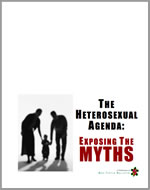 At last, the truth can now be told.
Using the same research methods employed by most anti-gay political pressure groups, we examine the statistics and the case studies that dispel many of the myths about heterosexuality. Download your copy today!
And don‘t miss our companion report, How To Write An Anti-Gay Tract In Fifteen Easy Steps.
 Anti-gay activists often charge that gay men and women pose a threat to children. In this report, we explore the supposed connection between homosexuality and child sexual abuse, the conclusions reached by the most knowledgeable professionals in the field, and how anti-gay activists continue to ignore their findings. This has tremendous consequences, not just for gay men and women, but more importantly for the safety of all our children.
Anti-gay activists often cite the “Dutch Study” to claim that gay unions last only about 1½ years and that the these men have an average of eight additional partners per year outside of their steady relationship. In this report, we will take you step by step into the study to see whether the claims are true.
Tony Perkins’ Family Research Council submitted an Amicus Brief to the Maryland Court of Appeals as that court prepared to consider the issue of gay marriage. We examine just one small section of that brief to reveal the junk science and fraudulent claims of the Family “Research” Council.
 The FBI’s annual Hate Crime Statistics aren’t as complete as they ought to be, and their report for 2004 was no exception. In fact, their most recent report has quite a few glaring holes. Holes big enough for Daniel Fetty to fall through.
“Google” is a trademark of Google Inc.
© Box Turtle Bulletin. All Rights Reserved.
 Posts
Posts  Posts via daily email: