Box Turtle Bulletin
 News and commentary about the anti-gay lobby
“Now you must raise your children up in a world where that union of man and box turtle is on the same legal footing as man and wife…”
News and commentary about the anti-gay lobbyApril 1st, 2008
Greece is not a leader in gay rights. The conservative Orthodox Church is very influential in the nation and is strongly opposed to gay equality.
Nonetheless, Greece is getting a lot of attention recently surrounding the issue of recognition of gay couples.
First some lesbians found a loophole in civil marriage law and are going to marry with the intent of seeing what happens.
Then Greece has drafted language on domestic partners – but for opposite sex couples only.
Now, however, at least one governmental bureau is considering gay couples:
The Greek Justice Ministry pledged to establish a working group on the rights of gay couples living together, which would “analyze all aspects of the issue, international practice and the existing domestic legal and social framework.”
The move follows a request by the country’s National Commission for Human Rights that proposed a civil union registry that would allow both same-sex couples to marry. Parliament could approve the law in a few months, national media said
April 1st, 2008
 We reported on a Kansas student that seemed to have been suspended for being gay. Now he’s had a hearing and the Wichita Eagle reports that he won’t be expelled.
Iniguez, who had been suspended since the incident, said he was innocent and was unfairly accused because he is gay.
He received a letter from the district today saying a hearing officer found him not guilty of the charge. He plans to return to school at the Towne East Educational Resource Center on Wednesday.
“I’m very happy it worked out and I can go back to school,” Iniguez said. “If anybody goes through what I went through, I encourage them to fight it and not give up.”
Fascinating to me, however, were the two other news sources who forgot to mention that Iniguez was found “not guilty”. They both leave the impression that Jimmy was guilty of sexally attacking another student – rather than just telling his best friend what people were saying about him.
April 1st, 2008
Virulently homophobic Zimbabwe stong-man Robert Mugabe may have been voted out of power after nearly three decades of rule. This is good news for gay and lesbian Zimbabeans.
March 31st, 2008
Editor’s note: Last week, we began a discussion on anthropological views of marriage, with special attention to its implications on same-sex marriage. Patrick Chapman, biological anthropologist and author of the forthcoming book, “Thou Shalt Not Love”: What Evangelicals Really Say to Gays (Haiduk Press: 2008) began the discussion. That post was followed by a response from Glenn T. Stanton, director of Global Family Formation Studies at Focus On the Family and co-author (with Dr. Bill Maier) of Marriage On Trial: The Case Against Same-Sex Marriage and Parenting
The editors of Box Turtle Bulletin requested that Glenn Stanton and I continue our discussion about marriage. I recognize that Stanton is at a disadvantage in this discussion because I essentially have the “home-field advantage:” his comments will come under much greater scrutiny by Box Turtle Bulletin’s readers than mine. As such, I credit Stanton for his willingness to participate further. However, as an anthropologist I remain in disagreement with his “anthropological” assessment of same-sex marriage.
In a limited space and with limited time, it is difficult to address all of the issues raised in Stanton’s response to my critique. I am concerned about his unscientific methodology, disagree with his comments about the American Anthropological Association, find inadequate, given the context, his explanation for including Colin Turnbull’s biographical information, and find unconvincing his dismissal of anthropological authority: he does not consult artists when trying to rebut definitions of marriage! However, in this round of the discussion Glenn Stanton and I have agreed to focus attention on two important themes: the distinction between gender and sex and the definition of marriage.
Sex and gender
Upon reading Stanton’s response, I am of the opinion he does not comprehend the implications of, or difference between, sex and gender. Sex, a biological entity, and gender, the socially constructed roles we play in society, are not synonyms. The folk belief in American society, which recognizes only two sexes and two genders, is that a person’s sex determines his or her gender: all biological males are gendered masculine and all biological females are gendered feminine. Our language reinforces this “reality:” we say “he” and “she,” implying there are only two sexes and two genders. We have no pronouns for biologically intersex individuals (sometimes called hermaphrodites), or for individuals who are transgender. However, other societies do not necessarily accept our binary construct and interchangeable sex and gender categories.
In the initial critique, I described the five genders recognized by the Bugis of Indonesia.1 Unlike American society, which blurs the distinction between sex and gender, the Bugis separate biological sex (male, female, and intersex) from gender roles, creating the five gender categories. Stanton’s comment that the Bugis situation “Seems pretty binary to me and not very inventive when it comes to expanding the boundaries of the two genders,” demonstrates ethnocentrism: he imposes upon the Bugis an American understanding of gender, dismissing the Bugis’ recognition of the five genders being different. Contrary to Stanton’s belief, the calabai and calalai do not fit into the gender categories of man or woman and are not simply transvestites. While a calabai performs many tasks associated with women, it is the calabai who often provides economically for the husband: a calabai performs some tasks associated with women and others associated with men.
A compounding problem in understanding the difference between sex and gender is that heterosexuality is the most common expression of sexuality. As such, societies normally expect same-sex marriages to conform to the heterosexual model. This heteronormativity and the confusion between sex and gender help explain Stanton’s surprise or disbelief that the Bugis recognize five genders, and why he dismisses the nature of their same-sex marriages. I believe it also lends understanding to his comment that he has
never met anyone who wasn’t either male or female or didn’t present themselves with easily discernible male or female qualities. Out of the eight different genders one student told me about, you would think I would have the privilege of meeting at least one of these non-male/female folks.
There are many individuals who are neither biologically male nor female; they are intersex. Unlike Mr. Stanton, I have met many intersex individuals and many individuals who are considered a third gender in their societies, including Tongan fakaleiti, Hawaiian mahu, and Native American two-spirit. That Stanton has yet to meet one of these individuals indicates to me that they are not comfortable “outing” themselves to him, that he is seeing people through a culturally-conditioned lens, does not accept that which does not fit his worldview, or that his social circle excludes individuals not fitting the socially prescribed categories.
Social construction of homosexuality
It is important to discuss the problems inherent in applying Western terms and concepts to non-Western cultures. We have a different worldview: the words and concepts we use to describe our physical and social environments are not consistent with the words and concepts others use. Generally speaking, when constructing sexuality Western society is concerned with the genitals. If a sexual pair has the same genitals, they are homosexual. If the genitals differ, they are heterosexual. However, most societies are concerned with the gender individuals perform, not the genitals. As such, there are often no recognized homosexuals in their societies, particularly if they accept gender-transformed marriages.
Our term “homosexual” does not fit the categories used in other societies for people who are same-sex oriented. While same-sex oriented individuals apparently exist in every culture, different societies channel them into different socially approved roles: how they construct “homosexuality” and how they categorize who we label “homosexuals” differs. Some societies prohibit the expression of same-sex attractions. Some societies accept it only if it follows a heterosexual gender model. Some societies view only the penetrated male as “homosexual:” the penetrating male is “heterosexual” because he is acting in a manner consistent with his gender norm. Meanwhile, American society is not accepting of gender transformation but is more accepting of egalitarian homosexuality, presumably because heterosexual relationships are commonly gender non-differentiated.
In Samoa there are no homosexuals; but there are fa’afafine. The fa’afafine are biological males who perform many of the tasks of women. However, unlike the gender category representing women, the fa’afafine do not necessarily dress as women and often perform traditional tasks of both men and women. Thus, the fa’afafine do not fit neatly into the gendered man or woman categories. They are a bridge between the two; they represent a third gender. Esera Tuaolo, a former Super Bowl lineman and author of Alone in the Trenches, explains how his American expression of homosexuality is not acceptable in his native Samoan culture because both he and his partner are masculine. While it is acceptable for a fa’afafine to have a socially recognized man as a lover in Samoa, it is entirely unacceptable for a socially recognized man to have another socially recognized man as a lover. Relationships must follow the heterosexual model.
Other Polynesian and Micronesian societies construct sexuality in a similar fashion. In these societies two biological males or two biological females fall in love, marry with full social recognition and acceptance, live together, raise children together, and are integrated into the kinship system. Martha Ward briefly discusses one such marriage in Pohnpei,2 while Alexandra Brewis discusses them on the island of Butaritari.3 Stanton will likely protest that these marriages include gender transformation, but this is irrelevant: the societies recognize the marriages as fully legitimate.
What’s love got to do with it?
Stanton demonstrates naïve realism, the assumption that every culture has a worldview identical to ours, when he demands that we provide examples of
culturally-approved marriage in the anthropological record, similar to the unions we are discussing today, where two men or two women fall in love, marry under the embrace of the community and its mores, set up a home and raise children together and both are accepted as part of the larger kinship group.
If other cultures construct sexuality differently than we do, we cannot expect to find exact equivalents to our expressions of marriage, heterosexual or homosexual. However, it is nonetheless possible to provide meaningful examples that fulfill Mr. Stanton’s basic requirements, as mentioned above with the examples from Pohnpei and Butaritari.
Stanton’s objection is that modern same-sex marriages lack strict gender differentiation. This objection is disingenuous because modern heterosexual marriages lack strict gender differentiation. Modern heterosexual marriages have no historical precedent: only in the last 50 years have they become common. Throughout history same-sex marriages mimic opposite-sex ones: that same-sex marriages in America do so once again is not grounds for banning them. If Stanton uses lack of historical precedent for gender undifferentiated marriages as the basis for rejecting same-sex marriages, then he must reject opposite-sex marriages.
Of interest, Stanton shape-shifts the definition of marriage. His report uses definitions from anthropologists that are inclusive of same-sex marriage because the central feature of marriage is the social and economic ties a marriage creates: biological sex does not matter. In the response to my critique he says: “as Christians, we define marriage as a union of one man and one woman. But biological connection is not a requirement.” If biological connection is not a requirement, then he has no issue with same-sex marriages provided one individual changes his or her performed gender. However, in his report he dismisses as legitimate gender transformed same-sex marriages, recognized by their societies as “one man with one woman.” Stanton then demands examples of same-sex marriage using falling in love, raising children, and living together as the important defining criteria for marriage. If these are the defining criteria for marriage, then most heterosexual marriages throughout history do not qualify. As historian Stephanie Coontz indicates, “not until the late eighteenth century, and then only in Western Europe and North America, did the notion of free choice and marriage for love triumph as a cultural ideal.”4 Historically, traditionally, cross-culturally, marriage is a social and economic union that creates social ties: love is irrelevant, in many societies biological sex is irrelevant, and in some societies even whether a groom is alive is irrelevant.
Stanton also demonstrates a strong predisposed bias. I mentioned that George Murdock’s definition of marriage, which Stanton uses in his report, omits the biological sex of the spouses. In response Stanton states that while Murdock does not specify biological sex when discussing marriage, he does so when discussing the family:
Yes, Murdock uses that gender-unspecific phrase in his explanation. But if you continue reading Murdock a few lines down, you get to the quote that I use, where Murdock explains that family “consists typically of a married man and woman with their offspring.” So he is specific, and there you have it again, that nagging male/female thing, without reference to or qualification of these other elusive gender couplings.
However, Murdock does explicitly qualify his comment with “typically.” Such qualifications are common when modern anthropologists discuss marriage and families because each society constructs them differently and exceptions are inevitable. Furthermore, Murdock uses gendered terms, not terms relating to biological sex.
In addition, Stanton demonstrates ethnocentrism by requiring that marriage be defined on his terms: if a society recognizes same-sex marriages as equal to opposite-sex ones, he dismisses them because they do not match his definition of marriage. However, using his criteria, we must argue that no society in the world has ever had marriage.
We are family
Anthropologists find tremendous variation in how societies form families and households. Anthropologists working in the South Pacific have difficulty keeping track of households because the membership is constantly changing: children in particular frequently change residence. Of interest, one anthropologist reports that nearly 50 percent of children in Lamotrek were adopted.5 Same-sex couples typically adopt and raise children in these societies: there is no evidence of harm to the children or society.
Strangely, Stanton argues that same-sex parenting harms children because studies show that children do better in two-parent homes than in one-parent homes. The argument is a non sequitur: same-sex households are two-parent homes. The studies he uses do not compare two-parent same-sex households to two-parent opposite-sex ones and are therefore irrelevant to the discussion. Stanton’s personal example regarding his wife’s loss of her father when she was young is also a non sequitur. Her grief over the loss of her father is irrelevant to a discussion of two living same-sex parents raising children.
Of interest, Stanton says “Some of these studies indicated father-love was a stronger contributor than mother-love to important positive child well-being outcomes” (emphasis in original). This, of course, implies that children raised by two fathers in a same-sex relationship would fair much better than those raised in a heterosexual family. He argues:
Unfortunately the legalization of same-sex marriage would not help us connect more children with their fathers, but often do precisely the opposite. This is one of the leading reasons why Focus on the Family opposes same-sex marriage, along with no-fault divorce and policies that tend to encourage out-of-wedlock child-bearing.
Opposing same-sex marriage does not prevent children from being raised in same-sex households: the 2000 Census reports over 25 percent of same-sex households have children. Focus on the Family’s opposition to same-sex marriage helps prevent these children from receiving the same financial, health, and emotional benefits children in heterosexual households receive: the opposition hurts innocent children. Stanton implicitly asserts that children with no parents, or with abusive parents, are better off than children with two loving same-sex parents, whose lives have been examined in minutia to ensure they will provide a healthy, stable, and loving home for any adopted children. Of tangential interest, but relevant to Stanton’s quote, Coontz references studies that indicate there is a 20 percent reduction in suicides by married women, a significant drop in domestic violence, and fewer murders of women in states with unilateral divorce.6 Apparently, divorce has its benefits.
Focus on the Family appears more concerned with its political agenda than its religious tenets. The organization opposes legislation benefiting children of same-sex parents. The organization wishes to restrict divorce, which has led to lower violence against women. The organization, generalizing from Stanton’s methodology and the recent article that began our conversation, is more concerned about fitting anthropological studies into its predisposed bias than an honest appraisal and reporting of the research. The organization deceives its readers and misrepresents a respected scientific organization: nearly one month later it has not corrected its claim that anthropologists agree with “traditional” marriage: the American Anthropological Association publicly stated the contrary in 2004.
References:
1. My discussion of the Bugis does not derive from the article referenced by Stanton, but from an ethnography by S. G. Davies, Challenging Gender Norms: Five Genders among the Bugis in Indonesia (Belmont: Thomson Wadsworth, 2007). [BACK]
2. M. C. Ward, Nest in the Wind: Adventures in Anthropology on a Tropical Island, 2nd ed. (Prospect Heights, Illinois: Waveland Press, 2005). [BACK]
3. A. Brewis, Lives on the Line: Women and Ecology on a Pacific Atoll (Fort Worth: Harcourt Brace, 1996). [BACK]
4. S. Coontz, Marriage, a History: How Love Conquered Marriage (New York: Penguin, 2005). The quote is from page 7. [BACK]
5. W. H. Alkire, Lamotrek Atoll: Inter-island Socioeconomic Ties (Prospect Heights, Illinois: Waveland Press, 1965). [BACK]
6. S. Coontz: 293. [BACK]
See also:
Round 2: Stanton Replies to Chapman
Round 2: Chapman Replies to Stanton
Glenn T. Stanton Responds to Professor Patrick Chapman
An Anthropologist Critiques Focus on the Family’s “Anthropological” Report on Marriage
March 31st, 2008
A few weeks ago we told you about John-David Schofield, Bishop of Fresno, who led his diocese in breaking from the Episcopal Church and seeking to align himself with conservative Anglicans in South America. Now he’s discovering that rebellion is contagious. Some of his parishioners have decided that they would break from him and return to the Episcopal Church.
About 40 former members of Visalia’s St. Paul’s Episcopal Church have decided to break away from the current Anglican church and reform their congregation as the Continuing Congregation of St. Paul’s Episcopal Church of Visalia, Calif.
March 31st, 2008
The Irish government is in the process of determining the method it will employ to recognize gay couples. Meanwhile, support for marriage equality has increased in Ireland. Currently,
Pinknews reports on the expected governmental decision.
The Irish government has ruled out gay marriage, claiming that it would require a change to the country’s constitution and a potentially divisive referendum.
Justice Minister Brian Lenihan is expected to bring forward proposals for a form of civil partnerships at the end of this month.
March 31st, 2008
The United States is one of only thirteen countries in the world which bans travelers with HIV from entering the country. This puts the U.S. in the distinguished company of Iraq, China, Saudi Arabia, Libya, Sudan, Qatar, Brunei, Oman, Moldova, Russia, Armenia, and South Korea.
Nice company. And America’s offensive enforcement of that ban mirrors what one might expect from any one of those other twelve:
The Surrey, B.C., man was on his way to Bellingham, Wash., for the Remembrance Day long weekend last November to shop, with the Canadian dollar trading at about $1.07 against the greenback. After lining up for four hours to reach the U.S. customs booth, he was asked where he worked.
“I said I was on disability. He said what’s my disability. I said I have HIV,” said the 47-year-old, who was diagnosed in 1989.
The customs officer told him he needed a special visa waiver to enter the country, even though Canadians do not require a visa to travel to the United States.
“He hauled me into a backroom. … He put on a set of rubber gloves to hold each of my fingers. Nobody else wore rubber gloves. Then he fingerprinted me, photographed me, ran me through the FBI’s most-wanted list and told me to go back to Canada and not return until I came back with a waiver,” Mr. Rooney said. “I felt like I was being treated like a terrorist.”
The U.S. Senate is expected to vote on a bill sponsored by Sen. John Kerry to lift the travel ban soon. Then maybe the U.S. can join the community of civilized nations. Like Canada.
March 31st, 2008
The name of the march was a bit facetious, but the results weren’t. About 400 people gathered in Gage Park near Fred Phelp’s Westboro Baptist Church to demonstrate against the “God Hates Fags” message that the Phelps clan has been spreading. Kansas City’s Fox4 has the details:
March 31st, 2008
We often debunk the junk science emanating from conservatives. Rarely do we mention junk science from the left. It’s not because it doesn’t exist; it’s just rarely anti-gay, so it often escapes our attention.
The Canadian bills itself as “Canada’s new socially progressive and cross-cultural national newspaper.” But from its web site, it’s unclear how often the paper is published, but a scan of its headlines show a strange fascination with conspiracies, especially if they get to use the word “eugenics”:
For one whose looking for weird stuff to debunk, there’s treasure to be had here. Like this one by AIDS conspiracy theorist Alan Cantwell:
HIV-AIDS was created with the use of Gay men as targets for Eugenic experiments suggests U.S. doctor
There is no doubt that AIDS erupted in the U.S. shortly after government-sponsored hepatitis B vaccine experiments (1978-1981) using gay men as guinea pigs. …The widely accepted theory is that HIV/AIDS originated in a monkey or chimpanzee virus that “jumped species” in Africa. However, it is clear that the first AIDS cases were recorded in gay men in Manhattan in 1979, a few years before the epidemic was first noticed in Africa in 1982. It is now claimed that the human herpes-8 virus (also called the KS virus), discovered in 1994, also originated when a primate herpes virus jumped species in Africa. How two African species-jumping viruses ended up exclusively in gay men in Manhattan beginning in the late 1970s has never been satisfactorily explained.
Those two paragraphs alone have a lot of whoppers which are easily refuted. Let’s break it down:
The first AIDS cases were recorded in gay men in Manhattan in 1979. Not quite. The first known case of AIDS was found in a 1959 blood sample drawn from an unknown man in Leopoldville, Belgian Congo (today’s Kinshasa, Democratic Republic of Congo, formerly Zaire). This was long before the hepatitis B vaccine experiments that Cantwell is so sure started it all.
The epidemic was first noticed in Africa in 1982. By having this sentence follow the previous one, Cantwell seems to suggest that the African epidemic followed the American one. But just because the African epidemic wasn’t noticed until 1982 doesn’t men that’s when it started. In fact, as early as 1983, researchers had identified an epidemic already well underway. In fact, it was well established in some parts of Zaire in 1976.
How two African species-jumping viruses ended up exclusively in gay men in Manhattan beginning in the late 1970s has never been satisfactorily explained. Here, Cantwell’s referring to the Herpes-8 virus, which we now know causes a form of cancer known as Kaposi’s sarcoma (KS). This disease was a very common opportunistic infection among those whose immune system was compromised. Being a transplant patients has been one historic risk factor due to anti-rejection medications which work by lowering the immune system. KS was also common among many ethnic groups in the Mediterranean, Middle East and Africans living in Africa.
The virus which causes KS may have been discovered in 1994 but the disease was first described in the medical literature by Dr. Moritz Kaposi back in 1872. Because KS has been quite common in Africa, there have been thousands upon thousands of medical reports on the disease throughout the past century. For evidence, all you have to do is go to the National Institutes of Health’s PubMed database, type in “Kaposi’s sarcoma” and press “GO.” As of this writing, you’ll find references for 10,850 articles in professional journals going back to 1948. That’s quite an achievement since PubMed rarely indexes articles published before 1950.
This is pretty elementary stuff that any dermatologist would know. It takes a lot of ignorant — willful ignorance even — for a retired dermatologist like Alan Cantwell to pretend these facts don’t exist. But like all such conspiracy theorists, he has to either ignore fundamental facts or bend them beyond all recognition for his crackpot theories to survive (like some other theorists we know). Cantwell’s theories are so nutty, he had to start his own publishing house just to get his books into print. Nobody else would touch them. But it just goes to show that the practice of abusing science isn’t confined to one end of the political spectrum. It’s everywhere.
Hat tip: Stefano
March 30th, 2008
On the 22nd, the Washington Post ran a story on the death of a war hero omitting the fact that he was gay. We, among others, found that this did a disservice to Maj. Rogers.
Rogers had been very active in the efforts to overturn Don’t Ask, Don’t Tell and I have little doubt that he would want his death to serve the same cause as his life.
Today Deborah Howell, the post’s ombbudsman wrote a column that clarified the process that went into striking this part of his life from the story. It reads as a tale of casual institutionalized heterosexism.
The reported knew of Maj. Rogers orientation and of his efforts to fight against DADT. She knew that he would want the world to know that gay men and women were fighting in Iraq with honor and dignity and giving their life for their country. The editorial staff said, “no”.
St. George first wrote a story that included his friends talking about his orientation; some at the paper felt that was the right thing to do. But the material was omitted when the story was published. Many editors discussed the issue, and it was “an agonizing decision,” one said. The decision ultimately was made by Executive Editor Len Downie, who said that there was no proof that Rogers was gay and no clear indication that, if he was, he wanted the information made public.
It is difficult to know what proof Downie required.
But within this story is, I believe, an illustration of how many heterosexuals view gay people.
Rogers’s cousin, Cathy Long of Ocala, Fla., said that she was the closest in the family to him. To her, “The Post did a wonderful job. Personally, as far as the family is concerned, we really didn’t know about this until after his death. It was in the back of our minds, but we didn’t discuss it.” She is glad The Post story did not say that he was gay. “I really feel Alan was a lot more than that.” She thought the Blade story was “self-serving whatever their cause is and that they’re trying to use Alan to do that.”
Shay Hill, his beneficiary and University of Florida roommate, said that he and Rogers were “like brothers” and that he knew Rogers was gay. “He worked to change the system from within. You don’t out yourself to make a point. Just because he’s gay should have no more relevance than I’m straight. It’s not fair to make a bigger deal out of this than it needs to be.”
Much was made that Rogers “didn’t have family”. Because to heterosexuals, decisions about life and death should be made by those with the same genes – or those linked by marriage (from which we are excluded). So a distant cousin – one Rogers didn’t feel comfortable discussing his life with – gets to decide that Rogers was “more than that”. And it matters little to her, or the straight college roommate or the straight editorial staff that the “self-serving cause” that the Blade was advocating is a cause that Rogers fought for.
Yet again straights get to decide that being gay is irrelevant and a bit of a dirty little secret. And those people that Rogers spent time with… well they are gay or socialized with gays so obviously they are just activists and their opinions can be dismissed. And the straights can hide behind “proof” and the notion that telling someone’s orientation somehow diminishes them.
Thank you Deborah Howell for giving dimension to Maj. Rogers’ life. Perhaps some day such exclusions will not require the help of an ombudsman.
(thank you to Jason Cianciotto for bringing this column to our attention and for giving his own testimony for his friend Maj. Alan Rogers)
March 30th, 2008
Chelsea Overstreet and Lauren Martin were like many other Scottsboro High School girls Saturday afternoon, both nervous and excited about going to their first prom in a only a few hours.
But unlike the others, they went to the dance as a gay couple, something the Scottsboro City Board of Education tried unsuccessfully to stop.
A last-minute court order from Circuit Judge John Graham citing two federal court rulings prohibited the board from barring the girls from last night’s junior-senior prom. He cited one U.S. Supreme Court ruling which said that “states and their agencies … cannot set-out homosexuals for special treatment…” Another ruling “prohibits publicly-funded schools … from barring same-sex couples from school functions.” Judge John Graham’s injunction came down at 10:15 am yesterday.
I find it tremendously inspiring to see the bravery on the part of so many of our young people, especially given the social circumstances of living in small towns and rural communities. The youth truly are our future
March 30th, 2008
 Beyond Ex-Gay co-founder Christine Bakke is truly a delightful woman. I got to spend a little bit of time with her again last February in Memphis during the Beyond Ex-gay Mid-South Regional Gathering. Not nearly enough time though — she was exceptionally busy putting together the art show for the weekend.
Last Friday, Christine posted a very thoughtful essay inspired by Peterson Toscano’s comments that ex-gay ministries are still depend on the developmental theories of Sigmund Freud — “Refried Freud” he called it. Which, when you think of it, means that the ex-gay movement is stuck in a very peculiar time warp. Most of their operating theories are founded on some rather ancient Freudian theories that the rest of psychology has largely abandoned.
 Some of us are old enough to remember when Freudian psychoanalysis was all the rage back in the 1950’s and 1960’s. Everyone who was anyone, it seemed, was seeing an analyst. And everyone who was anyone was just as messed up after seeing their analyst as they were before. It’s no wonder that Freudian psychoanalysis has largely fallen by the wayside. As a discipline, they remained too wedded to a narrow set of untested and untestable theories, while the rest of psychology and psychiatry honed their methods and understanding over generations of research and observation, throwing out old theories when they were disproved and adopting new ones as they came along.
Meanwhile, Freudian analysts and their ex-gay therapy counterparts, undeterred by the march of time, continued to press forward with their oft-parodied opening gambit: “So now, tell me about your mother.”
Christine Bakke knows where that leads all too well:
The fishing expeditions (a friend started to believe he didn’t feel his father’s love after being badgered with, “did your father say he loved you? It doesn’t matter if you knew; did he say it? He didn’t say it? Then you didn’t really know it, did you? Of course you didn’t know it; didn’t feel it. How can a child know it if they’re not explicitly told it?” and so on) and leading questions and suggestions (one pastor’s wife suggested I make up abusive things that might have happened to me, so that I could break the curse of satan, just in case I didn’t remember specific things that might have happened to me in my life. I forcefully refused.) I was even told that sometimes women can be gay because they have not been able to grow out of the stage of penis envy.
I knew one women whose therapist gave her assignments to flirt with men. An ex-gay guy who went on several dates to try to learn how to be with a woman (without disclosing that he identified as ex-gay), on the recommendation of his therapist. A woman who was counseled by the leader of the ex-gay group that women should wear makeup (“need to put some paint on the side of the barn”). A man who changed his last name because his ex-gay therapy led him to believe that his parents were to blame for him being gay. A woman who insinuated that she had been abused because she felt like her story didn’t “fit” the ex-gay model without some kind of a root cause. A young man who said that after he got out of the ex-gay movement and was finished with reparative therapy, that’s when the real repairing began. He had to repair the relationships with his family after buying into the belief that they were distant from him and made him gay.
The American Psychological Psychiatric Association removed homosexuality from its list of mental disorders in 1973. In doing so, they relied on non-psychoanalyitic studies like those of Evelyn Hooker. But the American Psychoanalytical Association dismissed non-psychoanalyic studies as “superficial.” This created a strange closed-off echo chamber where evidence that ran counter to a theory was thrown out because it didn’t fit the theory. In fact, the APsyA remained hostile to homosexuality until 1991, when openly gay candidates were for the first time allowed to apply for acceptance by the APsyA.
Since then, the APsyA has begun to consider the implications of research in a whole host of mental disorders like schizophrenia and bipolar disorder, which today are regarded as being at least partly physiological disorders. This would have been anathema to psychoanalysts a mere generation ago. Last year, the APsyA issued a statement supporting same-sex marriage. That’s quite an improvement since 1991.
But ex-gay therapies continue to rely on the same outdated theories that once threatened to make psychoanalysis a historical footnote. While the APsyA are allowing nonpsychoanalytic research to inform their work, ex-gay ministries remain stuck firmly in the past. But the problem with relying on untested and untestable theories is that they are no more scientific than any other folk remedies or superstitions. And some of these remedies may be damaging. Christine Bakke contrasts her experience with therapists and misguided religious-based lay leaders, and concludes:
Of course, like in my case, even licensed therapists who have an ex-gay mindset and agenda can be just as damaging as the lay leaders. Sometimes I can’t decide which is worse. Counseling by a therapist we think should know the best because we think they’re the experts and we trust them more, or lay leaders who we think love us more because we are not paying them. No matter what, ex-gay counseling done by therapists or lay leaders, many poorly equipped through books, Exodus conferences, Living Waters training programs (one week long), Love Won Out day-long conferences, on-the-job training, or for some, nothing more than being ex-gay themselves, mixed with refried Freud, is a recipe for disaster.
I highly recommend you read her entire essay.
March 29th, 2008
We’re constantly on the lookout for ways to enhance your experience at Box Turtle Bulletin. You can see all of our posts through your RSS favorite newsreader, and we’ve enhanced the delivery of our RSS feed by switching to Feedburner. For those of you who already subscribe, don’t worry. The switch was automatic and you shouldn’t have to do a thing. We’ve also added an additional RSS feed to allow you to keep up with comments.
Also, in case you haven’t noticed, you can sign up for a daily delivery of Box Turtle Bulletin to your email’s inbox. Just submit your email address in the appropriate form on the sidebar below the search box. Rest assured, your email address is safe with us. We will never rent, share, sell, or in any way disclose anyone’s email address.
If you have any questions, comments or suggestions, please share them with us. Thank you.
March 29th, 2008
We’ve already mentioned that the so-called fifty percent “spike” in HIV Infections between 2005 and 2006 was the result of more states reporting HIV infections to the CDC, not because there was an actual increase in infections in one short year. In fact, we’ve reported on the CDC’s new reporting requirements back last November. Once we remove the new states from the CDC’s count of HIV Infections, we find that there truly wasn’t an increase. HIV infections appeared to have remained approximately flat:
The Centers for Disease Control and Prevention’s (CDC) newly published 2006 HIV/AIDS Surveillance Report estimates that there were 52,878 new cases of HIV in 2006. This is a 49 percent increase over the 35,537 cases estimated for 2005, however, the increase is largely due to the fact that the CDC used data from seven additional states in 2006 compared with 2005. If you remove the states not included in the 2005 estimates from the 2006 estimates, the number of HIV cases drops to 34,878, a 2 percent decrease between 2005 and 2006.
I wonder how long it will be before someone ignores all the caveats from the CDC and jumps on the “spike” bandwagon. Start your stopwatches… now.
March 29th, 2008
 One thing you can say about Oklahoma State Rep. Sally Kern is this: She doesn’t give up. And the more she talks, the more she embarrasses herself and the good citizens of Oklahoma’s District 84. Today, the Bethany Tribune published a letter to the editor (A permanent copy is available here as PDF.) Kern’s letter contains the usual misinformation from the usual sources.
Kern’s very first paragraph cites a study titled, “The Lifespan of Homosexuals,” immediately following a sentence which references the CDC. The way it’s written, casual readers may assume that “The Lifespan of Homosexuals” was a CDC study, but they’d be wrong. That so-called “study” is actually from none other than Paul Cameron, the discredited “researcher” who has been censured and/or kicked out of virtually every professional association he’s ever been associated with for repeated ethics violations and gross professional misconduct. Most recently, he was censured by the president of the Eastern Psychological Association for misrepresenting his participating at their 2007 conference. In 1999, Paul Cameron wrote “Gays in Nazi Germany,” in which he whitewashed the treatment of gays in Nazi concentration camps, and he has advocated similar draconian measures throughout his career here in the U.S.
 Sally Kern will reach for anything to demonize gay and lesbian citizens of her district and beyond, including the rantings of a Nazi sympathizer and holocaust revisionist. We first awarded Kern the LaBarbera Award for her outrageous fear-mongering comments, saying that gays were “the biggest threat our nation has, even more so than terrorism or Islam.” As a Certified Cameronite, Kern has completed her own evolution to the lowest depths of extremist rhetoric. She now joins the ranks of so many others who care neither for the truth, ethics, or simple human decency in their zeal to render LGBT citizens as second class — or worse.
Hat tip: Alvin McEwen
See also:
Sally Kern Is a Little Confused
Sally Kern’s Economic Fallout
Sally Kern’s Meeting with PFLAG on Tape
Exodus’ Local Ministry Aligns with Sally Kern
Certified Cameronite: Sally Kern
Kern Speaks to College Republicans
Sally Kern: Out of Context? The Complete Transcript
We Be Jammin’
Muslims and Gays United
OK State Rep. Sally Kern’s Son is “Straight and Not Gay”
Sally Kern Exaggerates Death Threats
A Letter to Sally Kern
LaBarbera Award: Oklahoma State Rep. Sally Kern
Featured Reports
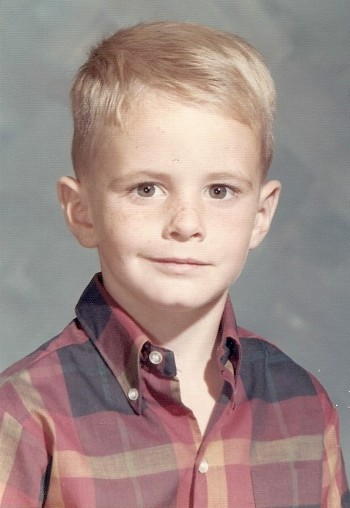 In this original BTB Investigation, we unveil the tragic story of Kirk Murphy, a four-year-old boy who was treated for “cross-gender disturbance” in 1970 by a young grad student by the name of George Rekers. This story is a stark reminder that there are severe and damaging consequences when therapists try to ensure that boys will be boys.
When we first reported on three American anti-gay activists traveling to Kampala for a three-day conference, we had no idea that it would be the first report of a long string of events leading to a proposal to institute the death penalty for LGBT people. But that is exactly what happened. In this report, we review our collection of more than 500 posts to tell the story of one nation’s embrace of hatred toward gay people. This report will be updated continuously as events continue to unfold. Check here for the latest updates.
In 2005, the Southern Poverty Law Center wrote that “[Paul] Cameron’s ‘science’ echoes Nazi Germany.” What the SPLC didn”t know was Cameron doesn’t just “echo” Nazi Germany. He quoted extensively from one of the Final Solution’s architects. This puts his fascination with quarantines, mandatory tattoos, and extermination being a “plausible idea” in a whole new and deeply disturbing light.
On February 10, I attended an all-day “Love Won Out” ex-gay conference in Phoenix, put on by Focus on the Family and Exodus International. In this series of reports, I talk about what I learned there: the people who go to these conferences, the things that they hear, and what this all means for them, their families and for the rest of us.
Prologue: Why I Went To “Love Won Out”
Part 1: What’s Love Got To Do With It?
Part 2: Parents Struggle With “No Exceptions”
Part 3: A Whole New Dialect
Part 4: It Depends On How The Meaning of the Word "Change" Changes
Part 5: A Candid Explanation For "Change"
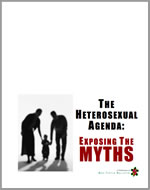 At last, the truth can now be told.
Using the same research methods employed by most anti-gay political pressure groups, we examine the statistics and the case studies that dispel many of the myths about heterosexuality. Download your copy today!
And don‘t miss our companion report, How To Write An Anti-Gay Tract In Fifteen Easy Steps.
 Anti-gay activists often charge that gay men and women pose a threat to children. In this report, we explore the supposed connection between homosexuality and child sexual abuse, the conclusions reached by the most knowledgeable professionals in the field, and how anti-gay activists continue to ignore their findings. This has tremendous consequences, not just for gay men and women, but more importantly for the safety of all our children.
Anti-gay activists often cite the “Dutch Study” to claim that gay unions last only about 1½ years and that the these men have an average of eight additional partners per year outside of their steady relationship. In this report, we will take you step by step into the study to see whether the claims are true.
Tony Perkins’ Family Research Council submitted an Amicus Brief to the Maryland Court of Appeals as that court prepared to consider the issue of gay marriage. We examine just one small section of that brief to reveal the junk science and fraudulent claims of the Family “Research” Council.
 The FBI’s annual Hate Crime Statistics aren’t as complete as they ought to be, and their report for 2004 was no exception. In fact, their most recent report has quite a few glaring holes. Holes big enough for Daniel Fetty to fall through.
“Google” is a trademark of Google Inc.
© Box Turtle Bulletin. All Rights Reserved.
 Posts
Posts  Posts via daily email: