Box Turtle Bulletin
 News and commentary about the anti-gay lobby
“Now you must raise your children up in a world where that union of man and box turtle is on the same legal footing as man and wife…”
News and commentary about the anti-gay lobbyMarch 29th, 2008
365Gay.com is reporting that thirty men have been arrested during a raid on a private home in the Iranian city of Esfahan. The men are being accused of consensual homosexual conduct, drinking alcohol, and other “morals” charges. Iranian law provides punishments up to death by hanging for penetrative same-sex sexual activity between men on the first conviction. Men convicted of non-penetrative consensual same-sex activity can receive up to 100 lashes. For women, homosexual conduct is punishable with death on the fourth conviction.
March 28th, 2008
 This month the Washington Post told us:
He was a soldier first, and that was clear when Army Maj. Alan G. Rogers was buried at Arlington National Cemetery with full military honors. Rifles were fired. A bugler played taps. An Army chaplain said the decorated officer would be remembered as “one of the heroes of history.”
And MSNBC filled in:
His parents passed away and he was divorced with no children. But he had his friends, one of whom he contacted just hours before his death.
Rogers was a hero, the media told us. But like so many heros, they just forgot to mention that he was gay. Well, you never know, this man who was active in D.C. chapter of the American Veterans for Equal Rights (a group dedicated to overturning Don’t Ask, Don’t Tell) just might not want people to know his dirty little secret. Ya know?
The Washington Blade has the story.
March 28th, 2008
News reports are breaking that the Centers for Disease Control and Prevention’s 2006 HIV/AIDS Surveillance Report (PDF: 2.6 MB/55 pages) shows a whopping 50% increase in the number of those who are infected with the HIV virus from the previous year. (This figure includes those who are infected with HIV, but who are not yet diagnosed with AIDS.) Regular readers of Box Turtle Bulletin may remember that we reported last November that the CDC had changed how they determined this statistic, and that this new methodology is resulting in a higher estimate than before. We reported:
Before the new regulations took effect, the CDC’s methods for estimating the HIV infection rate was based on actual AIDS diagnoses. But HIV infection and AIDS are two different things: HIV is the virus which leads to an AIDS diagnosis some ten years after infection on average. What the CDC used to do to estimate the rate of HIV infections was to take the actual count of AIDS diagnosis and work backwards from there to arrive at an estimate of HIV infections.
But with the average ten year latency period between infection and AIDS, along with the fact that Highly Active Anti-Retroviral Therapy (HAART) has lengthened this latency period for many people with HIV infection, the estimate has become grossly inaccurate. So now that states are required to report HIV infections as well as AIDS diagnosis, the CDC is getting a much better look at the actual rate of HIV infection.
…
So far, the CDC doesn’t believe these new numbers represent a significant increase in actual HIV infections.
Page 9 of the 2006 report shows that 52,878 people are reported to have HIV (not AIDS) in 2006. The 2005 report pegged that number at 35,537. However, several large states (California and Illinois, for example) are participating in the names-based reporting system for HIV (not AIDS) diagnoses for the first time. The CDC acknowledges that much of the increase is due to the dramatic rise in the number of states participating in the surveillance program:
CDC officials were emphatic that the higher number of HIV cases reported “do not represent an increase in the epidemic.”
“Instead, it’s more about our surveillance system than any increase,” CDC spokesperson Jennifer Ruth said Friday.
The CDC only recently tied HIV reporting to the amount of money states receive to fight HIV, meaning new numbers are beginning to come in as more states report HIV cases in compliance with CDC standards. In 2005, the CDC’s HIV/AIDS surveillance report included data from 38 states and territories, compared to the 50 states and areas that contributed data to the 2006 surveillance report.
Georgia, which was one of the last states to conform to CDC’s confidential name-based system for reporting HIV cases, ranked eighth in the number of HIV cases reported in 2006, according to the surveillance report.
Data from these new states were not included in the 2005 report.
Other data, specifically the number of actual AIDS diagnoses by year, seems to suggest that the actual prevalence of HIV is not rising nearly so dramatically, if at all. The number AIDS diagnoses has held relatively steady or even slightly downward for the past eight years even as the overall population continues to grow.

There are two ways to interpret this. First, more effective HIV medication may be forestalling the progression of HIV infection to full blown AIDS. But it also suggests that the number of HIV infections leading to those diagnoses may have been fairly stable through the 1990’s. If the number of yearly AIDS diagnoses continues to hold relatively steady over the next several years, then that should validate the belief that there has not been an actual spike in HIV infections.
See also:
HIV Infections Actually Remained Flat Between 2005 and 2006
March 28th, 2008

Rep. Sally Kern spoke last night at the Oklahoma City University’s University of Central Oklahoma’s Nigh Center at the invitation of the College Republicans. While the speech was scheduled well before Mrs. Kern became infamous for her homophobic rant, the leaders of the university’s CR’s took steps to shield Mrs. Kern from students who may wish to challenge her views. According to the student newspaper,
In the release, which didn’t go out to all UCO students, it states that only conservatives and/or College Republicans would be allowed to enter. The release also states that “protestors will not be tolerated.”
Well it would appear that either the CR’s relented and let in the godless liberals, or else not all College Republicans and conservatives share Mrs. Kern’s view that their gay classmates are a greater threat to the nation than terrorists. The Oklahoman reports,
About 40 people attended Kern’s speech, many of whom expressed their displeasure with Kern’s beliefs.
Kern spent much of her speech explaining why she thought Christianity plays an important role in American government before turning her attention to her previous comments and taking questions from the audience. Most of the questions came from people who disagreed with Kern’s views.
But lest we think the national criticism of her extremism and theonomic views have given her any perspective, they also report
If given the chance to do it all over again, state Rep. Sally Kern said she wouldn’t change a thing.
See also:
Sally Kern Is a Little Confused
Sally Kern’s Economic Fallout
Sally Kern’s Meeting with PFLAG on Tape
Exodus’ Local Ministry Aligns with Sally Kern
Certified Cameronite: Sally Kern
Kern Speaks to College Republicans
Sally Kern: Out of Context? The Complete Transcript
We Be Jammin’
Muslims and Gays United
OK State Rep. Sally Kern’s Son is “Straight and Not Gay”
Sally Kern Exaggerates Death Threats
A Letter to Sally Kern
LaBarbera Award: Oklahoma State Rep. Sally Kern
March 28th, 2008
I occasionally come across a pingback which extends a discussion here on BTB in some rather interesting ways. Here’s one I found this morning: anthropology professor Thomas Strong finds the mere fact that anthropology is being invoked in the same-sex marriage debate fascinating:
It’s a fascinating debate to me not necessarily because I am interested in definitions of marriage (though I am) but because of the way that anthropology is invoked by both sides as having authority on the subject. … Anthropologists: Do not despair! Someone still cares what we have to say. Anthropologists are seen to have the last word on human nature and therefore as potentially having knowledge that could settle debate on the topic. … To me what’s interesting is how a moral question appears to be disguised in these debates as a ‘scientific’ one, and therefore the real nature of the conflict gets displaced.
March 27th, 2008
 A few years ago when Florida Governor Charlie Crist was running for office, allegations surfaced that Crist was gay. Crist has repeatedly denied it — not that there’s anything wrong with that. After all, he isn’t opposed to civil unions, and he did direct the state Republican Party to halt funding of the anti-gay marriage initiative.
But now Governor Crist has a new girlfriend, and Crist’s father, Dr. Charles Crist is vouching for him as well:
Dr. Crist said his son, married once from 1979 to 1980, has always enjoyed the company of women: “Always! I mean, I can’t keep up with him,” Dr. Crist laughed. “And they like him, too.”
I guess he’s really straight after all. Good timing too, now that Gov. Crist is being talked up for as possible GOP vice-presidential slot.But none of that is enough for Peter LaBarbera. He still thinks all the as-yet unsubstantiated rumors by themselves are enough to disqualify Gov. Crist from the ticket. What’s more, Petey is intent on outing him:
You won’t believe the amount that’s already been written and discussed in the media about Crist’s sexuality and related issues in the homosexual and liberal press … In our view, that’s a reason right off the bat not to consider Gov. Crist for the highly visible and important position…
We called the Florida’s Governor’s office to ask if the governor is a homosexual or bisexual, and whether he has ever engaged in homosexual behavior — odd questions, to be sure, but necessary ones in this situation. We did not hear back.
Imagine that. The Florida Governor’s mansion isn’t returning Peter’s calls.
March 27th, 2008
 On March 19, 2008 Arthur C. Clarke died at the age of 90.
Even if you never read science fiction, there are a handful of household names that are synonymous with the genre, and Arthur C. Clarke is prominent among them. His classics include Childhood’s End, The City and the Stars, and of course, 2001: A Space Odyssey.
I plowed through a good chunk of Clarke’s fiction in my teen years.
But not only was Clarke a contributor of classics, a television host, and a promoter of space exploration, he was also among that class of early sci-fi writers who imagined technology that we take for granted today, including geostationary orbit for satellites in what is now called the Clarke orbit, cell phones, and the internet.
But what I did not know about Clarke, and what was not in most of his obituaries, was his sexual orientation. According to one of Clarke’s correspondents, author Toby Johnson,
He demurred about coming out publicly as gay, he wrote, because he felt this fact would be used to discredit his ideas. He was 61 at the time of Stonewall, already past the sexual prime in which it’s meaningful to identify oneself as gay.
He had a cute quip about not being gay: “At my age now,” he said, “I’m just a little bit cheerful.”
He wrote that he was quite fascinated with the role homosexuals have played down through time as revolutionary thinkers. (In our correspondence, he expressed great interest in C.A. Tripp’s book about Abraham Lincoln as gay.) He kept a private collection of writing which is not to be published until 50 years after his death. I’d wager the world is going to receive the open acknowledgement of his homosexuality and of his theory about gay consciousness as revolutionary come 2058.
Johnson’s story is confirmed by Clarke’s friend, Kerry O’Quinn, publisher of Starlog:
Yes, Arthur was gay – although in his era that wasn’t the term. As Isaac Asimov once told me, “I think he simply found he preferred men.” Arthur didn’t publicize his sexuality – that wasn’t the focus of his life – but if asked, he was open and honest.
It is sad that this luminary was not more open about his orientation, though not surprising considering his generation. And it is discouraging that newspapers couldn’t get beyond his “cheerful” quip to report accurately on his life.
But to those who think that gay people should be exported because “homosexuality is destructive to society” I present a man whose life enriched the world. Now give back your cell phone.
March 27th, 2008
Current immigration laws deny the foreign partners of gay Americans the ability to immigrate to the U.S, unlike their heterosexually-married counterparts. A bill is stalled in Congress which would address this problem. Last week, we awarded the LaBarbera Award to the Family “Research” Council’s Peter Sprigg for suggesting that instead of uniting gays and lesbians with their partners, we should export gays instead:
I would much prefer to export homosexuals from the United States than to import them into the United States because we believe homosexuality is destructive to society.
Today, Peter Sprigg issued an apology:
In response to a question regarding bi-national same-sex couples who are separated by an international border, I used language that trivialized the seriousness of the issue and did not communicate respect for the essential dignity of every human being as a person created in the image of God. I apologize for speaking in a way that did not reflect the standards which the Family Research Council and I embrace.
Of course, the Family “Research” Council’s standards still allow him to cite the discredited “research” of holocaust revisionist Paul Cameron. No apology or retraction for that. Nevertheless, a start is a start.
March 27th, 2008
 Naturally, no public school would openly state that they were expelling a student because he was gay. But the facts of the story, as reported by the Wichita Eagle, seem to indicate that this is what is happening in Wichita.
According to [Jimmy] Iniguez, the incident began when a female friend told him she had heard a rumor that a mutual male friend of theirs was gay.
“I told her that rumor was false,” Iniguez said. “I said I would know, because I was his best friend.”
But, “it’s like you can’t be straight and have a gay friend,” he added.
When the male student saw Iniguez in the bathroom later that day, he asked Iniguez what was going on.
“So I told him, ‘Some people are saying you’re gay, but don’t worry. I told them it wasn’t true,’ ” Iniguez said. “But he still got kind of upset.”
The student, who is 18, allegedly returned to class and threatened students and a teacher, Iniguez said. He was suspended and later expelled.
School officials then suspended Iniguez, saying he was partly to blame because he harassed the teenager in the bathroom.
Jimmy denies that he was harassing the other teenage in the bathroom. And the other kid is showing up at his hearing to testify for Jimmy.
That doesn’t seem to matter to the administration.
School officials said they could not comment on Iniguez’s case because of privacy restrictions. But spokeswoman Susan Arensman said the district’s anti-bullying and sexual harassment policies, as well as its student code of conduct, ensure safe schools.
“Harassment is harassment, and we write that broadly to apply to all students,” she said.
Aparantly very very broadly if punishing gay students.
However, not quite broadly enought to protect gay students. The district’s current policy offers protection from discrimination on the grounds of a person’s religion, race, gender, nationality, age or disability – but not on the basis of sexual orientation.
Jimmy and his attorney think that he’s being punished for being openly gay. And while there may be more to the story, so far it looks as though he has a point.
March 27th, 2008
The BBC reports that Mariela Castro, the daughter of new president Raul Castro, is pushing the government to adopt protections for gay people.
The proposed legislation would recognise same-sex unions, along with inheritance rights. It would also give transsexuals the right to free sex-change operations and allow them to switch the gender on their ID cards, with or without surgery.
There are limits: adoption is not included in the bill and neither is the word marriage.
March 27th, 2008
The rumors are true. I spoke with Josh Morgan, communications manager at Love In Action. He has confirmed that John Smid has resigned from the Memphis-based residential ex-gay program. A quiet announcement was made to staff and supporters, and an official announcement will be made in their April 1st newsletter to subscribers. Josh had no further details or statement about the announcement.
Love In Action gained worldwide attention in 2006 when a gay 16-year-old by the name of Zach posted on MySpace blog that he was about to be involuntarily committed to Love In Action’s youth live-in program “Refuge.” Thanks to Zach’s mySpace post, the world was able to learn about the complicated and bizarre rules that all house residents are expected to follow. When he was committed to a two-month stay in the residential program, his plight spawned international outrage along with unprecedented protests in Memphis. It also inspired filmmaker Morgan Fox to begin filming the documentary, “This Is What Love In Action Looks Like,” which is currently in post-production. Last July, it was announced that the controversial youth program was shut down.
More recently, we examined just a little bit about what goes on in Love In Action. I talked about my reaction to hearing him talk at last summer’s Exodus conference on the evils of masturbation. Particularly disturbing: Smid’s bragging to an audience of mostly celibate men that “my wife’s vagina is enough for me!” (You will hear him say that at about the two minute mark):
http://www.youtube.com/watch?v=mwsm9GMRyEkLast February, former Love In Action client Jacob Wilson bravely talked about his emotionally battering experiences at Love In Action. His frank talk is quite jarring:
I was standing near another former client of Love In Action as Jacob spoke. He described his experience at a different “friends and family weekend” which was very nearly identical to Jacob’s. I cannot imagine a more outrageous form of abuse short of physical abuse than to force anyone to speak like this in front of their parents.
I talked a bit more with Jacob the next day. He spoke about “drinking the kool-aid,” having convinced himself his same-sex attractions were lessening. He also speaks about how Love In Action made him feel like “part of myself was dying inside”:
March 26th, 2008
That’s the rumor anyway. We’re still looking for confirmation, but former Love In Action client Peterson Toscano got an interesting voice mail today:
I am running to do a show and just got a voice mail from a former Love in Action staff member who said, “I’m sure you heard the news, but if not, you may be interested to know that John Smid resigned from Love in Action.”
John Smid has been the executive director of the Memphis-based ex-gay residential program Love In Action since the early 1990’s, when he moved the ministry from California. If this is true, it is probably a good move. Here’s just a small taste of what this man thinks is good advice for struggling “ex-gays” (Hint: The best part is at about the two minute mark):
http://www.youtube.com/watch?v=mwsm9GMRyEkSo now that you’ve heard that, read the rules that the residential clients at Love In Action are expected to follow. I’d say that his leaving Love In Action can’t be anything but a good first step — assuming it’s true.
Update: It’s official.
March 26th, 2008
 Hey gay couples, grab your checkbooks. It’s that time of year where you get to pay more than your brother and his wife.
If you are part of a couple, you usually would benefit from filing an income tax return as a married couple. While this is not always the case, it is especially true for those couples in which one of the partners has a much lower income than the other.
Some states have decided that they value their gay citizens and seek to encourage stable families and have changed their laws so as to treat gay couples the same as heterosexual couples in their tax law. Massachusetts, California, Vermont, and Connecticut all allow for couples to file joint tax returns (this may also be the case in New Jersey, New Hampshire, Maine, Washington and Oregon and perhaps for some Rhode Island and New York residents – I haven’t researched every state).
But while this is to be commended and advanced in more states, it isn’t as simple as it seems. The federal government doesn’t care what the states have determined, they only recognize marriage as between a man and a woman. Thus, gay couples get to jump through hoops and make multiple tax returns. This becomes costly whenever you have a complicated return.
For example, a California couple in a Domestic Partnership has to prepare its state return as though they were a married couple. But CA tax law relies on federal tax treatment of certain situations, so this couple often has to prepare a federal income tax return as a married couple in order to apply the appropriate treatment on their state returns.
But they can’t file that federal joint return. The IRS won’t accept it. Instead they have to prepare federal returns as though they were unrelated roommates.
Add in some complexity, such as multiple state returns, and you may end up paying your accountant a much higher rate due to the extra time they incur.
If you can. Some accountants may not be familiar with the procedures at all.
H&R Block, the nation’s largest tax firm, is being sued by the ACLU because their online do-it-yourself system can’t accomodate Connecticut’s civil unions. Connecticut gay couples have to pay about $150 more and go into the H&R Block office in order to get their returns prepared correctly.
So the next time you hear some anti-gay whine about “special rights”, remind them that you pay more for your government than they do.
UPDATE
Reader John brought to my attention one of the stupidest and cruelest inconsistencies.
If your brother receives insurance covering his wife, it’s a tax free benefit. If you receive insurance covering your same-sex spouse, the federal government considers that to be a taxable part of your income. Yes, they actually make you pay income taxes on the amount of health insurance that you receive from your company for your spouse if you are gay.
I guess that concern about Americans without health insurance extends only to heterosexuals.
March 26th, 2008
Editor’s Note: Yesterday, we published Dr. Patrick Chapman’s critique of Glenn T. Stanton’s white paper, “Differing definitions of marriage and family” (PDF: 80KB/10 pages) Today, we are proud to present a guest post by Glenn Stanton in response to Dr. Chapman’s critique. Glenn T. Stanton is the director of Global Family Formation Studies at Focus On the Family. He is also the co-author (with Dr. Bill Maier) of Marriage On Trial: The Case Against Same-Sex Marriage and Parenting
In considering this exchange with Professor Chapman, I think of that popular VISA commercial, but with a different spin:
That is how I feel about this exchange and I am thankful for Box Turtle’s invitation to engage Professor Chapman on my paper comparing definitions of marriage and family used by anthropologists with those used by same-sex marriage advocates. I also greatly appreciate Dr. Chapman’s thoughtfulness and civility of response. As he said, we have exchanged notes in the past and I have enjoyed and benefited from those interactions.
Allow me to begin by explaining my intentions in writing my original report and the methodology I employed in that work.
My Methodology
My work at Focus on the Family affords me the privilege of being able to study, speak and write on why the family matters to human thriving. I have been doing this full-time for the last 15 years. I approach this question sociologically, theologically and anthropologically. One of my tasks is to help ensure Focus on the Family “gets it right” on what we say about why the family is important. Now, we will never “get it right” from everyone’s perspective, but we do want to make sure we don’t say incorrect or irresponsible things. To that end, we try to read widely, studying the leading thinkers in a particular field. We seek to learn from them and see how they inform, challenge or oppose our unapologetically evangelical Christian perspective. We often make adjustments based on reading and interactions with these scholars, strengthening, changing or dropping certain arguments. In this, I rarely make use of anything but academic books and professional journal articles, and when possible, develop relationships with these scholars. I also try to draw from thinkers respected on both sides of an issue. If I find widely respected sources that challenge my thesis, I try to make the reader aware of that. This, I hope, is reflected in my present paper under discussion.
My Influences
Having said that, this comparison paper had two influences. First, the impetus for my paper was David Blankenhorn’s excellent comparison between the definitions of marriage used by anthropologists and SSM advocates in his important book, The Future of Marriage. I was intrigued enough by this comparison that, standing on the shoulders of his work, I explored further.
Additionally, when I was doing research in 2003 for my book, Marriage on Trial (w/ Dr. Bill Maier), I was interested to see how anthropologists understood marriage and parenting across cultures in light of the two streams of humanity: male and female. I took to reading the works of leading anthropologists on the topic and was profoundly struck by what I didn’t find. I expected to find explanations of various cultures that confounded and challenged the binary male/female dyad. I did not find this.
What I found was a relentless explanation of marriage and family consisting of male and female as the core of new families. It did not find observations and explanations of multiple genders, nor did I find broad discussions of different forms of marriage that did not include both male and female. In book after book, article after article, I found discussions of how male and female are central to family in diverse cultures, and how they negotiate family and social life in different ways. An example of this is found in a leading journal article on gender in Bugis society, which Chapman informs us has five genders (!). Susan Bolyard Millar in the opening sentence of her piece explains, “When the Bugis of Indonesia interact in public, the men are generally treated with deference by the women.” And the rest of the article discusses the interactions of these two groups….two groups. Two genders and the only diversion from this is a reference to the calabai who are male transvestites….men who dress as women. 1
Seems pretty binary to me and not very inventive when it comes to expanding the boundaries of the two genders. I hear this “there-are-many-genders” and “gender-is-not-binary” talk every month when I do a same-sex marriage debate on some college campus. Funny thing among all these students who try to hip me to reality: I have never met anyone who wasn’t either male or female or didn’t present themselves with easily discernible male or female qualities. Out of the eight different genders one student told me about, you would think I would have the privilege of meeting at least one of these non-male/female folks. I wait for that day. In the meantime, I went to the anthropologists, who were unable to introduce me to such a person.
What the Comparison Revealed
So, I set out to write a paper showing how anthropologists, at least from my reading, do indeed recognize the fundamental nature of male and female in marriage and family across human cultures. In my research of reading the brightest lights in anthropology on social structure, all I found was male/female dyad talk. Compare this with the leading voices of same-sex marriage advocacy who just simply define marriage with no mention of male or female whatsoever. The absence is stunning. Chapman said these SSM advocates “do not use anthropological definitions.” I don’t expect they would, but the two ways of defining marriage and family have nearly no overlap at all. These advocates create wholly new, foundation-less, experience-free definitions of marriage, acting as if these nouveau definitions are basic, something everyone has always understood as a genderless union between any two or more people. The contrast in definitions between the two communities is not simply one of academics on one side and generalists on the other, but was as stark as any two groups I have experienced. That is all I desired to demonstrate in the paper, that and nothing more. I think that is clear from the paper itself.
But What About the AAA?
Professor Chapman stakes a great deal on the American Anthropological Association’s 2004 statement in support of same-sex marriage, offering that as a debate stopper. First, it should be noted that this statement from this academic organization was not academically motivated, but rather developed in response to President George Bush’s support for a Federal Marriage Amendment. I have little problem with such groups making political statements, but they should issue forth from previously established positions. That is not the case here. I find no indication of the AAA talking up this issue in any form before Bush’s statement. Was it only worth addressing when it became a political issue?
And this very short statement by the AAA makes no reference to any of the “available evidence” that Chapman refers to. You simply have to take their word that the data exists, which seems contrary to the discipline of academic rigor. If there is so much evidence, why not give the reader of the statement the slightest breadcrumb trail to follow? I could find only one short article there (Linda Stone’s) explaining how the anthropological record could be read as to support same-sex marriage. The others are merely op/eds written by AAA members. These were written after the original statement appeared. You would think a serious academic organization would have more to offer a curious, investigative reader.
There are additional concerns I have with the AAA statement, such as it shifting anthropology from a descriptive discipline to a prescriptive, but we can leave that for another day.
Who is Authoritative on Marriage?
Chapman says that Focus on the Family finally “acknowledges anthropological authority in defining marriage” and “that ‘sanctity of marriage’ arguments are not valid.” That is a pretty “binary” way of seeing the discussion. We believe that many disciplines have a voice in helping us understand and practice marriage and one does not eclipse another. If I wrote a paper on how marriage is portrayed in the history of art as a union that binds male and female, which I have dabbled at, could we say that I think artists are the only authoritative voice? Please! I am merely saying artists are a good voice because they uniquely report how people live, just as anthropologists do in their own way.
Miscellany
Before I close, let me address a scattering of Chapman’s other comments.
First, he seeks to correct me in that many of the anthropological quotes I employ “avoid specifying the biological sex of the spouses” and he offers an example from George Murdock (who, by the way, is “Elvis” among anthropologists who study family forms and social structures). To this end, Chapman quotes Murdock that marriage is a relationship “between a sexually associating pair of adults.” Yes, Murdock uses that gender-unspecific phrase in his explanation. But if you continue reading Murdock a few lines down, you get to the quote that I use, where Murdock explains that family “consists typically of a married man and woman with their offspring.” 2 So he is specific, and there you have it again, that nagging male/female thing, without reference to or qualification of these other elusive gender couplings.
He also says in my recognizing the rare occurrences of woman/woman marriage, I “effectively change” Focus on the Family’s “one biological man with one biological woman” definition of marriage. There is nothing to change. For starters, as Christians, we define marriage as a union of one man and one woman. But biological connection is not a requirement. Also, while we believe that male/female monogamy is the ideal marriage arrangement, no one can miss that many cultures practice polygamy, which leads to women being treated as objects to be collected. On this, Professor Chapman and I agree.
Additionally, Chapman states a few times that “many cultures throughout the world traditionally accept same-sex marriage” while offering no evidence of any of these cultures, just like the AAA. He does mention the Bugis having many genders and marriage being restricted only to those of “different gender categories.” But Millar’s work, which I referenced above, speaks only of male and female among the Bugis and Chapman informed us that the Bugis indeed have restrictions on same-gender marriage.
Has Homosexual Marriage Ever Existed in a Culture?
I have noted the absences of specifics from the professionals, but my paper does refer the reader to specific examples of woman-woman marriages, as the anthropologists call to them. But these are very unique and rare marriages arranged to serve the purposes of the heterosexual family and the community. They cannot be called homosexual in that the unions are strictly pragmatic – to provide offspring to the contracting woman – and are not emotional or sexual. The same is true for the Native American berdache, which neither of us has addressed in this exchange. When we examine these supposed “same-sex” marriages existing in human experience, there is always more to the story. Contrary to the AAA, I find no corresponding reference to true homosexual, culturally-approved marriage in the anthropological record, similar to the unions we are discussing today, where two men or two women fall in love, marry under the embrace of the community and its mores, set up a home and raise children together and both are accepted as part of the larger kinship group. I would be interested in learning of one.
Are Mothers and Fathers Merely Optional?
The most concerning of Chapman’s remarks are those that imply that male and female are able to perform the tasks of mother and father interchangeably, or that other extended family members can effectively replace a mother or father. This is certainly not true in heterosexual fatherless homes, and it has yet to be proven that mom’s lesbian lover can effectively replace a father, regardless of how caring and kind she might be.
If any person in any family has a belly-button, they also have a mother and father somewhere. And a wealth of research flowing from our nation’s three-decade experiment in fatherlessness strongly indicates that it is nearly impossible to replace the necessary influence and contributions a father makes to healthy child-development. 3 In the hundreds of studies I have read on this subject, I have not seen one which explains that the love of another family member can replace the contributions a father makes, no matter how vested and caring the love. My wife lost her father at age nine. The super-abundant love of her mother and sisters was a treasure, but could not replace the hole her absent father left in her life. In addition, the journal Child Development explains, “A review of the survey literature reveals no evidence that nonresident father involvement benefits children.” 4 Drive-by fathering is not fathering.
An analysis of over 100 studies on fatherhood and child-development outcomes found that having a loving and nurturing father was as important for a child’s happiness, well-being, and social and academic success as having a loving and nurturing mother. Some of these studies indicated father-love was a stronger contributor than mother-love to important positive child well-being outcomes. 5
The breadth and strength of this research on the irreplaceable influence of fathers for healthy child development is what compelled the Clinton and then Bush Administrations to both develop and execute smart federal programs to encourage greater father involvement in the United States. The research revealing that children who grow up without their fathers — regardless of the resultant family-form — face a number of serious life challenges was too great for either Administration to ignore.
Unfortunately the legalization of same-sex marriage would not help us connect more children with their fathers, but often do precisely the opposite. This is one of the leading reasons why Focus on the Family opposes same-sex marriage, along with no-fault divorce and policies that tend to encourage out-of-wedlock child-bearing.
With that, I offer sincere thanks to Box Turtle and Professor Chapman for the nice and thoughtful exchange.
Peace,
Glenn T. Stanton
PS. My mention of Colin Turnbull’s life story was simply to illustrate that he was not an anthropologist who was boxed-in by a “heterosexist” view of life and living in Virginia in his mixed-race relationship made him keenly aware of this issue of injustice.
References:
1. Susan Bolyard Millar, “On Interpreting Gender in Bugis Society,” American Ethnologist, 10 (1983): 477-493, p. 477. [BACK]
2. George Peter Murdock, Social Structure, (New York: The MacMillan Company, 1949), p. 1. [BACK]
3. Michael E. Lamb, “Fathers: The Forgotten Contributors in Child Development,” Human Development 18 (1975): 245-266.
Paul R. Amato and Fernando Rivera, “Paternal Involvement and Children’s Behavior Problems,” Journal of Marriage and the Family 61 (1999): 375-384;
Ronald P. Rohner and Robert A. Veneziano, “The Importance of Father Love: History and Contemporary Evidence,” Review of General Psychology 5.4 (2001): 382-405;
Natasha J. Cabrera, et al., “Fatherhood in the Twenty-First Century,” Child Development 71 (2000): 127-136. [BACK]
4. Cabrera, et al., 2000, p. 130. [BACK]
5. Rohner and Veneziano, 2001. [BACK]
See also:
Round 2: Stanton Replies to Chapman
Round 2: Chapman Replies to Stanton
Glenn T. Stanton Responds to Professor Patrick Chapman
An Anthropologist Critiques Focus on the Family’s “Anthropological” Report on Marriage
March 25th, 2008
We told you earlier that Utah legislators decided that Salt Lake City could not use the term “Domestic Partnership” on its couples registry. They’ve now picked a name: Mutual Commitment Registry.
In order to qualify for the registry, individuals must be in a committed relationship and responsible for each other’s welfare. In addition, registrants must demonstrate financial interdependence, be over 18 years old, competent to contract and share a primary residence in Salt Lake City.
So now when you travel across the nation on vacation, depending where you spend the night you might be married, civilly unioned, domestically partnered, mutually committed, or legal strangers. So travel safely, pack your documents, plan your route carefully, and make sure you don’t need hospital services in a hate state.
Featured Reports
 In this original BTB Investigation, we unveil the tragic story of Kirk Murphy, a four-year-old boy who was treated for “cross-gender disturbance” in 1970 by a young grad student by the name of George Rekers. This story is a stark reminder that there are severe and damaging consequences when therapists try to ensure that boys will be boys.
When we first reported on three American anti-gay activists traveling to Kampala for a three-day conference, we had no idea that it would be the first report of a long string of events leading to a proposal to institute the death penalty for LGBT people. But that is exactly what happened. In this report, we review our collection of more than 500 posts to tell the story of one nation’s embrace of hatred toward gay people. This report will be updated continuously as events continue to unfold. Check here for the latest updates.
In 2005, the Southern Poverty Law Center wrote that “[Paul] Cameron’s ‘science’ echoes Nazi Germany.” What the SPLC didn”t know was Cameron doesn’t just “echo” Nazi Germany. He quoted extensively from one of the Final Solution’s architects. This puts his fascination with quarantines, mandatory tattoos, and extermination being a “plausible idea” in a whole new and deeply disturbing light.
On February 10, I attended an all-day “Love Won Out” ex-gay conference in Phoenix, put on by Focus on the Family and Exodus International. In this series of reports, I talk about what I learned there: the people who go to these conferences, the things that they hear, and what this all means for them, their families and for the rest of us.
Prologue: Why I Went To “Love Won Out”
Part 1: What’s Love Got To Do With It?
Part 2: Parents Struggle With “No Exceptions”
Part 3: A Whole New Dialect
Part 4: It Depends On How The Meaning of the Word "Change" Changes
Part 5: A Candid Explanation For "Change"
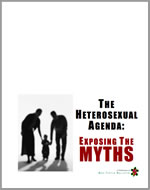 At last, the truth can now be told.
Using the same research methods employed by most anti-gay political pressure groups, we examine the statistics and the case studies that dispel many of the myths about heterosexuality. Download your copy today!
And don‘t miss our companion report, How To Write An Anti-Gay Tract In Fifteen Easy Steps.
 Anti-gay activists often charge that gay men and women pose a threat to children. In this report, we explore the supposed connection between homosexuality and child sexual abuse, the conclusions reached by the most knowledgeable professionals in the field, and how anti-gay activists continue to ignore their findings. This has tremendous consequences, not just for gay men and women, but more importantly for the safety of all our children.
Anti-gay activists often cite the “Dutch Study” to claim that gay unions last only about 1½ years and that the these men have an average of eight additional partners per year outside of their steady relationship. In this report, we will take you step by step into the study to see whether the claims are true.
Tony Perkins’ Family Research Council submitted an Amicus Brief to the Maryland Court of Appeals as that court prepared to consider the issue of gay marriage. We examine just one small section of that brief to reveal the junk science and fraudulent claims of the Family “Research” Council.
 The FBI’s annual Hate Crime Statistics aren’t as complete as they ought to be, and their report for 2004 was no exception. In fact, their most recent report has quite a few glaring holes. Holes big enough for Daniel Fetty to fall through.
“Google” is a trademark of Google Inc.
© Box Turtle Bulletin. All Rights Reserved.
 Posts
Posts  Posts via daily email: