Box Turtle Bulletin
 News and commentary about the anti-gay lobby
“Now you must raise your children up in a world where that union of man and box turtle is on the same legal footing as man and wife…”
News and commentary about the anti-gay lobbyOctober 21st, 2010
In a historic ruling today in the case of Nikolai Alexeev v. Russia, the European Court of Human Rights ruled that Russia violated the European Convention on Human Rights with the banning of the 2006, 2007 and 2008 Moscow Prides. The court awarded 12,000 euros in damages to Moscow gay rights advocate and Pride organizer Nikolai Alexeev and a further 17,500 euros in costs.
Alexeev told Moscow News, “This is the first ever decision of the European Court of Human Rights which concerns freedom of assembly in Russia. It guarantees everyone freedom of expression without special permission.”
In a statement released earlier this morning, Alexeev hailed today’s verdict as cause for celebration. “We declare October 21, the Russian LGBT Liberation Day and we will celebrate it every year from now on with public demonstrations,” he said.
The European Court ruled that Russian authorities violated three specific articles of the European Convention, namely Article 11 (freedom of assembly and association), Article 13 (right to an effective remedy) and Article 14 (prohibition of discrimination). Of the last violation, the court wrote:
It has been established above that the main reason for the ban imposed on the events organised by the applicant was the authorities’ disapproval of demonstrations which they considered to promote homosexuality. In particular, the Court cannot disregard the strong personal opinions publicly expressed by the mayor of Moscow and the undeniable link between these statements and the ban. In the light of these findings the Court also considers it established that the applicant suffered discrimination on the grounds of his sexual orientation and that of other participants in the proposed events. It further considers that the Government did not provide any justification showing that the impugned distinction was compatible with the standards of the Convention.
On the issue of freedom of assembly, the court took a particular slap at former Moscow Mayor Yuri Luzhkov:
The mayor of Moscow, whose statements were essentially reiterated in the Government’s observations, considered it necessary to confine every mention of homosexuality to the private sphere and to force gay men and lesbians out of the public eye, implying that homosexuality was a result of a conscious, and antisocial, choice. However, they were unable to provide justification for such exclusion. There is no scientific evidence or sociological data at the Court’s disposal suggesting that the mere mention of homosexuality, or open public debate about sexual minorities’ social status, would adversely affect children or “vulnerable adults”. On the contrary, it is only through fair and public debate that society may address such complex issues as the one raised in the present case. Such debate, backed up by academic research, would benefit social cohesion by ensuring that representatives of all views are heard, including the individuals concerned. It would also clarify some common points of confusion, such as whether a person may be educated or enticed into or out of homosexuality, or opt into or out of it voluntarily. This was exactly the kind of debate that the applicant in the present case attempted to launch, and it could not be replaced by the officials spontaneously expressing uninformed views which they considered popular. In the circumstances of the present case the Court cannot but conclude that the authorities’ decisions to ban the events in question were not based on an acceptable assessment of the relevant facts.
The foregoing considerations are sufficient to enable the Court to conclude that the ban on the events organised by the applicant did not correspond to a pressing social need and was thus not necessary in a democratic society.
The Moscow Times also notes that this ruling comes on the first day in which Moscow’s new mayor, Sergei Sobyanin, replaced outgoing mayor Yuri Luzhkov, who was fired last month by Russian President Dmitry Medvedev. Luzhkov had previously denounced Gay Pride parades as “Satanic” and vowed that he would never allow one to take place during his administration.
Latest Posts
Featured Reports
 In this original BTB Investigation, we unveil the tragic story of Kirk Murphy, a four-year-old boy who was treated for “cross-gender disturbance” in 1970 by a young grad student by the name of George Rekers. This story is a stark reminder that there are severe and damaging consequences when therapists try to ensure that boys will be boys.
When we first reported on three American anti-gay activists traveling to Kampala for a three-day conference, we had no idea that it would be the first report of a long string of events leading to a proposal to institute the death penalty for LGBT people. But that is exactly what happened. In this report, we review our collection of more than 500 posts to tell the story of one nation’s embrace of hatred toward gay people. This report will be updated continuously as events continue to unfold. Check here for the latest updates.
In 2005, the Southern Poverty Law Center wrote that “[Paul] Cameron’s ‘science’ echoes Nazi Germany.” What the SPLC didn”t know was Cameron doesn’t just “echo” Nazi Germany. He quoted extensively from one of the Final Solution’s architects. This puts his fascination with quarantines, mandatory tattoos, and extermination being a “plausible idea” in a whole new and deeply disturbing light.
On February 10, I attended an all-day “Love Won Out” ex-gay conference in Phoenix, put on by Focus on the Family and Exodus International. In this series of reports, I talk about what I learned there: the people who go to these conferences, the things that they hear, and what this all means for them, their families and for the rest of us.
Prologue: Why I Went To “Love Won Out”
Part 1: What’s Love Got To Do With It?
Part 2: Parents Struggle With “No Exceptions”
Part 3: A Whole New Dialect
Part 4: It Depends On How The Meaning of the Word "Change" Changes
Part 5: A Candid Explanation For "Change"
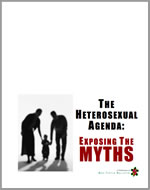 At last, the truth can now be told.
Using the same research methods employed by most anti-gay political pressure groups, we examine the statistics and the case studies that dispel many of the myths about heterosexuality. Download your copy today!
And don‘t miss our companion report, How To Write An Anti-Gay Tract In Fifteen Easy Steps.
 Anti-gay activists often charge that gay men and women pose a threat to children. In this report, we explore the supposed connection between homosexuality and child sexual abuse, the conclusions reached by the most knowledgeable professionals in the field, and how anti-gay activists continue to ignore their findings. This has tremendous consequences, not just for gay men and women, but more importantly for the safety of all our children.
Anti-gay activists often cite the “Dutch Study” to claim that gay unions last only about 1½ years and that the these men have an average of eight additional partners per year outside of their steady relationship. In this report, we will take you step by step into the study to see whether the claims are true.
Tony Perkins’ Family Research Council submitted an Amicus Brief to the Maryland Court of Appeals as that court prepared to consider the issue of gay marriage. We examine just one small section of that brief to reveal the junk science and fraudulent claims of the Family “Research” Council.
 The FBI’s annual Hate Crime Statistics aren’t as complete as they ought to be, and their report for 2004 was no exception. In fact, their most recent report has quite a few glaring holes. Holes big enough for Daniel Fetty to fall through.
“Google” is a trademark of Google Inc.
© Box Turtle Bulletin. All Rights Reserved.
 Posts
Posts  Posts via daily email:
Eman Pacquiao
October 21st, 2010
It only shows how courageous these people to belong and to have equal space on the planet. Human rights are on them since they have and they must have their own.
Bruno
October 22nd, 2010
Seems rather convenient to me that a decision that reflected a 4-year old issue came on the day that the main perpetrator (Luzhkov) left office. Where was this ruling in 2006, 2007, or 2008?
Leave A Comment