Box Turtle Bulletin
 News and commentary about the anti-gay lobby
“Now you must raise your children up in a world where that union of man and box turtle is on the same legal footing as man and wife…”
News and commentary about the anti-gay lobbyDecember 18th, 2012
Southern Baptist pastor David Dykes, who spoke on Uganda’s largest independent television station and denounced the U.S. State Department’s attempts to persuade Uganda from passing the Anti-Homosexuality Bill, is now telling a local television station in Texas that he he doesn’t support the bill, but is angry the U.S. is getting involved. He told Tyler, Texas’s KYTX television:
“I’ve never read the bill. I don’t know what the bill says. My whole point was that I think it’s not right for our government to put pressure on any government about their moral decisions,” Dykes said.
This is about as disingenuous as it gets. I feel pretty confident that if Uganda was making a moral decision about rounding up Christians to throw them in jail for the rest of their lives, Dykes would be singing a very different tune.
Dykes claims not to know anything about the Anti-Homosexuality Bill, which is pretty incredible to say the least. We’ve been following the situation in Uganda now for almost four years, three of them since the Anti-Homosexuality Bill was first introduced into Parliament. (Our coverage of the Anti-Homosexuality Bill begins here.) In order to follow events there, I have automated Google alerts set up which sends me virtually every news story there is about Uganda and Homosexuality. I can assure you that for news items originating both outside and inside of Uganda, there is virtually never a mention of homosexuality without also a description of the Anti-Homosexuality Bill for foreign readers or a mention of it in domestic reports (Ugandans know very well the bill’s major provisions). Consequently it has become impossible to talk about homosexuality inside of Uganda without reference to the Anti-Homosexuality Bill. It has been the singular point of reference with which all discussion about homosexuality takes place in Uganda for the past three years.
This is important, and I can’t emphasise it enough: Every statement, every discussion, every op-ed and news item about homosexuailty in Uganda is written with the Anti-Homosexuality Bill both as a point of reference and as a backdrop to whatever else may be happening with regard to homosexuality.
For Dykes to now say that he knew nothing about the Anti-Homosexuality Bill is simply beyond belief. This isn’t just some aw-shucks preacher from Texas. He has made missionary work one of the pillars of his church. He was recongized by the Southern Baptist Convention in 2008 for raising nearly $13 million for foreign missions, and his church sponsors at least one missionary group which has its particular focus on Uganda. For him to say, after all of the debate about the so-called “kill the gays” bill, that he never heard of it and knows nothing about it, is simply staggering.
But let’s say, for the sake of argument, that Dykes has never read a newspaper article about Uganda, has never seen a television report about Uganda, and has never heard anyone else mention the debate that has taken place in Uganda for the past three years. And let’s say, for the sake of argument, that he has recently awoken from a three year slumber to discover that he is now at a major pastor’s conference in Uganda and the number one subject touching on homosexuality somehow never came up — despite the incredible coverage the Anti-Homosexuality Bil had had there for three years running. And let’s say for the sake of argument that when he woke up, he just happened to be standing in front of a television crew from Uganda’s largest independent network and he said, apropos of nothing…
I’m extremely upset that our state department is putting pressure on Uganda to recognize homosexual behavior. And I’m praying that Uganda will say, “We don’t want your money, America. It is blood money. It is sin money.” I hope that you will continue to stand strong on what the Bible defines as the definition of a real marriage.
…which just happens to be several of many standard lines given by Ugandan pastors who want the Anti-Homosexuality Bill passed. (By the way, Clause 12 doesn’t just outlaw same-sex marriage, it throws everyone in jail for being in one or witnessing one or conducting one.)
Let’s just put aside all disbelief for the sake of argument and pretend that all of that is true.
Now what?
Well, if Dykes doesn’t believe that gay people should be hanged, if he doesn’t believe that gay people should be thrown in jail for the rest of their lives, if he doesn’t believe that their families should be jailed because they didn’t report their loved ones to police, then he has a responsibility to say so.
And not to a TV station in Tyler, Texas. To Ugandans. Over there.
Because I bet not many Ugandans get CBS19 on basic cable. And right now, they think he supports killing gay people. Not only that, but they heard him say that American Christians will ride to their rescue if they pass the bill and lose their aid. And I will believe that too until I see him taking serious steps to tell them otherwise. Because we’ve seen this kind of double-talking behavior before. The only way for this to not be another example of double-speak is for Dykes to speak clearly and loudly with just one voice.
December 18th, 2012

Archbishop Stanley Ntagali
Rt. Rev. Stanley Ntagali was installed as Archbishop of the Anglican Church of Uganda this weekend, and the topic that seems to be on everybody’s mind there continues to be the debate over the Anti-Homosexuality Bill. In this clip from NTV, Uganda’s largest independent television network, we hear President Yoweri Museveni addressing the crowd at Namirembe Cathedral:
(@1:47) We’re not going to kill them. (unintelligible) because we didn’t kill them in the past. We are not going to persecute them. We are not going to marginalize them. But there should be no promotion, and sex here is confidential.
The Anti-Homosexuality Bill which is currently before Parliament however would, in its current form, bring the death penalty or life imprisonment for gay people, and would endanger everyone else with lengthy prison terms for either knowing, providing services, or defending them.
The new Archbishop also addressed homosexuality and corruption as two areas that he would address as the Church’s new leader. And speaking of corruption, Ntagali accepted a brand new Toyota SUV from the President. Museveni routinely furnishes them to select religious leaders who he favors.
According to the anti-gay web site Anglican Mainstream, Rev. Robert W. Duncan, who heads an American breakaway Anglican movement which recognizes the Archbishop of Uganda as its spiritual leader (he is incorrectly identified as “Archbishop and Primate of the Anglican Church in North America”), was in attendance and spoke at the ceremony. It is not clear however whether he addressed either directly or indirectly the controversy over the Anti-Homosexuality Bill.
Ntagali succeeds retired Archbishop Henry Luke Orombi, who as recently as last June called for the Parliament to pass the Anti-Homosexuality Bill. When asked whether the Anglican Communion has reached a point of full schism during the 2010 All Africa Bishops Conference (which Archbishop of Canterbury Rowan Williams attended as head of the worldwide Anglican Communion), Orombi announced that “there is already a break.” Orombi has published invitations to American parishes to break from their own bishops to seek “spiritual guidance” from Orombi instead of the established Episcopal Church.
December 18th, 2012
TODAY IN HISTORY:
New York Court of Appeals Strikes Down Sodomy Law: 1980. New York became the twenty-fourth state in the nation to legalize homosexuality when the Court of Appeals, the state’s highest court, struck down the New York’s consensual sodomy law. In a 5-2 decision, the court ruled that the law violated Constitutional rights to privacy and equal protection, noting that the law banned anal and oral sex only when those acts were performed by unmarried couples. Married couples were exempt under the law. Writing for the majority, Judge Hugh Jones wrote:
“We express no view as to any theological, moral or psychological evaluations of consensual sodomy. It is not the function of the Penal Law or our governmental policy to provide for the enforcement of moral or theological values. …the People have failed to demonstrate how government interference with the practice of personal choice in matters of intimate sexual behavior out of view of the public and with no commercial component will serve to advance the cause of public morality or do anything other than restrict individual conduct and impose a concept of private morality chosen by the State.”
TODAY’S BIRTHDAY:
 Jay Bakker: 1975. Having grown up in front of television cameras as the son of televangelists Jim and Tammy Faye Bakker at their Christian theme park home in Charlotte, North Carolina, he was deeply affected when his father’s empire came crashing down. His father was sent to prison for financial irregularities and mail fraud, and his family was subsequently ostracized by fellow Evangelicals. For Jay, that led to a downward spiral of rebellion and drug abuse. But he eventually turned his life around and committed himself to a different vision of Christianity, one with God as a loving and accepting being rather than a God of judgment and wrath. In the process, he became a very different kind of minister, an “evangelical punk preacher,” as he describes himself. Jay’s experience of being outcast informed his own philosophy of inclusiveness which extends to LGBT people. In the 2006 documentary One Punk Under God, Jay is seen explaining why he supports same-sex marriage to a congregation that is not ready to accept that message:
In 2011, Jay Bakker released his book, Fall to Grace: A Revolution of God, Self and Society
If you know of something that belongs on the agenda, please send it here. Don’t forget to include the basics: who, what, when, where, and URL (if available).
And feel free to consider this your open thread for the day. What’s happening in your world?
December 17th, 2012
Of course I’m not surprised that someone would say this. I’m just surprised it took three days for it to happen:
Our country really does seem in complete disarray. I’m not talking politically, I’m not talking about the result of the November sixth election; I am saying that something has gone wrong in America and that we have turned our back on God.
I mean millions of people have decided that God doesn’t exist, or he’s irrelevant to me and we have killed fifty-four million babies and the institution of marriage is right on the verge of a complete redefinition. Believe me, that is going to have consequences too.
And a lot of these things are happening around us, and somebody is going to get mad at me for saying what I am about to say right now, but I am going to give you my honest opinion: I think we have turned our back on the Scripture and on God Almighty and I think he has allowed judgment to fall upon us. I think that’s what’s going on.
December 17th, 2012
From the Ugandan government-owned New Vision:
Seventh Day Adventist East and Central African President Blasious Ruguri
The Seventh -day Adventist (S.D.A) church has commended President Yoweri Museveni and Rebecca Kadaga, the speaker of parliament for their strong stand against homosexuality and corruption in the country.
Pastor Blasious Ruguri, the Seventh-day Adventist church president in East and Central Africa, said the church supports the government in the fight against homosexuality and corruption.
“Our stand is “zero tolerance” to this vice and to western influence on this crucial issue because God says no to it. We are together with the President and the Speaker and we fully support the Anti-Homosexuality Bill. I call upon all religious ministers, all Ugandans, and all Africans to say no to Homosexuality. Let us stand for our sovereignty as Ugandans and as God fearing people even the heavens fall.”
Ruguri made the statements at a Mbarara SDA church at the inauguration of the Southwestern Uganda Field, which New Vision describes as similar to a doicese. The article also states that the church also installed a field president, identified as Bishop Bernard Kakuru Bampata, at the ceremony. President Yoweri Museveni sent Rose Namayanja, the State Minister for Luwero Triangle, to represent him as the guest of honor. Namayanja read a statement from Museveni which reportedly reassured the gathering “that the government will not tolerate homosexuality and corruption vices.”
In 2010, the church’s Uganda president John Kakembo gave his support for the Anti-Homosexuality Bill. The Church responded with a tepid statement, saying simply, “These views do not reflect the values of the Church as expressed in published statements on same sex conduct.” It did not however call for a retraction of Kakembo’s support for the bill.
December 17th, 2012
American pastor David Dykes has traveled from Tyler Texas, where he pastors Green Acres Baptist Church, to Uganda to offer his apparently unqualified support for the Anti-Homosexuality Bill. Here, he appears on NTV, Uganda’s largest independent television station to denounce the State Department’s efforts to avert a human rights catastrophe and says that American churches will come together to fully back Uganda if the U.S. withdraws aid:
Dykes: I’m extremely upset that our state department is putting pressure on Uganda to recognize homosexual behavior. And I’m praying that Uganda will say, “We don’t want your money, America. It is blood money. It is sin money.” I hope that you will continue to stand strong on what the Bible defines as the definition of a real marriage.
…Already in Canada, there’ve been pastors who have been arrested for simply saying from their pulpit that a union between two men or two women is an abomination in the sight of God. A Canadian pastor was arrested for that. … But there’s also maybe a law soon that says we could be arrested if we say anything bad about gay marriage or about homosexual behavior. It would fall under the category in America of “Hate Crimes.”
… In America, Christians are going to put as much pressure as we can on our government not to cut the aid to Uganda over this issue. But if they do decide to do that, we’ll let our displeasure be known, but we’ll try to step in as the Church in America to try to make up sending resources over here, especially to the churches. We hope to stand alongside the believers of Uganda during this time of crisis.
Dykes’s Green Acres Baptist Church (Facebook page here), which is a member of the Southern Baptist conference, is one of the sponsors of Pastoral Care Ministries (Facebook page here). It appears that Dykes was in Uganda as part of a Pastoral Care Ministries effort. The PCM web site describes their work in Uganda (Emphasis in the original):
The work has just begun with Parental Care Ministries USA, yet the Lord has accomplished much in a short time. The effort in Parental Care School Mbarara Uganda, our first area of focus, has brought many improvements to the quality of life for this group of orphans and their staff of employees. Our accomplishments in 2008 included a new 16 passenger van for the ministry, dormitories for the orphans, new classrooms for the school, a uniform for every orphan, school desks, and teaching bibles for the teachers and pastors. …
Our other focus arm of the ministry is working with Pastor Emmy’s 50+ rural Ugandan pastors. We try to gather them from all over Uganda at least twice a year for conferences. We are assisting them with resources to help equip their churches to minister to local people. We have started a program called Cows for the Kingdom where pastors are given a cow to milk to provide for their family and sell the excess milk for a daily profit of a few dollars a day. Nearly 2/3 of all our pastors have a cow now. Pastors are also provided a bicycle which they use effectively sharing God’s Word wherever they go.
The other focus of work regarding the pastors is the School of Ezra that Pastor Emmy and Reuben direct. Here they teach these young pastors many Biblical truths and motivate them to share God’s Word with the reached and unreached in their particular areas. The school of Ezra currently meets at Mbarara Parental Care School when the children are on holiday.
It is worth remembering exactly what it is that David Dykes is so eager to support. The full text of the Anti-Homosexuality Bill is available online here (PDF: 847KB/16 pages). Our examination of the bill’s nineteen clauses are available below:
Clauses 1 and 2: Anybody Can Be Gay Under the Law. The definition of what constitutes “homosexual act” is so broad that just about anyone can be convicted.
Clause 3: Anyone Can Be “Liable To Suffer Death”. And you don’t even have to be gay to be sent to the gallows. There has been talk of removing the death penalty — which has not happened yet; it’s just talk — and replacing it with a life sentence. But can anyone seriously imaging that spending a lifetime in Uganda’s notorious Luzira prison is any better? Especially once your fellow prisoners learn that you were sent there for “aggravated homosexuality”?
Clause 4: Anyone Can “Attempt to Commit Homosexuality”. All you have to do is “attempt” to “touch” “any part of of the body” “with anything else” “through anything” in an act that does “not necessarily culminate in intercourse.”
Clauses 5, 6, 8, 9, and 10: How To Get Out Of Jail Free. The bill is written to openly encourage — and even pay — one partner to turn state’s evidence against another.
Clauses 7, 11, and 14: Straight People In The Crosshairs. Did you think they only wanted to jail gay people? They’re also targeting family members, doctors, lawyers, and even landlords.
Clause 12: Till Life Imprisonment Do You Part. And if you officiate a same-sex wedding, you’ll be imprisoned for up to three years. So much for religious freedom.
Clause 13: The Silencing of the Lambs. All advocacy — including suggesting that the law might be repealed — will land you in jail. With this clause, there will be no one left to defend anyone.
Clause 14: The Requirement Isn’t To Report Just Gay People To Police. It’s To Report Everyone. Look closely: the requirement is to report anyone who has violated any the bill’s clauses.
Clauses 16 and 17: The Extra-Territorially Long Arm of Ugandan Law. Think you’re safe if you leave the country? Think again.
Clause 18: We Don’t Need No Stinking Treaties. The bill not only violates several international treaties, it also turns the Ugandan constitution on its head.
Clauses 15 and 19: The Establishment Clauses For The Ugandan Inquisition. These clauses empower the Ethics and Integrity Minister to enforce all of the bill’s provisions. He’s already gotten a head start.
UPDATE: Dykes isn’t just some random Southern Baptist preacher. Jeff Sharlet, author of C Street: The Fundamentalist Threat to American Democracy

Following his prayer, Dykes was praised by Rep. Louie Gohmert (R-TX) for his “evident burden to reach out to help others.”
In 2008, the Southern Baptist Convention Executive Committee presented Dykes with the M.E. Dodd Cooperative Program Award in recognition of his strong support of the denomination’s missionary work around the world. At that time, his church was cited for contributing $18.4 million since 2000 for mission work.
Update: Rep. Gohmert not only attends Dykes’s Green Acres Baptist Church, he is also a former Deacon and teaches Sunday school there.
December 17th, 2012
TODAY IN HISTORY:
 New York Times: “Growth of Overt Homosexuality In City Provokes Wide Concern”: 1963. Randy Wicker was a brash young activist who, beginning in 1958, decided it was time to shake things up if the gay community was ever going to get anywhere. As a grad student, he volunteered with the New York Mattachine Society hoping to move the organization’s advocacy efforts in a much stronger direction. When the group scheduled a talk on “The Homosexual and the Law,” Wicker took it upon himself to print up some signs and post then throughout Greenwich Village to publicize the event. Mattachine members, who were more accustomed to the more closeted word-of-mouth method of getting the word out, found Wicker a “disturbing acquisition to the movement,” as the group’s president later said. To get around the Mattachines’ fearfulness, Wicker created a one-man advocacy “group” he called the Homosexual League of New York, so that whenever he had a project that the Mattachines felt was too far out there, his “League” could ride to the rescue. It was under that guise that Wicker appeared on WBAI radio in 1962 (see Jul 15), where New York radio listeners, for the first time, heard Wicker and six other gay men talk for ninety minutes about what it was like to be gay.
Wicker was always looking for ways to generate attention, and so when Robert Doty of The New York Times contacted him asking for help on a story about homosexuals — Doty explained that he actually knew very little about the subject — Wicker was eager to help. He took Doty on something on a field trip of gay bars in New York, and he provided him with articles from ONE magazine about Evelyn Hooker, the UCLA psychologist whose research challenged the prevailing view that homosexuality was an illness (see Aug 30 and Sep 2). As Wicker later recalled, “I told him, ‘Look, I understand that the majority opinion in the psychiatric community says that homosexuality is a disorder and that these people are out claiming they can change people. All I want is equal treatment. At least give some exposure to the minority voices that say homosexuality is not necessarily a pathology.”
Unfortunately, equal treatment was not on offer when the Doty’s story appeared on the Times’ front page on a brisk Tuesday morning in December:
The problem of homosexuality in New York became the focus yesterday of increased attention by the State Liquor Authority and the Police Department.
The liquor authority announced the revocation of the liquor licenses of two more homosexual taverns that had been repeatedly raided by the police. The places were the Fawn, at 795 Washington Street near Jain Street, and the Heights Supper Club at 90 Montague Street, Brooklyn.
The city’s most sensitive open secret — the presence of what is probably the greatest homosexual population in the world and the increasing openness of its manifestations — has become the subject of growing concern by psychiatrists and religious leaders as well as law enforcement officers. One division of the organized crime syndicate controls bars and restaurants that cater to the homosexual trade. Commenting yesterday on the attack on such places and the attention being directed at their habitues, Police Commissioner Michael J. Murphy said:
“The police jurisdiction in this area is limited. But when persons of this type become a source of public scandal, or violate the laws, or place themselves in a position where they become the victims of crime they do come within our jurisdiction.”
Mr. Hostetter said the Heights supper Club had a signal light system “that warned the boys to stop dancing with one another” when a newcomer was suspected of being a policeman. The Fawn had a back room to which an admission was charged and where as many as 70 to 80 deviates had parties on Friday and Saturday nights. Most of the patrons were males, but on police found women dancing with women.
There were 19 police visits this year resulting in summonses and complaints of a noisy jukebox, disorderly premises, insufficient lighting and dancing without a cabaret license, and an arrest for degeneracy.
Before Doty could even broach the subject of homosexuality as a mental illness — and he did devote much of his article to that very topic — he introduced New Yorkers to homosexuals as criminals, or at least as associating with the criminal element. Doty wrote that homosexuality had been, until now, “protected by taboos on open discussion,” which allowed it to become “an obtrusive part” of New York society. As for balance, Doty provided this:
Two conflicting viewpoints converge today to overcome the silence and promote public discussion. The first is the organized homophile movement — a minority of militant homosexuals that is openly agitating for removal of legal, social and cultural discrimination against sexual inverts. Fundamental to this aim is the concept that homosexuality is an incurable, congenital disorder (this is disputed by the bulk of scientific evidence) and that homosexuals should be treated by an increasingly tolerant society as just another minority.
This view is challenged by a second group, the analytical psychiatrists, who advocate an end to what it calls a head-in-the-sand approach to homosexuality. They have what they consider overwhelming evidence that homosexuals are created — generally by ill-adjusted parents — not born. They assert that homosexuality can be cured by sophisticated analytical and therapeutic techniques.
More significantly, the weight of the most recent findings suggest that public discussion of the nature of these parental misdeeds and attitudes that tend to foster homosexual development in children could improve family environments and reduce the incidence of sexual inversion.
Wicker’s copies of ONE magazine featuring articles about Evelyn Hooker’s research on homosexuality did make one small appearance in Doty’s article: “The homosexual has a range of gay periodicals that is a kind of distorted mirror image of the straight publishing world.” That was it. Doty then went on to describe, in a very stereotypical fashion, the homosexuals who “throng Manhattan’s Greenwich Village”:
They have their favored clothing suppliers who specialize in the rights slacks, short-cut coats and fastidious furnishings favored by mane, but by no means all, male homosexuals. There is a homosexual jargon, once intelligible only to the initiate, but now part of New York slang. The word “gay” has been appropriated as the adjective for homosexual.
… The list of homosexuals in the theater is long, distinguished and international. It is also self-perpetuating. There is a cliquishness about gay individuals that often leads one who achieves influential position in the theater — and many of them do — to choose for employment another homosexual candidate over a straight applicant, unless the latter has an indisputable edge of talent that would bear on the artistic success of the venture.
But back to that thing about homosexuality as a mental illness. A year earlier, Dr. Irving Bieber published the highly influential book, Homosexuality — A Psychoanalytic Study of Male Homosexuals, in which he and a team of seventy psychiatrists claimed a success rate of 27% in curing gay people through psychoanalysis. It would take several more years before many of Bieber’s colleagues and former patients to come forward to dispute those claims.But Doty devoted the remaining half of his lengthy article to Bieber’s views, including his theory that homosexuality was the result of of bad parenting:
In almost every homosexual case they found some combination of what they termed a “close-binding, intimate” mother and/or a hostile, detached or unresponsive father, or other parental aberrations.
Unsaid, though was that in almost every homosexual case they also found a gay man or a lesbian who was deeply distressed at being gay, so much so that they paid some very expensive psychoanalyst in a desperate attempt to get rid of it. What their so-called study said about those who didn’t seek their services, nobody bothered to ask. To back Bieber up, Doty turned to another psychoanalyst, Dr. Charles Socarides — the same Charles Socarides who would co-found the National Association for Research and Therapy of Homosexuality (NARTH) in 1992 and whose son, Richard, would come out as gay. In Doty’s article, Socarides denounced the efforts of gay activists to win social acceptance for what he called a kind of “normal abnormality.” The homosexual is ill,” he said, “and anything that tends to hid that fact reduces his changes of seeking and obtaining treatment. If they were to achieve social acceptance it would increase this difficulty.”
“I thought it was a terrible betrayal,” said Randy Wicker of Doty’s article. “Because he was a man I had given all the information to and when it came out it was disgusting. He didn’t give any mention — not one mention — that there was a division among psychiatrists — not one word.” The Daughters of Bilitis’s The Ladder wrote that the story was designed to frighten readers into believing that gay people were flooding the streets of New York and “threatening to engulf the normals.” But Newsweek saw the article positively: “While straining for objectivity, a Times trademark, Doty nevertheless tried to explode a favorite myth propagated by some homosexuals that their condition is incurable and innate.”
[Sources: Edward Allwood. Straight News: Gays, Lesbians, and the News Media
Robert Doty. “Growth of Overt Homosexuality In City Provokes Wide Concern.” The New York Times (December 17, 1963): 1ff.
Jack Nicols. “Randolphe Wicker (1938- ).” In Vern L. Bullough’s (ed.) Before Stonewall: Activists for Gay and Lesbian Rights in Historical Context
TODAY’S BIRTHDAY:
 Paul Cadmus: 1904. When he died in 1999 at the ripe old age of 94, his New York Times obituary read:
Paul Cadmus, an American artist noted for a virtuosic figurative style that he applied to subjects ranging from biting social satire to moralizing allegories to sensual, sometimes sentimental male nudes, died on Sunday at his home in Weston, Conn. He was 94.
Mr. Cadmus found his inspiration in the art of Italian Renaissance painters like Mantegna and Luca Signorelli. His career was remarkable for its unruffled stylistic consistency over 70 years, from his days as a precocious student in New York in the 1920’s through his incendiary stint in the 30’s with the federal Public Works of Art Project, later folded into the Works Progress Administration, and up to the present. Although he stopped painting a few years ago, he continued to sketch.

The Fleet’s In!, 1934 (Click to enlarge)
It took the Times’s Holland Cotter four paragraphs before he could work his readers up to Cadmus’s favorite subject matter: the frank depiction of gay men as free and happy people. His “incendiary stint” came about over his 1934 PWAP commission, The Fleet’s In!, which portrayed sailors on shore leave in New York picking up local “trade” in. That painting became the center of “the Battle of the Corcoran” when Navy Secretary Claude Swanson condemned it as “a most disgraceful, sordid, disreputable, drunken brawl” and ordered it seized from the gallery. The painting remained out of public view until 1981, but the outcry cemented Cadmus’s career as a satirist. For the rest of his life, he maintained that he was grateful for the publicity.

What I Believe, 1947 (Click to enlarge)
His cartoonish style became known as “magical realism,” and his themes nearly always touched on sexuality in some form, with homosexual themes nearly always present as either a subtext (glances and signals of cruising in otherwise ordinary scenes) or as an overt subject. His 1947 painting What I Believe, inspired by an E.M. Forster essay by the same name, was his visual manifesto. It depicts nude and contented gay couples in the center and left side of the painting in bright sunlight while reading, drawing, playing music, and conversing. That paradisal scene contrasted with the almost hellish right third of the painting, where heterosexual couples reclined in bare dirt and misery — not unlike traditional renderings of the final judgment. The painting, he said, celebrated “the sensitive, the considerate, and the plucky. Its members are to be found in all nations and classes, and all through the ages, and there is a secret understanding between them when they meet. They represent the true human condition, the one permanent victory of our queer race over cruelty and chaos.”
In an interview with the Smithsonian Institution’s Archives of American Art, Cadmus quoted the French artist Jean Auguste Dominique Ingres: “People say my paintings are not right for the times. Can I help it if the times are wrong?” Times since then have changed. The Fleet’s In!, the painting that started all the controversy, is now in the permanent collection of The Navy Art Gallery in Washington, where it is among its most popular attractions.
If you know of something that belongs on the agenda, please send it here. Don’t forget to include the basics: who, what, when, where, and URL (if available).
And feel free to consider this your open thread for the day. What’s happening in your world?
December 16th, 2012

Miami Mayor Abe Aronovitz
TODAY IN HISTORY:
Miami Officials Testify Before Senate Committee About Anti-Gay Crackdown: 1954. It has been quite a year for Miami’s long-running witchhunt in that city (see Aug 3, Aug 11, Aug 12, Aug 13 (twice that day), Aug 14, Aug 26, Aug 31, Sep 1, Sep 2, Sep 7, Sep 15, Sep 19, Oct 6, Oct 20, and Nov 12), and Miami’s Mayor Abe Aronovitz got one more shot in before the year was out. He and several other Miami officials testified before the Senate Juvenile Delinquency Subcommittee about the “alarming” rise in young people running afoul of the law. Several problems were discussed: a growing crime rate, the lack of resources in the county sheriff’s office, runaways appearing in Miami from other parts of the country, and, of course, homosexuals.
Daniel Sullivan, chairman of the Greater Miami Crime Commission, complained to the subcommittee that there had been a “tremendous increase” in the number of “perverts” making the Miami area their “headquarters.” He cited recent estimates of the number of homosexuals there at 8,000 (out of about 500,000 for all of Dade County). Sullivan blamed the “increase” on the number of bars and nightclubs that cater to gay people.
Miami Mayor Abe Aronovitz chimed in, criticizing Police Chief Walter Headly’s preferred policy of allow gay bars to operate in certain areas, saying that this was, in effect, an open invitation “to homosexuals from all over the nation.” But Chief Headly countered that while he had obeyed the mayor’s orders to break up such gatherings (see Sept 2), but he believed that all that he had actually accomplished was to “scatter” the problem elsewhere in the area rather than actually getting rid of the “perverts.” Aronovitz saw it differently, telling the committee that the crackdown “temporarily improved” the situation, but said, “the federal government should spend money to help local governments battle the problem.”
TODAY’S BIRTHDAY:
 Noël Coward: 1899. He first appeared on the stage at the age of eleven, and his stage work as a teenager — along with his (possibly romantic) relationship with the painter Philip Streatfeild — opened the doors for the precocious son of a house maid to London’s high society, and his embrace of that society cemented his image for the rest of his life. “I am determined to travel through life first class,” he often remarked. Coward went on to write fifty plays, over a hundred songs, and a dozen musical theater works. He never acknowledged his homosexuality, but given his body of work he hardly had to. His 1924 hit play, The Vortex, offered a daring portrayal of a nymphomaniac society woman and her drug-addicted son. The play shocked London sensibilities with its portrayal of drugs and hints of gay life in high society, but that shock leaned more toward titillation than outrage. Coward spent the rest of his life walking that balance.
Ever the fervent anti-Fascist, Coward enlisted with British Intelligence in 1938. For his first assignment in Paris he was given the cover story of working in the British Propaganda office, where he famously critiqued the quality of its work. “If the policy of His Majesty’s Government is to bore the Germans to death I don’t think we have time,” he said. His next assignment was to go to America and use his wit and celebrity status to sway popular opinion to support the British. He also used that tour to gauge public sentiment and political leaders’ opinions about the war and report those findings back to Bletchley Park. Coward’s next assignment was to travel the world to entertain the troops, another assignment which provided perfect cover:
“I was the perfect silly ass,” (Coward) said. “Nobody … considered I had a sensible thought in my head, and they would say all kinds of things that I’d pass along.”
It was a senior diplomat named Robert Vansittart, routinely dismissed in the Foreign Office as an anti-Nazi Cassandra, who in late 1937 or 1938 spotted how to use Coward’s flamboyance, intelligence and flawless memory to help tend an unofficial, off-the-books anti-Nazi intelligence network he had set up across Europe. Vansittart dispatched Coward on tour in such un-Cowardy places as Warsaw, Moscow and Helsinki, where he sang songs, gauged Nazi influence among star-struck V.I.P.’s and (very likely) contacted sources on the ground. If he fooled the V.I.P.’s, Coward failed to fool the Nazis. He was soon on the Gestapo’s list of people to be “liquidated” when Britain fell.
King George VI had recommended Coward for a knighthood during the war, but Prime Minister Winston Churchill vetoed it. Coward was too “flamboyant” for Churchill’s tastes. After the war, Coward continued to find success in Britain and America. He also fell in love with actor Graham Payn and they remained together for the next thirty years. The two became tax exiles and moved first to Bermuda, then Jamaica. He never did acknowledge his sexuality, believing that any direct discussion of sex was tasteless. Besides, he said, “There are still a few old ladies in Worthing who don’t know.” He was finally knighted in 1969. That year, Time wrote of him, “Coward’s greatest single gift has not been writing or composing, not acting or directing, but projecting a sense of personal style, a combination of cheek and chic, pose and poise.” He died in 1973, in the company of his partner Graham. His diaries

If you know of something that belongs on the agenda, please send it here. Don’t forget to include the basics: who, what, when, where, and URL (if available).
And feel free to consider this your open thread for the day. What’s happening in your world?
December 15th, 2012
TODAY IN HISTORY:
US Senate Committee Issues Report on “Employment of Homosexuals and Other Sexual Perverts”: 1950. The Senate Committee on Expenditures in the Executive Departments issued an interim report which would prove to become a major document of the 1950s anti-gay witch-hunts. The next day, The New York Times carried a story on the report:
“A Senate investigating group labeled sexual perverts today as dangerous security risks and demanded strict and careful screening to keep them off the Government payroll. It said that many Federal agencies had not taken “adequate steps to get these people out of Government.” …
Stressing the risks that the Government takes in employing a sex deviate or keeping one on the payroll, the subcommittee said:
“The lack of emotional stability which is found in most sex perverts, and the weakness of their moral fiber, makes them susceptible to the blandishments of foreign espionage agents.”
The report also noted that perverts were “easy prey to the blackmailer.” It said that Communist and Nazi agents had sought to get secret Government data from Federal employees “by threatening to expose their abnormal sex activities.”
The subcommittee criticized the State Department particularly for “mishandling ninety-one cases of homosexualism among its employees.” It said that many of the employees were allowed to resign “for personal reasons,” and that no steps were taken to bar them from other Government jobs. …
The committee said that it was unable to determine accurately how many perverts now held Federal jobs. It added, however, that since Jan. 1 1947, a total of 4,954 cases had been processed, including 4,380 in the military services and 574 on Federal civilian payrolls. …
In addition to strict enforcement of Civil Service rules about firing perverts, the subcommittee recommended tightening of the District of Columbia laws on sexual perversion, closer liaison between the Federal agencies and the police and a thorough inquiry by all divisions of the Government into all reasonable complaints of perverted sexual activity.
APA “Cures” Nation’s Gay Population: 1973. After years of research demonstrating that gays and lesbians are not mentally ill simply because they are gay, the American Psychiatric Association’s board of trustees approved a resolution that said, in part, “by itself, homosexuality does not meet the criteria for being a psychiatric disorder. … We will no longer insist on a label of sickness for individuals who insist that they are well and demonstrate no generalized impairment in social effectiveness.”
In a compromise to those who fought the finding, the APA agreed to define “sexual orientation disturbance” to describe “individuals whose sexual interests are directed toward people of their own sex and who are either disturbed by, in conflict with or wish to change their sexual orientation.” That diagnosis would provide cover for therapists to continue to try to “cure” gay people, with some of those “therapies” still involving electric shock aversion therapy. In 1980, that diagnosis would be changed to “ego dystonic homosexuality” before it was finally removed in 1986. Today, virtually all major medical and mental health professional organizations agree that homosexuality is not an illness to be “cured” or treated with the goal of trying to change one’s sexual orientation.
TODAY’S BIRTHDAY:
 W. Dorr Legg: 1904. Born William Dorr Lambert Legg, Dorr Legg (who also sometimes wrote as Bill Lambert) took a rather intellectual approach to things when he finally joined up with the homophile movement in the 1950s. While studying landscape architecture and music at the University of Michigan in his home town of Ann Arbor, Legg reputedly read Marchel Proust’s Remembrances of Things Past in the original French, just so he could learn something about gays in Europe. After graduating, and after a stint in Florida, he settled in New York City While there, he became involved with the local gay scene, but he was put off by what he saw as fussy queens. But he also discovered the speakies and drag balls in Harlem, and that’s where he became interested in the intersection of gay life with similarly taboo interracial relationships.
In 1935, Legg moved to Eugene, Oregon, where he took a teaching position at the State University of Oregon’s landscape architecture program. He remained there until 1942, when the draft claimed so many students that the landscape architecture program came close to collapse. Legg moved back to Ann Arbor where he met Marvin Edwards, and the two became lovers. But with Edwards being African-American, the sight of the two of them together sometimes raised the eyebrows of local police whenever they were out together. So in 1948, they decided to move to Los Angeles, where they felt that the more diverse culture there would be more to their liking.
Once they arrived in L.A., they quickly began to meet other gay African-Americans. Somewhere along the way, Edwards left and Legg met Merton Bird, another African-American, and the two of them founded the Knights of the Clock as a social and support group for interracial gay couples. That made Legg and Bird pioneers in the nascent gay rights movement in more than one way, but Legg gave Bird the credit. He later wrote, “Hostility and harassment were the daily lot of interracial same-sex couples in 1950. … [Bird’s] idea was that by coming together to form a mutual aid society, the group could at the very least offer each other encouragement.”
Legg also learned about the Mattachine Society, and he became one of that group’s early members. A few years, following a Mattachine Society discussion group that Legg hosted at his home, Legg, Don Slater (see Aug 21), Martin Block, and Dale Jennings (see Oct 21) stayed after the meeting was over and brainstormed about the pressing need for gay people across the country to have access to news and information about themselves and others. Out of that discussion, ONE Magazine was born (see Oct 15), and Legg became its business manager When ONE debuted in January 1953 as America’s first pro-gay magazine, it sported a very sophisticated look with bold graphics and professional typeset and design. ONE’s slick offering quickly caught the attention gays and lesbians across the country, and circulation jumped to nearly 2,000 within a few months — with most subscribers paying extra to have their magazine delivered in an unmarked wrapper.

ONE Magazine, October 1954.
ONE also caught the notice of federal officials. The FBI tried to shut the magazine down, but soon it the magazine wasn’t worth their efforts. But the Post Office was another matter. The Lost Angeles Postmaster ordered the August 1953, held for three weeks while deciding if it violated federal laws. (Ironically, the cover story for that issue was on “homosexual marriage,” an issue that is still contentious more than fifty years later.) Three weeks later, the Post Office decided no laws were violated and allowed its distribution. ONE, in its typically brash fashion, proclaimed “ONE is not grateful” on its October cover. A year later, its October 1954 issue was confiscated and this time the Post Office decided that the issue was illegal. Ironically, that issue’s cover proclaimed “You Can’t Print It!” ONE sued, and the case went all the way up to the Supreme Court. On January 13, 1958, the U.S. Supreme Court delivered its first ever pro-gay ruling in ONE Inc. v. Olesen, a landmark decision that allowed a magazine for gays and lesbians to be sent through the U.S. mail. (You can read more about that landmark case here.)
While ONE magazine was perhaps the most visible part of ONE, Inc., Legg envisioned the organization’s main mission as educational rather than publishing. At Legg’s behest, ONE, Inc. established the ONE Institute of Homophile Studies in 1956, which became the first institution to provide LGBT studies in the US. The ONE Instutute began conducting annual seminars known as the Midwinter Institute, and published the ONE Institute Quarterly as an academic journal dedicated to the study of homosexuality. Legg, as “Marvin Cutler,” also wrote Homosexuals Today: A Handbook of Organizations and Publications about the nascent gay rights movement.
Legg’s interest in the educational side of the organization at the expense of ONE magazine, coupled with his increasingly authoritarian style, created tensions within the group, principly between Legg and Don Slater, ONE Magazine’s editor and the organization’s librarian. While Slater also saw ONE’s mission as being educational, he also felt that the magazine as playing an indispensable role in that mission. He also feared for the integrity of ONE’s archives, which he believed were the heart and soul of the organization. By 1965, the split on ONE’s board became irreconcilable, and on Easter Sunday, Slater and two others entered ONE’s offices and moved the magazine’s assets and archives out and to another location.
For the next four months, two competing ONE magazines hit the streets: Slater’s ONE was sent to subscribers using the organization’s subscriber list, and Legg’s ONE arrived after Legg re-assembled a rival subscriber list from memory and detective work. Legg and Slater were soon in court, where Legg’s overbearing demeanor, it’s been said, alienated the judge who might have otherwise ruled in his favor. Instead, ONE, Inc., retaining the right to publish ONE Magazine, while Slater’s The Tangent Group, which by then had change the name of their magazine to Tangents, retained ownership of the archives. ONE finally ceased publication in 1969.
Legg’s first-hand experience with police raids and harassment, FBI surveillance and intimidation, and Post Office censorship gave him a deep and abiding distrust of government. That distrust informed his libertarian politics. In 1977, he became a founding member of the Log Cabin Club, a group of California gay Republicans who organized to oppose the Brigg’s Initiative which would have banned gays, lesbians, and their supporters from teaching in the public schools. The Log Cabin Club later changed its name to Log Cabin Republicans. Legg’s libertarian political beliefs however, contrary to stereotypes about gay conservatives, did not amount to an assent to assimilation. He forcefully opposed the idea that gay people should “desperately contort themselves into simulacra of heterosexuality.”
Legg died in 1994. By then, the ONE Institute had stop offering classes due to another legal dispute with a prominent donor. After Legg died, the remnants of ONE, Inc. merged with the International Gay and Lesbian Archives. The ONE National Gay & Lesbian Archives today is housed at the University of Southern California, and the ONE Archives Gallery & Museum is located in West Hollywood.
[Sources: Wayne R. Dynes. “W. Dorr Legg (1904-1994).” In Vern L. Bullough’s (ed.) Before Stonewall: Activists for Gay and Lesbian Rights in Historical Context
Martha E. Stone. “Unearthing the ‘Knights of the Clock’.” The Gay and Lesbian Review Worldwide 17, no. 3 (May 2010). Available online here.]
If you know of something that belongs on the agenda, please send it here. Don’t forget to include the basics: who, what, when, where, and URL (if available).
And feel free to consider this your open thread for the day. What’s happening in your world?
December 14th, 2012
Oh what a funny funny state the world is in.
For example, over in the UK, marriage is on the table. And the Anglican Church was wrought up about the sanctity of penis and vagina or some such thing. And how dare, how very dare the government to hint that anything other than penis and vagina could be linked in holy hoohaw.
So the government came of with the perfect solution. They would protect the Anglican Churches with a lock, no a double, scratch that, the government would protect the Anglicans with a “quadruple lock”. They would say that while other churches could opt-in and offer marriage if they so wanted, Anglican churches can’t. Even if William and Kate’s little bundle of joy grows up to be a charming young man who trots off to St. Andrews and falls in love with the Earl of Pudding.
So now they are all in a dither. You see, they didn’t want restrictions on themselves so much. They really just wanted the government to tell the Quakers and Jews what not to do. (Scotsman)
Archbishop of Wales Barry Morgan said that the move to outlaw gay marriage in the Church of England and Church in Wales came as a “total shock” when it was announced by equalities minister Maria Miller on Tuesday as part of a “quadruple lock” to protect them from legal challenge.
Dr Morgan said that his church did not want the protection, which has put it in an “enormously difficult position”.
December 14th, 2012
 Saba is about as big as a minute. Five square miles with less than 2,000 residents it sits near the Virgin Islands, an unspoiled paradise not yet ruined by tourist expectations. In fact, if you aren’t a diver, a climber, or Dutch, you’ve probably never heard of Saba.
It’s history is mostly pirates and rum and it’s economy is now eco-tourism, a place to go if you don’t want KFC on the corner and a rumcake factory down the block.
Saba is, along with Bonaire and Sint Eustatius, a Netherlands special municipality. As we discussed in 2009, this means that they fall under, to an extent, Dutch law and that they recognize same sex marriages performed in the Netherlands. But Bonaire and Sint Eustatius been hesitant to allow such marriage to be performed.
Not so Saba. It took them a while to get the laws in place, but last week the first same-sex marriage occurred in the Caribbean.
On Dec. 4, officials married Xiomar Alexander Gonzalez and Israel Ernesto Ruiz in a civil ceremony at the island’s courthouse.
The two men live together in Aruba and wanted to make their union official, dressing in all white to celebrate the occasion. Gonzalez said people in Saba were very welcoming.
Perhaps this is not so surprising:
“We’ve seen it as a human rights issue,” said Saba council member Carl Buncamper, who is openly gay. “It is important to give the partners equal rights when it comes to inheritance and other benefits.”
Dozens of gay couples cheered Saba’s unprecedented step, noting that gays often face taunts, threats and even death elsewhere in the Caribbean, with many islands enforcing so-called buggery laws implemented in colonial times. Some islands also have tried to amend their constitution to establish that marriage should only be between a man and a woman.
While Saba is the first, the other Dutch islands are expected to follow. But for now, the phone is ringing off the hook in their central registry office with gay couples calling in to take advantage of the opportunity.
And in case you want to marry in paradise, Saba is a Leeward island (less hurricane prone) with year-round warm weather, one beach, elfin forests, and is one of the world’s top ten diving destinations. The population speaks English and seems to take the idea of human rights very seriously. But, alas, you have to have a Dutch passport.
December 14th, 2012
HBO is producing Behind the Candelabra, the story of famed pianist Liberace, starring Michael Douglas. In the role of Scott Thorson, Liberace’s lover, is Matt Damon. Here is what he had to say to Playboy:
PLAYBOY: Are there any kinds of roles you think twice about doing now that you’re a family man?
DAMON: Well, normally I’d say no to nudity, but I just did a lot of it playing the long-term partner of Liberace, Scott Thorson, in Behind the Candelabra. I mean, it’s tastefully done. Steven Soderbergh directed it, and Michael Douglas plays Liberace. But this movie’s not going to be for everyone.
PLAYBOY: A movie about a closeted, larger-than-life TV and Vegas entertainer and his much younger lover, whose plastic surgery he paid for so they could look more alike? Sounds like must-see family viewing to us.
DAMON: These two men were deeply in love and in a real relationship—a marriage—long before there was gay marriage. That’s not an insignificant thing. The script is beautiful and relatable. Their conversations when they’re dressing or undressing or having a spat or getting ready for bed? That’s every marriage. It feels like you’re witnessing something really intimate you would normally see with a man and a woman, but instead it’s two men, which was thrilling. There’s stuff I think will make people uncomfortable. Great. It’s HBO—they can change the channel.
There’s more.
December 14th, 2012
On Christmas Eve every year a friend and I go to the same steakhouse for dinner, an old studio hangout with huge steaks and perfect cosmopolitans. A Christmas tree holds place of honor, the pictures on the walls are wrapped like presents, and tables are packed with three or four generations celebrating the holiday.

Sometimes it’s just us and one or two others, sometimes it’s a dozen or more. But one Christmas our crowd was large and one invitee was a rather loud and obnoxious person who we later realized was best not included.
Things like slashed tires and sugar in the gas tank tended to happen to those with whom he disagreed or who he thought had slighted him. But this Christmas Eve we were blissfully unaware. Until he started making comments that were inappropriate in public.
Anywhere. But especially in a family restaurant where there were kids.
Also there, was an equally loud and colorful friend who wasn’t having it. He decided to inform our boisterous friend that he was being inappropriate and should watch what he was saying. They bickered back and forth until the obnoxious one got in the other one’s face, shoved him in the chest, and screamed, “YOU RUIN EVERYTHING!!” before storming out of the restaurant.
It was this event that came to my mind when I read about the Pope’s message of hope and peace this Christmas. In a ceremony for lighting the Vatican Christmas tree as part of the annual celebration of the birth of Christ, His Holiness’ thoughts turned to gays. Of course. (FoxNews)

In comments to a delegation from Italy’s south-central Molise region, which donated the Vatican’s main Christmas tree this year, Benedict said the tree lights that were being turned on at a ceremony early Friday evening represented “divine light.”
“And when in the past they tried to stamp out the light of God to instead turn on illusory and misleading glows, there were seasons of tragic violence against man,” he said.
…
The Vatican on Friday released the pope’s peace message, in which he called for policymakers to think of themselves as peacemakers in economic and social policy. He warned that abortion and gay marriage were threats to peace.
…
Laws granting legal status for gay unions, he said, “actually harm and help destabilize marriage” by obscuring its specific nature as a union between man and woman that forms the basis of society.
Now I’m not suggesting that the Pope would put sugar in your gas tank. But he would deny you love in your life. He would take away your rights to civil equality.
And at this time when mankind is reminded of the goals of peace on earth and goodwill to all men, the Pope cannot help but think of you. Because, to the Pope, “YOU RUIN EVERYTHING!!”
……
(and, if you’re wondering, this year we will be just six – none of whom are loud)
December 14th, 2012

Pope Benedict XVI and Speaker Rebecca Kadaga (via the Uganda Parliament web site.)
The Second Meeting of the Second Session of the Ninth Parliament is expected to Adjourn today without bringing the Anti-Homosexuality Bill up for debate. According to Warren Throckmorton, who spoke with a Parliament spokeswoman, Parliament will begin its Christmas break after today’s sitting and will return on February 4. There had been some speculation that Parliament may extend is session through next week, but with Speaker Rebecca Kadaga off galavanting in Italy meeting the Pope and attending a human rights conference — I kid you not — it looks like the prevailing opinion is that the earlier they can start their Christmas break, the better.
Which is just as well, because if today’s Order Paper is any indication (DOC: 41KB/2 pages), Parliament’s eagerness to take up the Anti-Homosexuality Bill appears to be waning. It has now fallen to number seven under “Notice of Business to Follow,” following some fairly mundane committee reports, after having held the top spot just two weeks ago.
December 14th, 2012
As I have said before, I think that House Speaker Boehner’s defense of DOMA is not inappropriate. The law was passed through legal process and the members of the House at least nominally support the law and thus should be entitled to defend a law that the Executive branch refuses to defend, should they wish to do so. Even one that is so clearly in violation of the Constitution.
But what amuses me about the defense that Speaker Boehner is conducting is that it is, at best, a hangdog averted eyed mumbling defense. There is no “defending the family” or “protecting the sanctity of marriage” here. In the rare rare instance that DOMA’s legal defense gets a comment, it’s about “enforcing the law” or stopping the President from making unilateral decisions about which of Congress’ laws to uphold.
I agree. We don’t want Presidents just ignoring the law. We have checks and balances.
On the other hand, the Justice Department was also correct to find the law indefensible and unconstitutional. Nor do I fault the Senate for refusing to participate in the defense, as it was clearly not the will of that body.
This whole process has been, to me, an illustration of representative democracy at its best, respecting the roles that each other holds.
But it is funny to watch.
I might be less amused if we were losing the argument. Had virtually every DOMA case not gone our way, I be less sanguine about the House’s role.
But I have found it to be a regular reminder that we are not only winning the legal struggle, but the public argument and even the political one. Each victory has triumphal declarations in the press from lawyers and advocates for equality and an echoing silence from Boehner or other Republican leadership.
And now we have one more anecdote to illustrate the extent to which social and political support for DOMA has evaporated. (Rollcall)
House Republicans have quietly raised the value of a contract with a private law firm that is handling the chamber’s Supreme Court defense of a 1996 federal law that defines marriage as the union between a man and a woman.
House Administration Chairman Dan Lungren, R-Calif., signed off in September on a $500,000 increase in the maximum value of the contract with the firm, Washington-based Bancroft. Republicans have raised the cap of the contract twice: first on Sept. 29, 2011, from its original maximum of $500,000 to $1.5 million, and again on Sept. 28 to its new maximum of $2 million.
House Minority Leader Pelosi has conjured up some indignation over the raise but she must have been chuckling as she did so. Two million dollars for a multi-case, multi-state, multi-year defense is chump change, a piffle. The Justice Department budget is tens of billions of dollars per year.
And you have to laugh that a notion which was integral to a presidential campaign less than a decade ago, a bill that passed with overwhelming bipartisan support just two decades past, is now defended in secrecy and silence.
UPDATE: I prepared this on my phone and failed to include the link. It is now included above. Also, if anyone failed to make the connection, “have quietly raised” means that they didn’t inform the Democratic leadership.
Featured Reports
 In this original BTB Investigation, we unveil the tragic story of Kirk Murphy, a four-year-old boy who was treated for “cross-gender disturbance” in 1970 by a young grad student by the name of George Rekers. This story is a stark reminder that there are severe and damaging consequences when therapists try to ensure that boys will be boys.
When we first reported on three American anti-gay activists traveling to Kampala for a three-day conference, we had no idea that it would be the first report of a long string of events leading to a proposal to institute the death penalty for LGBT people. But that is exactly what happened. In this report, we review our collection of more than 500 posts to tell the story of one nation’s embrace of hatred toward gay people. This report will be updated continuously as events continue to unfold. Check here for the latest updates.
In 2005, the Southern Poverty Law Center wrote that “[Paul] Cameron’s ‘science’ echoes Nazi Germany.” What the SPLC didn”t know was Cameron doesn’t just “echo” Nazi Germany. He quoted extensively from one of the Final Solution’s architects. This puts his fascination with quarantines, mandatory tattoos, and extermination being a “plausible idea” in a whole new and deeply disturbing light.
On February 10, I attended an all-day “Love Won Out” ex-gay conference in Phoenix, put on by Focus on the Family and Exodus International. In this series of reports, I talk about what I learned there: the people who go to these conferences, the things that they hear, and what this all means for them, their families and for the rest of us.
Prologue: Why I Went To “Love Won Out”
Part 1: What’s Love Got To Do With It?
Part 2: Parents Struggle With “No Exceptions”
Part 3: A Whole New Dialect
Part 4: It Depends On How The Meaning of the Word "Change" Changes
Part 5: A Candid Explanation For "Change"
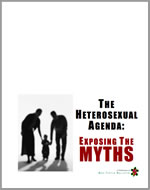 At last, the truth can now be told.
Using the same research methods employed by most anti-gay political pressure groups, we examine the statistics and the case studies that dispel many of the myths about heterosexuality. Download your copy today!
And don‘t miss our companion report, How To Write An Anti-Gay Tract In Fifteen Easy Steps.
 Anti-gay activists often charge that gay men and women pose a threat to children. In this report, we explore the supposed connection between homosexuality and child sexual abuse, the conclusions reached by the most knowledgeable professionals in the field, and how anti-gay activists continue to ignore their findings. This has tremendous consequences, not just for gay men and women, but more importantly for the safety of all our children.
Anti-gay activists often cite the “Dutch Study” to claim that gay unions last only about 1½ years and that the these men have an average of eight additional partners per year outside of their steady relationship. In this report, we will take you step by step into the study to see whether the claims are true.
Tony Perkins’ Family Research Council submitted an Amicus Brief to the Maryland Court of Appeals as that court prepared to consider the issue of gay marriage. We examine just one small section of that brief to reveal the junk science and fraudulent claims of the Family “Research” Council.
 The FBI’s annual Hate Crime Statistics aren’t as complete as they ought to be, and their report for 2004 was no exception. In fact, their most recent report has quite a few glaring holes. Holes big enough for Daniel Fetty to fall through.
“Google” is a trademark of Google Inc.
© Box Turtle Bulletin. All Rights Reserved.


 Posts
Posts  Posts via daily email: