Box Turtle Bulletin
 News and commentary about the anti-gay lobby
“Now you must raise your children up in a world where that union of man and box turtle is on the same legal footing as man and wife…”
News and commentary about the anti-gay lobbyApril 14th, 2011
The era of the soap opera is closing. And one of the longest running ‘daytime dramas’ is calling it quits. (NYTimes)
The demise of one of broadcasting’s oldest institutions, the daytime soap opera, crept closer Thursday as ABC announced it would end two of its long-running daily serial dramas, “All My Children” and “One Life to Live.”
At some point in the late 80’s I found myself subjected to All My Children and was won over by the campiness of the histrionic dialogue and wacky plotlines (though it did not survive the breakup). But AMC was not just a the mid-West housewife’s vicariously lived decadent tromp though heterosexual fantasy and lust. It also addressed social issues and conflicts that were going on in the real world.
 And although the show had in the 80’s introduced a brief gay plot arc, in 2000 it took a step that was at the time rather risky. They decided to include a major lesbian character, choosing Bianca Montgomery, the daughter of the show’s leading star, Erica Kane. Although Bianca had not been before this time a daily recurring character, her string of appearances since 1988 had made her a part of the AMC family and lore and a risky asset to gamble with.
The gamble proved to be a winner. Portrayed by Eden Riegel, who used the example of her lesbian sister to avoid one-note stereotypes, Bianca was embraced by AMC’s followers. Her contributions to the drama lasted far beyond that of coming out to the never-understated Erica Kane and became an unqualified success with a ‘controversial’ daytime kiss, rape (and resulting pregnancy), kidnapping, killing her rapist, marriage (which reminded viewers that people like their friend Bianca had to travel out of state to marry), romance with a transgender character, and the usual entangled confusion and general wackiness.
And, predictably, anti-gay activists overplayed their hand. Rather than reach a demographic that might have shared their uneasiness with a lesbian plotline, their vitriol towards the show backfired and viewers become defensive of Bianca. The drama surrounding the kidnapping of her child had middle-America tremendously invested in Bianca getting her kid back. (NYTimes)
Megan McTavish, the show’s head writer, said she was most astonished that fans elevated Bianca into one of the serial’s “tent poles” – soap parlance for characters who hold enormous sway with viewers.
“If a character is nice to Bianca, the audience tends to like that character, and if he is mean to Bianca the audience knows he’s a bad guy,” Ms. McTavish said. “It’s stunning. The lesbian girl became the moral tent pole of our show.”
But perhaps not all that surprising for a genre that in which deception, adultery, murder and evil twins are the staples on which all plot lines revolve.
All My Children’s final episode in September will also bring to an end the story of Erica Kane Martin Brent Cudahay Chandler (Roy Montgomery) Marick Montgomery, probably the best known of all soap characters. And with it the reign of Susan Lucci as queen of soaps.
Most actors consider soaps to be a stepping stone. But Lucci, who appears to be a genuinely decent person, chose to stay in the genre because her priority was to be home every night to have dinner with her family. And the soap world rewarded her loyalty. A 41 year run and 21 Emmy nominations (with, famously, 20 losses) is not bad for a woman with no discernible acting ability.
 And that may be an asset. What makes Erica Kane bearable, even adored, is that behind all of Kane’s scheming and conniving is Lucci, whose niceness can’t help bleeding through. Asked last year about her “favorite moments” Lucci said,
I’m so proud to have been part of the storyline where Bianca came out to her mother, Erica. There are gay kids in this country who commit suicide rather than tell their parents who they really are. They feel their parents won’t love them anymore.
In this medium, we could tell the story from everybody’s point of view with respect to people actually going through this. And I felt very proud to be a part of that.
And we should not fail to recognize the value of many Americans who shared in the experience. Some had known Erica all of their lives and their daily hour in Pine Valley was a relationship more enduring and constant than any other. Erica’s journey to acceptance and support was their own.
It does seem odd to me that AMC will be gone. It’s one of those constants you never think about but are surprised and saddened when it’s gone. It reminds you that the world is changing and making room for newer generations who don’t have as much use for daring attempts at prison breakouts dangling from a helicopter in a wedding dress and heels.
In the announcement, ABC included the promise that to honor the passionate fans of each show, they will “conclude in a manner that respects their legacies and the longstanding hopes of many of their viewers.”
Personally, my hope is that in a moment of inspired insanity Erica manages to kill the entire population of Pine Valley by poisoning her makeup line – before walking giggling into the sunset. It is a soap opera, you know.
April 14th, 2011

George Oundo
Last week, we reported that George Oundo, the off-again, on-again Ugandan “ex-gay” poster boy under Pentecostal Pastor Martin Ssempa’s wing, was on-again, supporting Ssempa’s drive to re-open debate in the draconian Anti-Homosexuality Bill which is languishing in Uganda’s Parliament. Oundo stood before reporters and claimed that he had been a founding member of a group whose aim was the “”recruitment of the next generation of homosexuals.” He also accused human rights groups, including the London-based Amnesty International, of financing the recruitment of young Ugandans into homosexual lifestyles.
The New York Times finally decided to catch up with this week-old news today, reporting on Ssempa’s demand that Parliament begin debating the bill. But their report adds an interesting addendum to the story: Oundo recanted his story an hour after his public statement:
But an hour later, in a quiet hotel, Mr. Oundo recanted much of what had been said at the meeting.
“David Kato was murdered; it was a plot,” Mr. Oundo said. “I don’t support the bill.”
As for being a “former homosexual,” that, too, was not true.
“I’ve always been gay,” Mr. Oundo said, in a timid but growing voice. “I didn’t choose it.”
“David Kato was the first one who taught me to protect my human right,” Mr. Oundo added.
Mr. Oundo said that his presence alongside Mr. Ssempa at Parliament had been to “protect” himself and that he had been contacted only that morning by Mr. Kagaba about the meeting and offered about $42 to attend. He said Mr. Ssempa had offered him about $2,000 in 2009 to repent and switch sides in the debate, but later reneged. Either way, Mr. Oundo became a poster-child for Mr. Ssempa’s anti-homosexuality movement.
Mr. Ssempa declined to comment on the allegations.
Mr. Oundo admitted that he had picked up boyfriends at high schools and universities, what the antigay movement calls recruiting. But he said Uganda’s gay population was full of “natural-borns,” like himself.
“If I live or die, I am gay, and if I am buried, bury me gay,” he said.
It’s hard to know what to believe when it comes to Oundo. He was a key player in a series of vigilante campaigns in 2009, particularly in the campaigns which immediately followed the infamous March 2009 anti-gay conference put on by American activists Scott Lively, Don Schmierer and Caleb Lee Brundidge. Oundo himself appears to have a great deal of difficulty deciding which side he should be on. This story, which appears to show Oundo playing both sides of the fence on the very same afternoon, only adds to the confusion.
April 14th, 2011

Published threat against Uche Nnabuife (Scan courtesy of Paul Canning. Click to enlarge.)
Paul Canning reports that a Nigerian newspaper has published a death threat against Uche Nnabuife, a gay Nigerian who is seeking asylum in the United Kingdom. British immigration authorities say they will deport Nnabuife on April 20.
National Times,a nationally circulated newspaper in Nigeria, printed an article warning Nnabuife that if he returned to Nigeria, he would be subjected to “jungle justice” and “his body would not be found”:
According to a reliable source, one Uche Nnabuife, a gay Nigerian has been warned not to come back to Nigeria or his body would not be found.
Nnabuife who is currently in Europe has been warned by a friend, Nnamdi Okafor who had revealed to him about a movement against the return of gay Nigerians headed by one Toyin Adelaja. The movement it is gathered believes that “Africans are not gay people but these Nigerian gays are only trying to imitate the white man’s culture and should stay there in their land”. The movement expressed disgust that “homosexuality is unafrican and any Nigerian found practising it or confirmed to have practised it within or outside Nigeria should expect jungle justice from the movement.”
Canning reports that Nnabuife has also been threatened on the internet as well. Rev Rowland Jide Macauley, a gay Nigerian priest who currently resides in London, told Canning, “‘Jungle Justice’ in Nigeria is a serious problem, people take the laws into their own hands and for the headline to read such, we truly have to give this all the possible worst interpretation.”
Nnabuife has been detained by British immigration authorities since November 2009. British authorities have maintained that Nnabuife’s claim of being gay are not credible, despite testimony from his ex-boyfriend and other close friends. Generally the Home Office has routinely rejected asylum claims which cite fears of persecution for sexual orientation. Canning believes that Nnabuife’s prior conviction of cannabis possession is playing a role in his pending deportation.
April 13th, 2011
From the beginning, those who sought to defend Proposition 8 in court have endeavored to do so behind a veil of secrecy. Ideally, they hoped to go into court, list a litany of prejudices as support for a “reasonable basis” for discrimination, and walk away unchallenged.
But unlike all other cases in which anti-gay bans have been challenged, Judge Walker didn’t allow constitutionality to be based on unsupported prejudice. And those who oppose equality were required to present evidence to substantiate their claims.
And, to what I suspect was their surprise, this did not prove to be an easy task.
Marriage advocates had spent the past few decades in research and knew that thoughtful analysis could not defend the status quo. But the marriage restricters, certain that the Bible, culture, tradition, and their own sense of innate superiority just had to mean that they were right.
And during depositions they made absolute idiots of themselves. Declarations of authority based on arrogance couldn’t hold up to facts. Assumptions of “how things are” were inadequate to challenges from history and sociology.
But maybe they could just wing it and hope for divine intervention. After all, they’d done quite well in the court of public opinion by appealing to fear and loathing without a scintilla of fact or evidence. And, besides, you don’t really make a fool of yourself if no one ever finds out.
So they set out to present their case in secret with anonymous “experts” who would be carefully shielded from public view.
But this case wasn’t going to be like most cases. The world was interested in Proposition 8 and the press wanted to broadcast the proceedings. Desperately afraid of nightly news with clips of their own witnesses hurting their cause, the Prop 8 supporters sued for privacy and unreported hearings.
They were, they claimed, afraid of what the horrible mean gays would do to them. They also admitted that they did not want to face the scorn of their peers, a far more likely explanation. After all, the logical consequence of saying something ridiculous is to be ridiculed. And it can be damaging to ones career to take positions – using your credentials and the reputation of your profession – that are in opposition to the collective research, scholarship, and wisdom of the field of study in which you work.
And even though the Supreme Court granted them a trial without televised reporting, they jettisoned all of their witnesses but one. By this point they knew that gay people were determined to have the truth be known and that one way or another the identity of their experts would be known and that their peers would be well aware of what they were claiming.
But Judge Walker did not stop the recording of the trial, just its dissemination. The public would not see their witnesses, but it would be shown in the overflow room to those who showed up to the courtroom to see history in action (a right that Prop 8 supporters bitterly opposed) and retained for the judge to review during his review of the trial.
And the case went forward. Bloggers covered the trial from opening statement to conclusion, providing a play by play analysis of the testimony. And as soon as it could be gathered, official transcripts were made public placing the testimony into permanent record subject to the harsh glare of history.
And the Prop 8 supporters lost in humiliating detail. Their claims had been exposed as the baseless prejudice and their tactics as the religious strong-arming that they were. It was not a happy day.
But now, a year later, they feel that their indignity has take on even greater proportions.
On February 18, 2011, Judge Walker delivered a speech at the University of Arizona in which he played a portion of the video recording of the cross-examination of one of Proponents’ expert witnesses in the trial of this case. The speech was video taped by C-SPAN, and it was subsequently broadcast on C-SPAN several times beginning on March 22. The speech is available for viewing on C-SPAN’s website.
Yes, in a forum sponsored by The American Bar Association’s Standing Committee on Law and National Security spoke at Arizona State about cameras in the courtroom. As part of that discussion, he included clips from a number of cases, including Perry v. Schwarzenegger.
And on the CSPAN recording you can see, projected on a screen far across the room at a 45 degree angle and in what looks like an all-blue recording, that there was someone – probably human – up there. And you can clearly hear their voice. But you certainly can’t make out from the picture whether they are an elderly Asian female with an afro or a young black male with a shaved head, much less identify who they are.
But that is not to say that they are incorrect to categorize this presentation as “irreparable harm”. On one clip, their witness is explaining that Proposition 8 is “official discrimination, that is discrimination enforced by the state.” Which is not exactly what the National Organization for Marriage wants you to hear.
The simple truth is that any exposure that the public gets to the testimony, arguments, and positions they presented in court causes irreparable harm to their public image campaign. Anti-marriage activists rely on the fact that they need not defend their claims, and ignorance, misinformation, and falsehood are the tools of their trade.
Currently the court’s copies are “under seal” and the Olson/Boies team has been ordered to keep their copies strictly confidential. And I’m unclear how the snippet did not fall under that order.
But that isn’t the Prop 8 Proponents’ issue. They fear that unless they destroy the evidence that some day it may come to light.
So they are using this incident to appeal to the court, asking that all copies of the trial be hidden away from public eyes. Even Olson and Boies should be denied the ability to review the trial as they go through appeals. At all cost, history should never have the opportunity to see what they presented as justification for anti-gay public policy.
For the foregoing reasons, the Court should order that former judge Walker cease further disclosures of the trial recordings in this case, or any portion thereof, and that all copies of the trial recordings in the possession, custody, or control of any party to this case or former judge Walker be returned promptly to the Court and held by the court clerk under seal.
And they may have a case. If Judge Walker was to have kept the trial under seal and only in his chambers, then he may have been in violation to play a snippet during his lecture.
But let’s not pretend that this effort on the part of the Prop 8 Proponents has anything to do with any fear that their witnesses may have over reprisals. It isn’t even about the possibility of someone somehow using some sophisticated technology being able to identify their image.
This is about their war on truth and accountability. They know that the only tactics left to them are secretly funded attack ads, lies spoken boldly, and the destruction of any record that might ruin their chances at future denial.
April 13th, 2011
A report in this morning’s Daily Monitor, Uganda’s largest and most reputable independent newspaper, indicates that last week’s attempt by Martin Ssempa and Julius Oyet to revive the Anti-Homosexuality Bill have gotten under President Yoweri Museveni’s skin, and so his cabinet is proposing an alternative:
A Cabinet sub-committee formed to study the Anti-Homosexuality Bill 2010 and report back to Cabinet, yesterday added a spin into the Bill and called for its withdrawal.
Sources, who attended the meeting, said the sub-committee, chaired by First Deputy Premier Eriya Kategaya, suggested that if Mr Bahati did not mind a lot, he could withdraw the Bill. “They said Cabinet doesn’t agree with the death penalty which the Bill proposes,” a source, who cannot be named because they are not authorised to speak on behalf of Cabinet, said. “They asked Bahati to drop the Bill if he doesn’t care much.”
That is a remarkably mild and polite request. As we all know, he does “care much.” But documents posted on Wikileaks indicate that Museveni has committed to seeing that the bill doesn’t become law. And so his sub-committee has offered an alternative:
In a closed-door meeting with Mr David Bahati, the mover of the Bill, the sub-committee said some of the penalties proposed in the Bill could be catered for by the Penal Code Act and the yet-to-come Sexual Offences Bill.
The sub-committee formed early last year following President Museveni’s call on Parliament to “go slow” on the bill following international outcry over its draconian provisions. In April, the committee reported that the biggest problem with the bill wasn’t so much it’s call to execute gay people, it was its name. The Anti-Homosexuality Bill simply drew too much attention.
According to last year’s Sunday Monitor report, the cabinet sub-committee argued that the bill should be dropped and certain sections of it (principally, the provisions criminalizing “promotion” of homosexuality with up to seven years’ imprisonment) be quietly transferred to other bills so as to draw less attention to what they are trying to do. Sunday Monitor noted last year that the Sexual Offences Bill would be a likely vehicle. This report indicates that we now have two bills to watch for: the Penal Code Act and the Sexual Offences Bill. The report doesn’t indicate which provisions would be transferred to the other two bills.
As currently written, the Anti-Homosexuality Bill would impose the death penalty on gay people under certain circumstances (including if one partner is HIV-positive) and would clarify lifetime imprisonment for all others, including for those who obtained legal same-sex marriages abroad. (Ugandan law already provides either a 14 years’ imprisonment or a lifetime sentence, depending on how the individual is prosecuted.) The Bill would also require family members, doctors, teachers and others “in a position of authority” to report LGBT people to police within 24 hours to avoid the risk of three years’ imprisonment themselves. Anyone convicted of “promoting” or “aiding and abetting” homosexuality would be liable to seven years imprisonment. Those provisions are so broadly written that they could include doctors and even lawyers called upon to defend LGBT people in court. The bill even targets landlords who rent to LGBT people under a “brothel” provision that provides seven years’ imprisonment. It also contains an extradition clause, allowing the Ugandan government to lodge extradition requests to foreign governments to extract Ugandans living abroad.
In this morning’s Daily Monitor, Bahati denies that the cabinet sub-committee pressured him to drop the bill.
April 12th, 2011
 Fox News points to this ad, and Exodus International President Alan Chambers sees another potential gay-identified activist in the making.
By the way, the Fox News piece is by Keith Ablow, who co-wrote a book with Glenn Beck about parenting. Many have suggested that the cover art to that book, on first blush to those who don’t recognize the two, can easily be mistaken for portraying some gender-nonconforming issues of its own. Makes devoting an entire op-ed to a single photo look kinda silly, doesn’t it?
April 12th, 2011
But you have to be celibate for ten years before you can donate.
April 12th, 2011
Former Sen. Alan Simpson (R-WY) calls out his fellow Republicans:
We have homophobes on our party. That’s disgusting to me. We’re all human beings. We’re all God’s children. Now if they’re going to get off on that stuff—Santorum has said some cruel things—cruel, cruel things—about homosexuals. Ask him about it; see if he attributes the cruelness of his remarks years ago. Foul. Now if that’s the kind of guys that are going to be on my ticket, you know, it makes you sort out hard what Reagan said, you know, ‘Stick with your folks.’ But, I’m not sticking with people who are homophobic, anti-women, moral values—while you’re diddling your secretary while you’re giving a speech on moral values? Come on, get off of it.
April 12th, 2011
Exodus International vice president Randy Thomas is stepping down from his position, according to a blog post by the group’s president Alan Chambers. Thomas isn’t going far however. He will take on a part-time position as Exodus’s Director of Digital Media and Development — basically, running the online and social media platforms for Exodus. According to the announcement, this gives Thomas an opportunity to allows his “pastoral, artistic and creative gifts …to grow and develop to their full potential.”
The announcement doesn’t indicate when the change becomes effective.
April 9th, 2011
On Top Magazine is reporting that two South American neighbors will be reviewing laws to legalize same-sex marriage. The largest, Brazil, currently has no nationwide recognition of same-sex couples.
A group of 171 senators and deputies in Brazil have joined a “Parliamentary Front for the LGBT Community,” which will promote the legalization of gay marriage, Spanish news agency EFE reported.
The effort is helmed by Senator Marta Suplicy and Congressman Jean Wyllys, Brazil’s first openly gay lawmaker.
The discussion surrounding this endeavor will well serve gay Brazilians as it introduces and debates the concept of equality. But Uruguay, sandwiched between Brazil and Argentina, where marriage equality is the law, may have a greater chance of success. It was the first to adopt nation-wide recognition of civil unions.
A bill that would legalize marriage between two members of the same sex is expected to be introduced in Uruguay next week, La Nacion reported.
The bill was drafted with the help of the gay right group Ovejas Negras (Black Sheep) and is being sponsored by Representative Sebastian Sabini of the Frente Amplio, the nation’s ruling party.
The bill also proposes to reform divorce in the country, making it easier for couples to end their marriage.
April 9th, 2011
Gary Gates of UCLA’s Williams Institute has written an op-ed in the Washington Post defending his decision to estimate the LGBT population. Gates does not speak to the criticism about his methods, which is unfortunate.
He does, however, address a greater concern, one which I share:
These facts matter because legislatures, courts and voters across the country are debating how LGBT people should live their lives. All parties deserve to be informed by fresh research, not a six-decade-old study. We should be able to search the standard places where scholars and policy advocates go for information about the health and well-being of Americans — all Americans. Places such as the Census Bureau’s decennial count and American Community Survey, the premier sources of demographic data in this country. Or the National Health Interview Survey, a primary source of information about Americans’ health. Or the Current Population Survey, the preeminent source of information about the nation’s economic well-being. Or the National Crime Victimization Survey, where we get most of our data about experiences of crime.
But searching these sources for information about LGBT people would be largely futile. None ask questions about sexual orientation or gender identity.
April 8th, 2011
San Diego-area friends and supporters of Joseph Bokombe have launched a petition drive imploring a U.S. immigration judge to grant Bokombe’s request for asylum. Bokombe overstayed his cultural exchange visa, friends say, because he was afraid to go home.
Those fears are well-founded. LGBT Ugandans have been subject to successive waves of anti-gay vigilante campaigns in the press and F.M. radio over the past several years. Ugandan LGBT advocate David Kato was murdered just three weeks after winning a court case against one tabloid which posted his photo under a headline reading “hang them!” That’s not the only worry. The draconian Anti-Homosexuality Bill, which would impose the death penalty for homosexuality, remains a potent threat despite government assurances that the bill will not be voted on.
Under these circumstances, Bokombe’s friends fear for his safety should he be forced to return to Uganda.
[Awichu] Akwanya, a Ugandan native, said he believes Bokombe would face a similar fate. “Actually I don’t think even past the airport. They just get him and then put him in detention. In detention, he can get poisoned or [they will] hire some people in jail to kill him,” said Akwanya.
Those grim prospects led Hector Martinez to begin a petition drive to help Bokombe’s appeal for asylum. Bokombe volunteers at a church and for several local groups, including Mental Health America of San Diego County, which is the mental health non-profit Martinez works at. “He’s a part of our community and people care about him. He deserves to live freely,” said Martinez.
A spokesman for U.S. Immigration and Customs Enforcement released this statement to KGTV television:
“Over the course of the last year, Mr. Bukombe’s immigration case has undergone extensive review by judges at multiple levels of our legal system. In those proceedings, the courts have held that he has failed to establish a legal basis to remain in the United States. ICE is now in the process of seeking to carry out the deportation order handed down by the immigration court.”
The petition currently has 258 signatures.
April 8th, 2011
Some time ago I set out to discover to just what extent are gay and bisexual people infected with the Human Immunodeficiency Virus (HIV). But to do that, I had to figure out just how many people are gay or bisexual. But, as I noted at the time, this is not an easy demographic to define:
To know how many gay people there are, one has to explain what one means by “gay person”. And there are several ways to approach this.
Just a few decades ago, self identification would be a useless parameter. Two men could have lived together for decades and been known to friends and family as a devoted couple without either being willing to be publicly identified as “gay” or “homosexual”. Even today, epidemiologists are careful to use terms such as “men who have sex with men (MSM)” so as to include for health purposes those who do not use LGBT identifications.
But sexual behavior is also not a good indicator. Some gay or bisexual persons may identify publicly as gay and yet for personal reasons choose not to be sexually active. A self-identified gay Christian, for example, may elect celibacy or may defer sexual activity until united in the bonds of a committed relationship but they are no less “gay” than the man with a life partner or the woman living for her next sexual conquest.
Perhaps the best definition would be those who are exclusively or primarily attracted to the same sex. But this definition might also include ex-gays and others who would object to being so identified. And for purposes of discussions of “gay community”, it’s hardly fair to include those who have no communion with other gay persons.
Others, thinking in terms of community, might include as “queer” all persons who do not identify at heterosexual. But to my way of thinking this is far too broad for our purposes, including asexual persons, anti-sexual persons, and those who choose to avoid labels, regardless of sexual attractions.
But, relying on what was, at that time, the best info available: an abstract of the 2002 National Survey of Family Growth put out by the Centers for Disease Control, I came up with an answer. And as the Survey allowed me to look at more than one possible definition – and as I got to the same result either way – I could state with a measure of confidence the following:
I think it fair to state that at least 2.3% of men are gay and at least 4.1% are “gay or bisexual”.I think it fair to state that at least 1.4% of women are gay and at least 4.1% are “gay or bisexual”.
and
Although this is based on assumptions, by applying the above percentages it is reasonable to state that there are at least 5.3 million gay or bisexual men and at least 5.5 million gay or bisexual women above the age of 15 living in the United States, for a total GLB Community of at least 10.8 million people.
I have generally stuck with my limited analysis waiting for additional or better information. But now Gary Gate of UCLA’s Williams Institute has undertaken the task of assessing the available data and coming up with an answer to that elusive question.
Gates is perhaps the foremost demographer studying the LGBT community. The information that has now become recognized about where gay families are (virtually everywhere) and what census data could tell us about them came primarily from Gates and the Williams Institute. When his Gay and Lesbian Atlas came out in 2004, it tossed over the apple cart of presumptions about same-sex families existing only in the cities.
So Gates’ findings have been given a level of credibility that has not been questioned. He is a specialist talking about his specialty. And, to my initial smug pleasure, Gates arrived at estimations that are not far from my own.
But while I am impressed by his scholarly contributions and defer to his understanding of demographics, I am shocked at some of his premises, methodologies and conclusions. I think that as he further continues his work that he should challenge some presumptions both in analysis and in presentation.
Averaging averages
Perhaps the weakest possible method for reconciling variances between study results would be to average them. Not all studies have equal likelihood of accuracy, equal methodology, equal statistical significance, or equal credibility. Outliers ought not have the same input, and a survey of ten people does not carry the same weight as a survey of ten thousand.
Additionally, the purpose of a survey weighs both on questions asked and the conclusions drawn. And let’s not pretend that a survey of Californians says much about Americans as a whole. Which leads me to question the inclusion of both the National Epidemiological Survey on Alcohol and Related Conditions and the California Health Interview Survey.
So I am troubled by a methodology described as:
However, combining information from the population-based surveys considered in this brief offers a mechanism to produce credible estimates for the size of the LGBT community. Specifically, estimates for sexual orientation identity will be derived by averaging results from the five US surveys identified in Figure 1.
I cannot tell from Gate’s description of his methodology whether he gave weight based on sample size or took other steps to smooth the results. Nor is it clear what sort of margin of error can be relied upon in Gate’s calculations.
But considering that we are talking about small numbers to begin with, I am concerned that “averaging results” can lead to results that are statistically meaningless.
Adopting the lowest possible estimate
I recognize and appreciate the value of estimating conservatively. This is the hallmark of a good demographer and demonstrates professionalism over advocacy. However, when dealing with a population which you know for certain is underestimated, it is not accurate to set the lowest estimate as though it were the the truest estimate.
And even if one is estimating those gay and lesbian people who so identify (as opposed to other measures), it is a given that public surveys under-count your population. There are virtually no people who will identify on a survey as being gay when they are not. But there are a not-insignificant number who do identify as gay – to themselves, their friends, their family – but who will not disclose their orientation in a survey.
So language that says “are” rather than “at least” falsely implies that the lowest number is accurate.
Male and Female Sexuality
Gates does note that the gay/bi breakout is not mirrored between gay men and lesbians. But I don’t think that he adequately emphasizes, or perhaps even recognizes, the extent and complexity of this difference.
Based on my experiences writing here, reviewing the literature, and discussing the issue with others who approach sexuality from different perspectives, I’ve come to conclude that male and female sexuality is very different. Men and women, and especially gay men and women, experience attraction differently, respond to it differently, and have differing incidences of fluidity in sexual desire.
So it is not only a simplistic presentation to ‘average’ the results of male and female sexual identity, but it presents a false picture of both. So while “Women are substantially more likely than men to identify as bisexual” is informative, the following is a useless statistic:
Among adults who identify as LGB, bisexuals comprise a slight majority (1.8% compared to 1.7% who identify as lesbian or gay).
A better set of bullet points – less likely to be distorted by dishonest or lazy media – would be to report what the demographics tell us about each group (to the extent that they do). For example, Gates would have been both more informative and more accurate to say:
And even that is not fully informative. Those of us in the community are well aware that identifying as bisexual rather than gay is often as much a matter of caution as it is a reflection of internal perception.
International skewing
For some reason Gates found it necessary to discuss difference between the sexual identity, sexual behavior, and sexual attraction of Americans by looking to surveys in Canada, the UK, and Australia. I think it fairly obvious that distinctions between attraction and identity are driven to a large part by culture. And it is also fairly obvious that Australian attitudes do not well explain the identity of Americans.
Transgender estimates
While his estimates of gay men and gay women were sloppy, his estimates of transgender Americans are, at best, fanciful.
Gates achieves his estimate by averaging two surveys, one of which was at 0.1% and one of which was at 0.5%. This is nonsense. Frankly there isn’t enough data to make any credible estimate, and Gates should know better.
When you are averaging two numbers, one of which is five times the other, and both of which are pretty much in your margin of error, anything you come up with is little more than a guess.
Gates should simply have noted that there is an additional demographic, likely less than one half of one percent of the population, of persons who identify as being transgender and left it at that. Even “likely less than one half of one percent” is aggressive, considering the scarcity of raw data.
To put a numerical value (0.3%, or 700,000) is to distort reality and misapply his profession. This does a service to no one.
Conclusion
I was initially pleased by Gates’ efforts. Finally someone credible was attempting to answer that oft-guessed-at but seldom analyzed question as to just how big the LGBT community might be. And I also felt validated that his answers so closely mirrored the conclusions of my limited efforts. Points for me!
But upon closer inspection, this report is notable as much by its limitations and failings as it is by its effort to provide an answer.
I don’t disagree with Gates’ conclusions, necessarily. They are in the ballpark of reasonable, however shoddily he got there. And they serve a purpose in that they can – I hope finally – put an end to Kinsey’s 10% figures.
But this report should be treated as nothing more than a stepping stone. An interim effort on which future work can build. And it is on this that Gary Gates and I agree:
Understanding the size of the LGBT population is a critical first step to informing a host of public policy and research topics. The surveys highlighted in this report demonstrate the viability of sexual orientation and gender identity questions on large national population-based surveys. Adding these questions to more national, state, and local data sources is critical to developing research that enables a better understanding of the understudied LGBT community.
April 8th, 2011
Gary Gates of UCLA’s Williams Institute has made a tentative calculation of the LGBT population. I’ll have an analysis up soon about his calculation. But, in the meanwhile, please be careful in what you read. A number of unscrupulous reporters are nearly giddy in their misrepresentation of Gates’ work.
Take, for example, the way in which SanDiego6 distorts the story:
A California demographer has released a best guess of how many gay men and lesbians there are in the U.S.
Gary Gates puts the figure at 4 million adults, representing 1.7 percent of the 18-and-over population.
That’s much lower than the 3 to 5 percent that has been the conventional wisdom in the last two decades, based on other isolated studies.
This is so dishonest that it is difficult to attribute the inaccuracy to ignorance or carelessness. Gates did not “put the figure at 4 million adults.” Here is what Gates actually said (PDF):
San Diego 6 doesn’t even mention bisexuals, choosing instead to go the lower number and pretending that it is reflective of the study.
Not surprisingly, this is the same spin that American Family Association’s Bryan Fischer put on the report. Perhaps they share the same motivation.
April 8th, 2011

This is huge! Good As You’s Jeremy Hooper has the scoop. Louis Marinelli, National Organization for Marriage’s former tour organizer, and NOM Facebook page founder and blogger, now supports civil marriage equality for LGBT people. Marinelli told Hooper in an email exchange that it was last summer’s marriage tour last summer which opened his eyes.
In the interview exchange, Marinelli repudiated much of what he had previously written, blogged and tweeted on behalf of NOM. He called his earlier statements using Paul Cameron’s discredited research “inappropriate and offensive,” retracted his endorsement of Peter LaBarbera (“he is just a hateful man and I would be embarrassed and ashamed to be associated with him”), and he regrets personal attacks against gay people (“This includes calling them an abomination”).
Marinelli’s position didn’t shift from completely anti-gay to 100% pro-gay:
“I personally do not agree with homosexuality and without any shame will continue to uphold my belief that homosexuality itself presents a public health concern due to the sexual diseases that are associated with it and that spread rapidly as a result of it. …
…Having said that, the health issues facing promiscuous homosexual men is irrelevant to the issue of same-sex marriage. I was guilty of and apologize for this insensitive and inappropriate rhetoric.
He’s not pro-gay, but his shift is, I think, enough:
…I personally disagree with it. The same way I disagree with many other things other people do with their lives. That doesn’t give me or anyone else the right to prevent homosexuals from being homosexuals or to take away their constitutionally protected civil rights as American citizens.
The most interesting thing about it, is that Marinelli’s change of heart came about during NOM’s disastrous 2010 Summer for Marriage Tour. When the tour stopped in Atlanta, where the overwhelming turnout of counter-protesters, when compared to the dismal showing of supporters, “was nothing short of inspiring.” He wrote, “the lesbian and gay people whom I made a profession out of opposing became real people for me almost instantly. For the first time I had empathy for them and remember asking myself what I was doing.”
He continued blogging on behalf of NOM through the fall, but things started to change for him. He began an exchange with a blogger by the name of RJ, who responded to one of Marinelli’s blog posts.
At that point, between what I had witnessed on the marriage tour and RJ’s post about marriage equality, I really came to understand that gays and lesbians were just real people who wanted to live real lives and be treated equally as opposed to, for example, wanting to destroy American culture. No, they didn’t want to destroy American culture, they wanted to openly particulate in it. I was well on my way to becoming a supporter of civil marriage equality.
By December, Marinelli became a supporter of repealing Don’t Ask, Don’t Tell, and relinquished his moderating duties for NOM’s Facebook page.
Hooper’s email interview with Marinelli is fascinating, and is indicative of the slow but sure growing support for marriage equality that we have been seeing over the past decade.
What’s more, Marinelli now has issued a statement on his own blog: “I now support full marriage equality,” where he speaks of his former cohorts at NOM:
Having done that [delegating his Facebook duties], I had to pick up where they left off. I was largely taken aback by the fact that the page I created had become such a hateful place. My comments and rhetoric paled in comparison to what that place had turned into. I began to understand why the gay community was out there claiming opposition to same-sex civil marriage was all about hate.
I soon realized that there I was surrounded by hateful people; propping up a cause I created five years ago, a cause which I had begun to question.
…My name is Louis J. Marinelli, a conservative-Republican and I now support full civil marriage equality. The constitution calls for nothing less.
i encourage you to go over there and show him some love.
Featured Reports
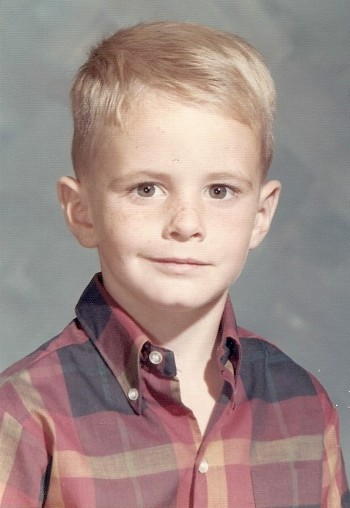 In this original BTB Investigation, we unveil the tragic story of Kirk Murphy, a four-year-old boy who was treated for “cross-gender disturbance” in 1970 by a young grad student by the name of George Rekers. This story is a stark reminder that there are severe and damaging consequences when therapists try to ensure that boys will be boys.
When we first reported on three American anti-gay activists traveling to Kampala for a three-day conference, we had no idea that it would be the first report of a long string of events leading to a proposal to institute the death penalty for LGBT people. But that is exactly what happened. In this report, we review our collection of more than 500 posts to tell the story of one nation’s embrace of hatred toward gay people. This report will be updated continuously as events continue to unfold. Check here for the latest updates.
In 2005, the Southern Poverty Law Center wrote that “[Paul] Cameron’s ‘science’ echoes Nazi Germany.” What the SPLC didn”t know was Cameron doesn’t just “echo” Nazi Germany. He quoted extensively from one of the Final Solution’s architects. This puts his fascination with quarantines, mandatory tattoos, and extermination being a “plausible idea” in a whole new and deeply disturbing light.
On February 10, I attended an all-day “Love Won Out” ex-gay conference in Phoenix, put on by Focus on the Family and Exodus International. In this series of reports, I talk about what I learned there: the people who go to these conferences, the things that they hear, and what this all means for them, their families and for the rest of us.
Prologue: Why I Went To “Love Won Out”
Part 1: What’s Love Got To Do With It?
Part 2: Parents Struggle With “No Exceptions”
Part 3: A Whole New Dialect
Part 4: It Depends On How The Meaning of the Word "Change" Changes
Part 5: A Candid Explanation For "Change"
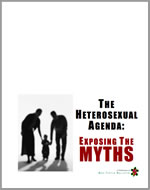 At last, the truth can now be told.
Using the same research methods employed by most anti-gay political pressure groups, we examine the statistics and the case studies that dispel many of the myths about heterosexuality. Download your copy today!
And don‘t miss our companion report, How To Write An Anti-Gay Tract In Fifteen Easy Steps.
 Anti-gay activists often charge that gay men and women pose a threat to children. In this report, we explore the supposed connection between homosexuality and child sexual abuse, the conclusions reached by the most knowledgeable professionals in the field, and how anti-gay activists continue to ignore their findings. This has tremendous consequences, not just for gay men and women, but more importantly for the safety of all our children.
Anti-gay activists often cite the “Dutch Study” to claim that gay unions last only about 1½ years and that the these men have an average of eight additional partners per year outside of their steady relationship. In this report, we will take you step by step into the study to see whether the claims are true.
Tony Perkins’ Family Research Council submitted an Amicus Brief to the Maryland Court of Appeals as that court prepared to consider the issue of gay marriage. We examine just one small section of that brief to reveal the junk science and fraudulent claims of the Family “Research” Council.
 The FBI’s annual Hate Crime Statistics aren’t as complete as they ought to be, and their report for 2004 was no exception. In fact, their most recent report has quite a few glaring holes. Holes big enough for Daniel Fetty to fall through.
“Google” is a trademark of Google Inc.
© Box Turtle Bulletin. All Rights Reserved.
 Posts
Posts  Posts via daily email: