Box Turtle Bulletin
 News and commentary about the anti-gay lobby
“Now you must raise your children up in a world where that union of man and box turtle is on the same legal footing as man and wife…”
News and commentary about the anti-gay lobbyPosts Tagged As: Uganda
August 24th, 2011
Daily Monitor, Uganda’s largest independent newspaper, today reports on reaction from members of Parliament to the weekend’s announcement that the Cabinet has “rejected” the Anti-Homosexuality Bill. Daily Monitor reports:
Members of Parliament yesterday accused Cabinet of bowing to pressure and described the Executive’s decision to block the gays Bill as “moral corruption”.
Ndorwa West MP David Bahati, the architect of the Bill, says Cabinet cannot throw out his Bill because it is now property of Parliament and insists that he is going to push for it.
The lawmakers said it was immoral for government to think that donor funds matter more than traditional values and vowed to push for the Bill and ensure that it is passed even without the support of government. “Whether they want or not, we are going to pass it. For government to come up and throw out such a Bill means we are living in a crazy world,” said Mr Andrew Allen (Bugabula North).
Ugandan lawmakers are particularly sensitive to the perception that they are under the domination of international pressure. Open defiance against foreign (read: rich, white, colonialist, etc.) pressure plays very well politically at home, as does any expression of hatred toward gay people. Adding to that is a third factor, the opportunity for members of Parliament to assert its independence by tweaking a very powerful and entrenched president. With that, support for the bill becomes a three-fer. The first and third elements are illustrated here:
Prior to the move, the international community had put pressure on government by threatening to cut aid if government passes the Bill. Ms Betty Amongi (MP Oyam South) says Cabinet has given Parliament a chance to exercise and prove its independence and not allow donor influence to “also jeopardize its works.”
The Anti-homosexuality Bill is a private members Bill and Shadow Attorney General, Abdu Katuntu (MP Bugweri) said Cabinet cannot throw out a Bill it didn’t bring. “The only option they have is to come and oppose it on the floor of the House,” he said.
August 22nd, 2011
 Last week, we reported that Britain’s Border Agency (UKBA) has denied a visa for Freedom and Roam Uganda (FARUG) founder and executive Kasha Jacqueline Nabagesera, who was scheduled to open a pride celebration in Derry, Northern Ireland later this month. Today, Paul Canning reports that UKBA has reversed its decision and granted Kasha a visa:
Kasha was today granted a visa to visit Northern Ireland. When reapplying in Kampala she reports it being granted extremely quickly. We understand that there has been significant lobbying regarding the previous visa denial, in particular of the UK Foreign Office.
August 22nd, 2011
Daily Monitor, Uganda’s largest independent newspaper, has a very brief report this morning saying that the Ugandan Cabinet has “dropped” the Anti-Homosexuality Bill:
Cabinet has finally thrown out the Anti-Homosexuality Bill, 2009 on the advice of Mr Adolf Mwesige, the ruling party lawyer. However, Ndorwa West MP David Bahati, the architect of the Bill, insists the proposed legislation is now property of Parliament and that the Executive should stop “playing hide- and- seek games” on the matter.
“We agreed that government should search the law archives and get some of the laws, enforce them rather than having another new piece of legislation,” a source said. “He [Mwesige] said the Bill is overtaken by events and that donors and other sections of the public were not comfortable.”
The decision to throw out the Anti-Homosexuality Bill was made at a Cabinet meeting on Wednesday where Mr Mwesige, according to sources, told ministers that the Bill was unnecessary since government has a number of laws in place criminalising homosexual activities.
It’s unclear what the reported action from the Cabinet would mean. In May of 2010, the Cabinet reportedly rejected the Anti-Homosexuality Bill, but the bill remained subject to debate in Parliament and had not been withdrawn.
[Update: Warren Throckmorton reports that a Parliamentary Spokesperson, Helen Kawesa, has confirmed that the “bill is in the Parliament now. It’s the Parliament’s property.” According to Throckmorton:
Currently, budget meetings are on the agenda but a budget is slated to get a vote by next Wednesday. After that, other business, including the anti-gay bill could be considered. As of now, according to Kawesa, there is no official action scheduled for the Anti-Homosexuality Bill but she said the bill could come up at any time after the budget has been passed.
This would indicate that not only is the bill very much alive, but is being actively worked in Parliament. If so, then the bill’s backers were already successful in reviving the bill without garnering any notice from the news media.]
Earlier reports of the Cabinet’s decision indicated that members recommended dismantling the bill and passing portions of it surreptitiously as amendments to other bills in the hopes of escaping worldwide attention. Many of those reported recommendations made their way into a Parliamentary report last May, barely a week before the Eight Parliament was scheduled to end. Early reports had it that the death penalty provisions had been dropped, but in an example of the kind of subterfuge the bill’s supporters would undertake to ensure its passage, it was revealed that the death penalty, in fact, was still part of the bill. Parliamentary Affairs Committee recommended that in the Clause 3 defining “aggravated homosexuality” and which specifies that “A person who commits the offence of aggravated homosexuality shall be liable on conviction to suffer death,” that the phrase “suffer death” should be replaced with “the penalty provided for aggravated defilement under Section 129 of the Penal Code Act.” Section 129 of the Penal Code Act mandates the death penalty for an unrelated offense of child molestation. Parliament ultimately failed to pass the bill due to a lack of a quorum because of controversy over another unrelated bill.
M.P. David Bahati, the bill’s sponsor, has repeatedly insisted that the bill would be brought back during the Ninth Parliament, with its status picking up where it left off at the close of previous Parliament where it was awaiting a final vote. The Ninth Parliament invoked the procedure to bring forward a bill from the prior Parliament last July when it quickly revived the controversial HIV/AIDS Prevention and Control Bill, which criminalizes the transmission of HIV/AIDS with ten years imprisonment. That bill also criminalizes the transmission of AIDS from mother to child through breast milk. HIV/AIDS workers and human rights advocates say that the penalties will will discourage testing and treatment for HIV/AIDS, as lack of knowledge of one’s status will be an effective defense against charges arising from the bill. That bill is now in the HIV/AIDS Committee.
Recent reports have speculated that the Anti-Homosexuality Bill would be brought back sometime in the second half of August, while another unconfirmed report placed the timing in November. Consistent throughout however is the concern that the bill would be brought up surreptitiously. Warren Throckmorton has reported:
I have also heard today from sources I trust that ministers are quietly appealing to MPs to pass the bill via letters and emails. The relevance of this is that the movement to get the bill considered is not as public as during the previous parliament.
August 18th, 2011
Britain’s Border Agency (UKBA) has denied a visa for Freedom and Roam Uganda (FARUG) founder and executive Kasha Jacqueline Nabagesera, who was scheduled to open a pride celebration in Derry, Northern Ireland later this month. Paul Canning reports that a UKBA spokesperson said that her visa was denied because Immigration officials feared that she might not return home after travelling to Britain. According to that spokesperson:
Each application to enter the UK is considered on its individual merits and in accordance with the immigration rules”.
“The onus is on the applicant to demonstrate that they meet the immigration rules. This may include providing evidence of financial ties to their home country which would indicate that they intend to return home at the end of their proposed visit.”
“Our rules are firm but fair and where insufficient evidence is provided visa applications may be refused, though the individual is able to apply again at any time and any new evidence will be considered.”
UKBA denies that Nabagesera’s LGBT advocacy was a factor in their decision.
Despite UKBA’s decision, Kasha Jacqueline Nabagesera has strong ties to the LGBT community in Uganda, and she has travelled abroad numerous times as part of her advocacy, returning every time to her were back home. She spoke last weekend at an international meeting of Amnesty International in Geneva. Earlier this year, she wasawarded the Martin Ennals Award for Human Rights by a consortium of ten international organizations. In May, she debated Ugandan MP David Bahati, the sponsor of draconian Anti-Homosexuality Bill on Voice of America television. Last week, Nabagesera led a major educational campaign in Uganda to counter the widespread homophobia in that country. In other words, none of this looks like the profile of someone who flees a country at the first opportunity. Nabagesera clearly has ties and commitments in Uganda, and her commitments have been recognized internationally. All of this makes UKBA’s decision very puzzling and troubling.
August 16th, 2011
All reports like this need to be taken with a huge boulder of salt, but Warren Throckmorton points to a Ugandan blogger who wrote:
However perhaps even matching its own record on the bizarre and grotesque was the so-called “Kill the Gays” Bill that was introduced by arguably one of the more capable Members of Parliament today, the Ndorwa West MP David Bahati. Last time I had a chat with the MP (who I had incidentally advised against the bill precisely because of the storm it may generate and because I considered it a waste of valuable time), he told me the bill would return to the house in November. ” I am winning,” he said.
These days I am sort of resigned to how disagreeable things can become what with an economic storm, a crisis of the Ugandan shilling and real hurt amongst Ugandan families that I consider this bill largely academic. But just like the bail law some people have suggested to me that the bill is intended for political purposes as well. My sources in parliament also add that because of the world wide storm it generated it will come to the House for debate in stealth not reflected in ” the order paper” of the day.
As I said, all such reports should be taken with skepticism, but there are several elements to this one which has important elements of credibility. The “stealth” plan, for example, builds on what appears to be a growing recognition among Ugandan lawmakers that if they want to pass this draconian bill, the best way to do it is on the down low. Such measures that we’ve already heard discussed include slipping various sections of the bill into other otherwise innocuous legislation, and concealing its the death penalty provision by quietly linking it to another law providing for capital punishment. And so why not extend the subterfuge to the methods for passing the bill and not just limit them to the contents of the bill? Throckmorton writes:
I have also heard today from sources I trust that ministers are quietly appealing to MPs to pass the bill via letters and emails. The relevance of this is that the movement to get the bill considered is not as public as during the previous parliament.
The current Speaker of Parliament, Rebecca Kadaga, was an early supporter for the Anti-Homosexuality Bill, and before that for increased penalties for homosexuality. She was Deputy Speaker in 2009, and presided over Parliament in April when MP David Bahati sought approval to submit an Anti-Homosexuality Bill as a private member’s bill. As Throckmorton notes, as speaker she has the authority to revive the bill from the prior Parliament, as was done with the controversial HIV/AIDS Prevention and Control Bill just last month.
August 1st, 2011
Freedom and Roam Uganda (FARUG) has reported that their offices were broken into on Saturday night. According to a message posted on facebook by the group’s leader, Kasha Jacqueline Nabagesera, thieves took five computers, two printers, a server, microwave oven and all office phones. Most worrying, some documents were taken, including the group’s membership database. A jerrycan of acid was left behind, and acid was poured into padlocks. No one was in the office at the time.
The crime has been reported to the police, but Kasha reports that they have not yet arrived at the premises to investigate the crime scene.
[Hat tip: Paul Canning]
August 1st, 2011
When Uganda’s Eighth Parliament came to an end last May, the draconian Anti-Homosexuality Bill died with it. Almost immediately, M.P. David Bahati vowed to resurrect the bill in the Ninth Parliament. Two weeks ago, Frank Mugisha of Sexual Minorities Uganda told reporters and bloggers that there are persistent reports that the bill may be resurrected sometime in mid- to late-August. Ugandan MP Otto Odonga, who has said that he would apply to be a hangman even if it were his own son who was gay and at the gallows, confirmed to Warren Throckmorton that the bill will be brought back “perhaps by the end of August,” and that it would pick up “from where the last parliament ended.”
It would be good to review where the bill was when the last Parliament ended. The Legal and Parliamentary Affairs Committee reported the bill back to Parliament during the legislative body’s last week in session amid widespread and erroneous reports that the committee recommended removing the death penalty from a newly defined crime of “aggravated homosexuality,” which would include those who are HIV-positive and those who are “repeat offenders” — meaning anyone who has had either more than one relationship or more than one sexual encounter with the same individual. The committee did recommend that the phrase “suffer death” should be replaced with “the penalty provided for aggravated defilement under Section 129 of the Penal Code Act.” But the penalty under Section 129 of the Penal Code reads that anyone who “commits a felony called aggravated defilement and is, on conviction by the High Court, liable to suffer death.”
In other words, the death penalty was replaced with — the death penalty under subterfuge. You can see a detailed rundown of other recommendations of the bill here. It is unknown at this time what form a new bill would take if it were revived in the Ninth Parliament.
The Ninth Parliament has already established a precedent for bringing a controversial bill from the Eighth Parliament’s death and put it on the fast track for passage. On July 13, Uganda’s Daily Monitor, the nation’s largest independent newspaper, reported that the Ninth Parliament had quickly revived the controversial HIV/AIDS Prevention and Control Bill, which criminalizes the transmission of HIV/AIDS with ten years imprisonment. The bill also criminalizes the transmission of AIDS from mother to child through breast milk. HIV/AIDS workers and human rights advocates say that the penalties will will discourage testing and treatment for HIV/AIDS, as lack of knowledge of one’s status will be an effective defense against charges arising from the bill. The bill is now in the HIV/AIDS Committee.
Since the close of the Eighth Parliament, MP David Bahati’s start has continued to rise. He has been named the vice-chairman of the ruling party’s caucus in Parliament. He was also named chairman of the Ugandan Fellowship, a branch of the U.S.-based secretive group known as the C Street Fellowship or The Family. During the Ugandan’ branch’s inaugural dinner for the new Parliament, First Lady and M.P. Janet Museveni told Parliamentarians that it was their duty to “recognize and fulfill God’s word.”
June 21st, 2011

Ugandan MP David Bahati (AP Photo/Ronald Kabuubi)
There had been speculation that MP David Bahati, author of 2009’s draconian Anti-Homosexuality Bill, would be appointed to Ugandan President Yoweri Museveni’s cabinet at the start of the Ninth Parliament last month. Mercifully, that hasn’t happened. But Bahati’s star nevertheless is rising in the inner circle of Ugandan politics. Last week, Daily Monitor, Uganda’s largest independent newspaper, reported that Bahati has been named the ruling party’s caucus Vice Chairman. He had originally held the title of caucus treasurer.
And that’s not all. The government-affiliated New Vision today reports that Bahati has been named chairman of the Ugandan Fellowship, a branch of the U.S.-based secretive group known as the C Street Fellowship or The Family. The Ugandan fellowship held its inaugural dinner for members of the Ninth Parliament at the Sheraton Hotel Kampala on Friday. While Bahati is now the ruling party’s caucus vice chairman, he stressed that the Fellowship was open to members of all parties:
The chairman of the parliamentary fellowship, David Bahati, said the caucus of God is bigger than all other caucuses and does not discriminate against political affiliations.
The parliamentary fellowship was founded in 1986 by the late Hon. Balaki Kirya, and has since 1991 been organising a prayer breakfast on every October 8.
Bahati said the fellowship, initiated some bills like the Anti- Homosexuality and Anti-Pornography believes in a God led country and God led policies. [sic]
The guest speaker of the inaugural dinner was First Lady and MP, Janet Museveni, who told the gathering:
Members of the 9th Parliament have been urged to enact laws and policies that will build a better Uganda.
The First Lady and minister for Karamoja affairs, Janet Museveni, said this would enable the future generations to live in a better and prosperous country.
Mrs. Museveni said it is God who sets seasons and times, therefore those elected to the 9th Parliament should recognise and fulfil God’s purpose.
The Anti-Homosexuality Bill, which would have provided for the death sentence for the crime of “aggravated homosexuality,” died last month at the close of the Eighth Parliament. Despite numerous inaccurate news reports to the contrary, the bill was not amended to remove the death penalty. Bahati has since vowed to reintroduce the bill into the new Parliament.
May 22nd, 2011
Uganda’s independent Sunday Monitor this morning has published an interview with MP David Bahati, sponsor of the infamous Anti-Homosexuality Bill, in which he reiterated that the close of the 8th Parliament was simply “pressing the pause button.” He told Monitor reporter Philippa Croome that the bill’s death penalty “is something we have moved away from,” despite the fact that the death penalty has not been removed at all. In fact, the recommendation from the Parliamentary and Legal Affairs Committee, which was given jurisdiction over the bill, recommended striking the phrase “shall suffer death” and replacing it with the phrase “shall suffer the penalty provided for aggravated defilement under Section 129 of the Penal Code Act.” Section 129 itself calls for the death penalty, which means that if the committee’s recommendations were adopted the death penalty would remain in place. It just wouldn’t be so obvious to those who don’t know what Section 129 specifies.
The death penalty however is barely scratching the surface for what the Anti-Homosexuality Bill would do, which Bahati acknowledges:
But the focus is on inducement, stopping the inducement of our children to this behaviour, and promotion- those two things are the ones that we will be focusing on.
If protecting children is the focus of the Bill, why does it require an entirely separate bill from current child protection laws?
We are not really singling out anybody. In 2007, we had an Act which stops defilement, the defilement Act, it is already there. We have the Penal Code which criminalises homosexuality in some form, but it is not specific, it’s not effective, it needs strengthening.
The Bill comes in to include other issues that have emerged over time-issues of promotion, it has never happened, it is happening now, issues of inducing children- it was never there, it was happening now.
Sunday Monitor also interviewed gay rights LGBT Kasha Jacqueline Nabagesera. She is the founder and director of Freedom and Roam Uganda and winner of the Martin Ennals Award for Human Rights Defenders by a coalition of international human rights organizations. She called on the international community to continue to stand up for human rights in Uganda.
Every human rights violation that happens in Uganda, we need Ugandans to stand up and say enough is enough – and our allies in the international community to also stand up. At the end of the day, Uganda is not alone, we operate in a global village.
She also denounced the false charges that gays were trying to “recruit” children into homosexuality:
If I found someone trying to recruit children into homosexuality, I would even hand them in myself – he is trying to pretend that he’s protecting children of Uganda, but he’s not doing that.
Today, he thinks he is condemning Kasha, but he could be condemning his own children in future. There are very many children who are growing up and he is pretending to be protecting them, but they could turn out to be like some of us.
The issue here is not even recruitment or promotion. For two years, Bahati has been asked by everyone to produce the evidence and he has not produced it. He is just using that to get sympathy from the masses of people in Uganda who are parents – that’s the only reason he has insisted we are recruiting children. He does not have any other argument.
May 19th, 2011
In contrast to reports attributed to the BBC (at 14:20) that the Anti-Homosexuality Bill will soon be taken up by Uganda’s new Parliament, a parliamentary spokeswoman denied today that any action has been considered. When asked about the BBC report that the Ninth Parliament had inherited three bills, including the anti-gay bill, parliamentary spokewoman, Helen Kawesa said, “I don’t know where that news is coming from. No one has said anything here about it.”
Kawesa said the Ninth Parliament was just getting started, and elected Rebbecca Kadaga to the post of Speaker, the first woman to hold that position in Uganda’s history. Kawesa said that bills will not be considered during this initial period when committees are being formed and chairs of those committes are appointed. She also confirmed that no motion to re-introduce or continue bills had been made.
The BBC’s Africa Service reported earlier today that the Anti-Homosexuality Bill had been revived in Uganda’s 9th Parliament. Throckmorton got additional confirmation that the bill has not been revived from Stephen Tashobya, former chair of the Legal and Parliamentary Affairs committee for the prior Parliament.
The situation however remains fluid, but as the BBC report initially stated (and is now confirmed by Daily Monitor) the new Parliament’s highest priority is a bill responding to the nationwide riots which have sprung up over the past month. The bill would amend the constitution to allow the government to ban public meetings and to hold people in detention for six months without bail for “economic sabotage.”
May 18th, 2011
A reader from Uganda wrote in to say that he heard a report from BBC Network Africa’s Joshua Male saying that three bills from the 8th Parliament have been carried over to the 9th, which convenes today. Two of the three bills, according to this report, are the Anti-Homosexuality Bill, and the similarly contentious Marriage and Divorce Bill. (Our reader didn’t catch the third bill.) We are still seeking confirmation. Stay tuned.
Update: I just listened to Joshua Male’s report on BBC Network Africa which is available online. His report said, in part:
The 9th Parliament has inherited three controversial bills that form part of its deliberations. They include the Anti-Homosexuality Bill which was shoved at the eleventh hour of the 8th Parliament, the Marriage and Divorce Bill which, among other things, would criminalize marital rape, widow inheritance [sic], in addition to providing for women’s property rights and rights to negotiate sex including seeking divorce on grounds of the man’s impotence or the size of their sexual organ. Another controversial bill is the one that seeks to enact more stringent laws for the media.
The report goes on to say that a new anti-rioting law will be the new Parliament’s first priority.
Update 5/18: It now appears that the BBC reporter either jumped the gun or was speaking to an unreliable source.
May 16th, 2011
Rumors are rife in Uganda now that President Yoweri Museveni is assembling a new Cabinet following the swearing in of the 9th Parliament. Sunday Monitor has what they say is Museveni’s short list of possible cabinet ministers.
When I first saw Anti-Homosexuality Bill author David Bahati’s name tapped as Ethics Minister late on Saturday, I re-read the article, and from the first two paragraphs concluded that it as something of a dream team put together by the paper’s staff. I was very dismayed to see it, because I have been very impressed with Monitor’scoverage throughout the past two years. But since I took it to be a list put together by Montor’s staff, I ignored it. Unfortunately. Because when Warren Throckmorton posted about it this afternoon, it prompted me to go back and look again. And sure enough:
We have defined the country’s needs as being economic development, geopolitical interests, social stability, environment and physical resource management, governance and integrity, and efficiency. We have also learned from reliable sources that these are names being considered by the President for appointment to the Cabinet and to junior minister positions. [Emphasis added].
What follows are two lists: the “president’s shortlist” and the Monitor’s dream list. Formatting of the two lists prevented me from noticing that there were, in fact, two lists. Bahati’s name does not appear on Monitor’s dream list, but it does appear on the one that matters: the one that reported to be the president’s list
Meanwhile, state-supported New Vision, which generally has closer ties to Museveni’s government, came out with theor own list about some possible new faces in the cabinet. One interseting name:
Tim Lwanga
The MP-elect for Kyamuswa County, Kalangala District, is also likely to bounce back on the list of the ministers.Lwanga, a Born-again Christian, is a former Minister of Ethics and Integrity. He had been dropped from the list of ministers after losing in the 2006 parliamentary elections.
Lwanga was replaced by James Nsaba Buturo, who was also defeated in the recent elections.
New Vision doesn’t say what position Lwanga would be considred for. Bahati is not on New Vision’s list. And so the rumor mill grinds along…
[This post replaces an earlier post in which I erroneously stated that Warren Thockmorton and David Badash (at the New Civil Rights Movement) “misread” Monitor’s article when, in fact, it was I who misread it. I apologize to Warren, David, and to the readers who saw that post.]
May 13th, 2011
Jim,
Politics is a funny animal and the Uganda Anti-Homosexuality Bill of 2009 could still raise its head in another form. But it does look very promising at this time that this bill may be finally dead.
And much of the credit goes to Box Turtle Bulletin, and especially to you personally.
This has been a TREMENDOUSLY time consuming effort involving a matter that surely no one here ever considered to be our bailiwick, involving connections that we could not assume we could even develop, and creating allies that were unimaginable. Going into this two years ago we never dreamed of reaching the State Department, much less having statements from the President and many governments around the world.
It has been a lot of work, but you must be feeling tremendous satisfaction. I certainly do for my much less significant role.
Congratulations, my friend and associate. You changed the world.
Timothy
A commentary
May 13th, 2011
This South African hit by Letta Mbulu was released in 1991 during the euphoric days after apartheid. While South Africans celebrated their newly-won freedoms, she sang, “There are some people who look at us as being free, but when you speak with regular folk they say it’s ‘not yet uhuru’.” The phrase “Not yet uhuru” is a mix of English and Swahili — not yet free. Similar to another phrase from Mozambique’s war for independence, “a luta continua” (the struggle continues), “not yet uhuru” reminds us that there is still much work to be done. As an email friend from Uganda reminded me a month ago, “Until equality is reality for every human being… it’s not. It’s not yet uhuru.”
For more than two years now, we have been watching in horror as events spun out of control in Uganda, events that were dangerously inflamed by American Evangelicals seeking to deport their thinly-veiled disgust (if not outright hatred) for LGBT people. From the moment we first learned about the then-pending March 2009 conference put on by three American anti-gay activists — Holocaust revisionist Scott Lively, still sitting Exodus International board member (and now treasurer!) Don Schmierer, and International Healing Foundation’s Caleb Lee Brundidge; may their shameful roles never be forgotten — through the connections between the Anti-Homosexuality Bill’s sponsor and the shadowy American evangelical group known as The Family, through other connections between the bill’s godfathers and the American-based College of Prayer, through a supporting Kampala rally featuring Lou Engle and open expressions of unreserved support from Andrew Wommack’s spokesman, WND’s Molotov Mitchell, and Peter Labarbera, it became clear that while homophobia runs rampant in Uganda, it is strongly supported through the active encouragement of American anti-gay extremists.
This looked like a saga without ending. I had begun compiling a list of all of the posts about Uganda and its slide into hatred, but by May of 2010 our blogging software stopped accepting updates to that page; it had gotten too big for it to handle. It was as if WordPress itself had thrown up its hands and shouted, “Enough!” But it wasn’t enough. Events continued to spin out and we kept watching and reporting. (You can follow our posts via this tag.)
And so finally we came to this moment. When I went to bed very late last night, it was already 9:00 a.m. this morning in Kampala. When I put the finishing touches on today’s Daily Agenda, I understood that the chances against the bill becoming law were somewhat in our favor, but the rapid pace with which the bill was suddenly put into play last Friday left me to wonder what forces were impelling its rapid progression in a country where nothing happens quickly. I was, frankly, despondent. Ask my partner. He’ll tell you.
This morning, the sun is very bright here in Tucson. The temperatures are going to be in the upper 90s, which is considered temperate here. The weekend looms, and the only hitch right now is that pollen is in the air and everyone’s sneezing. But that’s a minor hitch. On the other side of the world, nightfall has already descended upon a teeming city of more than two million people, and for many the work week has just ended. Restaurants and nightclubs will soon be hopping, the streets will be noisy, and Ugandans will be celebrating the weekend. Some folks will probably celebrate more than they should, but a few will celebrate with an extra dose of verve. And for some, their celebrations will be muted as they remember those who are no longer around to celebrate.
And tomorrow, a new day will begin, but it will not be much different from the day that just ended. We won’t know for certain whether this evil bill is well and truly dead until Parlaiment constitutionally expires on May 18. Even then we don’t know because there is speculation that there may be some unknown procedure allowing the 9th Parliament to take up the 8th Parliament’s unfinished business. And if it turns out it can’t, we still have the promises of one hate-filled politician who vows to introduce a new bill in the next Parliament.
But for the first time, I am just now beginning to allow myself to believe that this may be a turning point. It took me about three hours after I posted the news this morning before I could give myself permission to believe it. And even now I’ve discovered that giving myself permission and actually believing it are still two separate things. It’s not yet uhuru. A luta continua.
May 13th, 2011
The Order Paper for the Ugandan Parliament this morning has only three items on the agenda:
FRIDAY 13TH MAY 2011, ORDER PAPER
26TH SITTING OF THE 2ND MEETING OF THE 5TH SESSION OF THE 8TH PARLIAMENT OF UGANDA: FRIDAY 13TH MAY 2011 – TIME OF COMMENCEMENT 10.00 A.M.
1. PRAYERS
2. COMMUNICATION FROM THE CHAIR
3. ADJOURNMENT
KAMPALA
13TH MAY 2011
And the following announcement was subsequently posted on Uganda’s web site:
Emotional farewells as Eighth Parliament closes
The term of office for Members of Parliament elected to the Eighth Parliament of Uganda has come to an end. Speaker of Parliament Rt. Hon. Edward Kiwanuka Ssekandi announced to MPs, in an emmotional sitting , the end of the term of the Eighth parliament urging MPs to appreciate and embrace the multiparty political system.
“This Parliament was different from all parliaments before it.But my assessment is that people still long for the movement political system other than the multiparty system .The two systems are different and what you must know is that under multiparty system, Mps on the government side came with one manifesto that the executive is trying to implement,”he told MPs.
Speaker Ssekandi announced that the official proclamation for the end of the Eighth Parliament had already been signed and would be gazetted on May 18, the day the ninth Parliament would commence.
The middle paragraph is a bit of ruling party propaganda that can be safely ignored. The important point is that the proclamation for the end of the Parliament “had already been signed.”
Now the Associated Press confirms:
Uganda’s parliament adjourned Friday without acting on a criticized anti-gay bill that would mandate the death sentence in some cases, drawing praise from an advocacy group that said parliament’s failure to act was a “victory for all Ugandans.”
Speaker of Parliament Edward Ssekandi Kiwanuk said there is no time to take up the bill this session, which ends Wednesday, leaving the bill’s future uncertain. Kiwanuk adjourned the parliament Friday and set no date for the body to return.
…Kakoba Onyango, a member of parliament, said the anti-gay bill has taken so long to be acted on because President Yoweri Museveni did not back it and because of the criticism of human rights groups.
AFP adds a hint to the reason why Parliament abruptly adjourned:
David Bahati, the lawmaker behind the anti-gay bill, said that as the cabinet was dissolved following the inauguration of President Yoweri Museveni for a fourth term on Thursday no bills could be passed.
Warren Throckmorton points to this news item (and confirmed through a Parliament spokesperson) indicating that the hitch may have had to do with the Cabinet being dissolved in preparation for yesterday’s swearing in on President Yoweri Museveni for another term. Writes Throckmorton:
According to parliamentary spokeswoman, Helen Kawesa, Parliament is stalled on a “technicality.” She said there is no Cabinet in place because it was dissolved in preparation for the end of the 8th Parliament in advance of yesterday’s Presidential inauguration. It is unclear who raised the issue of the necessity for Cabinet to be place for business to be conducted. However the effect is that the session is winding up, with members discussing how to proceed before the end of the 8th Parliament on 18th.
Ordinarily, all unfinished bills die at the end of Parliament. There may be a procedural move which could allow the Anti-Homosexuality Bill to be carried forward to the next Parliament. It is unclear whether such a move will be made.
There have been so many twists and turns over the past two years that it’s been hard to ever really know (or believe) what the status of the bill really is. That’s why I am not given to celebrate until the 18th of May. But I am more optimistic than I ever have been before that this odious act of evil may well be finished.
UPDATE: Sexual Minority Uganda’s Frank Mugisha is considerably more confident: “Right now I would say that I am almost sure that the bill is not coming,” he told Radio Netherlands Worldwide.
Featured Reports
 In this original BTB Investigation, we unveil the tragic story of Kirk Murphy, a four-year-old boy who was treated for “cross-gender disturbance” in 1970 by a young grad student by the name of George Rekers. This story is a stark reminder that there are severe and damaging consequences when therapists try to ensure that boys will be boys.
When we first reported on three American anti-gay activists traveling to Kampala for a three-day conference, we had no idea that it would be the first report of a long string of events leading to a proposal to institute the death penalty for LGBT people. But that is exactly what happened. In this report, we review our collection of more than 500 posts to tell the story of one nation’s embrace of hatred toward gay people. This report will be updated continuously as events continue to unfold. Check here for the latest updates.
In 2005, the Southern Poverty Law Center wrote that “[Paul] Cameron’s ‘science’ echoes Nazi Germany.” What the SPLC didn”t know was Cameron doesn’t just “echo” Nazi Germany. He quoted extensively from one of the Final Solution’s architects. This puts his fascination with quarantines, mandatory tattoos, and extermination being a “plausible idea” in a whole new and deeply disturbing light.
On February 10, I attended an all-day “Love Won Out” ex-gay conference in Phoenix, put on by Focus on the Family and Exodus International. In this series of reports, I talk about what I learned there: the people who go to these conferences, the things that they hear, and what this all means for them, their families and for the rest of us.
Prologue: Why I Went To “Love Won Out”
Part 1: What’s Love Got To Do With It?
Part 2: Parents Struggle With “No Exceptions”
Part 3: A Whole New Dialect
Part 4: It Depends On How The Meaning of the Word "Change" Changes
Part 5: A Candid Explanation For "Change"
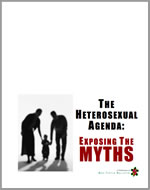 At last, the truth can now be told.
Using the same research methods employed by most anti-gay political pressure groups, we examine the statistics and the case studies that dispel many of the myths about heterosexuality. Download your copy today!
And don‘t miss our companion report, How To Write An Anti-Gay Tract In Fifteen Easy Steps.
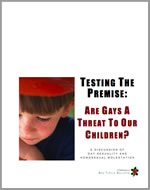 Anti-gay activists often charge that gay men and women pose a threat to children. In this report, we explore the supposed connection between homosexuality and child sexual abuse, the conclusions reached by the most knowledgeable professionals in the field, and how anti-gay activists continue to ignore their findings. This has tremendous consequences, not just for gay men and women, but more importantly for the safety of all our children.
Anti-gay activists often cite the “Dutch Study” to claim that gay unions last only about 1½ years and that the these men have an average of eight additional partners per year outside of their steady relationship. In this report, we will take you step by step into the study to see whether the claims are true.
Tony Perkins’ Family Research Council submitted an Amicus Brief to the Maryland Court of Appeals as that court prepared to consider the issue of gay marriage. We examine just one small section of that brief to reveal the junk science and fraudulent claims of the Family “Research” Council.
 The FBI’s annual Hate Crime Statistics aren’t as complete as they ought to be, and their report for 2004 was no exception. In fact, their most recent report has quite a few glaring holes. Holes big enough for Daniel Fetty to fall through.
“Google” is a trademark of Google Inc.
© Box Turtle Bulletin. All Rights Reserved.
 Posts
Posts  Posts via daily email: