Box Turtle Bulletin
 News and commentary about the anti-gay lobby
“Now you must raise your children up in a world where that union of man and box turtle is on the same legal footing as man and wife…”
News and commentary about the anti-gay lobbyPosts Tagged As: Uganda
October 25th, 2011
The legislation will be sent to the relevant session committee for consideration, Speaker Rebecca Kadaga told lawmakers today in a televised debate from the capital, Kampala.
Uganda’s parliament voted to reopen a debate on a bill that seeks to outlaw homosexuality that may be expanded to include the death penalty for gay people.
Giles Muhame, the former editor of the notorious Ugandan gay-baiting tabloid Rolling Stone (no relation to the U.S. publication by the same name) has more about the Parliamentary maneuvers and debates which, he says, brought the bill back. According to Muhame, the motion to revive the bill was made by MP Lt. Col. Sara Mpabwa, and was seconded by MP Crispus Ayena. A host of other contentious bills which were left unfinished when the Eighth Parliament expired last May were also reportedly brought back, along with all committee reports attached to the bills. Speaker Kadaga cited parliamentary procedures in Canada and India to justify the procedure of bringing bills back into Parliament without repeating the initial readings required to introduce a bill and refer it to committee.
The Speaker was an early supporter for the Anti-Homosexuality Bill, and before that for increased penalties for homosexuality. She presided over Parliament in April 2009 in her role as Deputy Speaker when MP David Bahati sought approval to submit an Anti-Homosexuality Bill as a private member’s bill.
If these reports are correct, then the bill’s revival appears to be occurring despite assurances from representatives of President Yoweri Museveni’s cabinet that they have “thrown out” the bill. When that annnouncement was made last August, a Parliamentary spokesperson immediately shot back that the bill was “Parliament’s property.” Meanwhile, M.P. David Bahati, the bill’s sponsor, was elevated to the vice-chairmanship of the ruling party’s caucus in Parliament. In October, the caucus chairman was forced to step aside due to a corruption probe, and Bahati has since been elevated to acting caucus chair.
Since the innauguration of the Nineth Parliament, there had been rumors that that the Anti-Homosexuality Bill would be brought back sometime in the second half of August while others placed the timing in November. It was unclear what form the reintroduced bill would take. In early 2010, the Cabinet had recommended dismantling the bill and passing portions of it surreptitiously as amendments to other bills in the hopes of escaping worldwide attention. Many of those reported recommendations actaully made their way into a Parliamentary report last May, barely a week before the Eight Parliament was scheduled to end. Media at that time carried several false reports that the death penalty provisions had been dropped, but we now know that the death penalty, in fact, was still part of the bill. The Parliamentary Affairs Committee recommended that in the Clause 3 defining “aggravated homosexuality” and which specifies that “A person who commits the offence of aggravated homosexuality shall be liable on conviction to suffer death,” that the phrase “suffer death” should be replaced with “the penalty provided for aggravated defilement under Section 129 of the Penal Code Act.” Section 129 of the Penal Code Act mandates the death penalty for an unrelated offense of child molestation. Parliament ultimately failed to pass the bill due to a lack of a quorum because of controversy over another unrelated bill.
If, as reported, this latest maneuver actually does revive the bill with its Parliamentary Affairs Committee report, then the bill’s passage might be imminent since the last step for its final passage last May was a final vote in Parliament.
October 10th, 2011
British Prime Minister David Cameron has warned that countries which persecute gay people will find their foreign aid budget cut. International Development Secretary Andrew Mitchell also told the Daily Mail that Britain has already cut aid to Malawi over it abuse of human right violation, citing the country’s conviction of Steven Monjeza and Tiwonge Chimbalanga, a same-sex couple who entered into a traditional engagement ceremony in violation of that nation’s anti-sodomy laws.
Mitchell’s comments however don’t quite line up with the chain of events in Malawi. The couple were pardoned by Malawi President Bingu wa Mutharika in May, 2010. Earlier this year, a Wikileaks cable revealed that the British ambassador warned that Malawi’s President was becoming increasingly autocratic and intolerant of criticism. Mutharika responded by expelling the ambassador while violently cracking down on dissent in the impoverished nation, thereby proving the ambassador’s point. Britain began cutting aid to Malawi in July 2011.
Malawi received about £200 million from Britain over the past three years, before Britain announced cuts of £19 million.
Mitchell also cited Uganda (which is due to received £70 million this year) and Ghana (which received £36 million each year) as possible targets for future cuts if they enact further criminal legislation against gay people. No mention was made of Zimbabwe, which received £69 million last year.
September 29th, 2011
 The Rafto Foundation, a Norwegian human rights and democracy advocacy organization, announced today that they are awarding the 2011 Rafto Prize to Sexual Minorities Uganda and the group’s Executive Director, Frank Mugisha. According to the Rafto Foundation’s press release, “The Prize is awarded to SMUG for its work to make fundamental human rights apply to everyone, and to eliminate discrimination based on sexual orientation or gender identity.” The Foundation explains the reason for the recognition:
The human rights situation in Uganda in general, and the plight of sexual minorities in particular, is getting worse. They are blamed for social problems and are “the good enemy” that politicians can attack in order to garner support. In this situation, SMUG’s work is especially important. The battle they wage is for human rights’ most basic purpose: to protect individuals from abuses by the authorities and the majority. The Rafto Foundation hereby gives its support to the work against what former SMUG leader Victor Juliet Mukasa, characterized as a “state-sponsored homophobia that is spreading across the African continent”.
SMUG is a coalition of organisations that work for the human rights of lesbian, gay, bisexual, transgender and intersex people (LGBTI people, or sexual minorities, which is the term used by SMUG). Since its inception in 2004, SMUG has become a powerful voice for a stigmatised and persecuted minority. The coalition has played an important role in opposing the proposed “Anti-Homosexuality Bill” and has successfully used the legal system to fight harassment and violence from government and private actors. SMUG also does important work supporting individuals who suffer from abuse.
Frank Mugisha and his colleagues in SMUG have demonstrated great courage in fronting the fight for LGBTI people’s rights.
The 2011 Rafto Prize will be awarded in Bergen, Norway on November 6. Earlier this month, it was announced that Mugisha has been chosen to receive the Robert F. Kennedy Human Rights Award from the Robert F. Kennedy Center for Justice and Human Rights.
September 23rd, 2011
First, let’s begin with a definition of the word “stakeholders“:
- (in gambling) An independent party with whom each of those who make a wager deposits the money or counters wagered
- A person with an interest or concern in something, esp. a business
- Denoting a type of organization or system in which all the members or participants are seen as having an interest in its success.
With that in mind, read this article in Thursday’s edition of Uganda’s pro-government newspaper New Vision, describing the visit of that nation’s Vice President Edward Ssekandi to New York to attend the United Nations General Assembly this week. While there, Ssekandi met with the U.S. Assistant Secretary of State for African Affairs Johnnie Carson at Uganda Mission, where they talked about a variety of issues, including the status of the Anti-Homosexuality Bill, which is rumored to be under consideration for reintroduction into Parliament. New Vision reports:
On the issue of homosexuality which Carson also raised, the Vice President explained that the government has not yet come up with a position on the issue adding that open objective consultation with stakeholders are still underway before a report is presented to government for decision.
Ssekandi doesn’t name the stakeholders involved with the consultation, but as far as I have been able to determine, the most important stakeholders of all — Uganda’s gay and lesbian community — have continued to be shut out of those “consultations.”
September 23rd, 2011
 Uganda’s First Lady and Member of Parliament Janet Museveni confirmed her support for the draconian Anti-Homosexuality Bill in an op-ed published yesterday in the pro-government New Vision newspaper. Museveni complains that press freedoms in Uganda have encouraged “elements within the media who have abused the environment of free expression, by making themselves available to the highest bidder in the political arena with all its ugly wars,” and points to recent reports of a Wikileaks cache illuminating her support for the bill. In yesterday’s op-ed, she wrote:
The second Daily Monitor report alleges that I am the initiator of the Gay Bill. This ludicrous claim is not only an insult to Hon. Bahati, the originator of the bill but also to me, because it implies that I need to hide behind someone else in order to introduce a bill in parliament.
I believe Ugandans know by now that I have always had the courage to stand by my convictions – even when they go against the grain of prevailing popular opinion. I think I have adequately demonstrated, in my work over the years, that I can boldly stand by what I believe in without fear or favour.
Last month, Wikileaks published U.S. diplomatic cables which described a meeting between U.S. diplomats and Ugandan Senior Presidential adviser John Nagenda and U.S. Ambassador to Uganda, Jerry Lanier. According the the dispatch, Nagenda said that Janet Museveni was “ultimately behind” the draconian legislation that would have imposed the death penalty on LGBT Ugandans. It remains unclear from the context whether being “ultimately behind” was intended to mean that the bill was her initiative, or whether she was placing her support behind the bill. Evidence appears to point to the latter, but even if her involvement is limited to support, it is still no small matter when the support comes from the wife of a powerful President.
See also:
Feb 17, 2011: Wikileaks Posts Cables from US Embassy in Uganda Concerning Anti-Homosexuality Bill
Feb 17, 2011: More Wikileaks Cables on Uganda’s Anti-Homosexuality Bill
Sep 10, 2011: Wikileaks: Ugandan First Lady “Ultimately Behind” Anti-Homosexuality Bill
Sep 11: 2011: More On Ugandan First Lady’s Support For Anti-Homosexuality Bill
Sep 11, 2011: Wikileaks: Vatican Lobbied Against Uganda’s Anti-Homosexuality Bill
Sep 12, 2011: Wikileaks on Uganda’s Homosexuality Bill: Museveni “Surprised” and Buturo “Obsessed”
Sep 12, 2011: Ugandan Presidential Aide Confirms Wikileaks Conversation
Sep 23, 2011: Ugandan First Lady Affirms Support For “Kill The Gays” Bill
September 15th, 2011

Frank Mugisha
Frank Mugisha, Executive Director of Sexual Minorities Uganda (SMUG), has been chosen to receive the Robert F. Kennedy Human Rights Award. From the Robert F. Kennedy Center for Justice and Human Rights:
“Frank Mugisha’s unbending advocacy for gay rights in Uganda in the face of deep-rooted homophobia is a testament to the indomitability of the human spirit,” said RFK Human Rights Award Judge Dean Makau Mutua, Professor of Law and Dean of the University at Buffalo Law School (SUNY).
…”Frank Mugisha has fought courageously in support of the rights of sexual minorities in Uganda, despite death threats and even exile,” said Kerry Kennedy, president of the Robert F. Kennedy Center for Justice and Human Rights. “He has become a leading advocate for sexual minorities in a country where they are persecuted, jailed, and their lives destroyed. We are proud at the RFK Center to begin our partnership with Mr. Mugisha to advance his invaluable work within this movement.”
…”For me, it is about standing out and speaking in an environment where you are not sure if you will survive the next day; it is this fear that makes me strong, to work hard and fight on to see a better life for LGBTI persons in Uganda,” said Mr. Mugisha. “The Robert F. Kennedy Human Rights Award gives me courage and hope that my work, which may not be accepted and recognized in my own country, is making a change with this international visibility.”
Mugisha has been an LGBT advocate since 2004, when he began advocating for LGBT and HIV/AIDS awareness as a college student. He started a support group, Icebreakers, to help LGBT people who were struggling through the issues of coming out. He had to flee the country when police targeted him for arrest, but he has since returned to continue his advocacy work in the face of death threats and governmental efforts to impose the death penalty on gay people.
September 12th, 2011

John Nagenda: "An accurate reflection."
Perhaps that headline should read “Former Ugandan Presidential Aide…”. There now appears to be a falling out between John Nagenda and Ugandan President Yoweri Museveni. The revelation via Wikileaks of Nagenda’s frank accusation that Uganda’s First Lady Janet Museveni is “ultimately behind” the controversial Anti-Homosexuality Bill would certainly provide sufficient cause for the split, but this article in Uganda’s The Observer points to a more substantial dispute that’s been brewing for some time. Go read the article for more background information, but as far as his comments concerning the First Lady’s support for the bill is concerned, Nagenda confirms the cable’s message:
In an interview with The Observer on Saturday, Nagenda admitted holding the said meeting with US Embassy officials and added that he maintains the views he shared with them.
“Yes; one or two words may be slightly different. I held a conversation with the political officer and it’s an accurate reflection in the sense that I said that the President is very strongly anti-gay, but I doubted that he would support such a bill. I did accurately predict that he wouldn’t support the bill. It was extreme,” Nagenda said.
“On the First Lady – it’s a long time ago – but what I meant is that she holds very strong views where she sees morality.”
Nagenda also said he advised the donors that their threat to cut aid because of the bill was “very stupid” because Ugandans would think they were out to fight the country, “so people would dig in their heels more by supporting the bill”.
He also had critical words concerning former Ethics and Integrity Minister James Nsaba Buturo.
In December of 2009 as international controversy exploded over the Anti-Homosexuality Bill, Nagenda published an op-ed in the government-aligned New Vision opposing the bill. The appearance of the op-ed in the pro-government newspaper was seen as a positive development at the time.
See also:
Feb 17, 2011: Wikileaks Posts Cables from US Embassy in Uganda Concerning Anti-Homosexuality Bill
Feb 17, 2011: More Wikileaks Cables on Uganda’s Anti-Homosexuality Bill
Sep 10, 2011: Wikileaks: Ugandan First Lady “Ultimately Behind” Anti-Homosexuality Bill
Sep 11: 2011: More On Ugandan First Lady’s Support For Anti-Homosexuality Bill
Sep 11, 2011: Wikileaks: Vatican Lobbied Against Uganda’s Anti-Homosexuality Bill
Sep 12, 2011: Wikileaks on Uganda’s Homosexuality Bill: Museveni “Surprised” and Buturo “Obsessed”
Sep 12, 2011: Ugandan Presidential Aide Confirms Wikileaks Conversation
Sep 23, 2011: Ugandan First Lady Affirms Support For “Kill The Gays” Bill
September 12th, 2011
The latest batch of leaked U.S. diplomatic cables reveals a fascinating look at U.S. diplomatic efforts to convince Uganda’s political leadership that killing gay people is lousy public policy. A batch posted on Wikileaks last February revealed that diplomats thought M.P. David Bahati, author of the draconian Anti-Homosexuality Bill, operated with a “blinding and incurable” homophobia, and they discussed security concerns with LGBT advocates who were trying to head off the bill’s passage. They also described diplomats’ discussions with President Yoweri Museveni over U.S concerns about the Anti-Homosexuality Bill, in which Museveni promised to head off the bill, but he also warned that international pressure could be counter-productive.

President Yoweri Museveni
The newest batch of Wikileaks cables reveals few new details about U.S. diplomats’ discussions with Museveni and his push-back against international pressure. Those cables are mostly dated December 2009 or later, and mostly reflect moves which were also publicly reported in the press. But one cable dated November 9, 2009, describes an October 24 meeting between Museveni and several U.S. diplomats. This would have been nine days after the Anti-Homosexuality Bill was introduced in Parliament. The bill had been introduced as a private member’s bill by M.P. David Bahati, rather than by the more normal route of being a government-sponsored bill from a member of the President’s cabinet or the President himself. This cable does show that Museveni may have been caught off guard by the bill:
(Assistant Secretary of State for the Bureau of African Affairs Johnnie) Carson also raised the issue of “anti-homosexuality” legislation recently tabled in Parliament. The draft bill, which is not sponsored by the Ugandan government, criminalizes homosexuality with proposed sentences ranging from imprisonment to, in some cases, death (ref. D). Recognizing that homosexuality is a difficult topic for Ugandans, Assistant Secretary Carson said the issue attracts a great deal of international attention and that passing this legislation will result in condemnation for Uganda.
Apparently unaware of the proposed legislation, Museveni said Uganda is “not interested in a war with homosexuals” and asked who was responsible for drafting the “anti-homosexuality” bill. When informed of the author by acting Finance Minister Nankabirwa, Museveni exclaimed: “But that’s a member of our party! We shall discourage him. It will divert us.” Museveni explained that Ugandans used to ignore homosexuality, blamed the legislation on western “advocacy” groups who call homosexuality a human right, and asked how Uganda should respond to the homosexual recruitment of young people. Assistant Secretary Carson noted that sexual exploitation of minors – whether hetero or homosexual in nature – was morally reprehensible and should be criminalized. Museveni agreed that criminalizing homosexuality between consenting adults “is going too far” and said Uganda should instead focus on protecting children from sexual exploitation.
Whether Museveni was actually caught off guard or his expression of surprise was for diplomatic consumption, no one can say. (Some observers suspect the bill may have been introduced as a private member’s bill in order to provide a safe distance for the government.) But what the public record does show is that Museveni subsequently warned a party conference to “go slow” on the bill because of its international implications. He also convened a special Cabinet subcommittee to try to come up with a solution to the controversy surrounding the bill. The subcommittee met on January 20, 2010, after which Ugandan media offered conflicting reports about the subcommitte’s recommendations. A cable dated February 4 describing a meeting with Foreign Affairs Minister Henry Okello Oryem provides a small inside look at what actually happened during that meeting:
Oyrem also advised patience on the anti-homosexuality bill, stating that Uganda is trying to craft a “win-win” situation for all stakeholders without provoking a backlash in Parliament and with the public. He urged the U.S. and other international donors to “take time out to consider and appreciate” the perspective of Uganda and Africa in general, and said additional “noise” on this issue from the international community plays into the hands of those supporting the bill.
Asking his note takers to leave subsequent statements out of the Ministry’s official record, Oryem assured (U.S. Under Secretary for Democracy and Global Affairs Maria Otero) that Cabinet is moving to quietly shelve the bill without agitating core members of the NRM caucus. He described the January 20 Cabinet meeting on the bill as a “free for all” that revealed the previously unknown positions of several Cabinet members. “Now we know who is who,” said Oryem, “and how to deal with it. It will be worked out.”
Another cable dated December 8, 2009 describes reactions among international donors to the proposed legislation, including comments by UN Secretary General’s Special Envoy on AIDS in Africa, Elizabeth Mataka, and Sweden’s threat to withhold aid if the bill passes, both developments that BTB reported at the time. In the cable, Mataka is described as being alarmed not only by the draconian measures spelled out in the Anti-Homosexuality Bill, but she was concerned about the bill’s controversy diverting much-needed attention away from the massive corruption that was draining AIDS/HIV funding from their intended recipients. Interestingly, the cable says that after Mataka spoke with M.P. David Bahati, she concluded that Bahati was not the main force behind the Anti-Homosexuality Bill:
Mataka said the bill’s sponsor, MP David Bahati, appeared amenable to softening some of the most offensive aspects of the legislation. However, she questioned whether Bahati is the main force behind the bill. Ethics Minister Nsaba Buturo, who is actively promoting the bill, canceled his meeting with Mataka, leaving Presidency Minister Beatrice Wabudeya as the senior-most Ugandan official on the Special Envoy’s agenda. At the end of her meeting with the U.S. Mission, Mataka expressed doubts that she delivered her message on anti-homosexuality and HIV/AIDS to the right Ugandan leaders.

Ethics and Integrity Minister James Nsaba Buturo
As we reported yesterday, another Wikileaks cable quotes a presidential adviser pointing the finger to First Lady Janet Museveni as being “ultimately behind” the bill. It’s unclear from the context whether being “ultimately behind” is intended to mean that the bill was her initiative, or whether she was placing her support behind the bill. The December 8 cable is silent on the First Lady’s role, turning instead to Ethics and Integrity Minister James Nsaba Buturo, who had earlier issued an angry statement condemning international criticism of the bill. The diplomatic cable reported that Mataka’s parallel concern about corruption also hit a nerve:
Responding to allegations that the Ugandan government is “offering lip-service as far as corruption is concerned,” Buturo said such comments come from “individuals who either know the truth but choose not to say it or are unaware of what is going on.” Buturo accused foreign diplomats of failing to understand the “complexities of corruption,” and said it is unrealistic to expect the Ugandan government to single-handedly address “matters to do with morality.” Buturo said Ugandans should remind donors “that there is integrity to be defended and that threats are not the way to go. If one chooses to withdraw their aid, they are free because Ugandans do not want to engage in anal sex. We do not care.”
The diplomatic cable then went on to offer this assessment of Buturo as a “misguided minister”:
Buturo’s homosexuality obsession is rapidly undermining any credibility his office might have to oversee Uganda’s anti-corruption institutions. Local contacts continue to warn that international condemnation of the anti-homosexuality legislation – and threats to withdraw donor aid if the bill is passed – will further embolden the legislation’s supporters by fueling accusations of western cultural imperialism. We do not believe President Museveni shares Minister Buturo’s dismissal of donor aid, given that foreign assistance accounts for more than 30% of Uganda’s budget and nearly the entirety of Uganda’s HIV/AIDS response. The bill’s proponents clearly overlooked the impact of the legislation on Uganda’s efforts to combat HIV/AIDS. In private discussions with Ugandan officials, we continue to stress the bill’s offensive human rights aspects and the negative impact this legislation will have on HIV/AIDS prevention.
Buturo no longer holds the title of Ethics Minister, and he is no longer a member of Uganda’s Ninth Parliament. He appears to have been effectively sidelined politically after losing his seat in a chaotic primary election for the ruling National Resistance Movement. He was subsequently forced to resign his Cabinet post.
See also:
Feb 17, 2011: Wikileaks Posts Cables from US Embassy in Uganda Concerning Anti-Homosexuality Bill
Feb 17, 2011: More Wikileaks Cables on Uganda’s Anti-Homosexuality Bill
Sep 10, 2011: Wikileaks: Ugandan First Lady “Ultimately Behind” Anti-Homosexuality Bill
Sep 11: 2011: More On Ugandan First Lady’s Support For Anti-Homosexuality Bill
Sep 11, 2011: Wikileaks: Vatican Lobbied Against Uganda’s Anti-Homosexuality Bill
Sep 12, 2011: Wikileaks on Uganda’s Homosexuality Bill: Museveni “Surprised” and Buturo “Obsessed”
Sep 12, 2011: Ugandan Presidential Aide Confirms Wikileaks Conversation
Sep 23, 2011: Ugandan First Lady Affirms Support For “Kill The Gays” Bill
September 11th, 2011
A leaked U.S. diplomatic cable dated December 15, 2009, reveals that the U.S. Embassy to the Vatican lobbied the Catholic church to oppose the proposed Ugandan Anti-Homosexuality Bill. According to the cable:
Embassy Vatican has actively lobbied Holy See officials to take a stand against pending legislation in Uganda that would criminalize homosexuality and in extreme cases, even punish it with death (reftel). On December 11, after the Ambassador raised USG (U.S. Government) concerns, Cardinal Antonelli Ennio, President of the Pontifical Council for the Family, reaffirmed the Church’s position that legal approaches to homosexuality are inappropriate. Antonelli admitted that he had not followed the Uganda controversy closely, but agreed that Catholic bishops there or anywhere should not/not support the criminalization of homosexuality. The Ambassador urged the Cardinal to make sure bishops in Uganda understood this. Embassy poloff followed up with the Cardinal, providing information about the bill and USG concerns about it
On December 8, DCM met with Monsignor Peter Wells, Assessor in the Vatican Secretariat of State’s Section for General Affairs (NSC equivalent) and raised these issues. Monsignor Wells expressed the Vatican’s view that the Church considers homosexuality sinful but does not believe it should be criminalized. Moreover, the Church is opposed to the death penalty.
…The Vatican likely will not want bishops in Uganda to support the criminalization of homosexuality, so Embassy efforts may well translate into Vatican officials communicating with bishops in Uganda to reaffirm the Church teaching that homosexuality is a personal moral decision, which should not be penalized in any way by judicial authorities. The Vatican, however, likely will shy away from instructing the bishops directly to denounce the bill, as bishops everywhere are given a lot of leeway in deciding how to conduct pastoral work in their own dioceses. Embassy Kampala may want to reach out to the Holy See’s Nuncio and to the President of the Ugandan Conference of Catholic Bishops to further underline USG concerns.
On December 10, 2009, the Vatican released a statement which opposing “all grave violations of human rights against homosexual persons,” particularly “the murder and abuse of homosexual persons are to be confronted on all levels, especially when such violence is perpetrated by the State.” The statement didn’t reference Uganda by name, but that last statement was taken as an oblique reference to the proposed Anti-Homosexuality Bill. Shortly before Christmas Day that year, the Roman Catholic Archbishop of Uganda, Cyprian Lwanga, denounced the proposed Anti-Homosexuality Bill in his annual Christmas message from Rubaga Cathedral. That message was broadcast over several Ugandan television channels.
See also:
Feb 17, 2011: Wikileaks Posts Cables from US Embassy in Uganda Concerning Anti-Homosexuality Bill
Feb 17, 2011: More Wikileaks Cables on Uganda’s Anti-Homosexuality Bill
Sep 10, 2011: Wikileaks: Ugandan First Lady “Ultimately Behind” Anti-Homosexuality Bill
Sep 11: 2011: More On Ugandan First Lady’s Support For Anti-Homosexuality Bill
Sep 11, 2011: Wikileaks: Vatican Lobbied Against Uganda’s Anti-Homosexuality Bill
Sep 12, 2011: Wikileaks on Uganda’s Homosexuality Bill: Museveni “Surprised” and Buturo “Obsessed”
Sep 12, 2011: Ugandan Presidential Aide Confirms Wikileaks Conversation
Sep 23, 2011: Ugandan First Lady Affirms Support For “Kill The Gays” Bill
September 11th, 2011
Following our initial report yesterday on the leaked U.S. State Department cables fingering Uganda First Lady Janet Museveni as being “ultimately behind” the Anti-Homosexuality Bill, a reader left a comment giving a link to the Wikileaks cable in question, and Paul Canning has more about the cable here. The relevant section begins with a brief description of Paul Nagenda, whose December 12, 2009 column in the pro-government New Vision was seen as an encouraging sign that there were powerful vioces in the government against the Anti-Homosexuality Bill. The cable describes Neganda as “one adviser against many“:
The New Vision published a column by senior presidential advisor John Nagenda against the draft anti-homosexuality legislation on December 12. Nagenda is known for challenging prevailing political winds, and has previously advised President Museveni against running for re-election in 2011. His column compared the bill to McCarthyism and the Inquisition, and urged Parliament to vote against it. In a separate discussion with PolOff (political officer), Nagenda said the New Vision – which is edited by a Dutch national – initially refused to run his column, and agreed only after Nagenda threatened to never again write for the newspaper. Nagenda said he felt morally obligated to speak out against the legislation, and accused those behind it of obfuscating differences between homosexuality, rape, incest, and pedophilia.
Nagenda said President Museveni is “quite intemperate” when it comes to homosexuality, but that the President will likely recognize the dangers of passing the anti-homosexuality legislation. He said First Lady Janet Museveni, who he described as a “very extreme woman”, is ultimately behind the bill. He added that the bill’s most vociferous public supporter, Ethics and Integrity Minister Nsaba Buturo, is a “very bad guy” responsible for a campaign of mass arrests – known by the Swahili term ‘panda gari’ – during the early 1980s under the Obote II regime while serving as Kampala’s District Commissioner. Nagenda said Buturo is using the anti-homosexuality legislation to redefine himself and “will do anything in his power to be a populist.” He advised the U.S. and other donors to refrain from publicly condemning the bill as this fuels the anti-homosexual and anti-western rhetoric of the bill’s proponents.
The fear about outside pressure having a negative effect on efforts to block the bill were echoed by a human rights lawyer, described as the “only human rights lawyer working to defend Ugandan homosexuals against charges under pre-existing anti-homosexuality laws.” The lawyer urged the international community to publicly oppose the bill, but said that threats to cut assistance as Sweden had already done “is counter productive and emboldens those pushing the legislation.”
The cable also reveals that members of the local gay community expressed fears over their security in the hostile environment stoked by the Anti-Homosexuality Bill. Members of the community were also very nervous over a very high-profile interview of LGBT advocate Valery Kalende that appeared on the front page of the main opposition newspaper, Daily Monitor. According to the cable:
Local gay and lesbian activists pleaded with one member, Val Kalende, to reconsider a feature interview with the opposition newspaper the Daily Monitor. The Monitor ran the interview as the front page story, along with several photographs of Kalende, on December 12. Published under an anonymous byline, the article provides a striking and remarkably well-written portrait of Kalende’s struggle against rising discrimination and hatred. After describing her initial reaction to (M.P. David) Bahati’s anti-homosexuality bill, Kalende said: “for the first time, I am very scared.” Bahati’s bill, said Kalende, “is not about homosexuality. It effects everyone; my pastor, my friends. It is not about us gays. Homosexuality is not about sodomizing young boys. What about relationships among people who are not hurting anyone?” The Monitor interview included a sidebar that dispassionately provided the facts about human homosexuality – its history and universality – and thus implicitly debunked many of the most absurd claims made by the bill’s proponents.
The first lady’s strident support for the Anti-Homosexuality Bill goes directly against President Yoweri Museveni’s attempts to sideline the bill, pointing to a political division within the Museveni family. Another cable dated September 23, 2009, reveals, amid corruption allegations against the First Lady, that Janet Museveni has no ambitions to be President, preferring to remain “the power behind the throne,” and that the president is grooming his son to eventually take power:
(Ruling party insider Mike) Mukula said Museveni was increasingly patterning himself after Robert Mugabe and wants to position his son, Lieutenant Colonel Muhoozi Kainerugaba Museveni, as his eventual successor. Muhoozi returned from the U.S. Army Command and General Staff College in mid-2008 to assume command of the new Special Forces, a still-murky component – or potentially entirely separate unit – of the praetorian Presidential Guard Brigade comprised of all the PGB’s elite, technical, and specialized non-infantry capabilities.
However, Paul Canning points to an op-ed appearing in this morning’s Sunday Monitor questioning whether the first lady has truly given up presidential ambitions herself.
See also:
Feb 17, 2011: Wikileaks Posts Cables from US Embassy in Uganda Concerning Anti-Homosexuality Bill
Feb 17, 2011: More Wikileaks Cables on Uganda’s Anti-Homosexuality Bill
Sep 10, 2011: Wikileaks: Ugandan First Lady “Ultimately Behind” Anti-Homosexuality Bill
Sep 11: 2011: More On Ugandan First Lady’s Support For Anti-Homosexuality Bill
Sep 11, 2011: Wikileaks: Vatican Lobbied Against Uganda’s Anti-Homosexuality Bill
Sep 12, 2011: Wikileaks on Uganda’s Homosexuality Bill: Museveni “Surprised” and Buturo “Obsessed”
Sep 12, 2011: Ugandan Presidential Aide Confirms Wikileaks Conversation
Sep 23, 2011: Ugandan First Lady Affirms Support For “Kill The Gays” Bill
September 10th, 2011

Ugandan First Lady Janet Museveni
Tomorrow’s edition of Sunday Monitor, Uganda’s largest independent newspaper, cites leaked diplomatic cables to report that Ugandan First Lady, Janet Museveni, was behind the Anti-Homosexuality Bill. According to Sunday Monitor’s reading of Wikileaks cables, Senior Presidential adviser John Nagenda revealed this to U.S. Ambassador to Uganda, Jerry Lanier:
In Mr Lanier’s comments which were leaked on September 1, by whistleblower Wikileaks, Mr Nagenda is quoted to have told the US embassy that President Museveni is “quite intemperate” when it comes to homosexuality, but the First Lady, who he described as ‘a very extreme woman,’ “is ultimately behind the bill.”
Mr Nagenda said [Ethics and Integrity Minister James Nsaba] Buturo is using the anti-homosexuality legislation to redefine himself and “will do anything in his power to be a populist.” He advised the US and other donors to refrain from publicly condemning the Bill as this fuels the anti-homosexual and anti-western rhetoric of the Bill’s proponents.
Mr Nagenda further told the US government that the bill’s most vociferous public supporter, the ex-Ethics and Integrity Minister Nsaba Buturo, was responsible for a campaign of mass arrests – known by the Swahili term ‘panda gari’ – during the Obote II regime.
Mr. Nagenda verified the conversation with a Sunday Monitor reporter. In December of 2009 as the controversy over the Anti-Homosexuality Bill exploded on the international stage, Nagenda published an op-ed in the government-aligned New Vision opposing the bill. The appearance of the op-ed in the pro-government newspaper was seen as a positive development at the time.
The revelation that Janet Museveni is one of the driving forces behind the Anti-Homosexuality Bill once again casts a light onto the influence that American-based Dominionist movements such as the New Apostolic Reformation and its Seven Mountains Mandate exerts in Uganda. Janet Museveni has reportedly spoken at several conferences around the world hosted by Ed Silvoso, and CEO of the International Transformation Network (ITN) and an apostle in C. Peter Wagner’s International Coalition of Apostles. Silvoso has also been a guest of the Museveni’s at State House. Video of Museveni speaking at one such gathering can be seen here.
In 2010, Janet Museveni spoke at a youth conference at Kampala’s prestigious Makarere University and said, “In God’s word, homosexuality attracts a curse, but now people are engaging in it and saying they are created that way. It is for money… The devil is stoking fires to destroy our nation and those taking advantage are doing so because our people are poor.” More recently, she was the guest speaker at the inaugural dinner for members of the Ninth Parliament sponsored by the Ugandan Fellowship, a branch of the U.S.-based secretive group known as the C Street Fellowship or The Family. M.P. David Bahati, the author of the Anti-Homosexuality Bill, had recent been elevated to chairman of the Ugandan Fellowship as well as caucus Vice Chair for the ruling party.
Janet Museveni is currently a member of Parliament representing Ruhaama County, located in the far southwest of the country near the border with Rwanda. She also holds a cabinet position as Minister for Karamoja Affairs. The restive Karamoja District is located at the opposite corner of Uganda, alongside its border with Kenya.
If this report is correct, it appears to indicate something of a schism within the Museveni family. Other cables posted on Wikileaks last February revealed that President Yoweri Museveni had assured U.S. diplomats that he would not allow the Anti-Homosexuality Bill to become law, and reminded them “that ‘someone in Uganda’, meaning himself, is handling the matter.” He also echoed Nagenda’s advice that too much outside pressure could backfire on his efforts to derail the bill. “Museveni warned outsiders of pushing Africa too hard on this issue, lest it create another hurricane,” the cable read. “Don’t push it, warned Museveni, ‘I’ll handle it’.”
See also:
Feb 17, 2011: Wikileaks Posts Cables from US Embassy in Uganda Concerning Anti-Homosexuality Bill
Feb 17, 2011: More Wikileaks Cables on Uganda’s Anti-Homosexuality Bill
Sep 10, 2011: Wikileaks: Ugandan First Lady “Ultimately Behind” Anti-Homosexuality Bill
Sep 11: 2011: More On Ugandan First Lady’s Support For Anti-Homosexuality Bill
Sep 11, 2011: Wikileaks: Vatican Lobbied Against Uganda’s Anti-Homosexuality Bill
Sep 12, 2011: Wikileaks on Uganda’s Homosexuality Bill: Museveni “Surprised” and Buturo “Obsessed”
Sep 12, 2011: Ugandan Presidential Aide Confirms Wikileaks Conversation
Sep 23, 2011: Ugandan First Lady Affirms Support For “Kill The Gays” Bill
September 6th, 2011
There has been a lot of talk about the pending revival of Uganda’s Anti-Homosexuality Bill (a.k.a., the “Kill the Gays” Bill) in the next month or so, or even as early as this week. This morning’s Daily Monitor, Uganda’s largest independent newspaper, reports on one important religious group in Uganda that is organizing a campaign to pressure Parliament to take up the bill. According to Daily Monitor:
L-R: Unidentified woman, American holocaust revisionist Scott Lively, International Healing Foundation's Caleb Brundidge, Exodus International boardmember Don Schmierer, Family Life Network (Uganda)'s Stephen Langa, at the time of the March 2009 anti-gay conference in Uganda.
Parents under the Family Life Network and Uganda Coalition for Moral Values (UCMV) have opened a fresh campaign to force the government abandon economic and foreign policy considerations and pass the Anti-Homosexuality Bill 2009.”We urge you to do what is right even if it is not politically correct. Remember that your first obligation and loyalty should be to the citizens of Uganda and our children who are our future,” they urged government in a statement signed by Mr Steven Langa, the executive director Family Life Network.
Mobilising under the ‘Uganda National Parents Network,’ the “Pass the BILL Now Campaign” the parents addressed journalists in Kampala yesterday and outlined their course of action, following revelations lately that Cabinet had abandoned the bill owing to international pressure from donor countries.
Langa’s Family Life Network was the organizer of the infamous March 2009 conference in Kampala which featured American anti-gay extremists Scott Lively, Exodus International boardmember (and current Treasurer) Don Schmierer, and Caleb Lee Brundidge of Richard Cohen’s International Healing Foundation. It was at Langa’s conference where Lively dropped his now-famous “Nuclear Bomb.” Langa followed that meeting with another one in which he repeated the falsehoods he learned from Lively, Schmierer and Brundidge. He also organized a press conference with a claimed Ugandan “ex-gay”, who was later found to have been paid by anti-gay extremists for his cooperation. Langa also appeared on local FM radio announcing the names of gay people in Kampala and demanding mass arrests, and he organized a march on Parliament demanding stiffer penalty against gay people.
Langa is a member of Phoenix-based Disciple Nations Alliance. According to the DNA’s web site, he heads the Uganda affiliate called Transformation Nations Alliance (TNA). The first DNA Vision conference in Uganda was held in 2000 at Stephen Langa’s Watoto Church (then known as Kampala Pentecostal Church). The second conference in 2001 was held at the same church. The DNA claims that Langa’s mission at TNA is to lead “to the restoration of God’s original plan for creation.” The DNA’s mission is very similar to the Dominionist “Seven Mountain’s Mandate,” particularly where they say:
The Disciple Nations Alliance began in 1997 as a joint initiative of Food for the Hungry International www.FH.org and the Harvest Foundation www.harvestfoundation.org to envision and equip local churches worldwide to fulfill their strategic role in the transformation of communities and nations. The Disciple Nations Alliance began by promoting a “school of thought” centered on the power of Biblical Truth for cultural transformation, the strategic role of the church in society, and the importance of wholistic, incarnational ministry.
In the latest report from Daily Monitor, Langa promises to launch a recall campaign against any member of Parliament who fails to support the bill’s reintroduction into Parliament.
September 2nd, 2011

Health Minister and pastor Christine Ondoa
Christine Joyce Dradidi Ondoa wears two hats. She is a pentecostal preacher at a Life Line Ministry in a Kampala, Uganda, suburb, and she is also the new Health Minister for the Ugandan government:
Asked if she expected to be named a minister, the Mount St. Mary’s Namagunga and Moyo SS alumna, said: “Yes and no”.
“Yes because I knew that I was always meant for good things and knew that God was preparing me for a big task. But I did not know that it was going to come this soon and at this time.”
Ondoa is not without qualifications. She is reportedly a trained pediatrician, and she served previously as the Executive Director of one of Uganda’s three national referral hospitals. However, as Bruce Wilson discovered at Talk To Action, she has some decidedly unorthodox medical opinions. According to the Ugandan news magazine The Observer:
The newly appointed health minister, Dr Christine Ondoa Dradidi, has told The Observer that prayer heals HIV/AIDS, and that she knows three people who were once positive but turned negative after prayer for deliverance.
She, however, said medical workers and the general public should be cautious about people who claim they were healed of HIV.
“I am sure and I have evidence that someone who was positive turned negative after prayers,” Ondoa told The Observer on last week, promising to ask colleagues in Arua hospital, where she once worked, to find the relevant documentation.
As pastor, at Life Line Ministries, she works under the direction of apostle Julius Peter Oyet, who is one of the most influential evangelical leaders in Uganda you’ve never heard of. Oyet was present in the gallery when the Ugandan Parliament first considered the introduction of the Anti-Homosexuality Bill in 2009, and he has been very open about his belief that homosexuality should be a capital offense. Oyet, who is also President of the Ugandan branch of the U.S.-based College of Prayer (or COP, which itself is a ministry of Rev. Fred Hartley’s Lilburn Alliance Church in Atlanta), was made a member of M.P. David Bahati’s staff to lobby Parliament for the bill’s passage. While Bahati is the bill’s author and sponsor, Oyet played a crucial role in its drafting. He reportedly told a documentary filmmaker:
I was there. Id have been part of the brains behind it. We worked on it. We planned who should propose it. It is the Ugandan’s bill. It is the culture of Uganda to keep purity. It is everybody’s voice. I worked with Bahati on this.
Wilson, who was among the first to raise the alarm over role played by the particular branches of Dominionism — you know, the thing that’s supposedly a myth — known as the New Apostolic Reformation and the so-called Seven Mountains Mandate in propelling the draconian Anti-Homosexuality Bill into Uganda’s Parliament, has effectively connected the dots between Ondoa and Oyet, to U.S. evangelical groups headed by Fred Hartley, III and C. Peter Wagner. Wilson points out that one key rhetorical hallmark of these groups is that they refer to homosexuality as a manifestation of “Baal worship.” Wilson also reports that two weeks after the Anti-Homosexuality Bill was introduced in Uganda’s Parliament in October, 2009, Hartley led a two day COP training session in Uganda to “mentor” Bahati and fifty other members of Parliament. Wilson’s report has many more details on the entire movement, tracing its inspiration from Christian Reconstructionist R.J. Rushdoony and Gary North, who advocated bringing back the Old Testament as the basis for civil law, including the mandate to kill gay people.
August 28th, 2011
 The Ugandan government-aligned New Vision newspaper reports today that Uganda’s new Ethics and Integrity Minister, Fr. Simon Lokodo, is no long a Catholic priest. According to New Vision, Lokodo violated Roman Catholic canon law which forbids priests from holding political office.
The Vatican’s action was slow in coming. Lokodo had long been a parish priest when in 2006 he became a member of Parliament for Dodoth County after his predecessor had passed away. The Ugandan Catholic hierarchy had already criticized his participation in politics, and he was reportedly suspended from his pastoral duties during the election over “a parish administrative glitch.” From 2009 to May, 2011, he served as State Minister for Industry and Technology, and was appointed Ethics Minister after James Nsaba Buturo, an ardent supporter of the Anti-Homosexuality Bill, resigned after losing his seat in chaotic party primaries held in late 2010.
August 24th, 2011
That’s what the South African LGBT blog Behind the Mask says:
Under Uganda’s Parliamentary Rules of Procedure, a Private Member of Parliament can table a bill. However Cabinet ordinarily discusses the bill and associates itself (cabinet) with such a bill. The legislator can then approach the Ministry of Finance to get a Certificate of Financial Implications, indicating how much it will cost government to set up institutions and frameworks for managing the bill if passed into law.
“That’s where Mr Bahati will have a technical challenge. The Ministry of Finance can refuse to give him this Certificate. That will mean he cannot reintroduce the bill,” Mr James Mukaga, a Clerk Assistant to the Parliament of Uganda said.
Obviously, one factor that would have to be considered in determining the bill’s cost would be the impact the bill’s passage would have in foreign aid. It is estimated that foreign aid makes up a third of Uganda’s budget. Sweden has already announced that they would cut aid if the Anti-Homosexuality Bill becomes law, and it is believed that many other nations, including the United States, Britain and Canada, may have issued similar warnings privately.
Last weekend, the Ugandan Cabinet announced that they were “throwing out” the Anti-Homosexuality Bill. Members of Parliament then responded that the bill, which is a private member’s bill, is the “property” of Parliament and that the Cabinet does not have the authority to kill the bill. If this report from Behind the Mask is true, then the ball may truly be in Cabinet’s court.
However, the bill was already introduced in the Eight Parliament following a similar procedure, presumably including a Certificate from the Finance Minister at the time the bill was introduced in October, 2009. If the bill is simply carried forward from the Eighth Parliament to the Ninth Parliament, it is unclear whether a new certificate would have to be issued.

MP David Bahati
Behind the Mask also includes this background information which shows that M.P. David Bahati, the bill’s sponsor, may see the Anti-Homosexuality Bill as his pathway to becoming Prime Minister:
Mr Bahati has meanwhile been preparing to bring back the bill to fight his own local political battles. He recently formed a local political grouping, the Kabale Parliamentary Forum (KPF) in his home area of Kabale, a town in western Uganda.
The group is seen as a potential political threat to Uganda’s Prime Minister, Mr Amama Mbabazi who also hails from Kabale. Mr Mbabazi is the leader of Government business in Uganda’s Parliament.
Some pundits have hinted that Mr Bahati may be using the bill for his own local political agenda. They claim he wants to show that Mr Mbabazi is the one blocking the Kill the Gays Bill if it is not reintroduced in the ninth Parliament. Bahati would then undercut the premier politically on the home front through trying to link him with the protection of homosexuals.
Bahati’s political star has been rising lately on the strength of his notoriety. He was elevated to the ruling party’s caucus vice chair last June, and he was also named the chairman of the Ugandan Fellowship, a branch of the U.S.-based secretive group known as the C Street Fellowship or The Family. When the Ugandan fellowship held its inaugural dinner for members of the Ninth Parliament at the Sheraton Hotel Kampala in June, first lady Janet Museveni was on hand as guest speaker.
[Hat tip: Paul Canning]
Featured Reports
 In this original BTB Investigation, we unveil the tragic story of Kirk Murphy, a four-year-old boy who was treated for “cross-gender disturbance” in 1970 by a young grad student by the name of George Rekers. This story is a stark reminder that there are severe and damaging consequences when therapists try to ensure that boys will be boys.
When we first reported on three American anti-gay activists traveling to Kampala for a three-day conference, we had no idea that it would be the first report of a long string of events leading to a proposal to institute the death penalty for LGBT people. But that is exactly what happened. In this report, we review our collection of more than 500 posts to tell the story of one nation’s embrace of hatred toward gay people. This report will be updated continuously as events continue to unfold. Check here for the latest updates.
In 2005, the Southern Poverty Law Center wrote that “[Paul] Cameron’s ‘science’ echoes Nazi Germany.” What the SPLC didn”t know was Cameron doesn’t just “echo” Nazi Germany. He quoted extensively from one of the Final Solution’s architects. This puts his fascination with quarantines, mandatory tattoos, and extermination being a “plausible idea” in a whole new and deeply disturbing light.
On February 10, I attended an all-day “Love Won Out” ex-gay conference in Phoenix, put on by Focus on the Family and Exodus International. In this series of reports, I talk about what I learned there: the people who go to these conferences, the things that they hear, and what this all means for them, their families and for the rest of us.
Prologue: Why I Went To “Love Won Out”
Part 1: What’s Love Got To Do With It?
Part 2: Parents Struggle With “No Exceptions”
Part 3: A Whole New Dialect
Part 4: It Depends On How The Meaning of the Word "Change" Changes
Part 5: A Candid Explanation For "Change"
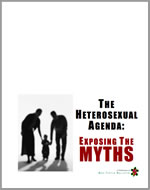 At last, the truth can now be told.
Using the same research methods employed by most anti-gay political pressure groups, we examine the statistics and the case studies that dispel many of the myths about heterosexuality. Download your copy today!
And don‘t miss our companion report, How To Write An Anti-Gay Tract In Fifteen Easy Steps.
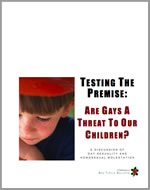 Anti-gay activists often charge that gay men and women pose a threat to children. In this report, we explore the supposed connection between homosexuality and child sexual abuse, the conclusions reached by the most knowledgeable professionals in the field, and how anti-gay activists continue to ignore their findings. This has tremendous consequences, not just for gay men and women, but more importantly for the safety of all our children.
Anti-gay activists often cite the “Dutch Study” to claim that gay unions last only about 1½ years and that the these men have an average of eight additional partners per year outside of their steady relationship. In this report, we will take you step by step into the study to see whether the claims are true.
Tony Perkins’ Family Research Council submitted an Amicus Brief to the Maryland Court of Appeals as that court prepared to consider the issue of gay marriage. We examine just one small section of that brief to reveal the junk science and fraudulent claims of the Family “Research” Council.
 The FBI’s annual Hate Crime Statistics aren’t as complete as they ought to be, and their report for 2004 was no exception. In fact, their most recent report has quite a few glaring holes. Holes big enough for Daniel Fetty to fall through.
“Google” is a trademark of Google Inc.
© Box Turtle Bulletin. All Rights Reserved.

 Posts
Posts  Posts via daily email: