Box Turtle Bulletin
 News and commentary about the anti-gay lobby
“Now you must raise your children up in a world where that union of man and box turtle is on the same legal footing as man and wife…”
News and commentary about the anti-gay lobbyA commentary.
January 14th, 2013

Jodie Foster in Taxi Driver (1976)
She was only thirteen, barely out of puberty, when she showed up on the first day of shooting Taxi Driver, the film that would change her life in ways that nobody could ever haveimagined. The role, that of the preteen prostitute Iris was already controversial enough that a long line of other actresses had turned it down. Foster’s performance won an Oscar for Best Supporting Actress, but gossip columnists weren’t particularly deft in their snide innuendos: where did she learn to play a prostitute so convincingly?
Her own fan base included John Hinckley, Jr., who watched Taxi Driver fifteen times in a row in a continuous loop, and fell in love. Now she’s nineteen and a freshman at Yale, where Hinkley is stalking her, sending love letters and even managing to get her on the phone a couple of times. And then Hinkley did the thing that he was sure would win Foster’s attention, if not her heart: he tried to kill President Ronald Reagan. News trucks invaded the Yale campus and pursued her as relentlessly as Hinkley had done. Then another man, Edward Richardson, began following her around campus, except he didn’t want to woo her or exploit her for television. Instead, he wanted to shoot her, but he decided against it because “she was too pretty.” When Hinkley was declared not guilty by reason of insanity a year later, it was all about Jodie Foster again. She continued making movies, but all reporters wanted to talk about was Hinckley and the shooting and Hinckly’s “getting off easy.” She soon took to walking out of interviews — “What a bitch!” — whenever Hinckley’s name was mentioned. In 1999, Hinckley was allowed to leave the psychiatric hospital in supervised, then unsupervised, releases, but those privileges were revoked when hospital personnel discovered that he was still obsessed with Jodie Foster.
And all the while, Jodie Foster was gay. How’s that for a head trip?
I think when most people see Jodie Foster, they see many things: an accomplish actress, a hounded teenager, an obsessively private person, a closet case. Much unlike the Kardashians, Lohans and Spears of the world, Foster saw public attention as a bullet, not a drug. That she managed to somehow maintain some semblance of calm in all that is a testament to some serious emotional survival skills.
Jodie Foster came out before, tentatively, timidly, to those who were quick enough to catch it. In 2007, she accepted a leadership award at the 16th annual Women in Entertainment Power 100 breakfast where she thanked “my beautiful Cydney who sticks with me through all the rotten and the bliss.” Who Cydney was, we were left to guess. In one separate interview, she acknowledged having a “partner,” and in another interview she acknowledged wearing an “eternity ring.” Only a few who really, really wanted her to come out — and it’s not a bad thing to have wanted her to come out — tied it all together. And then, apparently, everyone forgot.
But never was she as clear as she was last night. I think most of us are grateful, but I see that some are reacting with an amazing combination of resentment and entitlement. Resentment over her being a wealthy and famous actress — never mind one who was hounded by a would-be assassin — who sought the safety of privacy above all else. And entitlement, because it’s that very word — privacy — which galls them the most. Some believe that privacy is a quality that someone as famous as Foster isn’t entitled to. Others, perhaps more shockingly, seem to argue that she doesn’t deserve the right to define what’s private in her life and what’s not. There are, in effect, a surprising number of people presuming to be Jodie Foster right now.
Some of us come blazing out of the closet as soon as we hit puberty. Others of us can’t find it within ourselves to do it until we’re in our eighties. Some never come out. I came out at 40; only a fifth of my life so far has been spent out of the closet. Anyone who comes out early in life certainly deserves our admiration and respect. I, for one, have a lot of regrets about not coming out earlier, particularly when I recall how homophobic I was before making that transition. That’s why I’m patient with such transitions, whether its as an LGBT person or as an ally — even when they occur with (potentially) former homophobes.
Jodie Foster, near as I can tell, was never homophobic. But she could have been a role model, they say. They, who are not Jodie Foster. Of course, so could have a million other people. Some of them came out, others still haven’t. But because of those who have come out, there are more role models now than we can shake a glow stick at. So why the controversy now that she has come out? Does anyone seriously think there’s a teenager in Omaha who has been holding off on coming out, waiting for Jodie Foster to take the first step? Does anyone even think there’s a teenager in Omaha who knows who Jodie Foster is?
I’ve never begrudged her decision to maintain her privacy as she defines it, partly because of what she went through, but more so because it’s simply well within her rights. That she decided to be more public now is a testament to how close we really are to achieving what we’ve been fighting for. But if she had chosen not to make this speech, then that, too, is a testament to the very same victory. Because freedom is meaningless unless it applies to everyone. And that would include those who would take their own life experiences into account in deciding how they should live their lives, and who they should let in to be a part of it.
January 14th, 2013
Somewhere along the way, marriage equality picked up its biggest unexpected supporter: Corporate America. (Trib)
Dozens of Illinois business leaders and several companies publicly endorsed gay marriage Sunday in an attempt to reignite the issue after a proposed bill failed to get traction in Springfield this month.
…
In addition to Google, Orbitz Worldwide and Groupon, individual signers of the letter include Desiree Rogers, CEO of Johnson Publishing Co.; Lance Chody, CEO of Garrett Popcorn Shops; Fred Eychaner, chairman of the Newsweb Corp.; and Laura Ricketts, co-owner of the Chicago Cubs.
And so what once was Good Decent People against them there moral degenerates has now become a battle between Catholic Bishops (along with some Mormons and Muslims) and the Fortune 500. I have to say that this is a turn of events that I don’t think anyone could have predicted.
It was Wall St. that got us New York, and Microsoft and friends that paid for Washington’s referendum.
Hmmm… Coca-Cola, Georgia… nah, I’m just dreaming.
January 14th, 2013
THIS MONTH IN HISTORY:
Addressing “A Horror of Everything Related to the Homosexual Tendency”: 1899. In 1897, British sexologist Havelock Ellis published the first installment of his six-volume Studies in the Psychology of Sex. Volume 1 was subtitled Sexual Inversion, as homosexuality was more often called in the English language at that time. Two years later, his book was still making waves. In the January 1899 edition of the International Journal of Ethics, reviewer H. Sturt reviewed Ellis’s book, calling it “a solid and valuable contribution to psychology” and commending Ellis as “give(ing) the impression that he is a genuine scientific man doing his best to illustrate an obscure… province of human nature.” Sexual Inversion was revolutionary, being the first publicly-available scientific book in the English language to discuss homosexuality in a humane and nonjudgmental way. Ellis argued against the contemprary attitudes about homosexuality being abnormal, criminal, or immoral, and presented it instead as a variation in a broad spectrum of sexual expressions. Ellis concluded that it was useless to try to change sexual orientation, and he advocated for the abolishment of Britain’s anti-gay laws like the “gross indecency” law under which Oscar Wilde was prosecuted in 1895.
Most books about homosexuality at the turn of the century were severely restricted in their distribution in England. Sexual Inversion was first published in German in 1896 because Ellis feared it would be censored in England. Since several other books on sexuality had already been published there, German had become the lingua franca, so to speak, of sexuality research, so Ellis’s had a certain logic to it. Besides, when many of those German books were later translated into English, their carefully restricted distribution to solely the professional trade in England typically went unchallenged by the authorities. And so Ellis followed that route as the first English edition was published in London in 1897, with its distribution similarly restricted.
The ploy didn’t work. George Bedborough, a London bookseller, arrested in 1898 and charged with selling obscene material. In court the book was described as being a “certain lewd, wicked, bawdy, scandalous libel.” The judge warned Bedborough, “So long as you do not touch this filthy work again with your hands and so long as you lead a respectable life, you will hear no more of this. But if you choose to go back to your evil ways, you will be brought up before me, and it will be my duty to send you to prison for a very long time.” Ellis withdrew Sexual Inversion from sale in England, and thereafter published his works only in the U.S. and Germany. Sturt, in his review of Sexual Inversion a year later, argued that this established a very bad precedent:
There are some who would raise the general question whether a subject like the present can fitly be made the matter of a published treatise. Many excellent persons have a horror of everything related to the homosexual tendency. Their feelings commands our respect, and yet it seems better to have the subject brought out publicly. That all sorts of immature and half-educated people should read Mr. Ellis’s book is, of course, most undesirable. But in view of the prevalence of sexual inversion it is necessary that every schoolmaster, every criminal lawyer, we had almost said every head of a family, should be acquainted with its phenomena. Were the subject better understood, mistakes would be avoided that have ruined thousands of lives.
[Source: Jonathan Ned Katz. Gay/Lesbian Almanac: A New Documentary (New York: Harper & Row, 1983): pp 296-297.]
If you know of something that belongs on the agenda, please send it here. Don’t forget to include the basics: who, what, when, where, and URL (if available).
And feel free to consider this your open thread for the day. What’s happening in your world?
January 13th, 2013
There was only one award in tonight’s Golden Globes which was pre-announced: Jodie Foster was honored with the Cecil B. DeMille Award for her 47 years in the entertainment industry. Her acceptance speech was the acceptance speech to end all acceptance speeches:
http://www.youtube.com/watch?feature=player_embedded&v=yqpjQ1z-Vqo
Beginning at 2:25:
There won’t be a big coming-out speech tonight, because I already did my coming out about a thousand years ago back in the Stone Age, in those very quaint days when a fragile young girl would open up to trusted friends, family, co-workers and then gradually, proudly to everyone who knew her, to everyone she actually met. But now apparently, I’m told that every celebrity is expected to honor the details of their private life with a press conference, a fragrance, and a prime time reality show. You guys might be surprised, but I am not Honey Boo Boo Child. No, I’m sorry. That’s just not me, it never was, and it never will be, but please don’t cry because my reality show would be so boring….
If you had been a public figure from the time you were a toddler, if you’d had to fight for a life that felt real and honest and normal against all odds, then maybe then you too might value privacy above all else. Privacy. Someday, in the future, people will look back and remember how beautiful it once was. I have given everything up there from the time that I was three years old. That’s reality show enough, don’t you think?
There are a few secrets to keeping your psyche intact over such a long career. The first: love people and stay beside them.
…There is no way I can stand here without acknowledging one of the deepest loves in my life. My heroic co-parent, my ex-partner in love but righteous soul sister in life, confessor, ski buddy, consilieri, most beloved, BFF twenty years, Cydney Bernard. I am so proud of our modern family, our amazing sons Charlie and Kit, who are my yreason to breathe and to evolve, my blood and soul. And boys, in case you didn’t know it, this song, like all of this, this song is for you.
She closed her speech with what might be a hint of a possible retirement:
This feels like the end of one era and the beginning of something else. Scary and exciting… and now what? Well, I may never be up on the stage again, on any stage for that matter. Change. You gotta love it. I will continue to tell stories, to move people by being moved — the greatest job in the world. It’s just that form now on I may be holding a different talking stick. And maybe it wont as sparkly. Maybe it won’t open on 3,000 screens. Maybe it will be so quiet and delicate that only dogs can hear it whistle, but it will be my writing on the wall: Jodie Foster was here. I still am. And I want to be seen, to be understood deeply, and to be not so very lonely.
January 13th, 2013
TODAY’S AGENDA:
Events This Weekend: Arosa Gay Ski Week, Arosa Switzerland; Aspen Gay Ski Week, Aspen, CO; Midsumma, Melbourne, VIC; Utah Gay and Lesbian Ski Week, Park City, UT; Mid-Atlantic Leather Weekend, Washington, DC.
TODAY IN HISTORY:
Unitarian Church Sponsors Symposium on Homosexuality: 1954. The Unitarian Universalist Association has a long history of inquiry on a large number of contentious topics. In 1954, the First Unitarian Church of Miami hosted a forum called “Homosexuality: Cause, Society, and Crime.” According to a write-up in ONE magazine, the nation’s first gay publication, the attendance “broke all existing records.” The panel included Miami Mayor Abe Aronovitz, psychologist Dr. Syvil Marquit (no affiliation was given), Dr. Jack Capschan of the University of Miami’s psychology department, and Dr. Alvin Winder, psychologist for the Veterans Administration. The psychologists generally agreed that homosexuality wasn’t an illness, but they differed on whether it was “curable” or whether society was the problem. Mayor Aronovitz however pleaded ignorance on the subject, saying he was only there because “in his desire to, please, he had instructed his secretary to accept all speaking engagements.”:
He said that there are three or four places in Miami where homosexuals gather, but that the proprietors were not in business to help these people, only to profit monetarily from their suffering. He said that he didn’t want Miami known as a haven for homosexuals or divorce getting or any other criminals, but that homosexuals should not be persecuted or hounded, because they were undoubtedly suffering from a sickness of the mind. To conclude, he added, “They certainly need kindly understanding, but whose rights shall we consider?”
The discussion was then opened to questions from the audience. The first question was “How can we cure homosexuality?” Dr. Kapschan answered with this question, “Is it not possible that instead of sick homosexuals, we have a sick society?” Dr. Marquit added that we must have a wider acceptance of homosexuals. “In other words,” he said, “your sex life is your own business.”
…Then Mayor Aronovitz asked, “I would like to know if there are any individuals who have had the glorous experience of normal sexual relations who prefer homosexual relations?” “I’m sorry to disappoint the Mayor,” answered Dr. Marquit, “but it has been proven that a large percentage of confirmed homosexuals have experienced ‘glorious’ heterosexual relations. Then it was asked “If these, people are to be driven from the bars, beaches, and other gathering places, where would you have them spend their leisure time?” Mayor Aronovitz answered that if society accepted this, it should not be persecuted.
To the question “Is prejudice against homosexuality related to intolerance?” Dr. Kapschan answered, “Yes, research has proven that prejudice is generally against a number of minority groups, not just homosexuality. The authoritarian personality that condemns persons for their homosexual behavior is much more of a threat to society than the homosexual himself. They are psychoneurotics who need psychiatric treatment, not the harmless homosexual who varies from the so-called normal, criticized only insofar as what he does in bed. Prejudice against the homosexual makes an especially good scapegoat for the authoritarian personality.”
ONE’s editors were greatly encouraged by the forum, and hoped that it would “lead to more stimulated discussions by qualified people, sponsored by churches and other civic-minded groups.” Those hopes were short-lived however, as Mayor Aronovitz would go on that year to lead a notoriousanti-gay witch hunt in his city (see Aug 3, Aug 11, Aug 12, Aug 13 (twice that day), Aug 14, Aug 26, Aug 31, Sep 1, Sep 2, Sep 7, Sep 15, Sep 19, Oct 6, Oct 20, Nov 12 and Dec 16).
[Source: Unsigned. “Who’s Sick?” ONE 2, no. 2 (February 1954): 4-5.]

US Supreme Court Issues First Gay Rights Ruling: 1958. It was barely a ruling, just a terse, one-sentence line without even hearing oral arguments. But that was all it took for the US Supreme Court to affirm the rights of the first major gay magazine, ONE, to be distributed by the U.S. Postal Service without its subject matter, homosexuality, being declared obscene. It all began in 1953, when the L.A. Postmaster confiscated copies of the October issue (ironically, the cover story was “You Can’t Print It!”) and claimed that it violated 1873 Comstock Act, which prohibited sending “obscene, lewd, and/or lascivious” material through the mail.
What was considered “obscene” is hard to say. The entire magazine is mild — no photos, no description of sexual activity, nothing that could be remotely considered pornographic, then or now. It did however contain articles which spoke frankly about issues facing gay people, including, in the cover article, the legal tightrope the magazine had to navigate in order to remain in print. ONE sued the postmaster, citing their First Amendment rights to free speech. They lost their case in Federal District Court, with Judge Thurman Clark calling it “filthy and obscene material obviously calculated to stimulate the lust of the homosexual reader.” ONE appealed and lost again at the Ninth Circuit Court of Appeals, which called ONE , “morally depraving and debasing.” And so it was a major surprise — although it shouldn’t have been — when the U.S. Supreme Court ruled unanimously and without even bothering to hear oral arguments that even gay people enjoyed the same protections under the First Amendment as everyone else. Editor Don Slater celebrated the decision in the February 1958 issue: “By winning this decision ONE Magazine has made not only history but law as well and has changed the future for all U. S. homosexuals. Never before have homosexuals claimed their right as citizens.”
You can read the full, fascinating story of how a tiny magazine in Los Angeles beat the incredible odds here.
 Jesse Helms Calls Gays “Disgusting People”: 1990. When the three-term Senator from North Carolina stood on the platform at the state fairgrounds before a crowd of 1,700 to announce his intention to run for a fourth term, there was no doubt whatsoever what his platform would be: abortions and gays. “Family values in American are under attack as never before,” he said. “Think about it. Homosexuals and lesbians, disgusting people marching in our streets demanding all sorts of things, including the right to marry each other. How do you like them apples?” Helms won that election, and another one again in 1996 before finally leaving the Senate in 2003. Helms is currently dead.
TODAY’S BIRTHDAY:
 Charles Nelson Reilly: 1931. He was a very well respected Broadway actor, director and drama school teacher, but he was best known and beloved for his campy comedic roles and as a panelist on the game show The Match Game. His break on Broadway came in 1960 with Bye Bye Birdie. His part was small, but it opened the door to 1961’s Pulitzer prize-winning musical How To Succeed in Business Without Really Trying. He was also featured in 1964’s Hello, Dolly! Through the 1960s and 70s, he had several comedic guest appearances on television. He was a regular on The Dean Martin Show and made countless appearances on The Tonight Show with Johnny Carson. His campy character and his flamboyant dress marked him as a gay man. He never explicitly acknowledged it, although he would joke about how “butch” he was on The Match Game. No one asked, he didn’t tell, but everyone knew and no one bothered much with keeping the secret. In 2002, he finally discussed his private live in his one-man show Save It for the Stage, which became the basis for the autobiographical independent film, The Life of Reilly. He was too ill to attend its premiere in 2006 at South by Southwest, and he died at home on in 2007.
 Edmund White: 1940. He was born in Cincinnati and grew up in Chicago, then studied Chinese at the University of Michigan. He worked as a journalist in New York, then moved to France and settled in as a writer. In 1973, he co-wrote the first edition of The Joy of Gay Sex with psychiatrist Charles Silverstein, and that set him on his course of what one observer called his dedication to sexual truth-telling. His best known work, A Boy’s Own Story


White is currently a member of the faculty of Princeton University’s Creative Writing Program. His most recent novel, Jack Holmes and His Friend
 Nate Silver: 1978. The math whiz, baseball fanatic, poker player, and political polling savant who accurately predicted the outcome of the 2012 presidential election in each of the fifty states and the District of Columbia, wants it to be known that he is not a gay statistician, but a statistician who happens to be gay, while “ethnically straight.” To those who take such identity labels oh so seriously, Silver’s remarks challeneged an established orthodoxy, but one that is becoming increasingly irrelevant to those of Silver’s generation. As he recently explained in a Reddit “Ask Me Anything”:
My quick-and-dirty view is that people are too quick to affiliate themselves with identity groups of all kinds, as opposed to carving out their own path in life.
Obviously, there is also the issue of how one is perceived by others. Living in New York in 2013 provides one with much a much greater ability to exercise his independence than living in Uganda — or for that matter living in New York forty years ago. So perhaps there’s a bit of a “you didn’t build that” quality in terms of taking for granted some of the freedoms that I have now.
And/but/also, one of the broader lessons in the history of how gay people have been treated is that perhaps we should empower people to make their own choices and live their own lives, and that we should be somewhat distrustful about the whims and tastes and legal constraints imposed by society.
Silver, the author of The Signal and the Noise: Why So Many Predictions Fail — but Some Don’t
If you know of something that belongs on the agenda, please send it here. Don’t forget to include the basics: who, what, when, where, and URL (if available).
And feel free to consider this your open thread for the day. What’s happening in your world?
January 12th, 2013
TODAY’S AGENDA:
Events This Weekend: Arosa Gay Ski Week, Arosa Switzerland; Aspen Gay Ski Week, Aspen, CO; Midsumma, Melbourne, VIC; Utah Gay and Lesbian Ski Week, Park City, UT; Mid-Atlantic Leather Weekend, Washington, DC.
TODAY IN HISTORY:
Gay Men’s Health Crisis Founded: 1982. Several dozen men gathered in writer Larry Kramer’s New York apartment to discuss the mysterious “gay cancer” that had been claiming the lives of their friends and lovers, and to figure out how to raise money for research. The group originally thought they were coming together for a one-time thing: persuade a club to hold a benefit, invite a bunch of A-listers to come and donate, give the money to a suitable research organization, and go home. But it quickly became apparent that there was much, much more work to be done. Forced by widespread apathy on the part of the news media, city officials, local health authorities, and even “confirmed bachelor” and barely closeted Mayor Ed Koch, the Gay Men’s Health Crisis (GMHC) quickly went from being an ad-hoc group to organize a fundraiser to a full-fledged charitable service organization to fill the void that the city refused to fill.
GMHC would go on to raise money to provide services and assistance for people with HIV/AIDS, including assistance from a large army of volunteers to meet day-to-day needs like cooking, housecleaning, dog-walking, and transportation to medical appointments, as well as help in navigating the apathetic bureaucratic maze. They also, just as critically, hounded the news medial trying to get attention to the disease. When that mostly failed, GMHC started a crisis hotline, which became one of the organization’s most important avenue for distributing AIDS information in the pre-Internet era. They also distributed material to help educate the general public on the need for safer sex. In these areas, GMHC worked hard to meet the needs which had been, at best, ignored by local and national health authorities and charities (most shockingly, including most faith-based charities). GMHC also battled the overt stigmatization and hostility which grew among well-known public figures, nationally as well as locally.
GMHC quickly established itself as a well-regarded authority for HIV/AIDS education and service. By 1984, the Centers for Disease Control called on GMHC’s help in planning public conferences on AIDS. As the epidemic continued to grow, GMHC expanded its reach by assisting heterosexual men and women, hemophiliacs, intravenous drug users, and children. Today, the GMHC continues its work as one of the nation’s leading non-profit, volunteer-supported AIDS service and educational organizations.

John Singer Sargent, Self Portrait, 1906.
TODAY’S BIRTHDAY:
John Singer Sargent: 1856. Was he or wasn’t he? Scholars have scratched their heads over that question. He was born in Florence to American parents, who were well off enough to casually travel throughout Europe. Sargent’s drawing skills developed early, and at the age of eighteen he went to Paris to study painting. His early masterpiece, El Jaleo (1882), which portrayed a bare-armed Spanish Gypsy dancer in full movement, was both sensual and exotic — and, therefore, scandalous in the closing days of the Victorian era. Other portraits were similarly controversial. His full-length portrait of New Orleans-born Parisian socialite Virginie Gautreau (1884), depicting her in a strapless gown and a plunging neckline, had much of Europe clutching its pearls.
Almost immediately, Sargent established himself as the defining painter of what would soon become known as the Edwardian era. He worked on the edge between respectability and sensuality. But he also had a commercially-successful knack for finding beauty in everyone he painted while simultaneously preserving a candid honesty to his portraits. And just about everyone who was anyone sat for a portrait.

John Singer Sargent, portrait of Nicola D’Inverno, 1892.
For all of Sargent’s notoriety through his paintings, he was profoundly circumspect in his private life. He was flirtatious with women, but had no significant romantic attachments. He formed deep friendships with men — including Henry James, Oscar Wilde, and Robert Montesquiou, and perhaps most significantly, his assistant of twenty-six years and sometimes model Nicola d’Inverno — but there is no evidence that his relationships went beyond deep friendship.
And yet, the talk has always been there, and it was only amplified when, upon his death in 1925, his family destroyed his personal papers. And that talk centered on his male nudes, much of which were created for his own personal study and enjoyment, and not for public exhibition. In Donna Hassler’s preface in John Esten’s John Singer Sargent: The Male Nudes

John Singer Sargent, Thomas E. McKeller as Apollo, 1921-25.
To Sargent, however, rendering the nude male figure was more than just an academic pursuit… He showed a strong preference for portraying the masculine form throughout his career (few Sargent drawings or paintings of the nude female figure are extant), and his work ranges from a straightforward student study of an unidentified male model wearing an posing strap to an emotionally charged, fully nude drawing of an identifiable male model, Thomas E. McKeller.
As Esten points out, “Like beauty, homoeroticism is in the eye of the beholder.” And many beholders have seen it in Sargent’s paintings. Several of his male nudes made their way into the famous mural in the Rotunda of Boston’s Museum of Fine Arts, some of them, including his sketch of McKeller as Apollo, refashioned into female figures.

Felipe Rose: 1954. You know him as “the Indian” for his appearance as a founding member of the Village People. The son of a Puerto Rican mother and Lakota Sioux father, Rose grew up in Brooklyn where he took up dancing at a very young age. When he was sixteen, he studied dance with the Ballet de Puerto Rico and participated in a Lincoln Center dance recital with the Ballet Company. At the urging of an aught, he began dressing in tribal regalia and exploring Native American influences in dance as an homage to his father’s heritage. He also, at about the same time, began exploring New York’s gay nightlife. Soon after French producer Jacques Morali saw him working as a go-go dance in his “Indian” get-up at a New York gay bar, he recruited Rose into a new singing group in which members wore costumes representing different “masculine” occupations. The Village People scored their first major disco hits, “Macho Man” and “Y.M.C.A” in 1978.
There have been numerouls personnel changes in the Village People over the years, but there has only been one Indian. Rose is one of only two only Village People to have never left the group, and with Alex Briley (the G.I/Sailor), he remains one of only two original members.
While the Village People is all camp, Rose takes his Native American heritage seriously. In 2000, he recorded the single “Trails of Tears,” Which was nominated for 3 NAMMYs (Native American Music Awards). He is a member of the Advisory Board of the Native American Music Association.
If you know of something that belongs on the agenda, please send it here. Don’t forget to include the basics: who, what, when, where, and URL (if available).
And feel free to consider this your open thread for the day. What’s happening in your world?
January 11th, 2013
TODAY’S AGENDA:
Events This Weekend: Arosa Gay Ski Week, Arosa Switzerland; Aspen Gay Ski Week, Aspen, CO; Midsumma, Melbourne, VIC; Utah Gay and Lesbian Ski Week, Park City, UT; Mid-Atlantic Leather Weekend, Washington, DC.
TODAY IN HISTORY:
Britain Lifts Its Ban on Gay Military Personnel: 2000. Once they put their minds to it, there wasn’t much dithering. It just took them a while to put their minds to it. Unlike the U.S. (in theory, anyway), Britain had an outright ban on gays serving in the military, whether they were open about it or not. Anyone was subject to being followed or interrogated by the SIB (Special Investigations Branch) for any suspicion, or even no suspicion at all. In 1997, three gay men and a lesbian sued after they were discharged from the Royal Navy and RAF. Their case went all the way up to the European Court of Human Rights, which ruled in September 1999 that the Ministry of Defense’s policy violated the service members’ human rights.
The following December, the Labour government of Prime Minister Tony Blair announced the MoD would comply with the ruling. Members of the opposition Conservative Party were appalled. M.P. Gerald Howarth said, “This appalling decision will be greeted with dismay among ordinary soldiers in the armed forces, many of whom joined the services precisely because they wished to turn their back on some of the values of modern society.” Officers predicted sexual mayhem in the barracks or — horrors! — male couples dancing at a mess function. But one month after the announcement was made, the ban was lifted, and all of the fears came to naught. A review two years later across all the branches found widespread acceptance for lifting the ban, and gay and lesbian service members served with distinction in Afghanistan and Iraq alongside their American counterparts who still had to remain hidden and in the closet.
Prop 8 Trial Begins: 2010. Lawyers for the plaintiffs in the lawsuit against the state of California seeking to overturn Proposition 8 began their opening remarks. Attorney Ted Olsen promised to argue the case on three fundamental points:
Olsen and co-counsel David Boies would ultimately prevail and U.S. Federal District Judge would rule that Prop 8 was unconstitutional. The case was appealed to the Ninth Circuit Court of Appeals which upheld the lower court’s ruling but on much narrower grounds, namely that once a right has been granted and enjoyed by a class of people, it is unconstitutional to then strip them of that right. The case, now know as Hollingsworth v. Perry, is before the U.S. Supreme Court, which has scheduled oral arguments for March 26 at 10:00 a.m.
If you know of something that belongs on the agenda, please send it here. Don’t forget to include the basics: who, what, when, where, and URL (if available).
And feel free to consider this your open thread for the day. What’s happening in your world?
January 10th, 2013
Confirmed bachelor, Sen. Mark Kirk (R-Illinois) has weighed in on the brouhaha resulting from Illinois GOP State Chairman’s support for marriage equality. (WBEZ)
“Senator Kirk has full confidence in Pat Brady’s leadership as chairman of the Illinois Republican Party and looks forward to working with him to elect Republicans in 2014,” Lance Trover, a Kirk spokesman, said in a statement.
January 10th, 2013
The head of Illinois’ beleaguered Republican Party is staring down a revolt from some state party bosses after he bucked the official GOP line last week and urged state lawmakers to approve same-sex marriage.
State GOP Chairman Pat Brady faces growing calls for his resignation, at a time when some Illinois Republicans are rethinking the party’s image and stance on social issues, following a dismal showing in November’s elections.
Brady told WBEZ that he hadn’t spoken to party members before speaking out in support of a proposed marriage quality bill. Brady calls the ban on marriage quality the “last condoned discrimination” in Illinois. It is unclear whether there are enough votes in the party’s state committee to force his ouster. Brady isn’t backing down from the threat:
“If people want to throw me out because I took a stand on an issue of discrimination [as] the chairman of the Republican Party, the party founded by Abraham Lincoln, then that’s – that’s up to them and they’re free to do it,” Brady said. “But I’m not backing down.”
January 10th, 2013
I should note first that The Observer is an opposition publication in Uganda, so it’s hard to know how influential this debate might be, which David Tash Lumu describes as taking place “on the steps of Parliament” between several members of Parliament and a Deputy Secretary to the Treasury:
So at a time when the University of Buckingham in the UK has reportedly severed ties with Victoria University over the bill, which the Speaker of Parliament, Rebecca Kadaga, promised to pass last year as a “Christmas gift”, a rare debate happened at the steps of the august House. The MPs who were part of this debate included James Kakooza (Kabula), Fox Odoi (West Budama North) and Geoffrey Ekanya (Tororo).
This reporter was also part of the debate that sucked in (Deputy Secretary to the Treasury) Keith Muhakanizi. While Kakooza suggested the bill would protect the morals of the country, Fox Odoi, a member of Parliament’s committee on Legal Affairs that scrutinised it, argued that it is illogical to legislate on morality. Odoi, who has written a minority report bashing the bill, added that if lawmakers ignore his report and pass the bill, they will have set a wrong precedent—that government can enter or legislate what happens in your bedroom.
Ekanya, the shadow Finance minister, however expressed worry about the economy, arguing that the aid cuts have happened not because of corruption but largely because of this bill. Ekanya added that the bill is the best ammunition President Museveni has right now—because he uses it to scare donors.
“He must be saying that if you don’t give us the money, I am going to tell MPs to pass this bill,” Ekanya said.
But Muhakanizi dismissed this and accused MPs of not being sensitive about the economy. He said by bringing up such a bill, the MPs are hurting the economy because they have failed to look at the far-reaching financial consequences of passing it.
“I have never seen a country like this where politicians hurt the economy instead of building it,” he said.
Again, it’s hard to understand what level of importance to place in this. Kakooza is a member of the ruling National Resistance Movement (NRM), which holds a dominating super-majority of seats in Parliament. Odio is Independent member, and Ekanya is a member of the Forum for Democratic Change (FDC), the main opposition party in Uganda.
The Anti-Homosexuality Bill was reintroduced into Parliament in February, 2012, and spent the next several months languishing quietly in the Legal and Parliamentary Affairs Committee. Later last summer, Parliament leaders began hinting that the bill would be voted on by the end of the year. In November, Speaker Kadaga promised to pass the Anti-Homosexuality bill as a “Christmas gift to Ugandans.” The bill looked as though it would re-emerge on the House floor as Parlaiment began debating a highly controversial Petrolium Bill, which granted the presidentially-appointed Energy Minister with sweeping power to sign and cancel lucrative oil contracts with no oversight from Parliament.
As tensions mounted over the Petroleum Bill, the Anti-Homosexuality Bill rose to the top of Parliament’s list of “Business to follow,” potentially as a unifying incentive to ease the passage of the Petroleum Bill. Parliament nevertheless broke down in chaos over the Petroleum bill, only to regroup and pass it. It was thought that by getting the Petroleum Bill out of the way, the Anti-Homosexuality Bill would be the next item for discussion, but instead it was immediately lowered in priority on the Parliament’s list of business to follow. Parliament went on Christmas break on December 14, and will resume on February 4.
Meanwhile, a massive corruption scandal exploded in the Prime Minister’s office when it was discovered that foreign aid funds from several European countries were diverted to private bank accounts of more than a dozen Ugandan officials. Britain, Ireland, Germany, Norway, Denmark, and Sweden announced aid cuts due to the scandal. Germany’s announcement also cited the Anti-Homosexuality Bill as a reason. Earlier this week, Britain’s University of Buckingham announced that it was ending its relationship with Victoria University in Kampala over the pending legislation.
Despite numerous false reports to the contrary, the death penalty is still in the Anti-Homosexuality Bill.
January 10th, 2013
 In July 2011, Rhode Island Governor Lincoln Chafee (formerly R, currently I) signed a less-than-ideal civil unions bill. At that time he promised to work towards marriage. In May of last year he issued an executive order instructing state departments to recognize out-of-state marriages. Now he has called on the legislature to give him a marriage bill. (NBC 10)
Rhode Island’s governor says he wants lawmakers to pass same-sex marriage legislation and that he’d be inclined to veto any attempt to place it on a ballot as a referendum.
Gov. Lincoln Chafee told reporters Thursday that lawmakers owe it to voters to decide themselves.
A marriage bill was introduced last Thursday (AP)
Last Thursday, Democratic Rep. Art Handy of Cranston introduced a marriage equality bill in the House. Senator Donna Nesselbush, an openly gay Democrat from Pawtucket, introduced her version moments later.
Handy’s bill includes more than enough co-sponsors to assure passage in the House. In the Senate, which is led by President Teresa Paiva Weed, an opponent of marriage equality, support is not quite as robust. Nesselbush’s measure has 11 sponsors in the 38-member Senate.
The largest concern is about Paiva Weed’s committee appointments, which might doom the bill in the Senate. But Gordon Fox, the House Speaker (who is himself gay) is committed to passing the bill in the House and expects a vote on Tuesday.
In prior years there seems to have been a gentlemen’s agreement not to embarrass Paiva Weed, and a vote was never held on marriage for the state. But it appears to me that her defacto veto is no longer going to be allowed to thwart the goals of the governor or the significant and growing number of supporters of equality. And even if we fail to win a majority in the Senate, gay couples deserve to know who stands in their way.
January 10th, 2013
 According to a series of Tweets posted by ABC news journalist Jonathan Karl, Rev. Louis Giglio has removed himself from President Barack Obama’s inaugural program:
Rev. Gigilo[sic], who had been selected to give the inaugural invocation, has been removed from the program.
Rev. Gigilo[sic] had come under fire for his harshly anti-gay comments. He will no longer be giving the invocation at the inauguraiton.
In the 90s, Gigilo promoted “ex-gay therapy” and denounced the “homosexual lifestyle” and “aggressive agenda” of the gay rights movement.
Inaugural source: “Gigilo pulled himself out when he realized this was going to be a distraction.
Giglio had actually been chosen to give the benediction, not the invocation. Myrlie Evers-Williams, the widow of slain civil rights worker Medgar Evers who was shot in his driveway in 1963 by a white supremacist, will give the invocation. Moments ago, Karl posted the corrected story at ABC News.
The New York Times confirms Giglio’s departure, citing ” a source close to the inaugural committee.”
Update: ThinkProgress, which broke the story yesterday of Giglio’s anti-gay comments, obtained a statement from the pastor’s spokesperson:
Due to a message of mine that has surfaced from 15-20 years ago, it is likely that my participation, and the prayer I would offer, will be dwarfed by those seeking to make their agenda the focal point of the inauguration. Clearly, speaking on this issue has not been in the range of my priorities in the past fifteen years. Instead, my aim has been to call people to ultimate significance as we make much of Jesus Christ.
ThinkProgress has also posted a statement from a spokesperson for the Presidential Inauguration Committee saying they were unaware of Giglio’s comments from the mid-90s and will work to find a replacement whose beliefs “reflect this administration’s vision of inclusion and acceptance for all Americans.”
January 10th, 2013
TODAY’S AGENDA:
Events This Weekend: Arosa Gay Ski Week, Arosa Switzerland; Aspen Gay Ski Week, Aspen, CO; Midsumma, Melbourne, VIC; Utah Gay and Lesbian Ski Week, Park City, UT; Mid-Atlantic Leather Weekend, Washington, DC.
TODAY IN HISTORY:
 Gore Vidal’s “The City and The Pillar” Published: 1948. It turns out that the month of January, 1948 was a rather scandalous month for the American Public. On January 5, Sexual Behavior In the Human Male, the first of the the two Kinsey Reports, was released. Then just five days later, Gore Vidal’s novel, The City and the Pillar came out. Vidal wrote this novel, his third, at the relatively tender age of twenty-one, and it was the first mainstream novel dealing with homosexuality in its central characters. It was, in its day a kind of a Brokeback Mountain, a coming of age story in which the main protagonist awakens to his sexuality. Gore also smashed the prevailing stereotyes of the day by portraying the central characters as masculine. I guess both books coming out within the space of less than a week was too much for the New York Times. Their review the next day went like this:
Presented as the case history of a standard homosexual, this novel adds little that is new to a groaning shelf. Mr. Vidal’s approach is coldly clinical: there is no real attempt to involve the reader’s emotions, as the author sets down Jimmie’s life story — his first experience during his high school days, his life as a cabin boy, a tennis bum, his adventures in Hollywood and points East. Backdrops are gaudy, and Jimmie’s more ardent acquaintances include a picture star (the idol of a million bobby soxers), a fashionable novelist and members of the armed forces. But the over-all picture is as unsensational as it is boring…
Boring. Perhaps the worst thing that could be said about any novel, if anything was to be said at all. Most papers refused to review it, but a few saw it as a triumph. The Washington Post called it “an artistic achievement” and the Atlantic Monthly said it was “a brilliant exposé of subterranean life.” Despite it’s “subterranean” themes and The New York Times’ great displeasure, The City and the Pillar nevertheless made it to the best-seller’s list. The Times so thoroughly disliked it that it refused to run ads for it and ignored Vidal’s next five books. Cut off from an important promotion vehicle, Gore resorted to writing several mystery novels in the early 1950s under the pseudonym Edgar Box.
Although the gay characters’ portrayals in The City and the Pillar were generally positive, the tone was dark and the ending tragic, with the main character being murdered by his lover. It’s been widely reported that the publishers forced Vidal to change the ending to an unhappy one, but Gore himself denies this. But twenty years later, he published the novel again as The City and the Pillar, Revised and changed the overall tone to be less dark.
 Episcopal Church Ordains First Open Lesbian: 1977. Before Bishop Paul Moore of New York ordained Rev. Ellen Marie Barrett as a priest in his Episcopal diocese, there is a point in the service in which the ordaining bishop asks the congregation, “If any of you know any impediment or crime because of which we should not proceed, come forward now, and make it known.” Rev. James Wattley, who was an active opponent of the church’s decision to ordain women to the priesthood, rose to denounce the ordination as a “travesty and a scandal.” He went on: “my objection is for myself alone on the grounds that she is a self-proclaimed lesbian.”
Bishop Moore appeared prepared for the answer. “Attention has been drawn to the ordination because Ms. Barrett has not made a secret of her homosexual orientation,” the Bishop announced. “However, her personal life has never been under criticism. Many persons with homosexual tendencies are presently in the ordained ministry. Ellen Barrett’s candor in this regard is not considered a barrier to ordination. She is highly qualified intellectually, morally and spiritually. … Historically, many of the finest clergy in our church have had this personality structure, but only recently has the social climate made it possible for some to be open about it.”
Rev. Barrett’s ordination sparked another round of controversy in a church still split over its 1976 decision to admit women to the priesthood. Within a month of Barrett’s ordination, nine parishes announced they were leaving the church. In an unusual move, one Florida pastor read out an “excommunication decree” from the altar of his church against Bishop Moore and Rev. Barrett.
The following October, the church’s House of Bishops sought to calm the controversy with a resolution declaring that gay people should not be ordained as priests, saying that such an ordination would “require the Church’s sanction of such a lifestyle not only as acceptable but worthy of emulation.” The House of Bishops also gave a nearly unanimous consent to another resolution to support Bishops who “by their own conscience” refuse to ordain women priests or allow them to serve in their dioceses. But in a 28-62 vote, the House refused to censure Bishop Moore, and in a 49-68 vote refused to advise California Bishop Kilmer Myers against licensing Rev. Barrett in his diocese. Thus the precedent was set, and bishops continued ordaining openly gay priests under the same “conscience” principle which permitted other bishops to bar women from the altar.
TODAY’S BIRTHDAYS:
 Johnnie Ray: 1927. When his career broke open in 1951, he was quickly dubbed “The Prince of Wails” in a nod to his highly emotional brand of white R&B. His intense performances forshadowed the energy of Rock And Roll which would hit the charts hard a few years later. Ray’s first hits, “Cry,” and “The Little White Cloud That Cried”, were sides A and B of his first single, with both sides dominating the charts for several months. They were followed by a string of a couple dozen top-forty hits through 1957. He married very briefly in 1952, a marriage that ended a year later. His wife knew he was gay going in — he had been arrested for soliciting an undercover police officer in Detroit for sex before his career took off — but the aspiring Mrs. Ray was confident she could “straighten him out.” All the while, it appears that Rays true long-term relationship was with his manager, Bill Franklin.
His popularity in the U.S. faded by the late ’50s, but he continued to do well in the UK, where his show at the Palladium became legendary. But by 1960, his star began to fade, dimmed by alcoholism and a bout of turberculosis. There was a brief possibility of a revival in the early 1970s, but it turned out to be short lived. Frankin left him in 1976 and cut off all contact a few years later. By the time the 1980s rolled around, gen-X’ers had little idea of who he was except for a line in the 1982 hit “Come On Eileen” by Dexys Midnight Runners. (“Poor old Johnnie Ray sounded sad upon the radio / he moved a million hearts in mono.”). He died of liver failure in 1990.
Here is a performance of “The Little White Cloud That Cried.” When you watch this, imagine seeing it in 1951 when the top acts that year included Perry Como, Nat King Cole and Tony Bennett — five years before Elvis.
http://www.youtube.com/watch?v=myu_wBPfpxs
 Sal Mineo: 1939. He was a talented young actor who some say peaked with his first major role as John “Plato” Crawford in Rebel Without a Cause, the 1955 classic staring James Dean and Natalie Wood. That role got him an Academy Award nomination for best supporting actor. He also appeared in another James Dean vehicle Giant as a Mexican boy, and for a while he became typecast as a troubled teen. In 1957, he made a brief stab at pop music, and in 1959, he appeared as the famous jazz drummer Gene Krupa in The Gene Krupa Story. He received another Academy Award nomination for Best Supporting Actor in the epic Exodus in 1960. By the late 1960s, Mineo became one of the first Hollywood actors to acknowledge his homosexuality. He died in 1976, stabbed to death during a mugging as he was walking home from a rehearsal in West Hollywood. He was only 37.
 But back to Rebel Without A Cause. By the time I saw the film for the first time as a teenager in the late 1970s, I had already read a lot about the classic. Critics and observers wrote about the movie’s themes of alienation, aimless adolescence, the ambivalence of impending adulthood — all those things and more. And so when the movie appeared on television one night (remember, this was before you could rent movies on VHS), I was unprepared for what looked to be the most obvious theme of the movie: the sexual tension between Sal Mineo and James Dean. At the time I had no idea that Mineo was gay or that Dean was bi. But seeing their chemistry together on the screen, it was so bright, so combustible, so obvious! Well good lord, why wasn’t anybody talking about that? Yeah, I know. I would later find out that others noticed it too. But remember, this was the 1970s and I was growing up in Appalachia. And man, what an eye-opener.
If you know of something that belongs on the agenda, please send it here. Don’t forget to include the basics: who, what, when, where, and URL (if available).
And feel free to consider this your open thread for the day. What’s happening in your world?
January 9th, 2013
First, an introduction is in order. From the tag line:
Berin Szoka, a technology policy analyst based in Washington, was a D.C. delegate candidate for the 2008 GOP national convention, and was, until recently, an active member of the D.C. Log Cabin Republicans.
He was also a Ron Paul supporter. He’s also president of TechFreedom, an advocacy group which appears to lobby against regluations on technology and privacy concerns. Here’s a small part of why he says he quit LCR:
Keeping the controversy over Hagel’s comments alive gives some Democrats a convenient excuse for opposing Hagel: Can he be trusted to implement repeal of “Don’t Ask, Don’t Tell?” That reform is one of the few wins progressives can claim from a president they see as disappointingly “center-right.” So it’s the perfect wedge issue for attacking Hagel’s left flank while rallying conservatives — provided it comes from the right messenger: gay Republicans.
Craven as that is, it’s even more of a stretch for Log Cabin, which hasn’t exactly been tough on gay rights. Mitt Romney opposed DADT repeal, marriage equality, employment non-discrimination and essentially every other gay issue Log Cabin stands for — yet Log Cabin still endorsed him, albeit in a “qualified” way. Now they oppose Hagel, who’s said he’s “fully supportive of ‘open service’ and committed to LGBT military families” — the only gay issues a secretary of Defense actually handles. That bizarre double standard will frustrate what should be Log Cabin’s top goal: encouraging Republicans to improve on gay rights — precisely as Hagel’s done.
Log Cabin’s Romney endorsement declared that “building a stronger, more inclusive Republican Party requires Republicans reaching out to Republicans.” Apparently, that tolerance doesn’t extend to Republicans who believe that, in foreign policy, discretion is the better part of valor. That’s why I’ve quit Log Cabin, an organization I’ve been involved with for a decade and whose annual D.C. holiday party my partner and I used to host.
January 9th, 2013
President Obama has named two individuals to offer the benediction at his January 21 swearing-in ceremony. The first is Myrlie Evers-Williams, the widow of slain civil rights worker Medgar Evers, who was shot in his driveway in 1963 by a white supremacist. She is believed to be the first woman and non-clergy member to be invited to deliver the invocation at a presidential inauguration.
 Thats sounds to me like an excellent choice. It’s the second name which gives pause. The committee also announced that Pastor Louie Giglio, founder of the youth-oriented Passion Conferences, has been selected to offer the benediction. The Washington Post cites an unnamed inaugural official who said:
…Giglio was picked for the benediction in part because of his work raising awareness about modern-day slavery and human trafficking. Those were core issues at his most recent conference, Passion 2013, attended by more than 60,000 mostly young evangelicals in Atlanta.
But as ThinkProgress has discovered, Giglio has an anti-gay history:
In a mid-1990s sermon identified as Giglio’s, available online on a Christian training website, he preached rabidly anti-LGBT views. The 54-minute sermon, entitled “In Search of a Standard – Christian Response to Homosexuality,” advocates for dangerous “ex-gay” therapy for gay and lesbian people, references a biblical passage often interpreted to require gay people be executed, and impels Christians to “firmly respond to the aggressive agenda” and prevent the “homosexual lifestyle” from becoming accepted in society.
ThinkProgress has several choice excerpts from that sermon. This one is probably the worst:
[The homosexual] movement is not a benevolent movement, it is a movement to seize by any means necessary the feeling and the mood of the day, to the point where the homosexual lifestyle becomes accepted as a norm in our society and is given full standing as any other lifestyle, as it relates to family.
When I read that, I couldn’t help but recall that Scott Lively delivered almost those exact words at his infamous anti-gay conference in Uganda in 2009.
Giglio also compared being gay to alcoholism and drug addiction and eating disorders:
I would refer you maybe just to the article “Born gay?” by Joe Dallas, who is the president of a ministry that helps with homosexuals in “recovery.” … It really unfolds for us that the evidence that they say is there, that the media wants to tell us is there really isn’t there at all. But I want to tell you this tonight. How do you respond to the news reports that we’re hearing in the last few months that there is a genetic tendency to be an over-eater and it’s been supposedly proved by the scientists? That there is a genetic tendency to addictive behavior. Alcoholics by and large have a genetic tendency to addictive behavior. I predict in our lifetimes and not a very long period of time from now, scientists and geneticists will have found a way to prove a gene theory for every malfunction in sinful society. And do you know why? We talked about it the very first week—because we do not want responsibility for our choices.
(Joe Dallas at that time was president of Exodus International. More recenlty he has become involved with a more hardline breakaway group, the Restored Hope Network.)
That sermon was delivered in the 1990s. ThinkProgress says, “A spokesman for Giglio was not immediately available to respond to questions about whether this sermon represents Giglio’s current thinking.” If it doesn’t, then he really needs to speak up, loudly.
And if it does, then this is a reversion to the kinds actions which angered the LGBT community ahead of Obama’s first inaugural ceremony, when Saddleback Church pastor Rick Warren was selected to deliver the invocation. The selection was announced just a day after comparing consensual, loving same-sex relationships to polygamy, incest and child rape. The inauguration committee tried to mollify the anger by asking openly gay Episcopal Bishop Eugene Robinson to give the invocation for a inauguration-eve concert at the Lincoln Memorial, only to have his prayers cut from the live broadcast.
Featured Reports
 In this original BTB Investigation, we unveil the tragic story of Kirk Murphy, a four-year-old boy who was treated for “cross-gender disturbance” in 1970 by a young grad student by the name of George Rekers. This story is a stark reminder that there are severe and damaging consequences when therapists try to ensure that boys will be boys.
When we first reported on three American anti-gay activists traveling to Kampala for a three-day conference, we had no idea that it would be the first report of a long string of events leading to a proposal to institute the death penalty for LGBT people. But that is exactly what happened. In this report, we review our collection of more than 500 posts to tell the story of one nation’s embrace of hatred toward gay people. This report will be updated continuously as events continue to unfold. Check here for the latest updates.
In 2005, the Southern Poverty Law Center wrote that “[Paul] Cameron’s ‘science’ echoes Nazi Germany.” What the SPLC didn”t know was Cameron doesn’t just “echo” Nazi Germany. He quoted extensively from one of the Final Solution’s architects. This puts his fascination with quarantines, mandatory tattoos, and extermination being a “plausible idea” in a whole new and deeply disturbing light.
On February 10, I attended an all-day “Love Won Out” ex-gay conference in Phoenix, put on by Focus on the Family and Exodus International. In this series of reports, I talk about what I learned there: the people who go to these conferences, the things that they hear, and what this all means for them, their families and for the rest of us.
Prologue: Why I Went To “Love Won Out”
Part 1: What’s Love Got To Do With It?
Part 2: Parents Struggle With “No Exceptions”
Part 3: A Whole New Dialect
Part 4: It Depends On How The Meaning of the Word "Change" Changes
Part 5: A Candid Explanation For "Change"
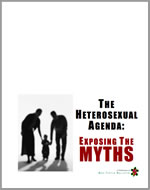 At last, the truth can now be told.
Using the same research methods employed by most anti-gay political pressure groups, we examine the statistics and the case studies that dispel many of the myths about heterosexuality. Download your copy today!
And don‘t miss our companion report, How To Write An Anti-Gay Tract In Fifteen Easy Steps.
 Anti-gay activists often charge that gay men and women pose a threat to children. In this report, we explore the supposed connection between homosexuality and child sexual abuse, the conclusions reached by the most knowledgeable professionals in the field, and how anti-gay activists continue to ignore their findings. This has tremendous consequences, not just for gay men and women, but more importantly for the safety of all our children.
Anti-gay activists often cite the “Dutch Study” to claim that gay unions last only about 1½ years and that the these men have an average of eight additional partners per year outside of their steady relationship. In this report, we will take you step by step into the study to see whether the claims are true.
Tony Perkins’ Family Research Council submitted an Amicus Brief to the Maryland Court of Appeals as that court prepared to consider the issue of gay marriage. We examine just one small section of that brief to reveal the junk science and fraudulent claims of the Family “Research” Council.
 The FBI’s annual Hate Crime Statistics aren’t as complete as they ought to be, and their report for 2004 was no exception. In fact, their most recent report has quite a few glaring holes. Holes big enough for Daniel Fetty to fall through.
“Google” is a trademark of Google Inc.
© Box Turtle Bulletin. All Rights Reserved.
 Posts
Posts  Posts via daily email: