Box Turtle Bulletin
 News and commentary about the anti-gay lobby
“Now you must raise your children up in a world where that union of man and box turtle is on the same legal footing as man and wife…”
News and commentary about the anti-gay lobbyPosts Tagged As: European Union
April 3rd, 2014
LGBT advocates in Uganda are split over the question of foreign aid cuts in response to the country’s adoption of the draconian Anti-Homosexuality Act. Many have argued that any actions taken against Uganda should be aimed at addressing the much larger human rights problems in what is increasingly becoming a one-party kleptocracy. Sexual Minorities Uganda executive director Frank Mugisha and others have cautioned against aid cuts:
“We can’t afford to create new victims,” (Mugisha) said on Twitter this week. “We should go after the crazy politicians! Not innocent Ugandans.”
…Edwin Sesange, director of the African LGBTI Out and Proud Diamond Group, said in a Gay Star News comment piece: ‘Aid in various forms helps all ordinary Ugandans, including LGBTI people who we are campaigning for. “Therefore the consequences of not being able to access those services financed by foreign aid will directly impact gay, lesbian, trans and bi Ugandans wellbeing. Our parents, sisters, brothers, friends and other relatives will also become victims. By contrast, most proponents of homophobia in Uganda can afford luxurious lives without depending on some foreign aid funded projects.”
He added: Politicians and the anti-gay vigilantes are using this threat from developed countries as a way of convincing people the west is using foreign aid and its influence to spread homosexuality to Uganda. We need to change this argument such people can understand the role of the western countries has is fighting homophobia, not making people gay. Western leaders need to assess the risks of their strategies before LGBTI people pay the consequences.”
Meanwhile, Ugandan critics question why the West is ignoring the protracted government-sponsored violence against opposition leaders and their supporters and focusing all of their attention on the LGBT population. This is the best way to understand the situation on the ground that the European Union Ambassador to Uganda Kristian Schmidt is trying to address in this interview with NTV Uganda yesterday.
Europe is not here to exchange money for African values. This is not the nature of our partnership. Our partnership is one of equal partners where what we do in the area of development cooperation is discussed and agreed with our Ugandan partners.
The discussion that we have on human rights are not conditional, and that’s why it’s important to note that we are not threatening. We didn’t threaten with aid cuts during the process of legislative adoption of the bill. This is not how Europe operates.
J. Lester Feder at Buzzfeed has more on the assurances Ambassador Schmidt says that he is seeking from the Uganda Government:
During an interview in his office in the Ugandan capital on Wednesday, Schmidt would not specify what assurances the E.U. sought from the five cabinet officials he met with behind closed doors last week. But, he said, he was “very” satisfied with the conversation and expected to resume the discussion after Ugandan officials returned from a summit between E.U. leaders and African leaders being held this week in Brussels.
“I am satisfied with the fact that … there were five ministers [in the meeting] … ready to give us assurances, that the law wouldn’t mean violations of privacy, freedom of expression, freedom of assembly, [and] the way medical care will be extended in facilities that are already caring for men who have sex with men,” Schmidt said. And while the E.U. believes the “law is discriminatory from A to Z and it has to be repealed,” he said, “there are ways to limit the damage. I want to keep working on that [through dialogue].”
…”We do not try to buy African acceptance for European or universal values through our development cooperation,” he said. “Because what happens when you try to do that, you get the [backlash] that we’re seeing…. It’s not productive to present it as a trade off.”
It’s hard to see what meaningful assurances government could offer when arrests like these are continuing across Uganda and suspects are being paraded before TV cameras:
Two men suspected of engaging in homosexuality acts have been arrested in Oyam. Oyam District Police Commander, Najibu Waiswa says 22-year-old Maurice Okello and his alleged partner, 18-year-old Anthony Oluku were caught red handed. Police claims the two admitted to having been involved in acts of homosexuality.
Meanwhile, Frank Mugisha is tweeting this morning that police have raided an NGO at Makarere University which receives PEPFAR funds from the US over services it provides to LGBT people:


January 15th, 2013
In four cases brought by people who say their Christian beliefs prohibit them from providing services to same-sex couples, the European Court of Human Rights ruled today that their beliefs do not justify discrimination. The ruling upheld British laws which ban discrimination on the basis of sexual orientation. According to a press release from the European Parliament’s Intergroup on LGBT Rights:
In the first case, Lillian Ladele was a civil registrar in London. She was dismissed because she refused officiating at civil partnership ceremonies for same-sex couples after it became legal in 2005. She claimed she was discriminated because of her faith.
The Court ruled there had been no discrimination, and that British courts—who upheld her dismissal—had struck the right balance between her right to freedom of religion, and same-sex couples’ right not to be discriminated.
In the second case, Gary McFarlane was a counsellor providing psycho-sexual therapy to couples. He was dismissed for refusing to work with same-sex couples, arguing this was incompatible with his beliefs. The Court ruled unanimously that there had been no violation of his right to freedom of belief.
The ruling may be appealed within the next three months.
Update: Arizona-based Alliance Defending Freedom (formerly Alliance Defense Fund) is mentioned in the official ruling (PDF: 515KB/53 pages) as a third party intervener.
March 4th, 2010
Several nations are competing to become the eighth to offer full civil marriage recognition to same sex couples. It is likely that at least three, possibly four, will change their laws by summer.
Portugal – The parliament has now finalized the language of the bill and around the first of the month sent it to President Cavaco Silva. Silva is a member of the PSD party and has spoken in the past in opposition to same-sex marriage recognition. It is uncertain what he will do.
Silva has four choices. He can sign the bill, send it to the Supreme Court within 8 days, or refuse to sign it and return it to Parliament within 20 days (a form of veto). Prime Minister José Sócrates has stated that he has the requisite two-thirds vote to overturn a Presidential veto.
Nepal – This Asian nation is scheduled to implement a new constitution by May 28, 2010. This new constitution is reported to have marriage equality provisions. Nepal has been capitalizing on this change in hopes of increasing tourism.
Luxembourg – This tiny duchy has had civil partnership laws since 2004. However, at the end of January, Minister of Justice François Biltgen announced that the nation would legalize civil gay marriage before Parliament’s summer break. Gay couples will not be allowed to adopt.
Iceland – This vast island with its hardy but tiny population has had registered partnerships since 1996. The current government, helmed by lesbian Prime Minister Jóhanna Sigurðardóttir, is committed to changing the law to enact marriage equality. Although no time line is currently reported, as of 18 November 2009, the Minister of Justice and Human Rights confirmed that the government was working on such an act.
This is not likely to be a highly controversial issue in Iceland. Only one lawmaker voted against the 1996 partnerships and the 2006 upgrade was passed unanimously.
Argentina – There have now been two legal same-sex marriages in that country opening up a precedent, if not exactly law. However, the current governmental leadership has indicated support for marriage equality and there are bills currently under consideration. Although movement forward was scheduled for last November, but parliamentary procedures were used to delay the decision until 2010. The two judicially authorized marriages may be seen as impetus for the legislature to enact marriage as a matter of legislation rather than concede to judicial mandate.
Cyprus – The Attorney-general’s office, Law Commissioner, Ombudswoman, and senior representatives of the relevant government ministries will meet this month to discuss whether the island off the coast of Turkey and Syria will adopt marriage equality.
To make the race even more uncertain, the European Court of Human Rights heard testimony last week from an Austrian couple suing for marriage rights. On Tuesday, the court determined that Poland could not treat a gay man and his partner differently than a married couple. It is expected to announce within the next few months whether European states can deny marriage to same-sex couples or whether civil unions, such as those adopted by Austria at the first of the year, were sufficient to protect equal rights.
So we see movement in Europe, Asia, and the Americas and at the most northern and most southern parts of the globe. And, of course, we may always be surprised by an unexpected nation taking this step, as well as determinations in the European . But, whichever moves first, it will certainly be a spring to remember.
UPDATE:
Slovenia – This eastern neighbor of Italy, and former portion of communist Yugoslavia, has already begun the process of changing their laws to allow for marriage equality. Their legislature voted yesterday to advance the bill.
December 17th, 2009
At a meeting in Strasbourg, France, the European Parliament passed a resolution strongly condemning Uganda’s proposed Anti-Homosexuality Bill. The E.U. resolution calls on Uganda “not to approve the bill and to review their laws to decriminalize homosexuality.” The resolution also calls on the European Commission and Council to reconsider EU aid to Uganda if the anti-gay bill passes. The EU currently provides Uganda $275 million annually in developmental aid, which is more than the $250 million provided by the U.S. The EU’s contribution amounts to just under 17% of Uganda’s total foreign aid receipts.
The full text of the resolution is available online.
The EU has been following these developments since the beginning. Last March, European Parliament\’s Intergroup on Gay and Lesbian Rights condemned the March 5th meeting between several Ugandan parliamentarians and Holocaust revisionist Scott Lively, Exodus International board member Don Schmierer, International Healing Foundation’s Caleb Lee Brundidge and Family Life Network’s Stephen Langa during their anti-gay conference held in Kampala.
Click here to see BTB\’s complete coverage of recent anti-gay developments in Uganda.
July 30th, 2009
 Back in May when Sweden became the seventh nation to recognize same-sex marriages, had we conducted a pool as to what nation would be next, very few of you would have bet on Albania. In fact, I imagine that very few of you could have found Albania on a map.
Albania is a Balkan nation tucked between Greece and Montenegro. It has a relatively conservative culture and homosexuality is not well tolerated by the people. In fact, none of its direct neighbors offer any recognition of same-sex relationships.
But Albania wants to join the European Union. And they know that passing marriage equality would present a modern progressive image to the rest of the continent. So Prime Minister Sali Berisha took a surprising step by announcing that the country would move in that direction. (BBC)
Albanian Prime Minister Sali Berisha has announced his party will propose a law legalising same-sex marriage.
It is an unexpected move in a country that is still one of the most conservative in the Europe and where homosexuality was illegal until 1995.
Mr Berisha acknowledged the proposed law might provoke debate but maintained that discrimination in modern Albania had to end.
This bill, which will be voted on in the fall, has the expected opposition of Catholic and Muslim leaders. But while Albania is primarily Muslim, this is not a strongly religious nation. While most residents still associate themselves with Christianity or Islam, over 70% of residents do not attend services and consider themselves to be non-religious. Practicing religion was banned during the 1944-1990 Communist regime.
I know too little of Albanian politics to make any predictions at this time. Although Berisha and his right-wing Democrat Party hold 74 of 140 seats and the bill is reportedly popular among the legislators, I am not sure whether they vote in a block or whether there may be defectors. Additionally, I’ve not heard whether the opposition Socialist Party is putting up a strong objection to the bill.
But should Albania become the eighth nation to enact marriage equality, this may well serve to shame some more progressive nations that pride themselves on their culture and civility.
March 9th, 2009
A European Parliament intergroup has issued a press release condemning the Ugandan anti-gay conference, and called out the three Americans by name:
European Parliament’s Intergroup condemns Ugandan parliamentarians for meeting anti-human rights militants.
European Parliament’s Intergroup on Gay and Lesbian Rights strongly condemns the meeting of 5 March between several Ugandan parliamentarians and Scott Lively, Don Schmierer, Caleb Lee Brundidge and Stephen Langa of the USA and Uganda-based groups working to diminish human rights of LGBT persons.“It is very sad that representatives of Ugandan parliament who should work for the rights of every Ugandan citizen, gravely discredit themselves by meeting people who work to spread hate and diminish rights of other human beings”, said Michael Cashman, President of the Intergroup. “It would never be acceptable for any member of the European Parliament to meet for example representatives of Ku Klux Klan thus I do not understand the rational of those Ugandan parliamentarians who agreed to the meeting with anti-gay militants.”
Raúl Romeva, Vice-President of the Intergroup for the GREENS/EFA added, “If these Ugandan parliamentarians are serious about respecting the constitution of their country and in particular Chapter 4 on Protection and promotion of fundamental and other human rights and freedoms, they should instead be working towards abolishing those discriminatory laws of Uganda which still deny full human rights to gay and lesbian citizens.”
Don Schmierer is a board member of Exodus International. This is the first time that I’m aware of that an activity by an Exodus board member has earned the condemnation of an official governmental committee. Today marks the tenth day since we made Exodus president Alan Chambers aware of the actions of a board member. We still hear nothing but silence from Exodus.
[Hat tip: Andy at UK Gay News]
Click here to see BTB’s complete coverage of recent anti-gay developments in Uganda.
Featured Reports
 In this original BTB Investigation, we unveil the tragic story of Kirk Murphy, a four-year-old boy who was treated for “cross-gender disturbance” in 1970 by a young grad student by the name of George Rekers. This story is a stark reminder that there are severe and damaging consequences when therapists try to ensure that boys will be boys.
When we first reported on three American anti-gay activists traveling to Kampala for a three-day conference, we had no idea that it would be the first report of a long string of events leading to a proposal to institute the death penalty for LGBT people. But that is exactly what happened. In this report, we review our collection of more than 500 posts to tell the story of one nation’s embrace of hatred toward gay people. This report will be updated continuously as events continue to unfold. Check here for the latest updates.
In 2005, the Southern Poverty Law Center wrote that “[Paul] Cameron’s ‘science’ echoes Nazi Germany.” What the SPLC didn”t know was Cameron doesn’t just “echo” Nazi Germany. He quoted extensively from one of the Final Solution’s architects. This puts his fascination with quarantines, mandatory tattoos, and extermination being a “plausible idea” in a whole new and deeply disturbing light.
On February 10, I attended an all-day “Love Won Out” ex-gay conference in Phoenix, put on by Focus on the Family and Exodus International. In this series of reports, I talk about what I learned there: the people who go to these conferences, the things that they hear, and what this all means for them, their families and for the rest of us.
Prologue: Why I Went To “Love Won Out”
Part 1: What’s Love Got To Do With It?
Part 2: Parents Struggle With “No Exceptions”
Part 3: A Whole New Dialect
Part 4: It Depends On How The Meaning of the Word "Change" Changes
Part 5: A Candid Explanation For "Change"
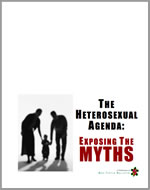 At last, the truth can now be told.
Using the same research methods employed by most anti-gay political pressure groups, we examine the statistics and the case studies that dispel many of the myths about heterosexuality. Download your copy today!
And don‘t miss our companion report, How To Write An Anti-Gay Tract In Fifteen Easy Steps.
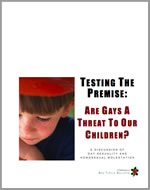 Anti-gay activists often charge that gay men and women pose a threat to children. In this report, we explore the supposed connection between homosexuality and child sexual abuse, the conclusions reached by the most knowledgeable professionals in the field, and how anti-gay activists continue to ignore their findings. This has tremendous consequences, not just for gay men and women, but more importantly for the safety of all our children.
Anti-gay activists often cite the “Dutch Study” to claim that gay unions last only about 1½ years and that the these men have an average of eight additional partners per year outside of their steady relationship. In this report, we will take you step by step into the study to see whether the claims are true.
Tony Perkins’ Family Research Council submitted an Amicus Brief to the Maryland Court of Appeals as that court prepared to consider the issue of gay marriage. We examine just one small section of that brief to reveal the junk science and fraudulent claims of the Family “Research” Council.
 The FBI’s annual Hate Crime Statistics aren’t as complete as they ought to be, and their report for 2004 was no exception. In fact, their most recent report has quite a few glaring holes. Holes big enough for Daniel Fetty to fall through.
“Google” is a trademark of Google Inc.
© Box Turtle Bulletin. All Rights Reserved.
 Posts
Posts  Posts via daily email: