Box Turtle Bulletin
 News and commentary about the anti-gay lobby
“Now you must raise your children up in a world where that union of man and box turtle is on the same legal footing as man and wife…”
News and commentary about the anti-gay lobbyPosts Tagged As: Iowa
August 11th, 2011

The metaphors become even more strained:
Rick Santorum today finally wrapped up his 50-city tour de Iowa. He continued to press anti-gay views, saying that calling same-sex marriage a marriage would be like calling a cup of tea a basketball. He repeatedly quoted a study that families do better in heterosexual marriages. Though that study actually uses the phrase “nuclear” family, which can include same-sex couples.
He made those remarks yesterday at a very lonely stop of the “Value Voters Bus Tour” which is making its way through Iowa. He’s really been straining at the metaphors: napkins and not paper towels, water and not beer. But none of those metaphors have the punchiness of “frothy mix.” His weird metaphors may go on a temporary hiatus: Santorum is reportedly developing laryngitis. That development will be particularly timely if it affects his participation in tonight’s GOP debate.
August 10th, 2011
The “Values Voters Bus Tour,” sponsored by the Family “Research” Council’s lobbying arm, the National Organization for Marriage, and the Susan B. Anthony List, kicked off yesterday in Des Moines, Iowa, with the goal of hitting several Iowa communities ahead of Saturday’s GOP presidential Straw Poll. Minnesota Gov. Tim Pawlenty was on hand for the tour’s start, which was greeted by a sparse crowd that appears to have been outnumbered by reporters:
The bus made five more stops before the day was done yesterday. This morning, the bus tour resumed with a breakfast in Cedar Rapids, Iowa, where Pennsylvania Sen. Rick Santorum met the bus.
August 8th, 2011
The way the Bachmans have been ditching questions about Marcus Bachmann’s counselling clinic providing ex-gay therapy in direct conflict with the position of every major medical and mental health organization, you’d think they would be extra careful to avoid anything which would invite further scrutiny in that particular area. And if you thought that, you’d be wrong. Yesterday, Michele and Marcus Bachman attended an Iowa church in which the main point of the sermon was the promotion of the ex-gay movement.
[Point of Grace Church Pastor Jeff] Mullen’s sermon concluded with video testimonial from a man named Adam Hood, who claims to have been gay before experiencing a conversation with God. “I am so happy God has given me natural affection for a woman,” Hood said in the video, adding that his wife is nine months pregnant.
“We need to have compassion for people that are bound by that sin,” Hood added. “And it is a sin. Call a spade a spade.”
Yes, that Adam Hood, a.k.a Scarfboi. And if Hood is now accepted as being completely, totally, believe-you-him straight, then I guess you can see how Marcus Bachmann might start to look a little butch. If you squint.
July 19th, 2011
That’s the punchline to a joke that had Iowa’s The Family Leader’s Bob Vander Plaats laughing and saying, “That’s pretty good! Oh shoot!”
Igor Volsky at ThinkProgress reacts:
Vander Plaats’ reaction is not entirely surprising, since the group has previously compared homosexuality to the cancerous effects of second-hand smoking and links supporters to ex-gay reparative therapy. What’s more telling is the willingness of Republican presidential candidates like Tim Pawlenty and Newt Gingrich to attend the group’s presidential forum and Michele Bachmann’s and Rick Santorum’s eagerness to sign its pledge.
July 13th, 2011
There is something truly delightful in watching the Family Leader’s anti-gay pledge – which was supposed to pressure Republican candidates into a commitment to fight the civil equality promised by the Fourteenth Amendment – go up in flames.
After it was discovered that Bob Vander Plaats had thrown in a statement that suggested that African-Americans were better off when white people owned them and after Michelle Bachmann was put in the unenviable position of having to explain to the media that, yes, she does think slavery is a bad thing, no one else wants to have anything to do with this pledge.
Mitt Romney rejected the pledge, calling it “undignified and inappropriate for a presidential campaign”, Newt Gingrich found too many unspecified problems (divorce, perhaps?), and even those who are slogging hardest to get the theocrat vote, Tim Pawlenty and Herman Cain, couldn’t distance themselves fast enough.
And as for Bachmann, this error combined with her husband’s wacky ex-gay counseling may prove just too much even for social conservatives who have a very high tolerance for crazy.
July 8th, 2011

Michele and Marcus Bachmann
GOP presidential candidate Rep. Michele Bachmann (R-MN) was the very first out of the gate to sign a new Anti-Gay pledge drafted by Bob Vander Plaats and Iowa’s Family Leader. Titled, “The Marriage Vow – A Declaration of Dependence upon Marriage and Family” (PDF: 1.02MB/8 pages), its points include (page 3):
Social protections, especially for women and children, have been evaporating as we have collectively “debased the currency” of marriage. This debasement continues as a function of adultery; “quickie divorce;” physical and verbal spousal abuse; non-committal co-habitation; exemplary infidelity and “unwed cheating” among celebrities, sports figures and politicians; anti-scientific bias which holds, in complete absence of empirical proof, that non-heterosexual inclinations are genetically determined, irresistible and akin to innate traits like race, gender and eye color; as well as anti-scientific bias which holds, against all empirical evidence, that homosexual behavior in particular, and sexual promiscuity in general, optimizes individual or public health.
Under “The Candidate Vows,” candidates are required to affirm that they will perform “Vigorous opposition to any redefinition of the Institution of Marriage — faithful monogamy between one man and one woman — through statutory-, bureaucratic-, or court-imposed recognition of intimate unions which are bigamous, polygamous, polyandrous, same-sex, etc.” The vow also requires the “Steadfast embrace of a federal Marriage Amendment to the U.S. Constitution which protects the definition of marriage as between one man and one woman in all of the United States.”

Michele Bachman at the New Hampshire debate
During last month’s GOP debate in New Hampshire, Bachmann reaffirmed her support for the federal marriage amendment.
Footnote 8 of the document includes an explicitly pro- ex-gay plank, indicating the political utility that social conservatives find in the movement: “No peer-reviewed empirical science or rational demonstration has ever definitively proven, nor even has shown an overwhelming probability, that homosexual preference or behavior is irresistible as a function of genetic determinism or other forms of fatalism.”
The footnote also claims that LGBT people have an average life expectancy of about 40 years, and cites a 1997 report by Robert S. Hogg et al., from the International Journal of Epidemiology. That study, which has become a favorite study for anti-gay extremists to distort, was based on research performed in Vancouver from 1987 through 1992, at the very height of the AIDS crissis The question that they were trying to answer was not about the mortality of gay men overall, but rather the impact that HIV might have on the Vancouver’s gay population. Vancouver was one of the epicenters of the epidemic in the early 1990s. When anti-gay extremists misrepresented that study to claim that the average lifespan was forty years, Hogg and his colleagues responded in a 2001 letter to that same journal, saying:
The aim of our research was never to spread more homophobia… [I]f we were to repeat this analysis today the life expectancy of gay and bisexual men would be greatly improved. Deaths from HIV infection have declined dramatically in this population since 1996. As we have previously reported there has been a threefold decrease in mortality in Vancouver as well as in other parts of British Columbia .
In fact, several recent studies have shown that people with HIV have near-normal life expectancies, and there is no peer-reviewed data showing that gay people overall have a life expectancy that is any different from anyone else’s.
The same vow also requires candidates’ “rejection of Sharia Islam and all other anti-woman, anti-human rights forms of totalitarian control.” Because, you know, the imminent imposition of sharia law is the pressing issue right now in the U.S.
Utah Gov. Jon Huntsman has declined to sign the pledge, saying that he has a policy of not signing any pledges. Rep. Rom Paul (R-TX) has said he has reservations. Former Minnesota Gov. Tim Pawlenty said last night he was reviewing the pledge. The agreement to “personal fidelity” to his or her wife could be a thorn to former House Speaker Newt Gingrich. Massachusetts Gov. Mitt Romney, Gingrich, former Pennsylvania Sen. Rick Santorum, and retired Georgia businessman Herman Cain have not yet responded to the pledge. Vander Plaats has set a deadline of August 1.
June 1st, 2011
In what has been, to me, a surprisingly short period of time, the fertile, tamed gay-supportive territory has come to support marriage equality. Democrats overwhelmingly are supportive, and independents have joined them to the extent that now a majority of Americans favor legalized same-sex marriages.
But Republicans – especially conservative evangelical Republicans – have held to their opposition with little exception. The red state, red meat, tea partying folk have not been receptive in any manner to talk about Teh Gheys being real people with real rights, especially the right to marry the person of their choosing.
Until recently. Very very recently.
Perhaps it took the high-profile support over unquestionably-conservative Ted Olson to make it possible for conservative Republican support to be considered. Perhaps the hopeless – but fascinating and visible – presidential campaign of Fred Karger introduced the possibility. Maybe it was Meghan McCain, Barbara Bush, or other young Republicans willing to talk back to their elders. But whatever allowed it, change has begun.
Marriage equality has finally set foot in this wild frontier, planted a flag, and claimed its place. In, of all places, Iowa’s activist Republican community. Today, Jeff Angelo, a former State Senator from Ames has launched a new group: Iowa Republicans for Freedom.
Angelo is a heterosexual father of three who identifies as an evangelical Christian. He regularly attends the Ames Evangelical Free Church. While he still considers himself “very much an activist Republican,” Angelo said he, and other Republicans, are recognizing banning same-sex marriage violates the widely-held conservative belief of personal freedoms.
But don’t assume that Angelo is just some “squishy moderate” who has let his liberal side take over. Angelo’s anti-gay credentials couldn’t be stronger. (DMRegister)
Angelo, who formerly lived in Creston, had opposed gay marriage while serving in the Iowa Senate and was co-sponsor of the Iowa Defense of Marriage Act in the late 1990s. In 2006, he was the lead sponsor of a proposed state constitutional amendment to define marriage as between a man and a woman. He said he gradually came to a realization after leaving the legislature that his stance on same-sex marriage was wrong and hurtful.
Like many, he had believed the lies he told himself. Especially the old “my gay friends” fiction. (Iowa Independent)
“I previously bought into the notion that I could tell my gay friends how much I loved them, that I just disapproved of their lifestyle and they would be OK with that,” Angelo admitted. “But they told me that I made them feel lesser in my eyes or that I made them feel like a second-class citizen. I labored under delusion for some time that [what my friends said] wasn’t true, that they really believed I loved them and that I was their friend.”
And he found that once he questioned his presumptions, it turned out that this new respect for his fellow man fit better with his ideals than had his prejudices. So he’s now sharing that message.
“Far too often, the conversation on marriage can get lost in rhetoric,” Angelo said. “But this debate really centers around one idea: whether government has the right to say whom a person should love and marry. As a proud conservative, I believe in smaller, limited government, and that government should have no more of a right to say whom I can marry than they should be able to tell my gay and lesbian brothers and sisters whom they can marry.”
…
“It is time for conservatives to get back to their roots,” Angelo said. “Through Iowa Republicans for Freedom, we will begin a conversation about whether our party and our state will stand for true conservative values, or whether we will allow ourselves to get lost in senseless debates that do nothing but demean our neighbors and threaten the rights of our fellow Iowans.”
Jeff Angelo is a very welcome advocate. His voice can reach those who simply cannot hear what our community is trying to say. I truly wish him well.
March 17th, 2011
 Rev. Keith Ratliff, pastor of the Maple Street Missionary Baptist Church in Des Moines, is the president of the Iowa-Nebraska chapter of the NAACP. He’s also an anti-gay activist who takes his opposition to gay equality so seriously that in last year’s gubernatorial election he endorsed Republican Bob Vander Plaats, who made opposition to equality his signature position.
Ratlif had a few choice things to say this week to a rally organized by Vander Plaats to stir up anti-gay sentiment. (Iowa Independent)
“For the few victories that the gay community is claiming,” Ratliff said, “they have won it mostly based on the hijacking of them trying to parallel themselves on the backs of the civil rights movement, here in America.”
He said their is “no parallel” of what an “insult” it was for them to compare themselves with the civil rights movement.
Ratliff, of the Maple Street Missionary Baptist Church in Des Moines, said not being able to marry a person of the same gender was no where near what it’s like to be denied service in a restaurant or hotel for the color of their skin.
How sad that Ratliff has been subjected to the insult of gay people thinking that they were equal to him. But while it may make me seem uppity, perhaps Mr. Ratliff needs a history lesson.
You see it was in 1965 that the state of Iowa banned racial discrimination in service at restaurants and hotels, but it was perfectly legal to deny gay people those exact same services until four years ago.
And there are more than a few readers who could give personal testimony to experiencing exactly the same treatment to which Ratliff thinks there is “no parallel.” Except they had no recourse. It was perfectly legal.
I don’t pretend that racial discrimination is identical to anti-gay discrimination. There are differences and subtleties that are better discussed by those who have experienced both and I’ve heard good argument why either was painful than the other. Nor do I deceive myself into thinking that racism ended in Iowa in 1965. However, I do know that civil rights are those to which each person is entitled from their government without arbitrary denial and that discrimination is ugly and cruel.
And I know that anti-gay bigotry looks just like all other bigotry: the smirk which says that the most despicable and characterless of the “acceptable” race or gender or religion or orientation will always be better than you based on a scale that has nothing to do with merit and everything to do with unearned presumptions of superiority.
Yet while it is foolish and pointless to pit victims of bigotry against each other as though injustice and indignity against one is acceptable because someone else ‘had it worse’, if Ratliff’s wants to compete in the Oppression Olympics on “not being able to marry” and “being denied service in a restaurant or hotel” then he loses and the gay community takes gold. In our lifetime, we’ve known both.
February 4th, 2011
You’ve probably seen this before, but if not, Zach Wahls gives testimony to the Iowa House on being raised by two mothers.
February 1st, 2011
From OneIowa
The Iowa House today, by a vote of 62-37, passed an amendment (House Joint Resolution 6) that would deny any form of legal recognition for gay couples. The amendment seeks to prohibit not only the freedom to marry for gay couples, but also civil unions or domestic partnerships.
The bill now moves on to the Iowa Senate, where Senate Majority Leader Mike Gronstal has vowed to fight attempts to pass the amendment. If passed through both legislative bodies in two consecutive General Assemblies, the issue could be on the ballot as soon as 2013.
As the Democrats hold a majority in the Senate and have already demonstrated their support for Gronstal on the issue, barring some bizarre turn of events, this amendment will not pass the Senate.
January 27th, 2011
As expected, the Democrats in the Iowa Senate held firm against a Republican effort to present a constitutional amendment to reverse the state’s recognition of same-sex marriages. Senate Majority Leader Mike Gronstal has vowed to keep the issue off the floor, but Sen. Kent Sorenson tried to use a procedural measure to get around that decision. (Iowa Independent)
A motion by state Sen. Kent Sorenson (R-Indianola) to suspend the Senate’s rules to allow a vote on a constitutional ban on same-sex marriage was defeated early Thursday morning on a party-line vote.
Sorenson asked all 50 senators to call up Senate Joint Resolution 8, a bill that would amend the Iowa Constitution to specify that marriage between one man and one woman is the only legal union valid or recognized in the state. Senate President Jack Kibbie (D-Emmetsburg) said “no,” but agreed to allow a vote on whether to suspend the rules and override his objection.
Twenty-six Democrats voted “no” and 24 Republicans voted “yes.” The motion was defeated.
So the Republicans having now made their token (but predictably unsuccessful) effort, perhaps the issue can rest until the next election.
January 16th, 2011
Remember when the tea party tried to sucker LGBT people into their movement by reassuring them that the party was only interested in fiscal issues?
Banning same-sex marriage was the focal point of a conservative tea party rally Saturday afternoon in Council Bluffs. About 35 people gathered at the Mid-America Center to hear speeches from Rep. Kim Pearson, R-Pleasant Hill, and former Republican state representative and current Family Leader lobbyist Danny Carroll.
“I’m a Christian, social, fiscal conservative,” Pearson told the crowd to much applause. “The social and fiscal conservative values work.”
…”The definition of marriage is between one man and one woman,” she said. “God is our ultimate law giver.”
December 1st, 2010

Upon the governor’s signature, Illinois will become the second state that is currently offering civil unions to same-sex couples. The status of the various recognition mechanisms is as follows:
Marriage on the same terms as heterosexual marriage – 5.1% of US Population:
Massachusetts
Connecticut
Iowa
Vermont
New Hampshire
District of Columbia
Civil Unions – a rights except the name – 7.1% of US Population:
New Jersey
Illinois
Domestic Partnerships will all the rights except the name – 16.3% of US Population
California
Oregon
Washington
Nevada
Limited recognition of same-sex couples – 6.2% of US Population
Hawaii – Reciprocal Benefits
Colorado – Reciprocal Benefits
Wisconsin – Domestic Partnerships
Maine – Domestic Partnerships
Maryland – Domestic Partnerships
In addition, the states of Maryland and New York (6.4% of US Population) will give full recognition to same-sex marriages conducted where legal. Rhode Island may possibly do so also (it’s a bit uncertain) and offers unregistered Domestic Partnerships with a scant handful of rights.
Also, there are dozens of cities offer some form of recognition and protection for same-sex couples.
November 29th, 2010
The 2010 election has changed the dynamic in a few states and presents both opportunities and challenges for supporters of marriage equality. Here are how I see the current landscape:
Hawaii – Neil Abercrombie, the newly elected governor of Hawaii, is a strong advocate for civil unions. Earlier this year the legislature overwhelmingly approved a civil unions bill and such a bill is likely to be presented again.
Illinois – it is expected that the state legislature will vote this week on a civil unions bill during a lame-duck session. There is adequate support in the Senate, but the House vote is uncertain. Should it pass, Governor Pat Quinn, a strong supporter who was just reelected, will sign the bill. This bill seems to be taking on the impression of a Catholic v. Protestant fight, with NOM and the Catholic Bishop serving as the public face in opposition to civil unions, while a great many Protestants ministers have endorsed the bill.
Minnesota – Mark Dayton holds a lead in the governor’s election over anti-gay Tom Emmer, but the election will not be determined until a recount is completed. Republicans took control of both houses of legislature, so no pro-equality bills are expected; but if Dayton is confirmed there also will be no anti-equality bills either.
The one concern might be that Republicans could try and put a constitutional amendment on the 2012 ballot that bans both marriage and civil unions. While that may seem like a great idea to anti-gay activists, Emmer ran a homophobic campaign designed to appeal to those who oppose marriage equality and it does not appear to have been successful. I think it likely that an anti-marriage amendment would pass, but anti-civil unions may be too much, and it is becoming increasingly more risky for anti-gays to make such assumptions. Additionally, attitudes can change dramatically in the next two years.
Meanwhile, three couples are suing the state claiming that laws restricting marriage to opposite-sex couples violate the state constitution. Today, a judge rejected the request of the Minnesota Family Counsel to intervene:
“The Council’s alleged injuries would occur solely due to its sincerely-held belief that principles rooted in its interpretations of religious texts are best for the well-being of children and families, and that marriage only between one man and one woman accords with these principles,” wrote Minnesota Fourth District Court Judge Mary S. DuFrense (PDF). “The Court certainly understands that the Council feels strongly about the social issue of same-sex marriage. Strong feelings, however, do not establish a legal interest in a lawsuit.”
Iowa – after three Supreme Court Justices were denied confirmation, anti-gay activists were celebrating. But as the Senate majority leader has committed to blocking any changes to the Iowa constitution, it is unlikely that marriage will be reversed.
New Hampshire – NOM is crowing that anti-marriage activists have taken over both houses. However, my analysis suggests that any reversal of marriage equality is unlikely. While Republicans took a veto-proof majority, a significant number have already voted against any repeal of the law.
Maine – Republican Paul LePage was elected governor, effectively eliminating any forward movement on marriage equality. However LePage supports the current domestic partnership laws so things will remain status quo for a while.
New York – this one is a big question mark. Incoming Governor Cuomo has promised to get marriage legalized. And after the last vote, state legislators have discovered that “things as they are” may well be the most dangerous position to hold; gay activists refused to play the “any Democrat is better than a Republican” game and set their sites on defeating anti-marriage votes.
Going by last year’s vote count, the current best case scenario is that we are three votes shy of what we need (there are still some undecided elections). However, this time our side is taking to the airwaves to drum up public support, and polls show that New Yorkers support marriage equality. What was a party-line vote last year may well be viewed this year in terms of tolerance and New York values and there may be an entirely different dynamic.
Rhode Island – Former-Republican Lincoln Chafee, who ran as an Independent, beat both the Democrat and the Republican candidates to take governor of the tiny state. And one of his first actions was to inform NOM that their opinion on marriage was not of any value to him. Rhode Islanders support marriage equality, and with Chafee’s backing there is a good chance that RI will be the next marriage state.
Maryland – another contender for next marriage state, Maryland did not suffer party reversal. A plurality of voter support marriage equality, and gay State Sen. Richard Madaleno is guardedly optimistic that marriage will be voted in, perhaps as early as January.
His optimism stems from a number of developments on Election Day 2010, some of which ran absolutely counter to national trends. In the Maryland Senate, Democrats actually expanded their majority to a 35-12 advantage over Republicans. And some Democrats who lost their seats did so in primary fights with more progressive challengers, many of whom vowed to be even stronger champions for marriage equality.
And, of course, all of the above could be impacted by Perry v. Schwarzenegger should the courts find that marriage laws which restrict gay people from participation are contrary to the Due Process or Equal Protections clauses of the 14th Amendement.
November 2nd, 2010
The Republicans picked up significant gains in the midterm election, gaining control of the House of Representatives, and bringing the Senate to within a few votes. This is not good news for the prospect of having issues of inequality addressed in the next two years.
However, this change in the direction of power was not a mandate for social conservatives. Indeed, it was those Republicans who made the most of their socially conservative credentials who fared least well. Christine O’Donnell lost miserably, as did Tom Tancredo, while Tea Party and Republican candidates that minimized or refused to discuss their positions on social issues attracted support.
But no indicator seems to have been more consistent this election than the extent to which a candidate was supported by the National Organization for Marriage. If you were a Senatorial or Gubernatorial candidate whom NOM supported, it seemed to be the kiss of death.
In New Hampshire, NOM has ran an anti-Lynch campaign for two years, and has ratcheted up the anti-Lynch television ads going into the election. Lynch just won his fourth consecutive election, a feat not accomplished for the past 200 years.
In California, NOM sponsored a bus tour for senate candidate Carly Fiorina, encouraging Latino voters to “vota tus valores“. Not only have the networks called this election for Barbara Boxer, Latinos found Fiorina’s valores not to be their valores by two-thirds.
NOM sued the state of New York in hopes of running anonymous ads in favor of Carl Paladino. Paladino’s homophobia sunk his campaign and he ended up pulling but 35% of the vote leaving Cuomo – a marriage support – one of the strongest winners of the night.
In Minnesota, NOM ran radio ads for Tom Emmer claiming that “Mark Dayton and Tom Horner want to impose gay marriage with no vote of the people.” Although Minnesota has not been called, Dayton is 7% ahead of Emmer with 85% of the vote counted.
This kiss of death is consistent with results of NOM’s electioneering in the District of Columbia during their primary. It would seem that using gay couples as a fear tactic seems to have peaked and dissipated.
This is not to say that NOM will not have any causes for celebration. The efforts to reject three supreme court justices in Iowa who were part of the unanimous decision to recognize gay Iowans as protected by the state Constitution, appears to have succeeded. Each appears to have only 46-47% support. Expect NOM to claim this as a clear mandate that the “people of Iowa have spoken” and that they don’t like their gay neighbors so much. NOM was not, however, successful in their effort to oust the Polk County judge who first found for marriage equality.
And NOM’s very own Andy Pugno – the attorney for the Prop 8 campaign – is running for state assembly in California’s 5th Assembly district. At present the vote is too close to call.
All in all, while NOM’s vindictive smearing of the Iowa justices may have proven effective (and may well prove to bring a chilling effect to future legal battles), we can say that they were big losers tonight.
UPDATE: 10:28 pm PST. LA Times:
With more than half the votes counted, Democrat Richard Pan holds a 51% to 45% lead over Republican Andy Pugno in a seat currently held by Republicans.
Not only may Pugno’s repugnant attack on gay couples have cost him the 5th Assembly seat, it may actually move the Democrats in CA closer to a supermajority. NOM must feel so proud.
Featured Reports
 In this original BTB Investigation, we unveil the tragic story of Kirk Murphy, a four-year-old boy who was treated for “cross-gender disturbance” in 1970 by a young grad student by the name of George Rekers. This story is a stark reminder that there are severe and damaging consequences when therapists try to ensure that boys will be boys.
When we first reported on three American anti-gay activists traveling to Kampala for a three-day conference, we had no idea that it would be the first report of a long string of events leading to a proposal to institute the death penalty for LGBT people. But that is exactly what happened. In this report, we review our collection of more than 500 posts to tell the story of one nation’s embrace of hatred toward gay people. This report will be updated continuously as events continue to unfold. Check here for the latest updates.
In 2005, the Southern Poverty Law Center wrote that “[Paul] Cameron’s ‘science’ echoes Nazi Germany.” What the SPLC didn”t know was Cameron doesn’t just “echo” Nazi Germany. He quoted extensively from one of the Final Solution’s architects. This puts his fascination with quarantines, mandatory tattoos, and extermination being a “plausible idea” in a whole new and deeply disturbing light.
On February 10, I attended an all-day “Love Won Out” ex-gay conference in Phoenix, put on by Focus on the Family and Exodus International. In this series of reports, I talk about what I learned there: the people who go to these conferences, the things that they hear, and what this all means for them, their families and for the rest of us.
Prologue: Why I Went To “Love Won Out”
Part 1: What’s Love Got To Do With It?
Part 2: Parents Struggle With “No Exceptions”
Part 3: A Whole New Dialect
Part 4: It Depends On How The Meaning of the Word "Change" Changes
Part 5: A Candid Explanation For "Change"
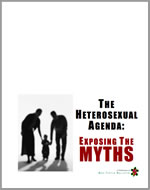 At last, the truth can now be told.
Using the same research methods employed by most anti-gay political pressure groups, we examine the statistics and the case studies that dispel many of the myths about heterosexuality. Download your copy today!
And don‘t miss our companion report, How To Write An Anti-Gay Tract In Fifteen Easy Steps.
 Anti-gay activists often charge that gay men and women pose a threat to children. In this report, we explore the supposed connection between homosexuality and child sexual abuse, the conclusions reached by the most knowledgeable professionals in the field, and how anti-gay activists continue to ignore their findings. This has tremendous consequences, not just for gay men and women, but more importantly for the safety of all our children.
Anti-gay activists often cite the “Dutch Study” to claim that gay unions last only about 1½ years and that the these men have an average of eight additional partners per year outside of their steady relationship. In this report, we will take you step by step into the study to see whether the claims are true.
Tony Perkins’ Family Research Council submitted an Amicus Brief to the Maryland Court of Appeals as that court prepared to consider the issue of gay marriage. We examine just one small section of that brief to reveal the junk science and fraudulent claims of the Family “Research” Council.
 The FBI’s annual Hate Crime Statistics aren’t as complete as they ought to be, and their report for 2004 was no exception. In fact, their most recent report has quite a few glaring holes. Holes big enough for Daniel Fetty to fall through.
“Google” is a trademark of Google Inc.
© Box Turtle Bulletin. All Rights Reserved.
 Posts
Posts  Posts via daily email: