Box Turtle Bulletin
 News and commentary about the anti-gay lobby
“Now you must raise your children up in a world where that union of man and box turtle is on the same legal footing as man and wife…”
News and commentary about the anti-gay lobbyPosts Tagged As: David Bahati
April 26th, 2011

Ugandan MP David Bahati (AP Photo/Ronald Kabuubi)
Ugandan M.P. David Bahati is not taking no for an answer. Last month, Information Minister Kabakumba Masiko articulated the government’s position that the draconian Anti-Homosexuality Bill would not be voted on in Parliament. Immediately, Bahati swung into action demanding that Parliament’s Legal and Parliamentary Affairs Committee, where the bill had been held for more than a year, schedule hearings on the bill. Since then, committee chairman Stephen Tashobya has been somewhat ambivalent about the bill, saying on the one hand that it may come up for discussion, and on the other hand pointing out that there is very little time left for the current Parliament to act before it expires next month.
Today, the Associated Press rorts that Bahati re-issued his “consession” that he would consider dropping the death penalty from the bill if it would help to move the bill forward. That’s not much of a concession; the more “lenient” punishment is lifetime imprisonment in a Ugandan prison. That’s hardly an improvement, and it’s barely scratching the surface. The bill would lower the bar for conviction, making mere “touching” for the perceived purpose of homosexual relations a criminal offense. It threatens teachers, doctors, friends, and family members with three years imprisonment if they didn’t report anyone they suspected of being gay to police within twenty-four hours. It also would broadly criminalize all advocacy of homosexuality including, conceivably, lawyers defending accused gay people in court or parliamentarians proposing changes to the law. It even threatens landlords under a “brothel” provision if they knowingly rent to gay people.
More worrying, newspapers all over the world are carrying this AP article with a misleading headline indicating that the death penalty’s being dropped is a fait accompli. Nothing could be further from the truth. The penalty has not been officially dropped. This is merely a statement of concession that Bahati is reiterating, one that he has made many times before. The bill itself remains unchanged.
The AP report also has Tashobya providing some wiggle room on whether the bill will come up for a vote:
But Stephen Tashobya, the chairman of the Legal and Parliamentary Affairs Committee, said the legislation may come up for a vote before parliament’s session ends May 12.
“We shall try and see how far we can go with the bill. It may be possible. We are doing all we can. We have limited time,” he said Tuesday, before adding: “Many people have expressed concern about that provision providing for the death sentence and I’m sure when we start hearings on that bill we will hear many more concerns.”
Whether Parliament can take up these measures in the two weeks it has left remains uncertain. Over the past week, the Ugandan government has been struggling with an open rebellion on the streets of Kampala. Things are only now beginning to quieten down, but the situation remans tense. That distraction only adds to the issues that Parliament will be grappling with before it ends on May 12.
In recent weeks, the bill’s supporters have been ratcheting up pressure for a vote, pressure which includes paying enourmous sums of money by Ugandan standards to gay people to hurl false accusations and pose as “ex-gays.” Governmental sources have responded by suggesting that some provisions of the bill be shifted to other bills, where they stand a better chance of passing with little notice.
April 13th, 2011
A report in this morning’s Daily Monitor, Uganda’s largest and most reputable independent newspaper, indicates that last week’s attempt by Martin Ssempa and Julius Oyet to revive the Anti-Homosexuality Bill have gotten under President Yoweri Museveni’s skin, and so his cabinet is proposing an alternative:
A Cabinet sub-committee formed to study the Anti-Homosexuality Bill 2010 and report back to Cabinet, yesterday added a spin into the Bill and called for its withdrawal.
Sources, who attended the meeting, said the sub-committee, chaired by First Deputy Premier Eriya Kategaya, suggested that if Mr Bahati did not mind a lot, he could withdraw the Bill. “They said Cabinet doesn’t agree with the death penalty which the Bill proposes,” a source, who cannot be named because they are not authorised to speak on behalf of Cabinet, said. “They asked Bahati to drop the Bill if he doesn’t care much.”
That is a remarkably mild and polite request. As we all know, he does “care much.” But documents posted on Wikileaks indicate that Museveni has committed to seeing that the bill doesn’t become law. And so his sub-committee has offered an alternative:
In a closed-door meeting with Mr David Bahati, the mover of the Bill, the sub-committee said some of the penalties proposed in the Bill could be catered for by the Penal Code Act and the yet-to-come Sexual Offences Bill.
The sub-committee formed early last year following President Museveni’s call on Parliament to “go slow” on the bill following international outcry over its draconian provisions. In April, the committee reported that the biggest problem with the bill wasn’t so much it’s call to execute gay people, it was its name. The Anti-Homosexuality Bill simply drew too much attention.
According to last year’s Sunday Monitor report, the cabinet sub-committee argued that the bill should be dropped and certain sections of it (principally, the provisions criminalizing “promotion” of homosexuality with up to seven years’ imprisonment) be quietly transferred to other bills so as to draw less attention to what they are trying to do. Sunday Monitor noted last year that the Sexual Offences Bill would be a likely vehicle. This report indicates that we now have two bills to watch for: the Penal Code Act and the Sexual Offences Bill. The report doesn’t indicate which provisions would be transferred to the other two bills.
As currently written, the Anti-Homosexuality Bill would impose the death penalty on gay people under certain circumstances (including if one partner is HIV-positive) and would clarify lifetime imprisonment for all others, including for those who obtained legal same-sex marriages abroad. (Ugandan law already provides either a 14 years’ imprisonment or a lifetime sentence, depending on how the individual is prosecuted.) The Bill would also require family members, doctors, teachers and others “in a position of authority” to report LGBT people to police within 24 hours to avoid the risk of three years’ imprisonment themselves. Anyone convicted of “promoting” or “aiding and abetting” homosexuality would be liable to seven years imprisonment. Those provisions are so broadly written that they could include doctors and even lawyers called upon to defend LGBT people in court. The bill even targets landlords who rent to LGBT people under a “brothel” provision that provides seven years’ imprisonment. It also contains an extradition clause, allowing the Ugandan government to lodge extradition requests to foreign governments to extract Ugandans living abroad.
In this morning’s Daily Monitor, Bahati denies that the cabinet sub-committee pressured him to drop the bill.
April 6th, 2011

Pastor Martin Ssempa (pointing) and Julius Oyet at Uganda's Parliament House (VOA / M. Onyiego)
The Voice of American is reporting that Ugandan pastors Martin Ssempa and Julius Oyet led a group of anti-gay activists to demand that Parliament pass the Anti-Homosexuality Bill. According to VOA:
Lead by Pastor Martin Ssempa, a charismatic and vocal opponent of homosexuality in Uganda, the group asked Ugandan Parliamentary Speaker Edward Kiwanuka to fight the emerging “homo-cracy” in Uganda and enter the bill for debate.
“We as religious leaders and civil society are distressed that the Anti-Homosexuality Bill is being deliberately killed largely by the undemocratic threats of western nations,” he said. “These same nations who promote democracy don’t want our representative to discuss laws to protect our children from the human trafficking of recruiting our children into homosexuality.”
Ssempa leads the Inter-Religious Taskforce Against Homosexuality. During the session with Speaker Kiwanuka, the Task Force presented a portion of over 2 million signatures it said were gathered from around Uganda in support of the bill.
The group trotted out Paul Kagaba, an “ex-gay” associate of Martin Ssempa who alleged that he had been “recruited” into homosexuality at the age of seventeen by murdered LGBT advocate David Kato. Kagaba has been implicate in at least two vigilante outing campaigns, the most recent of which is suspected of having been orchestrated by Ssempa himself.

George Oundo
Another putative ex-gay, George Oundo, re-appeared in this latest episode with his own allegations of foreign recruitment. Oundo has also participated in vigilante campaigns as well, particularly in the immediate aftermath of the infamous March 2009 anti-gay conference put on by American activists Scott Lively, Don Schmierer and Caleb Lee Brundidge. Oundo himself appears to have a great deal of difficulty deciding which side he should be on, but for now he appears to have cast his lot with Ssempa once again.
Julius Oyet’s appearance here is notable. Oyet and Ssema were present in the gallery when the Ugandan Parliament first considered the indroduction of the Anti-Homosexuality Bill. Oyet, who is President of the Ugandan branch of the U.S.-based College of Prayer (which itself is a ministry of Rev. Fred Hartley’s Lilburn Alliance Church in Atlanta), was made a member of M.P. David Bahati’s staff to lobby Parliament for the bill’s passage. While Bahati is the bill’s author and sponsor, Oyet played a crucial role in its drafting. He repordtedly told a documentary filmmaker:
I was there. I have been part of the brains behind it. We worked on it. We planned who should propose it. It is the Ugandan’s bill. It is the culture of Uganda to keep purity. It is everybody’s voice. I worked with Bahati on this.
Two weeks ago, Information Minister Kabakumba Masiko spoke on behalf of President Yoweri Musevini’s government to announce that the Anti-Homosexuality Bill would not be voted on by Parliament. Bahati however insists that the Legal and Parliamentary Affairs Committee, where the bill currently resides, will still hold hearings. The bill will automatically die if it does not come up for a final vote before the current Parliament ends on May 20.
Update: Daily Monitor picks up the story and adds a couple of interesting items. First, Daily Monitor quotes Parliament Speaker Edward Ssekandi:
“The mover of the Bill (David Bahati) is still a member of the 9th Parliament and even if the current Parliament doesn’t debate it, the new Parliament will do it,” Mr Ssekandi said.
This, I believe, indicates that he expects the bill to be reintroduced into the next Parliament after the current one ends.
And finally there’s this: a group of students from Makarere University had earlier met with Steven Tashobya, chairman of the Legal and Parliamentary Affairs Committee, and told him that ” recruitment of gays was rampant at the university campus“:
The students told Mr Tashobya that each of their colleagues who join homosexuals is paid a monthly salary of Shs800,000.
That’s about US$340, which is more than the average annual per-capita income in Uganda. Where’s my US$340? Nobody told me about this!
March 25th, 2011
We now have YouTube video of the television news item we told you about yesterday reporting that the draconian Anti-Homosexuality Bill will not be taken up by Parliament.
The chairman of the Legal and Parliamentary Affairs Committee had scheduled the Anti-Homosexuality Bill for debate in his committee, possibly as early as this week. But now, based on what Information Minister Kabakumba Masiko tells Uganda’s NTV, it appears that government has intervened to put a halt to the bill once and for all:
We had the Cabinet Subcommittee which gave us a report yesterday and we did realize that there are many things that are in the bill that are covered by other laws that are already in place. … And the law that is in offing, the Sexual Offenses Bill, will cover most of the other issues that were going to be covered.
Uganda President Yoweri Museveni directed a subcabinet committee to study the bill in January, 2010 amid growing international outcry over the proposed bill. In April, it was reported that the committee recommended that most of the bill be dropped with “useful provisions of the proposed law” incorporated into the Sexual Offenses Act. Which provisions the cabinet considered combining is not known. We currently do not have a copy of the Sexual Offenses Bill. The Bill’s sponsor, David Bahati, responded with a litany of issues which he felt were not covered:
We don’t have any prohibition on promotion of homosexuality anywhere, we don’t have any prohibition on same-sex marriage, we don’t have any prohibition in our laws on recruitment of homosexuality of our children, we don’t have any provision on counseling and caring. We want to make it very clear, we want Parliament to come up with a law that is specific and clear to address the emergent problem of homosexuality.
The Anti-Homosexuality Bill, if passed, would have imposed the death penalty on gays and lesbians under certain circumstances, including for “repeat offenders” — which would apply to anyone who had more than one relationship. Ugandan law already provides either 20 years or lifetime imprisonment, depending on how prosecutors chose to charge the accused. The new law would also have lowered the bar for conviction, making mere “touching” for the perceived purpose of homosexual relations a criminal offense. The law threatened teachers, doctors, friends, and family members with three years imprisonment if they didn’t report anyone they suspected of being gay to police within twenty-four hours. The law very broadly criminalized all advocacy of homosexuality including, conceivably, lawyers who defended accused gay people in court. It even threatened landlords under a “brothel” provision if they knowingly rented to gay people.
Bahati continued:
I am very confident that the Executive knows that 95% of Ugandans will not support homosexuality.
Minister Kabakumba responded:
Of course we are concerned and we don’t condone homosexuality in our country. That should be very, very, very clear. It’s in the constitution, we do not condone it, and of course our children are suffering.
Bahati called for committee to hold hearings on the bill:
Their views must be taken to committee of Parliament to be considered. They could be accepted, they cold be not accepted.
Last week, Tashobya said that the bill would be taken up for consideration by his committee, possibly as early as this week when Parliament returned for its lame duck session. Parliament returned on March 22. Parliament will expire on May 20. Our source in Kampala reports that Bahati has now gone on radio this morning saying that committee chairman Stephen Tashobya has assured him that the bill would be debated in committee.
But with the announcement coming from a cabinet member and not the committee chairman, it suggests that someone, possibly President Museveni himself via Masiko, has intervened and persuaded the Parliamentary Affairs committee to drop the bill altogether without a hearing. It should be noted that the bill’s main supporter in the cabinet, former Ethics and Integrity Minister James Nsaba Buturo, resigned last week in compliance with a court order following his loss in the ruling party’s primary elections last fall.With Buturo now out of the way, it appears that Masiko is the new point person for the government’s position on the bill. In Buturo’s parting remarks, he called on Parliament to pass the bill. (Shortly after Buturo’s departure, the offices of the Ethics and Integrity Ministry were padlocked by their landlord over failure to pay rent.)
January a year ago, Museveni spoke at an NRM meeting urging Parliament to “go slow” over the bill, pointing out that due to international outcry it is not just a domestic matter but one with worldwide ramifications, most notably in the threat it posed to foreign aid to the country. Foreign aid makes up an estimated one-third of Uganda’s budget and economy. He also called on a special subcabinet committee to examine the bill. In a cable from the U.S. Embassy in Kampala posted on Wikileaks, President Museveni “suggested the entire bill could be dropped, and twice asked the Ambassador to remind Washington that “someone in Uganda”, meaning himself, is handling the matter and knows what he is doing.” Museveni also complained about foreign pressure. “The President twice referred to a recent local political cartoon depicting him on this issue as a puppet of Secretary Clinton, Prime Minister Gordon Brown, and Stephen Harper, and asked international donors to stand down to give him room to deal with the anti-homosexuality legislation in his own way.”
That subcabinet committee completed it work the following April, but since then the bill has languished in Parliament’s Legal and Parliamentary Affairs Committee. There it quietly stayed through the February Parliamentary and Presidential elections, and its quiet repose there appeared to keep it safely out of electoral politics. Now that the elections are over, Buturo is out of the way, and with Parliament reconvening for a short lame-duck session, it appears that Museveni’s government saw this as the best opportunity to kill the bill.
March 18th, 2011
Following on earlier media reports that Uganda’s Parliament may begin consideration of the draconian Anti-Homosexuality Bill as early as next week, NTV, Uganda’s largest independent television network, has just posted this news report featuring Stephen Tashobya, Chairman of the Legal and Parliamentary Affairs Committee:
After the bill was introduced in October 2009 amid worldwide outrage, it was sent to the Legal and Parliamentary Affairs Committee for further review and report back to Parliament. It has languished quietly in that committee since then. Now that Parliamentary elections are over and Parliament is due back to complete its lame duck session (and only maybe coincidentally while the world’s attention is consumed by events elsewhere in Japan, Libya, Bahrain and Yemen) the bill, which many news outlets erroneously reported to be dead, is again rearing its ugly head.
In this NTV report, committee chairman Tashobya is shown saying:
The Anti-Homosexuality Bill has generated a lot of debate and interest in our population, both for and against. And we are sensitive about that interest.
So we shall put out public notices for all types of people, for even foreigners, let’s have a [unintelligible] to come and appear before the committee and have this matter resolved once and for all.
M.P. David Bahati, the bill’s sponsor, responds:
I’ll be working with my colleagues to talk to other members of Parliament to ensure that this bill is debated and concluded before we close the Eighth Parliament.
We are working with religious leaders, we are working with people in the legal fraternity, we are working with parents and schools…
At this point, the NTV reporter correctly pointed out that if the bill is passed into law in its current form, the provisions barring “promoting homosexuality” would potentially punish even lawyers who defend LGBT people in court. Uganda’s legal fraternity is expected to point out that the proposed law would be completely unfair. To them.
Earlier this week, the U.S. Congress’s House Financial Services Committee passed an amendment with nearly unanimous bipartisan support which calls on the Treasury to make foreign aide contingent on developing nations’ human rights records, including how those nations treat its LGBT citizens. Rep. Barny Frank (D-MA) sponsored the amendment and singled out Uganda as an example of a country that abuses its LGBT citizens. Bahati dismissed that threat:
In my opinion, the future of our children is more important than the money we get from abroad, and the interests of Uganda are more important than the interests of foreigners. We are a soverign state, and nobody should dictate the values we should adopt in our country.
March 3rd, 2011
 That’s the word Warren Throckmorton received from the Chair of the Parliamentary and Legal Affairs Committee, Stephen Tashobya. His committee was assigned the Anti-Homosexuality Bill for consideration and possible revision before reporting the bill back out to Parliament for a vote. Tashobya now says “I am not sure if we will get to that one now” before the current Parliament ends in May, citing a backlog of other bills that require consideration. Warren notes that this contradicts Tashobya’s prediction in January that the bill would be brought to a vote during Parliament’s lame duck session following February’s elections.
Uganda held Presidential and Parliamentary elections on February 18, which returned 25-year ruling President Youweri Museveni to another five year term and assured his ruling party a veto-proof majority in Parliament. His ruling party, the National Resistance Movement (NRM) also holds the required majority in Parliament to change the constitution at will. On the bright side, Ethics and Integrity Minister James Nsaba Buturo, one of the bill’s most ardent supporters, lost his re-election bid. It’s not clear though that this guarantees the end of his tenure in Museveni’s cabinet since the constitution allows the President to appoint ministers who are not members of Parliament. David Bahati, the bill’s sponsor, easily won re-election to represent his Ndorwa West constituency after his opponent withdrew from the race over concerns for his safety and that of his family.
The next Parliament will be seated in June. If the Anti-Homosexuality Bill is not reported out of committee and onto the floor of Parliament for a vote before the current Parliament ends, it will die at the close of Parliament.
February 11th, 2011
BBC Radio 1 DJ Scott Mills was in Uganda recently filming a show called “The World’s Worst Place to be Gay?” where he met with M.P. David Bahati, the sponsor of the draconian Anti-Homosexuality Bill (a.k.a. the “Kill the Gays” Bill) that is still before that nation’s Parliament. During Mills’s encounter with Bahati, Mills confessed that he was gay. That’s when, according to Mills, Bahati “went mental“:
He explained: “He was scary. He ordered us to cut the cameras then brought a security guard. We ran off and he rang one of our guys saying, ‘Where are they staying? What are the registration plates? I want them arrested. They won’t get far’.”
Fortunately Scott’s colleague lied about their location, and armed police arrived at the Sheraton – where they had been falsely told the team were staying. The DJ continued: “I’d heard horror stories about people getting arrested and roughed up and who knows what. I was scared.”
On a lighter note, Mills learned that some people turn to traditional healers in their desperate attempt to become straight. So Mills decided to give it a try.
It looks to be about as effective as therapies from NARTH or Exodus.
The program airs in Britain on BBC3 on Monday at 9:00 p.m. There’s no word on whether the program will be available on the web internationally.
December 10th, 2010
Last night, Rachel Maddow wrapped up her pre-recorded interview with Ugandan M.P David Bahati, author of the proposed Anti-Homosexuality Bill that is currently under consideration in that country’s Parliament. The full uncut video is available here, including portions that were not shown on Rachel Maddow’s show. The third part of that interview which aired last night follows:
This portion of the interview repeats a small segment that aired the day before, and here is the transcript of that portion:
RM: What is God’s law about homosexuality?
DB: God’s law is that homosexuality is sin.
RM: Punishable by…?
DB: God’s law is that homosexuality is sin. …
RM: … In your view, does God’s law prescribe an appropriate punishment for that sin?
DB: God’s law is always clear that the wages of sin is death, whether that is implemented through legislation like mine or by a mechanism of a human being, whatever happens is the end result. We need to turn to God.
Did you catch that? “…Through legislation like mine or by a mechanism of a human being, whatever happens is the end result.” This appears to be justification for killing gay people even if that killing takes place outside of the rule of law, through vigilante justice or other extra-judicial killing. Whatever happens, he says. This is truly a cold-blooded statement. It clearly matches Jeff Sharlet’s observation of him. In his must-read book, C Street: The Fundamentalist Threat to American Democracy
Sharlet accompanied Bahati to a restaurant, and later to his home, where Bahati told Sharlet that he wanted “to kill every last gay person.”
“It was a very chilling moment because I’m sitting there with this man who’s talking about his plans for genocide and has demonstrated over the period of my relationship with him that he’s not some back bender — he’s a real rising star in the movement,” Sharlet says. “This was something that I hadn’t understood before I went to Uganda, that this was a guy with real potential and real sway and increasingly a following in Uganda.”
Bahati also has increasingly a following in the U.S., including people like Lou Engle; Andrew Wommack and his man in Kampala, Leland Shores; and now, a former director of non-public education at the Department of Education under the President George W. Bush. Sharlet has more on that in the next segment.
Sharlet explains in a post on his facebook page that Bahati and Jack Klenk met through Klenk’s “Ugandan missionary work with an anti-gay Anglican religious movement.” (Update: Klenk is on the board of directors for Uganda Christian University, located outside of Kampala.) Sharlet told Maddow that he had spoken to Klenk and said that Klenk wouldn’t take a position on the bill. But Klenk says that the bill comes from a “beautiful place” and that the punishments in it are “loving punishments.” These loving punishments include not only the death penalty for many gays, but life imprisonment for the rest, seven years imprisonment for talking about homosexuality, and three years imprisonment for even knowing a gay person or renting a home or hotel room to him.
Sharlet believes that Klenk is not part of the Family, but he points out that Bahati nevertheless has numerous connections both inside and outside the Family, including Lou Engle, the Family Research Council and Sen. James Inhofe, who regularly travels to Uganda to talk about these issues. Sharlet describes Uganda as an American Evangelical “laboratory of ideas” that they cannot promote in the U.S. By exporting those ideas to a place like Uganda, the hope is these ideas can ferment so that they can then use those “successes” to re-import those ideas back to the West. In fact, Bahati has said several times that he believes his bill will serve as an example for the rest of the world to follow.
The anonymous blogger GayUganda notes that Uganda is in the midst of a very active campaign season ahead of Parliamentary elections in February. He says that it’s odd that Bahati would take the time to go to the U.S. to attend a conference that he likely knew would not welcome him. Given his hob-nobbing with a well-connected former Bush administration official, GayUganda’s speculation that this was actually a fundraising trip gains much greater credibility.
December 9th, 2010
Rachel Maddow is continuing her coverage of Uganda’s “Kill the Gays” bill tonight. She’s done a great job of keeping the story in the public eye, but she’s still missing one thing:
The bill would kill gays and would kill their friends, family, or co-workers who didn’t rat them out to the government. It would be impossible to be a gay person’s friend and not be subject to the death penalty.
I pointed this out in the video below, and it bears repeating. In fact, I’ll ask you this favor:
Post the link to this video on Rachel’s Facebook page. Email it to her, too. If enough people do this, it’s bound to get her attention.
Here’s the direct link to the video:
http://www.youtube.com/watch?v=2fuEsRJp2nU
Thanks.
December 9th, 2010
Ugandan M.P. David Bahati, the author of the Anti-Homosexuality Bill who traveled to the United States to attend a conference only to find himself banned from the conference’s premises, appeared on Rachel Maddow’s program last night. Here is part one of that interview:
Bahati alleges that the provisions of the bill calling for the death penalty were implemented “to protect the children,” and claims that it was modeled from Uganda’s law against child sexual abuse. However, as we have pointed out many times before, the death penalty provision in the Anti-Homosexuality Bill goes way beyond “protecting children,” and is so broadly written that it can include just about anyone. For comparison purposes, here is the text of Section 129(3) and (4) of the Penal Code, as amended in 2007 (Act No. 8 of 2007):
29(3)
Any person who performs a sexual act with another person who is below the age of eighteen years in any of the circumstances specified in subsection (4) commits a felony called aggravated defilement and is, on conviction by the High Court, liable to suffer death.129(4)
The circumstances referred to in subsection (3) are as follows-(a) where the person against whom the offence is committed is below the age of fourteen years;
(b) where the offender is infected with the Human Immunodeficiency Virus (HIV);
(c) Where the offender is a parent or guardian of or a person in authority over, the person against whom the offence is committed;
(d) where the victim of the offence is a person with a disability; or,
(e) where the offender is a serial offender.
The comparable section of the Anti-Homosexuality Bill reads as follows:
3. Aggravated homosexuality.
(1) A person commits the offense of aggravated homosexuality where the(a) person against whom the offence is committed is below the age of 18 years;
(b) offender is a person living with HIV;
(c) offender is a parent or guardian of the person against whom the offence is committed;
(d) offender is a person in authority over the person against whom the offence is committed;
(e) victim of the offence is a person with disability;
(f) offender is a serial offender, or
(g) offender applies, administers or causes to be used by any man or woman any drug, matter or thing with intent to stupefy overpower him or her so as to there by enable any person to have unlawful carnal connection with any person of the same sex,
(2) A person who commits the offence of aggravated homosexuality shall be liable on conviction to suffer death.
(3) Where a person is charged with the offence under this section, that person shall undergo a medical examination to ascertain his or her HIV status.
Bahati and others had previously claimed that the Anti-Homosexuality Bill was aimed at closing a “loophole” in Ugandan law, which they claim does not cover same-sex sexual abuse, but as you can see, the current law is already written in a gender-neutral way which includes same-sex as well as opposite-sex abuse. The proposed Anti-Homosexuality Bill also does not allow for consideration of consent, which is especially important in cases where the “offender” is HIV-positive or has a relationship with someone with a disability (a term which remains undefined in the proposed legislation).
In part two, Bahati commends the editors of the Ugandan tabloid Rolling Stone (no relation to the U.S. magazine by the same name) for publishing the photos of allegedly gay Ugandans, saying that he would hope that in the future, the police would use articles like these to hunt down gay people. He also called homosexuality a sin and said, “the wages of sin is death.”
Laura Conaway, one of the producers for Rachel Maddow, wrote on Maddow’s blog:
To me, one of the most amazing things about that conversation is that it’s able to happen at all — that Mr. Bahati’s able to say to her, “I think the bottom line, Rachel, is to make sure that we protect the children,” and she can say to him, “I think the international community is trying to decide whether or not Uganda is going to become an international pariah, a rogue state, excluded from the community of nations because you’re singling out a minority among your population for treatment that frankly is not the direction that the rest of the world is going.” They can say those things to each other and then keep talking. It’s amazing.
More of the interview will appear tonight.
Update: Afrogay reacts to Bahati’s incredible claim that US$15 million has been shipped to Uganda to oppose the bill and “recruit children into the practice” of homosexuality:
$15m?!! For those who can’t be bothered to put things in perspective, $15m is equivalent to 43,500,000,000 (forty three billion, five hundred million shilling) in Uganda’s money today.
The only viable referral hospital in Uganda, Mulago Hospital, which caters for the entire population of 33 million people asked for $4.8m in 2007 from the government for essential upgrades and they failed to get it.Why? The government of Uganda said that it didn’t have this money. As you can see, $15m in Uganda would be enough to refurbish a hospital that caters for 33 million people 3.5 times over. In fact $15m is more money than is allocated to entire ministries in Uganda annually.
And Bahati really wants anyone to believe that pro-gay groups have sent that kind of money to 10 or 15 people who represent perhaps 500,000 gay men and women in Uganda?
December 8th, 2010
Daily Monitor, Uganda’s largest independent newspaper, covered recent events in which M.P. David Bahati, author of the proposed Anti-Homosexuality Bill, was denied entrance to the International Consortium of Governmental Financial Management conference being held this week in Washington, D.C.
Daily Monitor appears to blame Bahati’s banishment on U.S. Secretary of State Hillary Clinton, but offers no details on that assertion. In fact, the decision came from conference organizers themselves. Some LGBT activists called on the State Department to refuse Bahati a visa, but there is no evidence to suggest that the State Department has acted on that request or put pressure on the conference organizers to ban Bahati. Bahati complained to Daily Monitor that in barring his attendance, conference organizers had shown a “high level of intolerance” that is “inconsistent with American values.”
The Ugandan delegation reportedly raised their objections to Deputy Assistant of Secretary of State Bureau of African Affairs, Karl Wycoff. There is no report on Wycoff’s response, or whether the pending legislation itself was discussed with U.S. officials. Bahati bragged to Daily Monitor, “[T]he resolve to defend the future of children and pursuit of this wonderful piece of legislation is intact.”
Daily Monitor, which is usually a reliable news outlet, slipped badly in reporting on the nature of the Anti-Homosexuality Bill. The paper says the bill “suggests life imprisonment for homosexuals, and in certain cases, death by hanging for those who recruit minors into the act.” That is the propaganda that bill supporters have been spreading about the bill from the very beginning, but it is not at all accurate. The death penalty of the bill, which we have posted online numerous times, reads as follows:
3. Aggravated homosexuality.
(1) A person commits the offense of aggravated homosexuality where the(a) person against whom the offence is committed is below the age of 18 years;
(b) offender is a person living with HIV;
(c) offender is a parent or guardian of the person against whom the offence is committed;
(d) offender is a person in authority over the person against whom the offence is committed;
(e) victim of the offence is a person with disability;
(f) offender is a serial offender, or
(g) offender applies, administers or causes to be used by any man or woman any drug, matter or thing with intent to stupefy overpower him or her so as to there by enable any person to have unlawful carnal connection with any person of the same sex,
(2) A person who commits the offence of aggravated homosexuality shall be liable on conviction to suffer death.
(3) Where a person is charged with the offence under this section, that person shall undergo a medical examination to ascertain his or her HIV status.
In fact, sex with minors is only one provision of the portion of the bill providing for the death penalty. Other provisions include merely being HIV-positive (with no provisions for disclosure or consent) along with a provision mandating HIV-testing to determine eligibility for the crime of “aggravated homosexuality.” The bill also mandates death for anyone who has a relationship with anyone with “a disability”, without defining what constitutes a disability and without any provisions for a consensual relationship.
Furthermore, the “serial offender” clause is likely to include just about anyone who is gay and has had more than one relationship. What’s worse, that clause can include just about anyone period, as Rob Tisinai illustrated earlier this year. It’s very disappointing to see Daily Monitor become a mouthpiece for the bill’s propagandists like this.
December 7th, 2010

Ugandan MP David Bahati
Warren Throckmorton has learned that Ugandan M.P. David Bahati, author of the draconian Anti-Homosexuality Bill, has been denied entry into the International Consortium of Governmental Financial Management conference being held this week in Washington, D.C. Throckmorton reports that according to conference spokesman Doug Hadden, Bahati arrived at the conference this morning where “[t]here was a frank but calm discussion and Mr. Bahati was not able to enter the building.”
Bahati was reportedly in the United States on a single-entry visa issued specifically for this event, according to a brief news item in Uganda’s Daily Monitor on Monday. It is unclear what the terms of his visa are, and whether he is now in violation of the visa as a result of being denied entry into the conference.
December 6th, 2010

Uganda MP David Bahati.
As we’ve reported, Ugandan MP David Bahati, author of the Anti-Homosexuality Bill which would provide for the death penalty for gay people under certain circumstances, was slated to come to Washington, D.C. to attend the International Consortium of Governmental Financial Management conference that kicks off today. The problem however is that conference leaders have announced that Bahati won’t be allowed to attend the conference. According to an official statement from the conference, “it is clear that his participation would be contradictory to our mission.” Conference leaders also said that they will post extra security to ensure that he won’t be allowed in.
Which leads us to this interesting item in this morning’s Daily Monitor from Uganda:
Unlike other MPs, the American mission in Kampala gave (Bahati) a single-entry visa specifically for the event.
With his invitation rescinded, is there any reason not to cancel Bahati’s visa?
December 5th, 2010
 Mike Jones at Change.org has learned that Ugandan MP David Bahati, who was slated to come to Washington, D.C. to attend next week’s conference of the International Consortium of Governmental Financial Management, will not be permitted entry into the conference:
According to Doug Hadden, the Vice President of Communications for the International Consortium of Governmental Financial Management, “David Bahati will not be attending this conference.” Bahati, for his part, is still telling folks, that he is attending. But conference organizers have said they will not allow him to attend, and are hiring extra security to make sure that he cannot attend. An official statement from ICGFM says: “It is clear that his participation would be contradictory to our mission.”
Warren Throckmorton confirms that Bahati, author of Uganda’s proposed Anti-Homosexuality Bill, still thinks he’s going to the conference, but Hadden told Throckmorton via email that “the ICGFM Executive Committee has agreed that his attendance is not consistent with the mission of the organization.”
December 2nd, 2010

MP David Bahati
That’s according to Warren Throckmorton, who has been talking with with M.P. David Bahati over the phone:
In addition to campaigning for re-election during the recess, Mr. Bahati plans to travel to the United States next week with a group of MPs to attend the 2010 Winter Conference of the International Consortium of Governmental Financial Management. The conference will be held in Washington DC from Dec. 6-8.
Parliament is now in recess in preparation for the February Parliamentary elections. Bahati expects the Anti-Homosexuality Bill to be considered during the Parliament’s lame-duck session between the elections and the installation of the next Parliament in May.
Featured Reports
 In this original BTB Investigation, we unveil the tragic story of Kirk Murphy, a four-year-old boy who was treated for “cross-gender disturbance” in 1970 by a young grad student by the name of George Rekers. This story is a stark reminder that there are severe and damaging consequences when therapists try to ensure that boys will be boys.
When we first reported on three American anti-gay activists traveling to Kampala for a three-day conference, we had no idea that it would be the first report of a long string of events leading to a proposal to institute the death penalty for LGBT people. But that is exactly what happened. In this report, we review our collection of more than 500 posts to tell the story of one nation’s embrace of hatred toward gay people. This report will be updated continuously as events continue to unfold. Check here for the latest updates.
In 2005, the Southern Poverty Law Center wrote that “[Paul] Cameron’s ‘science’ echoes Nazi Germany.” What the SPLC didn”t know was Cameron doesn’t just “echo” Nazi Germany. He quoted extensively from one of the Final Solution’s architects. This puts his fascination with quarantines, mandatory tattoos, and extermination being a “plausible idea” in a whole new and deeply disturbing light.
On February 10, I attended an all-day “Love Won Out” ex-gay conference in Phoenix, put on by Focus on the Family and Exodus International. In this series of reports, I talk about what I learned there: the people who go to these conferences, the things that they hear, and what this all means for them, their families and for the rest of us.
Prologue: Why I Went To “Love Won Out”
Part 1: What’s Love Got To Do With It?
Part 2: Parents Struggle With “No Exceptions”
Part 3: A Whole New Dialect
Part 4: It Depends On How The Meaning of the Word "Change" Changes
Part 5: A Candid Explanation For "Change"
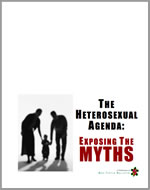 At last, the truth can now be told.
Using the same research methods employed by most anti-gay political pressure groups, we examine the statistics and the case studies that dispel many of the myths about heterosexuality. Download your copy today!
And don‘t miss our companion report, How To Write An Anti-Gay Tract In Fifteen Easy Steps.
 Anti-gay activists often charge that gay men and women pose a threat to children. In this report, we explore the supposed connection between homosexuality and child sexual abuse, the conclusions reached by the most knowledgeable professionals in the field, and how anti-gay activists continue to ignore their findings. This has tremendous consequences, not just for gay men and women, but more importantly for the safety of all our children.
Anti-gay activists often cite the “Dutch Study” to claim that gay unions last only about 1½ years and that the these men have an average of eight additional partners per year outside of their steady relationship. In this report, we will take you step by step into the study to see whether the claims are true.
Tony Perkins’ Family Research Council submitted an Amicus Brief to the Maryland Court of Appeals as that court prepared to consider the issue of gay marriage. We examine just one small section of that brief to reveal the junk science and fraudulent claims of the Family “Research” Council.
 The FBI’s annual Hate Crime Statistics aren’t as complete as they ought to be, and their report for 2004 was no exception. In fact, their most recent report has quite a few glaring holes. Holes big enough for Daniel Fetty to fall through.
“Google” is a trademark of Google Inc.
© Box Turtle Bulletin. All Rights Reserved.
 Posts
Posts  Posts via daily email: